
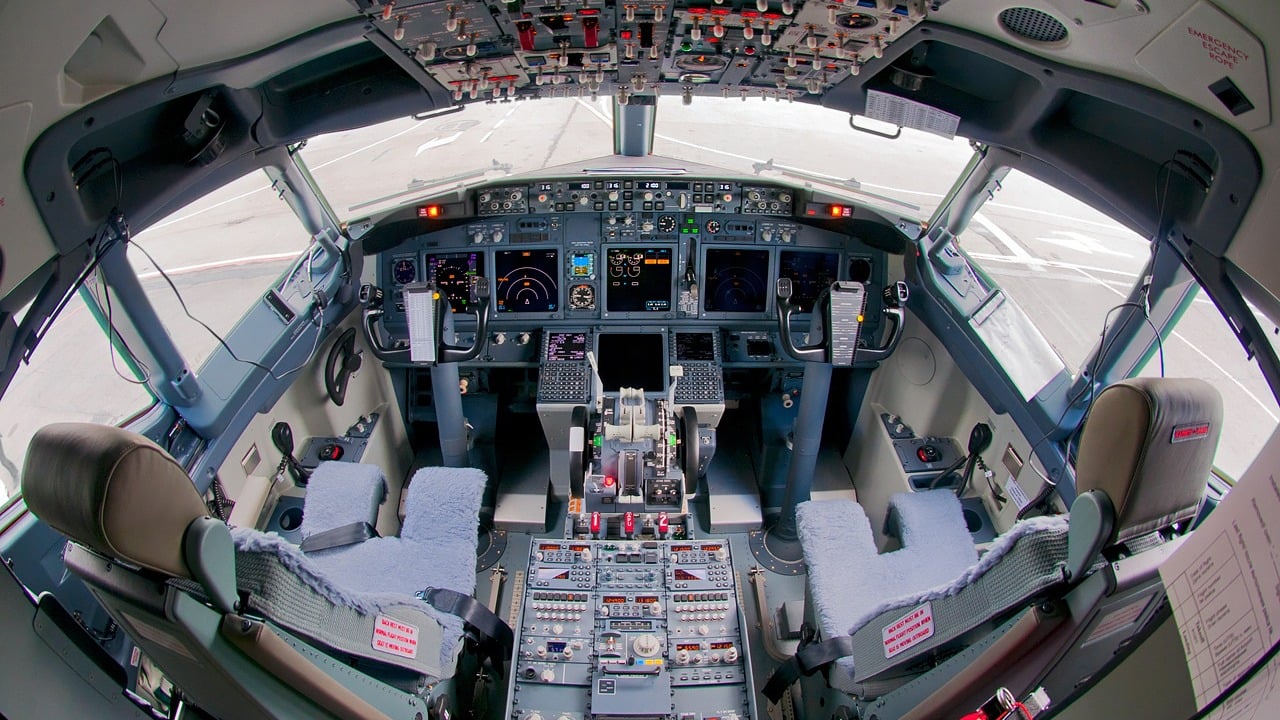
At 300 knots you are covering a nautical mile every twelve seconds. That is the governing constraint on every calculation a pilot does in the air: not whether an answer is exactly right, but whether it arrives before the situation it described has gone.
So pilots do not calculate. They approximate, with a small set of rules that are close enough, fast enough and memorable enough to survive a bumpy descent and a radio call at the same time. The 1-in-60 rule. The 3-to-1 descent. The clock method for crosswinds. None of them is exact. All of them are good enough, until suddenly they are not.
What follows is each rule, the geometry underneath it, and the honest part that textbooks skip: the point at which the approximation stops being close enough to use.
Quick Facts: the four rules
1-in-60: one degree of track error puts you about one nautical mile off after sixty flown
60-to-1: the same relationship vertically. One degree at one nautical mile is about 100 feet
3-to-1 descent: three nautical miles to lose 1,000 feet, so multiply the thousands of feet to lose by three
Clock method: wind angle divided by sixty gives the fraction of the wind that is crosswind, capped at one
Where they come from: all four are the same approximation, with 57.3 rounded up to 60
The one with a published source: the 3-to-1 formula, in the FAA Instrument Procedures Handbook
Typical error: about 5 per cent at small angles, growing past 20 degrees
The 1-in-60 Rule, and the Number It Hides
The rule is one line. If you are one degree off your intended track, you will be one nautical mile to the side of it after sixty miles. Two degrees gives two miles. Ten degrees gives ten.
Turned around, which is how it is actually used, it becomes a navigation fix. Measure how far off track you are, divide by how far you have flown, multiply by sixty, and you have your track error in degrees. Thirty miles out and three miles left of track? Three divided by thirty is 0.1, times sixty is six. You are six degrees left.
Where does sixty come from? Not from anything aeronautical. One radian is 57.2958 degrees, and for small angles the arc and the tangent are near enough the same thing, so the offset after a distance D at an angle A is roughly D times A divided by 57.3. Somebody rounded 57.3 up to 60 because you can divide by 60 in your head and you cannot divide by 57.3, and the entire family of rules in this article descends from that one decision.
It also means the rule is systematically wrong in a known direction. Sixty divided by 57.3 is 1.047, so the rule under-reads the true offset by about 4.5 per cent, all the way down to the smallest angles. At one degree the true offset after sixty miles is 1.05 miles, not 1.00. Nobody cares, and nobody should: 0.05 of a mile is 300 feet and your navigation is not that good anyway.
What matters is where the small-angle assumption gives out. At ten degrees the error is still only 5.5 per cent. At twenty it is 8.4 per cent. At thirty degrees the rule tells you 30 miles when the truth is 34.6, and now you are wrong by nearly five miles, which is the sort of error that puts you on the wrong side of a terrain feature. The practical limit is somewhere around twenty degrees, and if you are twenty degrees off track you have a bigger problem than arithmetic.
The 1-in-60 rule worked through with the numbers, including the two-part correction that gets you back on track rather than merely parallel to it.
The Two-Part Correction Nobody Teaches First
There is a trap in the rule that catches every student pilot exactly once. Work out that you are six degrees left of track, turn six degrees right, and you will fly a perfect track parallel to the one you wanted, three miles to the left of it, forever.
Correcting the heading only stops the error growing. To close it you need a second correction, and the second one is the same rule applied to the distance still to run. Six degrees to stop the drift, plus whatever angle takes you back across the remaining distance, and you add them together.
This is old knowledge, and you can see how old by looking at the tool it was printed on.
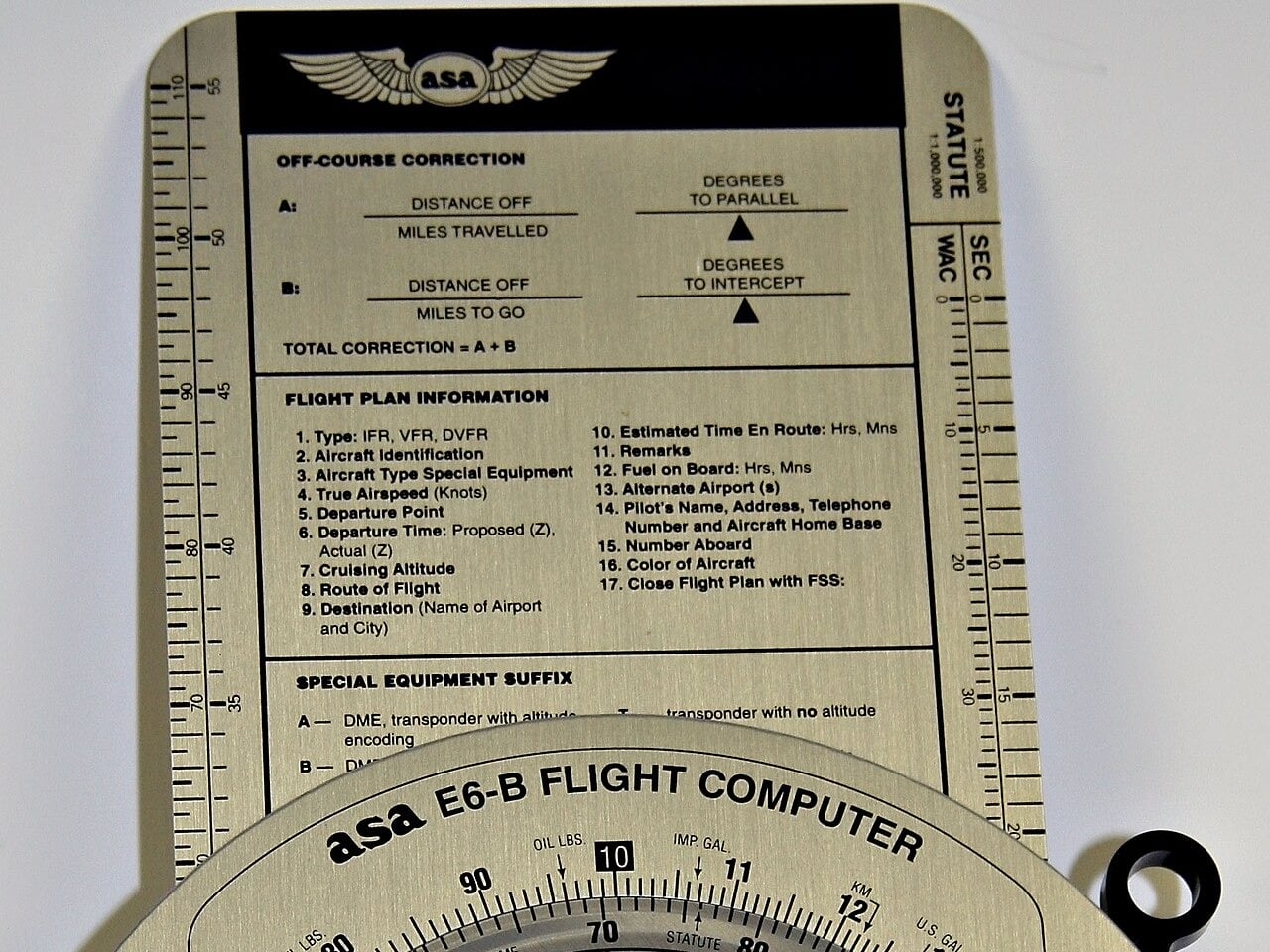
That panel is the 1-in-60 rule, written out as a procedure, on a circular slide rule designed in the late 1930s. The arithmetic has not improved since. What has changed is that a flight management system now does it continuously and silently, which is precisely why it is worth a pilot still knowing it: the rule is the sanity check on the box.
The 3-to-1 Descent, and the Only Rule Here With a Published Source
Every rule so far is training lore: passed down, printed on kneeboards, and absent from the regulations. The descent rule is the exception. It is written into the FAA’s own Instrument Procedures Handbook, in the section on descent planning for high performance aircraft.
The handbook then works the example, and it is worth following because it shows how little mental effort the rule actually costs. An aeroplane at FL310 with an approach gate at 6,000 feet has 25,000 feet to lose. Twenty-five thousands of feet, times three, is seventy-five. Begin the descent seventy-five miles out.
The handbook is also careful to say what aeroplane it is describing, which most repetitions of the rule leave out: a normal jet at idle thrust, Mach 0.74 to 0.78, coming down at 1,800 to 2,200 feet per minute. Change any of those and the number moves.
Wind gets its own adjustment, and it is as simple as the rule itself. Add two miles for every ten knots of tailwind. Subtract two miles for every ten knots of headwind. A seventy-knot tailwind at altitude, which is an ordinary winter day on the North Atlantic, adds fourteen miles to the descent. Ignore it and you arrive high, fast and unwelcome.

There is a pleasing coincidence buried in the 3-to-1 rule. Three nautical miles per thousand feet works out as a gradient of 5.49 per cent, which is an angle of 3.14 degrees. In other words the rule flies you down a path almost exactly as steep as the three-degree glidepath you will eventually intercept. A true three-degree slope needs 3.14 miles per thousand feet rather than three, so the rule is very slightly steeper, which leaves a small margin rather than consuming one. That is good rule design.
Descent planning explained from an airline flight deck, including how the top-of-descent point is worked out and why the computed figure and the mental figure should agree.
60-to-1: The Same Rule, Stood on Its End
Turn the 1-in-60 geometry from the horizontal plane into the vertical and you get the relationship instrument pilots know as 60-to-1: one degree of glidepath at one nautical mile is about 100 feet of height.
This is the one that makes approach design legible. A three-degree glidepath descends roughly 300 feet per mile, so if you are six miles from the threshold you should be somewhere around 1,800 feet above it. Say it in reverse and you have the altitude check that every instrument pilot runs down an approach, and it takes no equipment at all.
The same 57.3 rounding is hiding in here. One degree at one nautical mile is actually 106 feet, because a nautical mile is 6,076 feet and the tangent of one degree is 0.0175. The rule says 100. It is 6 per cent light, in the same direction and for the same reason as every other rule in this article, and 6 per cent of 1,800 feet is a hundred feet, which is well inside the accuracy of the technique it supports.
The Clock Method, and the One Place It Is Exactly Right
Wind rarely arrives down the runway. What a pilot needs, in the thirty seconds before touchdown, is how much of it is blowing across. The textbook answer is the wind speed multiplied by the sine of the angle between the wind and the runway, and nobody has ever computed a sine at 500 feet on short final.
The clock method replaces the sine with a clock face. Take the angle between the wind and the runway, read it as minutes, and the fraction of an hour it represents is the fraction of the wind that is crosswind. Thirty degrees is half an hour, so half the wind. Forty-five degrees is three quarters. Sixty degrees or more is the whole of it.
Checked against the real sine, the clock method behaves rather beautifully. At thirty degrees it is not an approximation at all: the sine of thirty degrees is exactly 0.5, and the rule says exactly half. Below that it is slightly conservative, reading about 4 per cent low at ten degrees.
Above thirty degrees the rule starts to overstate, which is the direction you want an error in a crosswind calculation to go. At forty-five degrees it gives you three quarters of the wind against a true 0.707, about 6 per cent high. The worst point is sixty degrees, where the rule hands you the entire wind against a true 0.866, an overstatement of 15 per cent. Then the cap stops mattering: at eighty degrees the error is down to 1.5 per cent and at ninety it is exact again.
So the single largest error in the whole method is a 15 per cent over-reading of crosswind at sixty degrees off the runway heading. A rule whose worst failure is telling you the crosswind is worse than it is has been designed by people who understood what the rule was for.
An airline pilot works through the crosswind component in his head, which is the only place the calculation ever actually happens.
What These Rules Are Actually For
It is tempting to treat all of this as a historical curiosity. A modern flight management system computes the top of descent to the second, the autopilot flies the track, and the wind component appears on a screen without anyone dividing anything by sixty.
That is exactly the argument for keeping the rules. A number from a box is only useful if somebody notices when it is wrong, and the rules above are how a pilot notices. If the FMS says to start down 40 miles out from FL370, the mental answer is 31 thousands of feet times three, or 93 miles, and the gap between those two numbers is a question that needs asking before the aeroplane is high and fast and committed.
The other thing they are for is the day the box stops. Every one of these works with no electrical power, no satellites and no database currency, on an aeroplane that is otherwise having a very bad afternoon. They are slightly wrong on purpose, they are wrong in a direction somebody chose, and they can all be done in the time it takes to fly a mile.
Sources: FAA Instrument Procedures Handbook FAA-H-8083-16B, chapter 3; 14 CFR 61.57; ASA E-6B flight computer, off-course correction panel; offsets and components calculated by the author.

0 Comments