
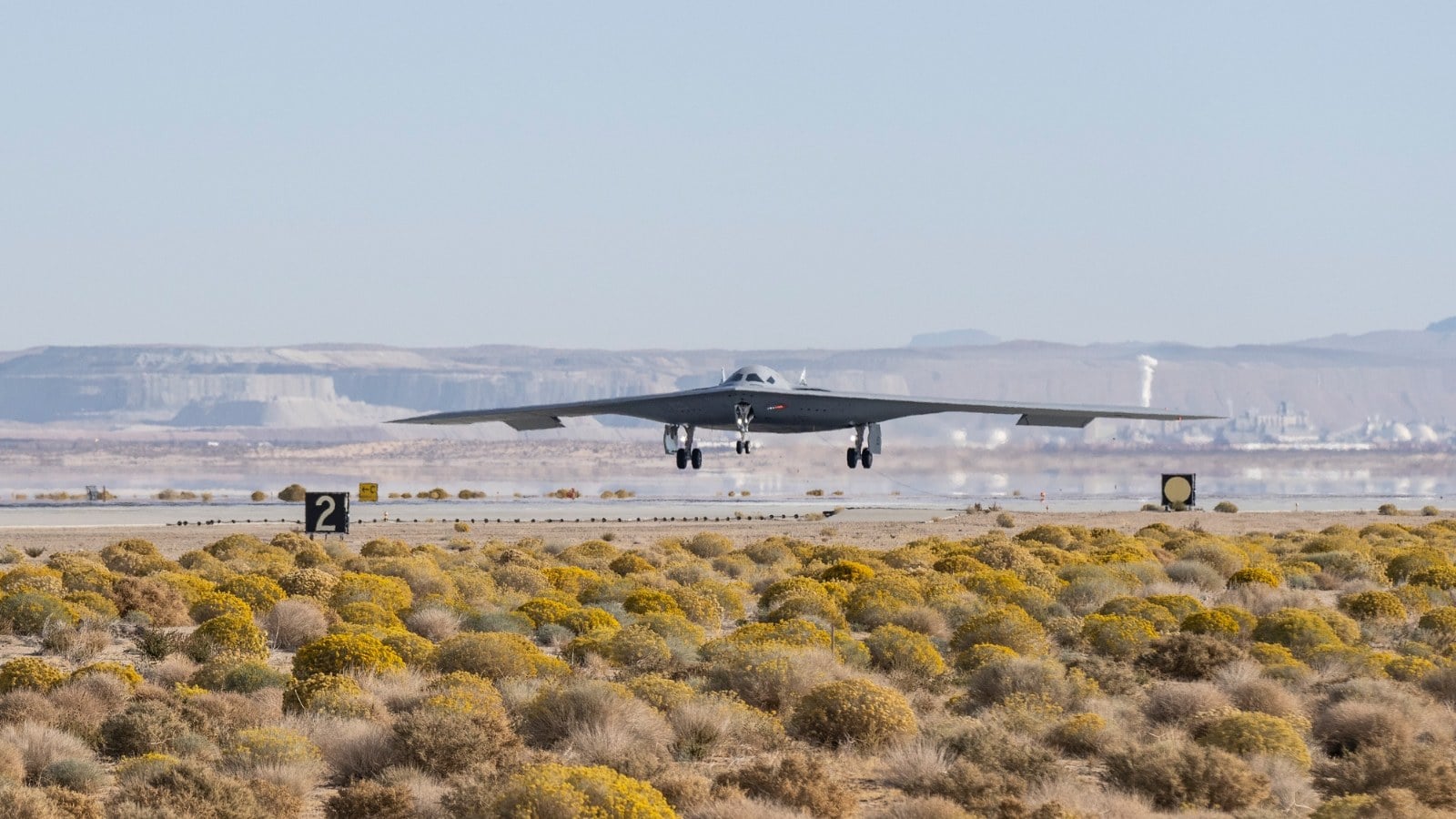
For almost four years after its unveiling, the most basic number about America’s newest bomber was a guessing game. How far does the B-21 Raider reach from wingtip to wingtip? The Air Force never said. Northrop Grumman never said. Then a satellite passed over Edwards Air Force Base, California, on 20 June 2026 and caught the Raider taxiing between the runways.
That image, recently added to Google Earth, let TWZ editor-in-chief Tyler Rogoway put a ruler on the jet. His verdict, published on 19 October 2026: a B-21 Raider wingspan of about 152 ft (46.3 m) and a length of about 61 ft (18.6 m), “give or take a few feet.”
This is not an official figure, and it is worth saying so plainly. The Air Force has still not published the bomber’s dimensions. But it is the first measurement taken from a straight-down view rather than coaxed out of angled photographs – and it confirms what everyone suspected. The Raider is a noticeably smaller aircraft than the Spirito B-2 it is replacing.
Informazioni rapide
Aeromobili: Northrop Grumman B-21 Raider
Measured wingspan: about 152 ft (46.3 m) – TWZ measurement, not an official figure
Measured length: about 61 ft (18.6 m)
B-2 Spirit for comparison: 172 ft (52.12 m) span, 69 ft (20.9 m) length (USAF fact sheet)
Source image: Satellite image of Edwards AFB dated 20 June 2026, published via Google Earth
Primo volo: 10 November 2023
First operational base: Ellsworth AFB, South Dakota – first aircraft expected in 2027
How a satellite settled the argument
Measuring a stealth bomber from press photos is harder than it sounds. Almost all official imagery has been shot from the ground or at oblique angles, and a flying wing offers no handy yardsticks – no tailplane, no fuselage frames, nothing of known size to scale against. After the Raider was rolled out at Palmdale on 2 December 2022, estimates of its span drifted across a range of ten feet or more.
An overhead view removes the perspective problem in one stroke. According to TWZ, the 20 June frame “had enough resolution, when paired with Google Earth’s excellent measurement tools, to get conclusive measurements.” The same outlet had earlier put the top end of the B-21 Raider wingspan at 155 ft; the satellite trimmed three feet off that.
A sensible caveat comes with it. At satellite resolution, a few pixels equal a few feet on the ground – exactly the tolerance Rogoway attached to his numbers. Until the Air Force publishes its own data, 152 ft is the best public measurement, not the official one.
About 12 percent smaller than the B-2
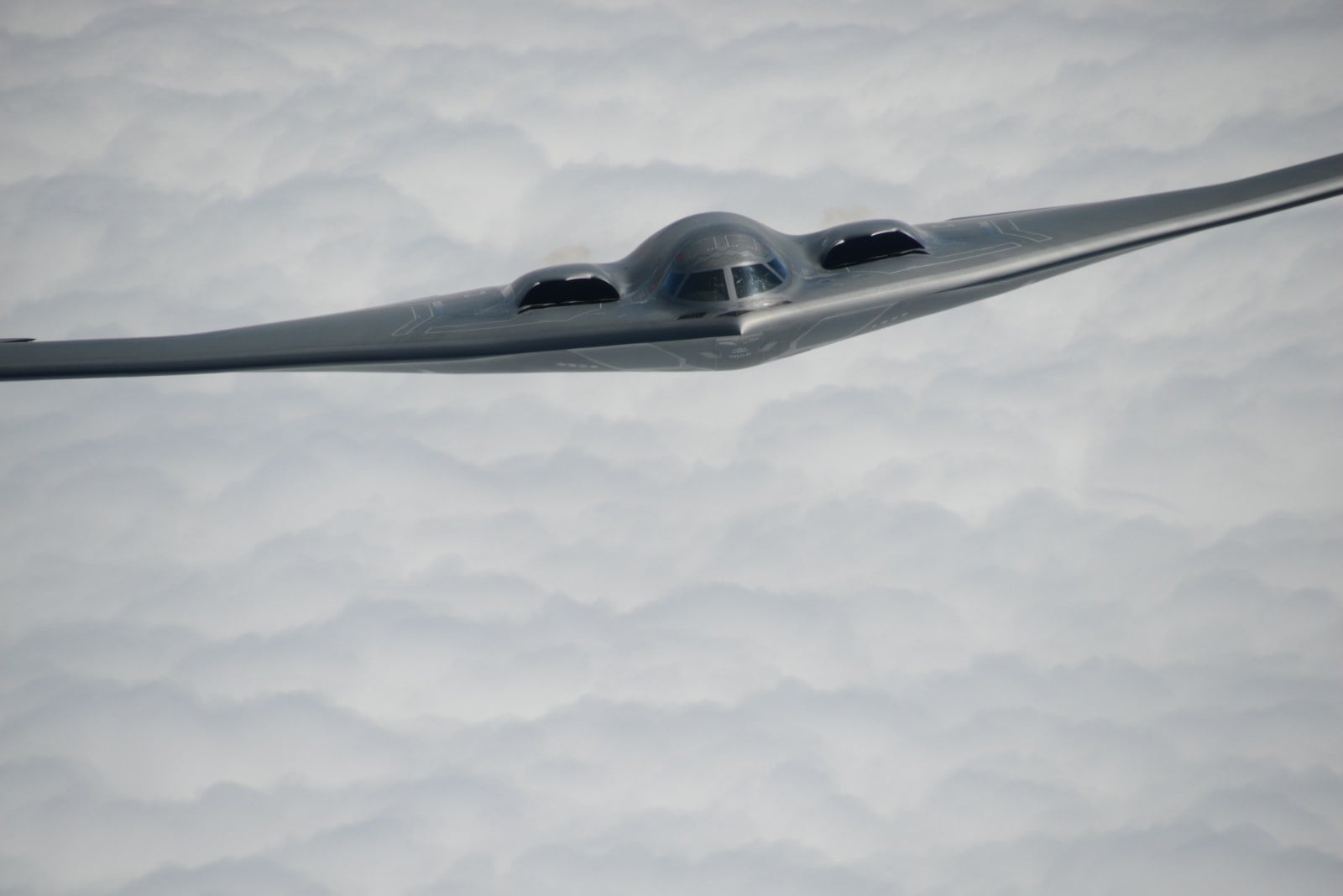
Put the B-21 Raider wingspan next to the B-2’s and the family resemblance turns into a size chart. The B-2 Spirit spans 172 ft (52.12 m) and is 69 ft (20.9 m) long, according to the Air Force fact sheet. The Raider gives up about 20 ft of span and 8 ft of length.
Here is the quietly satisfying part. Divide 152 by 172 and you get 0.88. Divide 61 by 69 and you get 0.88 again. TWZ describes it the same way: about 12 percent smaller in span and about the same 12 percent shorter. In outline, the Raider is very nearly a B-2 scaled down evenly in both directions rather than one with its wingtips clipped.
For a sense of scale, TWZ notes that a 61 ft bomber is close to the length of an F-15 fighter. A strategic bomber the length of a fighter jet sounds absurd until you remember that a flying wing keeps almost everything – fuel, engines, weapons, crew – inside the wing itself.
Why smaller makes sense
Rogoway reads the size as a deliberate choice: a bomber optimised for range, affordability and low observability rather than for hauling the heaviest possible load. In his analysis, a smaller wing also suits efficient high-altitude cruise and the Raider’s widely reported two-engine layout. The B-2 needs four General Electric F118 engines.
Affordability is the thread that runs through the whole program. The Air Force has long said it wants at least 100 Raiders to replace both the B-1B and the B-2, although the exact number it plans to buy is classified. A smaller airframe is a cheaper airframe to build, house and maintain – and the service is buying in bulk.
In February 2026 the Department of the Air Force and Northrop Grumman agreed to raise annual B-21 production capacity by 25 percent, using $4.5 billion already appropriated by Congress. Announcing the deal, Air Force Secretary Troy Meink framed the bomber as central to American deterrence.
At least two test aircraft are flying at Edwards; the second made its first flight in September 2025. The first operational Raiders are due at Ellsworth Air Force Base, South Dakota, in 2027.
The first public video of the B-21 in flight shows just how compact the wing looks against the desert at Edwards.
First public video of the B-21 Raider in flight (Defense One)
What the satellite cannot tell us
A planform measurement answers one question and leaves the interesting ones alone. Payload, range, weapons bay layout and radar signature remain secret, and the Air Force has shown no sign of publishing them. Even the official overhead photo released in April was edited: TWZ points out that the dark exhaust path visible in the Google Earth image had been removed from it.
What the satellite does give us is a solid number to argue from. For years, every comparison between the Raider and the Spirit began with “if the estimates are right.” Now, within a few feet, they are.
The B-2 set the template for the stealth flying wing. Its successor is about one-eighth smaller in every direction – and it took a satellite photo on Google Earth, not a press release, to prove it.
Sources: TWZ, U.S. Air Force, Air Force Global Strike Command, Military Times, Defense One, DVIDS



0 Comments