
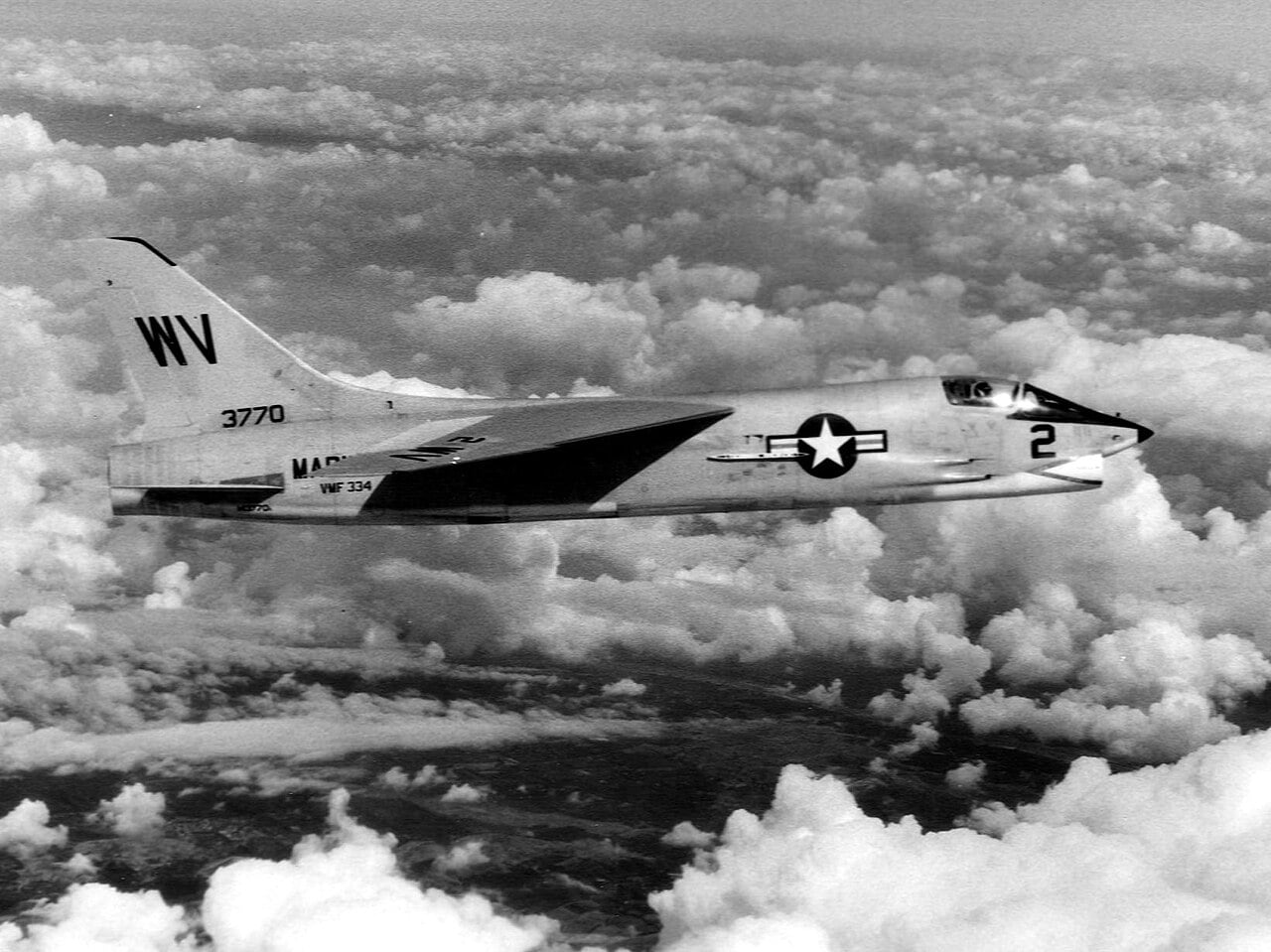
In June 1963 a group of US Marine Corps F-8 Crusader of the all-weather fighter squadron VMF(AW)-323 left El Toro, California, on a “Trans-Pac”: a ferry flight across the Pacific to Hawaii, then on via Midway and Wake to Atsugi in Japan. Somewhere around 600 miles out, 1st Lieutenant Cliff Judkins plugged into a four-engined tanker at 20,000 feet to take on fuel. Within minutes his aircraft was on fire, his ejection seat had failed and he was standing up in the cockpit of a falling jet.
Informazioni rapide
- Data: June 1963 (19 June, according to the Aviation Safety Network)
- Pilota: 1st Lt Cliff Judkins, USMC
- Unità: VMF(AW)-323
- Aeromobili: Vought F-8E Crusader
- Dove: Pacific Ocean, about 600 miles off California, en route to Hawaii
- What failed: Engine (explosion and fire), ejection seat, main parachute
- Rescue: USS Embattle, about two and a half hours after he hit the water
- Back in the cockpit: Within six months
“Jud, You’re On Fire”
Judkins wrote his own account of the day, later published by Ron Knott in Supersonic Cowboys. As he finished refuelling, he heard a loud explosion; the engine’s RPM and tailpipe temperature dropped away, fuel was streaming out and burning behind the jet, and another pilot called that he was on fire. The Marine Corps later concluded that an automatic fuel cut-off had failed, so that the tank overfilled and ruptured.
He pulled the primary ejection handle. Nothing happened. He pulled the alternate handle. Nothing again. Ditching a Crusader in the open ocean was not considered survivable, so he jettisoned the canopy by hand, unstrapped, stood up and let the slipstream, at around 225 knots, pull him out of the cockpit.
A Parachute That Would Not Open
He pulled the D-ring. The small pilot chute came out, but the main 24-foot canopy did not deploy: it flapped above him, tangled in its own shroud lines. He shook and pulled at the lines all the way down and could not free it. He hit the Pacific with almost no braking at all.
The list of injuries is long. His left ankle was broken in five places and his right in three, his right pelvis and a vertebra were fractured, a tendon in his left foot was cut and his left lung partially collapsed. His survival raft had been lost. Aircraft overhead dropped rafts, but he was too badly hurt to reach them, and he stayed in the water until the ship USS Embattle reached him about two and a half hours later.
A Navy doctor later noticed a long scar on his abdomen. Four years earlier Judkins had lost his spleen in a serious car accident in Texas. The doctor told him that a spleen would very probably have ruptured on impact, and that he would most likely have died.
Back in the Crusader
Within six months Judkins was flying the F-8 again. After the Marine Corps he joined Delta Air Lines, where he flew for 30 years and retired as a captain. He told the story for decades, including to cadets at his old school, Marion Military Institute in Alabama, in 2018.
What the Viral Post Gets Right
The story going round follows Judkins’ own account closely: the June 1963 Trans-Pac, refuelling at 20,000 feet, the explosion and fire, two failed ejection handles, the manual bailout, the unopened main parachute, the injuries, USS Embattle, the missing spleen and his return to flying within six months. Three details are not in his account. The 110 mph impact speed is a later estimate, not his figure. The bailout altitude of about 15,000 feet comes from the title of his story rather than from the narrative itself. And we have not been able to confirm the details given online about his death in 2024.
Sources: Cliff Judkins, “I Fell 15,000 Feet and Lived”, in Ron Knott, Supersonic Cowboys, reproduced by VFP-62; Aviation Safety Network, F-8E Crusader accident record, June 1963; Marion Military Institute, “GRIT Profile: Cliff Judkins ’56” (19 November 2018); John M. White, “Jud, You’re On Fire” (5 January 2024).


0 Comments