
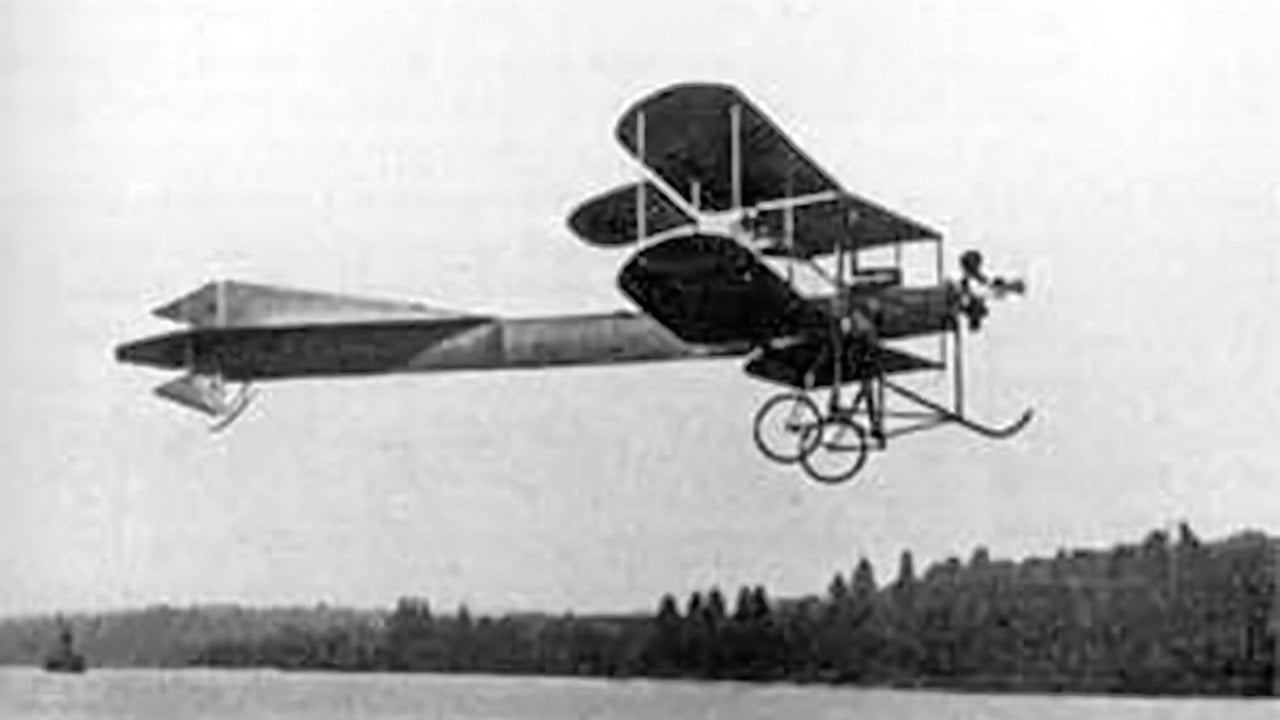
At about twenty to six on the morning of 28 August 1910, a home-built biplane bounced across a field at the eastern end of Lake Geneva, lifted off after barely 40 metres and headed out over the water. In the seat sat Armand Dufaux, a 27-year-old mechanic and inventor from Geneva. Ahead of him lay the whole length of the lake.
Somewhere out over the lake, the sheet of mica he had fixed in front of his face to keep off the engine’s castor oil tore away. He flew most of the rest of the way half-blinded by oil. Fifty-six minutes after take-off he landed on the shore near Geneva, the winner of a 5,000-franc prize and the man who had flown further over open water than Louis Blériot had over the English Channel.
Informazioni rapide
- Chi: Armand Dufaux (1883 to 1941), pilot, with his brother Henri Dufaux (1879 to 1980), co-designer
- Data: 28 August 1910
- Aeromobili: Dufaux 4 biplane, designed and built by the brothers
- Itinerario: From near Noville and Le Bouveret to Corsier, near Geneva: the full length of Lake Geneva
- Distanza e tempo: About 65 km in 56 minutes, at around 50 m altitude
- Prize: Perrot-Duval prize, 5,000 Swiss francs
- Aircraft today: Swiss Museum of Transport, Lucerne: the oldest surviving Swiss aircraft
Motorcycles, then helicopters
Armand Dufaux was born in Paris on 13 January 1883; his brother Henri in 1879. Their father was the Geneva painter and sculptor Frédéric Dufaux, and their maternal grandfather was the French writer and politician Henri Rochefort, who helped finance their first aeronautical experiments. The brothers grew up between Paris and Geneva.
According to the Historical Dictionary of Switzerland, Armand was the practical mechanic and Henri contributed the theory. Their first success had nothing to do with flying: a small auxiliary engine that could be fitted to an ordinary bicycle. Sold as the Motosacoche, it grew into a motorcycle business that made the family name famous across Europe.
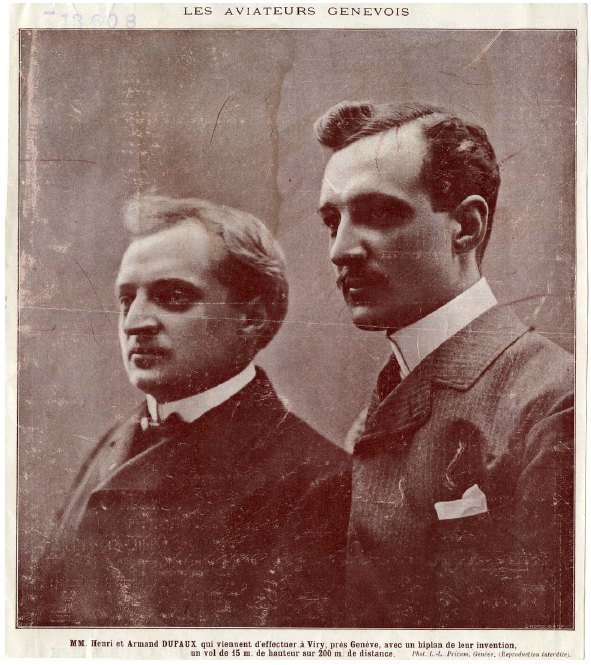
The brothers then turned to vertical flight. They patented a helicopter in February 1904, and in 1905 their model helicopter, the Dufaux 1, flew in public. A full-size design followed, but it did not succeed. Their second machine, an eight-winged aeroplane, never flew, and the Dufaux 3 crashed on its first flight.
The Dufaux 4
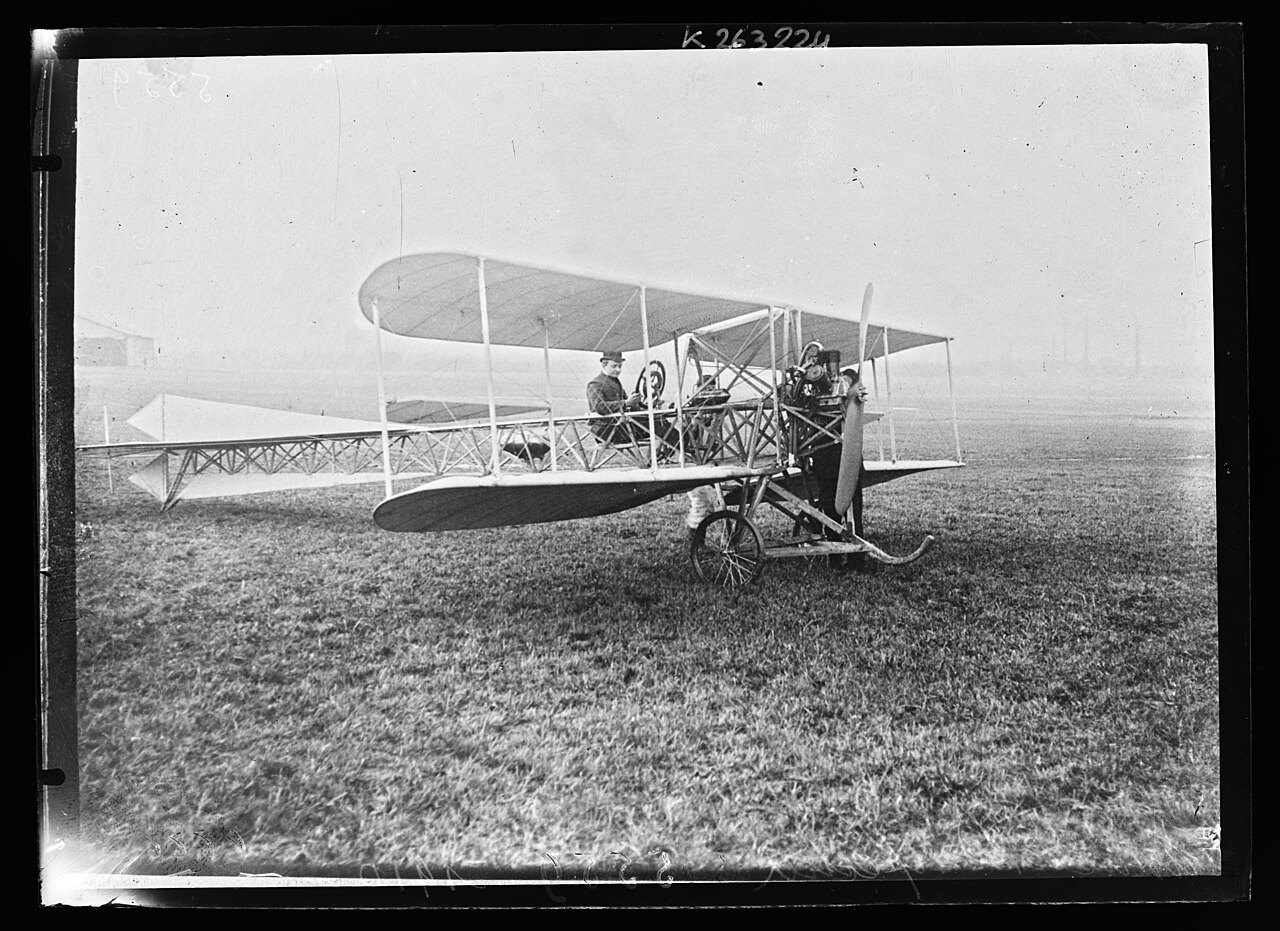
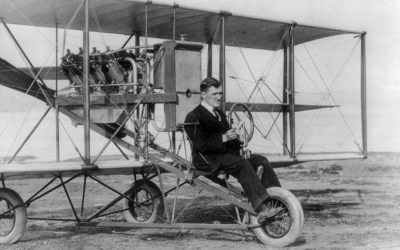
Their fourth design worked. The Dufaux 4 was a biplane, and the brothers tested it on a field at Viry, just over the border in Haute-Savoie, where they founded an aerodrome company in January 1910. Through the summer they stretched its endurance, with flights of 8 kilometres, then 23 kilometres on 10 July and a 31-minute flight on 12 July.
The goal was a prize. At the end of 1909, the automobile firm Perrot-Duval had offered 5,000 Swiss francs, then a considerable sum, for a flight along the whole length of Lake Geneva. The rules, as the Journal de Genève reported, demanded that the entire course be flown over the lake: no cutting across the Yvoire peninsula to save distance.
Blinded by castor oil
Dufaux took off from near Noville and Le Bouveret, at the eastern end of the lake. A timekeeper in the Hôtel de l’Aiglon at Le Bouveret started the clock; judges in a boat on the line between Versoix and Bellerive waited at the far end, and an official at Yvoire checked that he did not cut the corner.
The biplane climbed to about 50 metres and flew straight down the lake, keeping close to the southern shore. Then the mica screen came loose. Dufaux pressed on with oil streaming over his face, swung wide at the Geneva end and landed on a field at Corsier, near Collonge-Bellerive, prepared for him by removing trees and moving telegraph wires.
His time was 56 minutes and about 5 seconds over a distance of roughly 65 kilometres. The Journal de Genève pointed out that this was more than double the width of the Channel Blériot had crossed the year before, and that the lake was notorious among fishermen and sailors for contrary winds and violent gusts. It is often described as the longest flight over open water anywhere up to that time.
The engine of a Dufaux 4 of the “traversée du Léman” type is started up, filmed by AMPA.
A gold watch from Bern
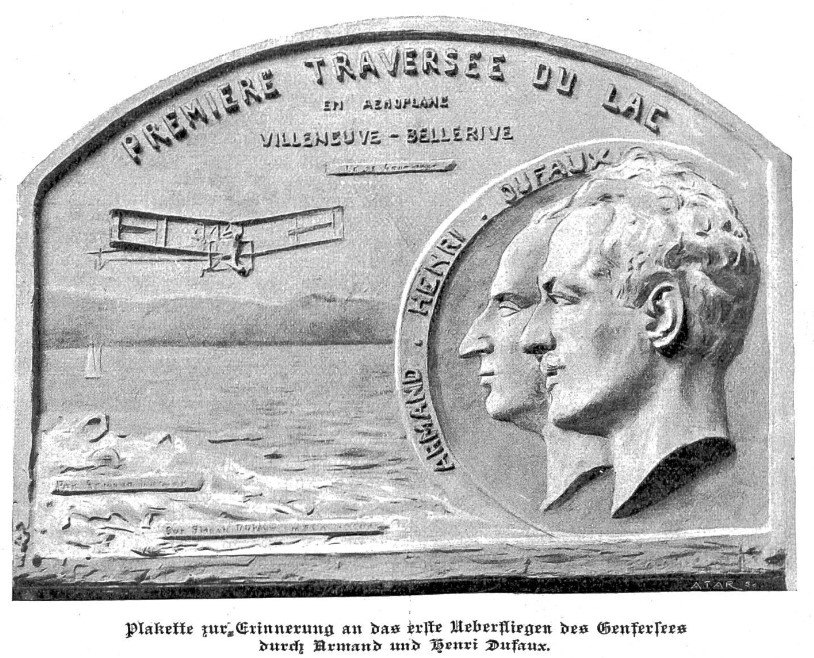
Switzerland noticed. The Federal Council presented the brothers with a gold chronometer engraved “De la part du Conseil Fédéral aux premiers aviateurs Suisses”, from the Federal Council to the first Swiss aviators. A commemorative plaque celebrated the “first crossing of the lake by aeroplane”.
The brothers sold aircraft, and in late 1910 Ernest Failloubaz ordered a two-seat Dufaux 5. In September 1911 he flew it on reconnaissance missions during manoeuvres of the Swiss Army’s 1st Army Corps, with his friend Gustave Lecoultre as observer. Those flights are counted as the beginning of Swiss military aviation, three years before the Fliegertruppe, the forerunner of today’s Swiss Air Force, was formed in 1914.
After the lake
By 1912 the brothers had given up building aircraft and sold their patents. Armand moved to Paris and worked on accessories for the motor industry, including remotely adjustable shock absorbers, and even built racing sleds. In 1931 both brothers received the Légion d’honneur. Armand returned to Geneva in 1939 and died there on 17 July 1941. Henri became a painter and illustrator and lived to 101, dying in Geneva on Christmas Day 1980.
The Dufaux 4 survived. It is on display today at the Swiss Museum of Transport in Lucerne, where it is the oldest surviving Swiss aircraft, in the same collection as the Blériot XI that Oskar Bider flew over the Alps three years later. Swiss aviation had to start somewhere. It started over a lake, with a man who could barely see.
Sources: Wikipedia (Armand Dufaux, en, de and fr; Henri Dufaux; Swiss Museum of Transport), Historical Dictionary of Switzerland (HLS: Armand Dufaux; Henri Dufaux), Journal de Genève 29 August 1910 via Le Temps
0 Comments