
The highest-scoring American ace of the Vietnam War never flew the aeroplane.
On 9 September 1972, Captain Charles B. DeBellevue shot down his fifth and sixth MiGs from the back seat of an F-4D Phantom. He was a weapon systems officer. The stick and throttles were three feet in front of him, in the hands of Captain John A. Madden Jr. DeBellevue finished the war with six victories, more than any American of any service, and he got every one of them without touching the flight controls.

Quick Facts
| Who | Captain, later Colonel, Charles B. DeBellevue, born New Orleans, 15 August 1945 |
| Role | Weapon systems officer, the back-seater in a two-seat F-4 Phantom |
| Victories | Six. The highest American total of the Vietnam War |
| With Steve Ritchie | Four MiG-21s, between May and August 1972 |
| With John Madden | Two MiG-19s, both on 9 September 1972 |
| That aircraft | F-4D-29-MC Phantom II, serial 66-0267, callsign OLDS 01 |
| Unit | 555th Tactical Fighter Squadron, 432nd Tactical Reconnaissance Wing, Udorn RTAFB, Thailand |
| Operation | Linebacker, on combat air patrol west of Hanoi |
| Career total | 220 combat missions, 550 combat hours, three Silver Stars, six Distinguished Flying Crosses |
| Afterwards | Sent to pilot training. Retired a colonel in 1998 after 30 years |
The rule that made it possible
For most of the war, an F-4 crew that killed a MiG split the credit. Half to the pilot, half to the man in the back. Under that arithmetic DeBellevue would have finished the war with three, and no American would have become an ace from the back seat.
In 1971 the Air Force Chief of Staff, General John D. Ryan, changed it, and made the change retroactive to 1965. From then on both members of an F-4 crew received a full aerial victory credit.
It reads like bookkeeping. It was a statement about what the aircraft actually was. The Phantom was not a fighter with a passenger. It was a weapons system operated by two people, and in the radar-missile engagements of 1972 the man who found the target, sorted it from the clutter, locked it and told the pilot where to point was doing at least half the fighting. Ryan’s ruling simply stopped pretending otherwise.
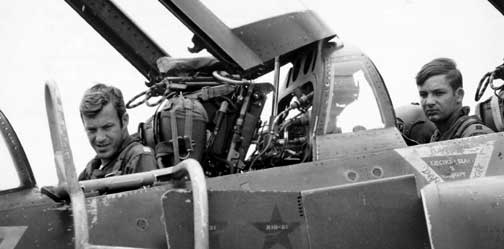
What the back-seater was actually doing
The F-4D had no internal gun. Everything depended on missiles, and missiles depended on the radar, and the radar depended on the man working it.
In a 1972 intercept the WSO ran the search, picked the contact out of ground clutter, established which of the returns was hostile, held the lock through the manoeuvring, checked the shot parameters, and kept up a continuous commentary so the pilot could keep his eyes outside the cockpit rather than down in the scope. He also ran the fuel, the navigation, the systems and the radio. The pilot flew and shot. The WSO did nearly everything else, at the same time, under g.
“It is a real team sport.”
Charles B. DeBellevue, on air combat, extending the credit from the crew to the crew chiefs, maintainers, cooks and supply staff behind them
Four with Ritchie
DeBellevue’s first four kills came with Captain Steve Ritchie flying, all MiG-21s, between May and August 1972. Ritchie became the only Air Force pilot ace of the war on the back of the same engagements, including the celebrated 8 July mission in which two MiG-21s went down in one minute and twenty-nine seconds.
“The 8th of July mission was the most intense, the most exciting mission that I ever flew. Everything worked. During that minute and 29 seconds I drew on all my life experiences.”
Steve Ritchie, interviewed for The History Channel’s Weapons at War: The Aces
The pairing is the point. Two men in the same aeroplane became aces off substantially the same fights, one from each seat, and the Air Force recognised both.
9 September 1972
The fifth and sixth came with a different pilot. Flying OLDS 01, an F-4D of the 555th Tactical Fighter Squadron out of Udorn, DeBellevue and Madden were on combat air patrol west of Hanoi in support of Linebacker when they ran into MiG-19s.
The MiG-19 was a different problem from the MiG-21. Older, slower at the top end, but with three 30 mm cannon and a good rate of roll at close range, and North Vietnamese pilots flew it as a knife fighter. Coming off a MiG-19 badly was a genuine way to die.
They engaged two of them with AIM-9 Sidewinders. The first missile detonated close alongside its target rather than striking it, damaging the MiG badly enough that it went down at Phuc Yen. The second hit, and that aircraft spiralled into the ground. Six.

Sent to pilot training
Then the Air Force took its leading ace out of the war. Aces were too valuable as prisoners and too valuable as symbols, so he went home.
And then it sent him to pilot training, at Williams Air Force Base in Arizona. He had started undergraduate pilot training years earlier and not finished it; that was why he was in the back seat in the first place. He completed it this time, returned to the Phantom as an aircraft commander in the front seat, and retired as a colonel in 1998 after thirty years. In 2015 he received the Congressional Gold Medal.
There is a neatness to it that is almost too good. The man who proved the back seat could win a war was rewarded with a transfer to the front one.
Two notes on the version going round
This came up via the Commemorative Air Force Gulf Coast Wing, and the substance is right. Two things are worth flagging for anyone reading the original.
The first is that the post describes only the 9 September engagement, which can leave the impression that those were his only kills. They were his fifth and sixth. The other four came earlier in 1972 with Ritchie, and a commenter corrected this underneath.
The second is an editing slip. A paragraph about Bennett and Bakke and the Strike Eagle’s only air-to-air victory, each credited with half a kill, has been pasted into the middle of the text from a different article. It sits directly against the sentence explaining that the Air Force had stopped splitting credits, which makes the post appear to contradict itself. Bennett and Bakke are a real story, from the Gulf War in 1991 and involving a laser-guided bomb rather than a missile, but they have nothing to do with DeBellevue.
Frequently Asked Questions
Who was the highest-scoring American ace of the Vietnam War?
How can a back-seater be an ace if he does not fly the aircraft?
What did DeBellevue actually do during an engagement?
What happened on 9 September 1972?
How many kills did DeBellevue score with Steve Ritchie?
What happened to DeBellevue after he became an ace?
Why was the MiG-19 dangerous to an F-4?
Sources: Air & Space Forces Magazine; Vintage Aviation News; Airpower Asia; Gathering of Eagles Foundation; US Air Force; Commemorative Air Force Gulf Coast Wing on Instagram; Afterburner reporting


0 Comments