

When the Grumman X-29 stunned airshow crowds in the 1980s with wings that swept the wrong way, and again when Russia rolled out the Su-47 Berkut, both were hailed as radical leaps. Neither was first. A German bomber had already flown on forward-swept wings in the summer of 1944 — cobbled together from the wreckage of other aircraft, and looking like nothing else in the sky.
It was the Junkers Ju 287, and it took off from a field near Leipzig on August 16, 1944, four decades before the Cold War rediscovered the idea it was built to test.
Quick Facts
- Type: Junkers Ju 287, jet bomber testbed
- First flight: August 16, 1944, from Brandis near Leipzig
- Engines: four Junkers Jumo 004 turbojets
- Wing: forward-swept, designed by Dr. Hans Wocke
- Test flights: 17, with fixed landing gear
- Fate: captured by the USSR in 1945; completed as the OKB-1 EF 131
A bomber built from scavenged parts
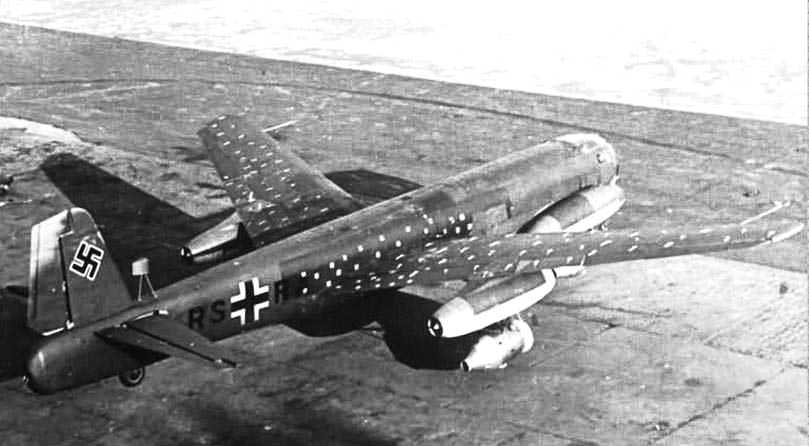
By 1944 Germany was desperate and short of everything, so the first Ju 287 was a flying scrapyard. Junkers grafted the fuselage of a Heinkel He 177, the tail of a Ju 188-family aircraft, and fixed landing gear pulled from a wrecked He 177 and a captured B-24 Liberator into a single testbed. The undercarriage did not even retract; it was faired over and left hanging, because the point was not speed but proving a shape.
Four Jumo 004 jets hung around the nose and wings, and small rockets could be strapped on to help the underpowered machine off the ground. It was ungainly, unarmed and unfinished. But the wing was the whole reason it existed.

The full story of the forward-swept "Frankenplane."
Why sweep a wing forwards?
Early jet engines were feeble and slow to respond, which made take-off and landing perilous. The Ju 287's chief designer, Dr. Hans Wocke, reasoned that sweeping the wing forward instead of back would keep good lift and control at low speed, with the wing stalling gently from the root outward rather than losing the tips first. In the air, it worked.
There was a catch, and it was the same one that would ground the idea for a generation. A forward-swept wing wants to twist and bend under load — the faster you fly, the harder it tries to tear itself apart. The Ju 287's testers saw it directly.
The idea that had to wait
The Ju 287 flew 17 times before the war overtook it. In 1945 the Soviets seized Wocke and an unfinished prototype and shipped both to Moscow, where the design flew on as the OKB-1 EF 131. The concept then went quiet — because metal wings could not be made stiff enough without becoming impossibly heavy.
The Ju 287 as pioneer of a shape that arrived forty years early.
The answer came only with carbon-fibre composites, which could be tailored to resist the twist. That is what let Grumman's X-29 and Sukhoi's Su-47 finally fly forward-swept in earnest in the 1980s and 90s. Both are rightly famous. But the shape they made their name on first cut the air over Saxony in 1944, bolted together from someone else's wreckage.
A quick look at the wing that was decades ahead of its structure.
Sources: Wikipedia (Junkers Ju 287, OKB-1 EF 131); Ransom, Korrell & Evans, Junkers Ju 287; GlobalSecurity.org.


0 Comments