

Air defence against a Shahed-type drone is, more often than not, a human being looking up. The aircraft is small, slow, made largely of composite and plywood, and flies low enough to disappear into ground clutter. Radar helps. Thermal sights help. But at the sharp end of Ukraine’s defence are mobile teams in pickup trucks with heavy machine guns, and what those teams need is to see the thing.
On Saturday night, northern and western Ukraine went under a solid deck of cloud.
Russia launched 863 drones.
Quick Facts
| What happened | One of the largest Russian drone barrages of the war, routed deliberately under heavy cloud cover |
| When | Overnight into Sunday 13 September 2026 |
| Scale | 863 drones launched in 24 hours, per the Ukrainian General Staff |
| Intercepted | 409 shot down or jammed in the immediate overnight window, per Ukraine’s Air Force |
| Weapons used | Geran-2 strike drones plus Gerbera and Parodiya decoys, S8000 Banderol missile-carriers and a newer jet-powered variant |
| Routing | In large groups along the Belarusian border, then west; a second group around Kyiv from the south |
| NATO response | Poland scrambled F-16s, helicopters and a Saab airborne early-warning aircraft; Polish airspace was not breached |
| Closest impact | About 1 km from the Polish border, per Poland’s defence minister |
The weather was the weapon
This is the part that deserves attention, because it is a tactic rather than an accident.
French open-source analyst Clement Molin, who tracks Russian drone routing, wrote that the aircraft flew in large groups along the Belarusian border before turning west, with some reaching the Polish frontier by morning. He said the poor visibility made it materially harder for Ukrainian crews to track and engage them visually, and that Russia appeared to have stockpiled Geran-2s for weeks before spending them in one night.
The Kyiv-based monitoring group CyberBoroshno tracked the same picture from the other end. The routes it plotted ran almost entirely beneath the cloud blanket over northern and western Ukraine, entering through the Chernihiv region and cutting west toward Volyn, while a second group swung around Kyiv from the south. Overcast conditions, the group noted, degrade optical and thermal tracking and make visual spotting by mobile teams difficult, leaving crews to work by sound.
Picking a night when the sky is closed is not sophisticated. It is just effective, and it costs Russia nothing.

Not all 863 carried warheads
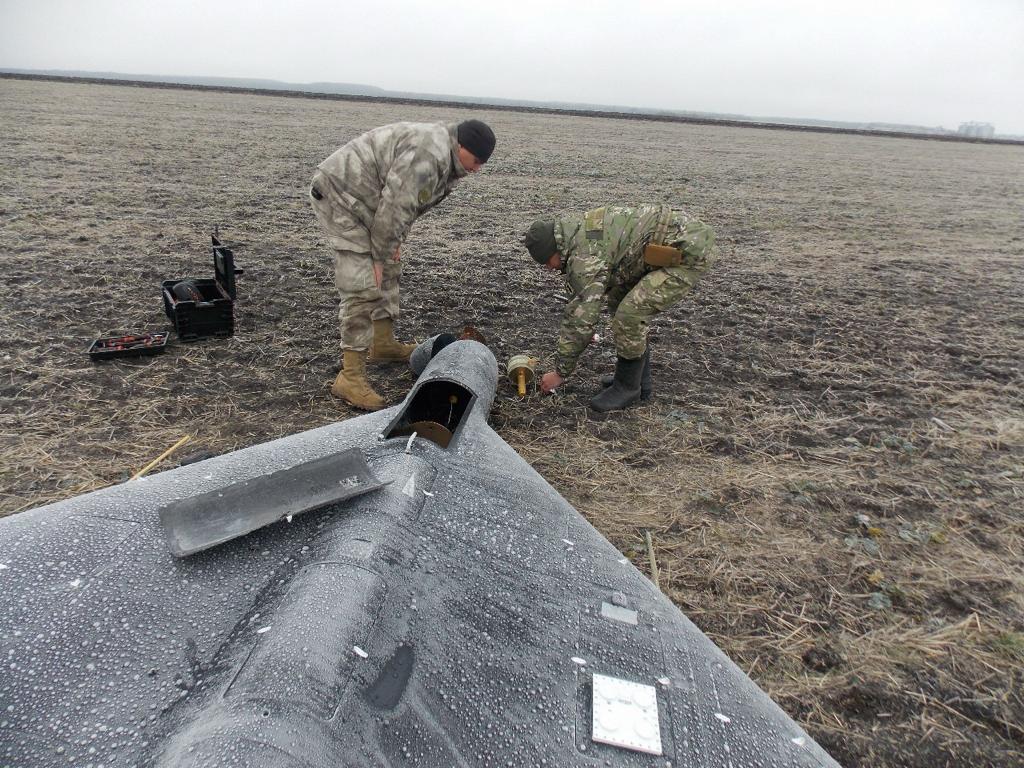
The raw number needs unpacking. Ukraine’s Air Force said the wave mixed Shahed and Geran-2 strike drones with Gerbera decoys, Parodiya decoys and S8000 Banderol missile-carrying drones, together with a newer jet-powered variant that flies faster and is correspondingly harder to intercept.
Decoys are the quiet story of this war’s air defence economics. A Gerbera is a cheap airframe whose job is to appear on a radar screen and be indistinguishable, for the crucial thirty seconds, from something carrying explosives. Fire an interceptor at it and you have spent a real missile on a plywood ghost. Ignore it and you may have ignored the wrong contact.
Ukrainian defences brought down or jammed 409 of the drones tracked in the overnight window. Against 863 launched in 24 hours, that is a hit rate the crews would take, and nowhere near enough.
One kilometre from NATO
The heaviest confirmed impacts fell along the rail corridor near the Polish border. A drone hit the locomotive of a passenger train in the Volyn region, roughly two kilometres from the frontier. Ukrzaliznytsia, the state rail operator, said its threat-monitoring teams spotted the danger and warned the crew in advance.
A chartered train on the same route, carrying former British Prime Minister Boris Johnson and senior European security officials back to Poland from the Yalta European Strategy conference in Kyiv, was halted around five in the morning and partially evacuated as a precaution. Former Swedish Prime Minister Carl Bildt, travelling the same corridor, said afterwards that his own train had not been the one hit.
On the Polish side, defence minister Wladyslaw Kosiniak-Kamysz said radar tracked drones striking within a few kilometres of the border, one at about a kilometre and another at five. Warsaw scrambled F-16s, helicopters and a Saab airborne early-warning aircraft. Polish airspace, officials said, was not breached. The Dorohusk-Yahodyn crossing briefly closed after a drone destroyed a truck some 800 metres from the checkpoint.
What comes next
Molin’s forecast, which he presents as a forecast and not a fact, is that Russia will lean on two patterns through the coming months: jet-powered Gerans aimed at Kyiv and central Ukraine, and large nighttime groups of standard Geran-2s routed through bad weather along the Belarusian border or through Moldova, to hit fixed targets further west.
Ukraine’s foreign minister Andrii Sybiha read the border strikes as a message aimed past Kyiv entirely.
Whether or not that reading is right, the operational lesson is uncomfortable and cheap to repeat. A weather forecast is free. Eight hundred drones are not, but they are a great deal cheaper than the interceptors fired at them, and cheaper still when the sky does half the work.
Frequently Asked Questions
How many drones did Russia launch at Ukraine on 13 September 2026?
What is a Geran-2 drone?
Why did Russia attack under heavy cloud cover?
What else was in the barrage besides Geran-2 drones?
Did the drones come close to NATO territory?
Was anyone hurt?
Sources: Ukrainian General Staff, Ukrainian Air Force, Ukrzaliznytsia, Polish Ministry of National Defence, Reuters, Defence Blog, CyberBoroshno.


0 Comments