
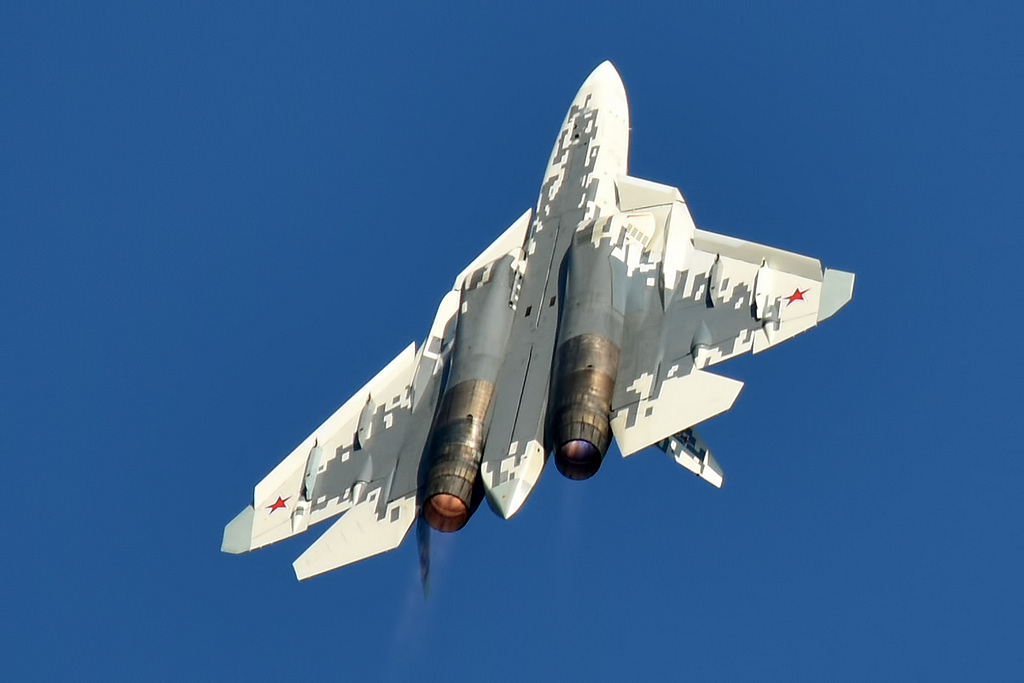
Sukhoi Su-57
“Felon”
Russia’s first fifth-generation stealth fighter — heavily promoted, built in small numbers, and still largely unproven in open sources. An ambitious design whose real-world capability is best read with caution rather than taken from the sales pitch.
The Su-57: ambition, advertised
The Su-57 is Russia’s first stealth fighter — and its most heavily marketed, least battle-proven one. It grew out of the PAK FA programme, Moscow’s post-Soviet answer to the American F-22, with Sukhoi selected as lead over Mikoyan in 2002 and the prototype designated T-50. On paper it is a genuine leap for Russian aviation: internal weapons bays, a blended low-observable planform, thrust-vectoring supermaneuverability and a claimed sensor-fusion suite. The story that actually defines it, though, is the gap between advertisement and reality.
Development ran long and troubled. Structural-fatigue problems, an early Indian co-development partner that later walked away, and Western sanctions all slowed progress. The first serial aircraft was lost in a crash in December 2019, before delivery; the Russian Aerospace Forces received their first operational Su-57 only in December 2020. Production has stayed slow — credible tallies cluster at a disputed few dozen airframes by 2026, against hundreds of American F-35s.
Independent analysts widely judge its stealth shaping and finish less refined than Western fifth-generation jets, and its combat use over Ukraine has, by most open-source accounts, been cautious stand-off missile launches from inside Russian airspace rather than penetrating stealth strikes. None of that is settled fact in the way Russian state media presents it — and neither are the Ukrainian counter-claims. The honest read sits between the two: an ambitious, still-maturing programme wrapped in unusually loud promotion.
01The Su-57’s numbers: how many Felons really exist?
Production figures for the Su-57 are genuinely disputed. Open-source estimates for delivered serial aircraft by 2026 range from roughly 22 to 40 airframes — a spread that reflects how little independently verified data exists. Russia has stated a target of about 76 jets by the late 2020s, but that is an ambition, not an achievement, and earlier targets have already slipped.
Whatever the exact number, the scale point holds: sanctions and industrial constraints have kept the Su-57 fleet tiny next to the hundreds of F-35s in Western and allied service. Any comparison of the two should start there. Treat single precise production figures with caution — the range is the honest answer.
What the Su-57 is built to do
Reduced-signature design (contested degree)
The Su-57 has a faceted forward fuselage, internal main and side weapons bays, radar-absorbent treatments and aligned edges — features intended to reduce its radar signature. Independent experts, however, widely judge it less stealthy than the F-22 or F-35, pointing to visible rivets, exposed engine faces and gaps. It is best described as designed for a reduced signature, not as F-22-class stealth.
Supermaneuverability
Thrust-vectoring nozzles, relaxed stability and a large lifting body give the Su-57 extreme high-alpha, post-stall agility — a Sukhoi signature familiar from the Flanker family and a staple of MAKS airshow displays. Spectacular to watch, though analysts caution that airshow agility is not the same as an advantage against modern radar and long-range missiles.
Engines and sensors — still maturing
Serial jets fly on twin Saturn AL-41F1 (izdeliye 117) turbofans derived from the Su-35’s. The definitive engine — izdeliye 30 / AL-51F1, promising more thrust and true supercruise — has been slow to enter series. Paired with the N036 Byelka AESA radar and claimed multi-sensor fusion, the capability figures are largely Russian-stated and should be treated with caution.
02The Su-57’s stealth: why experts hedge the claims
Stealth is not a single number, and the Su-57’s is hard to assess from the outside. Its shaping reduces radar return from some aspects, and it carries its main weapons internally — both genuine low-observable measures. But visible surface detail, the treatment of its engine inlets and exhausts, and gaps in its finish have led many Western analysts to rate it below the F-22 and F-35 in all-aspect stealth. Crucially, no independent open-source measurement exists, and Russian capability claims are promotional. The responsible framing is “designed for reduced signature, real-world performance unverified” — not the peer-to-Western-stealth billing Moscow prefers.
03The Su-57’s engine problem: still flying on interim power
The Su-57 was designed around a new engine, the izdeliye 30 (AL-51F1), promising more thrust and true supercruise. That engine has been slow to reach series production, so serial aircraft continue to fly on the AL-41F1 (izdeliye 117), an evolution of the Su-35’s powerplant. Until the definitive engine is fielded in numbers, the jet arguably operates on interim power — one more reason to treat headline performance figures, especially supercruise claims, as targets rather than demonstrated facts.
Su-57 specifications (estimated & contested)
Most Su-57 figures are Russian-stated or Western-estimated and are not independently verified. Treat the numbers below as approximate.
Airframe & Performance
- 全体人员
- 1
- 长度
- ~20.1 m
- 翼展
- ~14.1 m
- 高度
- ~4.6 m
- Max takeoff weight
- ~35,000 kg (disputed)
- Max speed
- ~Mach 2 (contested)
- Supercruise
- ~Mach 1.3–1.6 (claimed)
- 设备天花板
- ~20,000 m
- 范围
- ~3,500 km subsonic (estimate)
Propulsion & Systems
- 引擎
- 2 × Saturn AL-41F1 (izdeliye 117)
- 推力
- ~93 kN dry / ~147 kN reheat (each)
- Cannon
- 1 × 30 mm GSh-30-1
- Weapons
- Internal bays: R-77M / R-37M AAMs, Kh-59MK2 / Kh-38M
- First flight
- 29 January 2010 (T-50)
- Built
- ~22–40 serial (disputed)
- Unit cost
- ~US$35–50M (unverified)
- Cost per flight hour
- No reliable public figure
04The Su-57’s cost: why the price tag is hard to trust
Public cost figures for the Su-57 should be read sceptically. Russian sources cite unit prices in the region of US$35–50 million, strikingly low for a fifth-generation fighter; Western estimates tend to run higher, and none are independently audited. Currency effects, sanctions, small production runs and state accounting all distort the picture. No credible cost-per-flight-hour figure exists in open sources at all. As with the jet’s capability claims, the honest position is that the true economics of the Su-57 are not publicly known.
The Su-57 from PAK FA to today
PAK FA launched
Russia launches the PAK FA programme — a next-generation fighter to answer the American F-22.
Sukhoi selected
Sukhoi is chosen as lead over Mikoyan; the prototype is designated T-50.
First flight
The T-50 makes its maiden flight on 29 January at Komsomolsk-on-Amur, with test pilot Sergey Bogdan.
Public debut
The new fighter is shown publicly at the MAKS airshow near Moscow.
Named Su-57
The type formally receives the designation Su-57.
Brief Syria deployment (reported)
Two prototypes are reported to have deployed briefly to Syria for trials and publicity, not sustained combat.
First serial jet crashes
The first series-production Su-57 is lost in a crash before delivery; the pilot ejects safely.
Enters service
The Russian Aerospace Forces receive their first operational Su-57.
Cautious use over Ukraine (reported)
Analysts assess the Su-57 has been used sparingly, mostly for stand-off missile launches from Russian airspace.
Reported drone strike at Akhtubinsk
Ukraine claims a long-range drone reached a Su-57 at a flight-test centre deep inside Russia; damage extent is disputed.
Twelve honest stories about the Su-57
Russia’s first stealth fighter
The Felon breaks a Soviet mould — on paper.
Read the full story
From T-50 to Su-57
A long, troubled road to service.
Read the full story
Cautious over Ukraine
A stealth jet used with stand-off tactics.
Read the full story
Hit on the ground
A drone reportedly reached the Felon at home.
Read the full story
Few and far between
A fifth-gen fleet you can almost count.
Read the full story
The engine problem
Still waiting on its definitive powerplant.
Read the full story
Cobra and beyond
Thrust-vectoring theatre.
Read the full story
The customers that weren’t
Orders claimed, deliveries unclear.
Read the full story
The jet that never delivered
A crash before the handover.
Read the full story
Felon vs Raptor vs F-35
The comparison Russia invites.
Read the full story
Why “Felon”?
A NATO reporting name, not a Russian one.
Read the full story
Propaganda vs proof
Reading the Felon honestly.
Read the full story
The Su-57 in pictures
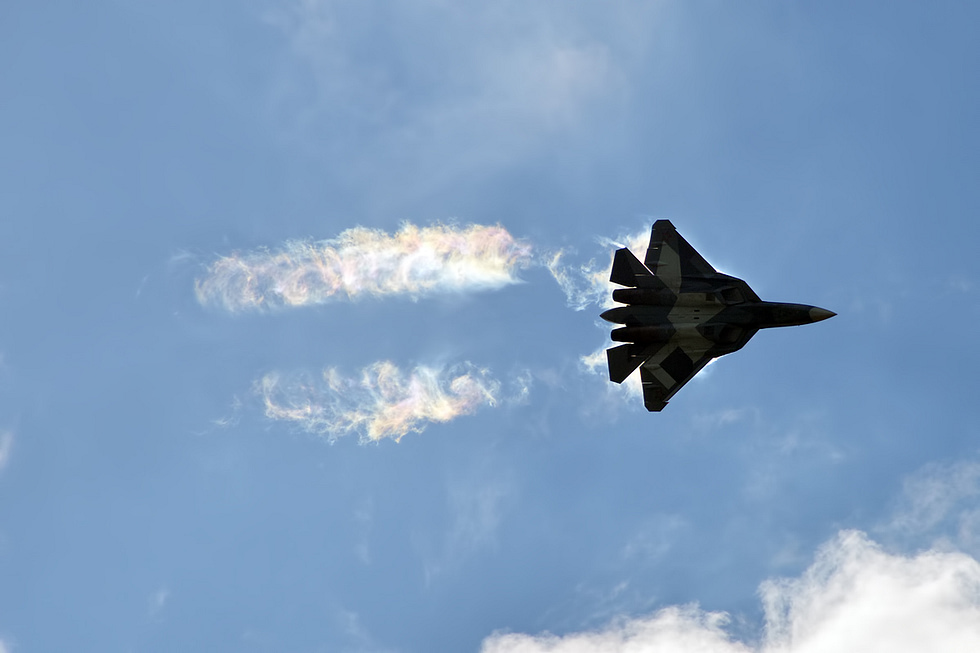
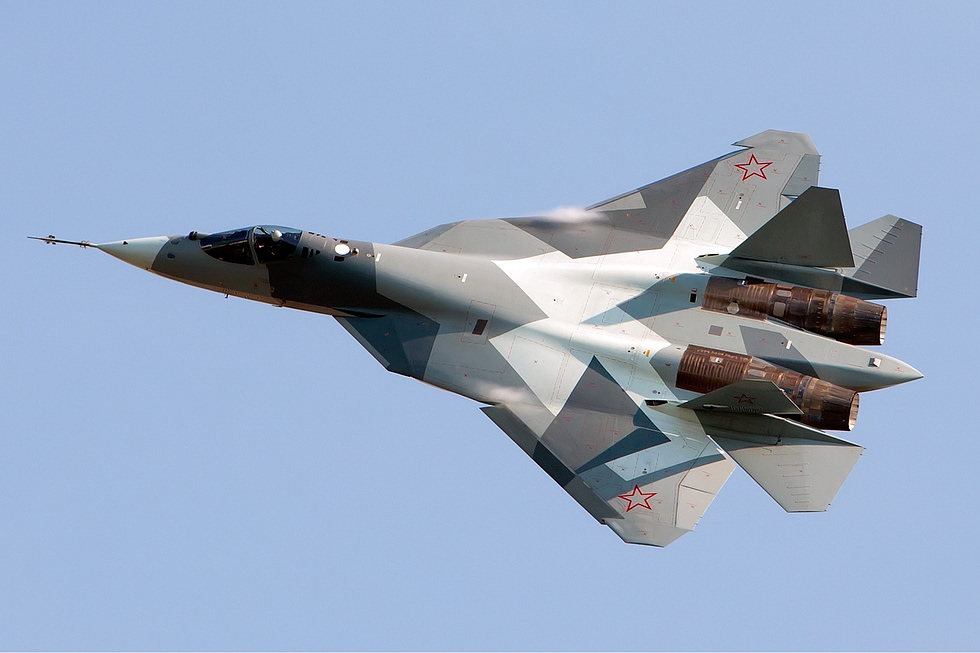
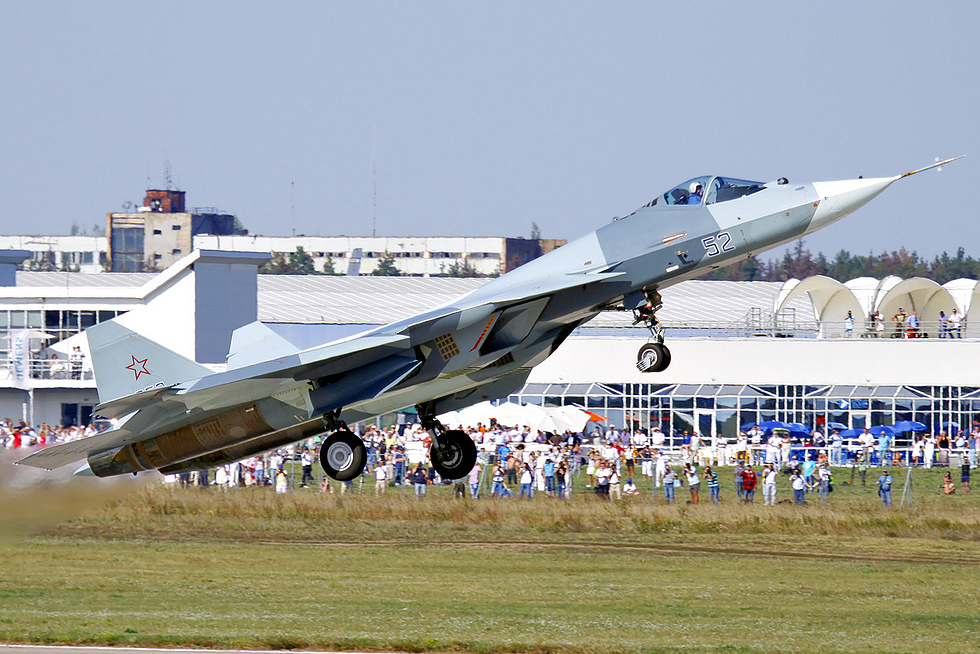
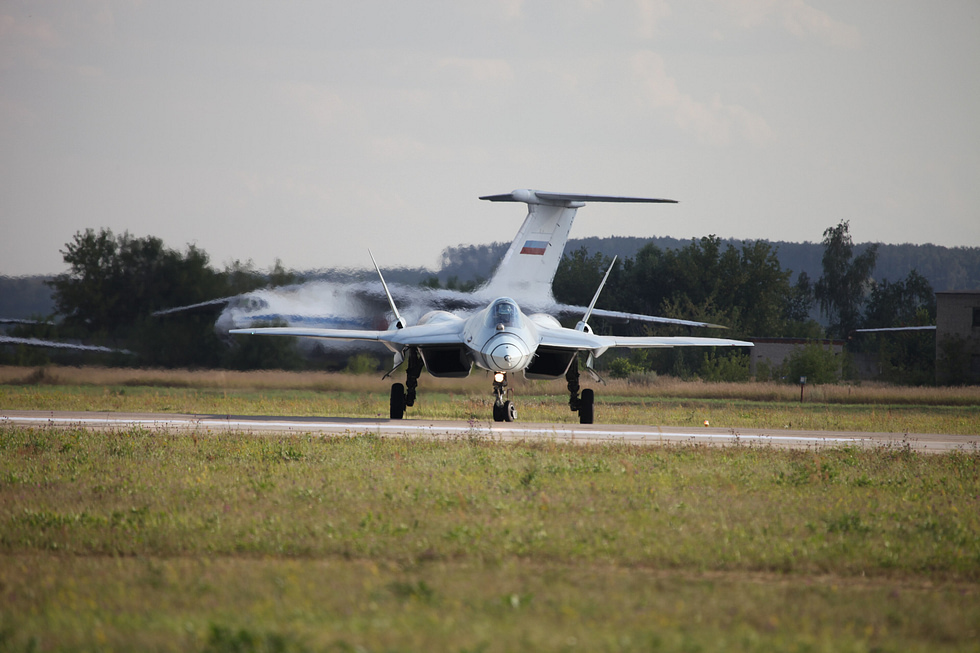
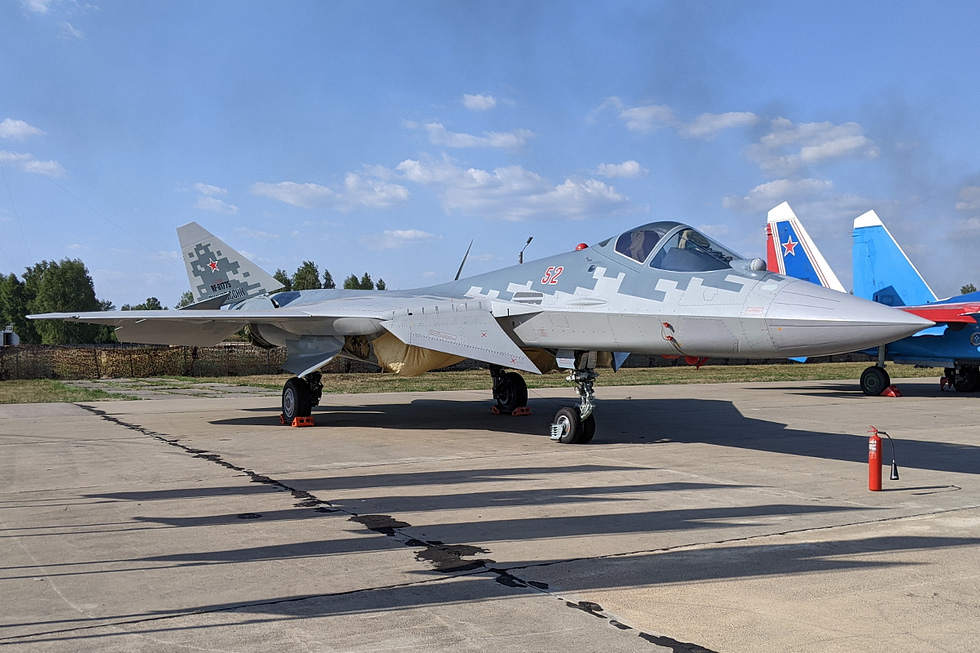
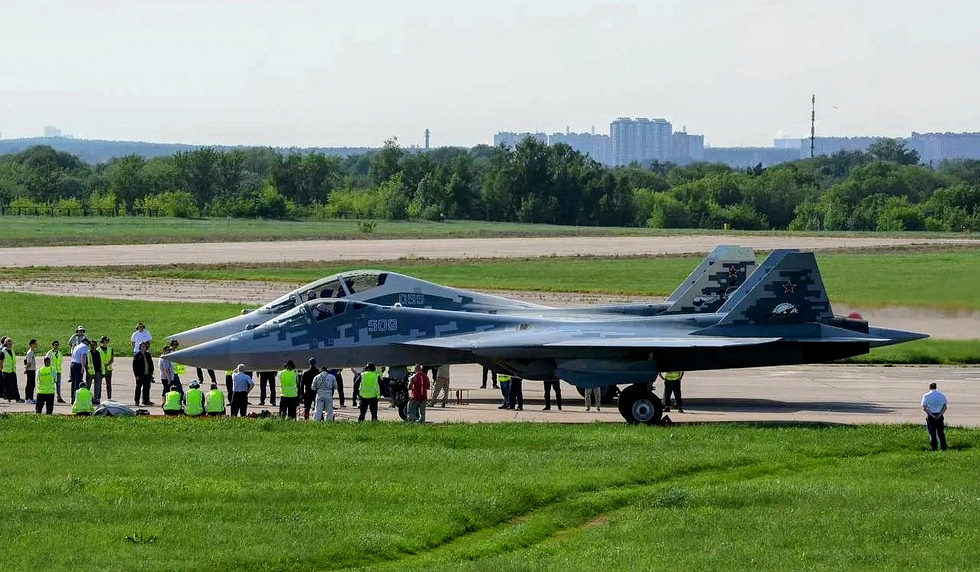
The Su-57 in motion
A neutral video on the Su-57 will be added here.
Where the Su-57 operates
The Su-57’s combat record — reported, not proven
The Su-57 has no verified air-to-air combat record — no confirmed kills and no confirmed air-to-air losses. Reported use over Ukraine since 2022 has, by most independent accounts, been cautious stand-off missile launches from inside Russian airspace, not penetrating stealth strikes. Russian capability claims and Ukrainian strike claims alike should be treated as contested. The jet should not be described as combat-proven.
Compare the combat record of every military aircraft. Figures as of July 2026.
Everything people ask about the Su-57
Can I fly in a Su-57?
Is the Su-57 stealthy?
How fast is the Su-57?
Is the Su-57 combat-proven?
Was a Su-57 really destroyed?
How many Su-57s exist?
Who flies the Su-57?
Why is it called “Felon”?
You can’t fly the Su-57.
These, you can.
Some legends only live in museums — others are fuelled and waiting. MiGFlug has put civilians in real military jet cockpits since 2004.
 Fly the L-39 AlbatrosThe world’s most-flown jet trainer — aerobatics included
 Fly the F-104 Starfighter“The missile with a man in it”
 Fly the MiG-21The Cold War’s most-produced jet
 驾驶T-33流星战斗机America’s first jet trainer
 Fly the DH VampireA piece of early jet history
 Fly the S.211Agile Italian jet trainer
 Fly the MB-326The classic Aermacchi jet
 Fly the MiG-15The Soviet legend of the Korean War
Continue the tour
Every claim, checked and hedged
- Forbes — David AxeAnalysis of the June 2024 Akhtubinsk drone-strike claim and Su-57 vulnerability.
- RUSICommentary on Russian airbase vulnerability and the Akhtubinsk incident.
- Kyiv PostUkrainian strike claims — clearly a Ukrainian-sourced perspective, to be weighed against Russian promotion.
- The National InterestDoctrine and vulnerability analysis of the Su-57 programme.
- Army RecognitionSpecifications and operator overview (Russian-stated figures noted as such).
- Encyclopaedia BritannicaGeneral overview of the Su-57 and PAK FA programme.
- EDR MagazineRosoboronexport export marketing at LIMA 2025 — treated as promotional.