
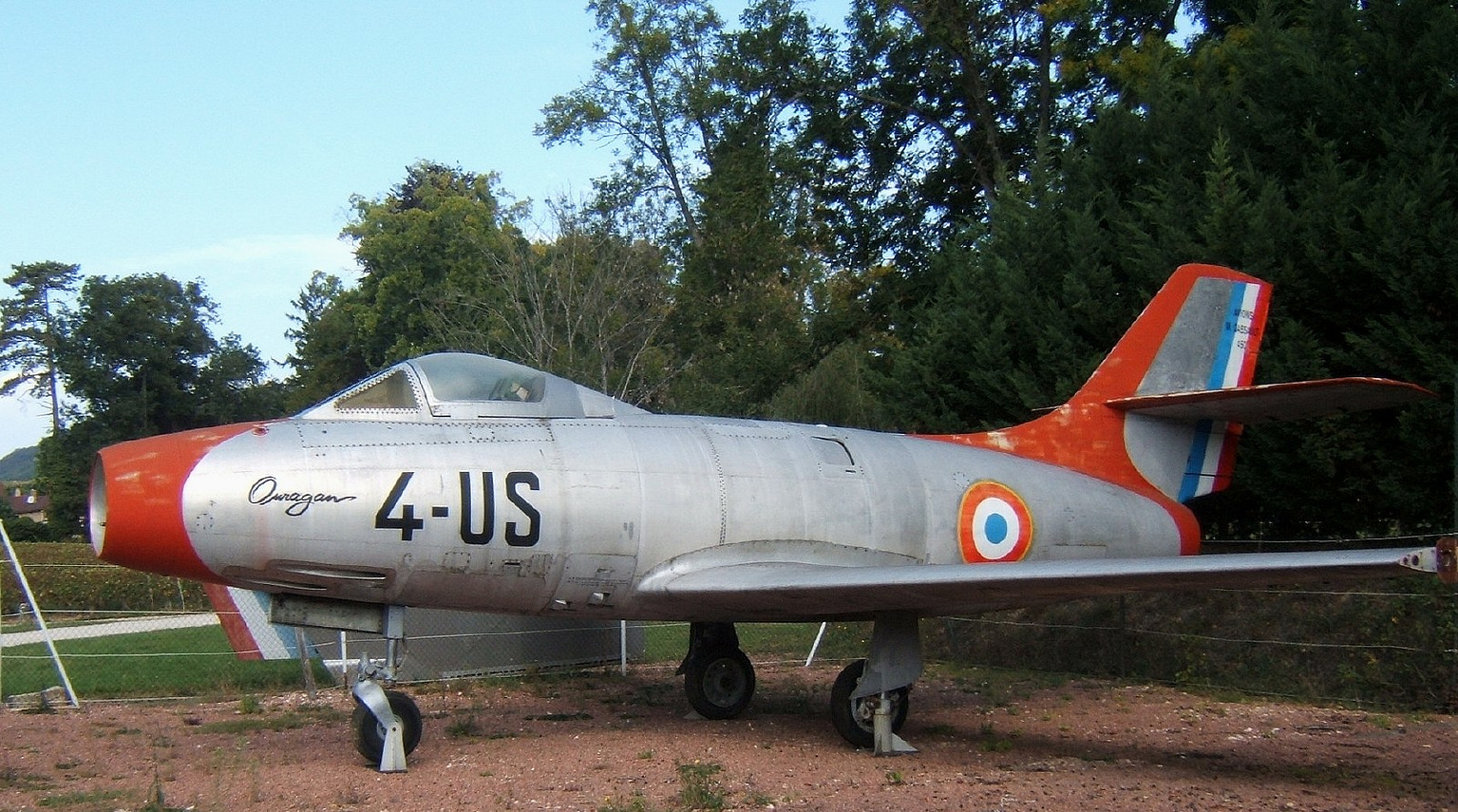
Dassault MD.450
“Ouragan”
France’s first mass-produced jet fighter — a rugged, straight-winged fighter-bomber that put a war-shattered French aviation industry back in the air and launched the Dassault dynasty that would lead to the Mystère and the Mirage.
The jet that rebuilt French aviation
In 1945 the French aircraft industry lay in ruins. Marcel Bloch — who had survived deportation to Buchenwald and returned to rename himself Marcel Dassault — set out to give France its own jet fighter as fast as possible. Working largely on his company’s own initiative from 1947, his team designed a deliberately conservative machine: a straight low-mounted wing, a nose intake feeding a single centrifugal-flow turbojet, a bubble canopy and tricycle gear. It owed an obvious debt to American jets like the Republic F-84 Thunderjet and the Lockheed F-80.
The prototype MD.450 first flew on 28 February 1949 in the hands of test pilot Constantin “Kostia” Rozanoff. Named Ouragan — French for “Hurricane” — it entered French Air Force service in 1952 as the country’s first indigenous jet fighter to reach mass production. Power came from a Rolls-Royce Nene, built under licence in France by Hispano-Suiza; there was nothing exotic about the aircraft, and that was the point.
The Ouragan was never a world-beater in raw performance — it topped out around Mach 0.76 with a straight wing while rivals were already going swept. But it worked, it was rugged, and it flew in anger far from home: Israeli Ouragans fought over Sinai, Indian “Toofanis” struck in Goa and Kashmir, and El Salvador flew them into the 1980s. Most important of all, it was the first rung of a ladder that ran straight through the swept-wing Mystère to the delta Mirage.
01Why the Ouragan mattered far more than its modest performance suggested
On paper the Ouragan was unremarkable: a straight-winged, subsonic fighter-bomber arriving just as swept-wing jets like the MiG-15 and F-86 Sabre were rewriting the rules. But its significance was industrial and strategic, not aerodynamic. It proved that Dassault could design, build and mass-produce a modern combat jet on French soil, restoring a capability the war had destroyed.
That confidence — and the design team, tooling and supplier network built around the Ouragan — fed directly into the swept-wing Mystère series and, a decade later, the delta-winged Mirage III, one of the most successful fighters of the Cold War. Every Rafale flying today traces its corporate lineage back to this stubby straight-winged jet of 1949.
What makes the Ouragan special
A proven engine and a conservative straight wing
The Ouragan was built around the Rolls-Royce Nene, a reliable British centrifugal-flow turbojet licence-built in France by Hispano-Suiza (the Nene 104B in production aircraft, about 22 kN of thrust). Paired with a thin, unswept low-mounted wing, it was a deliberately low-risk design — France needed a jet that would work, not a technological gamble. The straight wing capped its speed near Mach 0.76 but made it docile and predictable.
A rugged, simple fighter-bomber
Four 20 mm Hispano cannon sat under the nose intake, and four underwing hardpoints carried bombs, napalm or rockets — up to roughly 900 kg of stores. Pilots found it a stable, forgiving gun and rocket platform, ideal for close air support, though its stubby fuselage gave it a habit of snapping into a flat spin in very tight turns. Simplicity made it easy to maintain in the field — a virtue that served Israel, India and El Salvador well.
The foundation of the Dassault line
The Ouragan’s greatest engineering contribution was what it enabled next. Its airframe was the starting point for the swept-wing MD.452 Mystère, which in turn led to the Mystère IV, the Super Mystère and ultimately the Mirage family. The Ouragan was less a masterpiece than a proof of concept — the aircraft that showed Dassault could do it at all.
02The Ouragan’s Nene engine: British power built under licence in France
France in the late 1940s could not yet mass-produce a competitive jet engine of its own, so Dassault turned to the Rolls-Royce Nene, a robust centrifugal-flow turbojet that also powered the Soviet MiG-15 and versions of the American F9F Panther. Hispano-Suiza built it under licence in France. Early prototypes used the Nene 102; production Ouragans standardised on the Hispano-Suiza-built Nene 104B. Relying on a proven, licence-built engine let Dassault concentrate on the airframe and get a working fighter into squadrons quickly — while French firms like SNECMA developed the indigenous Atar engine that would power every later Dassault fighter.
03From Ouragan to Mirage: how one straight-winged jet started a dynasty
The Ouragan’s lineage is unusually direct. Dassault fitted a 30-degree swept wing and revised tail to the basic layout to create the MD.452 Mystère I, then refined it into the transonic Mystère IV and the supersonic Super Mystère. In parallel the company pursued the tailless delta configuration that became the Mirage III — a Mach-2 fighter exported around the world. The through-line from the 1949 Ouragan to the Rafale of today is one continuous corporate and engineering story, and it begins here.
Full Ouragan specifications
Airframe & Performance
- 全体人员
- 1
- 长度
- 10.73 m
- 翼展
- 13.16 m (over wingtip tanks)
- 高度
- 4.14 m
- 空重
- ~4,140 kg
- Max takeoff weight
- ~7,900 kg
- Max speed
- ~940 km/h · Mach 0.76
- 设备天花板
- ~13,000 m (sources vary to ~15,000 m)
- Combat range
- ~450 km (ferry ~920 km)
Propulsion & Armament
- 引擎
- 1 × Hispano-Suiza Nene 104B (Rolls-Royce licence)
- 推力
- ~22.2 kN (5,000 lbf)
- Guns
- 4 × 20 mm Hispano cannon (125 rpg)
- External load
- ~900 kg: bombs, napalm, rockets
- Rockets
- 16 × 105 mm or SNEB 68 mm pods
- First flight
- 28 February 1949
- Built
- ~567 across all operators — 350 for France, plus exports to India and Israel
- Unit cost
- No reliable public figure
04The Ouragan’s numbers: why production totals and costs vary between sources
The Ouragan was a state-era French product built across several subcontractors — SNCASE and SNCASO produced fuselage sections and wings while Dassault handled centre fuselage, tail and final assembly at Mérignac. France ordered roughly 350 aircraft (an initial 150 plus a follow-on 200), and that is the most commonly cited production figure; some references quote higher totals depending on how prototypes and export airframes are counted. Israel (~75), India (~104) and El Salvador (18) largely operated second-hand or transferred machines rather than wholly new production, so operator counts overlap. No firm flyaway unit price or cost-per-flight-hour exists in the public record — any precise dollar figure attached to the Ouragan is an estimate.
From ruined industry to the Mirage dynasty
Design begins
Marcel Dassault starts private-venture work on the MD.450, a simple straight-winged jet fighter for a recovering France.
First flight
The prototype flies on 28 February with Kostia Rozanoff at the controls, unarmed and unpressurised.
Production begins
The first series-production Ouragan flies on 5 December, powered by the Hispano-Suiza-built Nene.
French service
The Ouragan enters Armée de l’Air service, replacing the de Havilland Vampire as France’s first mass-produced homegrown jet.
Export & replacement
Israel begins receiving Ouragans; in France the swept-wing Mystère IV starts taking over frontline duties.
Suez combat debut
Israeli Ouragans fly ground-attack and score air-to-air kills during the Suez/Sinai campaign of October–November.
India’s Toofani
Indian Air Force Toofanis support the 1961 annexation of Goa and fly in the 1965 war with Pakistan.
Last operator
El Salvador buys ex-Israeli Ouragans and flies them through the Salvadoran Civil War until retirement in the late 1980s–90s.
Twelve Ouragan stories
A survivor rebuilds an industry
Marcel Bloch returned from Buchenwald, became Dassault, and set out to give France a jet fighter.
Read the full story
Rozanoff takes it up
Test pilot Kostia Rozanoff flew the unarmed prototype on 28 February 1949.
Read the full story
Why “Hurricane”
Ouragan is French for hurricane; India would later translate it as “Toofani.”
Read the full story
Borrowed from America
The Ouragan’s stovepipe-and-straight-wing layout echoed the F-84 and F-80.
Read the full story
Replacing the Vampire
From 1952 the Ouragan gave the Armée de l’Air its first mass-produced French jet.
Read the full story
The Ibrahim el Awal
Israeli Ouragans helped force the surrender of an Egyptian destroyer off Haifa.
Read the full story
Better than expected
Ouragans destroyed Egyptian aircraft and armour over Sinai and impressed even sceptical commanders.
Read the full story
Strikes over Goa
Toofanis flew ground-attack sorties supporting India’s 1961 annexation of Goa.
Read the full story
A trophy in Peshawar
A Toofani that strayed across the border became a Pakistani war prize.
Read the full story
From Sinai to Central America
El Salvador flew ex-Israeli Ouragans through a brutal civil war.
Read the full story
The flat-spin quirk
The Ouragan’s stubby fuselage could snap it into a flat spin in a hard turn.
Read the full story
The first Dassault fighter
The Ouragan began the line that runs through Mystère and Mirage to Rafale.
Read the full story
The Ouragan in pictures
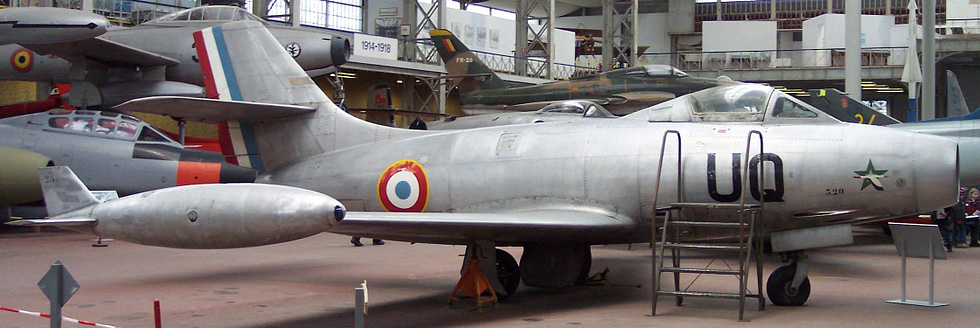
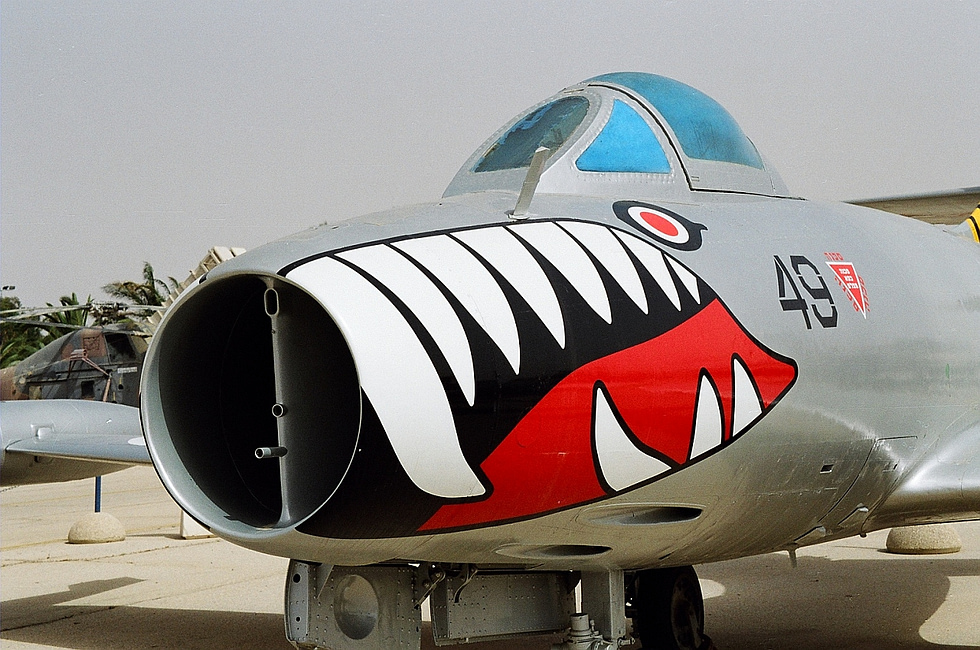
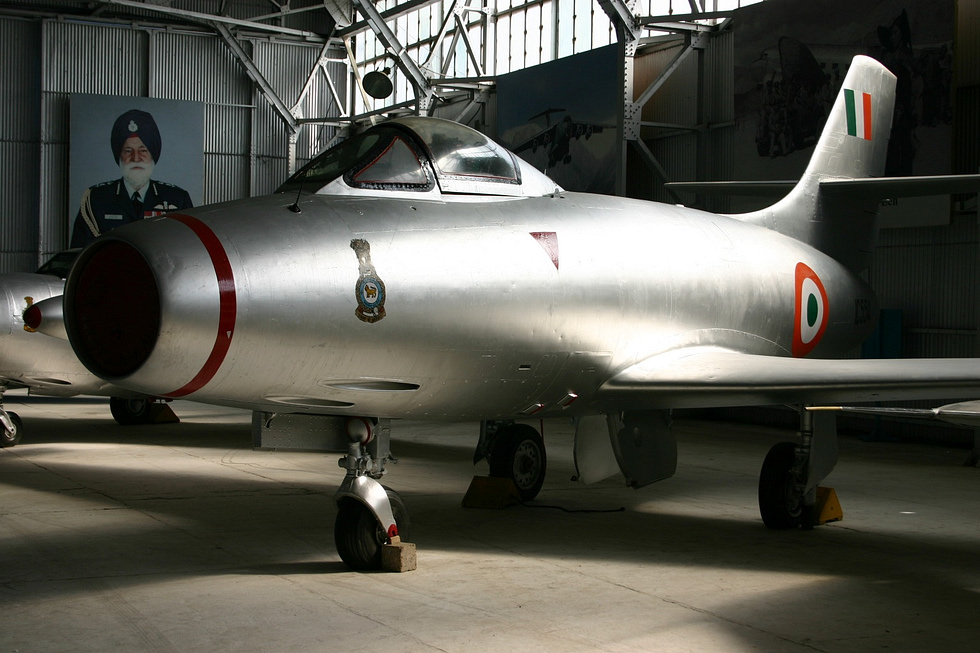
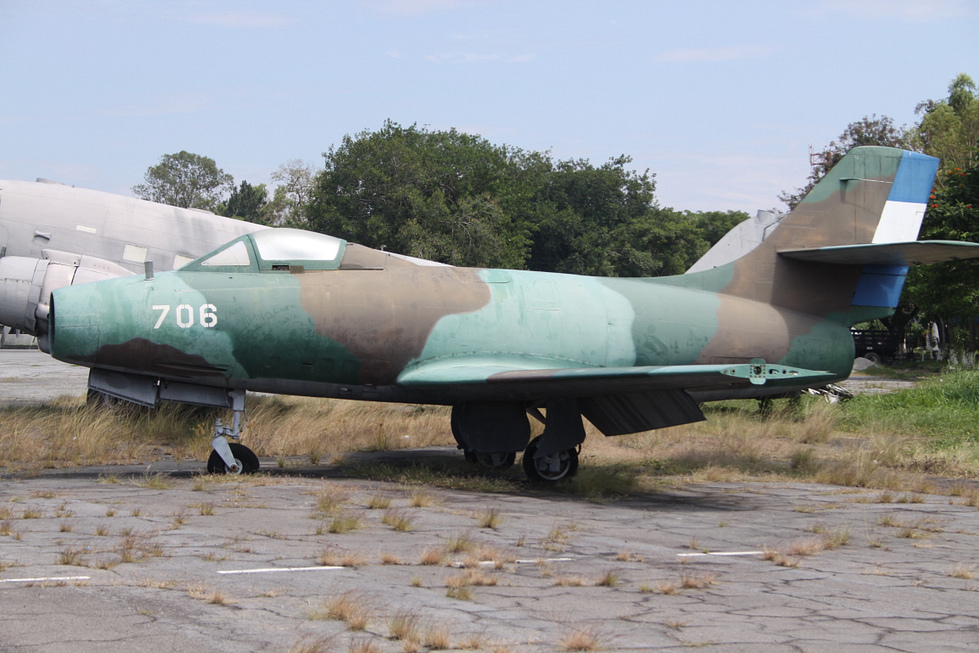
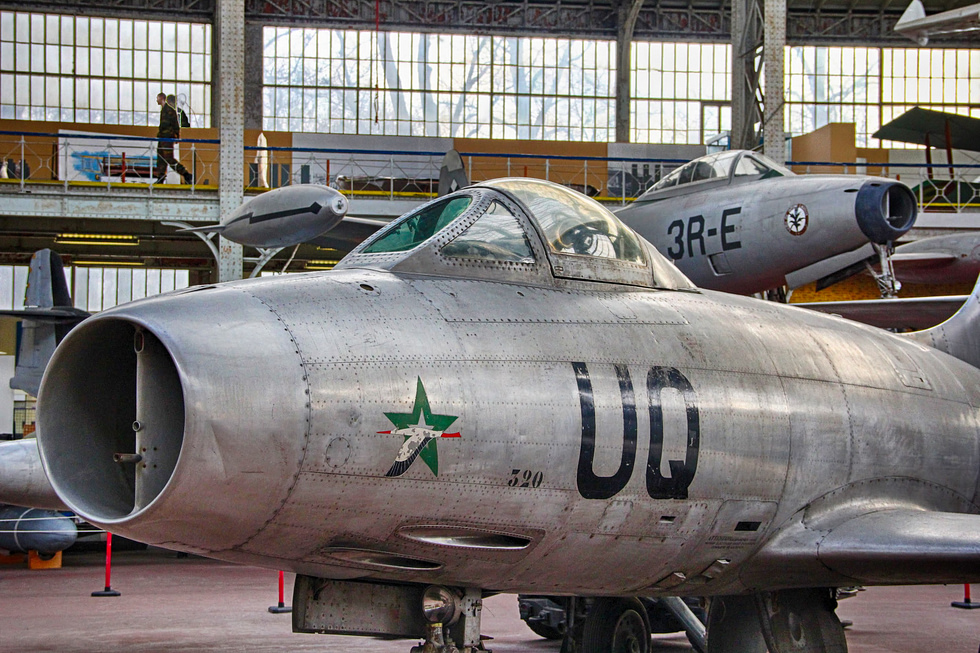
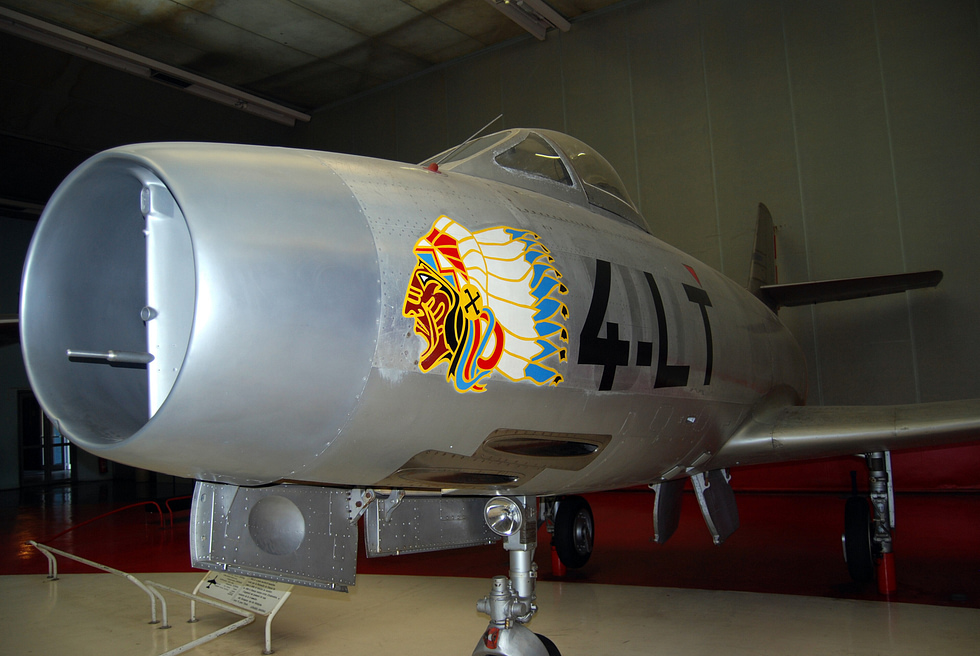
The Ouragan in motion
A dedicated Ouragan video feature is coming soon. In the meantime, explore the photo gallery above and the story of how this first Dassault fighter led to the Mystère and Mirage.
The Ouragan in motion
Not A Pound For Air To Ground — one of the most-watched Ouragan films on YouTube.
Where the Ouragan flew
A first-generation jet that fought worldwide
The Ouragan was a fighter-bomber, not a dogfighter — but it saw a surprising amount of combat far from France. Israeli Ouragans destroyed Egyptian aircraft, armour and even helped capture a warship in 1956; Indian Toofanis struck in Goa and flew in 1965; and El Salvador took the type into a long civil war. Air-to-air kills were modest and are hard to tally precisely, so treat specific totals with caution.
Compare the combat record of every military aircraft. Figures as of July 2026.
Everything people ask about the Ouragan
Can I fly in an Ouragan?
What was the Dassault Ouragan?
Why is the Ouragan historically important?
What engine did the Ouragan use?
Did the Ouragan see combat?
What is a “Toofani”?
How fast was the Ouragan?
Are any Ouragans still flying?
You can’t fly the Ouragan.
These, you can.
Some legends only live in museums — others are fuelled and waiting. MiGFlug has put civilians in real military jet cockpits since 2004.
 Fly the L-39 AlbatrosThe world’s most-flown jet trainer — aerobatics included
 Fly the F-104 Starfighter“The missile with a man in it”
 Fly the MiG-21The Cold War’s most-produced jet
 驾驶T-33流星战斗机America’s first jet trainer
 Fly the DH VampireA piece of early jet history
 Fly the S.211Agile Italian jet trainer
 Fly the MB-326The classic Aermacchi jet
 Fly the MiG-15The Soviet legend of the Korean War
Continue the tour
Every fact, checked
- Dassault Aviation — MD.450 OuraganManufacturer history, origins and performance data for the type.
- Air Vectors — Ouragan, Mystère & Super MystèreDetailed development, specifications and the line from Ouragan to Mirage.
- Vintage Aviation NewsFirst flight of 28 February 1949 and the Rozanoff prototype story.
- Military FactorySpecifications, armament and operator overview.
- SkytamerVariant details and service-history reference.
- Flugzeuginfo.netTechnical data and dimensions cross-check.
- Air Aces — Israeli victoriesReference for Israeli Ouragan air-to-air claims in 1956.
- National Museum of the US Air ForceGeneral reference for preserved early jet fighters on display.