
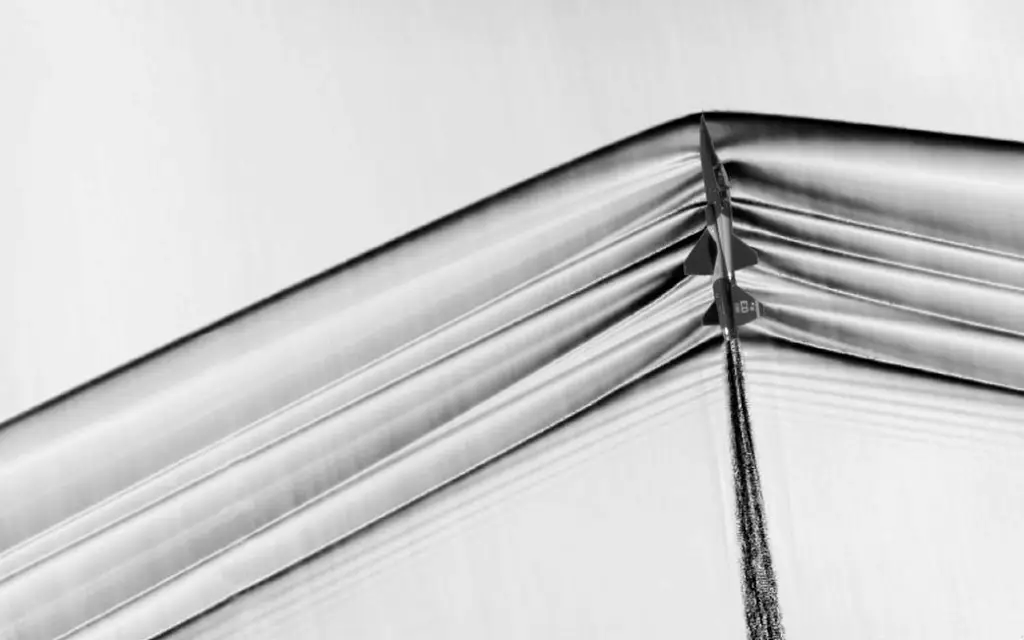
Pour commencer : qu'est-ce que le mur du son ?
Le “ mur du son ” désigne la vitesse à laquelle un objet se déplace à la vitesse du son, également appelée Mach 1. Le son se propage sous forme d'ondes de pression dans un milieu comme l'air, et sa vitesse dépend de facteurs tels que la température et l'altitude. Au niveau de la mer, la vitesse du son est d'environ 1 225 kilomètres par heure (761 miles par heure). Lorsqu'un objet approche cette vitesse, il subit une augmentation considérable de la résistance aérodynamique et des turbulences ; ce phénomène a longtemps été considéré comme une " barrière " infranchissable."Franchir le mur du son – et rendre les ondes de choc visibles
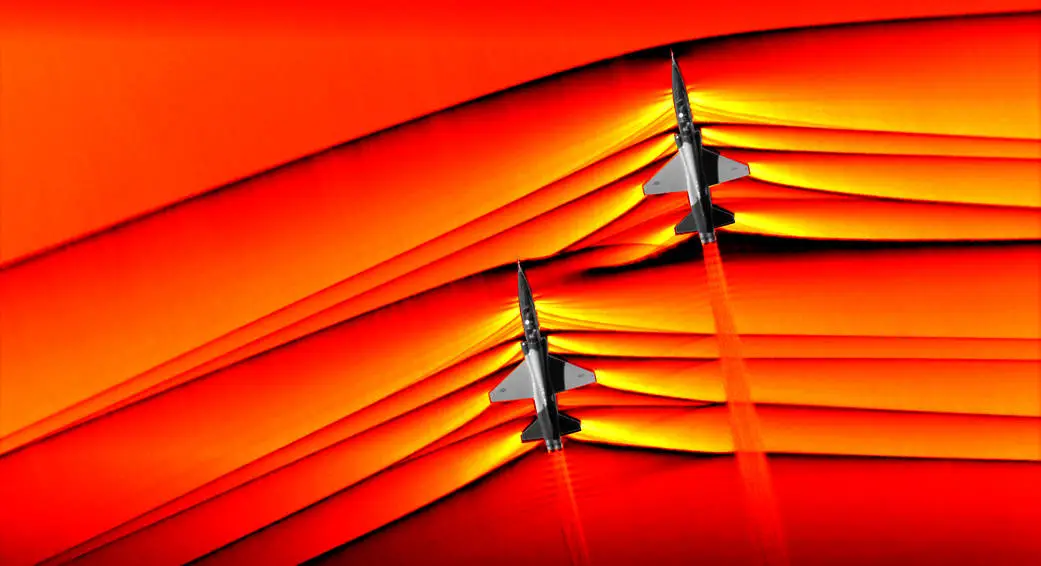
La NASA a utilisé la photographie schlieren pour capturer des images aériennes révolutionnaires illustrant l'interaction des ondes de choc générées par deux avions supersoniques volant en formation serrée. L'image montre deux jets T-38 de l'École des pilotes d'essai de l'US Air Force, volant à environ 9 mètres l'un de l'autre à des vitesses supersoniques. Alors qu'ils fendaient l'air, leurs ondes de choc — responsables des bangs soniques bien connus au sol — ont été enregistrées visuellement avec une précision stupéfiante. Initialement monochrome, l'image a ensuite été colorisée pour en améliorer la netteté et l'impact. Ce cliché remarquable faisait partie d'une série de vols supersoniques visant à approfondir notre compréhension de l'interaction des ondes de choc avec les panaches d'échappement des avions et entre elles.
Vol supersonique
Le vol supersonique se produit lorsqu'un aéronef se déplace à une vitesse supérieure à celle du son, généralement entre Mach 1 et Mach 5. Les aéronefs conçus à cet effet, comme le Concorde ou les avions de chasse militaires tels que le F-22 Les rapaces font face à des défis uniques :- ondes de chocLorsqu'un avion vole à une vitesse supersonique, des ondes de choc se forment autour de lui, affectant son aérodynamisme et créant une traînée.
- ChaleurLe frottement avec les molécules d'air génère une chaleur intense, ce qui nécessite des matériaux spéciaux pour résister aux hautes températures.
- EfficacitéLes vitesses supersoniques consomment d'immenses quantités de carburant, c'est pourquoi les avions de ligne supersoniques ont finalement été retirés du service en raison de problèmes de coûts.
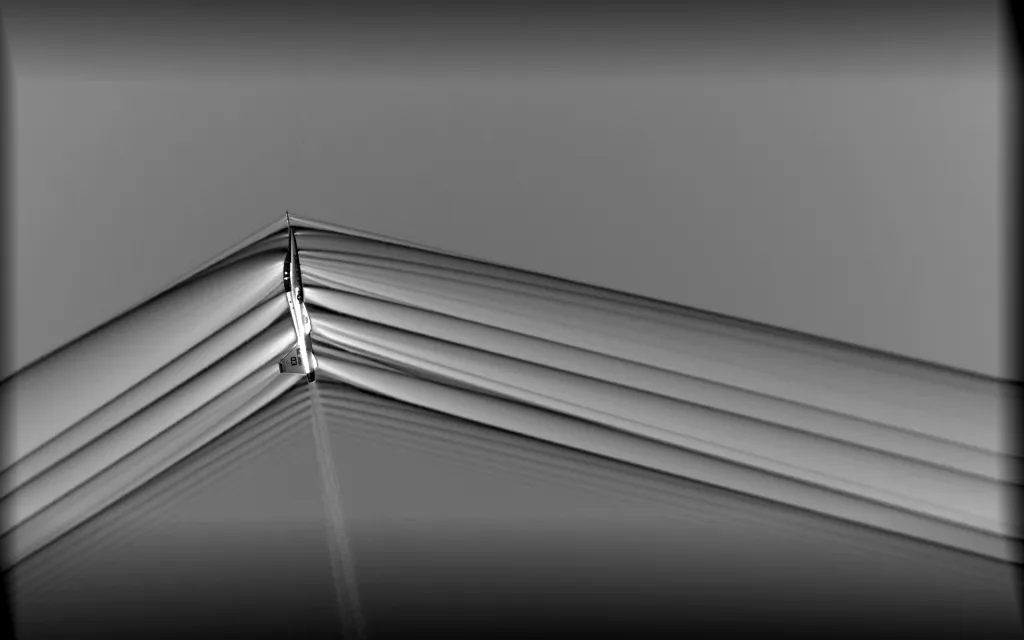
.…et comme ces photos sont si fascinantes, en voici une autre ! Bravo, NASA !
Comment fonctionne la photographie Schlieren ?
La photographie Schlieren est une technique fascinante permettant de visualiser les variations de densité des fluides transparents comme l'air. Ces variations sont souvent dues à des changements de pression, de température ou à des ondes de choc, telles que celles créées par des objets se déplaçant à des vitesses supersoniques. Voici comment cela fonctionne :Principes clés
- Réfraction de la lumièreLorsque la lumière traverse un milieu de densité variable, elle se courbe (se réfracte) car sa vitesse change légèrement en fonction de la densité du milieu.
- Configuration optiqueLes systèmes Schlieren utilisent une source lumineuse ponctuelle, des miroirs et des lentilles pour rendre visibles ces infimes variations de la direction de la lumière.
Comment ça marche
- Source lumineuseUne source ponctuelle lumineuse, comme une petite LED ou un laser, émet une lumière qui traverse un milieu transparent.
- Miroir ou lentilleUn miroir concave ou une lentille concentre la lumière en faisceaux parallèles, qui se propagent ensuite à travers la zone d'intérêt, comme l'air autour d'une onde de choc.
- Perturbations de densitéEn cas de changement de densité de l'air (par exemple, dû à une onde de choc), la lumière traversant ces zones se courbera légèrement.
- Lame de couteau ou filtreAu point focal, un petit obstacle (comme une arête vive) bloque une partie de la lumière. Cela accentue les différences d'intensité lumineuse, faisant ressortir la lumière réfractée.
- Image résultanteUne caméra capture la distorsion de la lumière, révélant les gradients de densité du milieu. Ces gradients apparaissent sous forme de zones claires et sombres, mettant en évidence des phénomènes tels que les ondes de choc ou les flux de chaleur.

Et voici une dernière. Bravo, la NASA, vous êtes géniaux !
Applications
La photographie Schlieren est largement utilisée dans :- Aérodynamique: Étudier les ondes de choc, les flux d'air et les panaches de chaleur autour des aéronefs ou des fusées à grande vitesse.
- IngénieriePour la visualisation des flux de chaleur et de fluides dans la recherche et le développement.
- Sciences et médecine: Observer la dynamique des gaz, comme le mouvement de l'air chaud autour des objets.
...je dis ça comme ça'
MiGFlug a réussi à montrer le moment où le MiG-29 franchit le mur du son lors d'un vol passagers en avion de chasseSans photographie Schlieren, mais avec des caméras vidéo classiques ! Regardez attentivement, vous le voyez ?Questions connexes
Qu'est-ce que le mur du son ?
Le " mur du son " est le point auquel un avion atteint la vitesse du son, Mach 1 — soit environ 1 225 km/h (761 mph) au niveau de la mer. À l’approche de ce mur, les avions rencontrent une forte augmentation de la traînée et des turbulences que les premiers ingénieurs craignaient être une barrière infranchissable, jusqu’à ce qu’elle soit franchie pour la première fois en 1947.
Qu'est-ce que la photographie schlieren ?
La photographie Schlieren est une technique qui rend visibles les différences de densité de l'air, permettant ainsi de photographier les ondes de choc, autrement invisibles, qui se propagent autour d'objets en mouvement rapide. La NASA a utilisé une version air-air avancée pour capturer les ondes de choc supersoniques générées par les avions à réaction en vol.
Comment la NASA a-t-elle photographié les ondes de choc supersoniques ?
NASA used schlieren imaging to photograph two T-38 jets from the US Air Force Test Pilot School flying about 30 feet apart at supersonic speed. The result showed how the shockwaves from the two aircraft interact — data that helps engineers design quieter supersonic planes.
Qu'est-ce qu'un bang sonique ?
Le bang supersonique est le bruit assourdissant, semblable au tonnerre, produit lorsqu'un avion se déplace à une vitesse supersonique et que ses ondes de choc atteignent le sol. Réduire ce bang est un objectif majeur de la recherche moderne sur les avions supersoniques, ce qui explique l'importance de visualiser les ondes de choc, comme sur les images de la NASA.
Pourquoi les ingénieurs veulent-ils observer les ondes de choc ?
La visualisation des ondes de choc permet de comprendre précisément comment les ondes de pression se forment et fusionnent autour d'un aéronef, orientant ainsi la conception d'appareils produisant des ondes de choc moins puissantes. Ces recherches pourraient un jour permettre le vol supersonique terrestre, ravivant une ambition oubliée depuis les avions à réaction rapides comme le SR-71 Blackbird.
Quel avion a franchi le mur du son en premier ?
Le Bell X-1, piloté par Chuck Yeager, est devenu le premier avion à franchir le mur du son en vol horizontal le 14 octobre 1947. Cet événement marquant a ouvert l'ère supersonique et a conduit à des machines de recherche comme le drone à propulsion par fusée. X-15.


0 Comments