
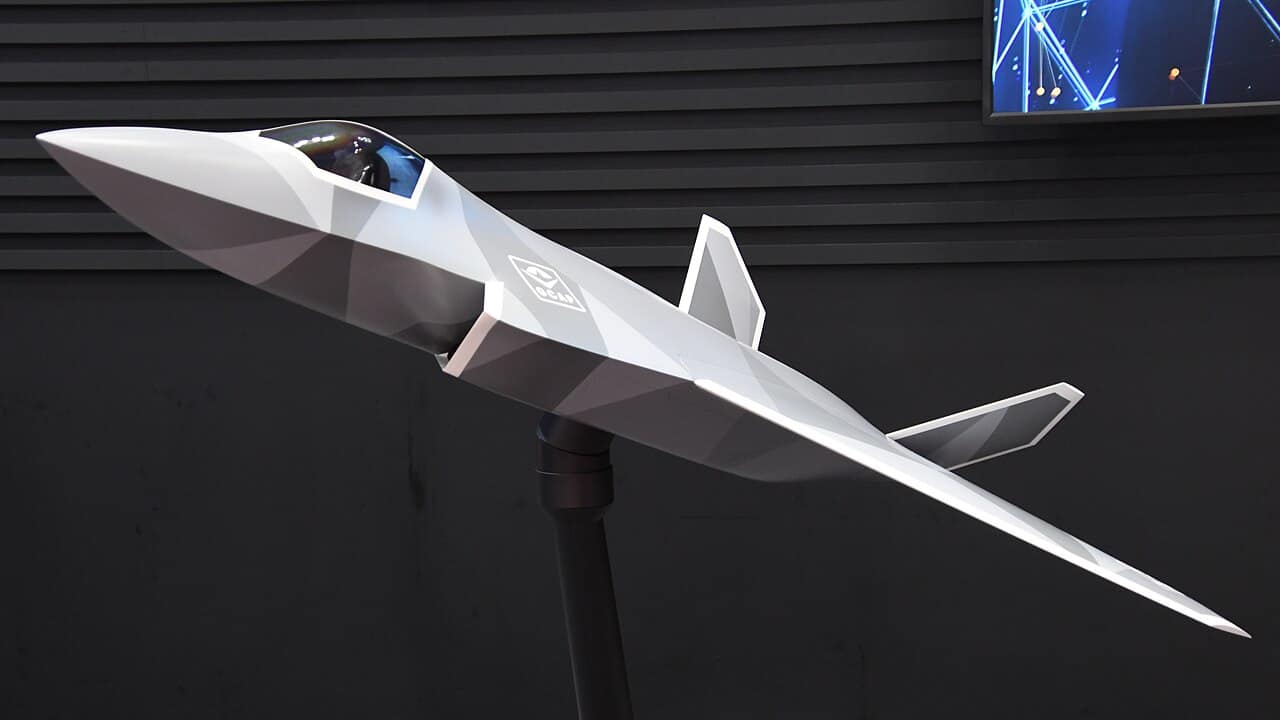
For months, Europe’s most ambitious fighter programme had a hole in the middle of it: the money. On July 3, 2026, that hole was filled. The United Kingdom, Italy and Japan signed a £4.6 billion ($6.1 billion) contract to push their sixth-generation combat aircraft into its next design phase — days after Britain finally freed up the cash to make it possible.
The Global Combat Air Programme, or GCAP, is the tri-national effort to field a stealth fighter by 2035. This contract is the moment the money actually reaches the people building it.
QUICK FACTS
| Contract | £4.6 billion ($6.1bn), jointly funded |
| Awarded to | Edgewing — BAE Systems, Leonardo & JAIEC |
| Partners | United Kingdom, Italy, Japan |
| Aircraft | GCAP sixth-generation stealth fighter |
| In service | Targeted for 2035 |
| UK funding | £8.6 billion over four years (Defence Investment Plan) |
The cheque that turns a concept into a jet
The £4.6 billion was awarded through the trilateral GCAP Agency to Edgewing — the industrial joint venture that binds together Britain’s BAE Systems, Italy’s Leonardo and Japan Aircraft Industrial Enhancement Co. It funds the next stage of design: nailing down the aircraft’s key requirements and putting them through rigorous testing before full development begins.
That may sound like paperwork, but it is the difference between a handsome model on an airshow stand and a flying weapon. The GCAP concept — a broad, clean delta wing revealed at Farnborough in 2024 — is meant to be the core of a wider “system of systems,” operating across air, land, sea, space and cyber and directing autonomous drones in combat.

Why the timing mattered
The contract landed just days after the UK’s Defence Investment Plan confirmed £8.6 billion for GCAP over four years — the funding commitment that had been holding the whole thing up. With Britain’s share settled, the three nations could finally put pen to paper together.
The economics are a large part of the pitch. Britain says the wider future combat air effort already supports around 4,500 jobs, drawing on a supply chain of roughly 600 organisations and pioneering AI, robotics, augmented reality and additive manufacturing to speed design and production.
A three-way bet on 2035
GCAP is designed to fly alongside upgraded Typhoons, F-35s and autonomous systems as the backbone of a next-generation Royal Air Force — and equivalent forces in Rome and Tokyo. It is a genuine three-way marriage of industrial strength: British digital engineering, Italian sensors and electronics, Japanese manufacturing muscle.
The competition is not standing still. China has already shown flying sixth-generation prototypes, and the United States is pressing ahead with its own next-gen fighters. For Europe and Japan, the £4.6 billion signed this week is the clearest signal yet that GCAP intends to be more than a beautiful idea — it intends to fly.
Sources: UK Ministry of Defence (gov.uk); Defense News; The Aviationist; Leonardo; Breaking Defense.
Related Questions
What is the Global Combat Air Programme (GCAP)?
GCAP is a joint programme by the United Kingdom, Italy and Japan to build a sixth-generation stealth fighter, targeted to enter service in 2035. It merged Britain’s Tempest project and Japan’s F-X into a single aircraft in December 2022 and is one of the largest defence collaborations in the world.
What is Edgewing?
Edgewing is the industrial joint venture building the GCAP fighter, bringing together Britain’s BAE Systems, Italy’s Leonardo and Japan Aircraft Industrial Enhancement Co. (JAIEC). It received the £4.6 billion development contract in July 2026 through the trilateral GCAP Agency.
When will the GCAP fighter enter service?
The three partner nations are targeting an in-service date of 2035. The July 2026 contract funds the next design phase — locking in the aircraft’s key requirements and testing — ahead of full development.
How much is the UK spending on GCAP?
The UK’s Defence Investment Plan committed £8.6 billion to the programme over four years. That sits alongside the £4.6 billion trilateral development contract funded jointly by Britain, Italy and Japan.
How is GCAP different from the F-35?
The F-35 is a fifth-generation fighter already in service. GCAP is a sixth-generation design intended to fly alongside F-35s and Typhoons — built around a large delta wing, an AI-driven “system of systems,” and control of autonomous drones across air, land, sea, space and cyber domains.


0 Comments
Trackbacks/Pingbacks