
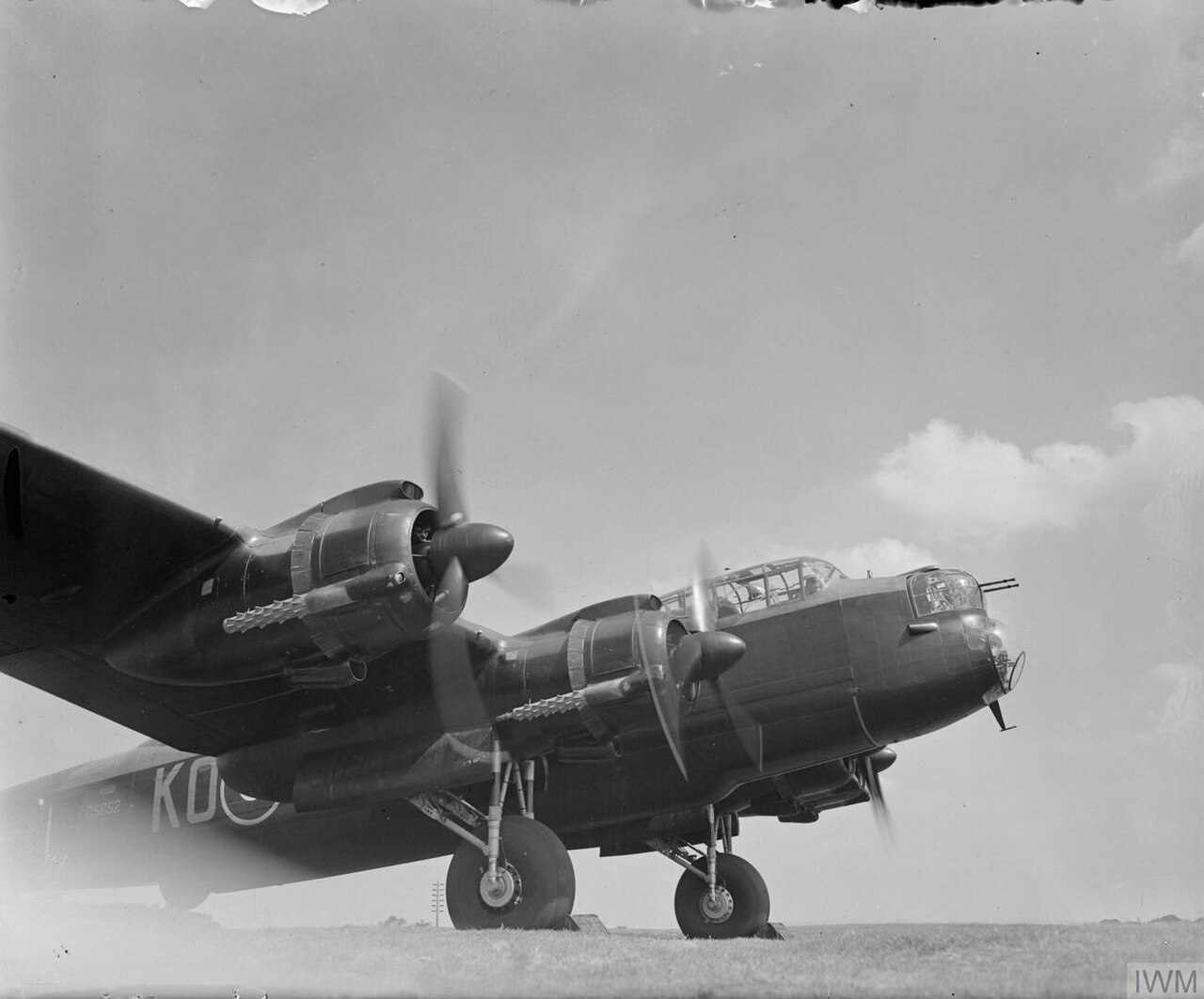
In August 1941 a civil servant named David Bensusan-Butt was given 633 night photographs taken by RAF bombers over occupied Europe and asked a simple question: are they hitting anything?
His answer broke Bomber Command. Of the aircraft whose crews reported attacking the target, only one in three had bombed within five miles of it. Over Germany it was one in four. Over the Ruhr, where the industrial haze was thickest, it was one in ten. Counted against every aircraft despatched rather than those claiming success, roughly five per cent of the force was getting within five miles. A later study found that half the bombs dropped in the first year of the offensive had fallen in open country.
Britain was flying men into flak at night, losing them at a serious rate, and ploughing fields.
Quick Facts
Formed: 15 August 1942 as the Path Finder Force. Became No. 8 (PFF) Group in January 1943
First operation: Flensburg, night of 18/19 August 1942. It missed, with bombs falling up to 25 miles away in Denmark
Commander: Air Vice-Marshal Donald Bennett, an Australian, who at 33 became the youngest air vice-marshal in RAF history
Original squadrons: 7, 35, 83, 109 and 156, one drawn from each operational Group
Key aircraft: Lancaster and Halifax as heavy markers, and the de Havilland Mosquito for Oboe marking
Tour length: 45 operations without a break, against 30 and a rest for Main Force crews
Sorties flown: 50,490 against around 3,440 targets
Casualties: 3,618 according to Bennett. RAF Wyton records at least 3,727 killed on operations
An idea nobody senior wanted
The proposal came from Group Captain Sidney Bufton: take the best crews, form them into a specialist force, and let them find and mark the target so everyone else could bomb the marks.
Arthur Harris hated it, and most of his group commanders agreed with him. The objection was not technical but social. An elite corps would drain the best crews from ordinary squadrons and leave the rest feeling like also-rans. The Air Ministry overruled him. Harris then suggested dispersing pathfinder-trained crews among existing squadrons instead, and was overruled again.
Having lost, Harris chose the commander himself: Donald Bennett, an Australian who had joined the RAAF in 1930, flown for Imperial Airways, written the standard textbook on air navigation, and been shot down attacking the Tirpitz in April 1942 before walking out through Sweden. He was 32 when he took the job.
The friction never really went away. In April 1944 Harris transferred three of Bennett’s squadrons to 5 Group, whose commander favoured a completely different low-level marking technique.
How you mark a city you cannot see
The Pathfinder technique was layered. Finders lit the route and the general area with flares. Illuminators put coloured target indicators on the aiming point. Backers-up re-marked as the indicators burned out, because a target indicator lasted about five and a half minutes and a raid lasted a great deal longer than that.
Three marking methods were used, each with a code name borrowed from a town. Newhaven was visual ground marking: flares to light the area, then markers placed by eye. Parramatta was blind ground marking, indicators dropped onto the ground by radar or radio guidance without anyone seeing the target. Wanganui was sky marking, parachute flares hung above cloud, and it was the least accurate of the three because flares drift with the wind.
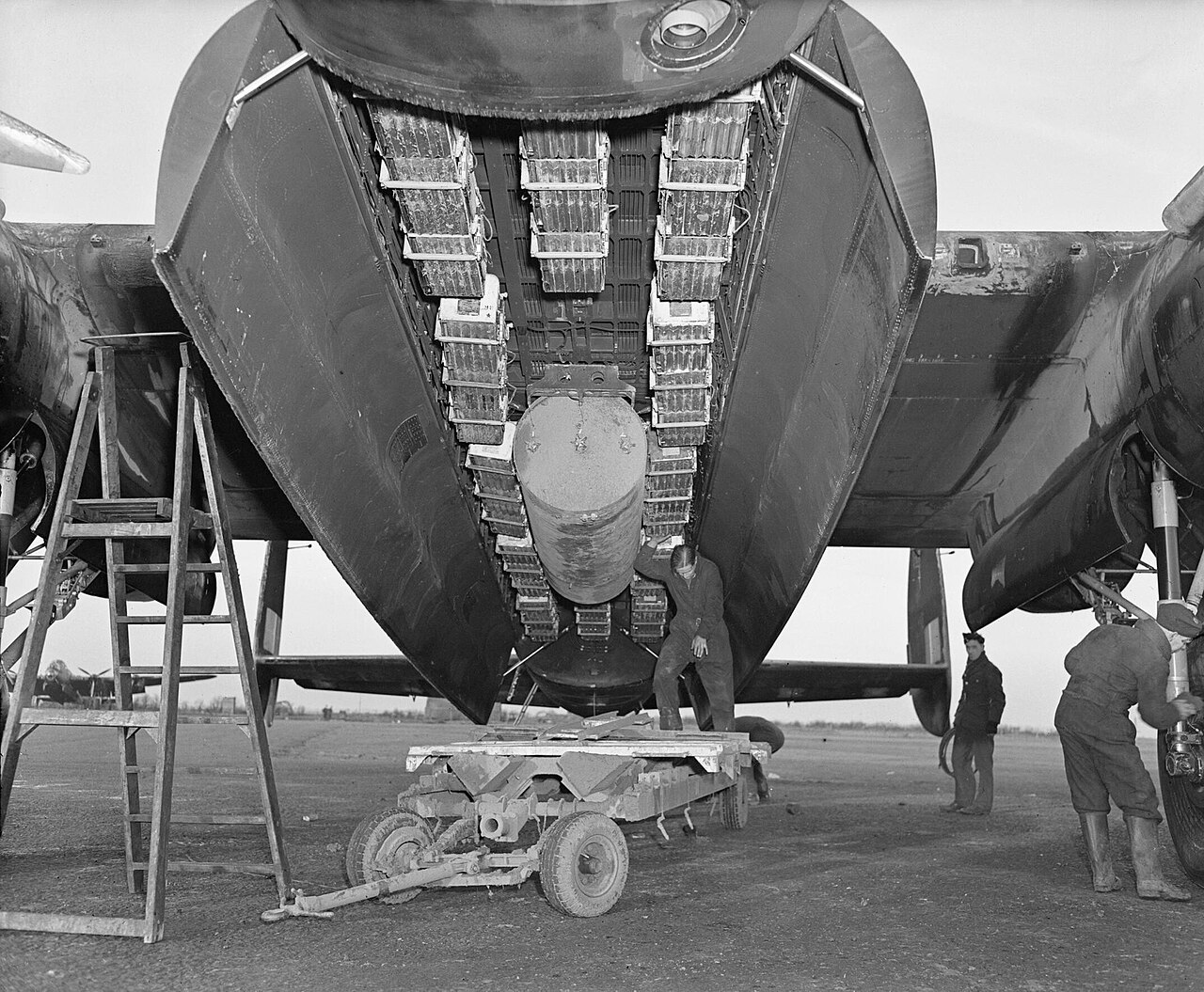
Indicator colours were changed constantly, because the Germans lit decoy markers. On Cologne in October 1942 a German decoy pulled most of a raid away from the city.
The other innovation was a voice. The Master Bomber orbited the target throughout the attack, watching where the bombs actually fell and calling crews onto specific indicators by radio. It was first proven at Friedrichshafen in June 1943 and used at scale over Peenemünde that August. The problem it solved was creepback: crews under fire tend to release at the near edge of the fires rather than pressing on to the aiming point, so a raid gradually walks itself backwards across the countryside. Guy Gibson was killed in September 1944 returning from a master bomber sortie.
Three boxes that changed the arithmetic
None of it would have worked without electronics, and the three systems involved had very different characters.
Gee was a hyperbolic navigation system, passive, usable by unlimited numbers of aircraft at once, with a range of roughly 300 miles. Its accuracy was measured in kilometres, which made it excellent for finding your way and useless for finding a factory. The Germans were jamming it by mid-1942.
Oboe was the precise one. Two ground stations in England tracked a single aircraft: one held it on a fixed-radius arc through the target, the other calculated the release point and called the drop. Trials showed accuracy on the order of fifty metres, which was extraordinary for 1942. It had two crippling limits. It was line-of-sight, so its useful range stopped around 250 miles, which excluded Berlin and most of central Germany. And initially it could handle one aircraft at a time.
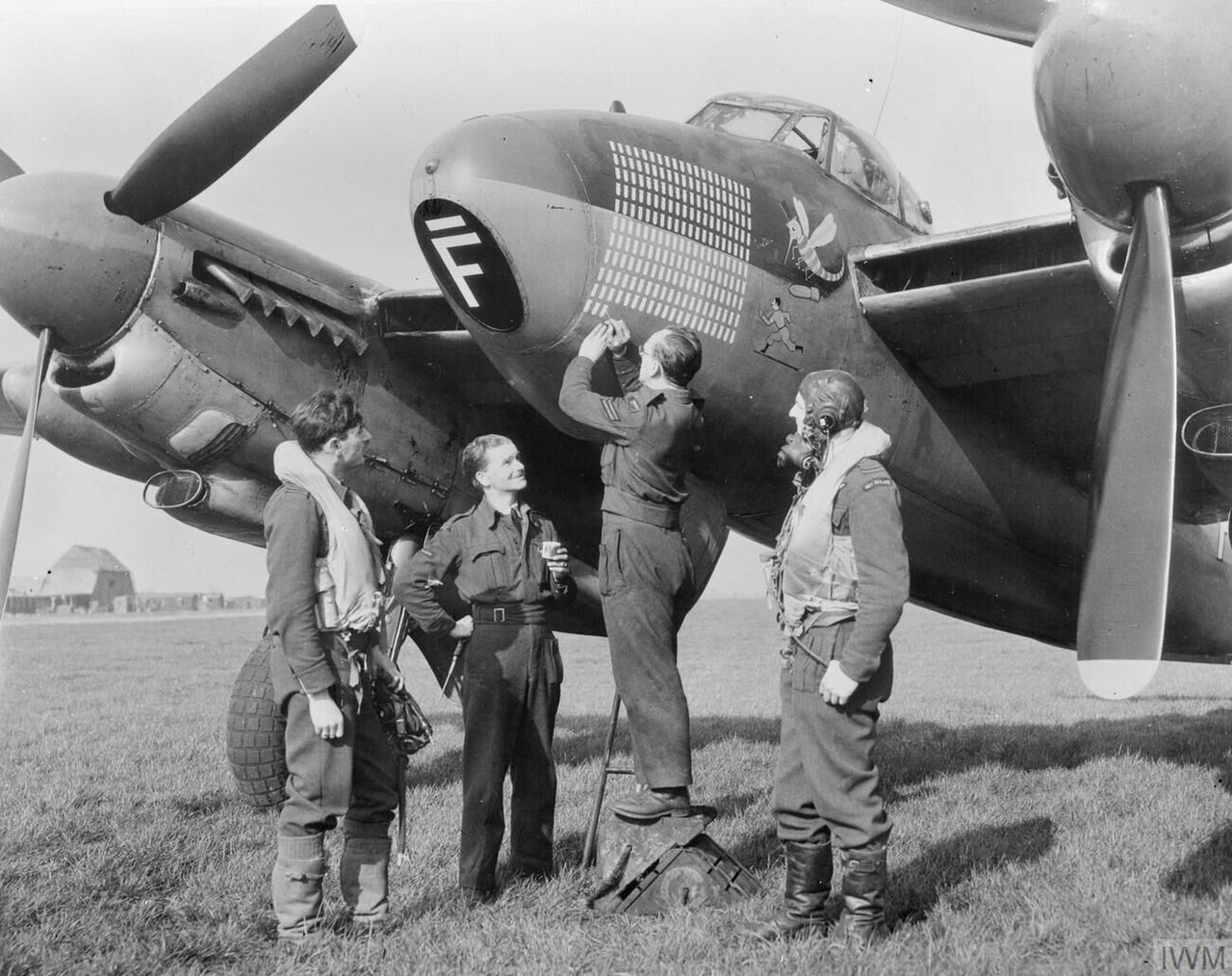
That is why the Mosquito mattered so much. It was the only aircraft with the altitude and speed to fly a long, straight, predictable Oboe run over a defended target and survive it.
H2S was ground-mapping radar carried in the aircraft, so it had no range limit and worked over Berlin. What it gave you was a crude picture: coastlines and rivers showed beautifully, city centres poorly, and an inland target with no water near it was very hard to interpret. It also radiated, and the German Naxos detector could home on the transmission, although the scale of that threat is still argued over.
The Mosquito force that flew almost free
Out of the Pathfinders grew the Light Night Striking Force, which began as a diversion to pull German night fighters away from the heavy bombers and turned into something else entirely. Nine Mosquito squadrons, carrying 4,000 lb bombs to Berlin, going out in groups of ten or twenty through the night or occasionally more than a hundred at once.
They flew 27,239 sorties and lost just under 200 aircraft. That is a loss rate around 0.7 per cent, against figures ten and twenty times higher for the heavies. Bennett noted drily that the name was used much to the dislike of his commander-in-chief.
The Pathfinders themselves paid a different price. Their tour was 45 operations without a break, where a Main Force crew flew 30, went to a training unit for a spell, then came back for 20 more. In exchange they got one step of acting rank and a small gold eagle badge. Early raids were savage: Kassel in August 1942 cost 10.1 per cent of the force, and Nuremberg the following night 14.5 per cent, with the Wellington squadrons losing over a third of the aircraft they sent.
Bennett himself, speaking to Movietone after the war.
Did it work?
Partly, and the honest answer requires holding two things at once.
The improvement was real and measurable. The British Bombing Survey Unit found that the proportion of bombs falling on target doubled once Oboe was in use. German observers of early Oboe raids recorded six to ten bombs coming down through cloud with eighty or ninety per cent hitting the power station or blast furnace they were aimed at. By early 1944 the bulk of Bomber Command was bombing within three miles of the Pathfinder markers, against the Butt Report’s baseline of one aircraft in ten reaching within five miles of a Ruhr target.
But three miles is not precision. It is a tighter area attack. And beyond Oboe range the gains largely evaporated: the Battle of Berlin over the winter of 1943 and 1944, fought on H2S and dead reckoning, was a failure by Bomber Command’s own reckoning. There is also a genuine historical argument, not merely a personal feud, about whether 5 Group’s low-level Mosquito marking under Leonard Cheshire was simply better for small targets. It demonstrably was on some of them.
And better marking had a consequence that should be stated plainly rather than glossed. Concentration is what turns a bombing raid into a firestorm. Düsseldorf in September 1942 left 19,427 people bombed out. When Dresden was attacked in February 1945 the aiming point chosen was a sports stadium, the Ostragehege, selected because it showed up clearly on H2S.
The Pathfinders were created to answer that sentence. They did answer it, and the answer was not a moral improvement so much as a technical one. The bombs landed closer together. What that meant depended entirely on what was underneath them.
Bennett interviewed at length about the Pathfinders, from the Royal Air Force’s own historic interview series.
Sources: Butt Report, 18 August 1941; Donald Bennett, Pathfinder (1958); Arthur Harris, Bomber Offensive (1947); British Bombing Survey Unit; RAF Pathfinders Archive; Imperial War Museum.

0 Comments