
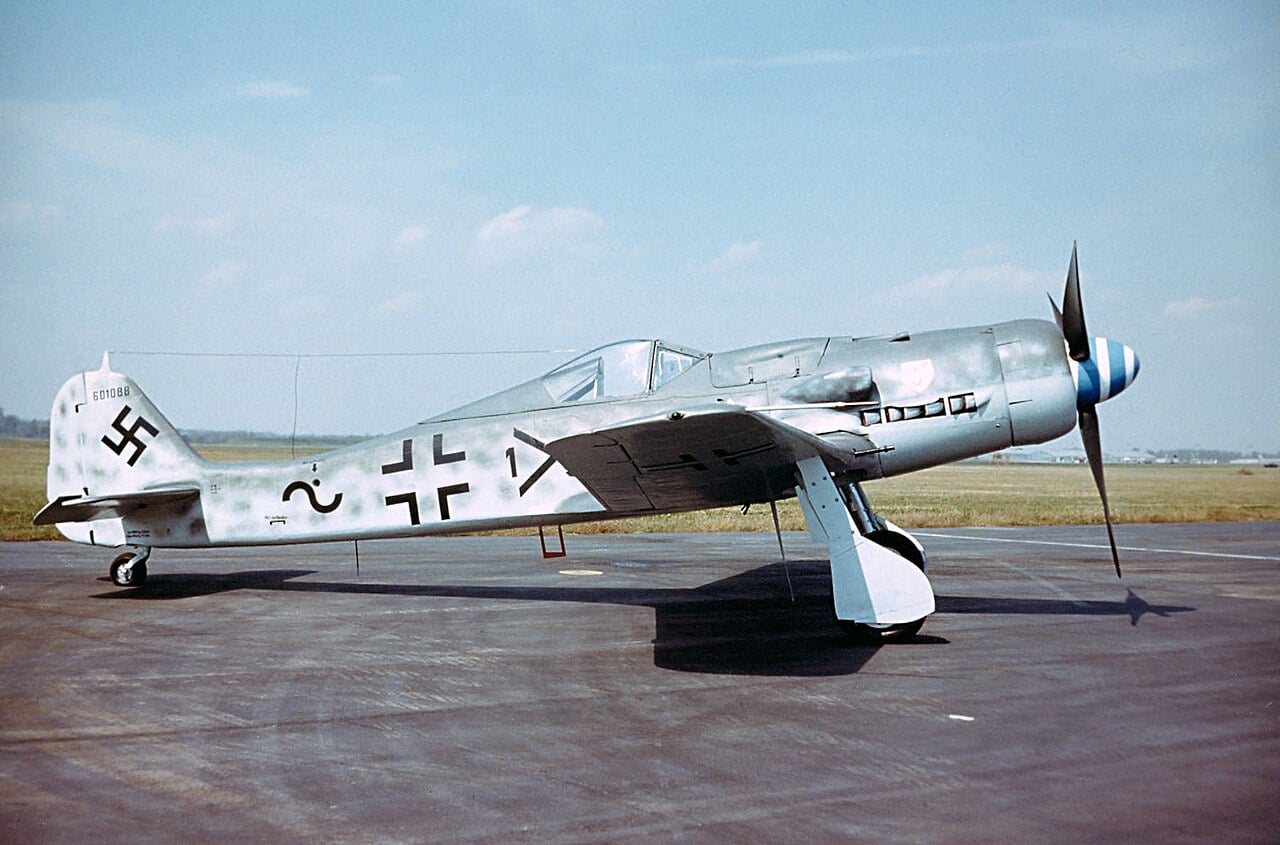
The Focke-Wulf Fw 190 was the best German fighter of 1941, and by 1944 it had a problem that no amount of courage could fix. Above roughly six thousand metres it ran out of air.
The BMW 801 radial had a single-stage supercharger, and at the altitudes where American bomber streams cruised with their Mustang escorts, it simply could not breathe. One pilot of the Sturm units summed the late-war A-model up with brutal economy: strong at low altitude, inferior to the Bf 109 higher up.
The answer was to take out the radial and put in an inline engine. What came out was the Fw 190D, and because the Luftwaffe’s phonetic alphabet rendered D as Dora, everyone called it the long-nose Dora.
Quick Facts
Type: Focke-Wulf Fw 190D-9, the principal production version of the D-series
Engine: Junkers Jumo 213A inverted V12, 1,750 PS, rising to about 2,100 PS with MW 50 boost
The disguise: An annular radiator at the nose, so a liquid-cooled fighter that looks air-cooled
Length: 10.19 m against 9.10 m for the radial-engined A, with plugs added front and rear
Speed: Around 680 km/h at 6,600 m with boost. Early aircraft without MW 50 managed roughly 590 km/h
Armament: Two 13 mm MG 131 in the cowling and two 20 mm MG 151/20 in the wing roots
First flight: The Jumo-engined V17 flew on 26 September 1942. The true D-9 prototype flew 17 May 1944
Built: 1,805 D-9s between August 1944 and April 1945, out of 1,826 D-series aircraft
The nose that lies to you
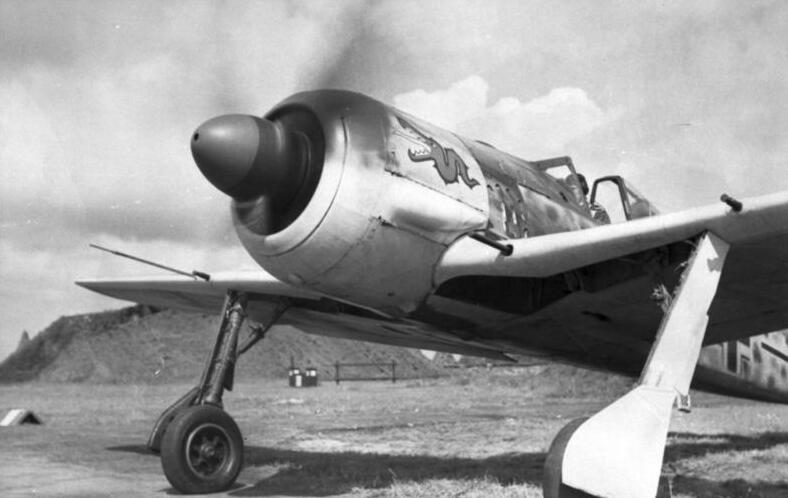
The single most interesting engineering decision on the Dora is cosmetic by accident. Kurt Tank’s team fitted the Jumo 213 with an annular radiator wrapped around the nose, the same solution Junkers used on the Ju 88. The result is a liquid-cooled inline fighter with a circular cowling that reads, at a glance, exactly like a radial.
Only the exhaust stubs give it away: six short stacks along each side, where a radial has none. Allied pilots who had learned to identify the Fw 190 by its blunt nose now had to learn that a blunt nose might be hiding a V12 that was considerably faster than what they expected.
The engine change upset the balance, so the fuselage was stretched at both ends, adding about a metre and a half overall. The rear plug did useful work as well as aerodynamic work: the oxygen bottles were relocated into it.
The pilots were not impressed, at first
This is the part that gets left out of the superlatives. The Dora arrived with a poor reputation among the men who had to fly it, and some of that came from Tank himself, who made no secret of regarding it as a stopgap until the Ta 152 was ready. Telling a fighter pilot his new aeroplane is a placeholder is not a confidence-building measure.
Opinion then split rather than converting wholesale. Oskar Romm thought it excellent. Hans Hartigs of I./JG 26 did not.
Hartigs was not wrong on the specifics. The Dora was faster, climbed better and dived better than the A, but it rolled worse, and the roll rate had been one of the original Fw 190’s great advantages over the Spitfire. Nor did it fully solve the altitude problem it was built to solve: performance still fell away above six thousand metres, just less catastrophically.
There was also a supply problem that shaped early opinion. Hartigs recalled that of I./JG 26’s first batch, only one aircraft had the MW 50 boost system fitted. The rest topped out around 590 km/h, which is a very different aeroplane from the 680 km/h machine the brochure describes.
A close look at a surviving Dora, including the annular radiator and the exhaust arrangement that betrays the inline engine.
What it actually did
III./JG 54 received the first aircraft in September 1944, followed by I./JG 26, which flew its last A-8 sorties in November. The Dora was conceived as a bomber destroyer and ended up doing almost everything except that: fighter-versus-fighter combat, ground attack, and one job nobody had planned for.
Because the Me 262 was desperately vulnerable on approach and landing, Dora units were assigned to orbit jet airfields and protect them. Adolf Galland’s JV 44 had its own protection flight with red and white striped undersides so German flak would recognise them. The arrangement had an absurdity built into it: the piston fighters had to land before the jets they were protecting, which rather defeated the purpose.
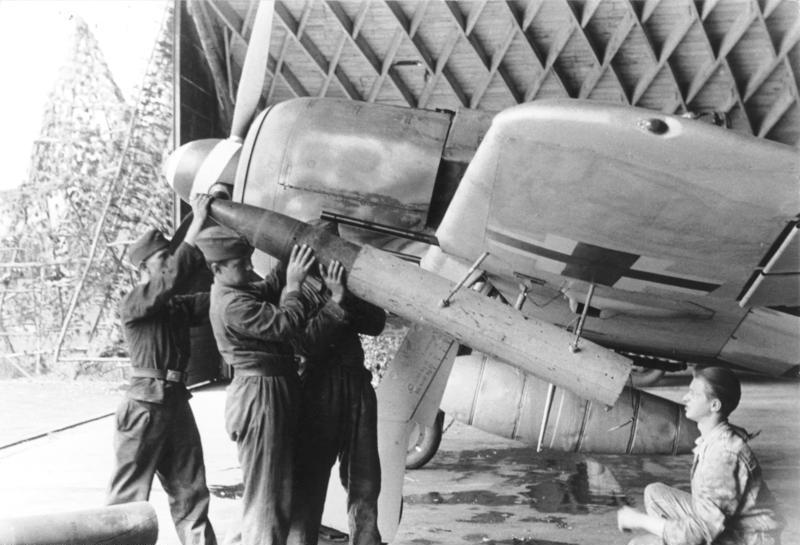
On 1 January 1945 Doras of I./JG 26 and III./JG 54 took part in Operation Bodenplatte, the mass low-level attack on Allied airfields. They were intercepted by Spitfires and five Fw 190s were shot down. The wider operation cost the Luftwaffe somewhere around 270 to 300 aircraft and roughly 143 pilots killed or missing, losses it could not replace.
That is the honest verdict on the Dora. It was a good aeroplane, arguably the best piston fighter Germany fielded in numbers, and it arrived in late 1944 into a force that had run out of fuel, run out of trained pilots, and lost control of its own sky. JG 26 lost a dozen new Doras in three days that December. III./JG 54 lost thirty aircraft on 29 December alone.
The world’s only surviving Fw 190D-13, a rarer late variant of the same family.
Not a Ta 152
The two are constantly conflated and they should not be. The D-9 was the basis from which the Ta 152 grew, not a version of it. The Ta 152H stretched the wingspan to 14.44 metres and used the intercooled Jumo 213E to reach 755 km/h at 13,500 metres, which is genuinely extraordinary high-altitude performance.
It also barely existed. Sixty-nine Ta 152s of all marks were completed against 1,805 D-9s. Some late Doras wore the Ta 152’s broad-chord fin, which is why photographs get misidentified.
A flying Fw 190A-5 for contrast, showing the radial-engined aircraft the Dora was developed from.
Tank once described his original conception of the Fw 190 not as a racehorse but as a Dienstpferd, a cavalry horse: something rugged that would keep working in bad conditions. The Dora was the last and best expression of that idea, and by the time it arrived the conditions were past saving.
Sources: Robert Forsyth, Fw 190D-9: Defence of the Reich 1944-45 (Osprey, 2022); Dietmar Hermann, Focke-Wulf Fw 190 “Long Nose”; wwiiaircraftperformance.org flight trial data; Bundesarchiv; National Museum of the United States Air Force.

0 Comments