
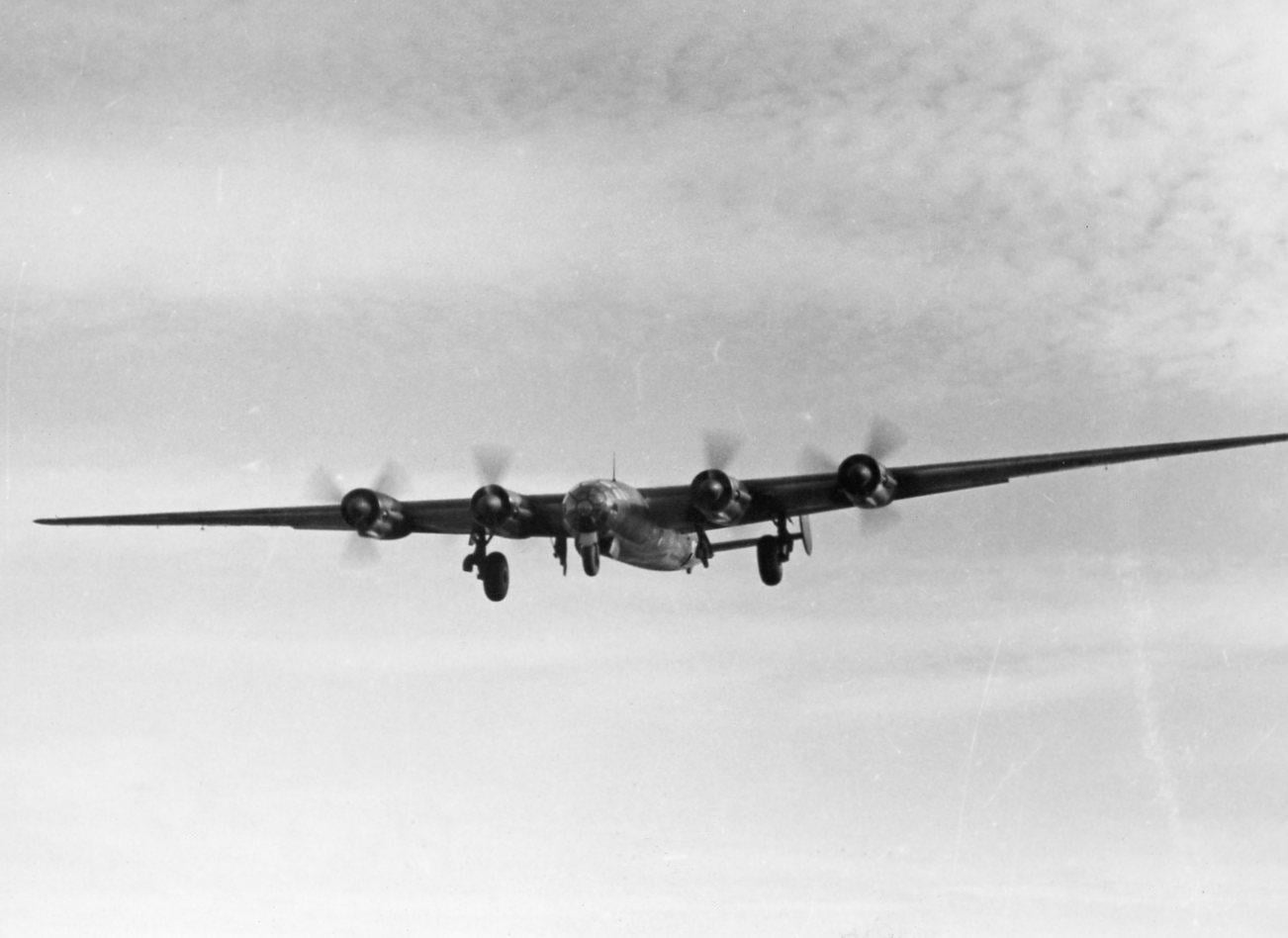
On 23 December 1942 a very large four-engined aeroplane with a glazed nose and twin fins lifted off from Augsburg. It had bunk beds in the fuselage and a galley with hot plates, because the flight it was designed for would take the best part of a day.
The destination it was designed for was New York.
It never got closer to America than a German airfield, and it never carried a single bomb.
Quick Facts
| Aircraft | Messerschmitt Me 264, Amerikabomber contender |
| First flight | 23 December 1942, prototype V1, code RE+EN |
| Engines | Four Junkers Jumo 211J, about 1,340 PS each; later four BMW 801G radials of 1,750 PS |
| Crew | Eight, with bunk beds and a galley |
| Wingspan | 43.00 m; maximum take-off weight 56,001 kg |
| Range | About 15,000 km at 333 km/h; 3,000 kg of bombs at 14,400 km, or 6,000 kg at 8,600 km |
| Built | Three airframes; only the V1 is recorded as having flown |
| Competition winner | Junkers Ju 390 |
| Cancelled | Development stopped October 1943; project formally closed 23 September 1944 |
| Fate | All three destroyed in Allied bombing, the V1 and V3 in the same raid on 18 July 1944 |
The idea came from the top, and it came early
The Amerikabomber was not a late-war fantasy dreamed up in a bunker. The concept was raised in 1938, the same year a Focke-Wulf Fw 200 Condor of Deutsche Luft Hansa flew direct from Berlin to New York.
Hitler’s interest was less strategic and more lurid. Albert Speer, writing in Spandau: The Secret Diaries, recorded what Hitler used to describe.
The practical obstacle was arithmetic. Bombing New York and coming home meant a combat radius of about 11,680 km with no refuelling. The longest-ranged German aircraft actually flown during the war, the Me 261 Adolfine, managed around 11,025 km in total.
Hence the Azores. Hitler repeatedly came back to the Portuguese islands as, in his words, the “only possibility of carrying out aerial attacks from a land base against the United States”. Salazar let German U-boats refuel there until 1943, when he leased bases to the British instead, and the idea died.
What Messerschmitt actually built
The Me 264 was a clean-sheet design and it looked the part: high wing, 43 metres of span, four engines, tricycle undercarriage, and the stepless fully glazed nose that German designers loved and Allied ones never adopted.
Six prototypes were ordered in early 1941. Three were built. The V1 flew on 23 December 1942 on Jumo 211J engines, which were not powerful enough, and was re-engined with BMW 801G radials in late 1943.
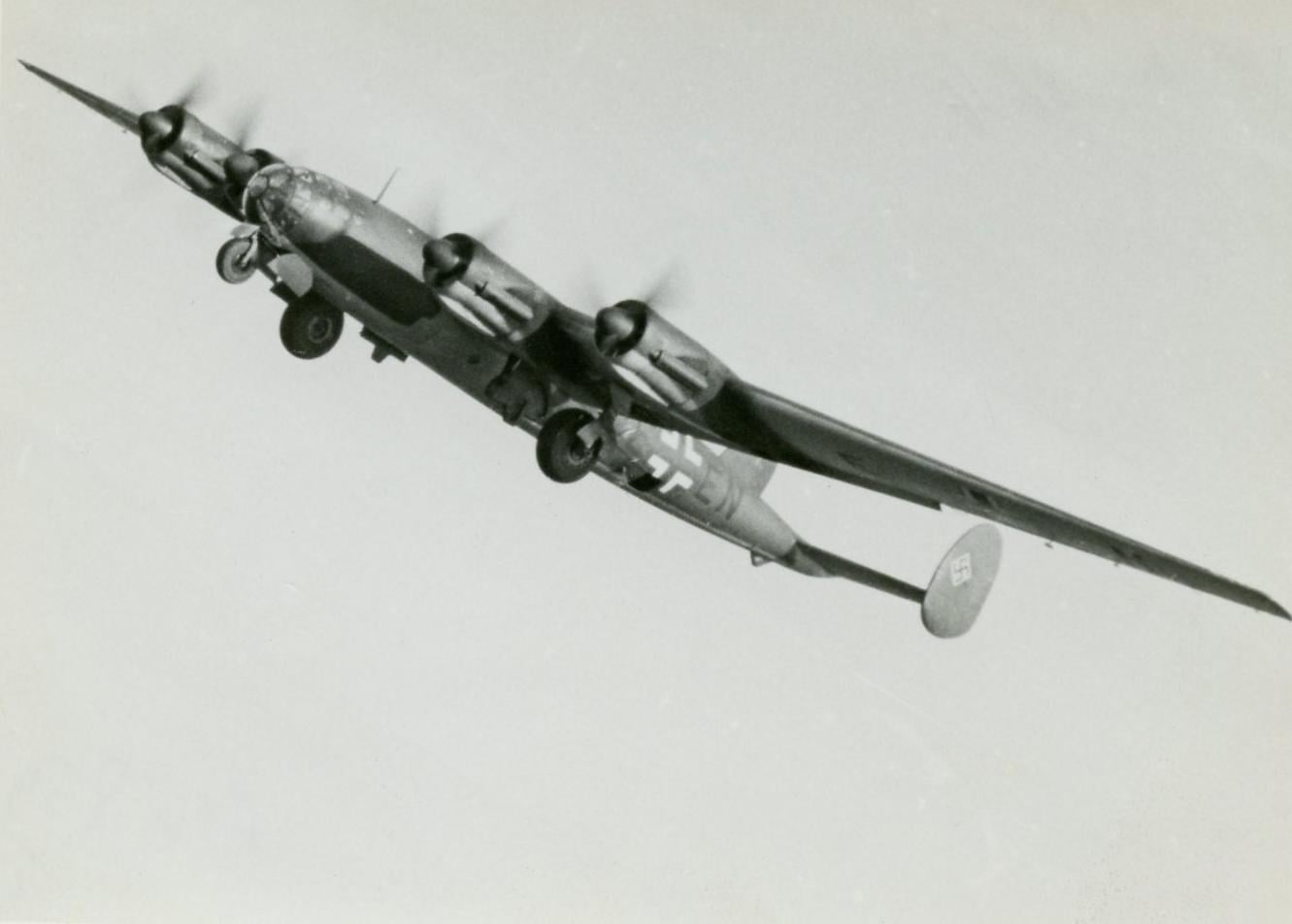
The numbers that killed it are in the wing loading. At roughly 356 kg per square metre, the Me 264 was more heavily loaded than a B-29 at 337 and far worse than the Ju 390 at 209. That meant poor climb, poor manoeuvrability and high take-off and landing speeds, in an aircraft that would have needed to carry guns and armour it had never flown with.
The verdict that mattered came in 1942 from Generalmajor Eccard von Gablenz, asked by Erhard Milch to assess the options. His conclusion was that the Me 264 could not be usefully equipped for a genuine transatlantic bombing mission, but would make a decent very-long-range maritime patrol aircraft working with U-boats off the American coast.
The plan itself still exists
The Amerikabomber plan was completed on 27 April 1942 and handed to Goring on 12 May. It ran to 33 pages, ten copies were made, and a copy was later found in Potsdam by the historian Olaf Groehler.
It lists 21 targets. Nineteen in the United States, one in Vancouver, one in Greenland. Almost all of them are factories feeding the American aircraft industry: Pratt & Whitney and Hamilton Standard in Connecticut, Sperry Gyroscope in Brooklyn, Bausch & Lomb in Rochester, Curtiss-Wright in Pennsylvania, New York and New Jersey, Alcoa’s aluminium plants, a cryolite refinery in Pittsburgh and the cryolite mine at Arsuk in Greenland that supplied it.
That last pairing tells you the plan was written by people who understood industrial warfare. It also tells you they were planning to bomb an aluminium supply chain from six thousand kilometres away with an aircraft that did not exist.
The one that involved a submarine
Among the schemes considered was a Huckepack arrangement: a Heinkel He 177 would carry a Dornier Do 217 fitted with a ramjet as far across the Atlantic as it could, then release it. For the Do 217 crew it was a one-way trip. They would bomb their target, ditch off the east coast, and be collected by a waiting U-boat.
It was abandoned on 21 August 1942, and the reason is recorded in the diary of Air Staff General Kreipe: the Kriegsmarine could not supply a submarine to pick up the aircrew. The navy and the air force would not cooperate, and the plan died of inter-service politics rather than physics.
The myth worth killing
Several post-war authors claimed that the second Junkers Ju 390 flew a transatlantic reconnaissance mission in early 1944, coming within about 20 kilometres of the north-eastern United States.
It did not happen. The Ju 390 V2 never flew at all. The story has been thoroughly discredited, and it persists mainly because it is a better story than the truth.
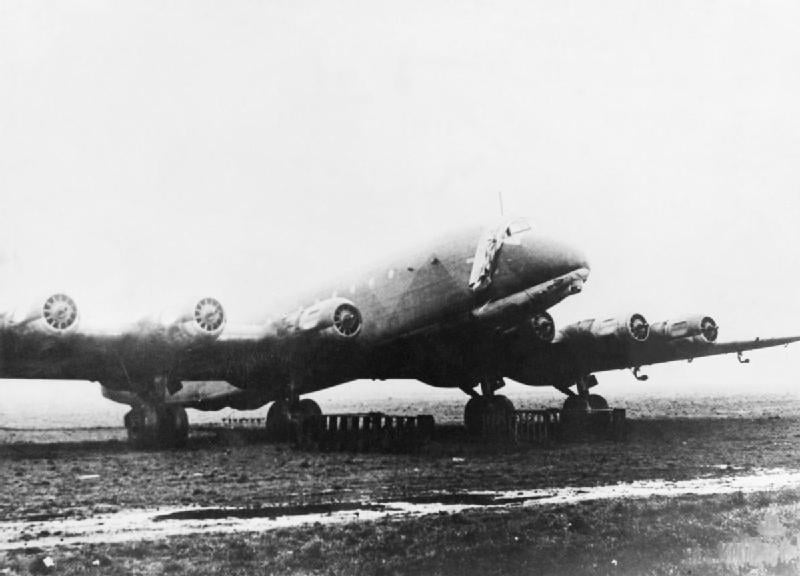
The truth is that the Amerikabomber project produced five prototypes across two designs, no operational aircraft, and a target list. All three Me 264s were destroyed by Allied bombing, two of them in the same raid on 18 July 1944, by which time the V1 had been reduced to flying transport tasks for Transportstaffel 5.
Germany could not build a reliable combat aero engine above about 2,000 horsepower, had no central authority coordinating advanced weapons, and was losing the fuel and the factories it needed. On 23 July 1943, the day the Heinkel firm was asked to propose a six-engined He 277, the United States Army Air Forces signed a letter of intent for the first hundred Convair B-36s.
One of those two programmes produced an aircraft that could cross an ocean with a bomb load. It was not the German one.
Frequently Asked Questions
What was the Messerschmitt Me 264?
Did the Me 264 ever fly?
Could the Me 264 have actually bombed New York?
Why did the Me 264 lose the Amerikabomber competition?
Did a German aircraft ever fly close to New York?
What were the Amerikabomber targets?
What happened to the three Me 264s?
Was there a six-engined version?
Sources: Wikipedia; James P. Duffy, Target America; Griehl and Dressel, Heinkel He 177-277-274; Albert Speer, Spandau: The Secret Diaries, via The New York Times.
0 Comments