
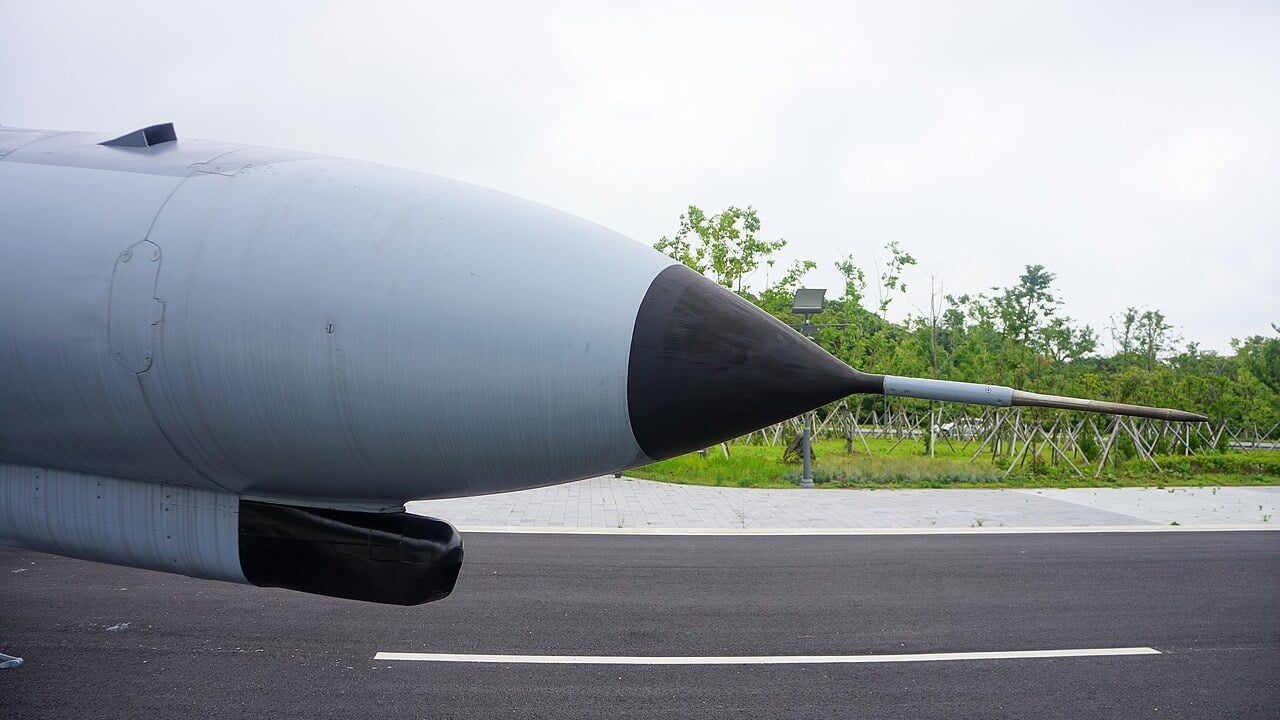
Walk up to almost any fighter on a museum flight line and look closely at the nose. On a Korean F-4E Phantom, the very tip is jet black. On plenty of other jets the nose cone is a subtly different grey from the fuselage behind it, as if it had been borrowed from another aircraft. Sometimes it has been.
That cone is a radome, a word built from “radar” and “dome”. It is one of the strangest parts of a combat aircraft: a structure that has to survive Mach 2 airflow, hail, rain and lightning while being, as far as the radar behind it is concerned, almost invisible.
Fighter radomes look simple. They are anything but. Here is what they are made of, why their shape is always a compromise, and why the nose so often refuses to match the rest of the paint job.
Quick Facts
- What it is: A radome (“radar dome”) is a weatherproof cover that protects a radar antenna while letting radio waves through
- Materials: Fibreglass, quartz fabric in cyanate ester or epoxy resin; ceramics such as Pyroceram and fused silica on missiles
- Key problem: Boresight error: the radome bends radio waves so a target appears slightly off its true position
- Shape: A hemisphere is best for radar, a slender point is best for supersonic flight; real radomes compromise
- Threats: Rain and hail erosion, lightning, aerodynamic heating
- Lightning: Segmented metal diverter strips bonded to the outside, typically 12 to 24 inches apart
- F-16: General Dynamics has built the nose radome for every one of the 4,600+ F-16s
- Biggest: The E-3 Sentry rotodome is 30 ft (9.1 m) across
A window for radio waves
A radar antenna works by sending out radio energy and listening for the echo. Put a metal cover over it and the energy simply bounces back inside. So the cover has to be made of a material that radio waves pass through with as little loss and distortion as possible, while still being stiff and tough enough to be the front of an aircraft.
According to General Dynamics Mission Systems, which has built radomes at Marion, Virginia, since 1945, materials such as metal or graphite are too opaque to be useful, while fibreglass or quartz-like materials are transparent enough to transmit signals and durable enough to protect the antenna. The company says its first radomes were made of laminated wood. The need for radomes during the Second World War was one of the main drivers behind fibreglass becoming a structural material in the first place.
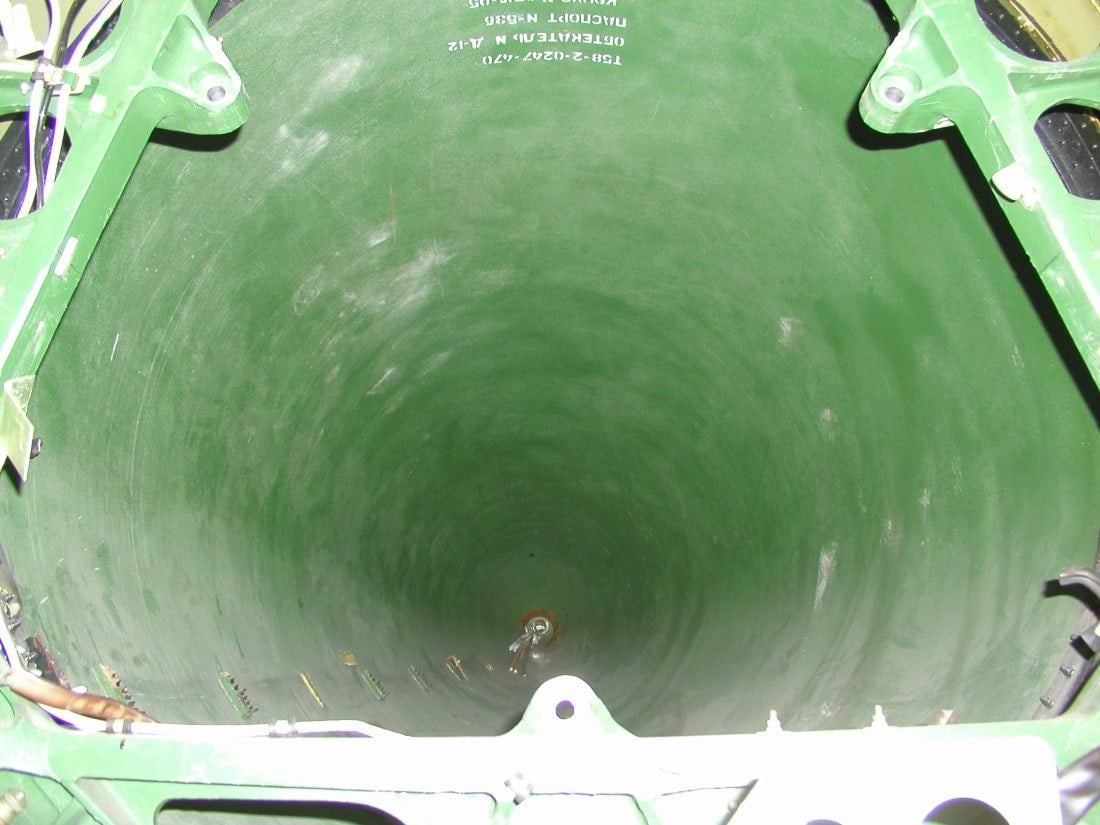
Today the best materials are woven quartz fabric set in cyanate ester resin. Toray Advanced Composites, a major supplier, lists a dielectric constant of about 3.2 to 3.35 for cyanate ester and quartz laminates, against 4.5 and above for ordinary epoxy and glass. A lower dielectric constant means the signal is bent and reflected less as it passes through the wall. Toray even makes its radome materials in facilities kept free of carbon fibre, because a stray conductive filament could disturb the signal.
From F-16 to F-35: a quiet industry
Most people never think about who builds a nose cone, but it is a specialist trade. General Dynamics says it has built every nose radome for the more than 4,600 F-16 Fighting Falcons produced, and in July 2024 it delivered its 1,000th nose radome for the F-35 Lightning II. In total the Marion team has produced more than 65,000 radomes for more than 50 aircraft types.
General Dynamics Mission Systems shows how its Marion, Virginia, plant designs, builds and tests aircraft radomes.
Modern radars have made the job harder. An active electronically scanned array (AESA) radar uses a much broader slice of the radio spectrum than older mechanically scanned sets, so the radome has to stay transparent across a wider band. General Dynamics has built “wideband” radomes for AESA-equipped F-15s, F-16s, F/A-18s and F-35s. On the F-35, the company says, the radome also helps reduce the aircraft’s susceptibility to detection by enemy radar.
That is a neat paradox: the nose of a stealth fighter must be wide open to its own radar while giving away as little as possible to everyone else’s.
General Dynamics programme manager Bruce Rush explains the F-16 wideband radome built for AESA radars, in an interview with the Defense & Aerospace Report.
Pointed or blunt? The shape compromise
If radar were the only customer, every radome would be a hemisphere, because a round dome passes radio waves most evenly. Aerodynamics wants the opposite: a long, slender point that slices through supersonic air with little drag and heating. Every real radome is a negotiation between the two.
The price of a pointed nose is distortion. When radio waves pass through a curved, angled wall, they are bent slightly. The radar then sees a target a fraction of a degree away from where it really is. Engineers call this boresight error: the angle between the apparent and true line of sight to the target. It changes as the antenna looks in different directions, and on fast missiles it even changes as the radome heats up, so guidance computers are often programmed to correct for it.
Missiles push this to the limit. According to a 1992 Johns Hopkins Applied Physics Laboratory study, radomes made of a glass-ceramic called Pyroceram 9606 were in use on the Phoenix, Sparrow and Standard missiles, and slip-cast fused silica on the Patriot. Ceramics survive the heat of high-speed flight far better than resin composites. The same study notes that missile radomes often have slightly blunted tips, typically 0.5 to 1.0 cm in radius, to reduce surface heating.
Rain, hail and lightning
Flying through rain at high speed is like flying through a cloud of tiny bullets. Each drop hits the radome with enough force to pit and crack the surface, and the nose takes the worst of it because it meets the weather head-on. A 1974 survey published through NASA’s technical reports server examined radome failures on US Navy aircraft flying from carriers in the Pacific and led to repair kits for erosion damage.
The problem is still serious enough that the US Air Force Research Laboratory runs a Supersonic Rain Erosion Test Rig at Wright-Patterson Air Force Base, which tests radomes and other parts in simulated rain at speeds up to Mach 2.3. For older aircraft, the answer was often a tough rubbery coating over the nose. According to Mentour Pilot, that rubberised layer is what gave many older aircraft their black noses.
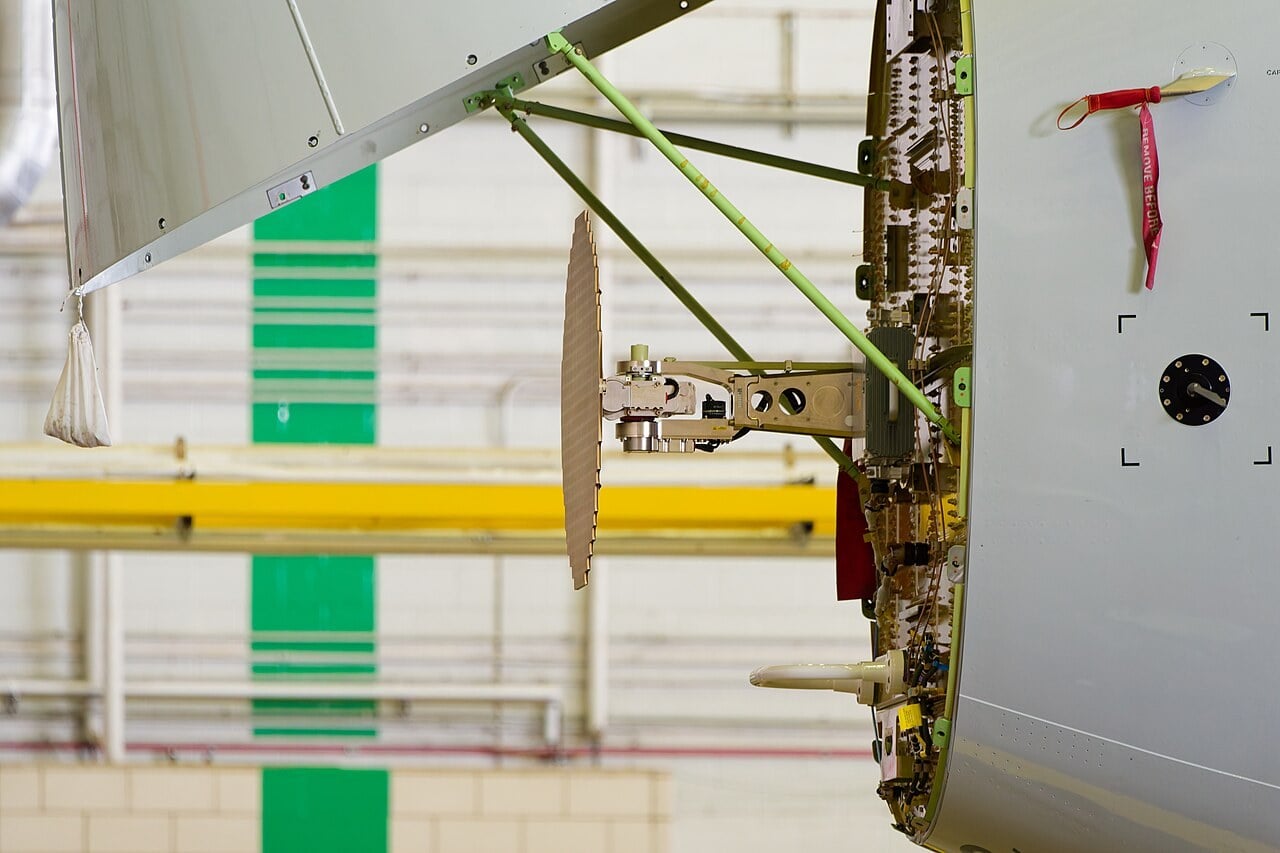
Lightning is the other enemy. Most of an aircraft’s metal skin carries a strike safely around the outside, but a radome is an insulator with sensitive electronics inside. The fix is a set of lightning diverter strips: thin lines of closely spaced metal segments bonded to the outside of the radome. Manufacturer Lightning Diversion Systems says the strips are designed to survive multiple strikes and have a negligible effect on the radar, and are usually spaced 12 to 24 inches apart. On many airliner noses you can see them as fine lines running back from the tip.
Why the nose rarely matches
So why is a fighter’s nose so often a different shade? Paint is the first reason. Anything sprayed on a radome becomes part of the radar window, so radome paints are restricted in their thickness and composition. According to Mentour Pilot’s explainer on black noses, the range of colours available for radome paint was long limited, and the earliest F-16s rolled out with black noses before pilots reportedly complained they stood out and the jets switched to grey. Even then, the grey radome rarely matched the grey airframe exactly.
The second reason is the material underneath. A composite nose is a different surface from the aluminium behind it, painted in a different coating and often refinished on its own schedule. Darker shades also fade faster than light ones. The third reason is that radomes are removable parts. They are taken off, repaired and swapped: the 573rd Maintenance Squadron’s composite shop at Robins Air Force Base alone repairs and overhauls more than 100 radomes a year, mostly from F-15s and C-130s.
Put those together and a jet can easily fly with a nose that is newer, older or simply differently painted than its fuselage. Not every mismatch has a deep reason. Sometimes the radome on the front is just the one that came back from the shop.
Rotodomes and shock cones
Not every radome is a nose. The E-3 Sentry carries its radar in a rotating radome, or rotodome, mounted above the fuselage for 360-degree coverage. It is 30 feet (9.1 m) across, 6 feet (1.8 m) thick at the centre and held 11 feet (3.4 m) above the fuselage on two struts. NATO’s E-3A fleet flies from NATO Air Base Geilenkirchen in Germany.
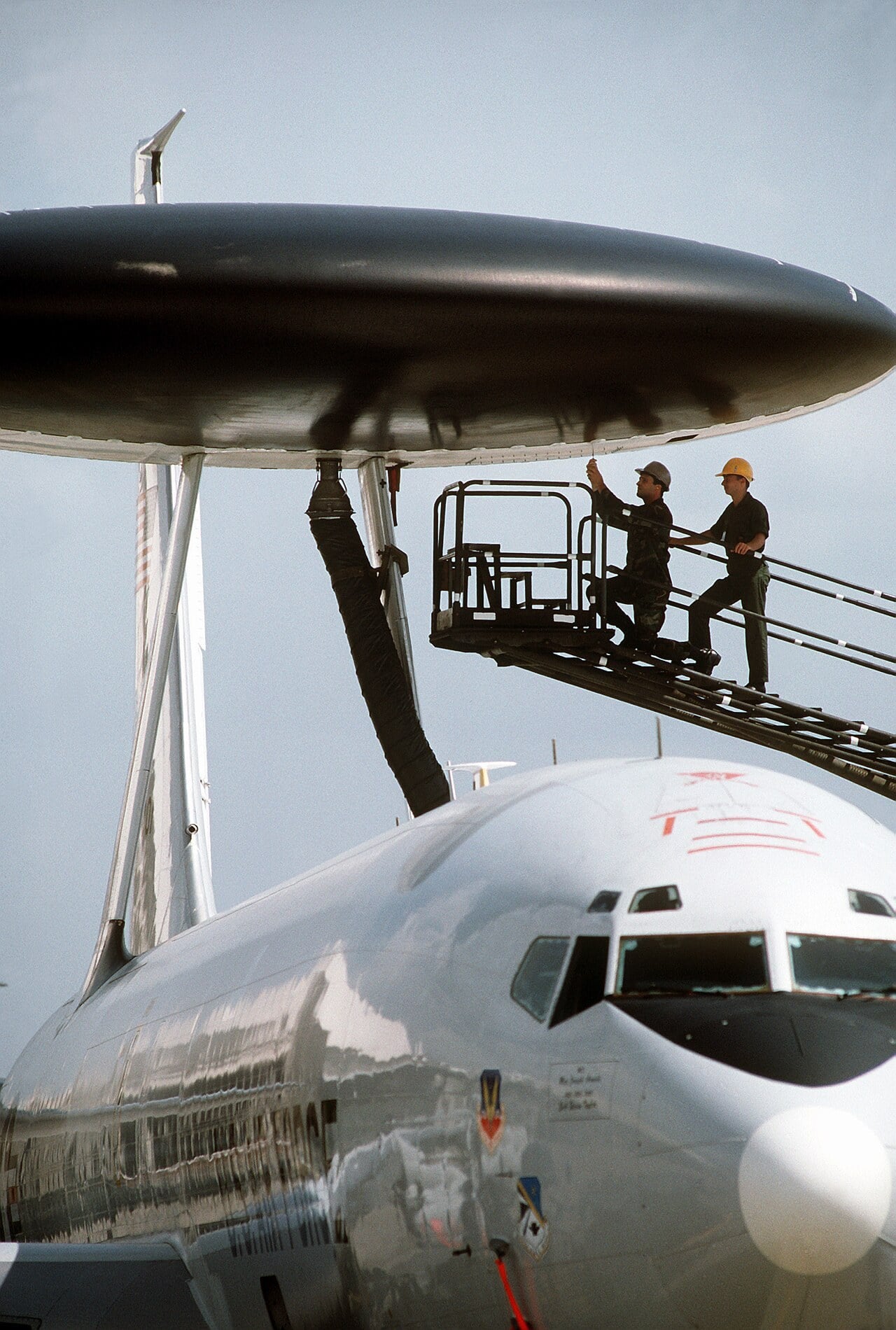
The radome makes the whole aircraft type recognisable at a glance, and it has to do everything a nose radome does, at a size no fighter could carry.
Then there is the MiG-21, whose famous nose cone is not a nose at all but the centrebody of the engine intake. From the MiG-21PF onward it also housed the radar, so the cone was both an airflow regulator and a radome, which limited how big the antenna could be. We have covered that clever piece of engineering in our MiG-21 nose cone explainer. Later designs from the F-4 Phantom II onward moved the intakes to the sides and gave the nose to a much bigger radar.
CNBC goes inside the US Air Force’s flying radar fleet, including the E-3 Sentry and its rotating radome.
Next time you see a fighter with a nose that does not quite match, you are looking at one of the hardest-working parts of the aircraft. It is a structure, a weather shield and a lightning conductor, and it has to do all of that while staying almost invisible to the radar behind it.
Sources: General Dynamics Mission Systems, Toray Advanced Composites, Johns Hopkins APL Technical Digest (1992), NASA Technical Reports Server, US Air Force Research Laboratory, 78th Air Base Wing / DVIDS, Lightning Diversion Systems, Mentour Pilot, CompositesWorld, Wikipedia (Radome; Boeing E-3 Sentry; General Dynamics F-16 Fighting Falcon)



0 Comments