
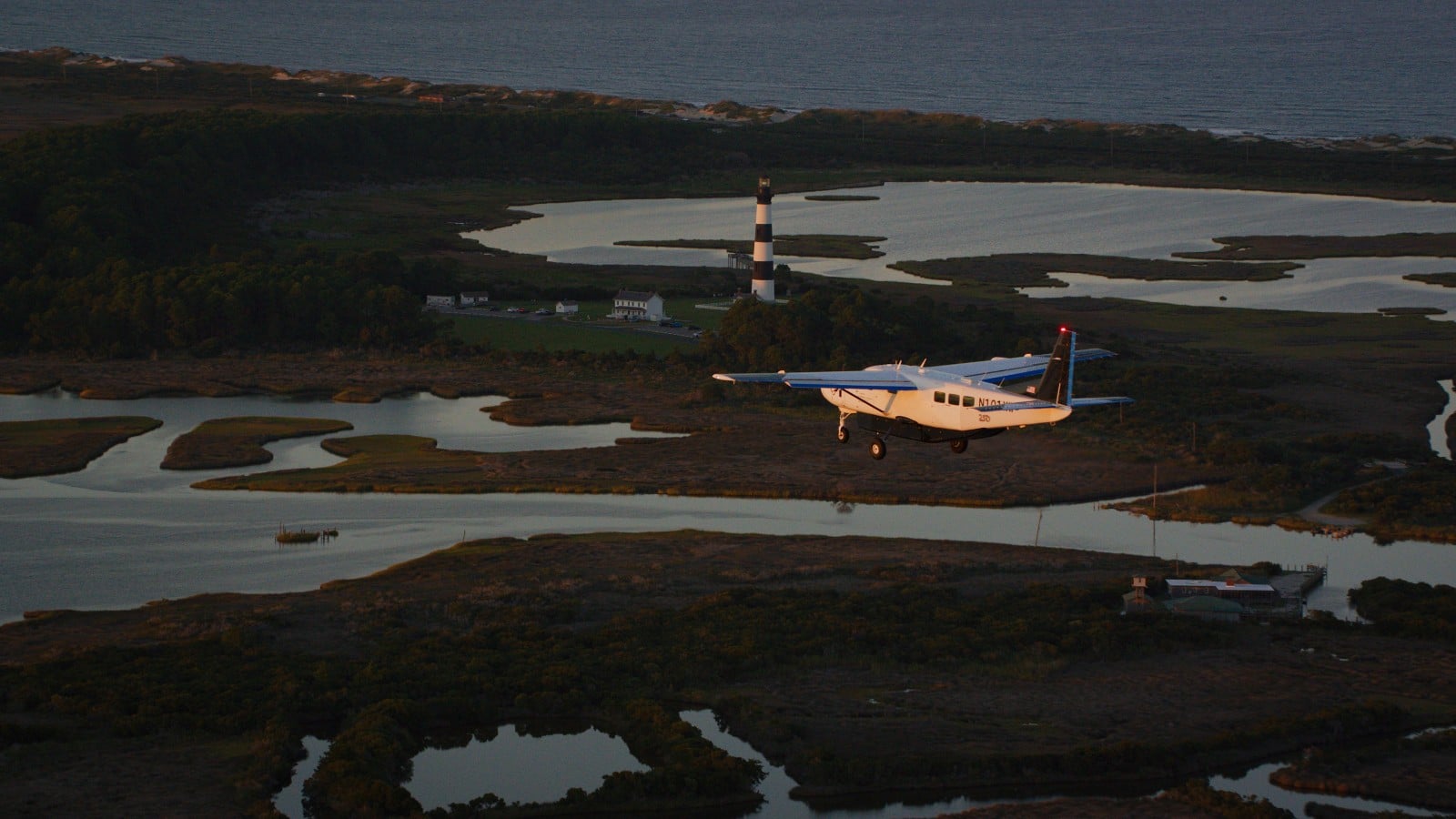
A single-engine turboprop flew from California to the Atlantic this month, taxied itself, took itself off, found its own way around thunderstorms, slotted into one of the busiest general aviation airports in America without ever having been there, and landed on the Outer Banks. The pilot sitting in the cockpit touched nothing for 3,199 miles.
Joby Aviation announced the crossing on 18 September 2026 and called it the first fully autonomous flight across the United States. The aircraft finished the eastbound leg a few miles from the spot where the Wright brothers got a heavier-than-air machine off the ground in 1903, then flew a low pass past the First Flight Monument on the way in. Subtle, it was not.
What Joby flew, though, is the genuinely interesting part. It was not the electric air taxi that the company’s share price rides on. It was a Cessna Caravan built in the 1990s.
Quick Facts
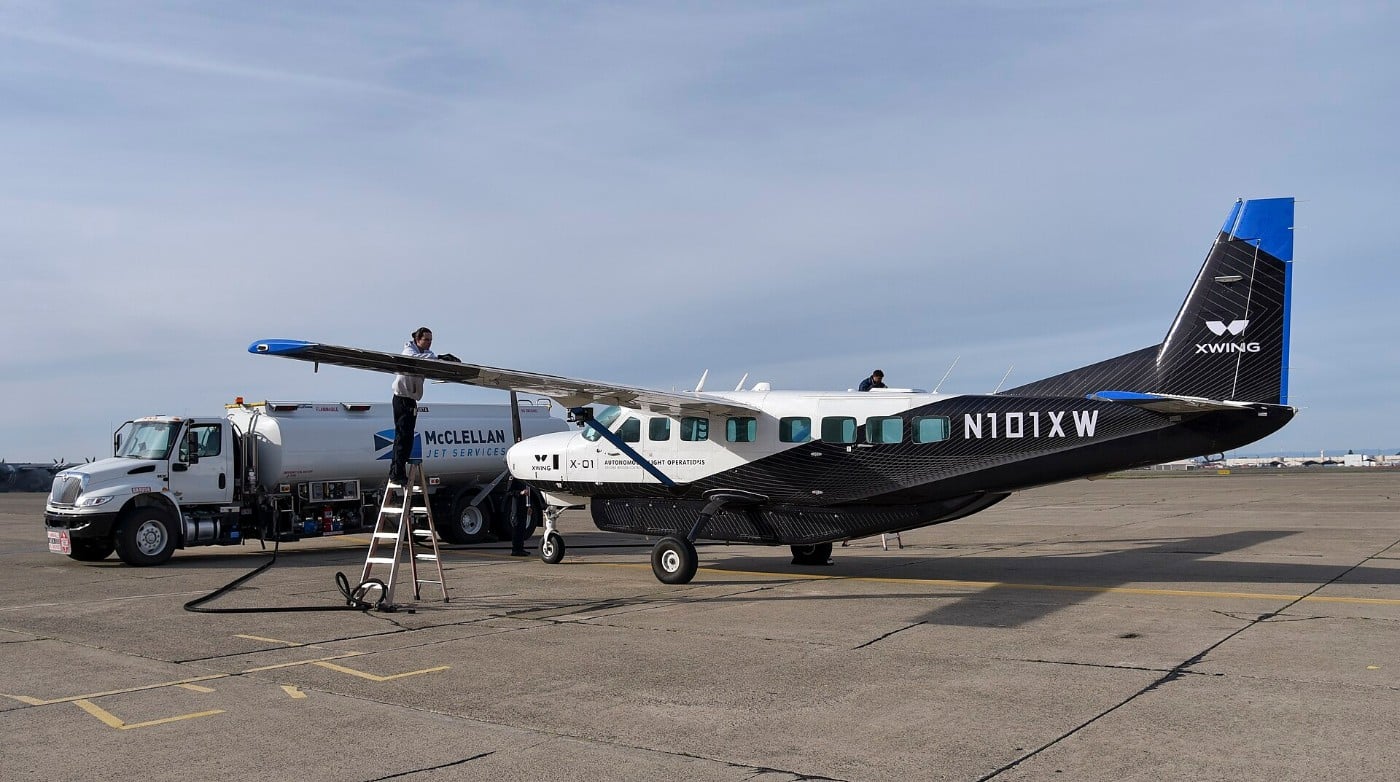
Aircraft: Joby J208, a converted Cessna 208B Grand Caravan, registration N101XW
Distance: 3,199 miles (5,148 km), Concord, California to the Outer Banks, North Carolina
Control inputs by the onboard safety pilot: zero
Autonomous phases: taxi, takeoff, route navigation, landing
Remote supervision: Joby’s Autonomy Headquarters in California and Shaw AFB, South Carolina, up to 2,323 miles away
Eastbound stops: KCCR, KDVT, KAFW, KSSC, KMQI
Announced: 18 September 2026
The aircraft is older than the software flying it
The J208 is a converted Cessna 208B Grand Caravan wearing the US registration N101XW. DroneXL, reading the FAA registry, records it as a 1993 airframe, serial 208B0382, registered to Joby Aero in July 2024 and carrying an experimental airworthiness certificate for research and development. The Caravan type certificate behind it dates to 1984.
That is not an accident, and it is not a compromise. It is the strategy. Joby’s stated logic is that bolting an autonomous system onto an airframe the FAA has already approved gives it a route into air logistics that does not require a new type certificate, a new production line, or a decade of flight test to prove a novel configuration. The Caravan has been hauling freight into small fields since the mid-1980s. The mechanics, the spares chain and the operator pool already exist. Everything new on this aircraft is software and sensors.
Two pilots, no flying
“Pilotless” is the wrong word for what happened, and Joby has not used it. There were two pilots involved in this flight. Neither of them flew the aeroplane.
A remote pilot on the ground acted as pilot in command, managing flight-plan updates and handling air traffic control on the aircraft’s radios. A safety pilot sat in the cockpit with the authority to take over at any second. Joby’s claim is narrow and specific: that safety pilot made zero control inputs from California to North Carolina. The aircraft handled taxi, takeoff, navigation and landing itself, supervised from Joby’s Autonomy Headquarters in California and from Shaw Air Force Base in South Carolina, at ranges of up to 2,323 miles.
The route ran Concord, California (KCCR) to Phoenix Deer Valley (KDVT), then Fort Worth Alliance (KAFW), Shaw Air Force Base (KSSC) and finally Dare County Regional Airport (KMQI). Each leg was a demonstration for somebody: dual-use autonomy in Arizona, freight at one of America’s big industrial logistics hubs in Texas, military flight operations in South Carolina.
Phoenix is the leg that matters
Flying a straight line across empty desert under an autopilot is a party trick. Deer Valley is not empty. It is one of the busiest general aviation airports in the United States, the radio never stops, and the circuit is full of student pilots doing student pilot things. Joby says the aircraft integrated into that traffic with no prior familiarity with the field, and rerouted around severe weather and thunderstorms in real time on the way there.
That is the engineering claim buried in a press release otherwise full of ribbon-cutting. Deviating around live convective weather into an unfamiliar, saturated airport is the actual problem in autonomous flight. Everything else is cruise.
Joby’s own film of the tour shows the ground station: a pilot commanding the mission with a keyboard, a mouse and a microphone. It looks less like a cockpit than like air traffic control, which is roughly the point.
The military has already been buying this
The autonomy stack came from Xwing, whose autonomy division Joby acquired in 2024, built around a Caravan that was already flying itself. Joby now counts more than 400 flights and over 800 automated flight hours behind the system, in both controlled and uncontrolled airspace.
It has also been through three US military exercises. In the Air Force readiness exercise Agile Flag, Joby says the aircraft carried replacement parts that got other aircraft back into service about 24 hours sooner than conventional delivery would have managed. In REFORPAC, aircraft in Hawaii were operated by people sitting in Guam, nearly 4,000 miles away. Those are not proofs of concept. Those are budgets.
On the civil side the flights are tied to state programmes rather than marketing: North Carolina’s eLIFT-NC healthcare logistics initiative, and the multi-state uFLY coalition led by Utah’s transport department, which is evaluating high-altitude and extreme-environment airspace integration on the FAA’s behalf.
Now it turns around
The J208 heads west again through Raleigh (KRDU), Fredericksburg and Washington DC (KRMN), Louisville (KSDF), Wichita (KICT), Oklahoma City (KOKC), Salt Lake City (KSLC) and Portland (KPDX). One of those stops is an easy drive from the Pentagon and Capitol Hill, which is unlikely to be a coincidence.
The honest summary is that a 33-year-old freight turboprop just flew itself across a continent, and the only thing standing between that and a commercial service is a regulator’s signature and a date nobody has published. The Wright brothers took 12 seconds and 120 feet. This one took a fortnight and 3,199 miles, and the pilot was the passenger.
Sources: Joby Aviation press release, 18 September 2026; AeroTime; FLYING Magazine; DroneXL.


0 Comments