
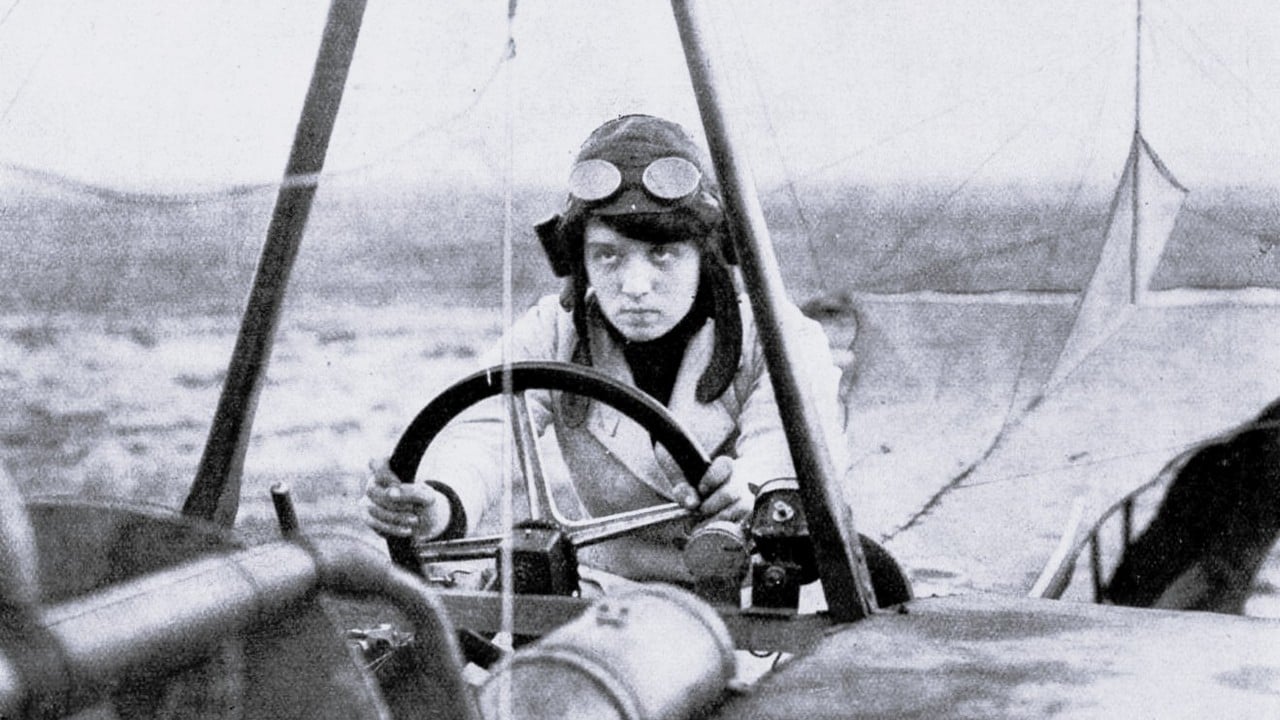
Early on the morning of 13 September 1911, before the other pupils had arrived at Berlin’s Johannisthal airfield, a young woman took off in a Rumpler Taube and flew the circuits and figures of the official pilot’s test. She had arranged her own witnesses. It was her 25th birthday.
By the time the men who had spent months sabotaging her training turned up, Melli Beese was holding German pilot’s licence No. 115. She was the first woman in Germany to earn one.
Quick Facts
- Name: Amelie Hedwig Beese (later Beese-Boutard), known as Melli Beese
- Born: 13 September 1886, Laubegast, near Dresden
- Died: 21 December 1925, Berlin, aged 39
- Pilot licence: German licence No. 115, 13 September 1911, the first for a woman in Germany
- Aircraft: Rumpler Taube
- Record: Women’s altitude record with a passenger, 825 m, Johannisthal autumn flying week 1911
- Business: Flugschule Melli Beese GmbH, founded 1912 at Johannisthal; built its own Taube copies
- War: Treated as an enemy alien after marrying Frenchman Charles Boutard; school closed
A sculptor who wanted to fly
Amelie Hedwig Beese was born on 13 September 1886 in Laubegast, then a village on the edge of Dresden, into a prosperous family; her father was an architect and master builder. German art academies did not train women sculptors, so from 1906 to 1909 she studied sculpture at the Royal Academy of Fine Arts in Stockholm. In Sweden she also fell for offshore sailing.
She came home fascinated by the first flights being reported from around the world. In autumn 1910 she attended lectures at the Technikum in Dresden as an external student, in mathematics, mechanics, shipbuilding and flight mechanics. Her father agreed to pay for flying lessons, and she headed for Johannisthal, opened in September 1909 as Germany’s first commercially run airfield.
Rejected, injured, sabotaged
The flying schools did not want her. She was turned away more than once before Robert Thelen of the small Ad Astra company agreed to teach her. On 12 December 1910 a drive chain failed on a training flight with Thelen and the aircraft fell to the ground. Beese was badly hurt, with leg injuries and broken ribs and nose, and her father died a few days later.
She was back at Johannisthal in January 1911, but Thelen would no longer teach her. In July she signed a training contract with the Rumpler works, whose management expected a woman pilot to be good publicity. Her instructor, the well-known aviator Hellmuth Hirth, was less keen.
Male pupils were always put ahead of her, and when she did get a turn the aircraft was often mysteriously defective. According to the Deutsches Museum, fuel was once drained from her tank just before take-off, and on another occasion the bracing of her wings was loosened. She flew solo for the first time on 27 July 1911 anyway.
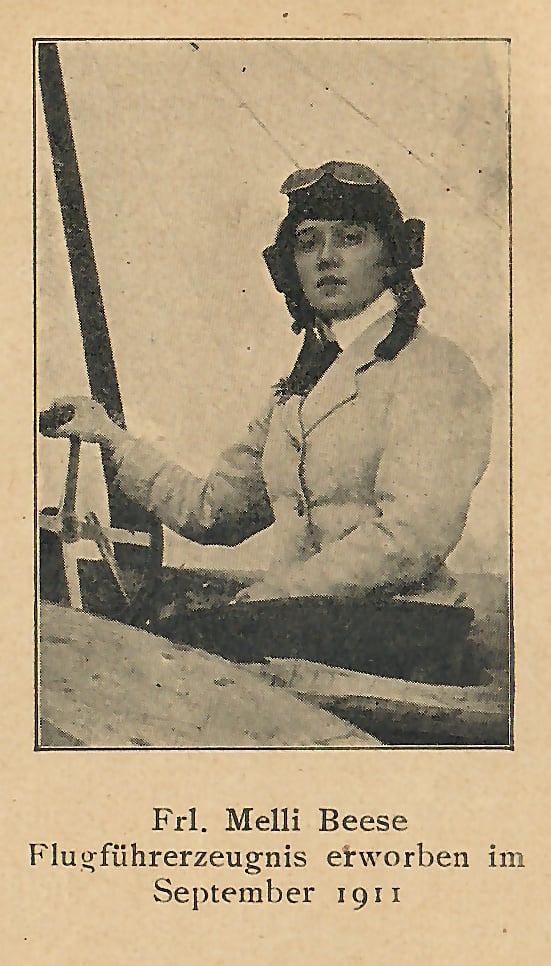
Then came the morning of 13 September, the early start, the outside witnesses and licence No. 115. In Germany the next woman, Princess Eugenie Shakhovskaya, would not qualify until August 1912.
The Deutsches Museum tells the story of Melli Beese and her fight to become a pilot (in German).
Records at the autumn flying week
Two weeks later Beese entered the Johannisthal autumn flying week on her Rumpler Taube. According to German accounts, two of the star pilots threatened not to take part if a woman flew in the works team, and the airfield director, Georg von Tschudi, who had advertised a woman pilot as an attraction, had to intervene so she could have an aircraft.
She finished fifth out of 24 competitors. Flying with a passenger, she climbed to 825 metres, a new altitude record for a woman, and she also set a women’s endurance record during the meeting. The Berlin press praised her flying.
Flugschule Melli Beese GmbH
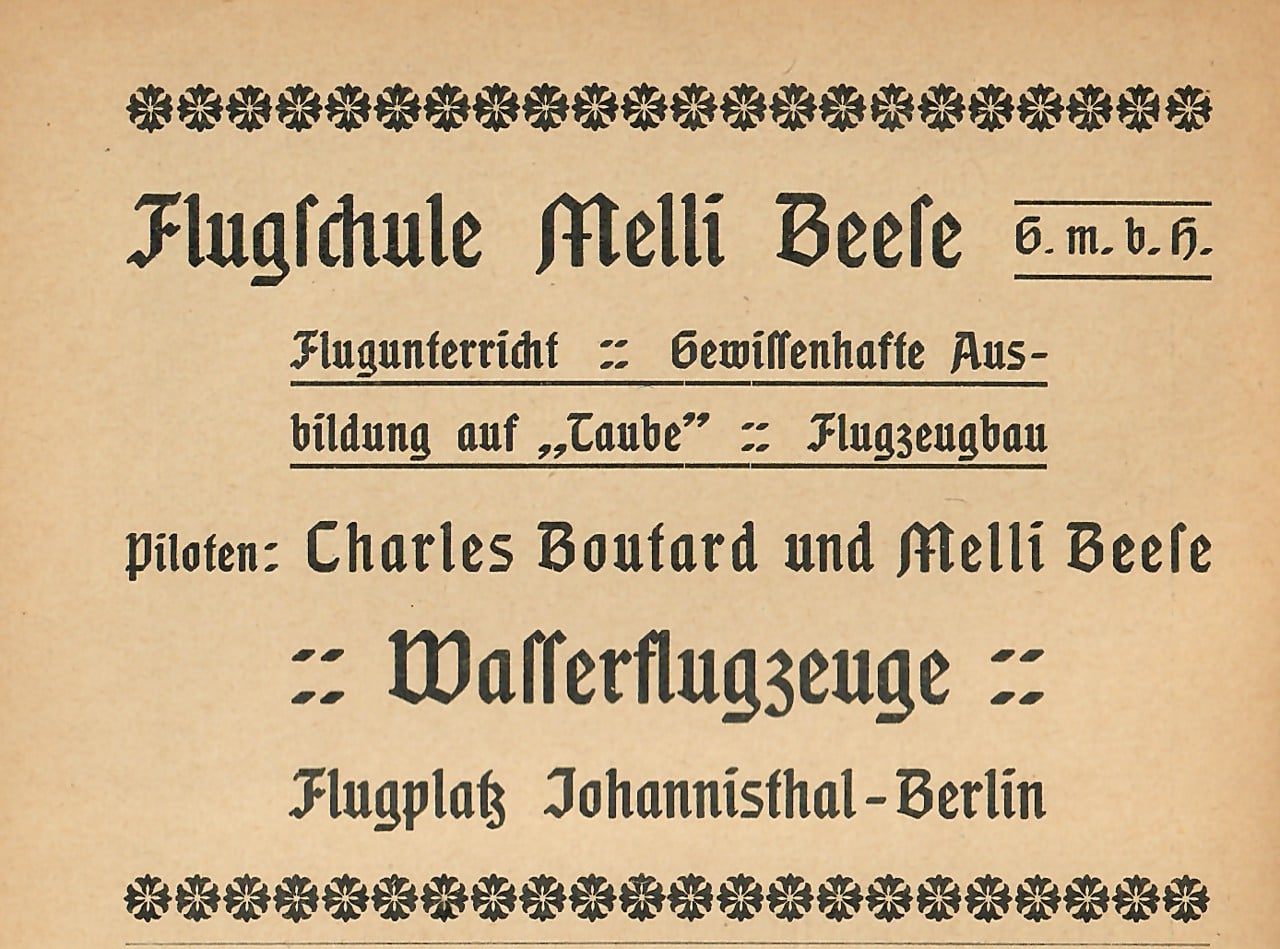
In 1912 she went into business. With the Frenchman Charles Boutard and Hermann Reichelt she founded the Melli Beese flying school at Johannisthal. She promised a properly run school with a limited number of pupils, three aircraft and three instructors, so that students would not hang around the airfield for months without flying.
The company also built aircraft. The Taube was not protected by patent in Germany, and Beese’s firm became the first after Rumpler to build its own copies, the Melli-Beese-Taube, offering them for 12,000 marks against the 20,000 that Rumpler charged. She also designed and patented aircraft of her own, and with Boutard began work on a flying boat for longer journeys.
As a member of the association of German pilots she campaigned for regulated pilot training, certified flying schools and a doctor on the airfield. When Germany raised more than 7.5 million marks through its 1912 National Aviation Fund, partly to train new pilots, though, her school was not among those chosen.
“Enemy aliens”
On 25 January 1913 Beese married Charles Boutard. Under the German law of the time, a woman who married a foreigner took his nationality, so Germany’s first woman pilot became a French citizen.
When the First World War began in August 1914, that made the couple enemy aliens. They were barred from Johannisthal, their school and factory had to close, and the authorities destroyed the flying boat they had been preparing for a meeting at Warnemünde. Boutard was interned, and the couple spent part of the war interned at Wittstock.
ARTE on Melli Beese and the first women pilots, from the documentary on the pioneers who conquered the skies (in German).
After the war Beese returned to an empty hangar and sued the government for compensation for her lost school and aircraft. The case dragged on for years. Part of the money she finally received was eaten up by inflation, and the rest went into a car company that failed. A plan to fly around the world with Boutard collapsed for lack of funding.
Remembered at last
By 1925 her marriage had broken down, and that year she tried to renew her pilot’s licence and crashed during the attempt, escaping unhurt. She died by suicide in Berlin on 21 December 1925, aged 39.
In 1971 a small memorial park with a sculpture called Taube by Annelise Rudolph was opened in her honour in Berlin, and since 1975 her grave in Berlin-Schmargendorf has been an honorary grave of the state of Berlin. Schools in Berlin and Dresden carry her name, streets across Germany are named after her, and the main access road to Berlin Brandenburg Airport is the Melli-Beese-Ring. Every day, travellers bound for Germany’s capital airport drive along a road named after the woman the men at Johannisthal tried so hard to keep on the ground.
Sources: Wikipedia (Melli Beese, English and German editions), Deutsches Museum blog (Tatjana Dietl, “Sie wollte fliegen, immer nur fliegen!” and part 2, 2020), Deutsches Museum, ARTE



0 Comments