
Captain Daniel Arsenault was running a morning charter out of Pensacola on Saturday when he spotted something floating offshore. He went over for a look, the way you do. Underneath it was a good-size mahi-mahi, which went straight into a cooler already full of fish.
The thing the mahi had been sheltering under was a delta-winged military drone, and it went into the boat too.
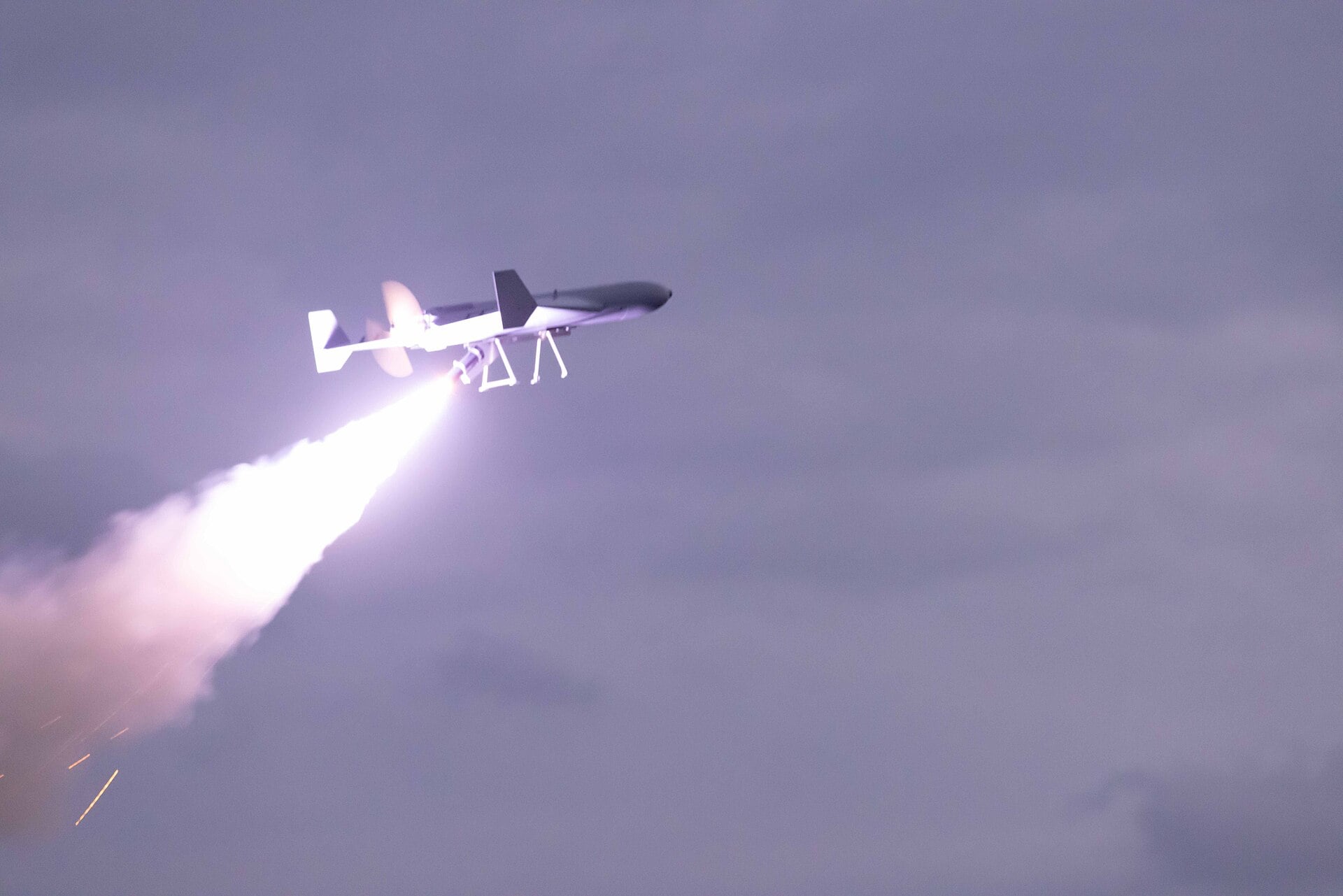
It turns out to be an FLM-136 — the American clone of Iran’s Shahed-136, and the airframe behind the US military’s LUCAS attack drone. Eglin Air Force Base, further along the Panhandle coast, confirmed to TWZ that it had recently lost one. It would not confirm that this was it.
Quick Facts
- When: Saturday 19 September 2026, off the Florida Panhandle
- Who found it: Capt. Daniel Arsenault, Hot Spots Charters of Pensacola
- What it is: FLM-136, built by Arizona-based SpektreWorks — a reverse-engineered Shahed-136 target drone
- Size: about 9.8 ft long, 8.2 ft wingspan, roughly 70 lb
- Armed version: LUCAS, the Low-Cost Uncrewed Combat Attack System, about $35,000 a copy
- Condition: engine, propeller and nose section missing — typical of a water impact
The Catch
Hot Spots Charters is a fishing business, not a salvage operation, so the crew did the sensible thing and hauled the drone aboard with the help of the paying passengers. Aviation photographer Charlie Green, who knows the operator and supplied the first pictures of the find, says Arsenault then notified every local agency he could think of. One of them eventually came and collected it. Green did not know which.
Arsenault himself was underwhelmed. “Riding along offshore and saw it floating,” he told CNN.
The photographs show an airframe missing its engine, its propeller and its nose cone. That is not sabotage or a shootdown. It is what happens when a small aircraft hits water at speed: the heavy bits at either end keep going and the fuselage does not.
That is the whole official statement. No aircraft type, no date, no location. The spokesperson referred further questions to the Pentagon, which had nothing to add.
What an FLM-136 Actually Is
Start with the Iranian original. The Shahed-136 is a delta-wing, propeller-driven, one-way attack drone: cheap, slow, and dangerous mostly because it arrives in quantity. Russia has fired thousands of them and their licence-built Geran derivatives at Ukraine.
SpektreWorks, based in Arizona, reverse-engineered it. The result, the FLM-136, was built as a target — something for American air defences to practise against, because the best way to learn how to kill a Shahed is to have a Shahed to shoot at. It is 9.8 feet long, spans 8.2 feet, and weighs about 70 pounds.
Then somebody pointed out that a convincing Shahed replica is also, by definition, a working one-way attack drone. Put a warhead where the instrumentation goes and you have LUCAS.
From Target to Weapon
LUCAS went to war on the opening day of Operation Epic Fury, 28 February 2026, flown by Task Force Scorpion Strike — the American military’s first dedicated one-way attack drone unit, stood up under US Special Operations Command Central the previous December.
Thirty-five thousand dollars is roughly what a mid-range family car costs, and a small fraction of what a cruise missile costs. That is the entire argument for the category. CENTCOM says LUCAS can be launched by catapult, by rocket-assisted takeoff, or off mobile ground and vehicle systems, and that it operates autonomously well beyond line of sight.
Losing them is part of the design. Locals in Iraq recovered a near-intact LUCAS earlier this year, and there were several such finds during the war with Iran. When the airframe costs less than the missile you would otherwise use, an occasional donation to an adversary’s intelligence service is an accepted cost of doing business.
Why the Gulf, and Why This Keeps Happening
Eglin’s host unit is the 96th Test Wing, the Air Force’s test and evaluation centre for air-delivered weapons, guidance systems and Air Force Special Operations Command kit. It runs the Eglin Gulf Test Range: roughly 120,000 square miles of overwater airspace covering the eastern third of the Gulf, from the Panhandle down to the Keys, plus 724 square miles of land range holding 70 separate test areas.
That is why development drones fly there. It is also why they occasionally end up in the water. The Air Force takes this seriously enough to operate a small fleet of 120-foot boats — the only vessels the service owns — crewed under contract by Florida Offshore, which recovers around a hundred drones a year.
Sometimes the boats do not get there first. In 2021 beachcombers in Palm Beach County found a BQM-167A high-performance target drone sitting on the sand.

The Loop Closes at Eglin
There is a neat circularity here that is easy to miss. The FLM-136 exists so that American forces can practise shooting down Shahed-type drones. One of the most important counter-drone programmes of the last two years — arming fighters with APKWS laser-guided rockets in an air-to-air role — was tested off Eglin, and began there back in 2019 before being rushed into service when the standoff with Iran turned hot.
So the same range that teaches American fighters to kill Shaheds also flies the fake Shaheds they practise on, and now builds the real ones the US shoots at other people. The drone in Captain Arsenault’s boat is a physical artefact of all three of those things at once.
Nobody has said what happens to it now. But the passengers who helped wrestle it over the gunwale have a better fishing story than anyone else on the Panhandle, and a cooler of mahi-mahi to go with it.
Sources: TWZ, CNN, CENTCOM, Eglin Air Force Base, SpektreWorks.



0 Comments