
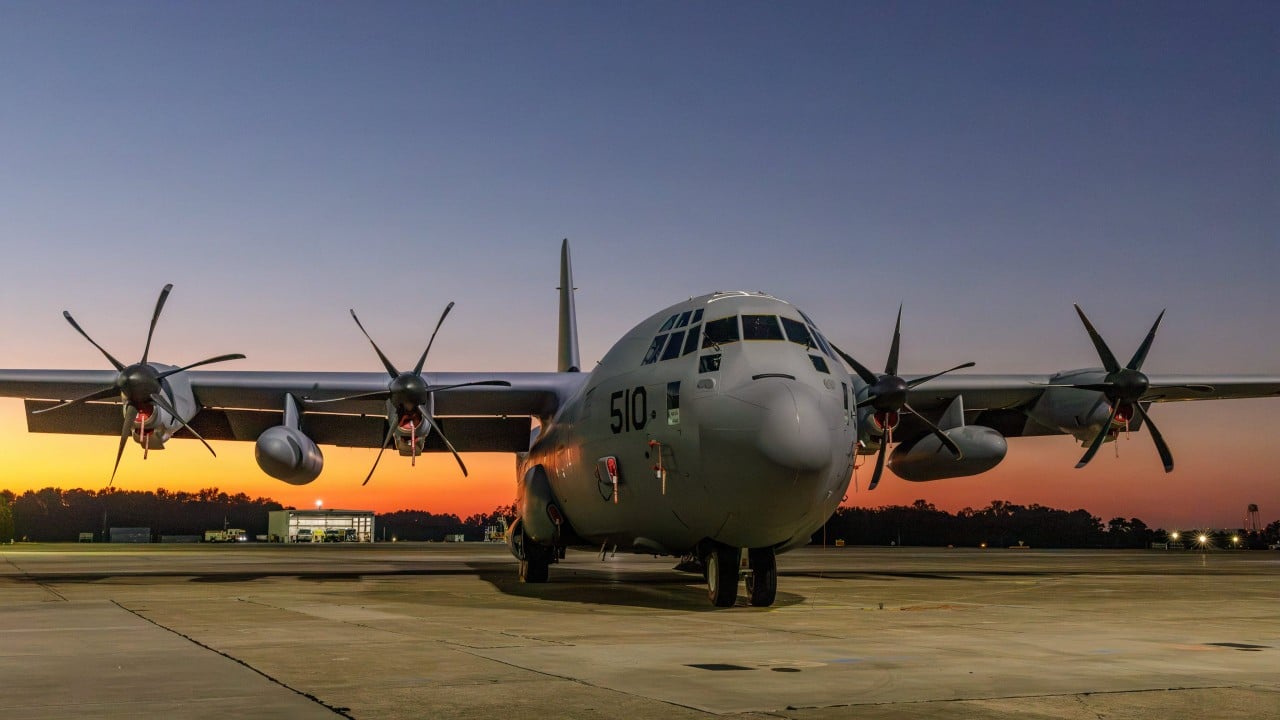
It does not look like a doomsday aircraft yet. Tail number 510 is a plain grey Lockheed Martin C-130J-30 Super Hercules, four propellers and a long fuselage, sitting on the ramp at Marietta, Georgia. But on 15 October the US Navy accepted it as the first airframe of the E-130J Phoenix II, the aircraft that will carry the order to launch nuclear missiles from submarines hiding deep under the sea.
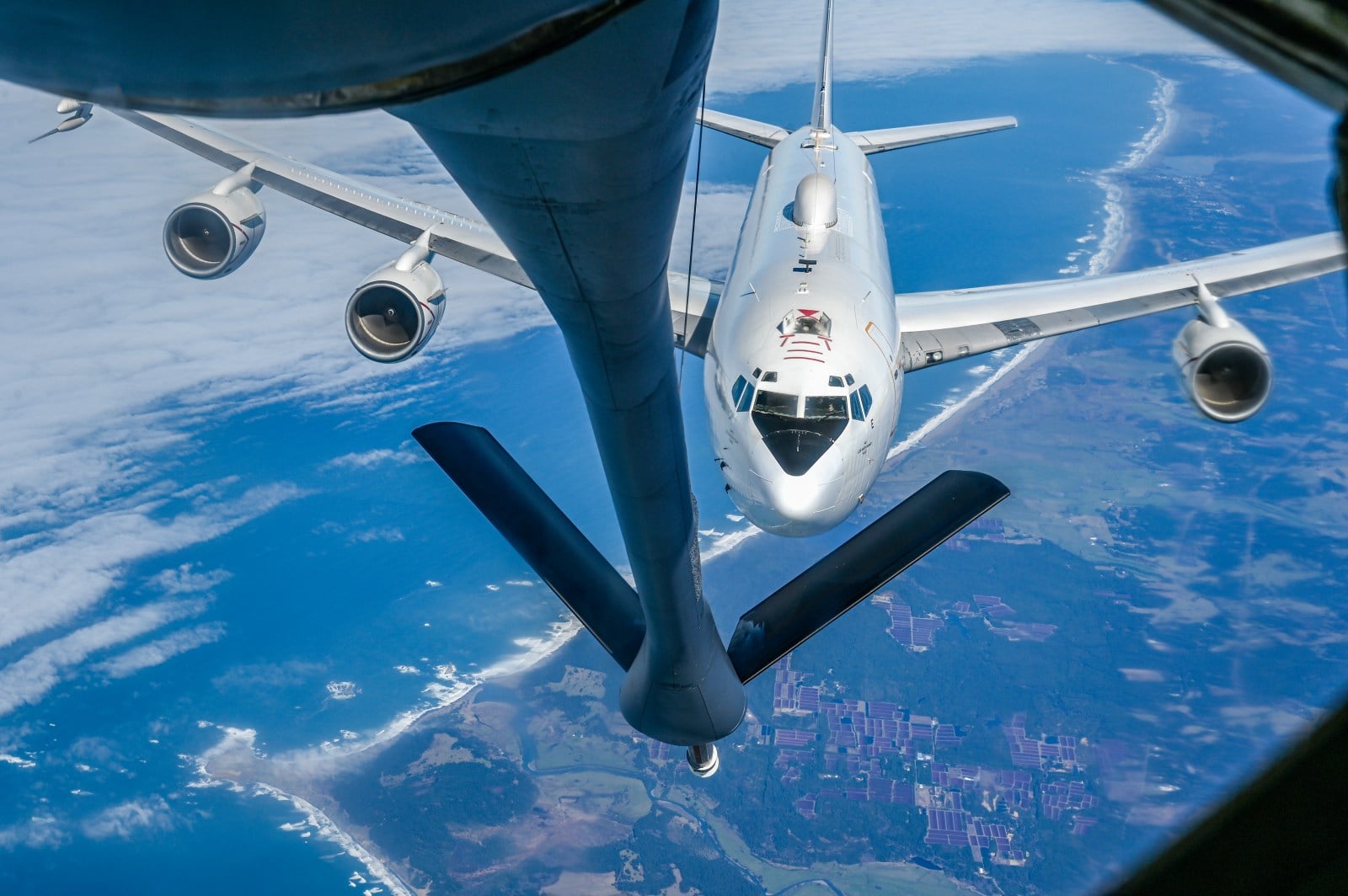
The delivery ceremony marks the start of the Navy's move away from the Boeing 707-based E-6B Mercury, which has flown the TACAMO mission, short for Take Charge and Move Out, since the late 1980s. Before the new aircraft can do any of that, though, it has a long conversion ahead of it.
Quick Facts
- What: First C-130J-30 for the E-130J Phoenix II TACAMO aircraft
- Delivered: 15 October 2026, Lockheed Martin, Marietta, Georgia
- Customer: US Navy, program office PMA-271
- Mission systems: Northrop Grumman (prime integrator); Collins Aerospace (VLF system)
- Replaces: Boeing E-6B Mercury (16 built)
- Next step: Mission-systems integration and testing
A lifeline to submerged submarines
A ballistic missile submarine on patrol is designed to be impossible to find, which also makes it hard to talk to. Ordinary radio waves barely penetrate seawater. Very low frequency (VLF) signals can reach a submarine at depth, but they need an enormous antenna. TACAMO aircraft solve that by trailing a wire antenna several kilometres long behind them while flying a tight orbit, so the wire hangs nearly vertical and radiates the message down to the boats.
The mission is a link in America's nuclear command, control and communications chain: a way for the president, the secretary of defense and US Strategic Command to send emergency action messages to the submarine fleet even if ground stations have been destroyed. That is why the aircraft must also be hardened against the electromagnetic pulse of a nuclear detonation.
The new airframe now goes to Northrop Grumman, the E-130J's prime contractor and mission-systems integrator, for conversion. Collins Aerospace supplies the VLF communications system. The Navy bought this aircraft as the first of an initial three C-130J-30s ordered in September 2024.
Back to the Hercules
For the TACAMO community this is a homecoming. The mission began on the Hercules: a modified KC-130 tested the trailing-wire concept in 1962, and EC-130G and EC-130Q aircraft carried it for the next two decades and more. The jet-powered E-6A Mercury entered service in 1989 to replace the EC-130Q, and all 16 E-6As were later upgraded to the E-6B standard, which also took over the Air Force's airborne command post role known as Looking Glass.
Going back to propellers is a trade-off. As TWZ has pointed out, a C-130J-30 cannot match the speed or altitude of a 707-sized jet, so it will be slower to reach its orbit and cannot climb as high above weather. In exchange it can operate from far more airfields, including short and rough ones, which makes the fleet much harder to destroy on the ground, and it is still in production, unlike the 707. According to TWZ, the Navy plans to acquire 31 E-130Js, nearly twice the size of the E-6B fleet.
There are open questions. The US Government Accountability Office has warned that squeezing the mission equipment into the smaller airframe creates size, weight, power and cooling challenges, and the Navy pushed back its low-rate production decision by about a year. The E-130J is also not expected to inherit the E-6B's Looking Glass airborne command post mission, which has worried members of Congress. For now, though, the airframe the whole program depends on has been handed over. Tail 510 heads off to be turned into the Navy's new nuclear voice.
Sources: US Navy / PAE Aviation (16 October 2026), Lockheed Martin, TWZ, The Aviationist, US Government Accountability Office

0 Comments