
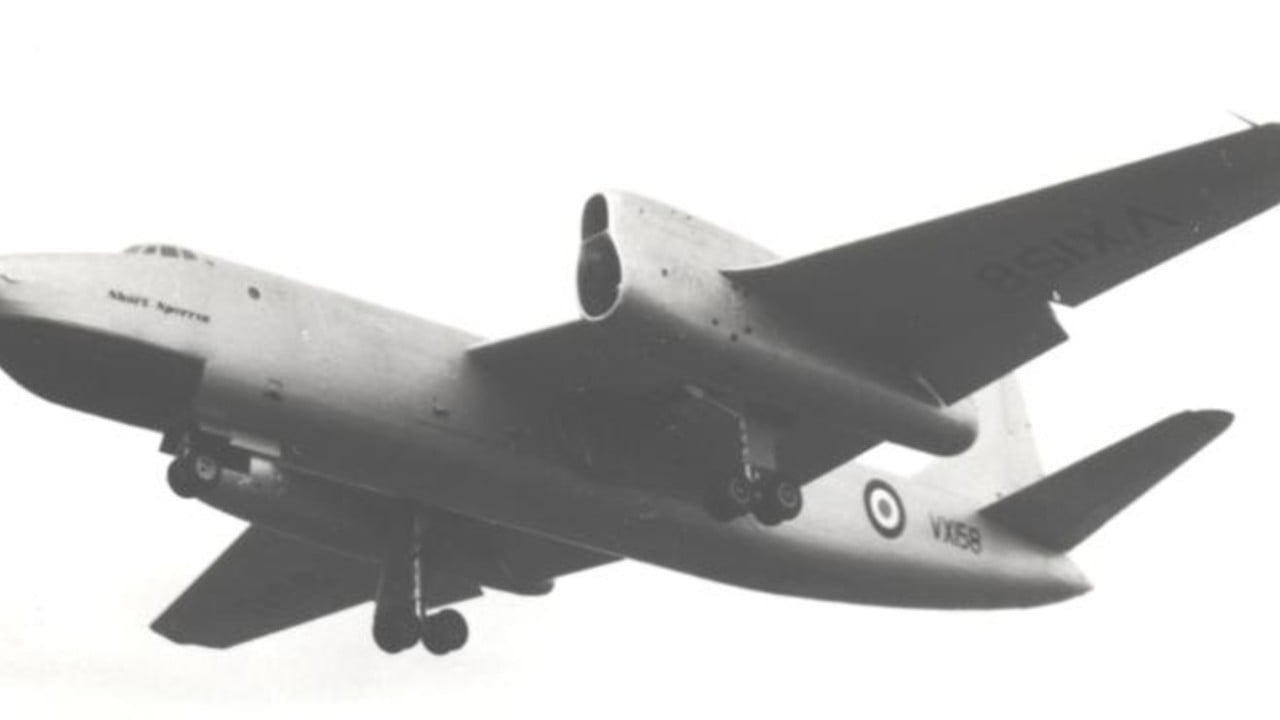
Everyone remembers Britain's three V-bombers: the Vickers Valiant, the Avro Vulcan and the Handley Page Victor. Almost nobody remembers the fourth. It had straight wings, engines stacked one on top of the other, and a job description that amounted to: please do not be needed.
The Short SA.4 Sperrin, built in Belfast and named after Northern Ireland's Sperrin Mountains, was Britain's insurance policy in case the advanced V-bombers ran late. They did not run late enough, so the Sperrin never went into service. Instead its two prototypes spent the 1950s as flying test beds, and one of them flew with some of the most powerful jet engines in the world bolted underneath its wings.
Quick Facts
- Manufacturer: Short Brothers and Harland, Belfast
- Specification: Air Ministry B.14/46, the insurance bomber
- First flight: 10 August 1951 (VX158); 12 August 1952 (VX161)
- Built: Two flying prototypes
- Engines: Four Rolls-Royce Avons, stacked in pairs; later de Havilland Gyron test engines
- Crew: Five
- Fate: VX161 scrapped in 1957, VX158 in 1958
A bomber built as a back-up
After the Second World War, Britain wanted its own nuclear bomber force rather than depending on the US Strategic Air Command. The Air Ministry's demanding specification B.35/46 called for a jet bomber to replace the Avro Lincoln that could match anything the Soviet Union or the United States could build. It would produce the Vulcan and the Victor, but the Air Ministry knew the required technology might take time.
So it hedged. An earlier specification, B.14/46, was redrafted as an insurance requirement for a less ambitious bomber with conventional, unswept wings and some sacrifice in performance. Four firms tendered and Shorts' design was selected. The Air Ministry ordered two flying prototypes and a static test airframe. To save time if production were ordered, the prototypes were built on production jigs, which, perhaps ironically, slowed them down.
Ed Nash's Military Matters on the Sperrin, Britain's back-up back-up nuclear bomber.
Stacked engines and a 1940s cockpit
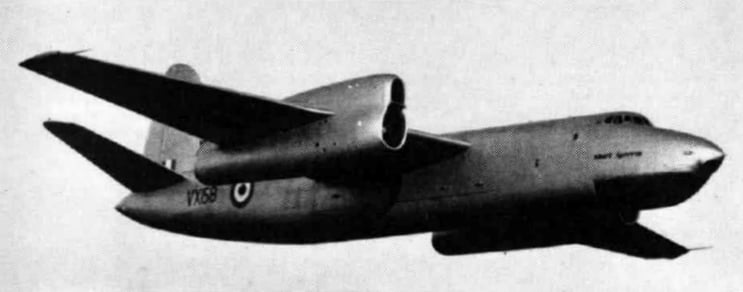
Much of the Sperrin looked back to the Second World War rather than forward. Its most unusual feature was the engine arrangement: four Rolls-Royce Avon turbojets mounted in two nacelles in the middle of each wing, one engine directly above the other. The first prototype, VX158, was the first aircraft to receive production Avon engines.
It carried a crew of five. Only the two pilots had ejection seats; the bomb aimer, navigator and air signaller had to bail out through a hatch under the navigator's console. The bomb aimer lay prone in a tube above the radome. Unusually for an aircraft of its size, the flying controls were manually operated through servo tabs rather than powered, a system aviation historians Bill Gunston and Peter Gilchrist have described as simple, light and reliable.
Cancelled almost as soon as it flew
Test pilot Tom Brooke-Smith took VX158 into the air for the first time on 10 August 1951. By then the Vickers Valiant was progressing well, only about six months behind the Sperrin, and the Air Ministry decided the insurance was no longer needed. The Valiant was ordered instead and the Sperrin bomber was cancelled. Construction continued anyway, because the Ministry of Supply wanted the two aircraft for research.
The second prototype, VX161, flew on 12 August 1952. It had a fully working bomb bay, and among its tasks were trials with bomb shapes, including mock-ups of the Blue Danube nuclear bomb and the Blue Boar television-guided glide bomb. VX158 got the more spectacular job: testing the de Havilland Gyron, a huge turbojet rated at 15,000 lbf in its first version.
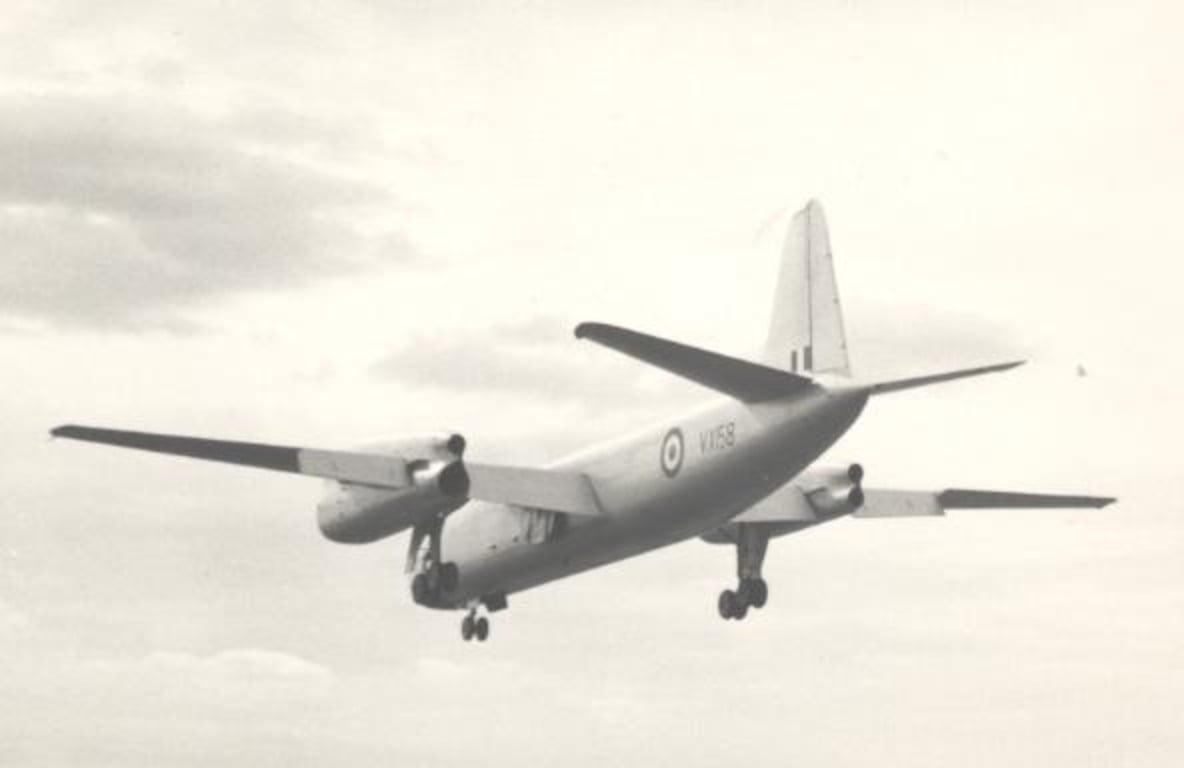
From July 1955 VX158 flew with a single Gyron in place of the lower Avon in the left nacelle, an asymmetric arrangement that lasted until March 1956. Then two Gyron Gy2 engines of 20,000 lbf each went in, one under each pair of Avons. When one of VX158's undercarriage doors fell off on its first flight in that configuration, VX161 was flown in so its door could be used for the repair. VX161 never flew again and was scrapped at Sydenham in 1957.
The fourth V-bomber that never was
VX158 flew at the 1956 Farnborough Airshow with two Avons and two Gyrons. Six months later the Gyron programme was cancelled, and in 1958 the aircraft was scrapped at Hatfield. Neither Sperrin survives.
It is easy to see the Sperrin as a dead end, but it did exactly what an insurance policy should: it was there if needed, and when it was not, it was put to good use. Gunston and Gilchrist have suggested that, had a production order come, an operational squadron could have been equipped by late 1953. Britain never had to find out.
Vector 1945 on the Sperrin, the fourth V-bomber nobody counts.
For a glimpse of the real thing, the archive clip below shows the Sperrin prototype flying in the early 1950s.
Archive footage of the Short Sperrin prototype in the early 1950s.
Sources: Wikipedia (Short Sperrin), citing Gunston and Gilchrist, Jet Bombers (Osprey, 1993) and Flight International
0 Comments