
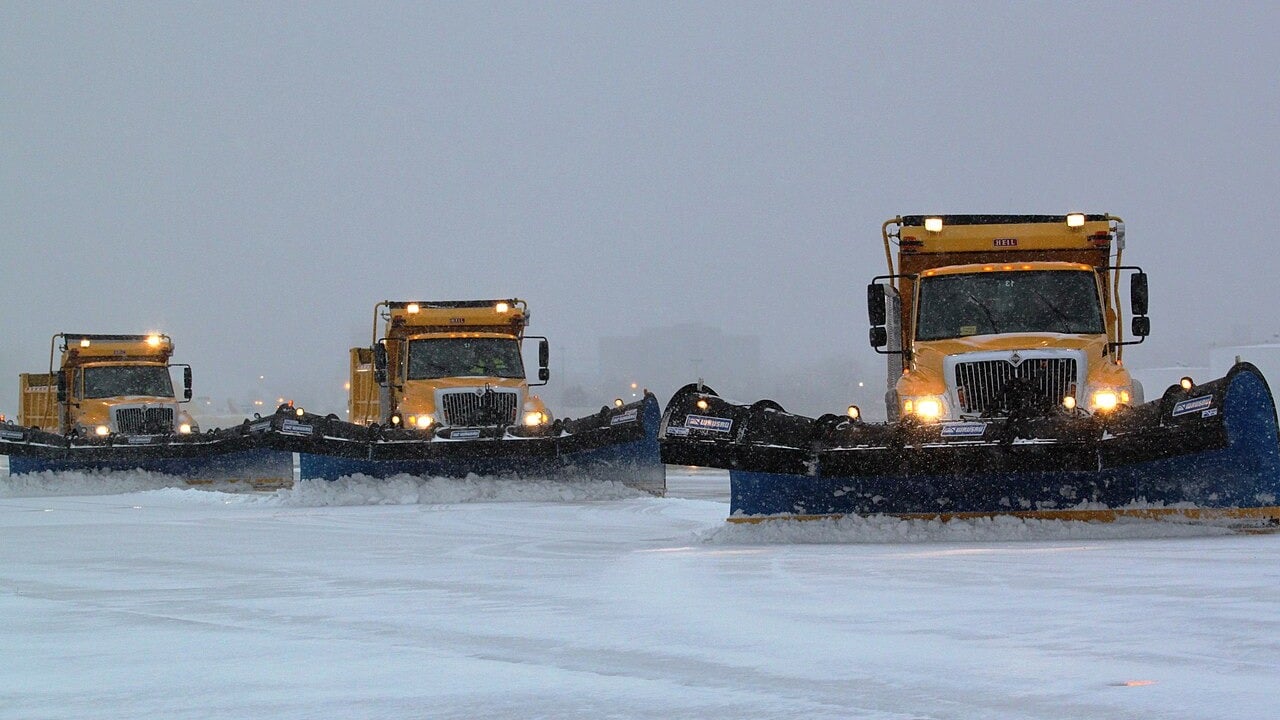
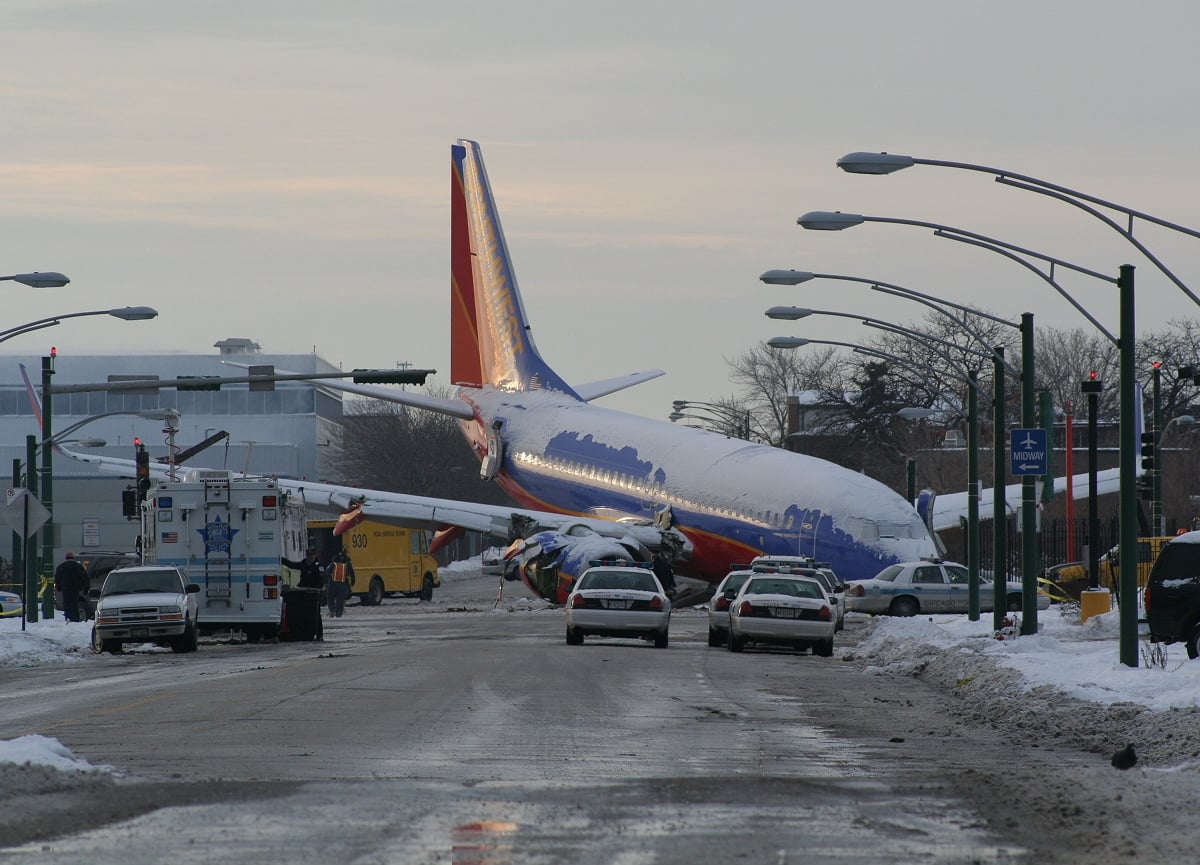
It was snowing hard at Chicago Midway on the evening of 8 December 2005, and the braking action reports coming off runway 31C did not agree with themselves. Crews were calling it good or fair for the first half of the runway and poor for the second half. A Southwest Airlines Boeing 737-700 landed into that, floated, and did not get the thrust reversers out in time.
The aeroplane went through the blast fence, through the airport perimeter fence and onto Central Avenue, where it struck a car. A six-year-old boy in the back of that car was killed. Eighteen of the 103 people on board were hurt.
Everything about how a slippery runway is described today — the number in the NOTAM, the words the controller reads you, the fact that one runway can carry three different codes at once — exists because the old system let two crews look at the same runway and honestly disagree about it.
Quick Facts
What RwyCC means: Runway Condition Code, a number from 6 (dry) down to 0 (nil braking), assigned to each third of the runway
Where it comes from: The Runway Condition Assessment Matrix (RCAM), built from manufacturers’ performance data rather than anyone’s opinion
Live in the United States since: 1 October 2016, following the TALPA Aviation Rulemaking Committee
What it replaced: Mu friction readings, which are no longer published in the NOTAM system, and the braking-action term “Fair”, now “Medium”
The depth that changes everything: 1/8 inch (3 mm). Below it, slush and snow behave almost like wet; above it, they do not
Code 0: A federally obligated US airport may not report nil braking action. The surface closes instead
The accident behind it: Southwest Airlines flight 1248, Chicago Midway, 8 December 2005 — one child killed in a car on Central Avenue
The Trouble With “Fair”
Before 2016, an American pilot asking about a contaminated runway got two kinds of answer, and neither was much use. The first was a braking action report: another crew’s impression, in words — good, fair, poor or nil. It was subjective by construction. A heavy jet with autobrakes and a light turboprop on the same ice will not report the same thing, and the pilot who says “fair” at the touchdown zone may never have tested the far end.
The second was a Mu value: a friction number produced by a vehicle dragging a calibrated wheel down the runway. It looked scientific, and that was the problem. Ground-vehicle friction readings never mapped reliably onto what a 70-tonne aeroplane with rubber-coated tyres and a lot of inertia would actually do, particularly on contaminants deeper than a thin film.
The NTSB’s report on the Midway overrun runs to 248 pages and spends a long stretch of it on exactly this: runway surface condition assessments, braking action reports and airplane-based friction measurements. Its probable cause is about the crew, but its recommendations reached much further.
The Matrix That Replaced the Guesswork
The FAA convened the Takeoff and Landing Performance Assessment (TALPA) Aviation Rulemaking Committee in response, and what came out of it is the Runway Condition Assessment Matrix. The RCAM does something deceptively simple: instead of asking anyone how slippery the runway feels, it asks what is physically on the runway and how deep it is, and then looks up the answer in a table built from performance data supplied by the aircraft manufacturers themselves.
The airport operator inspects the surface, identifies the contaminant and its depth, and the matrix returns a Runway Condition Code from 6 down to 0. That number is what reaches the flight deck.
| Code | What is on the runway | What the crew should feel | Braking action |
|---|---|---|---|
| 6 | Dry | — | — |
| 5 | Frost; wet (damp, or 1/8 in / 3 mm of water or less); 1/8 in or less of slush, dry snow or wet snow | Braking deceleration is normal for the wheel braking effort applied AND directional control is normal | Good |
| 4 | Compacted snow at −15°C and colder | Braking deceleration OR directional control is between good and medium | Good to Medium |
| 3 | Slippery when wet; dry or wet snow over compacted snow; more than 1/8 in of dry or wet snow; compacted snow warmer than −15°C | Braking deceleration is noticeably reduced for the effort applied OR directional control is noticeably reduced | Medium |
| 2 | More than 1/8 in (3 mm) of water or slush | Braking deceleration OR directional control is between medium and poor | Medium to Poor |
| 1 | Ice | Braking deceleration is significantly reduced for the effort applied OR directional control is significantly reduced | Poor |
| 0 | Wet ice; slush over ice; water over compacted snow; dry or wet snow over ice | Braking deceleration is minimal to non-existent OR directional control is uncertain | Nil |
The Runway Condition Assessment Matrix as published by the FAA in SAFO 16009, 15 August 2016. Codes are assigned for each third of the runway.
Read the middle column and one threshold jumps out: one eighth of an inch, three millimetres. A dusting of dry snow at or below that depth is a code 5, the same as a plain wet runway. The identical snow a millimetre deeper is a code 3. Water and slush fall further still, to a code 2, because above that depth the contaminant stops being a film the tyre can squeeze through and starts being a fluid the tyre has to displace.
An FAA TALPA briefing walking through runway conditions and contaminants — the same material airport operations staff are trained on before they are allowed to assign a code.
Three Codes, One Runway
A runway is assessed in thirds: touchdown, midpoint and rollout, numbered from the end the aeroplane is using. That is why a FICON NOTAM reads as a string such as 5/3/2 rather than a single number. The Midway crews were not confused in 2005 because they were careless; they were reporting a runway that genuinely was not the same all the way down, in a system that had no way to say so.
Two more rules are worth knowing. Codes are only generated when more than 25 per cent of the runway or its cleared width is contaminated — below that, the FAA takes the view that performance impacts are unlikely and no codes appear. And the airport operator may downgrade or upgrade a code based on its own wider assessment, which means the reported code can deliberately differ from what the contaminant table alone would give. What nobody downstream may do is adjust it: the operator of the aeroplane takes the number as published.
Nil Means Closed
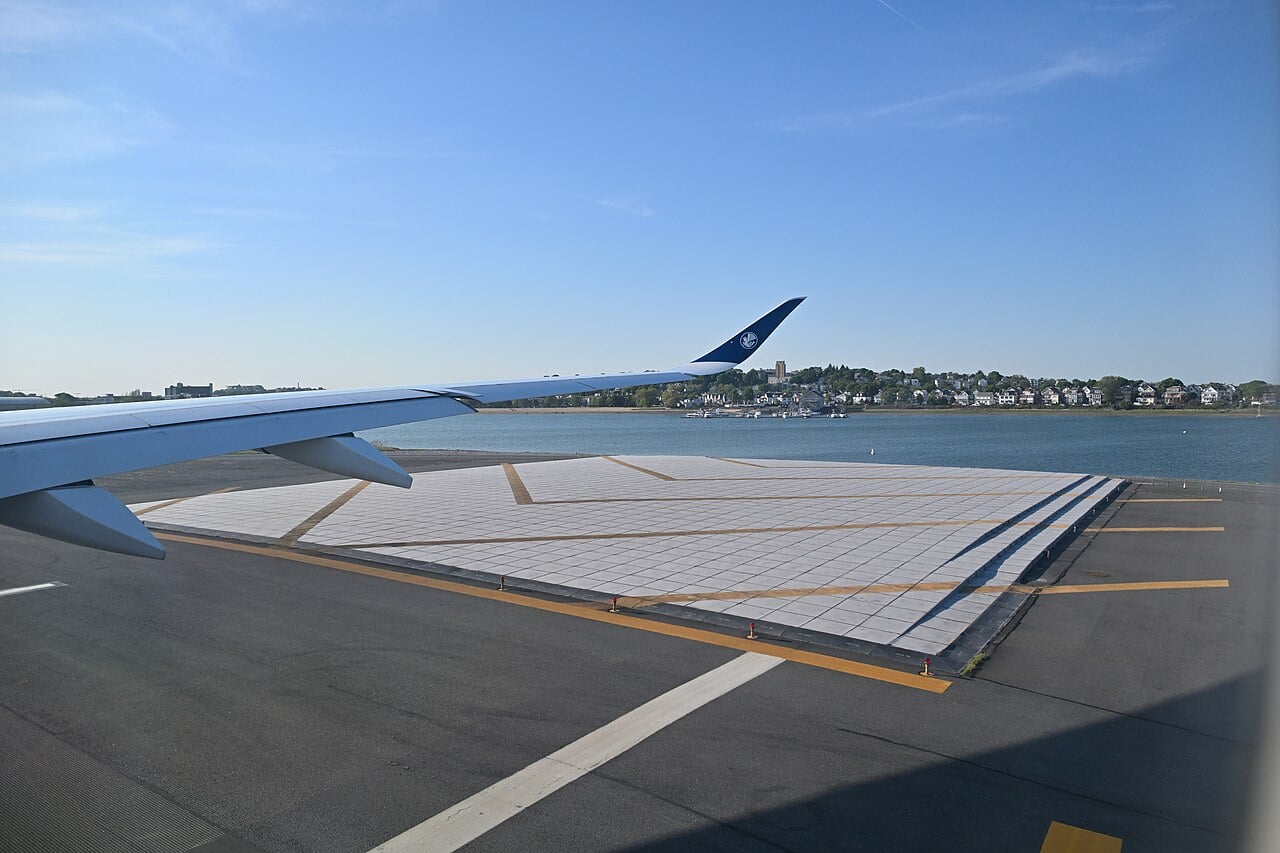
Code 0 is the strangest entry in the matrix, because in American practice a pilot should essentially never see it. A federally obligated airport is not permitted to report nil braking action; a surface in that state must be closed, and stays closed until the operator is satisfied the condition has gone. The code exists in the table to define the boundary, not to be used as an operating condition.
That is also why the vocabulary changed on the same day the matrix arrived. “Fair” became “Medium”, and the pilot report scale became good, good to medium, medium, medium to poor and nil, harmonised with ICAO wording. Pilot braking action reports did not go away — they remain one of the inputs an airport uses when deciding whether to downgrade a code.
Why Standing Water Is Worse Than It Looks
The deepest codes in the matrix belong to water and slush, and the reason goes back to a piece of NASA research from 1963. Walter Horne and Robert Dreher at Langley worked out when a rolling tyre stops touching the ground at all: the point where the hydrodynamic pressure under the contact patch equals the pressure holding the tyre up, which to a good approximation is simply the tyre’s inflation pressure.
Their simplification is the rule of thumb still taught today. Total hydroplaning speed in knots is roughly nine times the square root of tyre pressure in pounds per square inch. For an airliner main wheel at around 200 psi that is about 127 knots — comfortably inside the speed range of a landing rollout. For a light aircraft at 30 psi it is about 49 knots, which is why a flooded runway is a serious matter for a Cessna long after a jet has slowed down.
Once the tyre is riding on water, wheel braking contributes almost nothing and the anti-skid system cannot conjure friction that is not there. Directional control goes first, which is why the matrix treats loss of directional control as equal in weight to loss of deceleration all the way down the table.
A cockpit view of a takeoff from a contaminated runway. Note how much of the crew’s attention goes to keeping the aircraft on the centreline rather than to acceleration.
A longer explainer on operating from contaminated runways, covering braking, directional control and the performance penalties the codes are designed to capture.
What the Number Is Actually For
The code is not a warning light. It is an input to an arithmetic problem the crew has to solve before landing: given this aircraft, this weight, this wind, this runway and this condition code, does the aeroplane stop on the pavement available, with margin? That calculation — the landing performance assessment at time of arrival — is the thing the Midway crew got wrong, and the thing the matrix was built to make answerable.
The genuinely important shift is philosophical. The old system asked a human being how slippery something felt and then asked another human being to act on that feeling. The new one asks what is on the ground, converts it through data the manufacturer stands behind, and hands the crew a number their performance software already understands. Nobody has to be brave about it, and nobody has to guess.
Sources: FAA Safety Alert for Operators 16009, “Runway Assessment and Condition Reporting, Effective October 1, 2016”, 15 August 2016, including the published Runway Condition Assessment Matrix; NTSB Aircraft Accident Report NTSB/AAR-07/06, Southwest Airlines flight 1248, Chicago Midway International Airport, 8 December 2005; FAA Aeronautical Information Manual, runway condition code reporting; NASA Technical Note D-2056, “Phenomena of Pneumatic Tire Hydroplaning”, Walter B. Horne and Robert C. Dreher, Langley Research Center, 1963.

0 Comments