
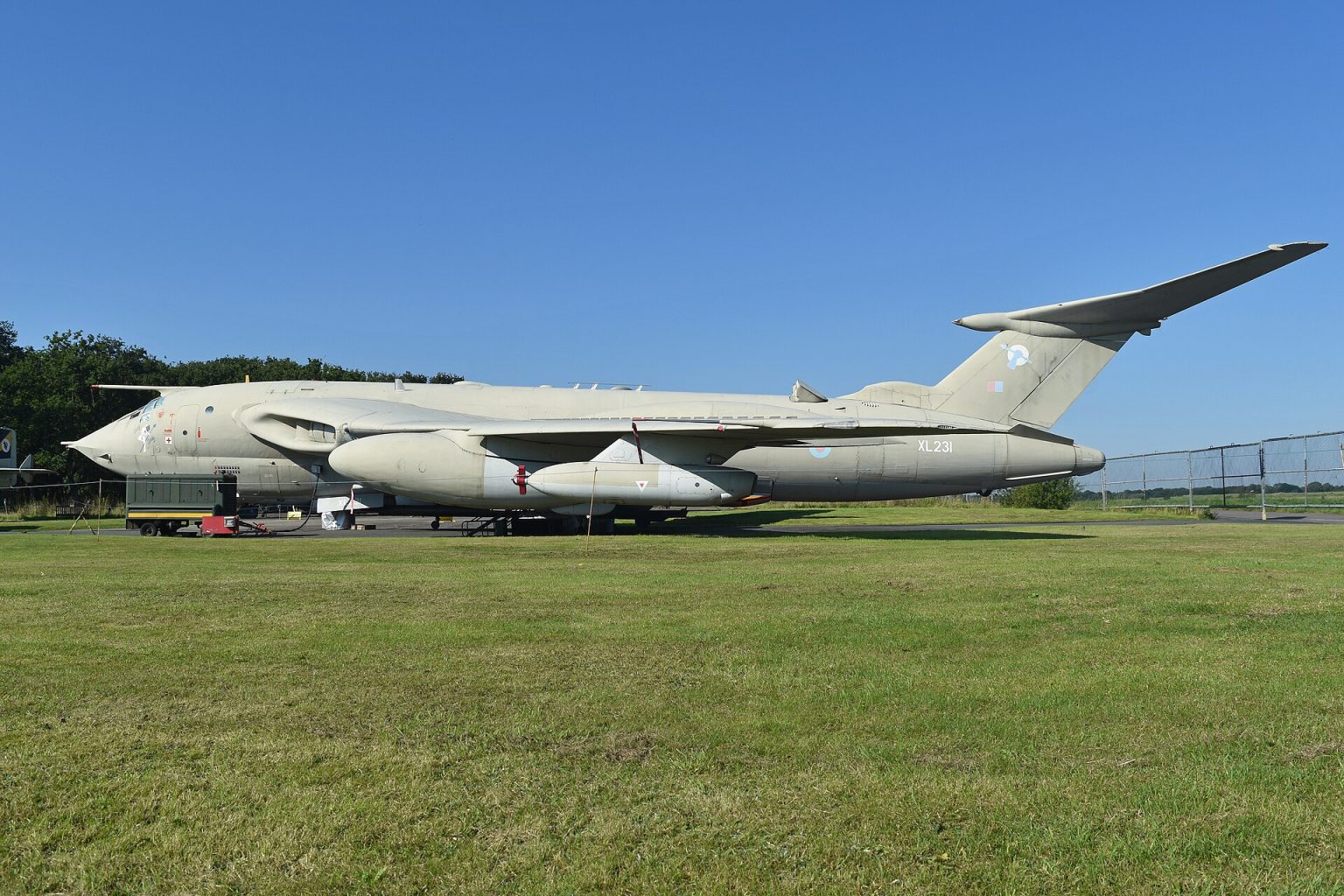
Handley Page Victor
Crescent-winged V-bomber & tanker
The third and fastest of Britain’s three V-bombers — a nuclear-deterrent aircraft with a unique crescent wing that found a vital second life as the RAF’s aerial tanker, and fed the epic Black Buck raids of the 1982 Falklands War.
The V-bomber that became the RAF’s lifeline
When Britain set out to build an airborne nuclear deterrent after the Second World War, it hedged its bets. The 1947 specification B.35/46 asked for a jet bomber able to carry an atomic weapon to a distant target at high altitude and high speed — and rather than gamble on one design, the RAF ordered three. The Vickers Valiant came first as an insurance policy, the delta-winged Avro Vulcan followed, and the third and most technically ambitious was Handley Page’s HP.80 Victor. Together they became the V-Force, the aircraft that carried Britain’s bomb through the tensest years of the Cold War.
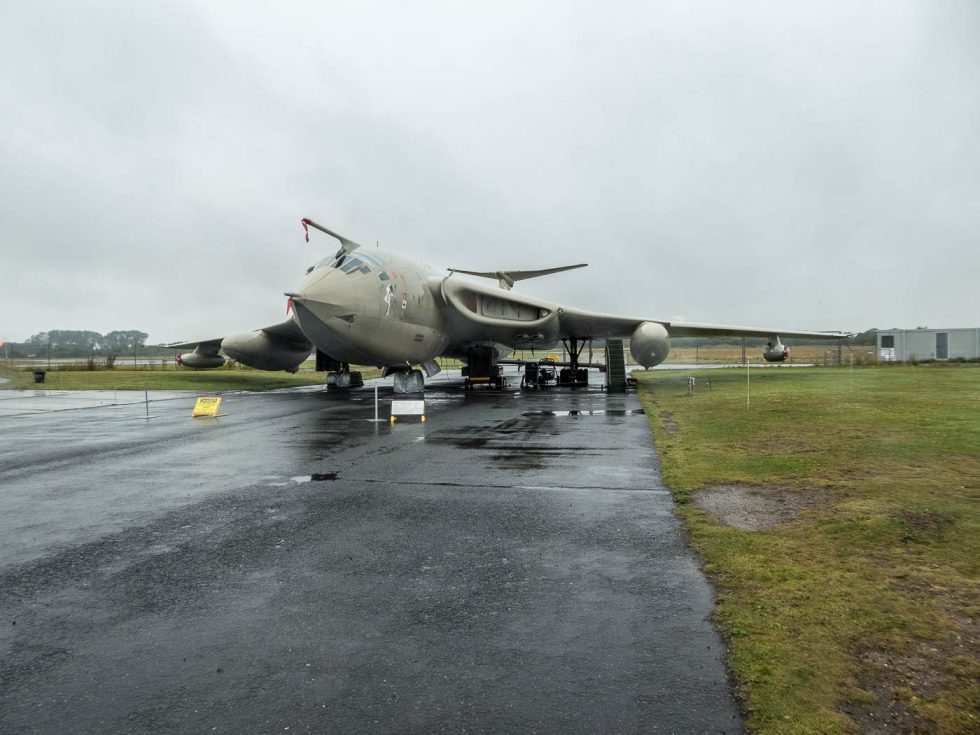
The Victor’s signature was its crescent wing — a graceful, compound-swept shape, sharply angled at the root and progressively straighter toward the tip. Designed under Godfrey Lee, the crescent kept a nearly constant critical Mach number across the whole span, letting the big bomber cruise efficiently at high subsonic speed. The prototype first flew on Christmas Eve 1952; the B.1 entered RAF service in 1958, and the definitive B.2, with more powerful Rolls-Royce Conway engines and a longer wing, could operate above 55,000 feet — for a time beyond the reach of Soviet interceptors.
As a bomber the Victor carried Britain’s free-fall nuclear weapons and, from the mid-1960s, the Blue Steel rocket-powered standoff missile, sitting Quick Reaction Alert ready to scramble within minutes. But surface-to-air missiles pushed the whole V-Force down to low level, and in 1969 the strategic nuclear deterrent passed to the Royal Navy’s Polaris submarines. That might have ended the story — except the Victor found a second career. With the Valiant tanker fleet grounded by fatigue in 1965, surplus Victors were rebuilt as K.2 aerial-refuelling tankers, and it was in that role that the type became indispensable.
Its finest hour came in 1982. During the Falklands War the RAF mounted Operation Black Buck — the longest bombing raids attempted to that date — and it was a fleet of Victor tankers, refuelling each other and the lone Vulcan in a vast relay across the South Atlantic, that made it possible. The Victor went on to serve through the 1991 Gulf War before the last aircraft retired on 15 October 1993, closing 35 years of service and the story of Handley Page’s final aircraft.
01The Handley Page Victor’s crescent wing: how Handley Page chased high-subsonic efficiency
The crescent wing is the Victor’s defining feature and one of the boldest aerodynamic ideas of the early jet age. Instead of a single sweep angle, the wing used three: heavily swept and thick at the root, then reducing in both sweep and thickness toward the tip. The goal was to hold the critical Mach number — the speed at which airflow over the wing first goes supersonic and drag rises sharply — roughly constant from root to tip, so the whole wing reached its limit together rather than the thin outer sections stalling drag-wise first.
The payoff was efficient cruise at high subsonic speed and a genuinely large, deep wing root in which to bury fuel and undercarriage. The Victor became the fastest of the three V-bombers, credited with cruising around Mach 0.92, and a B.1 is reported to have exceeded the speed of sound in a shallow dive in 1957 — then the largest aircraft to have done so. The crescent shape was complex and expensive to build, and no other production aircraft ever copied it, but it gave the Victor its unmistakable silhouette.
What makes it special
The crescent wing, chasing efficiency
Godfrey Lee’s crescent wing used three sweep angles — steep at the root, shallow at the tip — to keep the critical Mach number constant across the span. That let the Victor cruise efficiently at high subsonic speed and made it the fastest of the three V-bombers, credited around Mach 0.92. A B.1 reportedly went supersonic in a shallow dive in 1957, the largest aircraft to do so at the time.
From nuclear bomber to vital tanker
When Polaris submarines took over the deterrent in 1969, the Victor was not scrapped — it was reborn. Rebuilt as the K.2 three-point tanker, it could pass up to about 34,000 kg of fuel through hose-and-drogue pods. This second life made it the backbone of RAF long-range operations for another two decades, from the Falklands to the Gulf.
Blue Steel and the Quick Reaction Alert
At the peak of the Cold War, Victors stood Quick Reaction Alert at eastern English bases, ready to scramble in minutes carrying free-fall H-bombs or the rocket-powered Blue Steel standoff missile — a weapon meant to be launched tens of miles short of a heavily defended target. Operating above 55,000 ft, the Victor was, for a while, very hard to catch.
02The Handley Page Victor’s second life: why a bomber became the RAF’s most important tanker
The Victor’s conversion to a tanker began as an emergency. In January 1965 the entire Vickers Valiant fleet — then the RAF’s tanker force — was grounded when fatigue cracks were found in the wing spars. The RAF urgently rebuilt six Victor B.1As as two-point tankers, and the first rushed conversion flew that April with 55 Squadron operational by May. Full three-point K.1 and later K.2 tankers followed, the K.2 converted from the more powerful B.2 airframes.
It proved an inspired reuse. The Victor had the range, the fuel capacity and the high-subsonic speed that made it an ideal tanker for fast jets, and the type went on to out-serve its bomber career by years. Without the Victor tanker fleet, neither the Black Buck raids of 1982 nor the RAF’s Gulf War contribution in 1991 would have been possible — a nuclear bomber that ended up keeping everyone else in the air.
03The Handley Page Victor’s nuclear years: Blue Steel, high altitude and the move to low level
As first conceived, the V-Force doctrine was simple: fly high and fast, above the reach of defences, and drop the bomb. The Victor B.2, cruising above 55,000 feet, was built for exactly that. But the 1960 loss of a U-2 to a Soviet surface-to-air missile shattered the assumption that altitude meant safety, and the whole V-Force was forced down to low-level penetration, hugging the terrain to slip under radar.
To keep the deterrent credible the Victor carried Blue Steel, a rocket-powered standoff missile with a thermonuclear warhead that could be launched short of the target so the bomber never had to overfly the most dangerous defences. It was a stopgap: the planned longer-range Skybolt was cancelled, and by 1969 the deterrent role passed entirely to Polaris. The Victor’s front-line nuclear career was relatively short — but it spanned the most dangerous years of the Cold War.
Full specifications
Baseline note: the figures below describe the Victor B.2, and specifically the B.2R that twenty-one of the thirty-four became — four Rolls-Royce Conway RCo.17 turbofans, a 120 ft wing, and a bomb bay wired for one Blue Steel stand-off missile. Deltas for the B.1 and B.1A with Armstrong Siddeley Sapphires, for the nine SR.2 strategic reconnaissance conversions and for the K.2 tanker are given in grey. The K.2 is given more room here than a conversion normally deserves, because the Victor spent nineteen of its thirty-six service years as a tanker and only ten as a bomber, and because the tanker is the reason anyone outside Britain has heard of the aeroplane. Four cautions before any number below is quoted. First, unlike the Valiant, the Victor’s marks are not one airframe with different crates in the bay. The B.1 and the B.2 differ in engine, wingspan, wing area, electrical system and maximum weight by 43,000 lb; a single specification column covering both is not a summary but an error. Second, the published weights disagree. A widely reproduced online specification table is headed "Victor B.1" and gives 114 ft 11 in, 110 ft span and 89,030 lb empty, which are B.1 figures, but prints a maximum take-off weight of 205,000 lb, which sits between the 180,000 lb that Damien Burke’s tables give for the B.1 and the 223,000 lb they give for the B.2 and reconciles with neither. Third, the range figures are worse: 5,217 nautical miles in that same table against 2,700 statute miles for the B.1 and 4,600 for the B.2 in the tables compiled with the Handley Page Association. Those are a factor of two apart and this page says so rather than picking one. Fourth, the crescent wing is the whole point of the aeroplane and no authoritative set of its three panel sweep angles appears in open sources, so none is printed here — what is printed is the thickness taper that the sweep was designed around.
Dimensions & weights
- Crew
- 5 — two pilots side by side, a navigator/plotter, a navigator/radar and an air electronics officer. The Victor’s pressure cabin ran all the way to the nose tip, so unlike the Vulcan and Valiant the rear three sat at almost the same level as the pilots rather than in a well below them. Only the pilots had ejection seats; the rear crew had explosive cushions inflated by a CO₂ bottle to help them out of their seats towards the door, which in most emergencies was not a survivable arrangement. The specification had originally called for a jettisonable nose escape capsule for the whole crew and the Air Ministry deleted that requirement in 1950
- Length
- 35.03 m (114 ft 11 in) — the same on the B.1, the B.2 and the K.2. The first prototype WB771 was 111 ft 7 in; the nose was lengthened on production aircraft to fix a centre-of-gravity error that had been ballasted out with lead on the two prototypes, which had the useful side effect of moving the crew door further from the engine intakes
- Wingspan
- 36.58 m (120 ft) on the B.2, made up by a spanwise insert and a larger tip. The B.1 and B.1A spanned 33.53 m (110 ft). The K.2 came back down to 35.66 m (117 ft) because Hawker Siddeley cut 18 in off each tip to reduce wing bending stress — Handley Page had proposed tip tanks for the same purpose and the conversion contract was not signed until the firm had gone into liquidation
- Height
- 8.57 m (28 ft 1.5 in) — the T-tail sat at the top of the fin because the engines are buried in a mid-set wing and the tailplane had to stay clear of the efflux
- Wing area
- 241.3 m² (2,597 sq ft) on the B.2; 223.5 m² (2,406 sq ft) on the B.1; about 239.7 m² (2,580 sq ft) on the clipped K.2
- Wing planform
- Crescent: sweep and chord reduce in three distinct steps from root to tip — the signature feature, invented at Arado by Rüdiger Kosin and Walther Lehmann and brought to Britain by the Handley Page team who were sent to inspect their work in 1945. Bill Gunston called it "undoubtedly the most efficient high-subsonic wing on any drawing board in 1947". Secondary sources quote the three panel angles inconsistently and this page will not invent a set
- Wing thickness
- 16 per cent modified RAE section at the root, 6 per cent at the tip — and this taper is the reason the wing is crescent-shaped. A thick section reaches its critical Mach number at a lower speed than a thin one, and sweep raises critical Mach by lengthening the effective chord seen by the airflow. Gustav Lachmann and Godfrey Lee therefore gave the fat root a lot of sweep, the middle panel less and the thin tip least, so that shock waves would form everywhere along the span at the same Mach number instead of starting at the root and marching outwards. They then applied the same rule to the nose and the tail, so the whole aeroplane had one critical Mach number. That is a genuinely elegant piece of 1947 aerodynamics and nothing else in production ever used it
- Empty weight
- 44,450 kg (98,000 lb) for the B.2. The B.1 was 40,383 kg (89,030 lb); the K.2, loaded with permanent bomb-bay tanks and three hose-drum units, came out at 51,730 kg (114,050 lb) — an empty tanker heavier than a loaded early B.1
- Maximum take-off weight
- 101,150 kg (223,000 lb) for the B.2 and B.2R. The B.1 was 81,650 kg (180,000 lb); the K.1 tankers 83,900 kg (185,000 lb); the K.2 107,960 kg (238,000 lb), the heaviest Victor ever flown. The 205,000 lb printed as a B.1 figure in that widely reproduced table matches nothing in the Handley Page Association’s numbers
- Fuel, K.2
- 41,280 kg (91,000 lb) of fuel and transfer fuel combined — wing tanks, fuselage tanks, two permanent bomb-bay tanks and underwing tanks. No consistent internal-fuel total for the B.2 bomber appears in open sources and this page will not manufacture one; what is documented is that the K.2 could give away more fuel than a fully loaded B.1 weighed
- Weapon load
- 15,880 kg (35 × 1,000 lb bombs) as the maximum operational conventional load, against a bomb bay designed to take 48 of them, or 39 × 2,000 lb sea mines, or one 22,000 lb Grand Slam, or two 12,000 lb Tallboys. The Victor’s bay was much bigger than the Vulcan’s or the Valiant’s and it cost range to carry it. Alternatively one Blue Steel, recessed under the fuselage with the doors removed
- Wing loading
- 419 kg/m² at maximum take-off weight (85.9 lb/sq ft) for the B.2 — and for the K.2 at 238,000 lb on a 2,580 sq ft wing it rises to about 450 kg/m² (92 lb/sq ft), which is why the tanker’s ceiling fell to 49,000 ft
- Undercarriage
- Twin-wheel nose unit under the radar chin; eight-wheel main bogies, two rows of four, retracting forward into the wing — a lot of small wheels rather than a few large ones, because the wing was thin and the aircraft had to operate from existing runways without exceeding their load classification. The nosewheel bay, the H2S scanner and the auxiliary visual bomb-aiming position all shared the prominent chin bulge under the cockpit floor
Performance
- Maximum speed
- 1,038 km/h (645 mph, 560 kn) at 10,360 m (34,000 ft) in Damien Burke’s tables. C. H. Barnes gives 545 kn (627 mph, 1,009 km/h) at 11,000 m (36,000 ft), and the difference is not trivial: it is the difference between Mach 0.97 and Mach 0.94 at that height. The K.2 tanker was held to 982 km/h (610 mph)
- Limiting Mach number
- Mach 0.92 in service — but the first prototype was flown to Mach 0.98 with no buffet or handling trouble, and on 1 June 1956 a production B.1, XA917, flown by Johnny Allam, reached Mach 1.1 after the nose was allowed to drop a degree or two at high power. Ground observers from Watford to Banbury heard the bang. It was the largest aircraft in the world to have gone supersonic; Andrew Brookes has argued Allam did it deliberately to make a point about the Victor against the other two V-bombers. Paul Langston, an observer aboard, became the first man to break the sound barrier sitting backwards
- Design cruise
- 925 km/h (575 mph) at 13,700–15,240 m (45,000–50,000 ft) — the figure Specification B.35/46 demanded, and the Victor met it. Roughly Mach 0.87 at those heights
- Service ceiling
- 17,070 m (56,000 ft) for the B.2 as usually printed; Burke gives 16,765 m (55,000 ft). Either way it was the highest-flying of the three V-bombers, which is precisely the capability that Gary Powers’s U-2 rendered worthless in May 1960. The K.2 tanker, heavy and clipped, managed 14,935 m (49,000 ft)
- Range, B.2
- 7,400 km (4,600 miles). The B.1 managed 4,345 km (2,700 miles), which is the clearest single measure of what the Conway bought. The K.2 could cover 7,240 km (4,500 miles) without touching a pound of its transfer fuel. The 5,217 nmi occasionally printed for the B.1 is not reconcilable with any of these and looks like a units error
- Design radius of action
- 2,780 km (1,500 nmi) carrying one 10,000 lb bomb — the B.35/46 requirement, written round the size of Blue Danube and the assumption of a flight from Britain to a target in the western Soviet Union. It is a design figure, not a measured one, and it took no account of a run-in, an escape manoeuvre or a diversion
- Reaction time on alert
- Under four minutes from the scramble order to airborne — from cockpit readiness on a dispersal pan, with the Blackburn Artouste auxiliary power unit spinning the engines up. British intelligence assessed that Soviet radar could see a Victor at 200 miles, so the plan was not to outrun detection but to thread the gaps in the network with heavy jamming, each aircraft routed and flown entirely independently of the rest
- Bombing accuracy
- About 400 yd (365 m) with the Navigational and Bombing System — judged adequate for a megatonne weapon at high level and meaningless for anything else, which is part of why the low-level laydown era needed different weapons rather than different tactics
- Blue Steel launch
- Released at up to 17,000 m (56,000 ft) and, after a crash modification programme in 1964–65, from as low as 300 m (1,000 ft). The missile ran to Mach 3 and was meant to detonate within 100 m of the aiming point. Launch preparation took up to seven hours, and in 1963 the RAF’s own estimate was that half the rounds would fail to fire and have to be dropped on the target as free-fall bombs — which is the exact opposite of what a stand-off weapon is for
- Longest operational sortie
- 14 hours 45 minutes, 11,265 km (7,000 miles) — flown by K.2 XH675 out of Wideawake in 1982, radar-mapping the South Atlantic. The reconnaissance sorties towards South Georgia from 20 April 1982, the first of them flown by Squadron Leader John Elliott with four tankers outbound and four more waiting for the return, were among the first British offensive operations of the war and they proved the whole Ascension refuelling concept before a single Vulcan went south
- Black Buck One
- Almost 16 hours and 12,200 km (6,600 nmi) round trip — at the time the longest bombing mission ever flown, and it stood until the B-2s of 2001. The Vulcan took seven refuellings outbound and one on the way home
- Fatigue life at low level
- The number that ended the bomber career — no single published figure exists, but the effect is documented plainly enough. Ordered down to low level from 1963, the Victor B.2R fleet developed fatigue cracks fast enough that the whole force was retired from the strategic bombing role and put into storage by the end of 1968, after six years. The Vulcan, with a short, stiff delta, absorbed the same treatment and flew on until 1984. The Victor’s crescent wing was long, thin and flexible; crews reported that it gave a notably smooth ride down low, and that flexing was exactly what was eating the airframe
Propulsion & systems
- Engines
- 4 × Rolls-Royce Conway RCo.17 Mk 201 turbofans — buried in pairs in the wing roots. The first B.2s had Conway RCo.11 Mk 101s; the B.1 and B.1A had four Armstrong Siddeley Sapphire ASSa.7 turbojets, and the two prototypes flew on Sapphire 101s of about 8,000 lbf
- Rated thrust
- 91.6 kN (20,600 lbf) each for the RCo.17, which at the time made the Conway the most powerful non-afterburning engine outside the Soviet Union. Sources disagree here too: the Handley Page Association’s tables give 19,750 lbf for the Conway 20101 installation. The RCo.11 was 76.7 kN (17,250 lbf) and the Sapphire ASSa.7 was 49.2 kN (11,050 lbf) — so the B.2R had almost twice the thrust of the B.1 on the same airframe
- Sapphire trouble
- Centre-line closure — the Sapphires installed in the Victor were prone to it when flown through dense cloud or heavy tropical rain, the casing contracting onto the rotor. It is one of the reasons the Conway re-engining mattered beyond the extra thrust, and one of the few genuine black marks against an otherwise remarkably trouble-free airframe
- Auxiliary power
- Blackburn Artouste airborne auxiliary power unit in the starboard wing root (B.2 onwards) — high-pressure air for engine starting and electrical power on the ground or in the air. It is what made the four-minute scramble possible without a queue of ground equipment
- Emergency power
- Two ram air turbines fed by retractable "elephant ear" scoops on the upper rear fuselage — a B.2 recognition feature, forward of the fin. With fully powered controls and no manual reversion there was no fallback if the generators quit, so the RATs had to be able to run the flying controls long enough for the crew to relight the engines
- Electrical system
- AC on the B.2, DC on the B.1 — Godfrey Lee, one of the designers, said flatly that "an unbelievable improvement followed from going over from DC to AC". Reliability on the B.2 was in a different class
- Flying controls
- Fully powered ailerons, elevators and rudder with no manual reversion — duplicated instead, on the argument that a single pilot input would survive and that neither a hydraulic motor nor a screwjack would jam. Artificial feel was fed from ram air off the nose pitot, and that is how a pitot failure killed the B.2 prototype XH668 off Pembrokeshire on 20 August 1959: the mach trim strut ran fully out and drove the aircraft into an unrecoverable dive. More than 40 ships and 4,000 people recovered 600,000 pieces of it from the sea bed. Separate hydraulic circuits ran the gear, flaps, nose flaps, airbrakes, bomb doors, wheel brakes, nosewheel steering and the RAT scoops
- Nose flaps
- Automatic drooping leading-edge flaps on the inboard wing — fitted to counter a nose-up pitching tendency at low to moderate Mach numbers. On the B.1 the complex leading-edge droop was later deleted for weight and replaced with rather less elegant vortex generators on the upper surface; the B(SR).2 reverted to a fixed droop
- Navigation and bombing
- Navigational and Bombing System with H2S radar in the chin and Green Satin Doppler — the radar picture fed an electromechanical analogue bomb-aiming computer, some of it directly descended from equipment fitted to Handley Page’s own Halifax. A visual bomb sight was fitted to early aircraft and barely used. Trials were flown with terrain-following radar and a side-scan mode for the bombing radar; neither reached the operational fleet, which mattered when the fleet was sent down to 300 ft
- Defensive systems
- Red Steer tail warning radar in an enlarged tailcone, radar warning receivers, metric and communications jammers, chaff — the B.1A conversion of 1958–60 existed almost entirely to fit this suite, replacing the Orange Putter set inherited from the Canberra which was close to obsolete on the day the Victor entered service. On the B.2 the chaff moved into large streamlined fairings on the wing trailing edges after Blue Steel took its old stowage under the nose. Those fairings were adopted on Peter White’s suggestion after he heard Whitcomb’s work described in Brussels; they act as anti-shock bodies, Küchemann carrots, and they cut wave drag at transonic speed even though the added skin friction meant a small net drag increase in the cruise
- Refuelling equipment
- Fixed probe above the cockpit; as a tanker, one Mk 17 centreline hose-drum unit in the rear fuselage plus two Mk 20 wing pods — the Mk 17 delivered roughly three times the flow of the wing reels, which is the difference between refuelling a fighter and refuelling a bomber. The six rushed B.1A (K.2P) conversions of 1965 had the wing pods only, and could still drop bombs; the K.1, K.1A and K.2 had all three points and two permanent tanks in the bay. A Victor tanker could itself be refuelled, which is the single fact that made Black Buck arithmetically possible
04The Handley Page Victor’s operating costs: why no reliable price exists
The Victor was a 1950s British state defence programme, procured in small numbers under Cold War secrecy, so a clean, comparable flyaway unit price simply is not part of the public record — and any figure quoted today would need heavy inflation adjustment across seventy years to mean anything. No credible cost-per-flight-hour figure for the type exists in authoritative open sources either, so we do not quote one. What is well documented is that only 86 were built, that the crescent wing was complex and costly to manufacture, and that the tanker conversions extended the fleet’s value far beyond its original bomber role. Treat any precise dollar figure attached to a Victor as an estimate.
Armament & payload
The Victor had the biggest bomb bay of the three V-bombers, and it spent most of its life full of fuel it was giving away
Handley Page built the Victor around a bay big enough for a 22,000 lb Grand Slam, forty-eight thousand-pounders or thirty-nine two-thousand-pound sea mines, and paid for that volume in range — the Vulcan and the Valiant both carried less and went further. For the first decade the bay held Britain’s deterrent: Blue Danube, then Yellow Sun, then American Project E weapons, then from February 1963 a single Blue Steel stand-off missile recessed under the fuselage with the bomb doors taken off. There were no guns, no air-to-air weapons and no rockets on any Victor that entered service, and the only ordnance any Victor released in anger was practice ordnance.
What actually made the type historically important was the equipment that replaced all of it. From 1965 the bay took two permanent fuel tanks and a Mk 17 hose-drum unit, and the wings took Mk 20 pods; the Victor stopped being a weapon and became the thing that gave other people’s weapons their reach. That transition was not planned. It happened because the Valiant’s wing spars were found to be fatigued in December 1964 and the Royal Air Force woke up with no air-to-air refuelling capability at all, at which point Handley Page were told to convert six B.1As as fast as physically possible. Fits varied enormously by mark, by year and by squadron: a Wittering B.2R on quick reaction alert in 1964, a Wyton SR.2 in 1968 and a Marham K.2 on a North Sea towline in 1985 were the same airframe carrying nothing in common, and only aircraft actually on alert held live weapons.
Gun
- None, on any mark, at any point. No Victor ever carried a gun of any kind
- The one version that would have had guns was the HP.98, a proposed pathfinder Victor with remotely operated tail barbettes and Conway engines. It was rejected in favour of the Valiant B.2, which was then itself cancelled, so neither was built
- The V-force argument was the Mosquito argument scaled up: height, speed and electronic countermeasures instead of turrets, and the weight saved spent on performance. It held until May 1960, when an SA-2 reached a U-2 at 70,000 ft
- What went in the tailcone instead was Red Steer warning radar on the B.1A and B.2, replacing the Orange Putter set inherited from the Canberra. It told the air electronics officer that a fighter was closing and gave him jammers and chaff to answer with
- Blue Steel-armed Victors did carry an aggressive-looking pair of streamlined fairings on the wing trailing edges. They contained chaff, not weapons
Air-to-air
- None. No V-bomber carried an air-to-air weapon and no Victor was ever wired for one
- The defensive fit was electronic throughout: radar warning receivers, metric-band and communications jammers, chaff dispensers, and from 1958 the Red Steer tail warning radar
- Handley Page test pilots demonstrated what the aircraft could actually do about fighters by returning across the North Sea at full speed and height without telling air traffic control. The only interceptors in Britain that could regularly catch them were the USAF F-101 Voodoos of the 81st Tactical Fighter Wing, which says more about RAF air defence in the late 1950s than about the Victor
- In 1958 a Victor was looped and barrel-rolled while practising for the Farnborough display — not a combat capability, but a fair indication of how light the controls were on a 90-tonne bomber
- The type spent its second career on the other side of the equation entirely, passing fuel to Lightnings, Phantoms, Buccaneers, Tornados and, in 1991, to United States Navy aircraft
Air-to-surface guided
- Avro Blue Steel — 34 ft 11 in long, 17,000 lb, an Armstrong Siddeley Stentor Mk 101 twin-chamber rocket burning high-test peroxide and kerosene, cruise at about Mach 1 and a Mach 3 dash on the second chamber, inertial guidance accurate to 100 m, and a Red Snow thermonuclear warhead of 1.1 megatonnes anglicised from the American W28. Twenty-one Victor B.2s were converted to B.2R standard to carry one, recessed under the fuselage. In service February 1963, retired 31 December 1970
- Blue Steel was already obsolescent when it arrived. Its useful range was of the order of 100 nautical miles, launch preparation took up to seven hours, and the RAF’s own 1963 estimate was that half the rounds would fail to fire and would have to be dropped on the target — the precise defeat of a stand-off weapon. A crash programme in 1964–65 cleared release from 1,000 ft for the low-level era
- The Victor’s Blue Steel installation had one genuine advantage: the missile’s inertial platform was better than the aircraft’s, so the crew could tie their own navigation into it. Reverting a B.2R from missile carrier back to free-fall or conventional bombing took about thirty hours of intensive work
- GAM-87 Skybolt — not carried. Some B.2s were to be fitted for two, and Handley Page proposed a "Phase 6" Victor with more fuel and four of them for standing airborne patrols. The prospect of Skybolt is why the last twenty-eight Victors on order were cancelled; the American cancellation in December 1962 then left the RAF with neither the missile nor the bombers
- The Shrike anti-radar missiles fired at Argentine radars in 1982 were carried by Vulcans, not Victors. The Victor’s contribution to those sorties was fuel
Bombs
- Blue Danube — the 10,000 lb first-generation British atomic bomb the whole B.35/46 specification was written around, carried by the earliest B.1s. Superseded by Yellow Sun, 7,250 lb, flat-nosed, in Mk 1 form with the Green Grass warhead of about 400 kt and in Mk 2 form with Red Snow at 1.1 Mt
- Red Beard — the first British tactical nuclear weapon, an unboosted fission device, carried for the smaller-yield task
- Project E — American Mark 5 weapons made available under the 1957–58 arrangements and held in United States custody under a dual-key release. A British aircraft, a British crew and an American officer with one of the two keys
- WE.177B — the laydown weapon rushed into service to keep the V-force credible at low level, delivered from about 1,000 ft after a pop-up. It supplemented the modified Blue Steel rounds until Polaris took the deterrent to sea in 1969
- Conventional: 35 × 1,000 lb as the maximum operational load against 48 by design, or 39 × 2,000 lb sea mines. Provision existed for one 22,000 lb Grand Slam or two 12,000 lb Tallboys, and an underwing pannier scheme for 28 more thousand-pounders was drawn and dropped. In September 1964, at the peak of the Indonesian confrontation, two of the four Victor B.1As at Tengah stood at one hour’s readiness loaded with live conventional bombs. They were never sent
Rockets
- No rocket armament, offensive or defensive, on any mark
- The only rockets associated with the type were for getting off the ground: jettisonable de Havilland Spectre assisted take-off units, trialled on B.1 XA930 at Boscombe Down at very high all-up weights and short field lengths, in the same series of trials that first fitted a Victor with a refuelling probe and underwing tanks
- Spectre was not adopted. The Conway made it unnecessary on the B.2, and a rocket pack that fails asymmetrically on a 100-tonne aeroplane at rotation is a poor trade for a shorter ground roll
- Blue Steel was rocket-propelled, but it is a guided missile and is treated in that card rather than this one
- Unguided rockets are a weapon for an aircraft that can see its target and dive at it. The Victor was built to release one weapon from 50,000 ft and turn away, and later to release one from 1,000 ft and run
Pods & other stores
- Refuelling equipment — a Mk 17 hose-drum unit on the fuselage centreline with roughly three times the flow rate of the wing reels, plus two Mk 20 underwing pods, and two permanent tanks in the bomb bay. The six emergency B.1A (K.2P) conversions of 1965 had the wing pods only and kept their bombing capability; every later tanker had all three points. A K.2 carried 91,000 lb of fuel and could be refuelled itself
- Reconnaissance crate, SR.2 — up to four F49 survey cameras and up to eight F96 cameras for vertical or oblique daylight work, F89s and up to 108 photo-flares in three containers for night work, a bomb-bay radar mapping system, and air sampling equipment for detecting particles from foreign nuclear tests. Nine aircraft, with 543 Squadron at Wyton from December 1965
- Yellow Astor — a reconnaissance radar fitted with passive sensors to four B.1s of the Radar Reconnaissance Flight at Wyton, a unit that was not publicly acknowledged at the time
- Underwing tanks — fitted to the B.2 fleet along with the nose refuelling probe when the force went low level, and standard on the tankers thereafter
- F95 cameras in the nose — the K.2 conversion had plated over the bomb-aimer’s nose glazing; in 1982 some aircraft had it put back and cameras installed so that tankers could fly maritime reconnaissance in the South Atlantic. The last new operational capability the Victor ever acquired, improvised in weeks
Three typical loadouts
- Blue Steel quick reaction alert, RAF Wittering, 1964
- One Blue Steel round, recessed under the fuselage of a B.2R of 100 or 139 Squadron with the bomb doors removed, the aircraft in green and grey low-level camouflage over what had been anti-flash white. Five men in the cabin, cockpit readiness on the pan, airborne in under four minutes on the Artouste. Forty-eight live rounds were deployed across the Vulcan and Victor force with five more as spares, one per aircraft. The routing would have been low and independent, each crew flying its own gaps in the Soviet radar network with the air electronics officer jamming; the missile would have been released short of the SAM belt for a Mach 3 run to a 1.1 megatonne detonation. The RAF privately expected half of the missiles not to fire.
- Black Buck One tanker sortie, Wideawake, Ascension Island, 30 April–1 May 1982
- No weapons at all: 91,000 lb of fuel, a Mk 17 centreline hose and two Mk 20 pods, a Delco Carousel inertial platform and an Omega set fitted for the occasion. Eleven Victors and two Vulcans took off at one-minute intervals from a single runway from 2350Z, on a plan calling for fifteen Victor sorties and eighteen refuelling contacts; the RAF Museum’s own account gives thirteen tankers and fifteen contacts, and the discrepancy has never been tidied up. The Vulcan was refuelled seven times outbound and once homebound. In the last bracket, in a thunderstorm, Flight Lieutenant Steve Biglands’s probe broke; Squadron Leader Bob Tuxford took his slot, gave Martin Withers his fuel knowing it left him unable to reach Ascension, and held radio silence anyway rather than compromise the raid. He was refuelled on the way home by his own squadron commander and landed after 14 hours 5 minutes. Withers landed at 1452Z, about 16 hours and 6,600 nautical miles after leaving. Tuxford received the Air Force Cross.
- Operation Granby towline, Muharraq, Bahrain, January–February 1991
- Again fuel only, from eight K.2s deployed from Marham on the eve of the type’s planned retirement, flying racetrack patterns for Tornados, Buccaneers, Jaguars and allied aircraft including United States Navy types. Six of the eight carried nose art painted by Corporal Andy Price of 55 Squadron and named after ground crew’s wives and girlfriends, with fuel-pump symbols for missions flown. The detachment was tasked with 299 sorties and flew 299 — a hundred per cent availability record that no other RAF type in the campaign matched, achieved on airframes designed in 1947 and built before the Cuban missile crisis.
Sourcing: weapon fits are drawn from the standard Victor literature — Roger Brooks and John Fraser-Mitchell for the airframe and its equipment, Butler and Buttler on the design history, Humphrey Wynn’s official history for the nuclear stockpile, and Burden, Draper, Rough and Smith’s account of the air war for 1982. A weapon being available to the V-force is not evidence that a Victor squadron held it, and this page states what a given aircraft carried only where the record is explicit. Two areas remain genuinely contested. The Black Buck tanker numbers differ between the standard account (eleven Victors, fifteen planned sorties, eighteen refuellings) and the RAF Museum (thirteen tankers, fifteen refuellings), most likely because some Victors flew twice that night and the two counts are counting different things. And the Blue Steel reliability estimate is a 1963 internal assessment, not a measured failure rate; no round was ever fired in anger.
Variants
Handley Page built 86 Victors, lost the company that made them, and the aeroplane went on to outlive both its rivals and its maker
Eighty-six Victors were built: two HP.80 prototypes, fifty B.1s and thirty-four B.2s. That is fewer than the Vulcan and fewer than the Valiant, and the reason is not that the aeroplane was worse. The last twenty-eight on order were cancelled because Skybolt promised two targets per bomber; then the government reinstated a promise of twenty-seven more if Sir Frederick Handley Page would merge his firm with a competitor; then, with negotiations under way with Hawker Siddeley, twenty-two of the twenty-seven were cancelled anyway. The final B.2 was delivered in May 1963. Handley Page went into liquidation in February 1970, the last of the independent British aircraft firms, and the Ministry of Defence had deliberately delayed signing the K.2 conversion contract until that had happened.
The consequence was that the tanker conversion went to Hawker Siddeley at Woodford — the old Avro team, the Vulcan’s builders. They threw out most of Handley Page’s scheme. Handley Page had proposed wing-tip tanks, structural modification against further fatigue cracking, and ejection seats for all six crew positions. Hawker Siddeley instead cut 18 in off each wingtip to reduce bending stress, moved the underwing pods outboard, and left the rear crew as they were. The work turned out to involve near-total dismantling and partial spar replacement, cost the Ministry millions more than the Handley Page study had estimated, and produced a tanker with markedly worse performance than the bomber it came from. It also produced a tanker that worked, and worked for nineteen years.
There were no exports, no licence production and no foreign operator. South Africa enquired about bomber Victors in the early 1960s and nothing came of it. Every one of the 86 was built by Handley Page for the Royal Air Force, and every airframe that survives is in Britain except a single nose section in Ohio.
- HP.80 (prototypes, 1952–54, 2 built)
- WB771, flown from Boscombe Down on Christmas Eve 1952 by Hedley Hazelden for 17 minutes — it had to be taken there by road because the runway at Radlett was too short. Named Victor ten days later. It was destroyed on 14 July 1954 on a low calibration run over Cranfield when the tailplane came off the fin: the three bolts holding it had been carrying far more load than calculated and had fatigue-cracked around the holes. All four on board died. WB775 flew on 11 September 1954 with a fourth bolt added, and appeared at Farnborough on that first flight. Production aircraft got a smaller tailplane.
- Victor B.1 (1956–60, 50 built)
- Four Sapphire ASSa.7 of 11,050 lbf. First flight 1 February 1956, deliveries to 232 OCU at Gaydon from November 1957, first operational squadron 10 Squadron at Cottesmore in April 1958 — making the Victor the third and last V-bomber into service, five years after the Valiant. Blue Danube, then Yellow Sun, Red Beard and American Project E weapons. XA917 went supersonic on 1 June 1956.
- Victor B.1A (1958–60, 24 converted)
- A defensive-electronics rebuild rather than a new aeroplane: Red Steer tail warning radar in an enlarged tailcone, radar warning receivers and a full ECM suite, plus revised pressure cabin and engines. The Victor entered service with a countermeasures fit largely inherited from the Canberra and already close to obsolete, and this conversion is the correction.
- Victor B.1A (K.2P) (1965, 6 converted)
- The emergency tanker. When the Valiant was grounded in December 1964 with fatigued spars the RAF lost its entire air-to-air refuelling capability overnight, and Handley Page were told to produce something immediately. Two wing hose-drum units only, bombing capability retained, first aircraft delivered 28 April 1965 and 55 Squadron operational in August. The Mk 20A wing reels flowed too slowly to refuel bombers, so this was always a stopgap for fighters.
- Victor BK.1 and BK.1A, later K.1 and K.1A (1965–67, 11 and 14 converted)
- The definitive Mk 1 tanker: two permanent bomb-bay tanks and a high-capacity Mk 17 centreline hose-drum unit with three times the flow of the wing reels, giving three points. Redesignated K when the bombing capability was formally removed. Flown by 55, 57 and 214 Squadrons; 214 kept them at Marham until January 1977. Thirty-one of the fifty B.1s ended up as tankers.
- Victor B.2 (1959–63, 34 built)
- The "Phase 2A" aircraft, after Sapphire 9 and the more ambitious Phase 3 with a 137 ft span were both abandoned. Conway RCo.11 of 17,250 lbf with enlarged intakes, span out to 120 ft, AC electrics, an Artouste APU, ram air turbines behind retractable elephant-ear scoops. Prototype XH668 first flew 20 February 1959 and was lost off Pembrokeshire on 20 August after a pitot failure; entry to service was held up until February 1962 while 600,000 pieces of it were recovered from the sea and examined.
- Victor B.2R, also written B.2RS (1962–63, 21 converted)
- Conway RCo.17 of 20,600 lbf and provision for one Blue Steel. The chaff that had lived under the nose was displaced by the missile and moved into large streamlined fairings on the wing trailing edges — Küchemann carrots, adopted after Peter White heard Whitcomb’s conical-body work described at a symposium in Brussels. Two squadrons only, 139 from February 1962 and 100 from May 1962, both at Wittering. Retired from the bomber role and stored by the end of 1968 with fatigue cracks from low-level flying.
- Victor B(SR).2, usually SR.2 (1965–74, 9 converted)
- Strategic reconnaissance, replacing the grounded Valiants, delivered from July 1965 to 543 Squadron at Wyton. F49 survey and F96 daylight cameras, F89s and photo-flares for night work, a bomb-bay radar mapping system and air sampling gear for detecting fallout from French tests in the South Pacific. The often-repeated claim that one could photograph the whole United Kingdom in a two-hour sortie should be treated with caution; the better-attested figure is 400,000 sq miles of ocean surveyed in an eight-hour sortie. The cameras were removed in 1970 when Canberras proved cheaper for visual work, and the emphasis shifted to radar reconnaissance. XM716 broke up in the air over Wyton on 29 June 1966 while being demonstrated to the press, having exceeded its limits.
- Victor K.2 (1972–77, 24 converted)
- The aircraft that earned the type its place in history. Converted by Hawker Siddeley at Woodford from stored B.2Rs and SR.2s, first flight 1 March 1972, in service from May 1974. Wingspan clipped to 117 ft, bomb-aimer’s nose glazing plated over, bombing and much of the ECM equipment stripped out, 91,000 lb of fuel, three refuelling points. Twenty-nine were planned; the 1975 defence review cut it to twenty-four, and the last of the twenty-four served until October 1993.
- Unbuilt projects (1950–62, none completed)
- The HP.96 troop transport for 85 men and the HP.97 airliner, both 1950; the HP.101 military version of the HP.97; the HP.98 pathfinder with remotely operated tail guns, rejected in favour of the Valiant B.2; the HP.104 "Phase 3" bomber of 1955 with Olympus or Conway engines; the HP.111 of 1958, a double-deck Conway-powered transport for 200 troops or 145 passengers; the HP.114 "Phase 6" with two or four Skybolts for standing patrols; and the HP.123 tactical transport with blown flaps, rejected in favour of the AW.681, which was itself cancelled. Handley Page’s repeated attempts to turn the Victor into a transport or an airliner all failed, and the failure of that diversification is a substantial part of why the firm did not survive.
Disposition, verified to 2026: four complete Victors survive, all in Britain, none airworthy and none likely to fly again. Victor B.1A (K.2P) XH648 at the Imperial War Museum Duxford is the only complete Mk 1 left and the only survivor that is not a K.2; a five-year restoration was formally completed in September 2022. K.2 XH672 "Maid Marian" is in the National Cold War Exhibition at the Royal Air Force Museum Midlands, Cosford, alongside a Vulcan and the Valiant XD818 — the only place on earth where all three V-bombers stand together. The two aircraft usually described as taxiable need correcting, because only one of them still is. K.2 XL231 "Lusty Lindy" at the Yorkshire Air Museum at Elvington, owned by André Tempest, is the world’s only Victor kept in running condition; it performs public engine runs, most recently on its Victor Day events, and in August 2025 it was unveiled in restored 1980s camouflage after 32 years in hemp. It was the B.2 to K.2 conversion prototype, first flew on 28 December 1961, served with 139 Squadron and then 57 Squadron from July 1977, flew in support of the Falklands campaign and in Operation Granby, and was retired on 15 October 1993. K.2 XM715 "Teasin’ Tina" at Bruntingthorpe is no longer taxiable. It made the last Victor flight in history on 3 May 2009, when it left the ground unintentionally during a fast taxi run after a missed "throttles back" call, climbed briefly and landed safely before the runway threshold, without a permit to fly — the Civil Aviation Authority declined to investigate. After the airfield was leased to Cox Automotive the Cold War Jets Collection closed, XM715 was towed in March 2021 to a hardstanding outside the airfield proper, a six-foot fence now separates the aircraft from the runway, and the taxi runs have been suspended. A fifth complete airframe, K.2 XH673, stood as gate guardian at RAF Marham from 1993 until it was condemned as structurally unsafe and largely scrapped by December 2020; the RAF released time-lapse footage of the dismantling in February 2021. Beyond those, nine nose or cockpit sections survive — XA917 privately at Kemback in Fife, XH592 at the Midland Air Museum, XH669 at Duxford, XH670 at the South Wales Aviation Museum, XL160 at the Marham Aviation Heritage Centre, XL164 at Bournemouth, XL190 at Manston, XM717 at the RAF Museum London, and XL191 in Walter Soplata’s collection at Newbury, Ohio, the only piece of Victor outside the United Kingdom — together with a K.2 simulator at Newark. Every one of these is original structure; there are no reproductions and no replicas of a Handley Page Victor anywhere. Of 86 built, four complete aircraft is a poor return, and it is worth stating plainly why the type deserved better: the Valiant was grounded in January 1965 after ten years, the Vulcan left RAF service in 1984 and its display aircraft XH558 made its last RAF flight in March 1993, while 55 Squadron flew Victors from Marham until 15 October 1993. The last of the three V-bombers into service was the last one out, by thirty-five years over the first and seven months over the second.
From nuclear deterrent to Gulf War tanker
The V-bomber requirement
Specification B.35/46 calls for a high-altitude jet nuclear bomber; the RAF orders three designs — Valiant, Vulcan and Handley Page’s HP.80 Victor.
First flight
The crescent-winged prototype WB771 flies on Christmas Eve 1952.
Enters RAF service
The Victor B.1 joins the V-Force with No. 10 Squadron, carrying Britain’s free-fall nuclear weapons.
The B.2 arrives
The definitive B.2, with Rolls-Royce Conway engines and a longer wing, enters service and can operate above 55,000 ft.
Blue Steel on QRA
Victors stand Quick Reaction Alert armed with the rocket-powered Blue Steel standoff nuclear missile.
Emergency tanker role
With the Valiant tanker fleet grounded by fatigue, Victors are rushed into service as aerial-refuelling tankers.
Deterrent passes to Polaris
The strategic nuclear role moves to Royal Navy Polaris submarines; surplus B.2s are rebuilt as K.2 tankers.
Operation Black Buck
A relay of Victor tankers refuels the lone Vulcan across the South Atlantic to bomb Port Stanley — the most complex tanking operation of its day.
Gulf War swan song
Eight Victor K.2s fly tanker support in Operation Granby with a reported 100% availability rate.
The last Victor
No. 55 Squadron disbands at RAF Marham on 15 October 1993, retiring the last of Handley Page’s V-bombers.
From the V-Force: twelve Victor stories
Third of the three V-bombers
Britain hedged its nuclear bet by ordering Valiant, Vulcan AND Victor.
Read the full story
The crescent wing
Godfrey Lee’s three-angle wing kept the whole span at its efficient limit.
Read the full story
A Christmas Eve first flight
The prototype WB771 took to the air on 24 December 1952.
Read the full story
The tail that ripped off
An early prototype was lost when fatigue tore its tailplane away.
Read the full story
The bomber that went supersonic
A Victor B.1 reportedly broke the sound barrier in a shallow dive.
Read the full story
Four minutes to scramble
Victor crews lived on Quick Reaction Alert, ready to launch at a moment’s notice.
Read the full story
Blue Steel
The Victor carried a rocket-powered nuclear missile meant to be fired short of the target.
Read the full story
Rescued by a rival’s failure
The Valiant’s sudden grounding handed the Victor a whole new career.
Read the full story
Bomber turned fuel-giver
Made surplus as a bomber, the Victor became indispensable as a tanker.
Read the full story
The Black Buck relay
It took a fleet of Victor tankers to put one Vulcan over Port Stanley.
Read the full story
7,000 miles in one flight
A Victor radar-mapped the vast South Atlantic ahead of the task force.
Read the full story
The Gulf and the finale
The Victor bowed out with a near-perfect record in Desert Storm.
Read the full story
The Victor in pictures
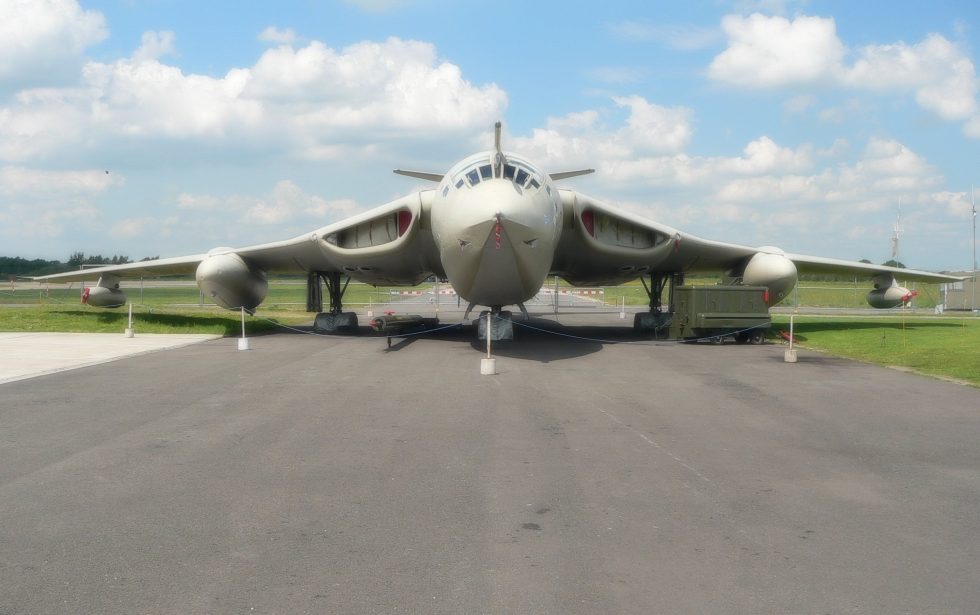
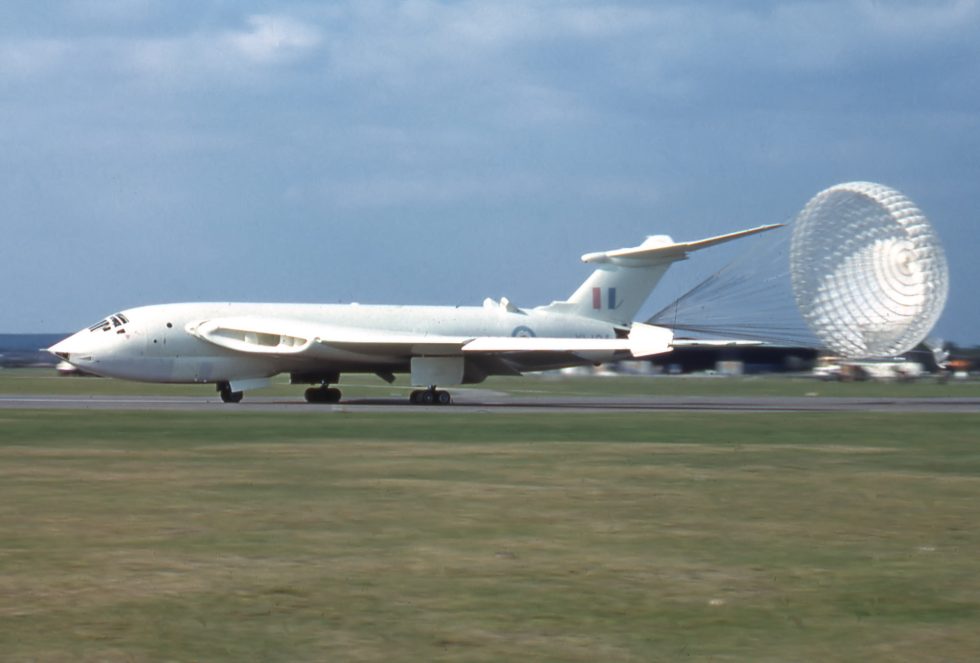
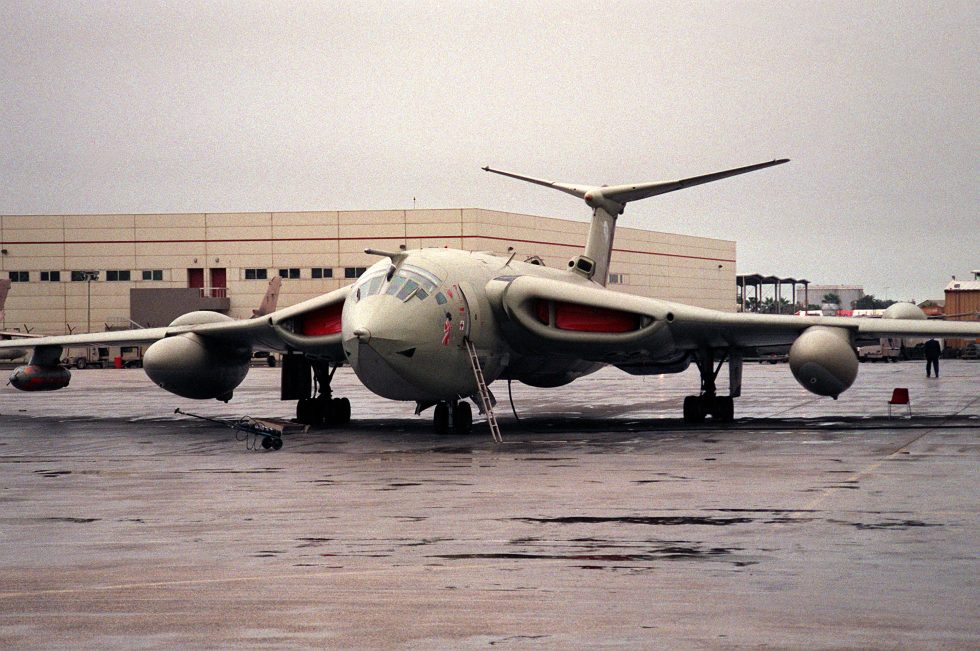
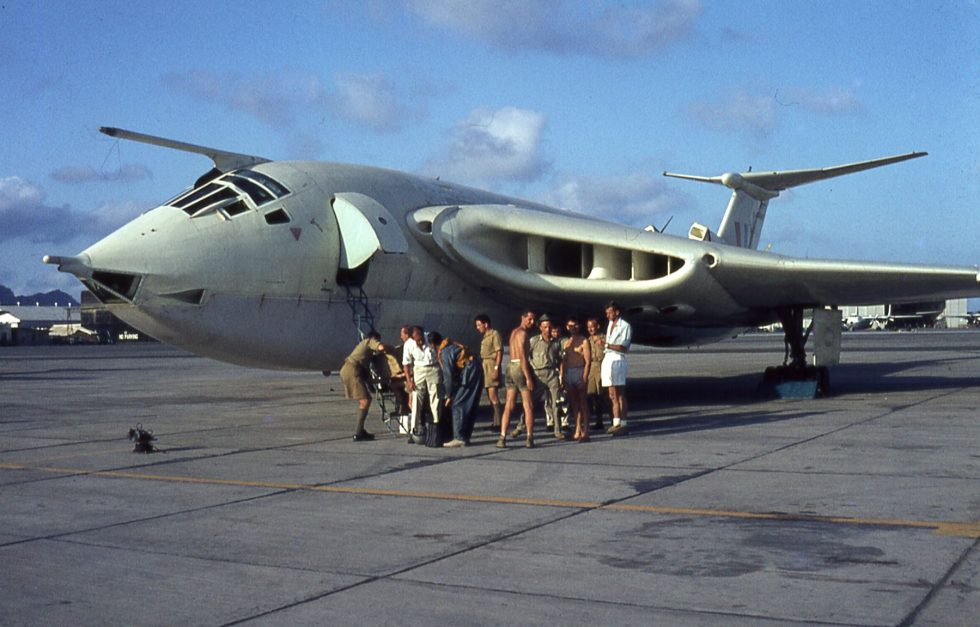
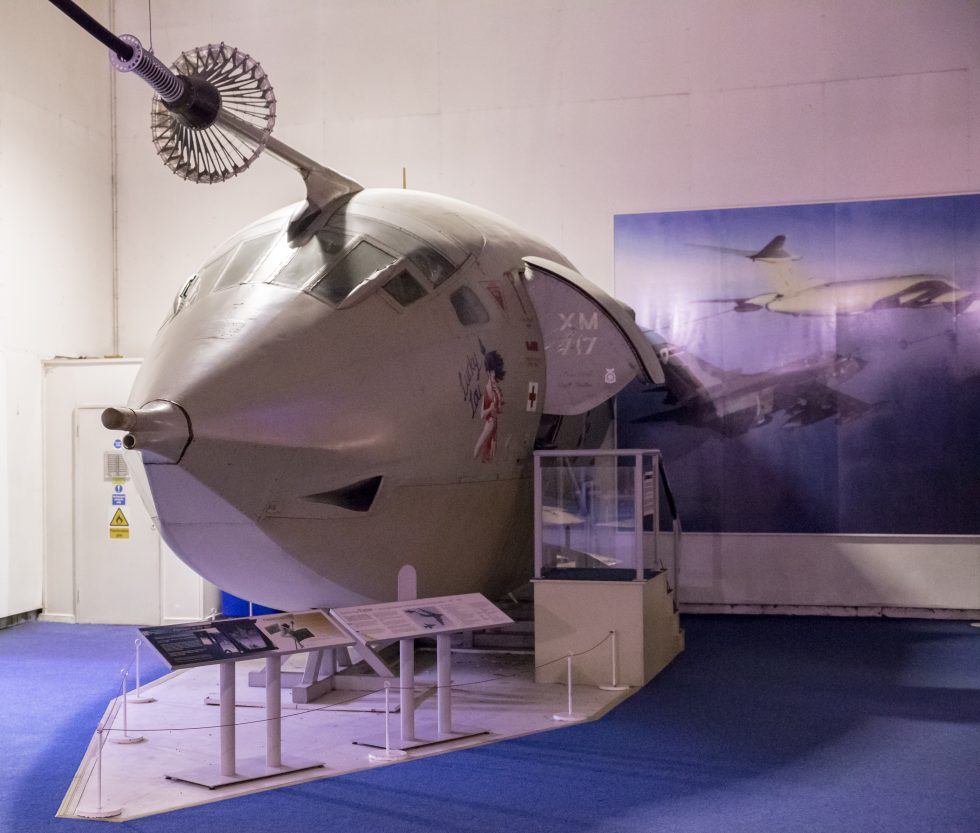
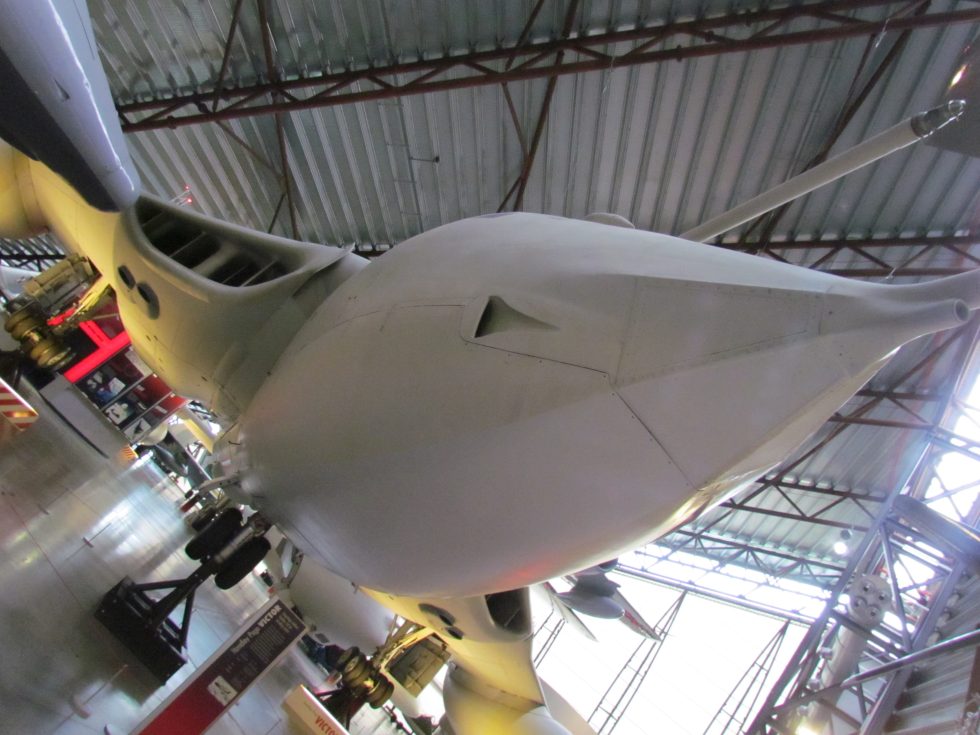
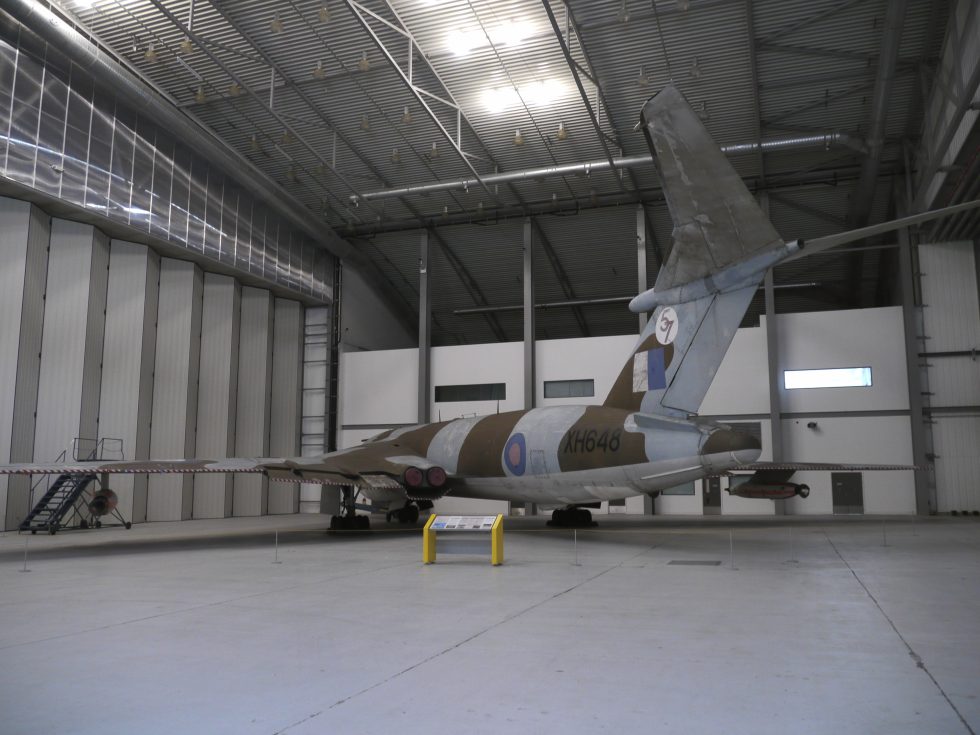
The Victor in motion
A hand-picked Handley Page Victor documentary is coming soon to this exhibit. In the meantime, explore the photo gallery above and the full combat record and operations map below.
Where the Victor served
The score that defines it
The Victor never fought as a bomber in anger — its nuclear weapons were, thankfully, never used, and by the time Britain went to war in the South Atlantic it was flying as a tanker. Its combat legacy is written not in bombs dropped but in the operations it made possible: above all the Black Buck raids of 1982, where a fleet of Victor tankers reached across the South Atlantic to put a single Vulcan over Port Stanley in the most complex aerial-refuelling operation of its day.
Compare the combat record of every military aircraft. Figures as of July 2026.
Everything people ask about the Victor
Can I fly in a Handley Page Victor?
What were the three V-bombers?
Why did the Victor have that unusual crescent wing?
Why was the Victor turned into a tanker?
What was the Victor’s role in the Falklands War?
How fast was the Victor?
What weapons did the Victor carry?
When did the Victor retire?
You can’t fly the Victor.
These, you can.
Some legends only live in museums — others are fuelled and waiting. MiGFlug has put civilians in real military jet cockpits since 2004.
 Fly the L-39 AlbatrosThe world’s most-flown jet trainer — aerobatics included
 Fly the F-104 Starfighter“The missile with a man in it”
 Fly the MiG-21The Cold War’s most-produced jet
 Fly the T-33 Shooting StarAmerica’s first jet trainer
 Fly the DH VampireA piece of early jet history
 Fly the S.211Agile Italian jet trainer
 Fly the MB-326The classic Aermacchi jet
 Fly the MiG-15The Soviet legend of the Korean War
Continue the tour
Every fact, checked
- RAF Museum — Air-to-air refuelling in the Falklands WarThe Victor tanker relay behind Operation Black Buck and the scale of the refuelling plan.
- Royal Air Force — 40th Anniversary of Op Black BuckOfficial RAF account of the Black Buck raids and the tanker support that enabled them.
- Thunder & Lightnings — Handley Page Victor historyDetailed development, variants, tanker conversion, Falklands and Gulf War service.
- AirVectors — The Handley Page VictorDesign, the crescent wing, Blue Steel and the bomber-to-tanker story.
- Yorkshire Air Museum — Victor K.2 “Lusty Lindy”Preserved, fast-taxi-able Victor K.2 at Elvington and its service history.
- Federation of American Scientists — VictorThe Victor in Britain’s nuclear forces: V-Force role, Blue Steel and QRA.
- Vulcan to the Sky Trust — Operation Black BuckThe Vulcan and Victor tanker plan for the 1982 Falklands raids.
- MiGFlug Afterburner — The Handley Page Victor: nuclear bomber turned tankerMiGFlug’s own feature on the Victor’s crescent wing and its two careers.