
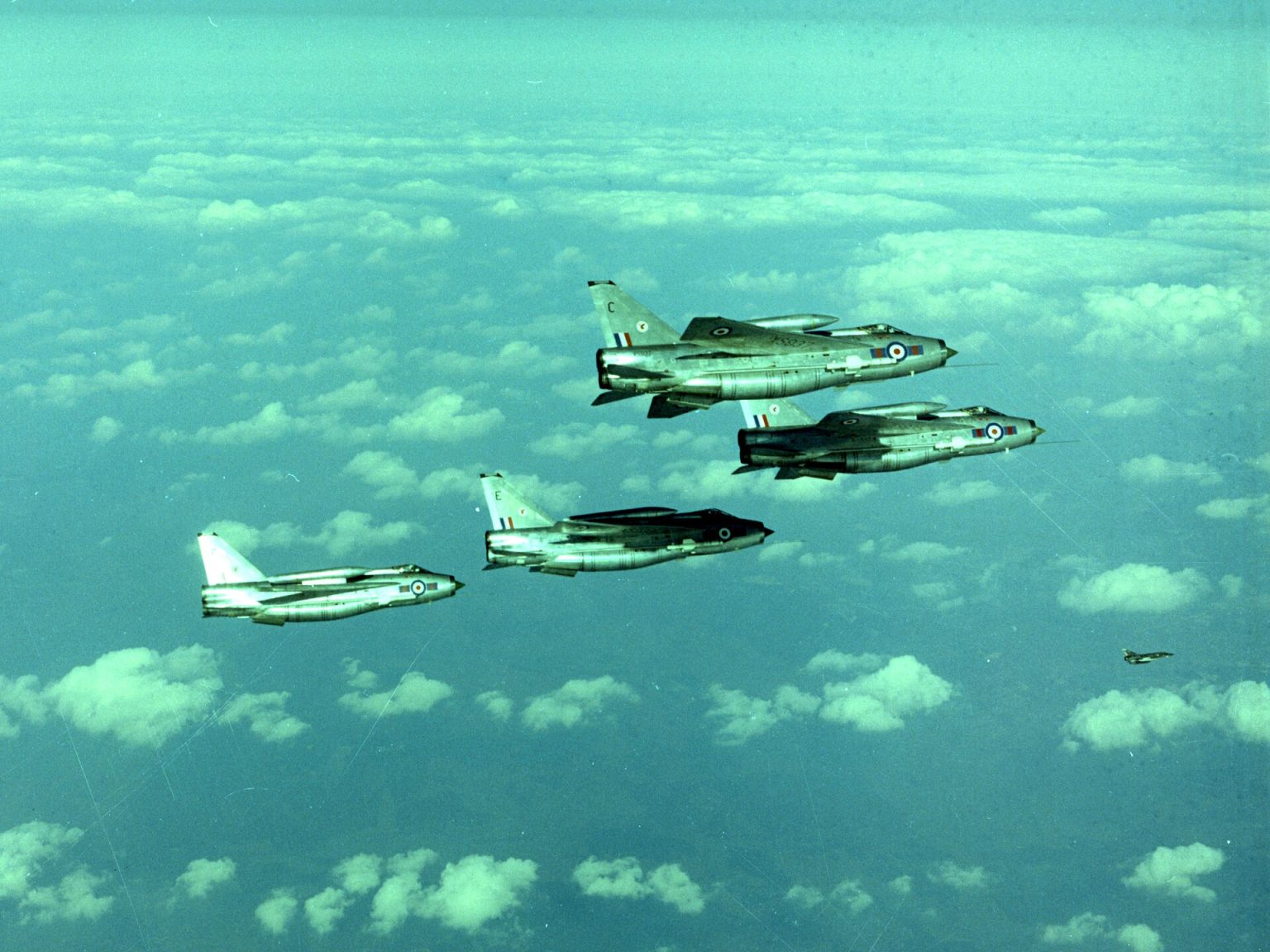
English Electric
Lightning
Britain’s Cold War rocket with wings — a twin-engined interceptor that could stand on its tail and climb almost vertically to the edge of the stratosphere, and the only RAF fighter ever built purely to go up, fast.
Built to go straight up
In the late 1940s, English Electric’s chief engineer W. E. W. “Teddy” Petter set out to give Britain something it had never had: a fighter that could reach supersonic speed in level flight and climb to meet a nuclear bomber before it could reach its target. The result of that idea, the research aircraft P.1, first flew in 1954 and quietly went supersonic days later. Its operational successor, the P.1B, became the Lightning — and in 1958 it was the first British aircraft to reach Mach 2.
Everything about the Lightning was bent toward one job: get up, fast. Two Rolls-Royce Avon engines were mounted one on top of the other in a vertically stacked, staggered layout — the thrust of two engines with the frontal drag of about one and a half. Fed by a single nose intake, the aircraft could rotate off the runway and climb at close to 20,000 feet per minute, standing almost vertically on a column of reheat. At airshows it became famous for exactly that: a near-vertical rocketing departure that no other fighter of its day could match.
It entered RAF service in 1960 and guarded British airspace for nearly three decades, scrambling again and again to intercept Soviet aircraft probing the North Sea. Its Achilles heel was fuel: the Lightning drank it so fast that a full-reheat climb could empty the tanks in minutes, and its combat radius was measured in low hundreds of kilometres. It was a magnificent sprinter with almost no stamina — and pilots adored it anyway. The last RAF Lightnings flew in 1988.
01The English Electric Lightning’s vertical-climb legend: how a 1950s fighter out-climbed almost everything
The Lightning’s party trick was real. Using its optimum climb profile with both engines in reheat, it would lift the nose steeply off the runway and settle into a sustained climb of roughly 20,000 ft/min, reaching 36,000 ft in under three minutes. At displays, pilots would rotate into a near-vertical climb straight after take-off, the jet apparently hanging on its afterburners as it disappeared upward — an image that defined the aircraft.
The official service ceiling was kept secret; low-security RAF documents simply said “in excess of 60,000 ft.” In practice Lightnings could zoom-climb far higher: pilots recorded ballistic climbs to 80,000–88,000 ft, and one F.53 was reportedly taken above 87,000 ft over Saudi Arabia. These were not sustained level flight — the aircraft ran out of air to breathe — but they let the Lightning reach targets that were supposed to be untouchable.
What makes the Lightning special
An interceptor that climbed like a missile
The Lightning was optimised for one thing: getting to altitude before an incoming bomber could release its weapon. With two Avons in full reheat it climbed at about 20,000 ft/min and could reach Mach 2 at height. Its official ceiling was secret — stated only as “in excess of 60,000 ft” — but in zoom-climbs it reached far higher, intercepting U-2 spyplanes at altitudes they had thought safe.
Two engines, stacked one above the other
Uniquely, the Lightning’s two Rolls-Royce Avon turbojets were mounted vertically stacked and staggered fore-and-aft, fed by a single nose intake. The layout gave the thrust of two engines with the frontal drag of only about 1.5 — a claimed 25% drag reduction over side-by-side twins — plus excellent handling with no asymmetric thrust if one engine failed. The penalty was maintenance: reaching the lower engine was awkward, and a fire in the upper engine bay was a recurring hazard.
Guns above, missiles below, fuel everywhere
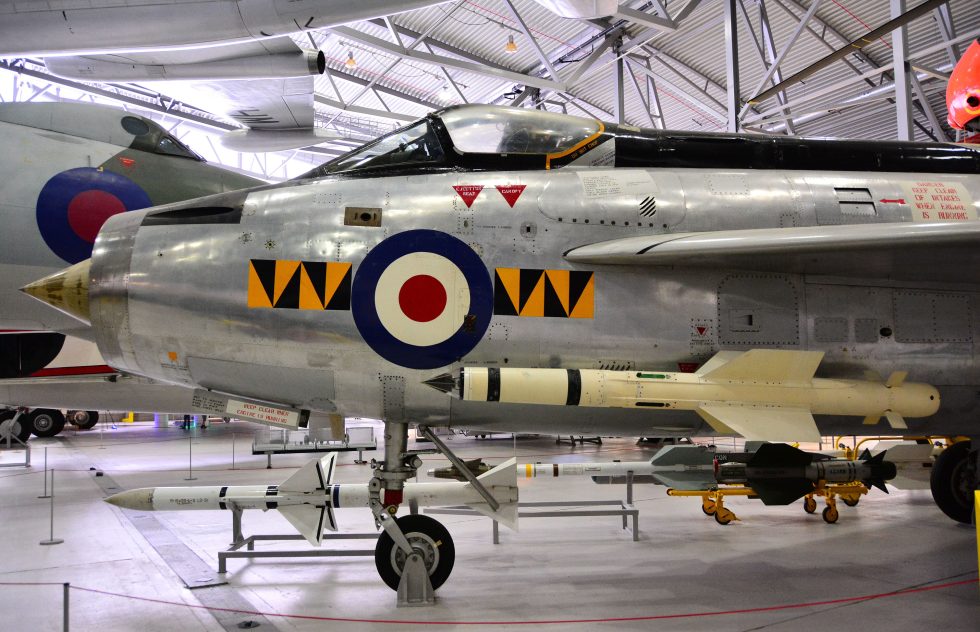
Weapons were packed around a slim fuselage: two 30 mm ADEN cannon ahead of the cockpit and an interchangeable belly weapons pack carrying two Firestreak or later Red Top heat-seeking missiles. Export F.53s even gained over-wing hardpoints for bombs and rockets. But the airframe was so fuel-hungry that later marks bolted a huge non-jettisonable ventral tank under the belly and ferry tanks over the wings — still never curing its notoriously short range.
02The English Electric Lightning’s stacked Avon engines: clever aerodynamics, awkward maintenance
Most twin-engined fighters place their engines side by side. English Electric instead stacked the Lightning’s two Avons one above the other, staggered so the lower engine sat slightly forward. Fed by a single circular nose intake that split the airflow vertically behind the cockpit, the arrangement kept the fuselage narrow and cut drag sharply — the thrust of two engines with roughly the drag of 1.5. It also meant there was no asymmetric-thrust problem if one engine quit. The downsides were real: the engines sat close enough that an uncontained failure could wreck both, an engine change on the lower unit was a major job, and leaking fluid onto the hot upper engine casing — which could reach 600 °C, protected by a gold-bearing heat-reflective paint — made fire a persistent worry.
03The English Electric Lightning’s fuel problem: a sprinter with no stamina
The Lightning’s great weakness was endurance. The original specification asked only for a radius of operation of about 150 miles from its bases, and the thin wings that made it fast left little room for fuel. A full-reheat climb could burn through the tanks alarmingly fast, and typical sorties were short. Designers fought back with ever-larger tanks: a big ventral belly tank (made non-jettisonable and enlarged to 610 imperial gallons on the F.6), enlarged wing leading-edge tanks, and finally jettisonable ferry tanks mounted over the wings. These extended its reach for deployments but capped top speed to around 1,000 mph. The Lightning never shook off its reputation as a thirsty aircraft that had to be flown with one eye always on the fuel gauge.
Full Lightning specifications
Figures are for the Lightning F.6, the definitive RAF mark, with the cambered wing, the enlarged non-jettisonable ventral tank and overwing ferry-tank pylons. Where the F.1, F.3 and the export F.53 differ, the delta is given in grey alongside. Lightning performance was Cold War sensitive and the pilot's notes deliberately understated the top end, so several numbers here are best-available rather than definitive.
Dimensions & weights
- Crew
- 1 (the T.4 and T.5 trainers seated two, side by side, in a widened forward fuselage)
- Length
- 16.84 m (55 ft 3 in, including the intake shock cone)
- Wingspan
- 10.62 m (34 ft 10 in)
- Height
- 5.97 m (19 ft 7 in)
- Wing area
- 44.08 m² (474.5 sq ft, 60-degree swept notched delta)
- Empty weight
- 14,092 kg (31,068 lb — the zero-fuel weight with pilot, cannon, ammunition and two Red Tops aboard; stripped of those the airframe is 12,591 kg / 27,759 lb)
- Loaded weight
- 18,632 kg (41,076 lb, full internal fuel and two Red Top missiles)
- Max takeoff weight
- 20,752 kg (45,750 lb; above 20,412 kg / 45,000 lb the mainwheel tyres were treated as single-use)
- Internal fuel
- ~5,690 L (~1,251 imp gal: 716 imp gal in the wings and flaps plus a 535 imp gal ventral tank with the cannon pack fitted, 610 imp gal without it. The F.1 carried 700 imp gal in total, all of it in the wings.)
Performance
- Max speed
- Mach 2.0 — 2,124 km/h at 11,000 m (1,320 mph at 36,000 ft; 700 kn IAS, about 1,296 km/h, down low. The small-fin F.1, F.1A and F.2 were held to Mach 1.7 by fin stability and shock-cone heating.)
- Cruise speed
- Mach 0.87 — 924 km/h at 11,000 m (574 mph at 36,000 ft, dry thrust; the standard transit and loiter profile)
- Rate of climb
- 102 m/s (20,000 ft/min, sustained to 30,000 ft at operational weight; 22,000 ft/min clean, and zoom-climb rates of 50,000 ft/min have been quoted). 36,000 ft in 2.8 minutes from brake release. The Lightning could rotate off the runway and go vertical, and in 1984 Flt Lt Mike Hale intercepted a U-2 at a height thought safe at 66,000 ft, then ballistic-climbed an F.3 to 88,000 ft. This is the number the aeroplane is remembered for.
- Service ceiling
- 18,300 m (60,000 ft; RAF documents said only "in excess of 60,000 ft". Zoom ceiling above 21,300 m / 70,000 ft, and a Saudi F.53 was taken to 87,300 ft.)
- Combat radius
- ~250 km (~135 nmi on a supersonic intercept — target engaged 10.7 minutes after brake release, home in a 35-minute total sortie. A subsonic profile stretched it to ~685 km / 370 nmi with 15 minutes on station.)
- Ferry range
- ~1,480 km (~800 nmi on internal fuel; ~2,040 km / 1,100 nmi with the two overwing tanks, which capped speed at a reported 1,000 mph)
- Takeoff run
- 610–915 m (2,000–3,000 ft, military power or full reheat; 50 ft cleared in 497 m / 1,630 ft of ground distance)
- Landing run
- 1,000–1,200 m (3,300–3,900 ft, brake parachute streamed, with Dunlop Maxaret anti-skid brakes; published figures vary with weight and chute use, and a tailhook for airfield arrestor gear backed it up)
- Load factor
- +6 g (the commonly quoted operational limit, reduced with overwing tanks fitted. At high Mach the fin, not the wing, was the real constraint — two development aircraft were lost to fin failure during high-speed rolls.)
Propulsion & systems
- Engines
- 2 × Rolls-Royce Avon 301R afterburning turbojets (stacked vertically in the fuselage, one above and behind the other, rather than side by side — a genuinely unusual arrangement that kept the frontal area and the drag of a twin-engined fighter down to something close to a single. The bill came in maintenance: reaching the upper engine meant working through the lower one's bay, and fluid leaking down from the top engine was a recurring fire hazard.)
- Thrust each
- 56.4 kN dry, 72.8 kN reheat (12,690 lbf and 16,360 lbf. The F.1A's Avon 210R gave 50.0 kN / 11,250 lbf dry and 64.2 kN / 14,430 lbf in reheat.)
- Armament
- 2 × 30 mm ADEN cannon, 120 rounds each, plus 2 × de Havilland Firestreak or Hawker Siddeley Red Top infrared missiles (guns in the front of the ventral pack on the F.6, in the upper nose on early marks, and deleted altogether on the F.3. Missiles rode an interchangeable forward-fuselage pack. No radar-guided weapon was ever carried.)
- Radar
- Ferranti AI.23 AIRPASS (Airborne Interception Radar and Pilot's Attack Sight System, housed in the intake centre-body; AI.23B from the F.3 onward for forward-hemisphere Red Top shots. An early integrated radar and attack-sight system, but with no look-down capability, so ground-controlled interception found the target and the Lightning flew the last few miles.)
- Fuel capacity problem
- Inadequate from the start — and by design, not by accident. The P.1 fuselage was so tightly packed with stacked engines that there was no room for fuel at all, so it went into the thin wings: 700 imp gal on the F.1, against a specification asking only for a 150-mile radius of action. Endurance was famously short; a supersonic intercept was a 35-minute sortie that ended in the circuit with 800 lb of fuel. The 610 imp gal non-jettisonable ventral tank on the F.6 nearly doubled the fuel, and the jettisonable overwing ferry tanks stretched deployments, but both were fixes bolted onto a shape whose limitation had been designed in years earlier.
- First flight
- 4 April 1957 (P.1B XA847, Roland Beamont, supersonic on the first flight; the earlier P.1A prototype flew on 4 August 1954)
- Service entry
- 1959 (F.1 deliveries from December 1959; 74 Squadron at RAF Coltishall was the first operational unit in July 1960. The RAF flew the type until 30 June 1988.)
- Built
- ~340 (usually given as 337: roughly 277 single-seat fighters, 52 two-seat trainers and the prototype and development airframes, every one of them assembled at Samlesbury)
- Unit cost
- ~GBP 0.3–0.6 million per airframe in 1960s money (a hedged figure. No audited flyaway price was ever published, and quoted values swing with the mark and with whether spares, weapons and support are folded in; the export F.53 packages were priced as programmes, not per aircraft. Very roughly GBP 6–12 million in today's money.)
- Cost per flight hour
- ~USD 30,000–50,000 per hour if one flew today (an order-of-magnitude estimate, not a published figure — neither the RAF nor any export operator released a Lightning flight-hour cost, and there is nothing currently flying to benchmark against. A small number of UK airframes are kept in fast-taxi running condition at Bruntingthorpe, Cranfield and the former RAF Binbrook, which burns fuel and engine life without ever leaving the ground. The only recent civil flying was Thunder City's in South Africa, whose passenger sorties were priced in five figures in US dollars for well under an hour — a price, not a cost. Two thirsty Avons, the stacked-engine access problem and a spares chain that no longer exists all push the real number toward the top of that band.)
04The English Electric Lightning’s cost: why no clean price exists
The Lightning was a 1950s–60s British state defence programme, not an aircraft sold on an open market, so a single tidy flyaway price is hard to pin down. Contemporary figures for a Lightning were of the order of several hundred thousand pounds each in 1960s money — a large sum for the era — and the aircraft was notoriously expensive to keep flying, demanding intensive maintenance because of its complex systems, stacked engines and fire-prone bays. Export customers Saudi Arabia and Kuwait paid a premium for support packages. Any precise cost-per-flight-hour figure you see for the Lightning should be treated as an estimate rather than a sourced number.
Armament & payload
The Lightning carried two missiles and two guns, and that was the entire argument
The Lightning was built to do one thing: get off the ground at Binbrook or Wattisham, climb faster than anything else in the sky, and put a pair of infrared missiles into a Soviet bomber heading for the United Kingdom. Judged on that job it was superb, and pilots loved it — the climb and acceleration are still remarkable sixty years on. Judged on anything else it was narrow to the point of severity. Two missiles, no reloads, no radar-guided weapon, no look-down radar, no meaningful air-to-ground capability in RAF hands, and an endurance measured in tens of minutes. That narrowness was deliberate: the 1957 Defence White Paper environment assumed the manned fighter was on its way out and missiles would take over, so the Lightning was funded as the last British interceptor rather than the first of a family. Only the export F.53 stretched the airframe into a multirole aircraft, and the RAF never bought that capability.
Cannon
Two 30 mm ADEN cannon with 120 rounds each. On the F.1, F.1A and F.2 they sat in the upper nose, and a swap-in forward pack could add two more for four guns on the F.2A. The F.3 deleted them entirely on the doctrine that missiles were sufficient — a decision pilots disliked intensely, because a peacetime interception often calls for a warning burst rather than a missile, and because the Red Top could not be fired at everything a Lightning was sent to look at. Guns came back on the F.6, mounted in the front of the ventral tank, at a cost of 75 imp gal of fuel.
Air-to-air missiles
Two de Havilland Firestreak infrared missiles on the early marks: rear-hemisphere only, so the Lightning had to be manoeuvred into a stern chase before it could shoot. The Hawker Siddeley Red Top that followed on the F.3 and F.6 had a larger warhead, a better seeker and forward-hemisphere capability, with a launch limit around Mach 1.8. Two rounds was the whole magazine; the missiles sat on an interchangeable forward-fuselage pack rather than on pylons, and there was no way to carry more.
Ground attack (export marks)
Unique to the F.53. Two extra underwing hardpoints carried up to two 1,000 lb bombs, or SNEB pods of eighteen 68 mm rockets each, and a retractable ventral launcher held 44 unguided 2 in rockets. BAC also proposed clearing the overwing pylons for weapons and Matra JL-100 combined rocket-and-fuel pods, which on paper gave a developed export Lightning six 1,000 lb bombs, or 44 rockets of 2 in plus 144 of 68 mm. Carrying ordnance above the wing is an unusual sight, forced by the fact that the wing underside was full of retracted undercarriage. Royal Saudi Air Force F.53s flew ground-attack sorties against targets on the Yemeni border in 1969. No RAF Lightning ever had this fit.
Fuel tanks & range extension
The F.6 carried a 610 imp gal non-jettisonable ventral tank, cut to 535 imp gal when the cannon pack went in the nose of it, plus two jettisonable 260 imp gal ferry tanks on overwing pylons. Overwing again because there was nowhere underneath to hang them. They roughly doubled deployment range but capped speed at a reported 1,000 mph, so they were a transit fit, not a combat one. An in-flight refuelling probe under the port wing arrived with the F.1A, and Victor tankers effectively became part of the Lightning weapon system.
Radar & interception
Ferranti AI.23, known as AIRPASS: Airborne Interception Radar and Pilot's Attack Sight System, packaged inside the conical centre-body of the nose intake, with AI.23B from the F.3 to support forward-hemisphere Red Top shots. It was an advanced integrated system for the late 1950s, driving both the radar picture and the sight, but it had no look-down or shoot-down capability against low-flying targets. In practice the UK ground radar chain and the fighter controller did the finding; the Lightning did the last few miles very fast indeed.
Reconnaissance fit
Because the forward-fuselage weapons pack was interchangeable, the export F.53 could take a reconnaissance pack carrying five 70 mm Vinten Type 360 cameras in place of its missiles. Changing role between interception, reconnaissance and ground attack was a matter of swapping packs on the flight line, and that flexibility was BAC's main selling point to Saudi Arabia and Kuwait. RAF Lightnings were never given a reconnaissance fit.
Three typical Lightning fits
- QRA intercept (F.6)
- Two Red Top missiles, two 30 mm ADEN with 120 rounds each in the ventral pack, full internal and ventral fuel, no overwing tanks. The Quick Reaction Alert fit: two aircraft held at cockpit readiness, airborne within minutes, sent north under ground control to identify and shadow Soviet Tu-95 and Tu-16 aircraft probing towards UK airspace — frequently with tanker support arranged before the wheels were up, because the fuel state allowed nothing else.
- Practice intercept
- Two acquisition-round missiles — seeker heads without motor or warhead — guns loaded or empty, ventral fuel, no overwing tanks. Thirty-five to forty-five minutes wheels-up to wheels-down, which on this aeroplane counted as a full sortie and usually included a practice diversion because the fuel margin was so thin.
- F.53 ground attack
- Two 1,000 lb bombs or four SNEB rocket pods on the underwing pylons, the retractable 44-round 2 in rocket launcher in the ventral pack, cannon fitted, ventral fuel full. The export profile the RAF never flew, and the only configuration in which a Lightning was a strike aircraft.
Almost every statement about Lightning armament is mark-dependent, and the type contradicts itself across its own production run: the F.1 had nose cannon and rear-aspect Firestreaks, the F.3 had no cannon at all and all-aspect Red Tops, the F.6 put the cannon back into the fuel tank, and only the export F.53 could carry a bomb. Any single-line summary of what a Lightning carried is wrong for most of the fleet.
Variants
Lightning marks, from nineteen F.1s to the Saudi F.53
The Lightning was developed forwards under constant pressure from two directions: more thrust and higher Mach numbers on one side, and the same nagging fuel problem on the other. Almost every mark change is a response to one or the other. The political backdrop matters too — the 1957 Defence White Paper assumed guided missiles would replace manned fighters, so the Lightning was developed as an endpoint rather than as the first of a line, and the multirole growth that would have been normal elsewhere happened only on the export aircraft. Set against that, the RAF still flew it on Quick Reaction Alert until 1988, its maintenance burden was heavy and its serviceability rates ordinary, and the pilots who flew it have never stopped talking about it.
- F.1 / F.1A
- 19 F.1s delivered from December 1959 and 28 F.1As from 1961. Avon 200-series engines, small fin, Mach 1.7 limit, twin nose ADEN, two Firestreaks and AI.23. The F.1A added an in-flight refuelling probe and UHF radio. Short front-line careers, then conversion training.
- F.2 / F.2A
- 44 F.2s from 1962, essentially a refined F.1A. 31 were rebuilt as F.2A with the cambered wing, the large ventral tank, an arrestor hook and provision for up to four ADEN. RAF Germany flew them at low level into the late 1970s, and they had the longest endurance of any RAF Lightning, around two hours. Five ex-RAF F.2s became F.52s for Saudi Arabia.
- F.3
- 70 built from 1964. Avon 301R engines, a larger square-cut fin, strengthened shock cone clearing Mach 2.0, AI.23B and Red Top — and no cannon whatsoever. The highest-performing Lightning yet and the thirstiest, so its radius of action was worse than the aircraft it replaced. 16 interim F.3As with the big ventral tank and cambered wing followed as a stopgap.
- F.6
- The definitive RAF mark: 39 new-build plus nine converted from F.3 and 15 from F.3A. Cambered wing, 610 imp gal non-jettisonable ventral tank, overwing ferry-tank pylons, Red Top, and eventually two ADEN restored in the front of the ventral pack. This was the aircraft on QRA at Binbrook to the end in 1988.
- T.4 and T.5 trainers
- Side-by-side two-seat conversion trainers: 22 T.4s based on the F.1A from 1962, and 22 T.5s based on the F.3. Both retained combat capability in principle and served the Lightning Conversion Unit. The side-by-side cockpit meant a wide, draggy forward fuselage and a modest performance penalty.
- F.53 (Saudi / Kuwait export)
- 46 built, 34 for the Royal Saudi Air Force and 12 for Kuwait, plus one converted from an F.6. F.6 airframe and avionics with two extra underwing hardpoints, and swap-in forward packs for missiles, a 44-round rocket launcher or five Vinten cameras. The only genuinely multirole Lightning. Saudi service ran from 1967 to 1986, Kuwaiti from 1968 to 1977, and serviceability suffered from the same maintenance difficulty the RAF knew well.
- T.55 export trainer
- Eight built, six for Saudi Arabia and two for Kuwait, plus one converted from an RAF T.5 that crashed before delivery. Unlike the RAF two-seaters it was fully combat-equipped, combining the T.5 fuselage with the F.6 wing and large ventral tank.
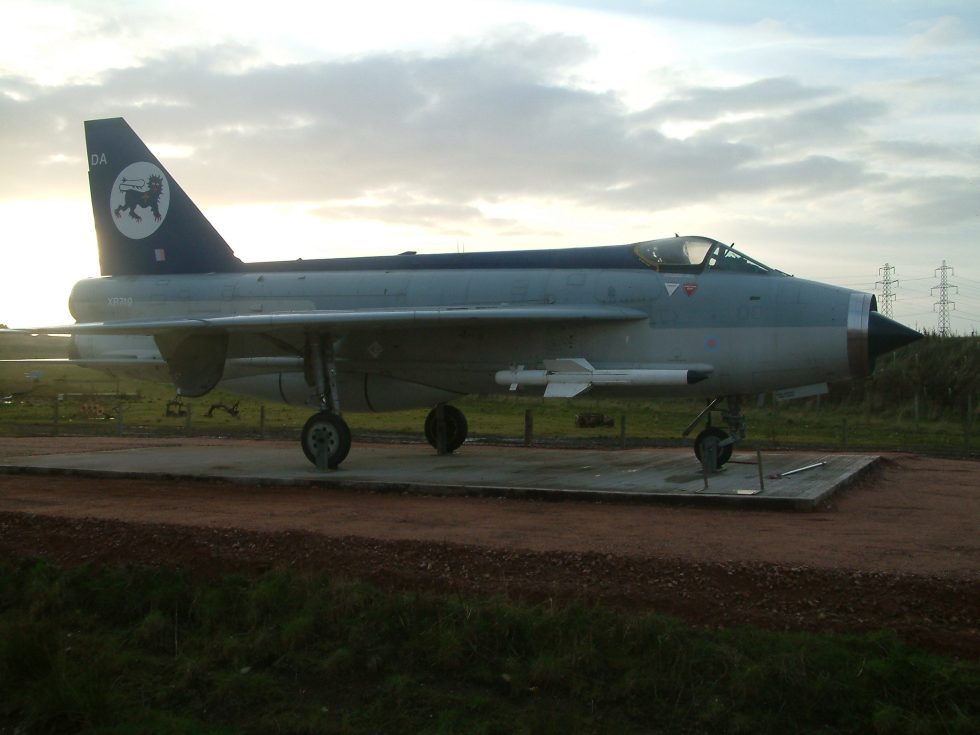
A good number of Lightnings survive. Dozens sit in British museums and as gate guardians, and several are maintained in fast-taxi running condition — engines lit, reheat occasionally seen, but never airborne — at sites including Bruntingthorpe, Cranfield and the former RAF Binbrook. A handful were flown privately in South Africa by Thunder City at Cape Town, offering passenger sorties, until a fatal accident at the Overberg airshow on 14 November 2009 effectively ended that operation; one aircraft flew again briefly after restoration before Thunder City closed in 2016, and its surviving airframes have since been stored or sold on. No Lightning is known to be flying anywhere today.
From research prototype to Cold War guardian
The P.1 takes shape
English Electric’s Teddy Petter proposes a supersonic fighter; the Ministry of Supply backs the P.1 research aircraft with its distinctive 60° swept wing and stacked engines.
First flight
Roland Beamont flies the P.1A (WG760) on 4 August from Boscombe Down; it goes supersonic in level flight days later.
P.1B — the real Lightning
The reheated, radar-equipped P.1B first flies on 4 April, the true prototype of the operational interceptor.
Mach 2 and a name
On 25 November the P.1B becomes the first British aircraft to reach Mach 2; the type is officially named “Lightning.”
Enters RAF service
No. 74 Squadron at Coltishall receives the Lightning F.1 from July — the RAF’s first Mach-2 interceptor.
Catching the uncatchable
Interception trials prove the Lightning can reach U-2 spyplanes at up to 65,000 ft under ground control.
The accidental flight
Engineer Wg Cdr “Taffy” Holden, not a fast-jet pilot, accidentally takes off in Lightning XM135 during a ground run — and lands it safely. Saudi and Kuwaiti export orders are placed the same period.
Overtaking Concorde
During BA trials, only a Lightning — XR749, flown by Mike Hale — manages a stern intercept and overtakes Concorde where F-15s and F-14s could not.
The last Lightnings
The RAF retires the type; the final flight is on 30 June from Binbrook. It is replaced by the Tornado F3.
From the cockpit: twelve Lightning stories
The fighter that had to go up
Teddy Petter’s 1940s vision was a jet that could climb to a bomber before it struck.
Read the full story
Standing on its tail
The near-vertical take-off climb became the Lightning’s signature and the reason crowds loved it.
Read the full story
The engineer who accidentally took off
Wg Cdr “Taffy” Holden, an engineering officer, unintentionally got airborne in Lightning XM135 — and brought it home.
Read the full story
Reaching the U-2
Lightnings proved they could intercept the high-flying U-2 spyplane at heights thought to be safe.
Read the full story
The jet that caught Concorde
Only a Lightning managed to overtake Concorde during a NATO intercept exercise.
Read the full story
Two engines, one on top of the other
The stacked-Avon layout was the Lightning’s most distinctive engineering feature.
Read the full story
Always watching the fuel
The Lightning’s short range shaped — and limited — everything it did.
Read the full story
Scrambling against the bombers
For nearly three decades the Lightning was Britain’s front-line quick-reaction interceptor.
Read the full story
The Lightning goes to war
Saudi Lightning F.53s flew the type’s only real combat — ground attack over the Yemen border.
Read the full story
A short, hard-pressed career
Kuwait’s small Lightning fleet struggled with maintenance and was gone within a decade.
Read the full story
Thunder City’s Lightnings
Long after RAF retirement, a handful of Lightnings kept flying privately in South Africa.
Read the full story
The end of the sprint
The Lightning bowed out in 1988, out-ranged and out-teched but never out-climbed.
Read the full story
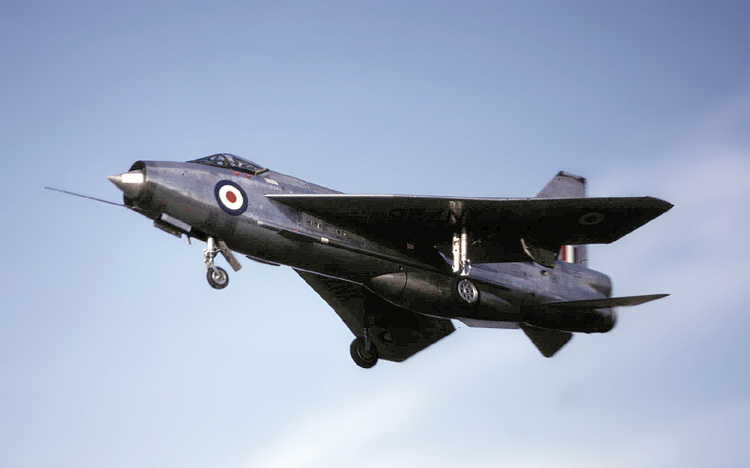
The Lightning in pictures
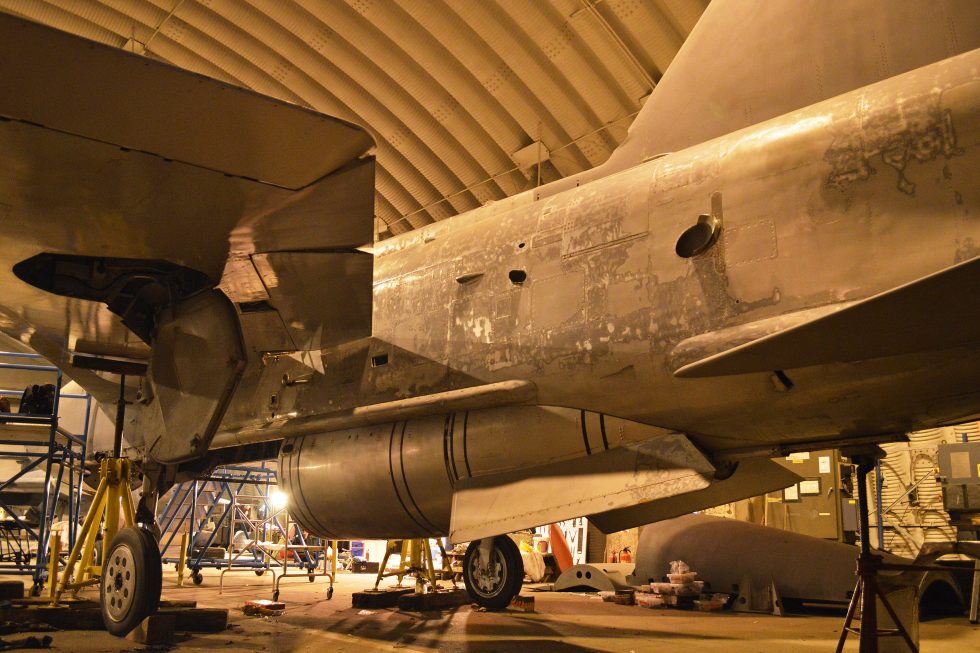
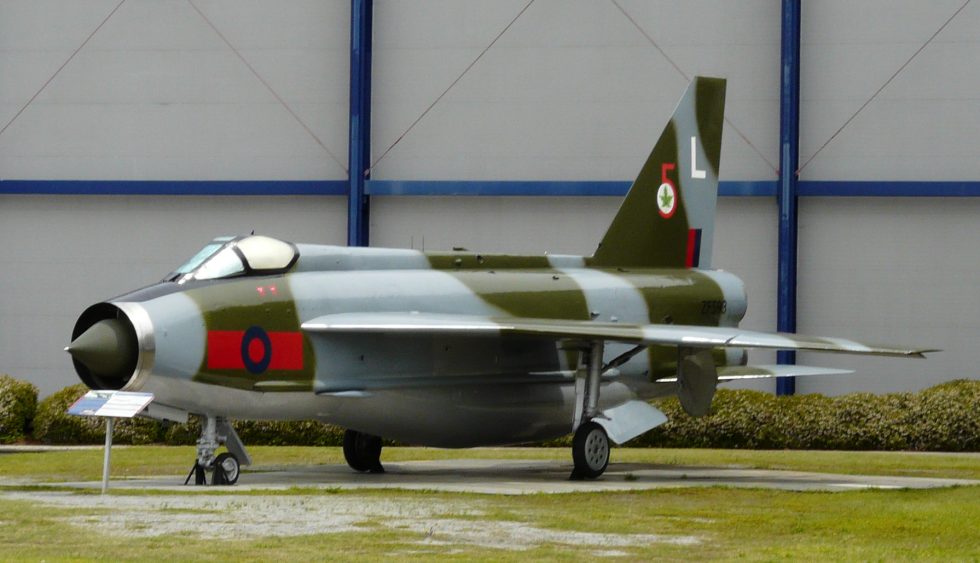
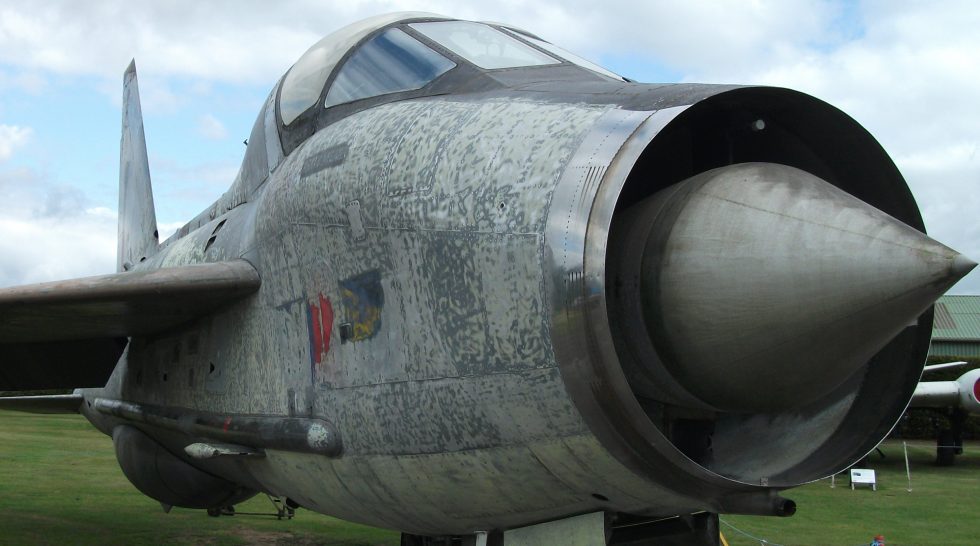
The Lightning in motion
A dedicated Lightning video feature is coming soon. In the meantime, explore the photo gallery above and the twelve stories for the full picture of Britain’s vertical interceptor.
The English Electric Lightning in motion
Megaprojects — one of the most-watched English Electric Lightning films on YouTube.
Where the Lightning flew
The score that defines it
The RAF’s Lightning never fired a shot in anger. It was a pure air-defence interceptor whose whole career was deterrence — scrambling, climbing and shadowing Soviet aircraft, thousands of times, without ever needing to shoot. Its only true combat was flown by export F.53s of the Royal Saudi Air Force in a 1969–70 border conflict with South Yemen. The Lightning’s record is written not in kills, but in intercepts nothing else could reach.
Compare the combat record of every military aircraft. Figures as of July 2026.
Everything people ask about the Lightning
Can I fly in a Lightning?
How fast was the English Electric Lightning?
How high could the Lightning fly?
Why did the Lightning have its engines stacked on top of each other?
Did the Lightning ever see combat?
Is the story of the accidental Lightning flight true?
Why was the Lightning’s range so short?
Are any Lightnings still flying?
You can’t fly the Lightning.
These, you can.
Some legends only live in museums — others are fuelled and waiting. MiGFlug has put civilians in real military jet cockpits since 2004.
 Fly the L-39 AlbatrosThe world’s most-flown jet trainer — aerobatics included
 Fly the F-104 Starfighter“The missile with a man in it”
 Fly the MiG-21The Cold War’s most-produced jet
 Fly the T-33 Shooting StarAmerica’s first jet trainer
 Fly the DH VampireA piece of early jet history
 Fly the S.211Agile Italian jet trainer
 Fly the MB-326The classic Aermacchi jet
 Fly the MiG-15The Soviet legend of the Korean War
Continue the tour
Every fact, checked
- BAE Systems Heritage — English Electric LightningManufacturer heritage record of the Lightning’s development and service.
- The Lightning AssociationDesign and development history maintained by the type’s enthusiast association.
- Key AeroDetailed features on Lightning operations, variants and records.
- The Aviation Geek ClubThe Concorde intercept, U-2 zoom-climbs and cockpit accounts.
- Old Haltonians — “Taffy” Holden’s inadvertent flightAccount of Wg Cdr Holden’s accidental 1966 flight in XM135.
- Imperial War Museums (Duxford)Reference for preserved Lightning airframes, including XM135.
- Royal Air Force MuseumRAF service history, squadrons and retirement of the Lightning.
- Military FactorySpecifications, variants and production summary for the Lightning.