

Neel Kearby was the man who proved the P-47 Thunderbolt could fight in the Pacific. Many pilots there thought the heavy fighter was hopeless against nimble Japanese aircraft. Kearby, commander of the 348th Fighter Group, worked out how to use its weight and diving speed instead, and on 11 October 1943 he showed what that meant: leading four Thunderbolts into a formation of nearly fifty Japanese aircraft over Wewak, New Guinea, he was credited with six of them.
A post on Instagram tells his story well. Most of it checks out; a few details are worth sharpening.
Quick Facts
- Pilot: Col. Neel E. Kearby, US Army Air Forces
- Born: 5 June 1911, Wichita Falls, Texas
- Unit: Commander, 348th Fighter Group (P-47D)
- Famous action: 11 October 1943, near Wewak, New Guinea: six aircraft credited
- Medal of Honor: Presented by General Douglas MacArthur, 23 January 1944
- Victories: 22, the most of any P-47 pilot in the Pacific
- Killed: 5 March 1944, near Dagua, west of Wewak, aged 32
- Aircraft: P-47D “Fiery Ginger”, named after his wife Virginia
Making the Thunderbolt Work
Kearby was a Texan, educated in Arlington, who commanded a P-39 squadron in the Panama Canal Zone before taking over the newly formed 348th Fighter Group in October 1942. It was one of the first groups equipped with the P-47D and the first sent to General George Kenney’s Fifth Air Force in New Guinea with the type. The P-47 was big and heavy, and turning with an Oscar or a Zero was a losing game. Kearby built his tactics around what it did well: climb high, dive in fast with all eight .50-calibre machine guns firing, and use the speed to zoom back up out of reach.
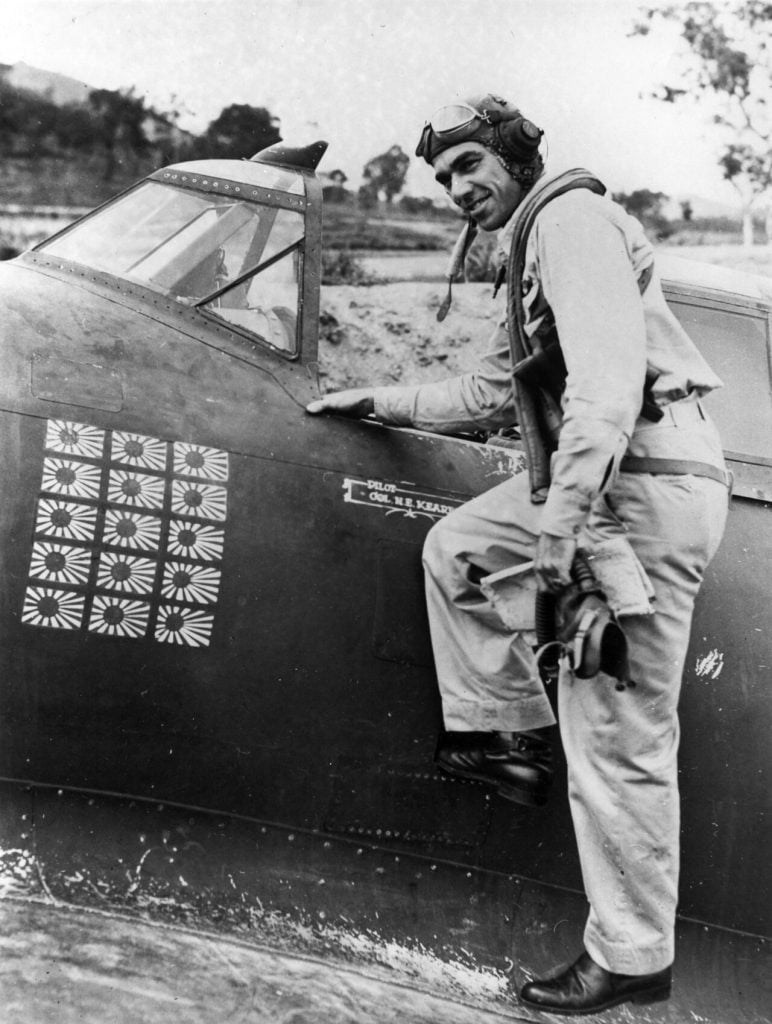
Wewak, 11 October 1943
Kearby had volunteered to lead a four-ship reconnaissance flight over the Japanese bases around Wewak. With the job done and fuel getting low, the flight spotted a large formation: his Medal of Honor citation describes about 12 bombers escorted by 36 fighters, odds of 12 to 1. He led the attack anyway.
According to the citation, he shot down three bombers in quick succession, then destroyed two fighters attacking one of his pilots, and was credited with six aircraft in all, the most by any USAAF pilot in a single mission at the time. All four Thunderbolts got home, landing at an emergency field nearly out of fuel. Later research suggests that all six of his victims were actually fighters, Ki-43 Oscars and Ki-61 Tonys, rather than a mix of bombers and fighters as the citation says.
Kearby’s record did not last. In the US Navy, David McCampbell shot down nine Japanese aircraft in a single mission in October 1944, and in the USAAF William Shomo later beat Kearby’s figure too. We tell McCampbell’s story in Nine Kills in a Single Mission.
The Medal of Honor
Kenney and MacArthur recommended Kearby for the Medal of Honor, and MacArthur presented it on 23 January 1944. By then Kenney had moved him to a staff job at V Fighter Command headquarters. Kenney deliberately encouraged a rivalry between his top aces, including P-38 pilots Richard Bong and Thomas McGuire, who were chasing Eddie Rickenbacker’s First World War record of 26 victories. Kearby kept flying combat missions.
The Last Mission
On 5 March 1944, Kearby led a sweep over Wewak with two other pilots. Near Dagua they attacked three Ki-48 bombers, and Kearby shot down the leader, his 22nd victory. Breaking his own rule, he came round for another pass at low altitude and low speed. A Ki-43 of the 77th Sentai caught him. Witnesses saw him bail out, but his parachute snagged in a tree and he died of his wounds. He was 32.
Australian war graves personnel found the wreck of his P-47 in 1947, and his remains were brought home and buried in Dallas in 1949. The vertical fin of “Fiery Ginger IV”, still showing the bullet holes from the fighter that shot him down, is on display at the National Museum of the US Air Force in Dayton. In 2024 the new National Medal of Honor Museum in Arlington, Texas, his home town, named its theatre after him.
What the Viral Post Gets Right
The essentials are right: the four Thunderbolts against about 48 Japanese aircraft, the low fuel, the diving tactics, the six credited victories, MacArthur presenting the Medal of Honor on 23 January 1944, the fatal second pass on 5 March 1944, the 22 victories, the tail fin in Dayton and the theatre in Arlington. Three refinements. Six kills was a USAAF record for a single mission at the time, not an all-American record that lasted; McCampbell beat it in 1944. The citation’s mix of three bombers and three fighters is not supported by later research, which suggests all six were fighters. And sources differ on the year his remains were found, 1946 or 1947, with most accounts giving July 1947.
View this post on Instagram
Sources: National Museum of the US Air Force, “Col. Neel E. Kearby: Pacific Thunderbolt Ace”; Medal of Honor citation; Pacific Wrecks; Military Times (October 2025); City of Arlington (March 2024); Wikipedia, Neel E. Kearby.


0 Comments