
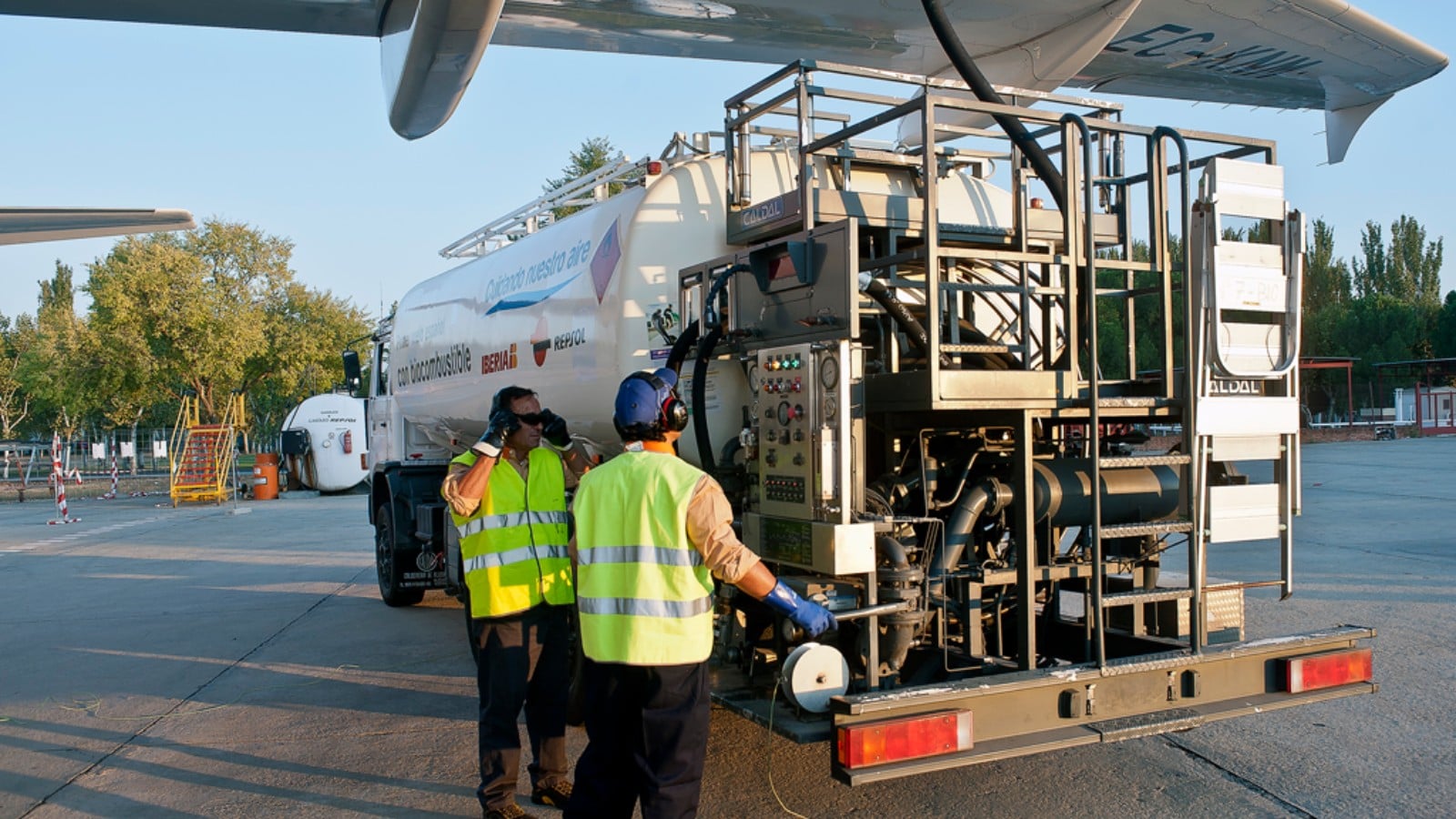
A Boeing 747-8 holds 238,610 litres of fuel. Boeing prints the figure in its own airport planning document, to the litre, alongside the 63,034 US gallons and 191,565 kilogrammes that are the same quantity in other clothes. It is the number search engines are asked for a thousand times a day.
No airline ever fills those tanks. A 747-8 leaving Frankfurt carries what the flight needs, plus a set of cushions that are defined in law. Those cushions are the airline fuel reserves, and they are the interesting part. Each one answers a different question about what might go wrong. Each one is a different size depending on which regulator wrote the rule. And the two radio calls a crew can make when those cushions start to disappear mean very different things, which is a distinction that cost 73 lives before anyone standardised the words.
The capacity is the hook. The planning is the story.
Quick Facts
747-8 usable fuel: 63,034 US gal / 238,610 l / 191,565 kg (Boeing ACAP, Rev C, Aug 2023)
737-8 usable fuel: 6,820 US gal / 25,816 l / 20,730 kg (Boeing ACAP D6-38A004 Rev K, Jul 2025)
US domestic reserve: 45 minutes at normal cruising fuel consumption (14 CFR 121.639)
US flag/supplemental reserve: 10 per cent of trip time, plus alternate, plus 30 minutes holding at 1,500 ft (14 CFR 121.645)
EASA contingency fuel: 5 per cent of trip fuel in the basic scheme, 3 per cent in the approved variation
EASA final reserve: 30 minutes, unchanged by the 2021 rewrite
The two calls: “Minimum fuel” is an advisory. “Mayday mayday mayday fuel” is a distress call.
The wrong question, asked very precisely
Tank capacity is one of the few airliner performance figures the manufacturers publish as a single discrete number rather than a chart. Boeing's 747-8 Airplane Characteristics for Airport Planning, Revision C of August 2023, gives the Intercontinental 63,034 US gallons of usable fuel and the Freighter 59,734, the difference being the tail tank that the Freighter does not have. The 737 MAX document, D6-38A004 Revision K of July 2025, gives every passenger variant from the 737-7 to the 737-10 the same 6,820 US gallons, because they share a wing and a centre tank.
Those are ceilings, not loads. Fuel weighs roughly 0.8 kg per litre, so filling a 747-8 to the brim adds about 191 tonnes to an aircraft whose maximum take-off weight leaves nowhere near that much room once there are passengers and freight aboard. On most routes the tanks could not legally be filled even if an airline wanted to pay for it. What actually gets loaded is a sum: the planned burn, plus the airline fuel reserves. Every term in that sum has a name, a regulation behind it and a different reason for existing.
What the American rule actually says
The US rules are short, old and specific, and they differ depending on where the flight is going. For anything flown as a domestic operation, 14 CFR 121.639 is three lines long. No person may dispatch or take off unless the aeroplane has enough fuel to fly to the airport to which it is dispatched; thereafter to the most distant alternate where one is required; and thereafter, in the regulation's own words, “to fly for 45 minutes at normal cruising fuel consumption”.
Leave the 48 contiguous states and the shape changes. Section 121.645(b), which covers turbine-engined flag and supplemental operations, requires fuel to fly to the destination, then “to fly for a period of 10 percent of the total time required to fly from the airport of departure to, and land at, the airport to which it was released”, then to the most distant alternate, and then “to fly for 30 minutes at holding speed at 1,500 feet above the alternate airport”. That ten per cent is the American contingency fuel, and on a fourteen-hour sector it is close to an hour and a half of flying.
There is a third case that catches people out. Under 121.645(c), a flight released to an airport for which no alternate is specified must carry enough fuel to reach it and then fly “for at least two hours at normal cruising fuel consumption”. Dispensing with the alternate does not save fuel. It costs it.
General aviation lives under 14 CFR 91.167, which asks for the destination, the alternate, and “45 minutes at normal cruising speed” after that. Note the wording: 121.639 says consumption, 91.167 says speed. It is the kind of difference that matters only when it does.
Long overwater flights add another layer. Section 121.646 requires a three- or four-engined aeroplane operating more than 90 minutes from an adequate airport to carry fuel to reach that airport after a rapid decompression at the most critical point, descending in compliance with the oxygen rules, and then to hold for 15 minutes at 1,500 feet and land. The ETOPS version in 121.646(b) goes further again, and includes a requirement to inflate the forecast headwind by five per cent purely to allow for the forecast being wrong.
The European rule is a different shape
Europe does not count in minutes of cruise the way the American domestic rule does. It counts in percentages of the trip, and since Regulation (EU) 2021/1296 it does so inside a framework called a fuel/energy scheme, set out in CAT.OP.MPA.180 and the planning rules in CAT.OP.MPA.181, with aerodrome selection in .182 and in-flight management in .185.
The basic scheme, described in the first set of acceptable means of compliance, prescribes contingency fuel of five per cent of trip fuel. An operator that can demonstrate the right capabilities, including a fuel consumption monitoring programme, may be approved for a variation that reduces it to three per cent. An operator with enough data and enough institutional maturity can go further still and build an individual scheme. The difference between five per cent and three per cent on a long sector is a serviceable amount of payload.
What did not change in the rewrite is the floor. Final reserve fuel remains 30 minutes. That is the quantity which, in European planning language, must still be in the tanks when the wheels touch down, and it is the number that defines both of the radio calls below. Above it sit extra fuel, carried for anticipated delays or specific operational constraints, and discretionary fuel, which the commander may always add and which forms no part of the legal minimum.
Two regulators, then, solving the same problem with different instruments: the Americans with a fixed block of cruise time and a percentage reserved for the long sectors, the Europeans with a percentage throughout and an approval process that lets a well-run airline shrink it. Neither is obviously right. Both end at the same place, which is half an hour of fuel that is not yours to spend.
Captain Joe walks through the same components from the cockpit side, which is a useful corrective to reading them as legal text: the crew sees them as lines on a flight plan that either add up or do not.
Two radio calls, and only one of them is an emergency
This is the part that is misreported most often, including by people who should know better. A crew running low on fuel has two distinct things it can say, and they are not points on a scale. They are different categories of message with different consequences.
The first is an advisory. Under ICAO Annex 6 Part I, as amended in 2012, a commander who has committed to landing at a specific aerodrome and calculates that any change to the existing clearance could result in landing with less than final reserve fuel declares minimum fuel. The Federal Aviation Administration put the meaning plainly in Information for Operators 08004, which says a minimum fuel state “is not an emergency situation but merely indicates an emergency situation is possible should any undue delay occur”, and adds flatly that “A minimum fuel advisory does not imply a need for traffic priority.” What it buys is information: the controller will tell the crew about any further delay, and will pass the fuel state on when the flight is handed to the next unit.
The second is a distress call. When the calculated usable fuel on landing at the nearest aerodrome where a safe landing can be made would be less than the planned final reserve, the commander declares a fuel emergency by broadcasting mayday mayday mayday fuel. That is a Mayday in the full sense, with the nature of the distress appended exactly as the radiotelephony rules require, and it carries every obligation a Mayday carries. The same FAA document is unambiguous about the difference in what it buys: “Declaration of a fuel emergency is an explicit statement that priority handling by ATC is both required and expected.”
The trap is the space between them. A crew that has used part of its reserve is not automatically in either state, and the FAA document says so: burning into reserve is not by itself a reason to declare minimum fuel. Individual airlines often write a stricter trigger into their own manuals, which is how two crews in identical situations can make different calls.
Avianca 052 and the words that were not standard
The reason the phraseology exists in this form is a Boeing 707 that came down in woodland at Cove Neck, Long Island, on 25 January 1990. Avianca Flight 052 had flown from Bogota via Medellin to New York, held three times in deteriorating weather, missed an approach to runway 22L at John F. Kennedy, and ran its tanks dry on the way round for a second attempt. Seventy-three of the 158 people aboard were killed: 65 of 149 passengers and eight of the nine crew.
The crew knew. The captain told the first officer to tell air traffic control they were in an emergency. The first officer did not use the word. What went out over the radio was a request, not a declaration, and nothing in it matched any phrase a New York controller was trained to act on.
The National Transportation Safety Board's probable cause names the crew's fuel management and their failure to communicate an emergency fuel situation. But it then names something larger, and this is the finding that changed the rules: contributing to the accident was, in the Board's words, “the lack of standardized understandable terminology for pilots and controllers for minimum and emergency fuel states”. Two professional groups had been talking about the same danger without a shared word for it.
The two calls at the top of this section are the answer to that sentence. They took more than two decades to reach their current ICAO form, and they are the reason a crew in trouble today has a phrase that cannot be misheard as a request.
Why the commander can always add more
Every one of these numbers is a minimum, and every scheme on both sides of the Atlantic preserves the commander's authority to carry more. European planning calls it discretionary fuel and says explicitly that it is no part of the legal minimum. The American rules achieve the same thing from the other direction: 121.645(d) lets the Administrator amend an operator's specifications to demand more fuel than the stated minimums on a particular route, in the interest of safety.
In practice the pressure runs the other way. Fuel is weight, weight is money, and an airline with a good monitoring programme can be approved to carry less contingency than one without. There is even a case for deliberately carrying fuel you do not need, which is a separate and surprisingly political argument covered in our piece on fuel tankering. And when a crew does end up spending its margins, it usually happens in the least dramatic way imaginable, which is a hold at a congested airport that goes on longer than the flight plan assumed.
So the honest answer to how much fuel an airliner carries is not a capacity figure at all. It is the trip, plus the airline fuel reserves: a percentage for the forecast being wrong, a diversion, half an hour that nobody is allowed to touch, and whatever else the captain thinks the day deserves. The 238,610 litres are just how much room there is to be wrong in.
Sources: 14 CFR 121.639, 121.645, 121.646 and 91.167 (eCFR, current text); FAA Information for Operators 08004; NTSB Aircraft Accident Report AAR-91/04 as summarised in the FAA Lessons Learned library; ICAO Annex 6 Part I amendment on minimum and emergency fuel, as reported in IFALPA Safety Bulletin 13ATSBL01; Regulation (EU) 2021/1296 and the CAT.OP.MPA.180 acceptable means of compliance; Boeing 747-8 Airplane Characteristics for Airport Planning, Rev C; Boeing 737 MAX Airplane Characteristics for Airport Planning, D6-38A004 Rev K.



0 Comments