
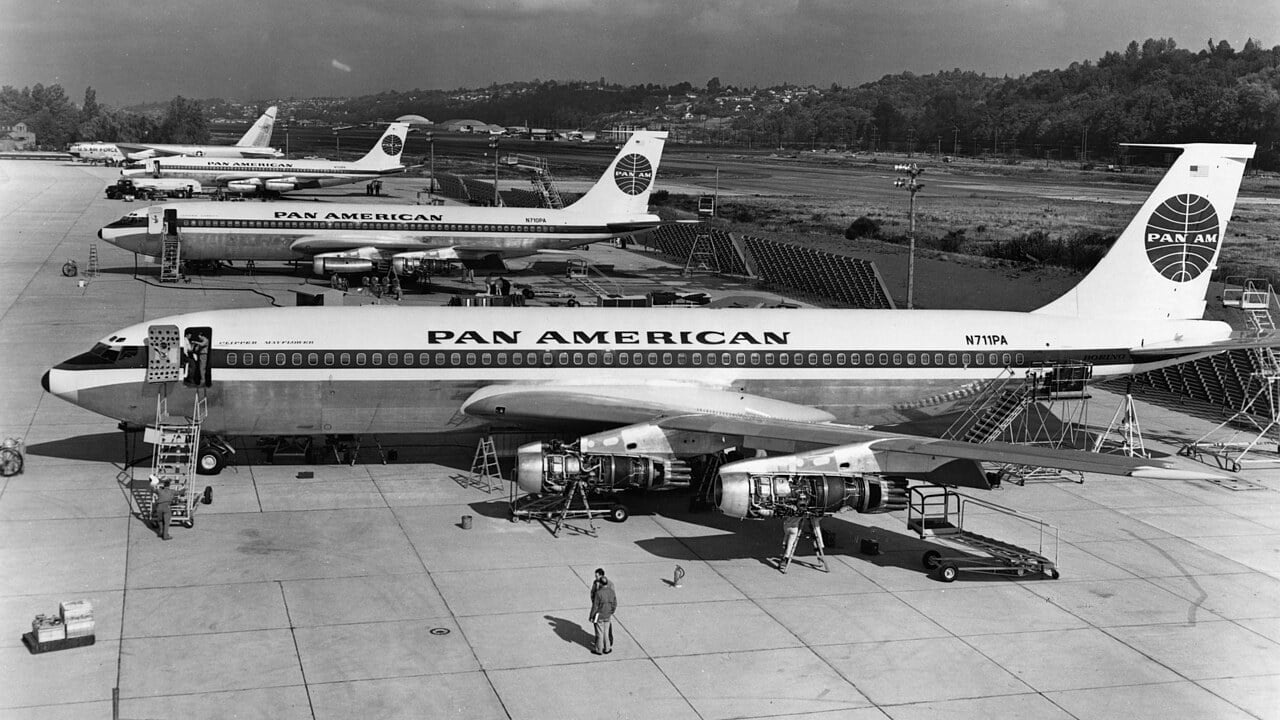
On 26 October 1958, with military bands playing on the ramp at New York’s Idlewild Airport, 111 passengers climbed the airstairs of a gleaming Pan American Boeing 707-121. On her nose, in neat script, was her name: Clipper America. Her destination was Le Bourget, Paris.
It was the first scheduled jet service by an American airline, and the start of something much bigger. The 707-121 could carry almost twice as many passengers as the Douglas DC-7C, the most productive piston airliner of the day, and fly 60 percent faster, and within two years Pan Am had switched its routes around the world from propellers to jets.
Yet Clipper America was not first across the Atlantic. Three weeks earlier, Britain had beaten Pan Am to the punch. The story of how the American jet still won the race, 68 years ago this week, begins with one stubborn airline boss.
Quick Facts
- Date: 26 October 1958
- Route: New York Idlewild to Paris Le Bourget, with a fuel stop at Gander, Newfoundland
- Aircraft: Boeing 707-121 N711PA Clipper America
- Engines: Four Pratt & Whitney JT3C turbojets
- Passengers: 111
- Journey time: A little under nine hours, including the Gander stop
- Pan Am order: 13 October 1955: 20 Boeing 707s and 25 Douglas DC-8s
- Beaten by: BOAC Comet 4, London to New York, 4 October 1958
Beaten to the Atlantic by the Comet
On 4 October 1958, BOAC used the new de Havilland Comet 4 to open the first regular jet-powered transatlantic services, between London and New York. It was a sweet moment for British aviation. The original Comet had carried the world’s first fare-paying jet passengers in 1952, then was grounded after a series of fatal accidents and redesigned almost from scratch.
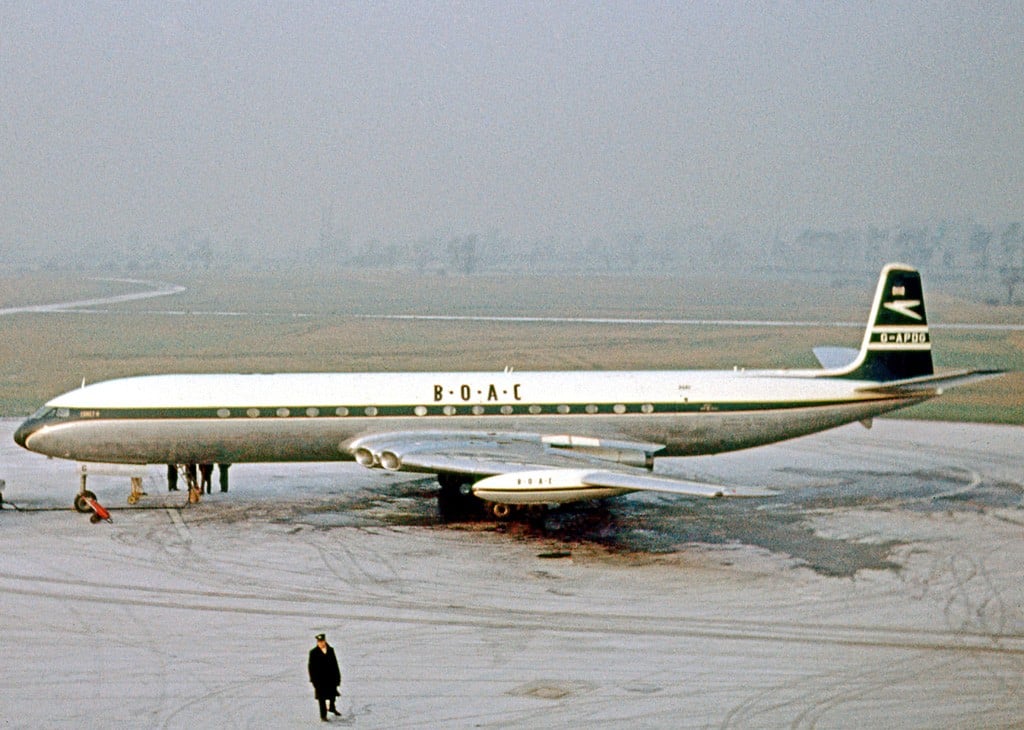
BOAC took the headlines. But the Comet 4 was smaller and slower than the Boeing, and by the end of that same month Pan Am was flying the 707 on the New York to Paris route. Pan Am had been planning for that moment for three years.
Juan Trippe’s gamble
In the early 1950s, most of the airline industry wanted nothing to do with jets. They burned enormous amounts of fuel, needed long runways and cost a fortune. The Comet’s grounding seemed to prove the doubters right, and the smart money expected turboprops to replace the piston airliners.
Pan Am’s founder, Juan Trippe, disagreed. On 13 October 1955 Pan Am committed to 20 Boeing 707s and 25 Douglas DC-8s. According to the Pan Am Historical Foundation, Trippe announced the 45-jet order at a gathering of world airline leaders, at a then-staggering cost of $269 million. Every rival suddenly knew it would have to buy jets too.
Trippe drove a hard bargain. Boeing, which had refused to widen the 707’s fuselage, agreed to make room for six-abreast seating once it learned Douglas was designing a wider jet. In return, Pan Am agreed to take its first few 707s with the smaller, less powerful engines, so that it could start flying as soon as possible.
“6 1/2 Magical Hours”, a 1958 film made for Pan American World Airways to promote its new Boeing 707 service, shared by the Pan Am Museum Foundation.
From Dash 80 to Clipper
Boeing had a head start: a flying prototype. The Model 367-80, the “Dash 80”, was rolled out on 14 May 1954 and first flew on 15 July 1954. Boeing had studied layouts based on its B-47 Stratojet bomber and C-97 transport before settling on a four-engine design with swept wings and podded engines.
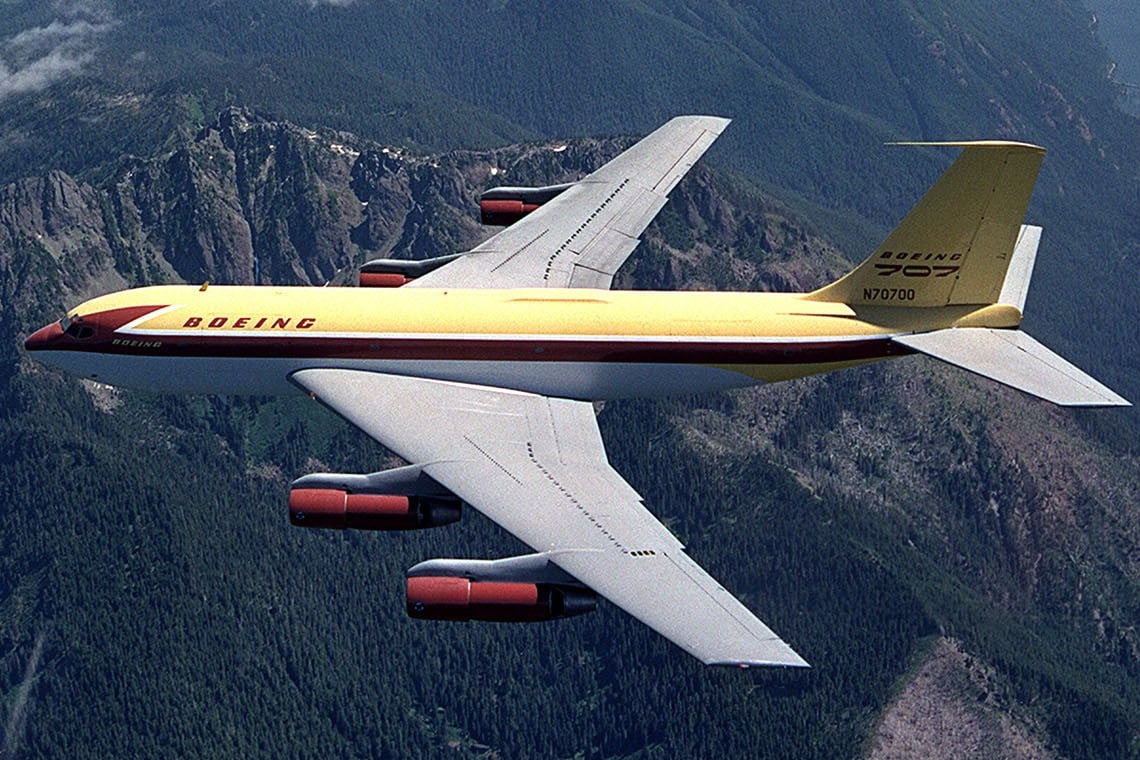
The Dash 80 became famous on 7 August 1955, when test pilot Tex Johnston barrel-rolled it over Lake Washington outside Seattle. The same prototype also led to the military C-135 family, including the KC-135 Stratotanker.
The engine that made it all possible was the Pratt & Whitney JT3C, the civilian version of the J57 turbojet that was already proving itself on the B-52 Stratofortress. The first production 707-120 flew on 20 December 1957, FAA certification followed on 18 September 1958, and Pan Am had accepted its first 707 on 15 August 1958.
Idlewild to Le Bourget, via Gander
Pan Am christened the 707 at Washington National Airport on 17 October 1958 in a ceremony attended by President Eisenhower. Pan Am then flew a group of VIPs, personal guests of Juan Trippe, from Baltimore’s Friendship Airport to Paris. Paying passengers had to wait nine more days.
The aircraft that flew the first revenue service was 707-121 N711PA, one of the first three 707s built for Pan Am. Before the departure from Idlewild there was a speech by Trippe and a US Army band. Then Clipper America took off for Paris with 111 passengers on board.
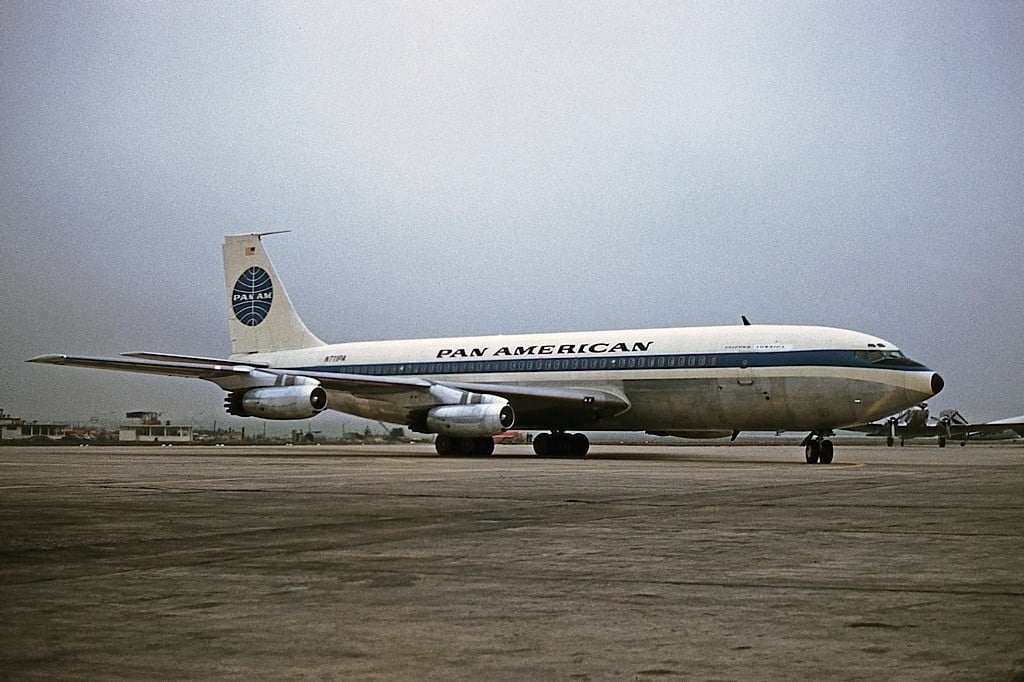
She did not fly there non-stop. According to Pan Am’s company newspaper at the time, weight restrictions at Idlewild meant the jet could not take off with full tanks, so it stopped for fuel at Gander, Newfoundland. Even so, the trip took a little under nine hours, including the Gander stop.
Archive footage from Boeing Classics: passengers board a Pan American Boeing 707 by airstair in 1958.
The early 707-121 had its limits. According to the Pan Am Historical Foundation, it needed two miles of runway to take off and injected water into its engines for extra thrust, and it could not match the range of the piston DC-7C. But it flew at about 555 mph, cruised as high as 32,000 feet above much of the weather, and could seat 165 passengers in an all-economy layout.
The world shrinks
The handicaps did not last. From mid-1959, Pan Am’s more powerful 707-321s could fly from New York to Frankfurt, Rome or Rio de Janeiro without stopping. In December 1958 National Airlines flew the first US domestic jet services, New York to Miami, with 707s leased from Pan Am. TWA followed with New York to San Francisco in March 1959.
Speed was only half the story. In 1958 Pan Am also introduced economy fares. Back in 1943, Trippe had set the goal of flying 150 passengers from New York to London in ten hours for a one-way fare of $100. With the 707, he had reached the capacity and speed targets, and he kept pushing fares down.
Boeing went on to build 1,010 civil 707s between 1958 and 1978, and Pan Am alone bought 130 of various models. TWA flew the last scheduled 707 passenger flight by a US airline on 30 October 1983, a quarter of a century after Clipper America lined up at Idlewild.
British Pathé newsreel from 1958: the rival de Havilland Comet 4 lands at Hatfield after a record Atlantic flight, with test pilot John Cunningham.
The Comet got there first. But the 707 was the jet that made flying across the ocean an ordinary thing to do, and Pan Am’s gamble set a pattern Trippe would repeat with the Boeing 747. The jet age had started in Britain, but it went mass-market with Clipper America.
Sources: Wikipedia (Boeing 707; de Havilland Comet; Juan Trippe), Pan Am Historical Foundation, Smithsonian National Air and Space Museum, IEEE Spectrum, This Day in Aviation, Airways Magazine, SFO Museum
0 Comments