
On 19 October 2026 the Federal Aviation Administration issued airworthiness directive 2026-20-14, ordering operators of 1,987 American-registered Boeing 737NGs to measure the free play in their horizontal stabiliser pivot hinges and jackscrews. The agency had received reports from multiple operators of pitch oscillation events caused by excessive stabiliser freeplay. Its reason for acting was stated in a single clause: the condition could lead to a flutter event, which can result in loss of control of the airplane.
That is the quiet word that runs underneath almost every number in a pilot's operating handbook. Flutter is why the airspeed indicator has a red line. It is why a jet's maximum operating speed sits where it sits and not forty knots higher. It is why a few thousandths of an inch of wear in a hinge is worth grounding an aeroplane over.
It is also one of the most misused words in aviation. People call buffeting flutter. People call the Tacoma Narrows bridge flutter, which is closer but still not quite right. And almost nobody can say what separates flutter from the two failure modes that sit either side of it in the same regulation. So here is the real thing: what it is, what it is not, how engineers find its boundary without being killed by it, and why a worn hinge on a 737 made the FAA move this month.
Quick Facts
Flutter: a self-excited, oscillatory instability in which aerodynamic, elastic and inertia forces feed energy into a structure faster than damping removes it
Divergence: the non-oscillatory cousin. Per AC 25.629-1B the mode frequency approaches zero and the structure simply twists until it fails
Control reversal: loss of control effectiveness caused by elastic deformation of the structure the control is attached to
Buffeting: forced vibration driven by separated airflow. Not self-excited, and not the same failure mode
The governing rule: 14 CFR 25.629 for transport aircraft, 14 CFR 23.2245 for the rest
The margin: 25.629(b)(1) requires freedom from aeroelastic instability across the VD/MD envelope enlarged by 15 per cent in equivalent airspeed
First recorded case: a Handley Page O/400 bomber in 1916, fuselage torsion coupled with antisymmetric elevator rotation
Still live in 2026: AD 2026-20-14, 1,987 US-registered 737NGs, effective 23 November 2026
Four failures, one regulation, and the words people mix up
The useful place to start is the rule itself, because it is unusually tidy. 14 CFR 25.629 is titled aeroelastic stability requirements, and paragraph (a) lists what the evaluation has to cover: flutter, divergence, control reversal, and any undue loss of stability and control as a result of structural deformation. It then adds that the evaluation must include whirl modes associated with any propeller or rotating device that contributes significant dynamic forces, which will matter a great deal later in this article.
Those are four different things, and the difference is not pedantry.
Flutter is oscillatory. Two or more modes of the structure, typically a bending mode and a torsion mode, couple together through the airflow, and above a certain speed the air puts more energy into the oscillation each cycle than the structure's damping takes out. The amplitude grows. It does not grow slowly.
Divergence is not oscillatory at all. The FAA's own guidance material, Advisory Circular 25.629-1B, describes it as the non-oscillatory instability, the one whose mode frequency approaches zero. A surface twists under load, the twist increases the load, and there is nothing periodic about the failure. A wing simply folds.
Control reversal is the one that reads like a joke until it happens to you. Deflect an aileron at high dynamic pressure and the aileron's lift increment twists the wing in the opposite sense. Past a certain speed the twist wins, and the aeroplane rolls the wrong way. AC 25.629-1B defines it as loss of control effectiveness caused by elastic deformations.
Buffeting is not in that list at all, which is the clue. Buffet is forced vibration: separated airflow, a shock boundary-layer interaction, a wake off a speed brake or an engine nacelle shaking a tail that happens to be behind it. The energy comes from outside the structure's own motion. Turn off the disturbance and the shaking stops. Flutter does not work like that. Flutter is driven by the structure's own movement, which is why it is called self-excited and why it does not settle down.
A pilot feeling high-speed buffet is receiving a warning. A pilot feeling flutter is, in most cases, already out of time.
What flutter actually is
The cleanest definition in the literature comes from NASA Dryden. In A Historical Overview of Flight Flutter Testing, NASA Technical Memorandum 4720 of October 1995, Michael W. Kehoe sets it out in one line.
Three forces, and all three have to be present. Take away the air and a wing struck sharply will ring and then stop, because the structure damps itself. Take away the elasticity and nothing bends. Take away the inertia, which in practice means the mass distribution along the chord, and the bending and twisting motions no longer feed each other.
The classic case is wing bending-torsion flutter. A wing flexing up and down also twists slightly, because its centre of mass sits behind its elastic axis. The twist changes the angle of attack, which changes the lift, which drives the bending. At low speed the aerodynamic damping absorbs that energy. The damping available falls as the structure's modes converge in frequency with increasing airspeed, and at the flutter speed it reaches zero. Above it, the oscillation is divergent.
The mass-distribution insight is the reason for one of the oldest fixes in aviation. Put lead in the nose of a control surface, ahead of its hinge, and you move its centre of gravity forward, decoupling the surface's rotation from the structure's bending. That is what the balance weights in a light aircraft's elevator are for, and 14 CFR 25.629(c) still requires that if concentrated balance weights are used, their effectiveness and strength, including supporting structure, must be substantiated.
1916, and a torque tube
Kehoe dates the first recorded incident to 1916, on a Handley Page O/400 twin-engined bomber. The fuselage torsion mode had coupled with an antisymmetric rotation of the elevators, which on that aeroplane were actuated independently. The fix, identified in a 1916 report by E. W. Lanchester, was to join the two elevators with a torque tube so that they could no longer move in opposition.
Wing-aileron flutter was widespread during the First World War, and the mass balance on the control surface hinge line was proposed as the answer. Primary surface flutter appeared around 1925, and air racers suffered a run of incidents from the mid-1920s to the mid-1930s. The problem then simply changed shape with the technology: eleven cases of servo tab flutter were reported on military aircraft between 1947 and 1956, and transonic control surface buzz produced twenty-one incidents over the same period, starting with P-80 aileron buzz in 1944.
A survey of the early years, when flutter was killing test pilots faster than anyone could explain why.
The Electra, and the failure nobody had designed against
The most consequential flutter accidents in airline history did not involve a wing bending against its own torsion. They involved a propeller.
On 29 September 1959 a Braniff Lockheed L-188 Electra, N9705C, broke up near Buffalo, Texas, with 28 passengers and six crew aboard. The flight engineer's logbook put the aircraft at 15,000 feet and 275 knots. The left wing failed and the wreckage was spread over 13,900 feet of Texas. On 17 March 1960 a Northwest L-188C, N121US, came apart near Cannelton, Indiana, with 57 passengers and six crew, leaving a crater thirty feet across and twelve feet deep.
The Civil Aeronautics Board's probable cause for the Braniff accident was structural failure of the left wing from forces generated by an undamped propeller whirl mode. For the Northwest accident it found flutter induced by outboard engine nacelle oscillations, with reduced nacelle stiffness and clear air turbulence as contributing factors.
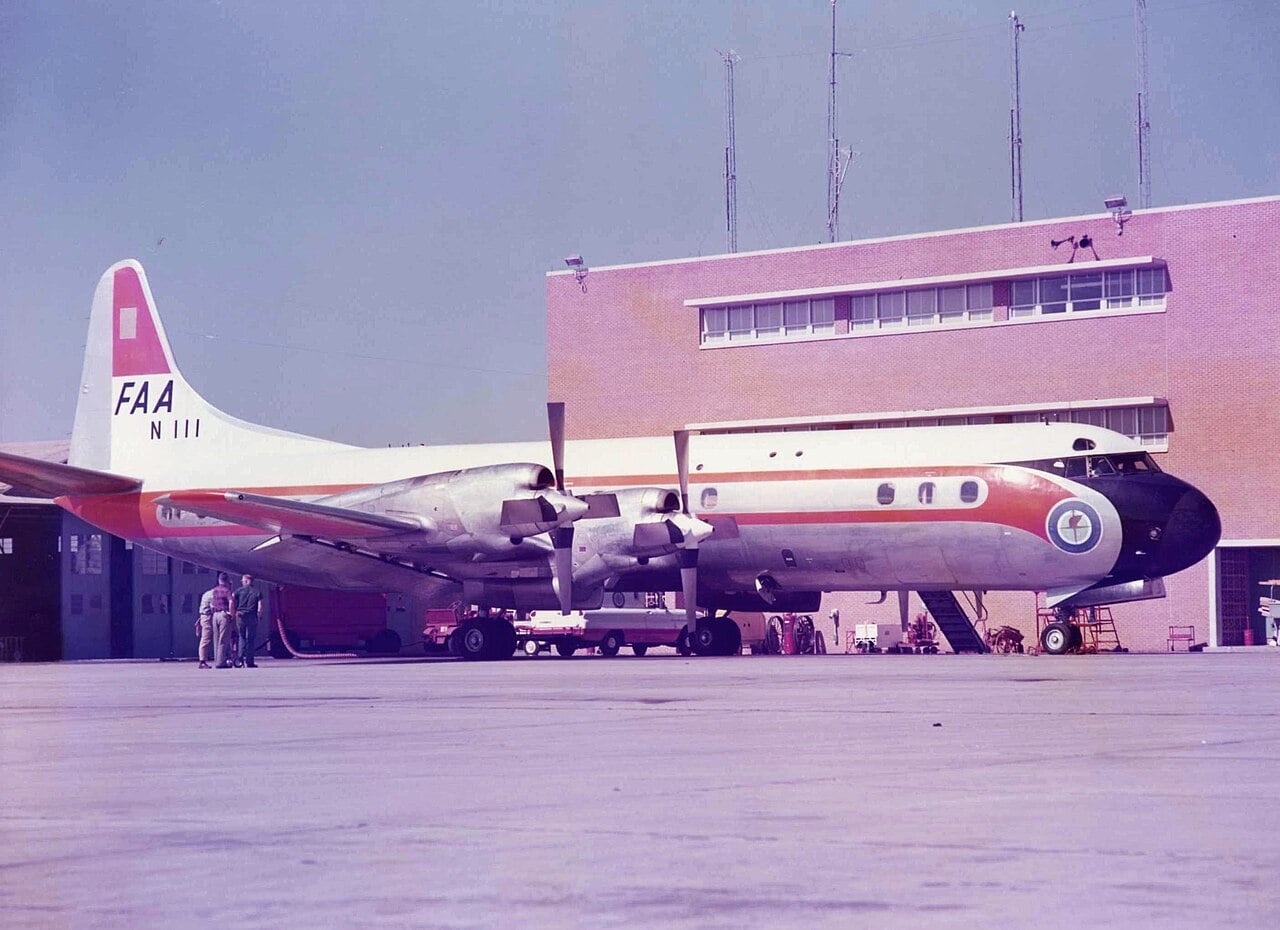
Whirl mode is its own species of aeroelastic instability. A spinning propeller on a flexible mounting can precess, the hub tracing a cone rather than staying square to the airflow. Normally the engine mount is stiff enough that the motion damps out. On the Electra, the FAA's own Lessons Learned account records that a hard landing could fail an upper engine mount without leaving damage visible on a walk-around, and the aircraft's landing characteristics made hard landings common early in service. With the mount softened, the whirl-mode frequency dropped until it coincided with a natural frequency of the wing, and the propeller began driving the wing.
The regulatory response was brutal and immediate. An emergency directive on 20 March 1960 cut the Electra's normal operating speed from 324 knots calibrated to 275. Five days later, AD 60-09-03 cut it again to 225 knots and set a never-exceed speed of 245 knots, required immediate propeller feathering if a torque meter read zero or full scale, and deactivated the autopilot entirely.
Then came the Lockheed Electra Action Program, with NASA Langley, Boeing and Douglas assisting. An eighth-scale powered model in Langley's 19-foot tunnel reproduced the failure exactly: reduce outboard engine mount stiffness, and the whirl mode couples with the wing's natural flapping frequency. Lockheed redesigned the engine mounts, nacelles and cowlings and strengthened the wing.
The rules changed with the aeroplane. CAR 4b.308 was revised in October 1964 to add aeroelastic requirements covering forces from rotation and displacement of the propeller plane, and 14 CFR 25.629 was adopted in November 1964 with a specific flutter-free speed envelope and fail-safe criteria. The modern rule still carries the scar: 25.629(d) lists the failures that must be assumed, and among them are failure of any single element of the structure supporting an engine, any single failure of an engine structure that would reduce the rigidity of the rotational axis, and any propeller rotating at the highest likely overspeed.
Why your airspeed indicator has a red line
Now the speeds make sense. Flutter is not a gradual degradation; it is a boundary. The certification problem is to establish where that boundary sits and then keep the aeroplane a long way below it.
14 CFR 25.629(b)(1) sets the margin. For normal conditions, without failures, the aircraft must be free from aeroelastic instability across every combination of altitude and speed inside the VD/MD envelope enlarged at all points by an increase of 15 per cent in equivalent airspeed, at both constant Mach number and constant altitude. It adds that a proper margin of stability must exist at all speeds up to VD/MD, with no large and rapid reduction in stability as that speed is approached.
VD is the design dive speed, and it is not a number anyone picks for marketing reasons. 14 CFR 25.335(b) says VD must be selected so that the design cruising speed VC/MC is not greater than 0.8 VD/MD, or so that the margin covers a specific upset: from stabilised flight at VC/MC, the aeroplane is upset, flown for twenty seconds along a flight path 7.5 degrees below the initial one, and then pulled up at 1.5 g. Whatever speed that produces is the floor for the margin. The Mach margin at altitudes where MC is limited by compressibility must not be less than 0.07 Mach, and may never be reduced below 0.05 Mach.
Then 14 CFR 25.1505 defines the number the crew actually sees. The maximum operating limit speed, VMO/MMO, is a speed that may not be deliberately exceeded in any regime of flight, and it must be set sufficiently below VD/MD to make it highly improbable that the latter will be inadvertently exceeded in operations.
Stack those together and the red line on the instrument is the bottom of a chain. The flutter boundary must be above 1.15 VD. VD is at least 1.25 times VC. VMO sits below VC. By the time you reach the figure a pilot is told not to exceed, there is a great deal of structural daylight between it and the speed at which the wing starts taking energy out of the air. That daylight is deliberate, and it was bought with accidents. If you want the speeds themselves unpicked, we went through indicated, true and Mach earlier this month.
Finding the boundary without crossing it
Here is the uncomfortable part. You cannot calculate your way to certainty, and you cannot test to failure, because the failure destroys the aeroplane. Flight flutter testing is the business of approaching a cliff edge in fog and deciding, from the shape of a curve, where it is.
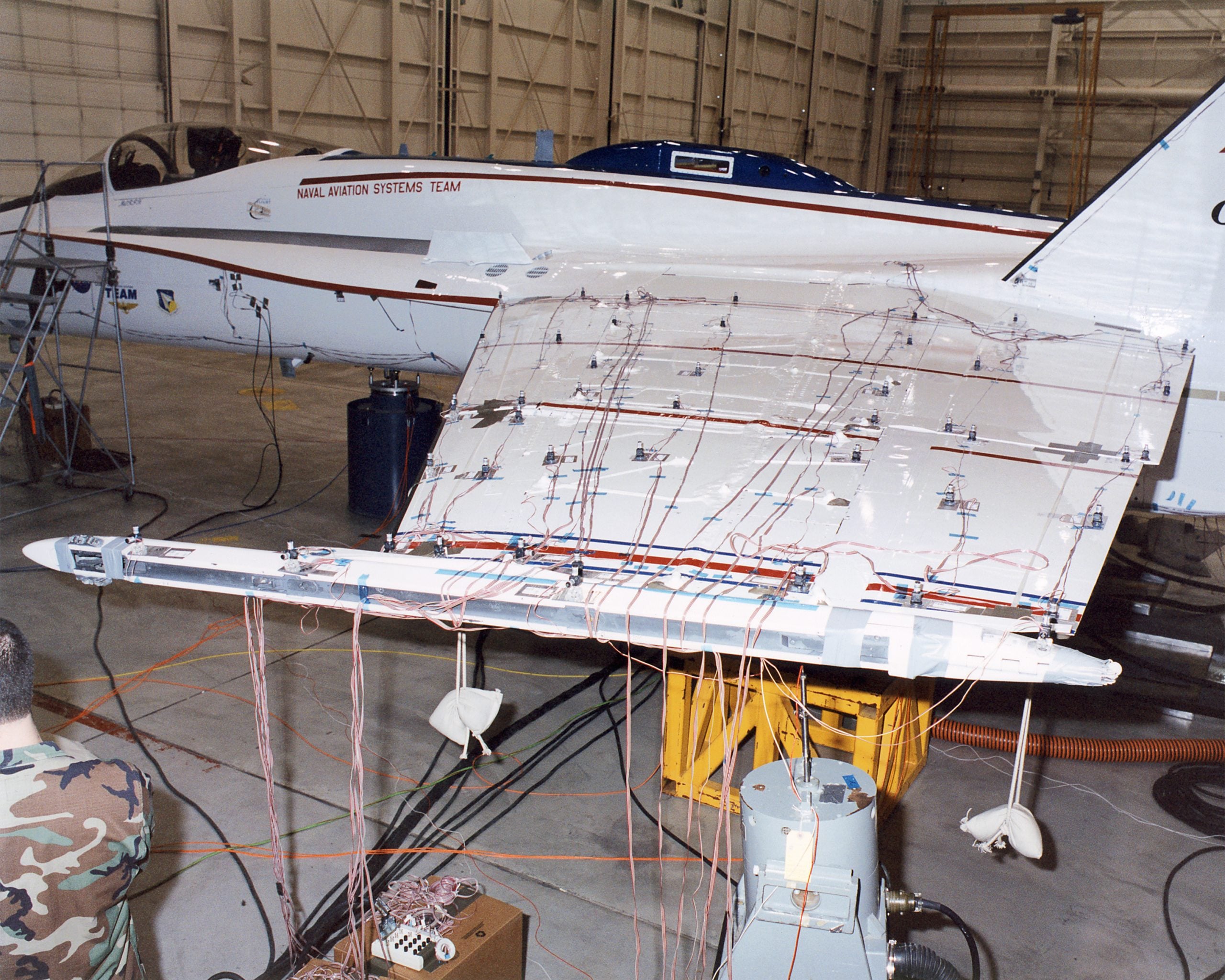
It begins on the ground. AC 25.629-1B says ground vibration tests are normally conducted on the complete conforming airplane, with the suspension arranged so that rigid-body modes are effectively uncoupled from the elastic ones, and the excitation strong enough across a wide enough frequency range to excite every significant mode. The measurements have to define both the mode shapes and the structural damping of each mode. That is the photograph further up this page: an aeroplane on soft supports, wearing several hundred accelerometers, being shaken deliberately.
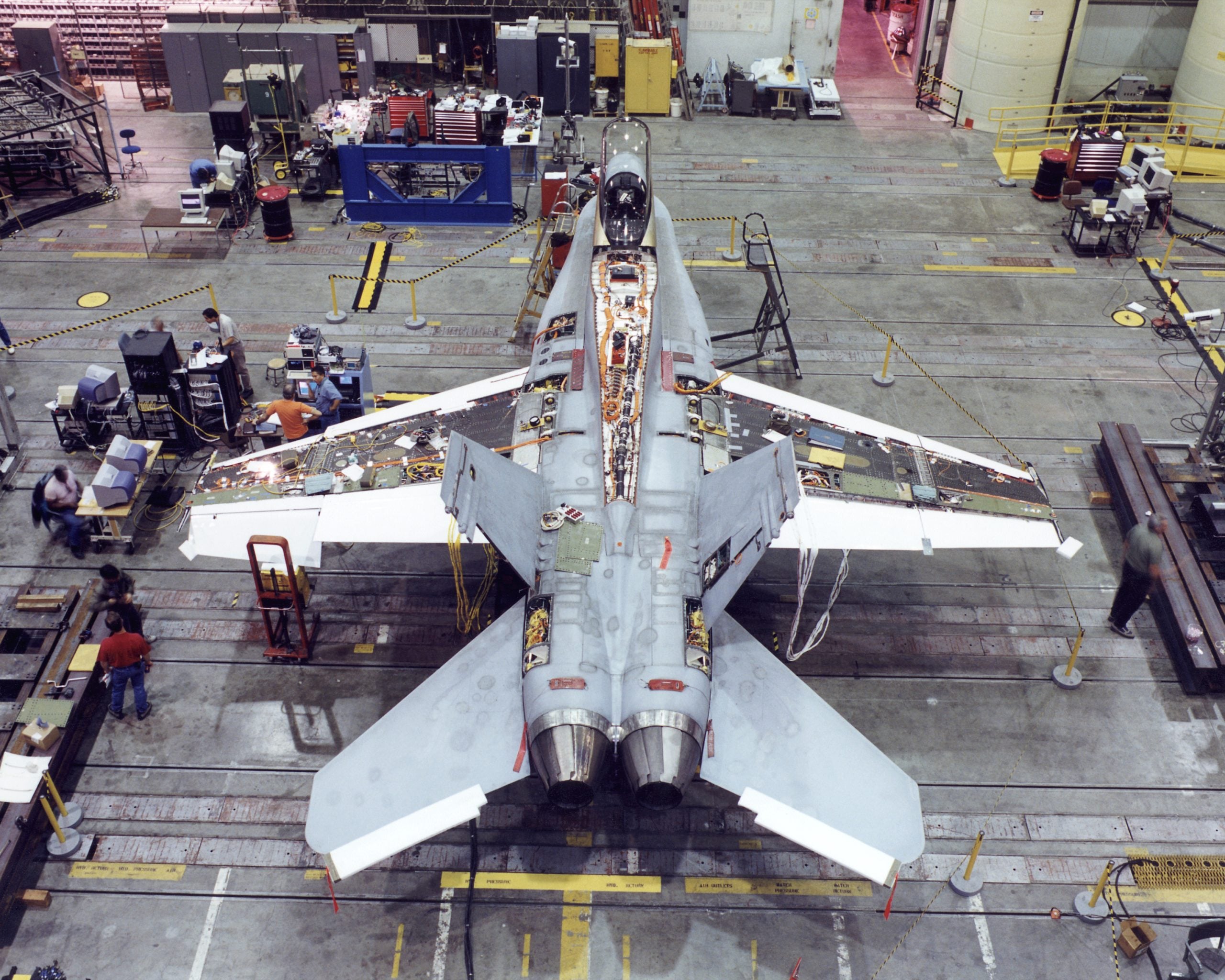
Then you fly it. AC 25.629-1B calls full-scale testing to VDF/MDF a necessary part of the flutter substantiation, and lists the ways the aircraft may be excited: control surface motions, internal moving masses, external aerodynamic exciters, or flight turbulence. At each test airspeed the response is measured to determine amplitude, damping and frequency in the critical modes, and the engineers watch the damping trend as speed increases.
Kehoe's history catalogues how the excitation evolved, and it reads like a list of increasingly desperate ideas. Control surface pulses first, useful to about 10 Hz and easy to analyse but hard to repeat. Oscillating control surfaces from the 1950s, starting with the XF3H-1 rudder, with function generators driving F-4 surfaces by the mid-1960s and the X-31 eventually sweeping from 0.1 to 100 Hz. Single-shot solid-propellant thrusters, known to everyone as bonkers, from around 1940. Rotating-unbalance inertial exciters through the 1940s and 1950s, heavy and awkward to fit inside a wing; the B-1A carried a five-exciter system producing around 550 pounds of force. Aerodynamic vanes from the 1950s, beginning with a YB-52 wingtip shaker. And, from the late 1950s, simply flying in turbulence and taking whatever the atmosphere offered.
The criteria are stated with care. AC 25.629-1B says explicitly that it has no intent to define a flight test minimum damping level, then gives the analysis methods their numbers: one method assumes 0.03 structural damping, equivalent to 1.5 per cent of critical, and requires that no significant mode cross zero damping below VD or fall below g equals 0.03 beneath 1.15 VD. The alternative method sets a minimum damping line at 0.03 or the zero-airspeed modal damping, whichever is less, but never below 0.02.
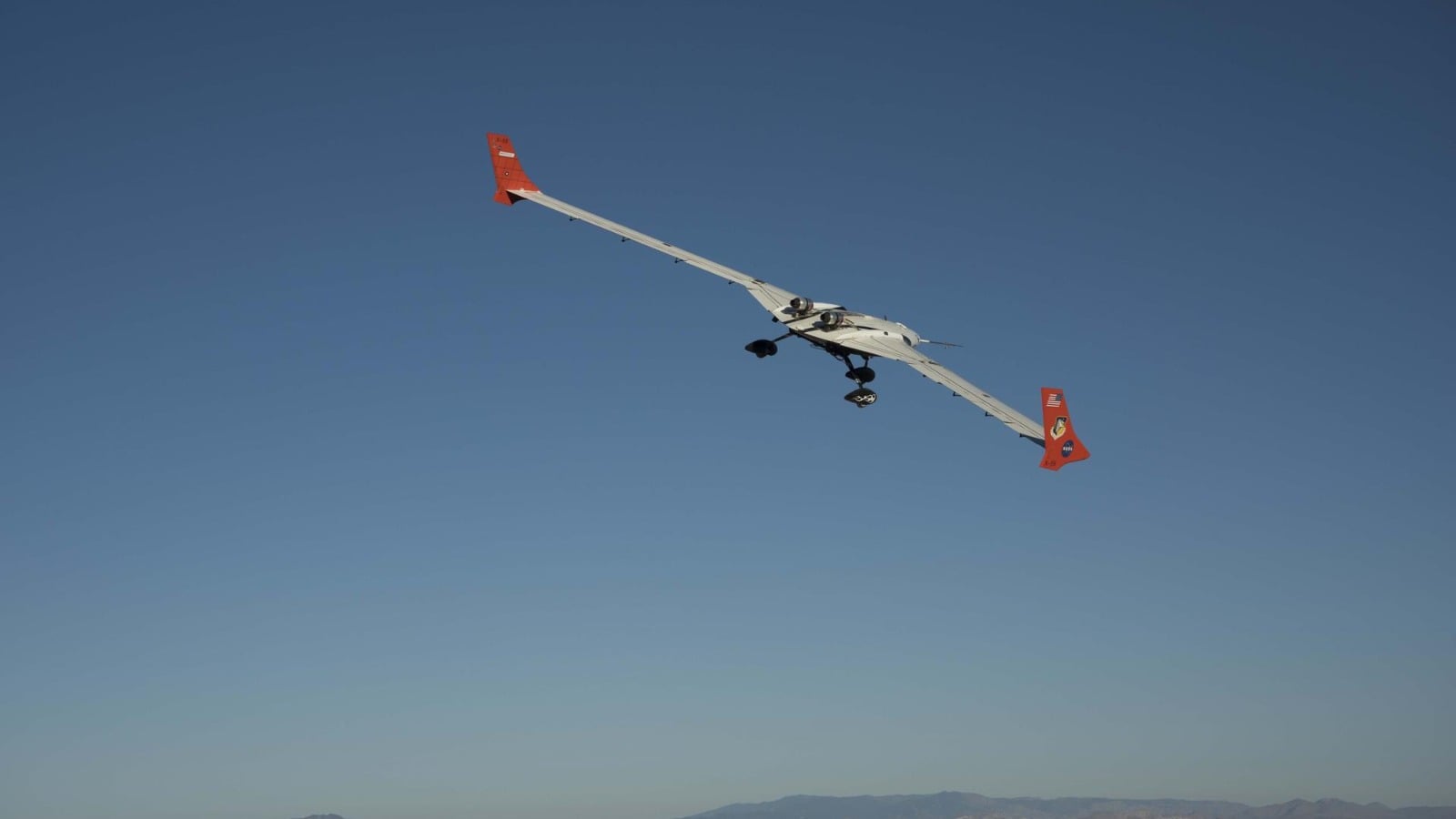
NASA Armstrong's Active Aeroelastic Wing F/A-18, the aircraft in the ground vibration photograph above, flying the research programme that treated wing flexibility as something to exploit rather than merely survive.
None of this is routine. Kehoe is blunt about it: flutter testing, he writes, is still a hazardous test for several reasons, the first being that one still must fly close to actual flutter speeds before imminent instabilities can be detected, and the second that subcritical damping trends cannot be accurately extrapolated to predict stability at higher airspeeds. The profession learned that the hard way. Von Schlippe's resonance method, developed in Germany in 1935, was used successfully on several aircraft until a Junkers Ju 90 fluttered and crashed in 1938; inadequate excitation and response measurement were identified as the probable causes. American attempts in the 1940s, on a Martin XPBM-1 and a Cessna AT-8, avoided destructive flutter by what Kehoe calls the narrowest of margins.
About the bridge
Every discussion of flutter arrives at Galloping Gertie, and it is worth being precise about what the Tacoma Narrows bridge actually did on 7 November 1940, because the popular account and the engineering account are different.
The textbook version says resonance: a periodic force from vortex shedding happened to match the bridge's natural frequency. That explanation has been contested since at least 1991, when K. Y. Billah and R. H. Scanlan published Resonance, Tacoma Narrows bridge failure, and undergraduate physics textbooks in the American Journal of Physics, volume 59, pages 118 to 124. Their argument is that the collapse was not forced resonance at all but an aerodynamically induced self-excitation, a negative-damping condition in a torsional degree of freedom. The wind that day was steady at roughly 42 miles per hour. A steady wind has no frequency to resonate with; what it does have is energy, and the bridge deck's own twisting motion was what extracted it.
The Smithsonian National Air and Space Museum on the collapse. The footage is the best-known film of a self-excited structural instability ever shot.
So the bridge belongs in the same family as flutter, and that is why aeronautical engineers reach for it. But it is not the classical case an aircraft certification engineer worries about. Bending-torsion flutter on a wing is a coupling of two structural modes. What happened at Tacoma is usually described as a single-degree-of-freedom torsional instability driven by the flow separating off a bluff, unstreamlined deck. Same physics of energy extraction, different mechanism, and the film has probably taught more people the wrong lesson about aircraft than any other ninety seconds of footage in existence.
Which brings us back to a worn hinge
Every flutter analysis assumes a stiffness. Wear changes it, and the place wear shows up first is freeplay: the small amount of slop in a hinge, an actuator attachment or a mount that lets a surface move before the structure resists it.
AC 25.629-1B treats this directly. Freeplay may be modelled as a stiffness variation in order to set wear limits on actuators, hinges and engine mounts, and it should be included in the analysis to account for in-service wear effects on flutter margins for control surfaces. On balance weights the guidance is categorical: freeplay between the balance weight, its support arm and the control surface should not be allowed.
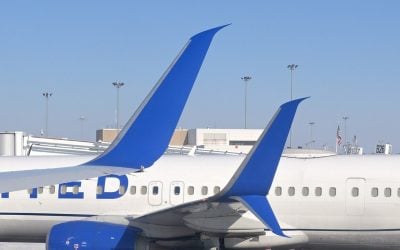
Which is exactly what AD 2026-20-14 is about. Multiple operators reported pitch oscillation events. The cause was excessive horizontal stabiliser freeplay. The FAA's stated concern was that it could lead to a flutter event and loss of control. The remedy is to go and measure the freeplay at the left and right stabiliser pivot hinges and the jackscrew, and repair or replace what is worn. We covered that directive in detail last week; what this article adds is why a measurement in thousandths of an inch is worth 1,987 inspections.
The honest summary is that flutter has not been solved. It has been bounded. The margins in 25.629 are wide, the ground and flight testing is thorough, and flutter in airline service has become rare enough that a new case now arrives as an airworthiness directive rather than as an accident report. But the margin depends on the aeroplane still being the aeroplane that was tested, and that is a maintenance problem, not an aerodynamics one. The wing does not know it is twenty-five years old. It only knows how stiff it is today.
Sources: 14 CFR 25.629, 25.335, 25.1505 and 23.2245 (eCFR); FAA AC 25.629-1B, Aeroelastic Stability Substantiation of Transport Category Airplanes, 27 October 2014; Michael W. Kehoe, A Historical Overview of Flight Flutter Testing, NASA TM-4720, October 1995; FAA Lessons Learned from Transport Airplane Accidents, Lockheed L-188 Electra; FAA AD 2026-20-14, Federal Register, 19 October 2026; K. Y. Billah and R. H. Scanlan, American Journal of Physics 59 (1991), 118-124.
Frequently Asked Questions
What is flutter in aircraft?
What is the difference between buffeting and flutter?
What causes flutter in aircraft?
What is the difference between flutter and divergence?
Why do aircraft have a never-exceed speed?
How do engineers test an aircraft for flutter?
Was the Tacoma Narrows bridge collapse caused by flutter?
Can worn parts cause flutter on an airliner?
Related Posts
Boeing 737NG Flutter Risk: FAA Orders Stabilizer Freeplay Checks
Airspeed Explained: IAS, TAS, Groundspeed and Mach
Service Ceiling: Why Boeing and Airbus Jets Stop at 41,000 Feet
A Welded Fuselage Would Be Stronger. That Is Why Nobody Builds One
Supplemental Type Certificate: Why Boeing Doesn’t Own Its Winglets


0 Comments