
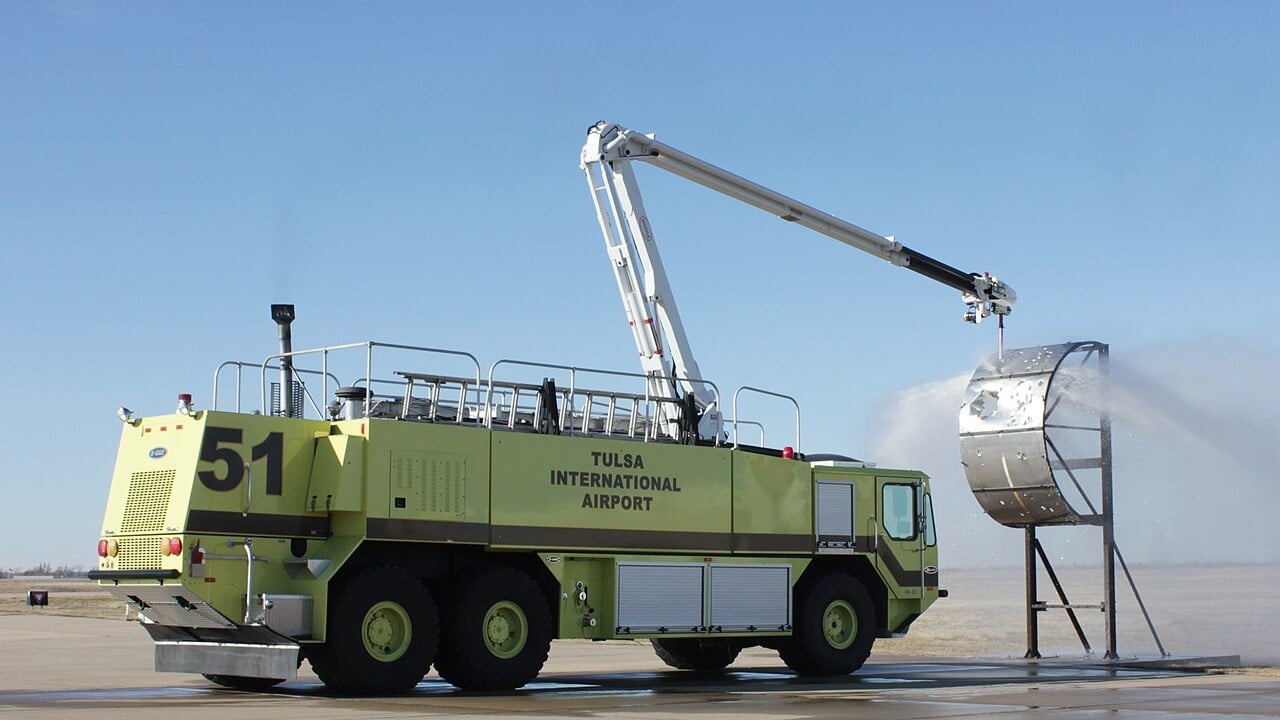
The alarm sounds in the fire station beside the runway. Doors roll up, diesels roar, and a bright yellow-green truck the size of a small house lurches onto the airfield. Somewhere a stopwatch has started. At a US airport with airline service, federal rules give that first truck three minutes, not to arrive, but to be at the middle of the farthest runway and already putting agent on the fire.
That clock, and almost everything about the trucks themselves, comes from three short sections of US federal regulations: 14 CFR 139.315, 139.317 and 139.319. Together they define aircraft rescue and firefighting, or ARFF, at every airport certificated under Part 139. And the whole system hangs on one surprisingly simple measurement: how long the airliners are.
Quick Facts
- Rules: 14 CFR 139.315 (index), 139.317 (equipment and agents), 139.319 (operations)
- Index A: Aircraft under 90 ft; one vehicle with dry chemical, halon 1211 or clean agent
- Index B: 90 to under 126 ft; at least 1,500 gal of water for foam
- Index C: 126 to under 159 ft; at least 3,000 gal
- Index D: 159 to under 200 ft; three vehicles, 4,000 gal
- Index E: 200 ft and longer; three vehicles, 6,000 gal
- Which aircraft counts: Longest type averaging five or more daily departures; fewer than five drops one index
- Response: First vehicle at midpoint of farthest runway and applying agent within 3 min; all others within 4 min
The ARFF index: measured in feet
Every Part 139 airport is assigned an ARFF index from A to E. Under 14 CFR 139.315, the index depends on two things: the length of the air carrier aircraft using the airport and their average daily departures. The length bands are blunt. Index A covers aircraft under 90 feet long; B, 90 to under 126 feet; C, 126 to under 159 feet; D, 159 to under 200 feet; and E, 200 feet and longer.
Put real aircraft into those bands and the logic becomes clear. An Airbus A320, at about 123 feet, is an Index B aircraft. A Boeing 737-800, at 129 feet 6 inches, tips into Index C. A Boeing 767-300, at about 180 feet, is Index D, and a 777-300, at more than 242 feet, sits firmly in Index E. Length is a proxy for the size of the fuselage, the number of people inside and the size of the fuel fire firefighters may face.
Then comes the twist that catches most people out. The index is set by the longest aircraft with an average of five or more daily departures. If the longest type averages fewer than five, the airport drops to the next lower index. A regional airport with one daily widebody is not automatically an Index E airport. The minimum is Index A, and the smallest certificated airports, Class III, can meet it through an approved arrangement with local fire and medical services that gives a comparable level of safety.
What is on the truck
Section 139.317 turns the index into hardware. At Index A, one vehicle is enough, carrying at least 500 pounds of sodium-based dry chemical, halon 1211 or clean agent, or 450 pounds of potassium-based dry chemical plus water and foam concentrate totalling 100 gallons. Dry chemical knocks down fires fast; water mixed with foam smothers a burning fuel spill.
From there the water climbs steeply. Index B requires at least 1,500 gallons of water for foam production, on one or two vehicles. Index C needs 3,000 gallons. Index D needs three vehicles carrying a combined 4,000 gallons, and Index E three vehicles with 6,000 gallons between them. Each vehicle that carries foam must also carry enough concentrate to mix with twice its water load.
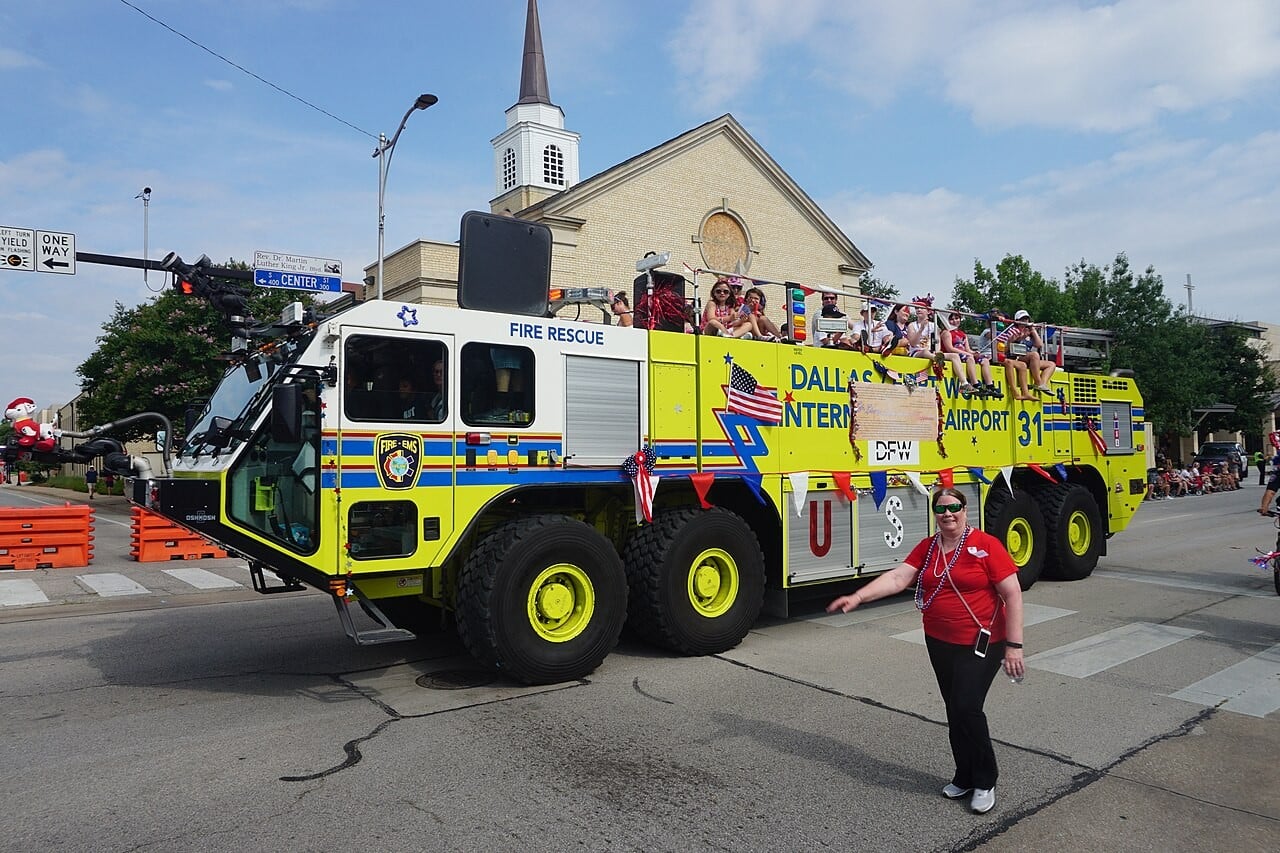
Oshkosh Airport Products shows its Striker 6x6 ARFF vehicle, one of the best-known airport crash tenders.
The rules also say how fast that water must come out. Any ARFF vehicle with at least 500 gallons of water for foam production must have a roof turret. A truck with 500 to under 2,000 gallons needs a turret rate of 500 to 1,000 gallons per minute; a truck with 2,000 gallons or more needs 600 to 1,200 gallons per minute. Dry chemical or halon must flow at 5 pounds per second through a hand line, or 16 through a turret.
That is why airport crash tenders look nothing like city fire engines. They are built to drive across grass and sand, fire on the move and carry huge water loads. The Oshkosh Striker is one of the best-known families. Many airports also use a high-reach extendable turret, a boom with a piercing nozzle that can punch through a fuselage skin and discharge agent inside the cabin, covered by FAA Advisory Circular 150/5210-23.
The three-minute rule
Section 139.319 is where the stopwatch lives. When the FAA asks an airport to demonstrate its response, the requirement is precise.
The detail that matters is the end of that sentence. The clock does not stop when the truck arrives; it stops when agent starts flowing. All the other required vehicles then have four minutes from the alarm to reach the same point and begin applying agent. That is why ARFF stations sit close to the runways, and why crews drill the route until it is muscle memory.
The same section covers the less dramatic machinery that makes the clock achievable. Every required vehicle needs two-way radios to talk to the other emergency vehicles, the control tower (or the common traffic advisory frequency when there is no tower) and the fire stations named in the airport emergency plan. Each needs a flashing or rotating beacon and a paint scheme chosen for contrast, which is why so many trucks are lime-yellow.
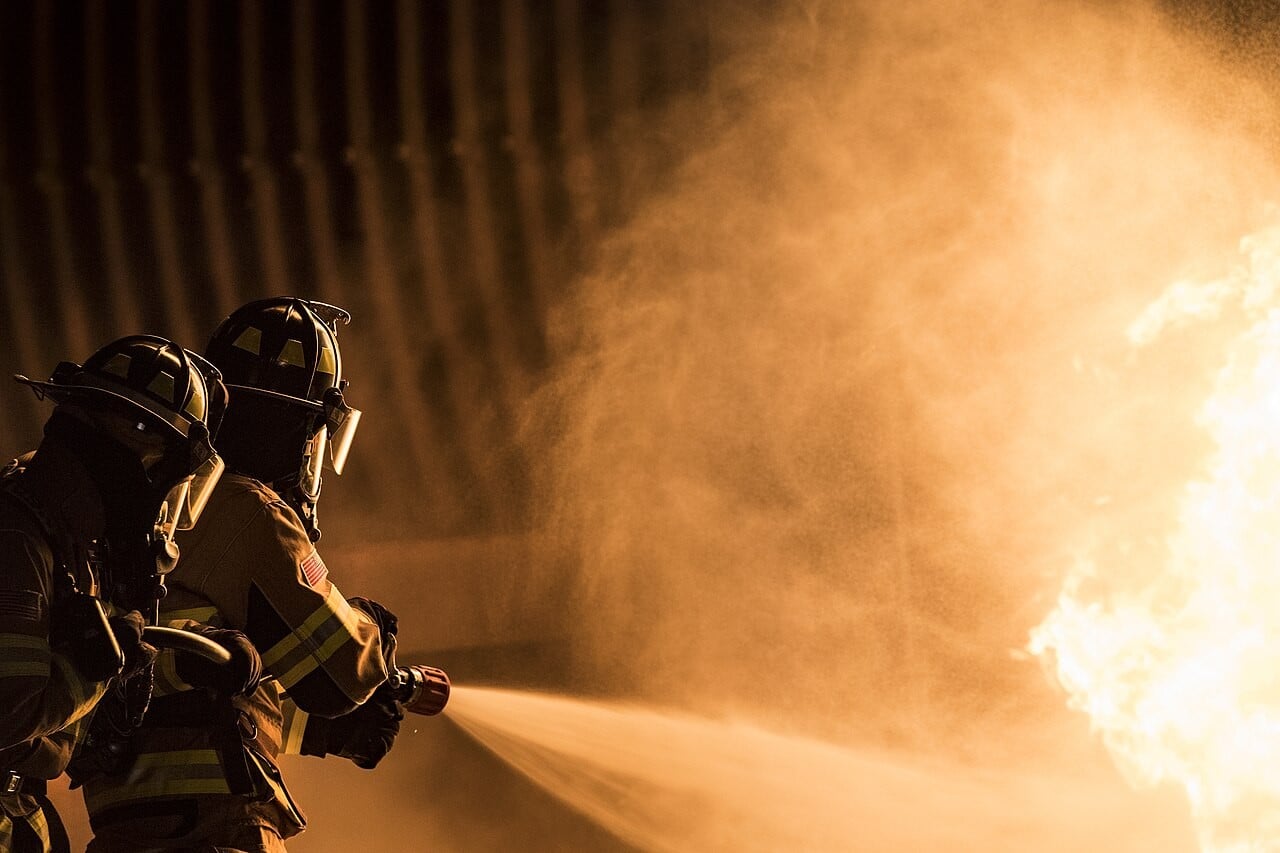
Albany International Airport takes viewers inside its live-fire aircraft firefighting training.
Rules for bad days are included too. If a required vehicle breaks down and cannot be replaced immediately, the airport must notify the FAA and the airlines, and if full index capability is not restored within 48 hours, air carrier operations must be limited to what the remaining equipment can protect. At airports with prolonged temperatures below 33°F, vehicles need cover or other protection so their agents still discharge in freezing weather.
Airports can also scale down. When only shorter aircraft are operating, an airport may reduce its ARFF level to the index of the longest air carrier aircraft actually flying, as long as the procedures, a recall system and notification to airlines through the airport directory or NOTAMs are in place. Afterburner explained how those notices work in NOTAMs Explained.
People, training and the foam problem
Trucks are only half the system. Under 139.319, every ARFF firefighter must have proper protective equipment and be trained before starting duty, with recurrent instruction every 12 consecutive calendar months. The curriculum begins with airport familiarisation, including signs, markings and lighting, then aircraft familiarisation, firefighter safety, emergency communications and the hoses, nozzles and turrets on the trucks.
The newest chapter is about the foam itself. For decades the standard agent was aqueous film-forming foam, or AFFF, which contains PFAS chemicals. The FAA notes that, according to the US Environmental Protection Agency, certain PFAS can cause serious health problems, including cancer, after long-term exposure. In January 2023 the Department of Defense published a military specification for fluorine-free foam, known as F3, and Congress had already directed the FAA, in December 2022, to plan an orderly transition.
In practice that means airports are swapping foams, cleaning out trucks that carried AFFF and retesting their vehicles after the change, under a run of FAA CertAlerts. The 1,500, 3,000, 4,000 and 6,000-gallon numbers stay the same. What fills the foam tank is changing.
The FAA’s introduction to fluorine-free firefighting foam (F3), the replacement for PFAS-based AFFF.
Next time you taxi past a fire station on the way to the runway, look for the trucks parked nose-out behind the open doors. Their number, their size and the speed they must move were all decided by the length of the longest jet that uses that airport five times a day. The ARFF index is one of aviation’s quiet rules: almost invisible, and measured in seconds when it matters.
Sources: 14 CFR 139.315, 139.317 and 139.319 (eCFR), FAA Aircraft Rescue and Fire Fighting and F3 transition pages, FAA Advisory Circular 150/5210-23, Boeing and Airbus aircraft dimensions
Header photo: woodleywonderworks / Wikimedia Commons, CC BY 2.0

0 Comments