
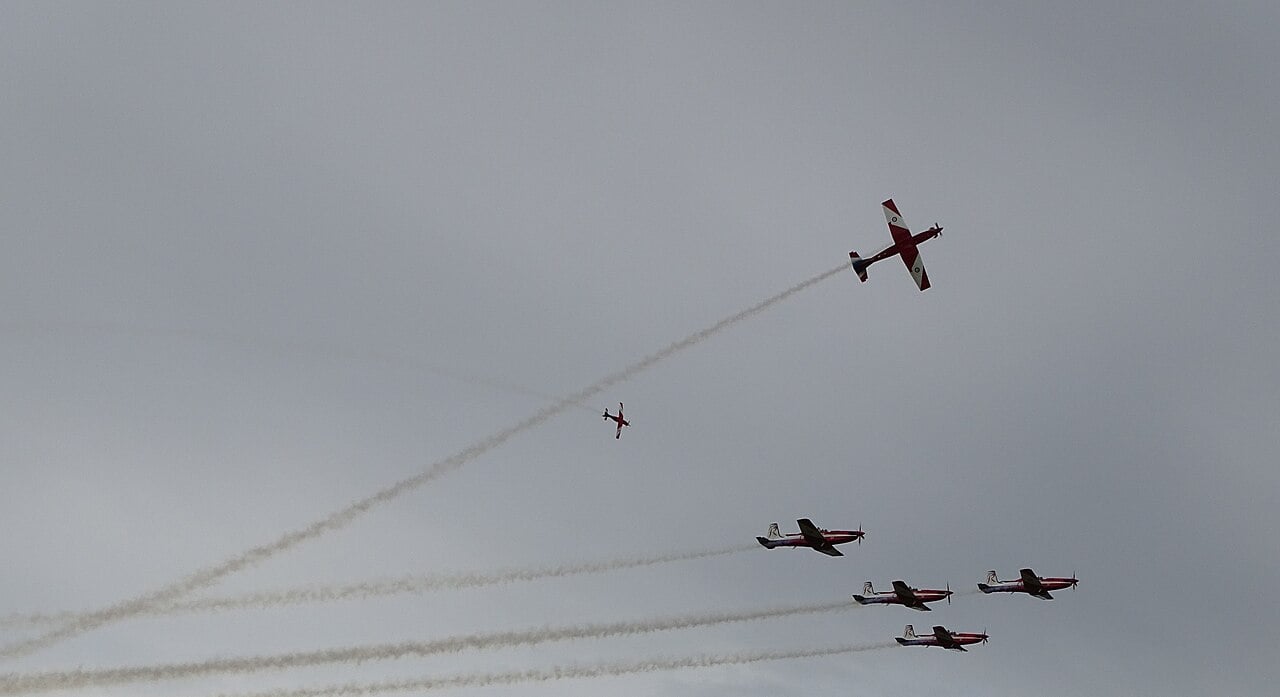
At the Avalon Air Show in early 2019, the Roulettes of the Royal Australian Air Force flew their last aerobatic display in the red-and-white Pilatus PC-9/A. By the end of that year the whole Australian fleet had been retired, after more than three decades and more than 1,400 military pilots.
It was a fitting send-off for an aeroplane that rarely makes headlines. The Pilatus PC-9 is a modest Swiss turboprop with two seats and one propeller. Yet it trained pilots on five continents, won a place in Australian aviation folklore and, in its American guise, became one of the most widely flown military trainers in the world.
Quick Facts
- Type: Two-seat tandem turboprop military trainer
- Manufacturer: Pilatus Aircraft, Switzerland
- First flight: 7 May 1984 (Swiss certification September 1985)
- Engine: Pratt & Whitney Canada PT6A-62, flat-rated to 950 shp
- Top speed: About 320 knots (593 km/h), PC-9M
- First order: 30 aircraft for the Royal Saudi Air Force
- Australia: 67 PC-9/A, in RAAF service 1987 to 2019
- Offspring: Beechcraft T-6 Texan II, JPATS winner in 1995
A Swiss answer to a changing market
Pilatus already had a hit with the PC-7 Turbo Trainer of the 1970s. But air forces were rewriting their syllabuses. They wanted fewer stages and fewer aircraft types between a student’s first lesson and a fast jet, to save time and money.
The PC-9 programme was officially launched in 1982 with that goal: one aircraft able to take a pilot from ab initio flying through to advanced training, aerobatics and weapons work, without an intermediate type. The prototype first flew on 7 May 1984, a second followed on 20 July, and Swiss type certification came in September 1985.
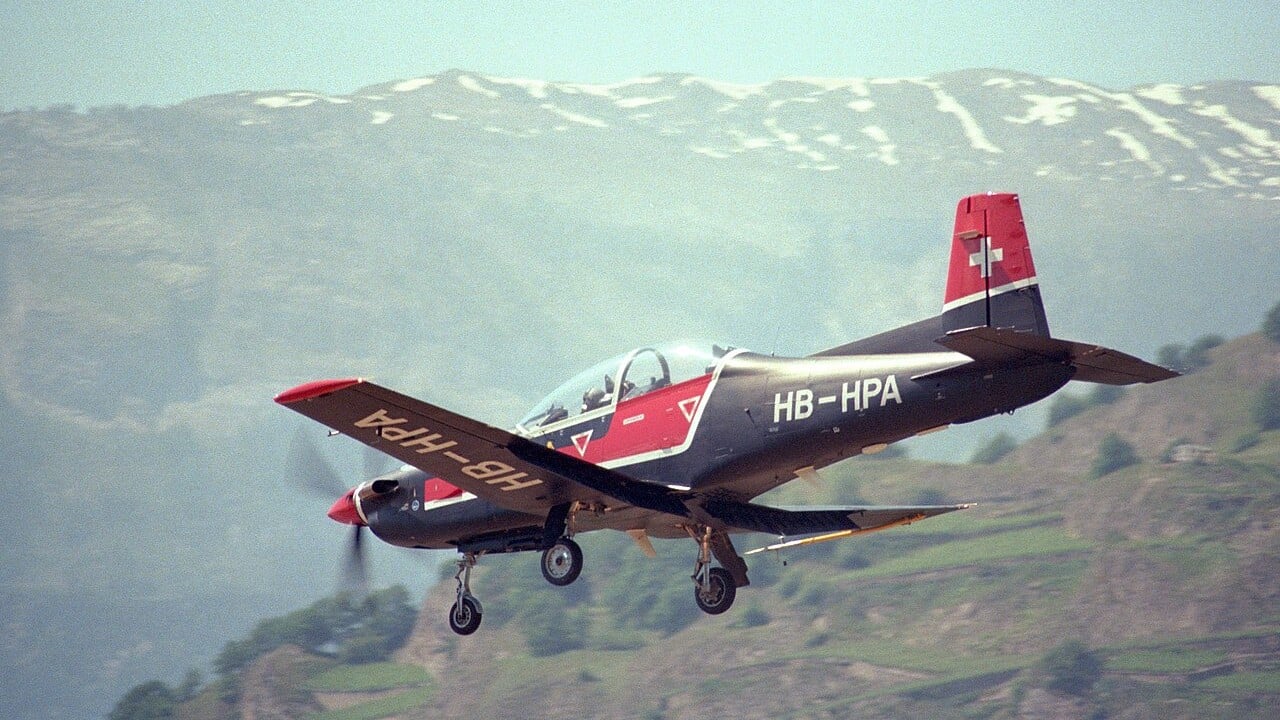
It looked like a PC-7, but it was largely a new aeroplane, almost 300 kg heavier, with a longer nose and canopy. The two Martin-Baker ejection seats were stepped so that the instructor in the back could see over the student, and a ventral airbrake was added. Up front, a Pratt & Whitney Canada PT6A-62 was flat-rated to 950 shaft horsepower, good for a top speed of about 320 knots.
Losing the RAF, winning the Gulf
The first big test was political. In 1984 Pilatus teamed with British Aerospace to offer the PC-9 as the Jet Provost replacement for the Royal Air Force. By the time the type was certified, the RAF had chosen the Short Tucano instead.
The partnership was not wasted. The marketing links built with British Aerospace reportedly helped bring in the PC-9’s first production order: 30 aircraft for the Royal Saudi Air Force. Quantity production began in 1985.
The Irish Defence Forces’ own film of the Air Corps PC-9M, the trainer at the heart of Irish military pilot training since 2004.
Australia’s PC-9/A
In December 1985 Australia ordered 67 aircraft, designated PC-9/A. Two were built in Switzerland, 17 were assembled from kits and the remaining 48 were built under licence by Hawker de Havilland, with a large share of Australian-sourced materials and parts. The first, A23-001, flew on 19 May 1987, and the type entered RAAF service that year.
From 1989 the PC-9/A was the backbone of Air Force and Navy pilot training. When the RAAF said farewell at RAAF Base Pearce on 12 December 2019, it had supported 103 pilot courses and graduated more than 1,400 Navy and Air Force pilots. The PC-21 took over.
The PC-9/A also became the mount of the Roulettes, the RAAF’s aerobatic team, and its displays are fondly remembered at air shows across Australia. Many retired aircraft went to heritage centres; others were sold, and some now fly in civilian hands.
The PC-9M and its European customers
In 1997 Pilatus introduced the improved PC-9M, with an enlarged dorsal fin for better stability, revised wing-root fairings, stall strips on the wing leading edges and new engine and propeller controls. It found a ready market among smaller European air forces.
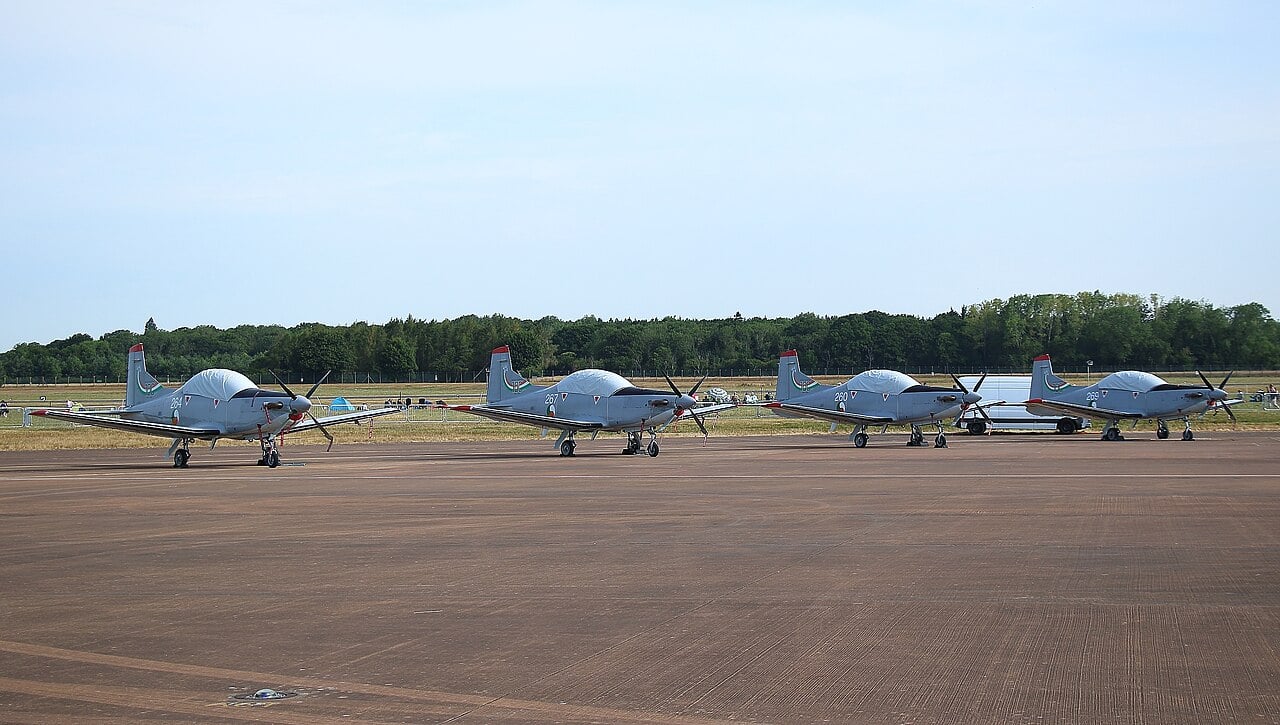
Croatia bought 17 in 1997, Slovenia ordered nine that December, Oman ordered 12 in 1999 and Bulgaria 12 in 2004. In January 2003 Ireland signed a €60 million contract for eight PC-9Ms to replace the SIAI-Marchetti trainers that had taught Irish Air Corps pilots, with deliveries in 2004. According to The Irish Times, four tenders were received and Pilatus beat Raytheon and Embraer, with negotiations taking less than a month.
The Irish aircraft remain the Air Corps’ main pilot trainers, and a team of them displays as the Silver Swallows. Ireland also placed the very last PC-9M order, for a single attrition replacement delivered in 2017.
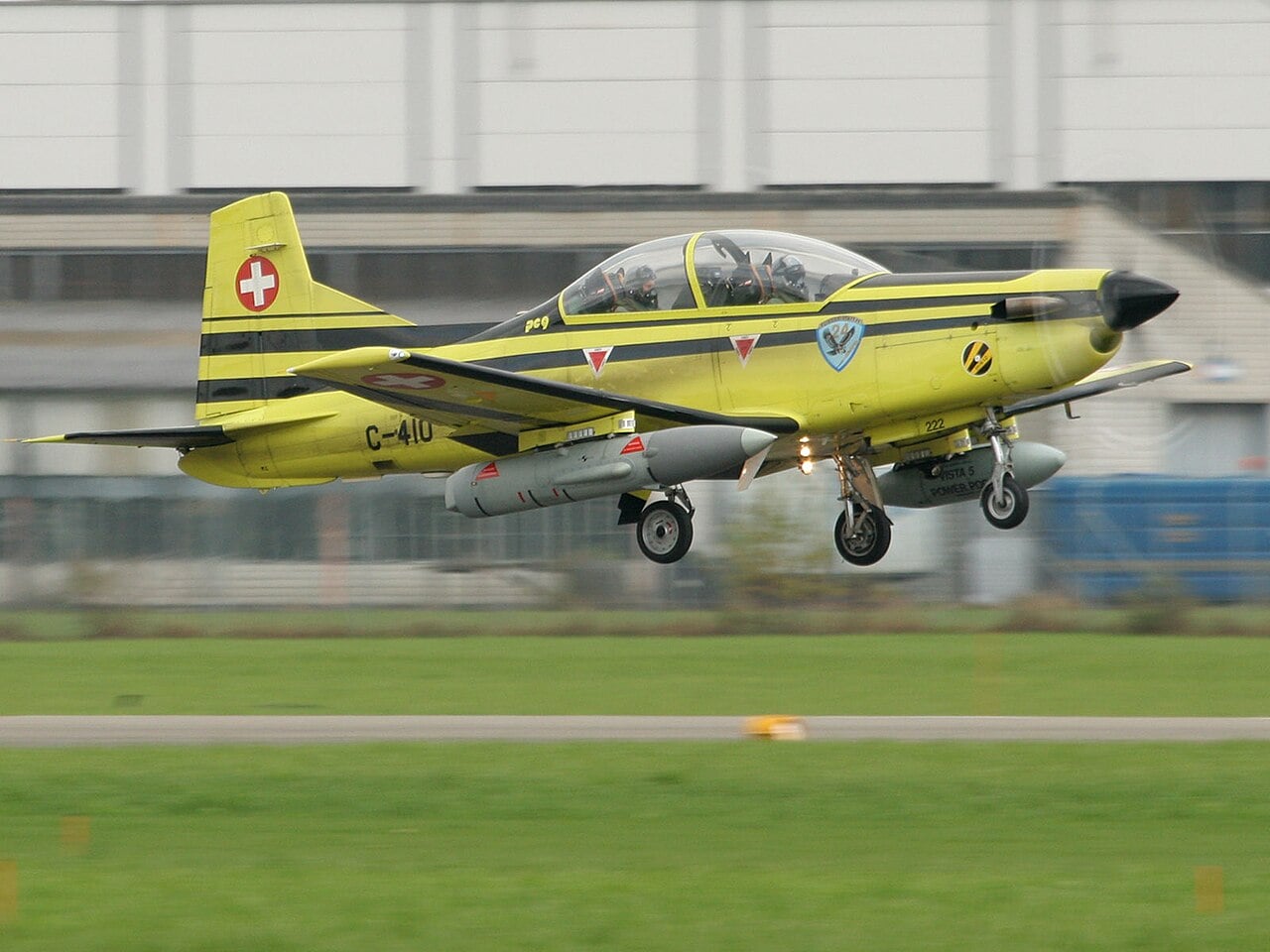
Not every PC-9 is a trainer. Germany used the PC-9B as a target tug, with extra fuel for flights of up to three hours and 20 minutes and two underwing winches able to reel a target out to 3.5 kilometres. At home, the Swiss Air Force also operates the type.
RAAF Roulettes PC-9/As starting up and taxiing at Point Cook.
The American offspring
The PC-9’s biggest legacy was written in Kansas. In the early 1990s Pilatus and Beechcraft developed an extensively modified Beech Pilatus PC-9 Mk II for the US Joint Primary Aircraft Training System competition. In June 1995 it won, and as the Beechcraft T-6A Texan II it replaced the US Air Force’s T-37 Tweet and the US Navy’s T-34C.
It was no walkover. JPATS merged the Air Force’s and Navy’s primary-trainer needs into one programme, and the Swiss-American design beat seven other contenders. The irony was hard to miss: a decade after losing the RAF contest to the Tucano, the PC-9 family had won an American contest for hundreds of aircraft.
More than 700 were planned for the two services, and the T-6 has since been exported widely. It is built and marketed by Beechcraft, while Pilatus receives royalties. In Thailand the story came full circle: the Royal Thai Air Force, whose Blue Phoenix team displayed the PC-9 from 2012, retired its PC-9s in February 2024 and replaced them with the T-6.
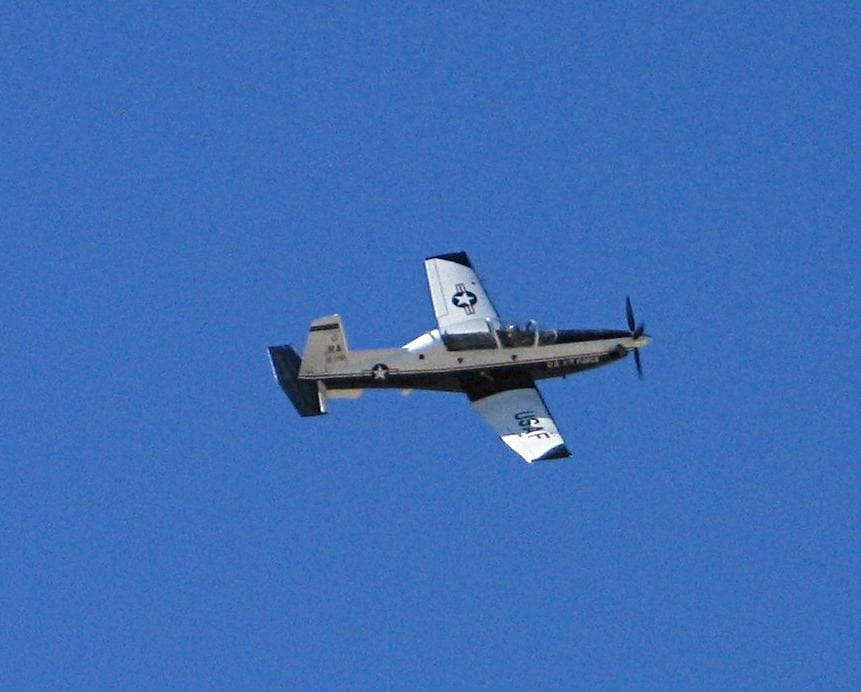
Back in Switzerland, production of the original PC-9 had wound down by the 2010s, with roughly 276 delivered by then, according to reported figures. Its place in the Pilatus range went to the PC-21, the aircraft that replaced it in Australia.
Arthur Aero Australia flies its ex-military PC-9 on its first civilian flight, one of the retired Australian airframes now in private hands.
The PC-9 never flew faster than sound and never needed to. Its achievement was quieter: proving that a well-made turboprop could carry a student most of the way to a fighter cockpit. A good part of today’s military pilot training, from Wichita to Western Australia, still follows the path this Swiss trainer marked out.
Sources: Australian Department of Defence (PC-9/A farewell release, 12 December 2019; Minister for Defence Personnel release, 28 February 2019), ADF-Serials (A23 PC-9/A records), The Irish Times, Irish Defence Forces (military.ie), European Airshows aviation anniversaries
Header photo: Anidaat / Wikimedia Commons, CC BY-SA 4.0
0 Comments