
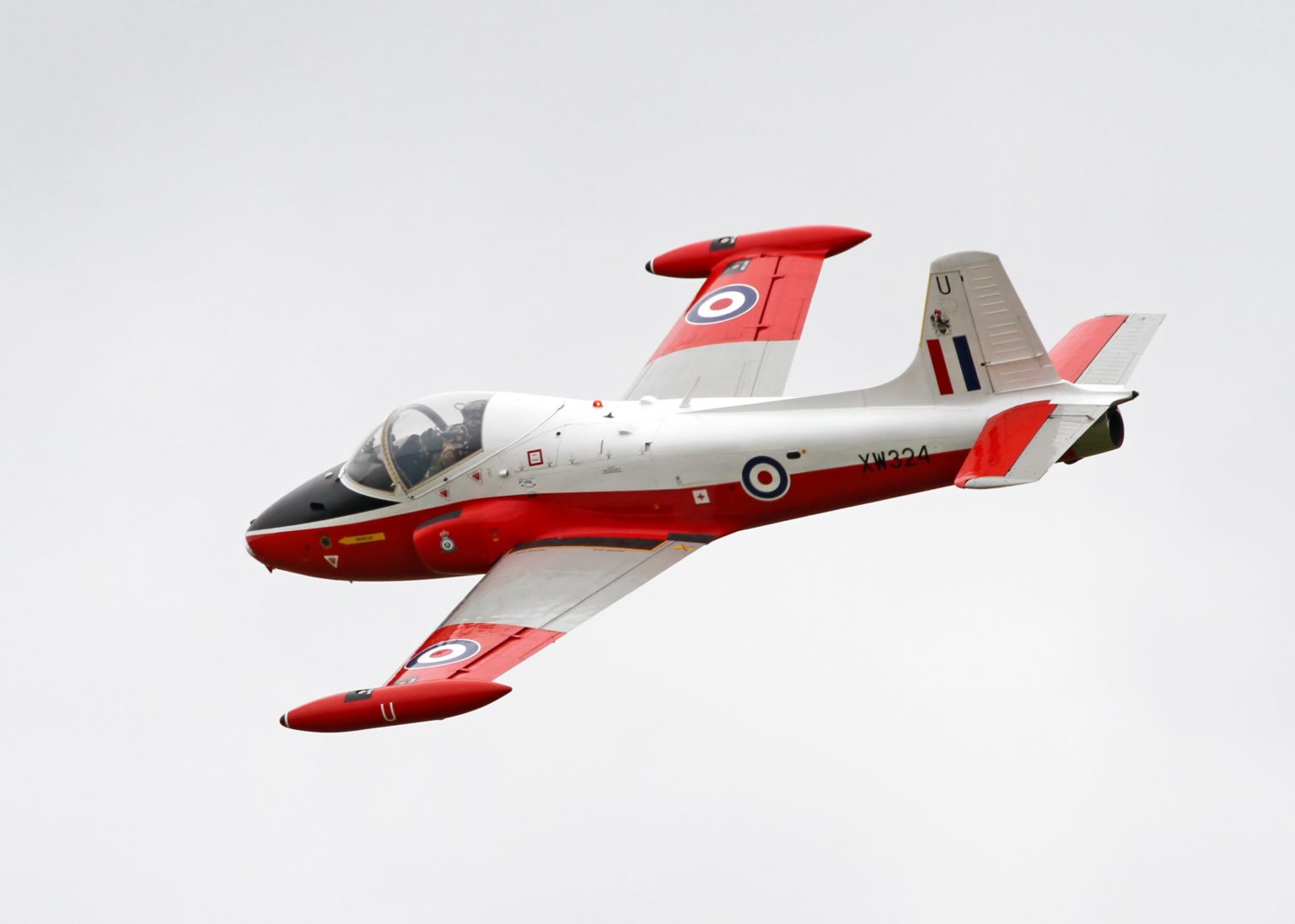
BAC Jet Provost
The RAF’s first jet a pilot ever flew
For almost four decades the side-by-side Jet Provost took Royal Air Force recruits from their very first flight through basic training — a friendly, forgiving jet that taught generations to fly and lives on today as a much-loved civilian warbird.
The jet that taught the RAF to fly
In the early 1950s the Royal Air Force still began every pilot’s career on piston-engined trainers before moving them onto jets. The jump was awkward and expensive. Hunting Percival’s answer was elegantly simple: take the company’s existing piston Percival Provost basic trainer, replace its Alvis Leonides radial with a small turbojet, and let recruits learn on a jet from their very first flight.
The Jet Provost prototype first flew from Luton on 26 June 1954. Early T.1 aircraft went to the RAF for evaluation in 1955, and with the definitive T.3 of 1959 the type became the service’s standard basic jet trainer. It is often described as the first jet trainer used to take a pupil all the way from first flight through basic training — so-called “all-through” jet training.
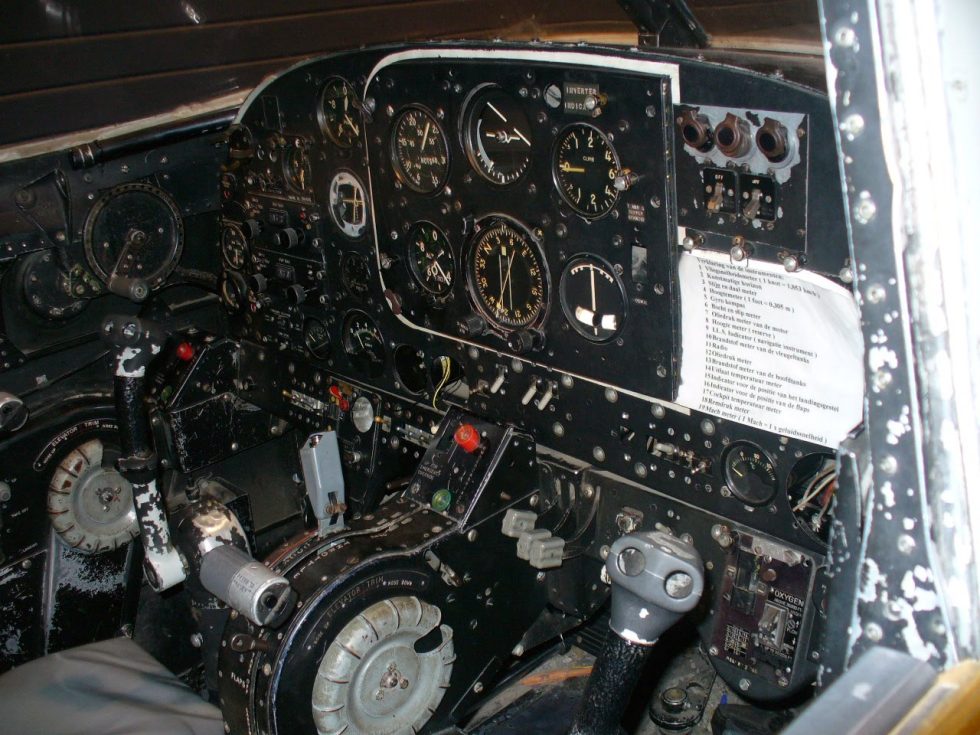
What made it work was its friendliness. Instructor and pupil sat side by side, not one behind the other, so the instructor could watch the student’s hands and eyes and share a single warning panel. The Viper turbojet was gentle and reliable; the aircraft was docile at the edges of its envelope. Later marks added ejection seats (from the T.3), more power, and finally a pressurised cabin in the T.5 of the late 1960s.
Through the British Aircraft Corporation merger of 1960 the aircraft became the BAC Jet Provost, and BAC turned the pressurised T.5 into the armed Strikemaster, a light-attack jet that saw real combat in Oman and elsewhere. Lightly armed export Jet Provosts — the T.51, T.52 and T.55 — were sold to Sri Lanka, Sudan, Iraq, Kuwait, Venezuela and South Yemen.
The RAF finally retired its Jet Provosts on 20 September 1993, replacing them with the turboprop Shorts Tucano after roughly 38 years of service. Thousands of RAF aircrew earned their first hours on “the JP.” Today it is one of the most affordable and popular vintage jets on the civilian warbird circuit, with around a dozen airworthy in the UK alone.
01The BAC Jet Provost’s all-through jet training: how the RAF put pupils straight onto jets
Before the Jet Provost, RAF pilots learned the basics on piston trainers such as the Percival Provost and only later converted to jets — a two-step process that cost time and money. The Jet Provost was designed so a raw recruit could climb into a jet on day one and be taken through the entire basic syllabus without ever touching a propeller. The side-by-side cockpit, forgiving handling and reliable Viper engine made this “all-through” jet training practical, and the RAF adopted it as standard with the T.3 from 1959. It is widely cited as the first jet trainer standardised for true ab-initio jet instruction, and the pattern it set — learn to fly on a jet from the start — shaped RAF training for the rest of the century.
What makes the Jet Provost special
A side-by-side cockpit
Unlike most jet trainers, which seat instructor and pupil in tandem, the Jet Provost put them shoulder to shoulder with fully duplicated controls and a shared central warning panel. The instructor could directly watch the student’s hands, eyes and reactions — a layout borrowed from the piston Provost and chosen deliberately to speed up early training.
A jet grown from a piston trainer
The Jet Provost was essentially a jet conversion of the piston Percival Provost, sharing much of its design DNA. Swapping the Alvis Leonides radial for a small Viper turbojet roughly doubled its speed to over 400 mph while keeping the gentle, predictable handling that made it ideal for pilots on their very first flights.
The pressurised T.5 — and the Strikemaster
The final RAF mark, the T.5, added a pressurised cabin so it could train pilots comfortably at higher altitude. BAC then strengthened and armed the T.5 to create the Strikemaster, a light-attack jet with wing pylons and an armoured cockpit that saw real combat — a fighting aircraft grown from a basic trainer.
02The BAC Jet Provost’s side-by-side cockpit: why instructor and pupil sat shoulder to shoulder
Most training jets — from the T-37 to the Hawk — seat the instructor behind the pupil. The Jet Provost inherited its side-by-side layout from the piston Percival Provost. With both crew abreast, the instructor could see exactly what the student was doing with the controls, follow their eyes onto the instruments, and demonstrate by touch on duplicated controls. A single central warning panel served both seats. For the very first phase of a pilot’s training — where communication and reassurance matter as much as raw skill — the arrangement was a genuine teaching advantage, even if it made for a wider, draggier fuselage than a slim tandem trainer.
03The BAC Jet Provost’s Viper engine: from Armstrong Siddeley to Rolls-Royce
Every Jet Provost was powered by a single Viper turbojet. The engine began life as the Armstrong Siddeley Viper; through the mergers that created Bristol Siddeley and then folded into Rolls-Royce in 1966, the same engine line became the Rolls-Royce Viper. Thrust grew across the marks from roughly 1,750 lbf in the earliest aircraft to about 2,500 lbf in the Viper Mk.202 of the pressurised T.5. It was simple, robust and cheap to run — exactly what a basic trainer needed — and the same engine family went on to power the armed Strikemaster and a range of other aircraft.
BAC Jet Provost T.5A specifications
Baseline: the BAC Jet Provost T.5, the pressurised final Royal Air Force mark, 110 of which were built, first flown on 28 February 1967 and delivered from BAC Warton from 3 September 1969, on a single Viper Mk 202 turbojet of 2,500 lbf. Deltas for the T.1 and T.2 of 1955, the T.3 of 1958, the unpressurised T.4 of 1960 and the armed export T.51, T.52 and T.55 are in grey. Three warnings before any number below is repeated. First, one aeroplane has three manufacturer names: Hunting Percival began the P.84 as a private venture in 1951, the firm became Hunting Aircraft in 1957, and the British Aircraft Corporation absorbed Hunting in 1960, so the same design appears in print as a Hunting Percival, a Hunting and a BAC product depending on which year the writer had in mind. Second, the single specification block that circulates online describes the T.5 and is applied indiscriminately to the T.3, whose engine gave 1,750 lbf rather than 2,500; a T.3 will not do 440 mph, and no amount of reprinting will make it. Third, that same block lists a 6,989 lb gross weight and a 9,200 lb maximum take-off weight in the same table, a gap of over two thousand pounds that no source consulted here explains; the higher figure is almost certainly an armed or overload condition belonging to the export marks, and it should not be used to compute a training-configuration wing loading.
Dimensions & weights
- Crew
- 2, seated side by side under a single canopy with fully duplicated controls and instruments. The layout came straight off the piston Provost and was the entire argument for both aeroplanes: an instructor sitting alongside can watch the pupil's hands, feet and eyes, which an instructor in a tandem rear seat cannot. It is also the layout the RAF abandoned when it replaced the type with the tandem-seat Short Tucano, on the reasoning that a fast-jet student should learn to fly from a cockpit shaped like the one he was going to end up in.
- Length
- 10.36 m (34 ft 0 in), T.5 the T.3 and T.4 were shorter, the T.5 gaining nose length to house the pressurised cockpit and its equipment; published lengths for the earlier marks vary between compilations and none could be corroborated here to better than about a foot
- Wingspan
- 10.77 m (35 ft 4 in) greater over the tip tanks fitted to the T.5B navigation trainers and to some export aircraft; no consistent over-tanks figure is published
- Height
- 3.10 m (10 ft 2 in)
- Wing area
- 19.85 m² (213.7 sq ft)
- Aspect ratio
- 5.84:1 — low, and deliberately so. A short, broad wing gives crisp roll response and an honest, well-mannered stall, both of which matter far more in an aeroplane flown by a man on his fourteenth hour than cruise efficiency ever will
- Aerofoil
- NACA 23015 modified at the root, NACA 4412 modified at the tip — a mid-1930s section on a jet aeroplane, which is the quickest way to grasp how much of the Jet Provost was simply the piston Provost with the engine changed
- Empty weight
- 2,217 kg (4,888 lb)
- Normal loaded weight
- 3,170 kg (6,989 lb) — the training configuration, and the weight from which the published wing loading is calculated
- Maximum take-off weight
- 4,173 kg (9,200 lb) quoted in the same table as the 6,989 lb gross weight without explanation. A 32 per cent margin over normal loaded weight is far too large to be a fuel or stores allowance on an unarmed RAF trainer, and the figure most plausibly belongs to an armed export aircraft at maximum ordnance. Treat it as a structural limit, not a training weight.
- Internal fuel
- all of it in the wings; the fuselage volume behind the cockpit is taken by the engine bay. No internal capacity figure could be corroborated in the sources consulted, and the only published range figure for the type is explicitly qualified "with tip tanks", which is itself a strong hint that the internal-only figure was modest and that the aeroplane was never expected to go anywhere.
- Wing loading
- 160 kg/m² (32.7 lb/sq ft) at normal loaded weight — roughly half what a contemporary front-line British jet carried, and the single number that explains why the Jet Provost lands slowly, floats forgivingly and refuses to bite a student who is late with the flare
- Structure
- all-metal stressed skin. The forward fuselage, from the nose to the rear of the engine bay, is built round a double frame that absorbs the wing and engine loads; the rear fuselage is semi-monocoque, its loads carried by four longerons and a single longitudinal beam along the upper centreline. The design brief was explicitly to reuse as much of the Percival Provost as possible, and the tail surfaces, the mainplanes and the main undercarriage legs were carried straight across
- Undercarriage
- retractable tricycle, and the most-photographed feature of the whole programme. The prototype XD674 first flew from Luton on 26 June 1954 with conspicuously long legs, the consequence of grafting a nosewheel and a jet efflux onto a wing and a gear designed for a tailwheel aeroplane; it stood absurdly tall and looked, in every surviving photograph, like a trainer on stilts. Production aircraft from the T.3 had shortened and strengthened legs, which lowered the aeroplane, gave a smoother ride on semi-prepared surfaces and quietly removed the type's one visual absurdity
Performance
- Maximum speed
- 707 km/h (440 mph, 382 kn) at 7,620 m (25,000 ft), T.5 this figure is routinely and wrongly attached to the T.3, an aeroplane with 30 per cent less thrust
- Thrust and speed by mark
- the whole performance history of the type is a thrust history. T.1: Viper Mk 101, usually quoted at 1,640 lbf, though 1,700 lbf also appears in print. T.2 and T.3: Viper Mk 102 at 1,750 lbf. T.4: Viper Mk 11 series at 2,500 lbf. T.5: Viper Mk 201 or 202, also 2,500 lbf. The T.4 is the mark instructors remember with affection, because it received the 2,500 lbf engine without the T.5's pressurisation structure and extra equipment, and was therefore the liveliest Jet Provost ever built. The T.5 traded some of that back for cabin altitude.
- Rate of climb
- 20.3 m/s (4,000 ft/min) at sea level, T.5 a T.3 on 1,750 lbf climbed appreciably worse, and the difference was felt most on a hot day with full tanks and two men aboard
- Service ceiling
- 11,200 m (36,750 ft) — and the T.5's pressurisation is what made that ceiling usable. On an unpressurised T.3 or T.4 the practical training height was set by cabin-altitude and oxygen rules rather than by anything the aeroplane could not do
- Range
- 1,440 km (900 mi, 780 nmi) with tip tanks
- Typical sortie
- about an hour, from the school airfield and back to it. Range was never the point of this aeroplane: it was designed round a circuit, a local training area and a recovery, and the only fuel state that mattered was the one that let an instructor authorise another circuit
- Thrust-to-weight ratio
- 0.36 at normal loaded weight, T.5 about 0.25 for a T.3 at the same weight — the figure that explains why the RAF replaced the T.3 with the T.4 after barely two years of production
- Take-off and landing
- no take-off or landing run for any mark could be corroborated here, and figures quoted in secondary compilations do not agree. What is documented is that the undercarriage was shortened partly to improve the ride on semi-prepared surfaces, and the type spent its life operating from RAF training airfields with both grass and hard runways
- Stalling and spinning
- the type was used to teach stalling, spinning and recovery, aerobatics and close formation to men who had never flown anything, every working day for thirty-four years, which is a stronger statement about its handling than any published number. Permitted g limits and spin clearances differ between marks and between the RAF release and the restrictions carried by civil-registered survivors today; none could be corroborated here, so none is given.
- Display flying
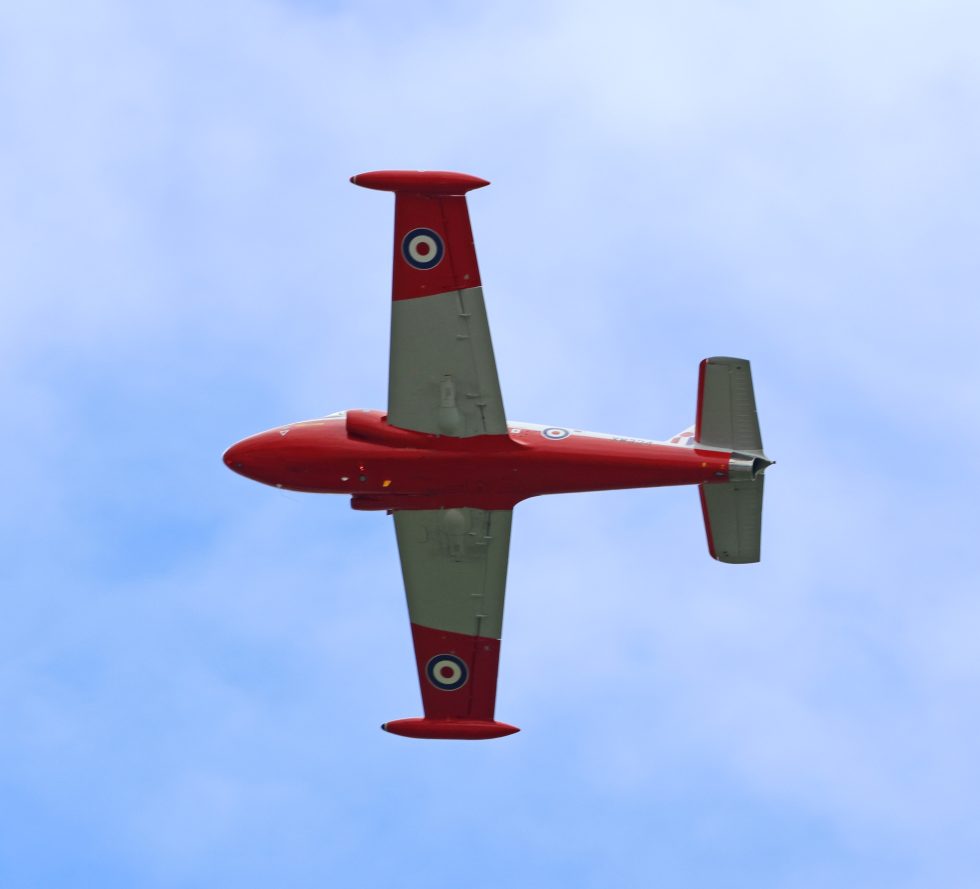
- good enough to carry the RAF's premier aerobatic team. The Central Flying School team at Little Rissington flew Jet Provosts as the Sparrows from 1958, the Redskins from 1959 and the Pelicans from 1960, took the premier RAF display slot in 1964 and 1965 as the Red Pelicans, and flew four aircraft, briefly six from 1963, with smoke systems fitted to the T.4s from 1962
- Fatigue life
- the quiet problem behind the whole story. The Jet Provost wing, carried over into the Strikemaster, has since suffered fatigue cracking severe enough to limit Strikemaster operations worldwide, and spare wings do not exist. Hours flown on RAF Jet Provosts were accumulated in the harshest possible way — circuits, aerobatics and spinning, all at low level — and airframe life, not obsolescence alone, is part of why the fleet went in 1993 and part of what limits the civil fleet now.
Propulsion & systems
- Engine, T.5
- 1 × Bristol Siddeley (later Rolls-Royce) Viper Mk 202 single-shaft turbojet, 11.1 kN (2,500 lbf) static thrust. The Mk 201 is quoted for some T.5 airframes and the rating is identical
- Engine by mark
- T.1 Viper Mk 101 at about 7.3 kN (1,640 lbf); T.2 and T.3 Viper Mk 102 at 7.8 kN (1,750 lbf); T.4 Viper Mk 11 series at 11.1 kN (2,500 lbf). Sources disagree on the early ratings: the type specification table gives 1,700 lbf for the T.1 to T.3 installation as a single figure, while the engine literature separates the Mk 101 and the Mk 102. The 1,750 lbf figure for the Mk 102 is the better attested of the two.
- Engine architecture
- seven-stage axial compressor, annular combustor, single-stage turbine; overall pressure ratio 4.3:1, air mass flow about 20 kg/s (44 lb/s), specific fuel consumption about 1.09 lb per hour per lbf, dry weight 249 kg (549 lb) for the later marks. Crude by any modern standard, and exactly what a trainer wanted: simple, light and cheap to run
- Where the Viper came from
- an expendable engine, designed for production versions of the Australian Jindivik target drone and originally expected to run for a matter of hours before being thrown away with the aeroplane. It entered service in 1953, was progressively man-rated, and ended up powering RAF aircraft until January 2011. Its unusually low maintenance demand for a 1950s turbojet is the least glamorous and most important reason the Jet Provost worked as a school aeroplane.
- Engine installation
- mounted behind the cockpit in a stainless-steel-lined bay carried on a secondary steel-tube structure, fed by a pair of ram intakes on the forward fuselage through sharply curving ducts that converge just ahead of the engine. It is delivered as a complete engine-change unit — engine, accessories and oil tank together — and started electrically
- Fuel system
- wing tanks only, with no fuselage cell. Tip tanks were fitted to the thirteen T.5B navigation trainers and to some export aircraft, and are the only way the type ever achieved a useful transit range
- Hydraulics
- the T.1 used pneumatic services; the T.2 of 1955 replaced them with hydraulics, which became standard for every subsequent mark. The T.2 also smoothed the fuselage lines and added the dorsal fillet that all later Jet Provosts carry
- Pressurisation
- none up to and including the T.4. Cabin pressurisation was the defining change of the T.5 and the reason for its redesigned forward fuselage and one-piece canopy. It is also why the T.5 is heavier and slightly less sprightly than the T.4 on the same thrust.
- Escape system
- ejection seats, listed among the changes introduced with the T.3 alongside the more powerful engine and the shortened undercarriage. Seat marks fitted to individual airframes and to the export variants are not consistently documented and are not stated here.
- Flight controls and warnings
- entirely manual, the surfaces worked by a cable and tie-rod arrangement with no power assistance anywhere. A centralised warning panel alerted both crew to icing, fire and oxygen failure. The cockpit and much of the operational equipment fit were, by design, essentially those of the piston Provost
- Avionics updates
- 70 T.3s were reworked as T.3As and 94 T.5s as T.5As, in both cases to bring the navigation and radio fit up to contemporary RAF standard so that students learned on equipment resembling what they would meet on the front line. Individual equipment types fitted under these programmes are not listed in any accessible source and are not invented here.
- Maintainability and armament provision
- 49 external service panels, and a hinged metal nose assembly holding the radio, batteries and electronics that a ground crew could open and work in without special equipment. The export marks added two 0.303 in machine guns in the intake fairings and four underwing stores stations; no RAF Jet Provost was ever fitted with either
04The BAC Jet Provost’s operating costs: why no reliable price exists
The Jet Provost was a British service aircraft procured through government contracts rather than sold on an open dollar market, so a firm, well-attributed flyaway unit price for the type simply is not part of the reliable public record, and figures quoted online vary widely. No dependable public cost-per-flight-hour figure exists for it either. What can be said with confidence is that the Jet Provost was deliberately cheap and simple to operate — that was the whole point of a basic trainer — and that its low running costs are exactly why it remains one of the more affordable ex-military jets to own and fly on the civilian warbird circuit today. Any precise cost figure attached to a Jet Provost should be treated as an estimate.
Armament & payload
The Royal Air Force flew the Jet Provost for thirty-four years without ever hanging a weapon on one, and every shot the type fired in anger was fired by somebody else
This is the rare aircraft whose armament section is mostly about an absence. The RAF bought 525 Jet Provosts across five marks and armed none of them: the aeroplane taught men to fly, to spin and recover, to navigate and to hold formation, and it did all of that clean. Weapons belonged to the export marks. The T.51, the T.52 and the T.55 added two 0.303 in Browning machine guns in the intake fairings and four underwing stations for rockets and light bombs, and 70 of them were sold, to Ceylon, Kuwait, Sudan, Iraq, Venezuela and South Yemen. For most of those customers the guns were a training aid and a sales argument rather than an operational plan.
Twice they were more than that. Ceylon bought twelve T.51s in 1959, mothballed them by the late 1960s, and brought them back out in April 1971 to fly ground-attack sorties against the JVP insurrection, losing one aircraft and its pilot. Two ex-Sudanese T.51s reached Nigeria in 1967 and were flown against Biafra. That is the whole combat record of the Jet Provost as such, and it is a fair verdict on sending a 2,500 lbf basic trainer to war. The serious fighting was done by the aeroplane BAC built next: the Strikemaster, essentially an armed and re-engined T.5, which flew close air support at Mirbat in 1972 and saw action in Oman, Yemen and Ecuador. Fits varied widely by customer and almost none are documented in primary sources; the store types below come from a single armament block of unstated origin and from secondary compilations.
Gun
- None on any Royal Air Force Jet Provost. There is no gun bay, no ammunition space and no provision for either; in thirty-four years of RAF service the type never carried a weapon of any kind
- The armed export marks T.51, T.52 and T.55 carried 2 × 0.303 in (7.7 mm) Browning machine guns mounted in the intake fairings, one on each side, firing outside the propeller-free arc that a jet makes irrelevant
- Two rifle-calibre guns was a light fit even by 1960 standards. It was adequate for gunnery instruction and for strafing unprotected targets, and adequate for nothing else
- The BAC 167 Strikemaster, the dedicated attack development of the T.5, replaced them with 2 × 7.62 mm FN machine guns under the intake lips — a real improvement in ammunition commonality rather than in weight of fire
- Gun designations for the export marks come from secondary compilations. No unit armament record for a T.51 or T.52 was consulted for this page.
Air-to-air
- None, on any mark, ever. No air-to-air missile has been cleared on a Jet Provost and none was proposed
- There is no radar, no ranging gunsight of any consequence and no aircraft performance to support air combat: a 382 kn maximum at 25,000 ft was slow in 1959 and absurd by 1969
- The two 0.303 in guns of the export marks were sighted and used for ground gunnery. Nothing in the installation was intended to engage another aeroplane
- The nearest the type came to an air-to-air role was as a target: Jet Provosts were flown as targets for interception practice and as forward air control trainers at RAF Brawdy, both of which are jobs done by being shot at rather than shooting
- This card is kept because the template requires it, and the honest entry is that it is empty
Air-to-surface guided
- None. No guided weapon of any kind was cleared on any Jet Provost mark, and none was offered
- The same is true of the Strikemaster, which fought in Oman, Yemen and Ecuador entirely with guns, rockets and unguided bombs
- This was not an oversight. A guided weapon in the 1960s meant a stabilised sight, an operator with both hands free and an aircraft steady enough to fly a command-guidance solution, and a two-seat basic trainer with manual controls offered none of the three
- Export customers who wanted precision bought something else; those who bought Jet Provosts wanted a trainer that could also strafe
- Any secondary source that lists guided weapons for this type should be treated as an error or as a transfer from another aircraft.
Bombs
- Up to 4 × 540 lb (245 kg) bombs on the four underwing stations is the figure printed in the standard armament block for the export marks
- That figure deserves open scepticism. It amounts to 2,160 lb of ordnance on an aeroplane with 2,500 lbf of thrust, and it is quoted without a source. It sits at the extreme of what the 9,200 lb maximum weight allows, and treating it as a routine load misdescribes the aeroplane badly.
- Realistic operational loads were far lighter: practice bombs, light general-purpose bombs and marking stores, carried two or four at a time
- The Strikemaster, with 3,410 lbf and a strengthened wing, is quoted at 3,000 lb total across four hardpoints — a genuine light-attack load, and a fair measure of how much less the Jet Provost proper could do
- Ceylonese T.51s flew ground-attack sorties during the JVP insurrection from April 1971, and two ex-Sudanese T.51s in Nigerian hands from 1967 were used against Biafra. Those are the only documented occasions on which Jet Provost bombs were dropped in anger
Rockets
- 6 × 60 lb (27 kg) rocket projectiles, or 12 × 25 lb (11 kg) practice rockets, on the underwing rails of the export marks
- Alternatively 28 × 68 mm SNEB rockets carried in four pods, seven tubes to a pod, which was the standard European light-attack fit of the period
- Rockets suited the aeroplane better than bombs did. They are light, they leave the aircraft cleanly and they reward a shallow dive from a machine with modest energy to spend
- This is the fit that Ceylon, Sudan, Iraq and South Yemen actually bought the aeroplane to use, and the fit that a weapons-training syllabus was built around
- The 60 lb and 25 lb figures are British rocket-projectile designations of Second World War ancestry; how many export aircraft carried them rather than SNEB is not documented in the sources consulted.
Pods & other stores
- Rocket pods and gun pods on the four export stations; camera and reconnaissance fits are mentioned in sales literature for the family but not corroborated on a specific airframe
- Wingtip tanks, fitted to the thirteen RAF T.5Bs used for navigation training and to some export aircraft. These are the only external stores an RAF Jet Provost routinely carried
- Smoke generators, fitted to the Red Pelicans' T.4s from 1962 and removed again when the team dropped back to four aircraft without smoke after 1965. In terms of hours flown, smoke is comfortably the most-used external store in the type's history
- Practice bomb carriers for light stores, the everyday equipment of a weapons-training syllabus in the export air forces
- Nothing above was carried by an RAF aircraft except tip tanks and smoke. The stores list for the export marks is a manufacturer and compilation list, not a record of what was hung on a particular aeroplane on a particular day.
Three typical loadouts
- RAF basic flying training, 1959–1993
- Nothing whatever. Two crew, full internal wing fuel, an hour in the local area, and back to the circuit. This is not a token entry: it is the configuration in which the overwhelming majority of the type's several million flying hours were flown, and the reason the aeroplane existed.
- RAF navigation training, T.5B
- Wingtip tanks, no weapons, a second seat used by a student navigator rather than a pilot under instruction. The only RAF fit that changed the aircraft's external shape, and the only one that gave it a useful transit radius.
- Ceylon Air Force counter-insurgency, April 1971, T.51
- Two 0.303 in Brownings with ammunition, and rockets or light bombs on the underwing stations, flown from Katunayake against ground targets. The precise stores carried on those sorties are not published; guns are certain, the rest is inference from the aircraft's known fit.
Sourcing caveat: the ordnance figures above trace to one armament block that is reproduced across the internet without a citation, and its 4 × 540 lb bomb entry is not credible as a routine load. Where this page gives a weapon type it is naming what the manufacturer and the compilations say the aircraft could carry, not what any squadron is recorded as having loaded. No RAF armament clearance, no export delivery contract and no operator manual was consulted.
Variants
The Jet Provost proved that ab initio jet training worked, and then the Royal Air Force spent thirty years quietly deciding it could not afford to be right
The claim usually made for this aeroplane is that it was the world's first jet used for ab initio pilot training, and the claim is sound. In 1955 and 1956 No. 2 FTS at Hullavington took students with no flying experience at all and taught them on Jet Provost T.1s, and the Central Flying School examiners who watched reported that student performance had improved. That was a genuinely radical result. Every other air force in the world still put a beginner in a piston aeroplane, on the assumption that a jet was too fast, too thirsty, too unforgiving and too expensive to be the machine on which a man discovered whether he could fly at all. The Jet Provost answered that a jet with 1,750 lbf, a wing loading of 33 lb per square foot and an instructor sitting beside rather than behind the pupil was none of those things.
The argument for all-through jet training was never really about handling; it was about transfer. A student who learned throttle response, cockpit height, approach speeds and instrument scan on a jet arrived at his Vampire or Gnat conversion with nothing to unlearn. The counter-argument was money, and money won in the end. Jet hours cost several times piston hours, and it is expensive to discover forty hours into a jet course that a student was never going to make it. The RAF quietly conceded the point from the early 1970s: grading and elementary flying went back to piston aircraft, the Scottish Aviation Bulldog T.1 entering service in 1975 with the University Air Squadrons and for elementary training. The Jet Provost kept the basic phase, but the pure all-through jet idea was dead within fifteen years of being proved.
The final verdict came in 1985. Air Staff Target 412 sought a Jet Provost replacement, and the RAF chose the Short Tucano — a turboprop — over the Pilatus PC-9, the NDN-1T Turbo-Firecracker and the A.20 Wamira II, ordering 130 aircraft for £126 million on 21 March 1985. Deliveries began in June 1988 and the last RAF Jet Provosts were withdrawn in 1993. That decision was not a judgement on the aeroplane, which had done its job for thirty-four years; it was the same economic argument arriving at its conclusion. The world followed: the PC-7, the PC-9, the Tucano and the T-6 Texan II now do basic training in almost every serious air force, and the Jet Provost stands as the one experiment that proved the jet could do it and then demonstrated why nobody should.
Along the way it flew a great deal of aerobatics. The Central Flying School team at Little Rissington formed as the Sparrows in 1958, became the Redskins in 1959 and the Pelicans in 1960 after the school's mascot, took smoke systems on its T.4s in 1962, expanded to six aircraft in 1963 and held the RAF's premier display slot as the Red Pelicans in 1964 and 1965 before the Red Arrows took the role. The team went on flying four-ship displays until the 1973 fuel crisis ended it. The RAF's flying training schools ran a string of smaller Jet Provost teams alongside it — the Macaws at the RAF College Cranwell, the Poachers, the Gemini Pair, the Blades, the Swords and the Vipers among them. These are documented mainly in enthusiast literature, their dates, marks and aircraft numbers differ between accounts, and none could be corroborated for this page beyond the Red Pelicans.
- Percival P.56 Provost T.1 (1950–56, 461 built)
- The ancestor, and the reason the jet looks the way it does. Designed by Henry Millicer to Air Ministry Specification T.16/48 as a Prentice replacement, first flown 24 February 1950, powered by a 550 hp Alvis Leonides radial and fitted with a fixed tailwheel undercarriage and side-by-side seating. It entered RAF service in 1953 and served into the early 1960s. Armed T.52 and T.53 export versions carried machine guns, bombs and rockets, which is where the jet's armed export marks got the idea.
- Hunting Percival P.84 prototypes (1954–55)
- Begun as a private venture in early 1951, government-sponsored from March 1953. XD674 flew from Luton on 26 June 1954 in the hands of Dick Wheldon, reused the Provost's tail surfaces, mainplanes and main undercarriage legs, and stood on the very long legs needed to give a nosewheel aeroplane ground clearance for its jet efflux. 123 flying hours had been accumulated by early November 1954, after which the aircraft went to Boscombe Down. The legs were shortened for production.
- T.1 (1955, 12 built)
- First production batch, first flight 19 February 1955, Viper Mk 101. Three went to the Central Flying School in May 1955 and the type then ran the trial that made its name: an ab initio course at No. 2 FTS, RAF Hullavington, completed successfully on 2 July 1956, in which students who had never flown were taught from scratch on a jet. CFS examiners reported that the Jet Provost had noticeably improved student performance.
- T.2 and T.2B (1955–56, 4 built)
- Development and demonstration aircraft, first flight 1 September 1955. Smoothed fuselage, hydraulic services in place of pneumatics, dorsal fillet. Used for winterisation trials in Scandinavia and for sales tours of Europe, Canada, the United States and Latin America; the T.2B was the company demonstrator evaluated in Portugal. One was lent to the RAAF for a six-month evaluation in 1959, ended up at Sydney Technical College as an instructional airframe and survives as A99-1 at the RAAF Museum, Point Cook.
- T.3 and T.3A (1958–62, 201 built; 70 converted)
- The first mark built in quantity and the aeroplane that made all-through jet training real. Ordered June 1957, first flight 22 June 1958, in service from June 1959 with No. 2 FTS at Syerston. Viper Mk 102 at 1,750 lbf, ejection seats, a redesigned airframe and the shortened, strengthened undercarriage. It equipped the Central Flying School, the RAF College Cranwell and Nos. 1, 3, 6 and 7 FTS, and trained forward air controllers at Brawdy. 70 were later reworked as T.3As with updated avionics.
- T.4 (1960–64, 198 built)
- The T.3 with the 2,500 lbf Viper Mk 11, first flown 15 July 1960 and into service almost immediately. No pressurisation and no significant weight growth, which makes it the best-performing Jet Provost by feel if not by ceiling, and the mark the Red Pelicans took to the premier RAF display slot in 1964.
- T.5, T.5A and T.5B (1967–72, 110 built; 94 and 13 converted)
- The definitive RAF mark. First flight 28 February 1967, deliveries from Warton from 3 September 1969, pressurised cabin, redesigned forward fuselage and canopy, Viper Mk 201 or 202. 94 became T.5As with updated avionics; 13 became T.5Bs with wingtip tanks for navigation training. These were the Jet Provosts that flew on to the end in 1993.
- T.51 (from 1959, 22 built)
- Armed export version of the T.3, with two 0.303 in machine guns and four underwing stations. Ceylon took 12 from early 1960, Kuwait 6 and Sudan 4. The Ceylonese aircraft were mothballed in the late 1960s, reactivated in April 1971 for ground attack against the JVP insurrection, and two of the Sudanese machines passed to Nigeria in 1967 for use against Biafra.
- T.52 and T.52A (from 1962, 43 built)
- Armed export version of the T.4, the biggest export mark. Iraq took 20 from August 1964, Venezuela 15, Sudan 8 from 1962 and South Yemen 4 T.52As in 1967; three of the South Yemeni aircraft later served Singapore from 1975 to 1980. Those operator figures sum to 47 against a build total of 43, a discrepancy of four aircraft that the sources consulted do not resolve. The likeliest explanation is that the South Yemeni machines were transferred rather than newly built, but this page cannot confirm it.
- T.55 (ordered 1966, 5 built)
- Armed export version of the pressurised T.5, built only for Sudan. With its 4 T.51s and 8 T.52s this made Sudan the only customer to operate all three armed export marks, and the most persistent Jet Provost operator outside Britain.
- BAC 167 Strikemaster (1967–83, 146 built)
- Not a Jet Provost mark but the design's destination: an armed T.5 with a Rolls-Royce Viper 535 of 3,410 lbf, a strengthened wing, four hardpoints for 3,000 lb of stores and two 7.62 mm guns under the intake lips. Sold widely as a counter-insurgency aircraft, bought mostly as an advanced trainer, and blooded in Oman, Yemen and Ecuador — four Omani aircraft flew close air support at Mirbat in July 1972. The Viper 535 is usually rated at 3,410 lbf; 3,140 lbf also appears in print and is probably a transposition.
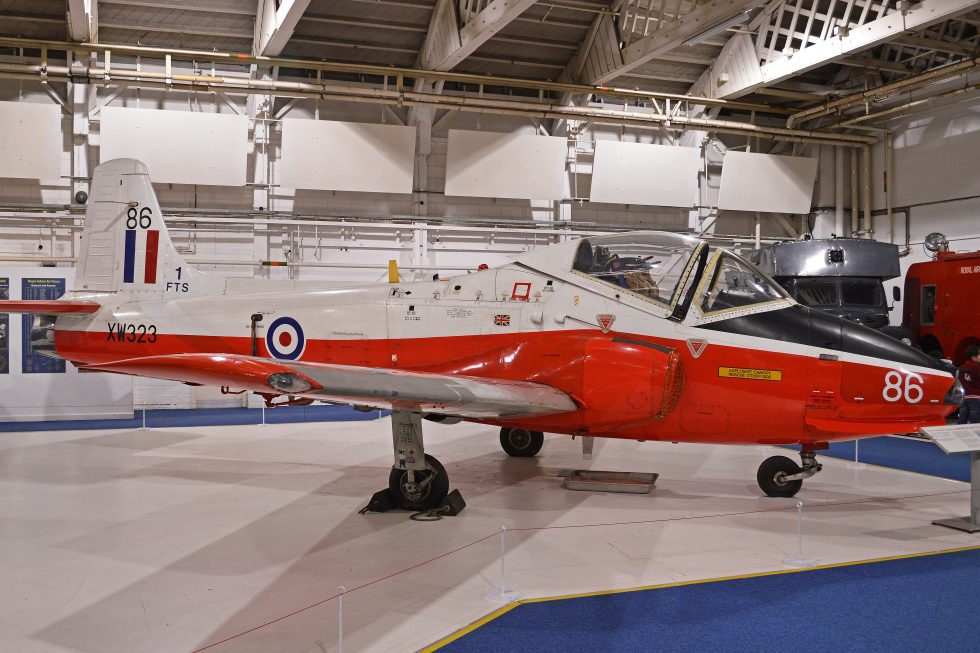
Production and survivors. The mark totals above sum to 525 Jet Provosts for the RAF and 70 for export, 595 airframes in all; adding the 146 Strikemasters gives 741, which is where the frequently quoted "about 730" and "over 700" totals come from. Anyone citing a single production number for this type should say whether the Strikemaster is inside it. As for survivors, no honest exact count exists. Every surviving Jet Provost is an original airframe — there are no reproductions, and no reason anyone would build one — but they are spread across museums, gate guardians, private hangars and the civil registers of at least half a dozen countries. The selective survivors list in the standard reference names on the order of forty aircraft; the true figure is certainly well into three figures, because the type was sold off cheaply into private hands in large numbers and is now one of the most numerous ex-military jets flying anywhere. A realistic shape of the population is: a few dozen airworthy, the majority of them British-registered and flown from UK airfields such as North Weald and Leeds East, with roughly as many again kept in ground-running condition; a further large body of complete but unflyable airframes in museums and collections across the United Kingdom, the United States, Australia, Canada, New Zealand and Sri Lanka; and the historically important individuals preserved, among them the prototype XD674 and the T.3 XM351 at the RAF Museum Cosford, the T.5 XW323 at the RAF Museum London, and the RAAF's evaluation T.2 at Point Cook. Numbers in the flying fleet move every year as airframes change hands, run out of permit or run out of wing life, and any figure printed as current should be read as a snapshot rather than a count.
Nearly four decades of RAF service
Prototype flies
The Jet Provost prototype, a jet development of the piston Percival Provost, first flies from Luton on 26 June 1954.
Into RAF hands
Early T.1 aircraft reach the RAF for evaluation, beginning trials of true all-through jet training.
The T.3 becomes standard
The definitive T.3 — with ejection seats and more power — enters service as the RAF’s standard basic jet trainer.
The BAC Jet Provost
Hunting is absorbed into the new British Aircraft Corporation, and the aircraft is rebranded the BAC Jet Provost.
Pressurised T.5 and the Strikemaster
The pressurised T.5 first flies; BAC develops it into the armed Strikemaster light-attack jet.
Export sales
Armed T.51/T.52/T.55 trainers are sold to Sri Lanka, Sudan, Iraq, Kuwait, Venezuela and South Yemen.
A future king’s wings
Prince Charles trains on Jet Provost T.5A XW323 and receives his RAF wings, flying about 92 hours on type.
Retired after ~38 years
The last RAF Jet Provosts are withdrawn on 20 September 1993, replaced by the turboprop Shorts Tucano.
A popular warbird
Around a dozen Jet Provosts remain airworthy in the UK, flying at airshows and offering a taste of RAF jet training history.
From the cockpit: twelve Jet Provost stories
“The JP”
To generations of RAF aircrew the Jet Provost was known simply as “the JP.”
Read the full story
From propeller to jet
The Jet Provost was literally a jet conversion of the piston Percival Provost trainer.
Read the full story
Sitting side by side
Instructor and pupil sat shoulder to shoulder, not one behind the other.
Read the full story
The all-through jet trainer
The JP let the RAF take a recruit from first flight through basic training entirely on jets.
Read the full story
A king’s first wings
The RAF Museum’s T.5A XW323 was used to train Prince Charles, now King Charles III.
Read the full story
The Red Pelicans
The RAF’s Central Flying School flew the JP as a formation aerobatic team.
Read the full story
Ejection seats arrive
The first Jet Provosts had no ejection seats; the T.3 introduced them from 1959.
Read the full story
The pressurised T.5
The final RAF mark added a pressurised cabin, keeping the JP relevant into the 1990s.
Read the full story
The Strikemaster
BAC turned the pressurised T.5 into an armed light-attack jet that saw real combat.
Read the full story
Guns for export
RAF Jet Provosts were pure trainers, but export models were lightly armed.
Read the full story
Thirty-eight years of service
The JP served the RAF from 1955 until the last examples retired in 1993.
Read the full story
Still flying today
The Jet Provost is now one of the most popular and affordable civilian warbirds.
Read the full story
The Jet Provost in pictures
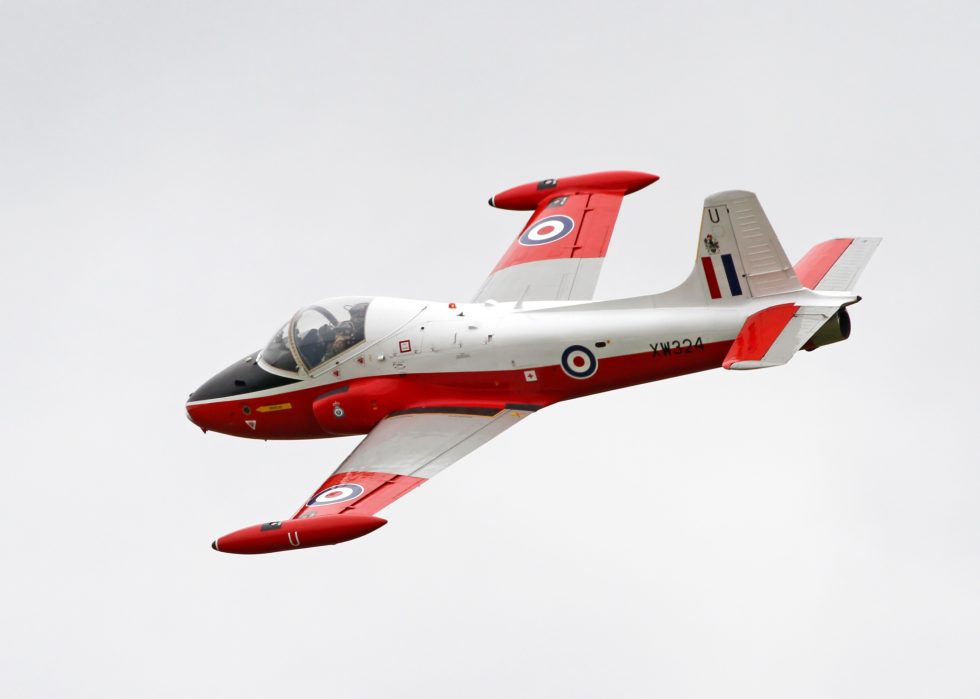
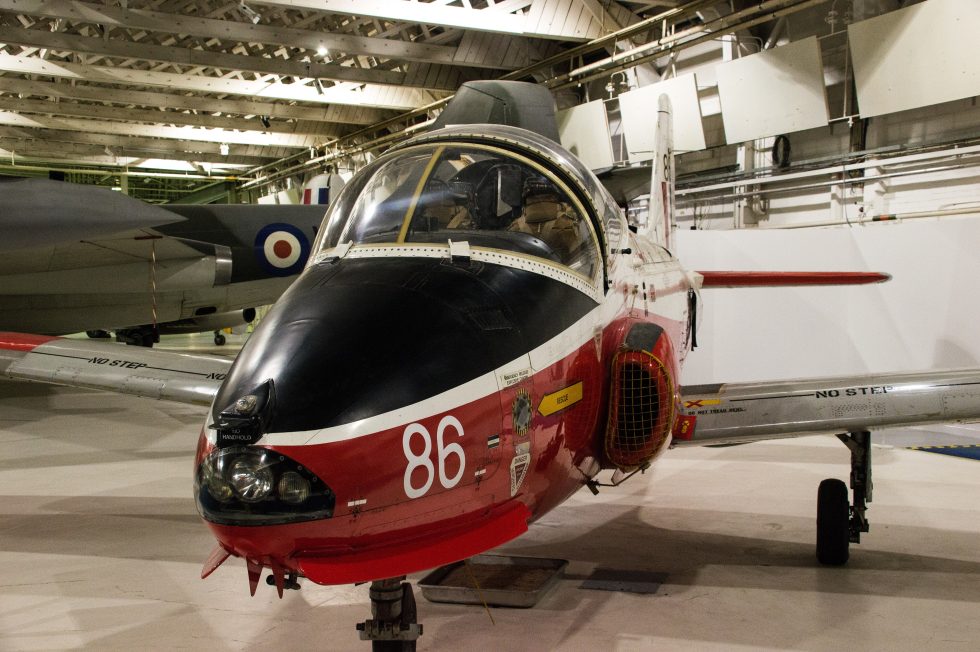
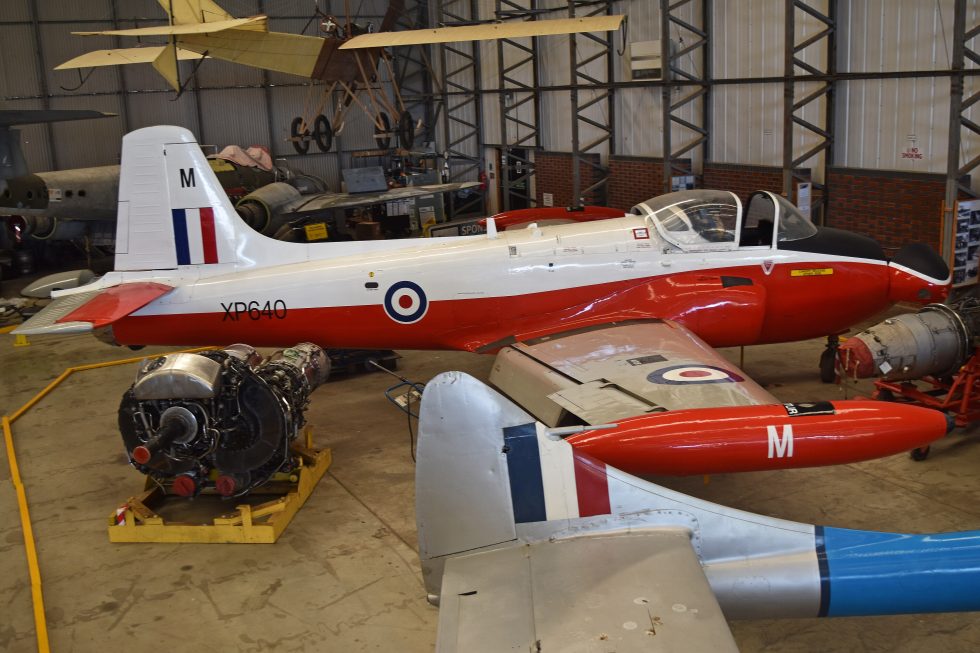
The Jet Provost in motion
Palm Springs Air Museum: BAC Jet Provost — Warbird Wednesday Episode #243. A museum walk-around and history of the type from an established aviation-museum channel.
Where the Jet Provost flew
A trainer first — and the armed cousins that fought
The Jet Provost was, above all, a trainer. In RAF hands it never fired a shot in anger; its job was to turn recruits into pilots, which it did for almost four decades. But lightly armed export versions carried guns and light ordnance, and BAC’s derived Strikemaster became a genuine combat aircraft — so the JP’s bloodline saw real fighting even if the trainer itself did not.
Compare the combat record of every military aircraft. Figures as of 2026.
Everything people ask about the BAC Jet Provost
Can I fly in a BAC Jet Provost?
What was the BAC Jet Provost used for?
How is the Jet Provost related to the Percival Provost?
Why did the Jet Provost have a side-by-side cockpit?
What is the difference between the Jet Provost and the Strikemaster?
How many Jet Provosts were built?
Is the Jet Provost still flying?
You can’t fly the BAC Jet Provost with us.
These, you can.
Some legends only live in museums — others are fuelled and waiting. MiGFlug has put civilians in real military jet cockpits since 2004.
 Fly the L-39 AlbatrosThe world’s most-flown jet trainer — aerobatics included
 Fly the F-104 Starfighter“The missile with a man in it”
 Fly the MiG-21The Cold War’s most-produced jet
 Fly the T-33 Shooting StarAmerica’s first jet trainer
 Fly the DH VampireA piece of early jet history
 Fly the S.211Agile Italian jet trainer
 Fly the MB-326The classic Aermacchi jet
 Fly the MiG-15The Soviet legend of the Korean War
Continue the tour
Every fact, checked
- Royal Air Force MuseumCollection records for Jet Provost T.5A XW323, service history and 1993 retirement.
- Newark Air MuseumAircraft profiles and preserved Jet Provost airframes.
- Skytamer aircraft archiveDetailed variant data and T.5A / T.3A specifications.
- The Four Prop — Jet Provost briefingDevelopment history, the “JP” nickname and the piston-Provost lineage.
- AeroResourceThe Jet Provost Display Team and the civilian warbird scene.
- GlobalSecurity — BAC 167 StrikemasterThe armed derivative, its engine and its combat use in Oman.
- Palm Springs Air MuseumWarbird Wednesday walk-around and history of the type (video source).