
BAE Systems Hawk
The world’s trainer
The docile-but-deadly British jet that has taught more than 20 air forces to fly fast — mount of the RAF Red Arrows, carrier tutor of the US Navy as the T-45 Goshawk, and a light-attack fighter in its own right.
The trainer that taught the world to fly fast
By the late 1960s the Royal Air Force needed a single, affordable jet to replace two ageing trainers — the Folland Gnat and the Hawker Hunter — and take a pilot all the way from basic flying to the edge of front-line readiness. Hawker Siddeley’s answer was the HS.1182, a clean, tandem-seat monoplane with a single Rolls-Royce Turbomeca Adour turbofan. It first flew from Dunsfold on 21 August 1974 in the hands of chief test pilot Duncan Simpson, and it was so trouble-free that it entered RAF service barely two years later, in 1976.
Named the Hawk, it was designed to be forgiving enough for a student on his first fast-jet sortie yet honest enough to teach real airmanship — and strong enough to carry guns, bombs and missiles when asked. That combination turned a modest training requirement into one of the most successful jet programmes Britain ever built. When Hawker Siddeley became British Aerospace, and later BAE Systems, the Hawk went with it, selling to air force after air force around the world.
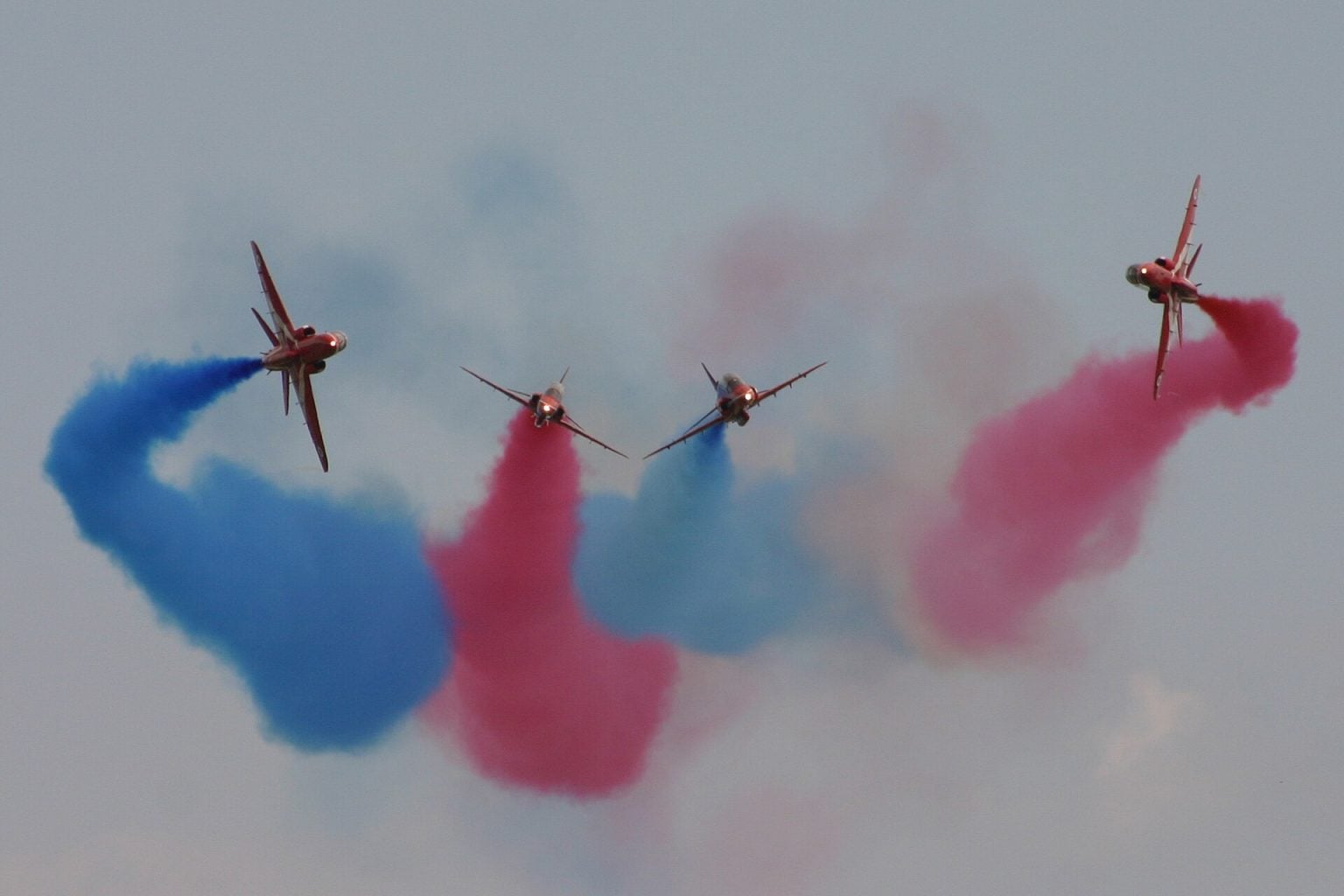
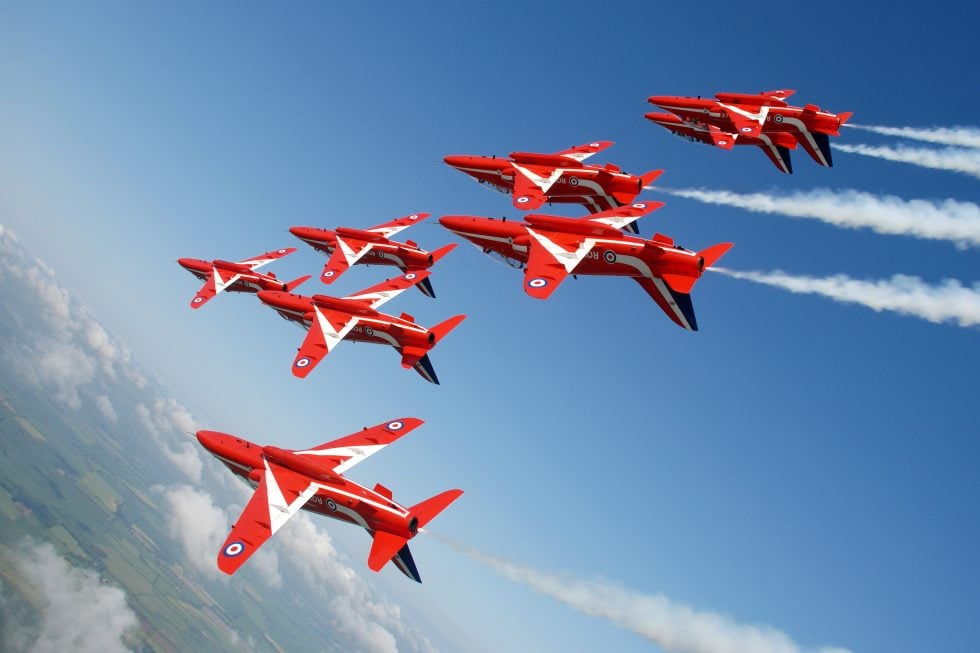
In 1979 the Red Arrows traded their little Gnats for the Hawk, and the jet became the shape the world pictures when it thinks of British aerobatics. The US Navy chose a navalised version — the T-45 Goshawk — to teach its pilots carrier landings. India builds it under licence. Fifty years after that first flight, the Hawk is still in service, still training the pilots who go on to fly Typhoons, F-35s and Super Hornets.
01From Gnat replacement to global bestseller: how the BAE Hawk conquered the trainer market
The Hawk was born from RAF Air Staff Target 397, a 1970 requirement for a cheap, reliable jet trainer. Hawker Siddeley deliberately kept it simple: one proven engine, a strong airframe stressed for hard use, and handling qualities that were honest rather than tricky. That discipline paid off — the prototype flew in 1974 with almost no drama, and the type matured fast.
What turned a national trainer into a world one was its stretch. The same airframe could be armed for weapons training, uprated into the combat-capable Hawk 100 and single-seat Hawk 200, navalised into the T-45 Goshawk, and licence-built in India. Roughly 1,000 Hawks have been produced for more than twenty operators — and with the 220-odd T-45s, the family comfortably passes 1,200 airframes. Few post-war British aircraft have sold on that scale.
What makes the Hawk special
Docile to fly, honest to learn on
The Hawk’s genius is its handling. A modestly swept wing and a single, responsive Adour turbofan give it benign low-speed manners and no vicious habits — a student can be flown safely to the edge of the envelope — yet it is agile enough to teach genuine fast-jet skills and pull up to 8 g. It is the rare trainer that is easy to fly and hard to master, which is exactly what an instructor wants.
A trainer that can bite
From the start the Hawk was stressed to carry weapons. RAF T1As held a wartime point-defence role armed with Sidewinders and a 30 mm ADEN gun pod. The dedicated combat models went much further: the single-seat Hawk 200 added an APG-66 multi-mode radar and seven hardpoints for missiles, bombs and rockets — a genuine light fighter wrapped around a trainer’s airframe.
The Hawk that goes to sea
The US Navy’s T-45 Goshawk is a Hawk rebuilt for the carrier: a strengthened structure, an arrestor hook, catapult-capable nose gear, wider-track landing gear and revised aerodynamics for the brutal low-speed precision of a deck landing. It is the only foreign-designed aircraft the US Navy adopted as its standard jet trainer — and it still qualifies naval aviators today.
02The Adour engine and the Hawk’s benign aerodynamics: why students survive their mistakes
The Hawk is powered by a single Rolls-Royce Turbomeca Adour, a non-afterburning turbofan shared in reheated form with the Jaguar strike jet. In the trainer it delivers around 23–26 kN of thrust — enough for lively performance without the fuel-thirst or complexity of an afterburner. Crucially the engine is docile at low speed and quick to spool, so a student who mishandles the throttle on approach is not immediately punished.
The airframe matches that philosophy. The wing is thick enough to stay controllable deep into the stall, the controls are well harmonised, and the aircraft gives clear warning before it departs. That forgiving nature is deliberate engineering: the Hawk was designed so that trainees could explore the limits of fast-jet flight and live to debrief it.
03Hawk 100 and Hawk 200: how a jet trainer became a light-attack fighter
The two-seat Hawk 100 added a combat wing, more hardpoints and modern avionics, turning the trainer into a capable weapons platform. The single-seat Hawk 200, first flown on 19 May 1986, went the whole way: it deleted the second cockpit, fitted a Northrop Grumman APG-66 radar, and offered seven weapon stations for AIM-9 and AIM-120 missiles, Maverick, laser-guided bombs and rockets.
The result was an affordable multi-role light fighter for nations that could not justify a Typhoon or an F-16. Indonesia, Malaysia and Oman all bought it — and Indonesia used its single-seat Hawks in the ground-attack role during the 2003–04 Aceh offensive, one of the few times the type has been flown in anger.
Full specifications
Baseline note: the figures below describe the Hawk T2, the BAE Systems Hawk 128 as the Royal Air Force flies it at RAF Valley today — combat wing, glass cockpit, Rolls-Royce Adour Mk 951 with full authority digital engine control, and only about ten per cent structural commonality with the aeroplane that first flew from Dunsfold on 21 August 1974. Deltas for the original Hawk T1, for the 50, 60 and 100 export series, for the single-seat Hawk 200 light fighter, for the carrier-capable T-45 Goshawk and for the Indian Hawk 132 are given in grey. One warning before the numbers, because it contaminates almost every Hawk table in print. A great many published "Hawk T1" specifications — the Ministry of Defence’s own October 2021 Hawk fact sheet among them — give a 12.43 m airframe of 9.94 m span with an Adour Mk 951 of 6,500 lbf. Those are Hawk 128 numbers wearing a T1 label. The T1 is a smaller and much lighter aeroplane, 11.85 m long and 9.39 m in span, and its engine is the 23.1 kN Adour Mk 151. The RAF’s own aircraft page gives the T1 as 11.9 m by 9.4 m, which is the honest order of magnitude. Where authorities disagree below, it is said so in grey rather than averaged away.
Dimensions & weights
- Crew
- 2 — student forward, instructor aft on a raised seat with full duplicate controls. The stepped tandem cockpit under one long hinged canopy was in the 1968 Hawker Siddeley studies from the start, and it is the single feature that made the Hawk sell: the man in the back can see the runway
- Length
- 12.43 m (40 ft 9 in) — Hawk T1 11.85 m (38 ft 11 in); Hawk 200 11.38 m (37 ft 4 in), shorter despite the radar because the second cockpit is gone; T-45 Goshawk 11.97 m (39 ft 3 in)
- Wingspan
- 9.94 m (32 ft 7 in) measured over the wingtip missile rails. The basic wing is 9.39 m (30 ft 10 in) and that is the figure for the T1, the Hawk 200 and the Goshawk; quoting the two interchangeably is the second most common Hawk error after the engine mark
- Height
- 3.98 m (13 ft 1 in) — Hawk T1 4.00 m (13 ft 1 in); Hawk 200 4.16 m (13 ft 8 in) on a taller fin added to hold directional stability with the single-seat nose; T-45 4.11 m (13 ft 6 in)
- Wing area
- 16.7 m² (179.6 sq ft) — unchanged in every Hawk ever built, which is remarkable for a design that has gained nearly a tonne of empty weight across fifty years
- Wing
- Combat wing, revised leading edge, four pylons — introduced on the Hawk 100 in 1987 and carried through every LIFT-generation aircraft. The T1 has the original wing with two pylons and no leading-edge devices; only the T-45 got full-span slats, and it needed them to reach a carrier approach speed
- Undercarriage
- Retractable tricycle, single nosewheel, brake parachute — uprated wheels and brakes from the 60 series onward. The Goshawk has twin nosewheels carrying a catapult launch bar and new legs entirely, which is where most of its extra weight went
- Empty weight
- 4,400 kg (9,700 lb) — Hawk T1 3,647 kg (8,040 lb) per the MoD fact sheet, 3,635 kg by other tabulations; Hawk 200 4,128 kg (9,101 lb); T-45C 4,261 kg (9,394 lb). The Hawk has put on roughly 750 kg since 1974 and every kilogramme bought either fatigue life or avionics
- Maximum take-off weight
- 9,100 kg (20,065 lb) — this is the figure that gets misattributed to the T1. Against a 3,647 kg empty weight and a quoted useful load of 3,000 kg, the T1 in practice tops out near 6,650 kg (14,660 lb), and a clean training sortie is flown a good deal below that
- Wing loading
- 545 kg/m² (111.6 lb/sq ft) at maximum take-off weight; nearer 340 kg/m² (70 lb/sq ft) clean with a training fuel load, which is why the aeroplane is pleasant at low speed and why students are not frightened by it
- Internal fuel
- ~1,360 kg (3,000 lb) — a fuselage bag tank and integral wing tanks. There is no crossfeed drama and no refuelling probe as standard; a probe is an option taken up by Malaysia and by several Hawk 100 and 200 customers
- External fuel
- Up to 3 × 591 L (130 imp gal, 156 US gal) tanks on the inboard pylons and centreline; earlier 50-series aircraft used 455 L (100 imp gal) tanks. Ferry fuel with three tanks is quoted at 3,210 kg (7,080 lb) total
- Maximum external stores
- 3,085 kg (6,800 lb) across five hardpoints on the combat wing. The T1 was cleared for 680 kg (1,500 lb) on two pylons and a centreline pod, which is the difference between a trainer that can carry practice bombs and an aeroplane that can go to war
- Airframe fatigue life
- Four times that of the Hawk T1 — the T2 was designed for a service life running to 2040. The T1 was designed in an era of cheap airframes and is now the constraint on the Red Arrows: 14 of the 24 surviving T1s had passed 80 per cent of their fatigue index by 1 June 2026
Performance
- Maximum level speed
- 1,028 km/h (555 kn, 639 mph) — the figure the RAF publishes for the T2 and the one the MoD fact sheet gives
- Maximum Mach number, level
- M0.88 — the Hawk is a subsonic aeroplane in level flight and always has been. Students meet supersonic flight on the Typhoon, not here
- Never-exceed speed
- M1.2 in a dive — the airframe goes supersonic downhill and the RAF quotes M1.15 for the T1 in the same condition. It is a limit, not a capability anyone uses in a syllabus
- Speed at sea level
- 1,037 km/h (560 kn, 644 mph) — quoted for the Hawk 200, which spends its life low down. The trainer marks are flown to the same numbers
- Rate of climb
- 47 m/s (9,300 ft/min) at sea level, clean — a genuinely lively figure for 29 kN of dry thrust, and the reason the Red Arrows can build a display around vertical manoeuvres
- Service ceiling
- 13,565 m (44,500 ft) — and here the authorities part company. The RAF publishes 42,000 ft for the T2 and 48,000 ft for the T1; 15,250 m (50,030 ft) is tabulated for the Hawk 200. The spread reflects different definitions of ceiling and different weights, not different aeroplanes
- Ferry range
- 2,520 km (1,360 nmi, 1,565 mi) with external tanks. The Hawk 200 with three tanks is quoted at 1,950 km (1,053 nmi), the difference being what a single-seat combat nose does to drag and fuel fraction
- Combat radius
- ~617 km (333 nmi) — the published Hawk 200 figure carrying three Sea Eagle anti-ship missiles, which is close to the worst case. A clean point-defence sortie from a coastal base does far better; a low-level strike with bombs does worse
- Load factor limits
- +8 / −4 g — the airframe is stressed to +9 g and the normal RAF service limit is +7.5 / −4 g. The 2011 Red Arrows fatality at Bournemouth was attributed in part to g-force impairment, and the 1986 loss of the Hawk 200 prototype at Dunsfold was g-induced loss of consciousness; this is an aeroplane that will pull more than its pilot can take
- Thrust-to-weight ratio
- 0.52 at a typical 5,700 kg training weight with the Adour Mk 951 (calculated); about 0.32 at maximum take-off weight, which is the honest measure of what a fully loaded combat Hawk feels like
- Planned service life
- To 2040 for the RAF Hawk T2, confirmed by the Ministry of Defence in 2021 and again in March 2024. The Hawk T1 out-of-service date is 2030
Propulsion & systems
- Engine
- 1 × Rolls-Royce Turbomeca Adour Mk 951 — a two-shaft turbofan without reheat, the unreheated cousin of the engine in the SEPECAT Jaguar, fitted with full authority digital engine control
- Thrust
- 29.0 kN (6,500 lbf) dry — there is no afterburner on any Hawk and never has been
- Engine by mark
- Adour Mk 151, 23.1 kN (5,200 lbf) in the Hawk T1; Mk 861, 25.4 kN (5,710 lbf) in the 60 series; Mk 871, 26.0 kN (5,845 lbf) in the Hawk 100, 200 and Australian Mk 127; F405-RR-401 in the T-45 Goshawk. The Red Arrows fly a Mk 151-02 tuned for throttle response rather than thrust
- Engine life and reliability
- Adour Mk 951 rated at up to twice the service life of the Mk 871 — but first-stage compressor blade problems cut the interval between rebuilds badly, and in March 2024 the Ministry of Defence confirmed that 16 of the RAF’s 28 Hawk T2s were unavailable for fast jet training on 11 March 2024. That is the single worst fact about the modern Hawk
- Air intakes
- Fixed-geometry lateral intakes — no variable ramps, no bleed doors, nothing to go wrong. The T-45 needed forward-swept inlets retrofitted from 2022 to cure compressor stalls it suffered behind a carrier island; the land-based Hawk never had the problem
- Cockpit
- Three colour multifunction displays, HOTAS, wide-angle head-up display — with two mission computers and 27 selectable display formats. The T1 is analogue throughout; the leap between the two is larger than the leap between the two airframes
- Embedded simulation
- Synthetic radar, radar warning receiver, sensor and weapon effects generated on board — the defining feature of the T2. It carries no radar, so a student flies simulated Typhoon intercepts against threats that exist only in software, cued through a datalink between aircraft and to the ground station. It is cheaper than flying a Typhoon and it is the reason the type earns its keep
- Navigation
- GPS-aided inertial navigation with ring-laser gyro — the LINS 300 in the Hawk 100 and 200; the T1 has a simple attitude and heading reference system and a stopwatch
- Radar
- None in any trainer mark — the Hawk 200 alone carries a real set, the Northrop Grumman AN/APG-66H multi-mode pulse-Doppler radar derived from the early F-16 unit, with ten air-to-air and ten air-to-surface modes
- Ejection seats
- Martin-Baker zero-zero, Mk 10B in the T1 — and the seat has a dark history in this aeroplane. In November 2011 a Red Arrows pilot was killed when his seat fired while the aircraft was stationary on the ground and the parachute failed to deploy; the resulting restrictions on flying in aircraft with similar seats stayed in force on the Hawk long after they were lifted elsewhere
- Auxiliary systems
- Auxiliary power unit, health and usage monitoring system, brake parachute — the HUMS is what lets the RAF quote fatigue index by tail number, which is how we know how tired the Red Arrows fleet is
- Refuelling probe
- Optional, fixed — taken up by Malaysia on its Hawk 208s, the first Hawks so fitted, and offered on the 100 and 200 series. No RAF Hawk has ever had one
04What a BAE Hawk costs: purchase price and cost per flight hour
Because the Hawk sells in many marks to many customers, there is no single sticker price. A modern advanced trainer such as the Hawk T2 or a new-build export airframe is generally reckoned in the region of USD 20–30 million each once support and systems are included — a fraction of a front-line fighter, which is the whole point of the aircraft.
Operating cost is the Hawk’s real selling point: it is far cheaper to fly than the jets its graduates go on to. No fully authoritative public cost-per-flight-hour figure exists, and quoted numbers vary widely with variant and country, but credible estimates put it in the low tens of thousands of dollars per hour — well below the running cost of a Typhoon, F-35 or Super Hornet. Any precise figure you see should be treated as an estimate.
Armament & payload
The Hawk is two aeroplanes wearing one name: an unarmed trainer and a genuine light fighter that has bombed people
Hawker Siddeley sold the Hawk as a trainer and then discovered, as everyone who builds a cheap jet discovers, that customers wanted it to shoot. The RAF converted 89 of its T1s to T1A standard between 1983 and 1986 with two AIM-9L Sidewinder rails and a centreline 30 mm ADEN pod, intending them to be vectored onto Soviet bombers by Tornado F3s that had the radar the Hawk lacked. Export customers went much further. The combat wing of 1987 took external stores to 3,085 kg on five hardpoints, and the single-seat Hawk 200 of 1986 added an APG-66H radar and a nose designed around guns.
What the aeroplane cannot do is survive a modern air defence, and nobody has ever pretended otherwise. It is slow, unstealthy, short-legged and carries no meaningful self-protection suite. Against an enemy with no air force it is lethal and absurdly cheap to run; against anything else it is a target. Both of those propositions have been tested in earnest — over the Congo by Zimbabwe, and over Sabah by Malaysia. Fits vary enormously by mark and operator: an RAF Hawk T2 carries no weapon at all and simulates everything, a Finnish Mk 51 was cleared for Soviet R-60 missiles and a Finnish 12.7 mm gun pod, and an Indonesian Hawk 209 is a different aeroplane again. Read every line below as "on some marks, for some customers".
Gun
- 30 mm ADEN Mk 4 cannon in a centreline pod, 120 rounds — the standard fit on the RAF Hawk T1A and on most armed export trainers.
- 2 × 25 mm ADEN internally in the nose of the Hawk 200 as designed; the installation gave trouble in development and production aircraft largely reverted to the 30 mm centreline pod.
- Finnish Mk 51s carried a Finnish 12.7 mm gun pod with a Saab RS-2 sight instead of the ADEN, a purely national fit.
- No gun on the RAF Hawk T2, and none on the T-45 Goshawk. Gunnery is taught on the front-line type.
Air-to-air
- AIM-9L Sidewinder — 2 rounds on the RAF Hawk T1A from 1983; Kuwait’s Mk 64s were cleared for four.
- Matra R550 Magic on Dubai’s Mk 61s, the usual French alternative for customers outside the American supply chain.
- R-60, NATO reporting name AA-8 Aphid, cleared on Finnish Mk 51s — a British trainer carrying a Soviet missile, which tells you a good deal about Finland’s Cold War.
- ASRAAM on later marks and A-Darter on the South African Mk 120, both from wingtip rails.
- On the Hawk T2 the missile is entirely synthetic: the shot exists in the mission computer and in the debrief, and nowhere else.
Air-to-surface guided
- Sea Eagle anti-ship missile — investigated by British Aerospace in the early 1990s for export Hawk 200 customers; the type’s published combat radius of 617 km is quoted for a three-missile fit.
- AGM-65 Maverick offered on the Hawk 200 for customers already in the American ecosystem.
- Brimstone has been marketed and trial-fitted on later combat Hawks; no operator flies it as a standard service load.
- India’s Hawk-i and the joint BAE and HAL Advanced Hawk of 2017 exist precisely to fix this gap and integrate Indian precision stores; neither has become a production standard.
- In practice, almost no Hawk in service carries a guided air-to-ground weapon. This is the card where the light fighter argument runs out.
Bombs
- Mk 82 500 lb general purpose bombs; the marketing brochures quote clearance to 1,000 lb weapons on the combat wing.
- BL755 cluster bomb on British-supplied aircraft — a weapon most operators have since had to give up under the Convention on Cluster Munitions.
- 3 kg practice bombs on carriers, up to eight on an RAF T1 in the close air support training role.
- The Malaysian Hawk 208s that struck the Lahad Datu camps on 5 March 2013, alongside F/A-18Ds, were carrying free-fall ordnance. That remains the type’s most recent recorded combat use.
Rockets
- SNEB 68 mm rockets in Matra pods — the classic European fit and the one the Hawk was first cleared for.
- Brandt 68 mm and CRV7 70 mm pods on later and Commonwealth aircraft.
- Rocket pods with practice heads remain a standard weapons-delivery training store wherever armed Hawks fly.
- Zimbabwe’s Hawk 60s used rockets and bombs in the Second Congo War between 1998 and 2000, flying strikes in support of the Congolese army; the resulting British arms embargo of 2000 to 2002 stripped the fleet of spares and effectively killed it.
Pods & other stores
- 591 L drop tanks, up to three, on the inboard pylons and centreline; 455 L tanks on early marks.
- Vinten reconnaissance camera pods on Finnish Mk 51s and Dubai Mk 61s — the cheapest tactical reconnaissance capability anyone has ever fielded.
- Telemetry and air combat manoeuvring instrumentation pods on RAF T1s in their final aggressor role with No 100 Squadron.
- The Red Arrows fit: a tank of diesel mixed with coloured dye, fed into the jet exhaust to make red, white or blue smoke. It occupies the station a gun pod would use, and it is the only ordnance most people ever see a Hawk carry.
Three typical loadouts
- Red Arrows display
- Clean wings, centreline smoke pod with roughly enough diesel and dye for a full display, reduced fuel. Nine aircraft, a Mk 151-02 engine chosen for throttle response rather than thrust, and an airframe that has been doing this since the first Hawk arrived at RAF Kemble on 17 August 1979.
- Hawk 200 point defence
- Two AIM-9L Sidewinders on the outboard pylons, 30 mm ADEN centreline pod, two 591 L tanks inboard, APG-66H radar working. This is the configuration Oman and Malaysia bought the single-seater for: a cheap runway-and-coastline defender that can be scrambled by a small air force without a fighter budget.
- Hawk T2 advanced fast jet training sortie
- Completely clean. No pylons, no pods, no gun. Every sensor, every threat and every weapon in the sortie is generated inside the aeroplane and shared over the datalink with the other aircraft in the formation and with the ground. It is the loadout that defines the modern Hawk, and it carries nothing at all.
Sourcing caveat: Hawk weapon clearances are contract-specific and rarely published in full. Manufacturer brochures list what the airframe can be cleared to carry, which is not the same as what any air force holds in its magazines. Where a store is named above it is because a specific customer or a specific action is attested; options offered in sales literature are labelled as such.
Variants
One airframe, four generations and thirty-odd customer designations, of which the mark number tells you almost everything
Hawk designations run in blocks and the block is the fact that matters. The 50 and 60 series are first-generation aeroplanes with the original wing and a modest Adour. The 100 series brought the combat wing, the Adour Mk 871 and a digital cockpit in 1987. The 200 is that aircraft with the second seat deleted and a radar fitted. The 120 series and everything above it — what BAE calls LIFT, lead-in fighter training — is effectively a new aeroplane sharing a silhouette, with roughly ten per cent structural commonality with a T1 and four times the fatigue life.
Roughly 1,000 aircraft have been built across the family counting the T-45, which makes the Hawk the most successful Western jet trainer of the era and the aeroplane that buried the Alpha Jet commercially. The production line is now closed. BAE Systems built the last new-build Hawks for Qatar, and a restart would require a fresh order — a fact that hangs over the British competition to replace the Red Arrows’ T1s.
- Hawk T1 and T1A (1976–, 175 for the RAF)
- The original: Adour Mk 151, analogue cockpit, two pylons. 89 aircraft converted to T1A between 1983 and 1986 with Sidewinder rails and an ADEN pod for wartime point defence. Retired from the aggressor role on 31 March 2022; only the Red Arrows still fly them.
- Hawk 50 series (1977–1985, about 90 built)
- First export block, Adour Mk 851, higher take-off weight and larger tanks. Mk 51 and 51A for Finland, Mk 52 for Kenya, Mk 53 for Indonesia. Finland ordered 50 in December 1977 with four built in Britain and the remainder assembled by Valmet — the first Hawk licence line anywhere.
- Hawk 60 series (1981–1993, about 110 built)
- Adour Mk 861 of 25.4 kN and a refined wing. Mk 60 and 60A Zimbabwe, Mk 61 Dubai, Mk 63 Abu Dhabi, Mk 64 Kuwait, Mk 65 and 65A Saudi Arabia under Al Yamamah, Mk 66 Switzerland assembled at Emmen, Mk 67 South Korea with a lengthened nose.
- Hawk 100 series (first flight October 1987)
- The turning point: combat wing with four pylons, Adour Mk 871, digital cockpit with HOTAS and head-up display, optional refuelling probe, stores load raised to about 3,000 kg. Mk 102 Abu Dhabi, Mk 103 Oman, Mk 108 Malaysia, Mk 109 Indonesia.
- Hawk 200 (first flight 19 May 1986, 62 built)
- Single-seat light fighter on the combat wing: new forward fuselage, APG-66H radar, taller fin, twin 25 mm ADEN as designed. The demonstrator was lost within two months, killing test pilot Jim Hawkins after g-induced loss of consciousness. Mk 203 for Oman (12), Mk 208 for Malaysia (18), Mk 209 for Indonesia (32).
- Hawk LIFT: Mk 120, 127, 128, 129 (1999–)
- Third generation. Mk 120 for South Africa, 24 aircraft, later assembly by Denel with the first locally built example flying on 13 January 2005. Mk 127 for Australia, 33 ordered June 1997, 12 British-built and 21 assembled in Australia, upgraded towards Mk 128 standard from 2014. Mk 129 for Bahrain. Mk 128 for the RAF: design and development contract 22 December 2004, first flight 27 July 2005, 28 aircraft on a £450 million production contract of October 2006, training from April 2012.
- Hawk Mk 132 (India, 2007–, 123 ordered)
- The largest Hawk programme of all. 66 ordered in 2004 with 24 built by BAE, the last delivered November 2009, and 42 licence-built by Hindustan Aeronautics at Bangalore, the first handed over on 14 August 2008. A second batch of 57 all-HAL aircraft followed in 2010, 17 of them for the Indian Navy. India now flies more Hawks than any nation but the United States.
- Hawk Mk 165, 166, 167 (2016–2022, 39 built)
- Final production block. Mk 165 for Saudi Arabia: 22 British-built completed in 2017 and 22 more assembled locally, the first delivered June 2019. Mk 166 for Oman, 8 aircraft from 2017. Mk 167 for Qatar, 9 ordered 2018 alongside the Typhoon deal, first delivery September 2021. These closed the line.
- McDonnell Douglas / Boeing T-45 Goshawk (1988–2009, 221 built)
- The Hawk rebuilt for catapults and arrested landings: new undercarriage, arrestor hook, full-span slats, squared tips, taller fin, F405-RR-401 engine. Selected 1981, in service 1994. Every survivor is a glass-cockpit T-45C. The most expensive and most technically difficult Hawk derivative ever attempted.
- CT-155 Hawk (Canada, 2000–2024, 21 aircraft)
- Mk 115 for the NATO Flying Training in Canada programme at CFB Moose Jaw, operated under a Bombardier-led contract for allied as well as Canadian students. All retired in March 2024, ending the type’s North American training career outside the US Navy.
Closing caveat: Hawk mark numbers were assigned by customer, not by standard, and BAE reused them freely — a Mk 127 is an Australian LIFT aircraft in one document and a Bahraini trainer in another. Totals also vary by whether the T-45 is counted; BAE claimed nearly 1,000 sales by July 2012, while independent tabulations put land-based Hawk production near 765 with a further 221 Goshawks. Both can be right depending on what is being counted.
Operators today
Fourteen air forces still fly a Hawk, and the biggest fleet of all belongs to a navy that calls it something else
The Hawk is the most widely used jet trainer in the Western world and, half a century after the prototype flew, it is still the aircraft on which a large share of NATO and Commonwealth fast jet pilots learn their trade. The largest single fleet is American: the US Navy’s T-45C Goshawk, a Hawk so heavily rebuilt for carrier work that only the silhouette survives, is counted here because it is one. India is second and rising, with a licence line at Hindustan Aeronautics that has outlived the British one. Saudi Arabia is third, across two generations and a local assembly line of its own.
Two names that belong on such a list a few years ago have come off it. Canada retired the last CT-155 Hawks in March 2024 when the NATO Flying Training in Canada programme wound down. Zimbabwe, which flew Hawk 60s in the Second Congo War and then lost its spares to a British embargo, has restored an unknown number of airframes since 2022 and declines to explain how; without a corroborated figure there is no honest row to draw. Switzerland, Kenya, South Korea and Jordan have all gone entirely.
The British picture is the awkward one. The RAF holds 28 Hawk T2s at RAF Valley, of which 16 were unavailable for fast jet training on 11 March 2024 because of first-stage compressor blade problems in the Adour Mk 951 — a fleet more than half grounded, with the National Audit Office and parliamentary committees since examining the training pipeline. Behind them sit 24 Hawk T1s on the register as of 1 June 2026, effectively the Red Arrows alone, 14 of them past 80 per cent of their fatigue index and all of them due out of service in 2030. In June 2026 the Defence Investment Plan confirmed £360 million for a full recapitalisation of the Jet Training System, and on 8 August 2026 the Ministry of Defence opened market engagement with submissions due by 11 September 2026. The candidates are the Boeing and Saab T-7A Red Hawk, the Leonardo M-346 and the Korea Aerospace Industries T-50 family; the British clean-sheet contender, Aeralis, went into administration. BAE’s own Hawk line is closed and would need a new order to restart. After fifty years, the aeroplane that replaces the Hawk in Red Arrows colours will very probably not be a Hawk.
These are estimates. Many airframes counted on paper are stored, in deep overhaul, or not operational — the South African Mk 120 fleet flies on severely reduced hours, the Kuwaiti and Emirati aircraft are forty years old, and the British total above is more than half unavailable or fatigue-limited. Figures reflect open reporting current to September 2026, drawn from IISS The Military Balance and FlightGlobal World Air Forces as reflected in published operator tabulations, cross-checked against delivery and loss records; India is 102 with the Air Force and 17 with the Navy, Oman 11 trainers and 10 single-seaters, Malaysia 4 Mk 108 and 12 Mk 208, Indonesia 22 Mk 209 and 7 Mk 109, Finland 9 Mk 51, 7 Mk 51A and 16 Mk 66 although the Finnish Air Force’s own listing gives 35. Canada and Zimbabwe are omitted for the reasons given above, and entries that could not be corroborated are omitted entirely.
Fifty years of the Hawk
The requirement
RAF Air Staff Target 397 calls for a cheap, reliable jet trainer to replace the Gnat and Hunter. Hawker Siddeley offers the HS.1182.
First flight
The prototype Hawk flies from Dunsfold on 21 August, piloted by Duncan Simpson — and proves remarkably trouble-free.
Enters RAF service
The Hawk T1 reaches RAF Valley, quickly becoming the backbone of British advanced flying training.
The Red Arrows convert
The RAF aerobatic team swaps its Folland Gnats for the Hawk — the jet it still displays today.
The Hawk 200
The single-seat, radar-equipped light-combat Hawk 200 makes its first flight, extending the family into the fighter role.
T-45 Goshawk
The navalised Goshawk first flies in 1988 and enters US Navy carrier-training service in 1991.
India signs on
India orders 66 Hawk 132s, most licence-built by HAL — the start of a fleet that grows past 100 aircraft.
Fifty years airborne
The Hawk marks half a century since its first flight; Canada retires its CT-155 fleet as the type soldiers on elsewhere.
Twelve stories of the Hawk
The trouble-free prototype
The Hawk flew from Dunsfold in August 1974 and was so honest it barely needed fixing.
Read the full story
The shape of British aerobatics
Since 1979 the Red Arrows have flown the Hawk, and it has become the jet the world pictures trailing red, white and blue smoke.
Read the full story
A British jet on American carriers
The T-45 Goshawk became the US Navy’s standard jet trainer — the only foreign design chosen for the job.
Read the full story
Built under the Indian sun
India licence-builds the Hawk at HAL and flies it with both the Air Force and Navy — and the Surya Kiran display team.
Read the full story
The Hawk that went to war
Indonesian single-seat Hawks flew ground-attack sorties during the 2003–04 Aceh offensive.
Read the full story
Hawks over the Congo
Zimbabwe committed its Hawk Mk 60s to the Second Congo War, flying strike sorties far from home.
Read the full story
The engine it shares with the Jaguar
The Hawk’s Adour turbofan is a de-rated cousin of the Jaguar strike jet’s engine — minus the afterburner.
Read the full story
A fighter in a trainer’s clothes
The single-seat Hawk 200 added radar and seven hardpoints, turning the trainer into an affordable light fighter.
Read the full story
The Midnight Hawks
Finland has flown the Hawk for over forty years and displays it with the Midnight Hawks team.
Read the full story
Britain’s reserve fighters
In the Cold War, armed RAF Hawks were assigned a wartime point-defence role alongside the Phantom and Tornado.
Read the full story
Glass cockpit, fifth-gen prep
The Hawk T2 gained a fully digital cockpit to prepare pilots for the Typhoon and F-35.
Read the full story
Fifty years and counting
Half a century after its first flight, the Hawk is still training the pilots of the world’s air forces.
Read the full story
The Hawk in pictures
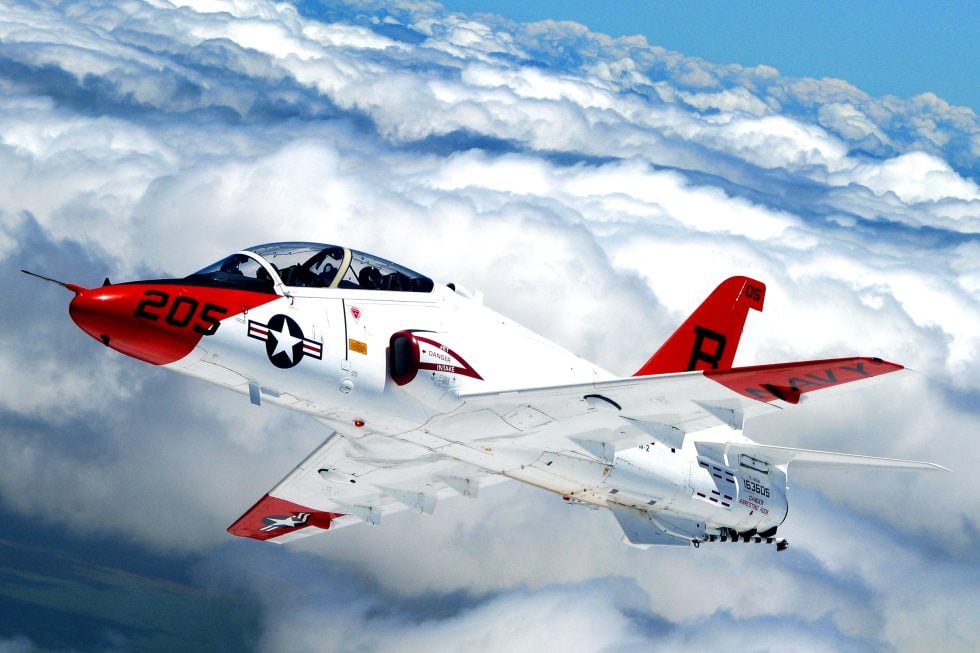
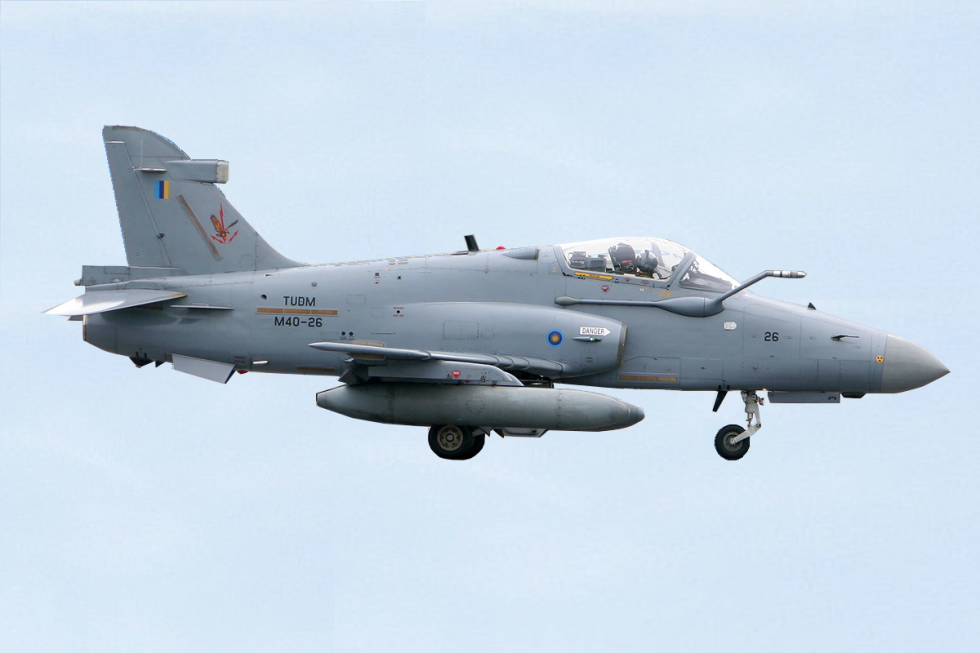
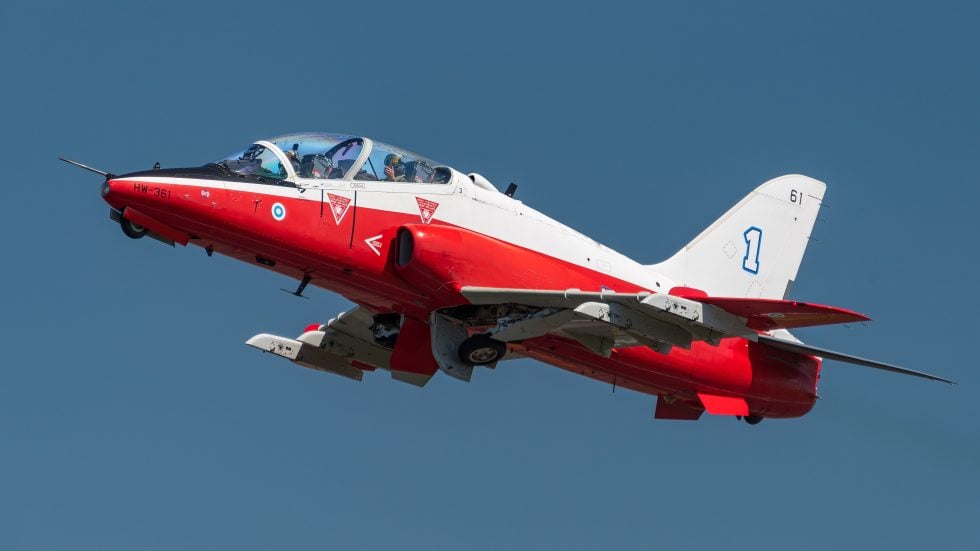
The Hawk in motion
A dedicated video feature for the BAE Systems Hawk is coming soon. In the meantime, explore the gallery and the twelve stories above — or catch the Red Arrows displaying the Hawk live at an RAF airshow this summer.
Where the Hawk flies
The score that defines it
The Hawk’s legacy is written mostly in the tens of thousands of pilots it has trained, not in air-to-air kills — it has never claimed one. But armed Hawks have flown in real conflicts: Indonesian single-seaters struck ground targets in Aceh, and Zimbabwean Hawk Mk 60s flew combat sorties in the Second Congo War. Those cases are genuine but poorly documented, and should be read with caution.
Compare the combat record of every military aircraft. Figures as of July 2026.
Everything people ask about the BAE Hawk
Can I fly in a BAE Hawk?
How fast is the BAE Hawk?
Is the BAE Hawk still in service?
What is the T-45 Goshawk?
Do the Red Arrows fly the Hawk?
Has the Hawk ever seen combat?
Who makes the BAE Hawk?
What is the difference between the Hawk 100 and Hawk 200?
You can’t fly the Hawk.
These, you can.
Some legends only live in museums — others are fuelled and waiting. MiGFlug has put civilians in real military jet cockpits since 2004.
 Fly the L-39 AlbatrosThe world’s most-flown jet trainer — aerobatics included
 Fly the F-104 Starfighter“The missile with a man in it”
 Fly the MiG-21The Cold War’s most-produced jet
 Fly the T-33 Shooting StarAmerica’s first jet trainer
 Fly the DH VampireA piece of early jet history
 Fly the S.211Agile Italian jet trainer
 Fly the MB-326The classic Aermacchi jet
 Fly the MiG-15The Soviet legend of the Korean War
Continue the tour
Every fact, checked
- BAE Systems — HawkManufacturer overview of the Hawk family, variants and operators.
- Airforce Technology — HawkDevelopment history, Hawk 50/60/100/200 variants, radar and export operators.
- NAVAIR — T-45 GoshawkUS Navy programme page for the navalised carrier trainer.
- Royal Air Force — Red ArrowsOfficial page on the RAF aerobatic team and its Hawk aircraft.
- FlightGlobalThe Hawk’s 50th anniversary, production wind-down and career overview.
- The AviationistCanada’s 2024 retirement of the CT-155 Hawk fleet.
- Defense AdvancementHawk T1/T2 specifications, Adour engine and armament data.
- Naval History and Heritage CommandT-45 Goshawk service history and navalisation detail.