
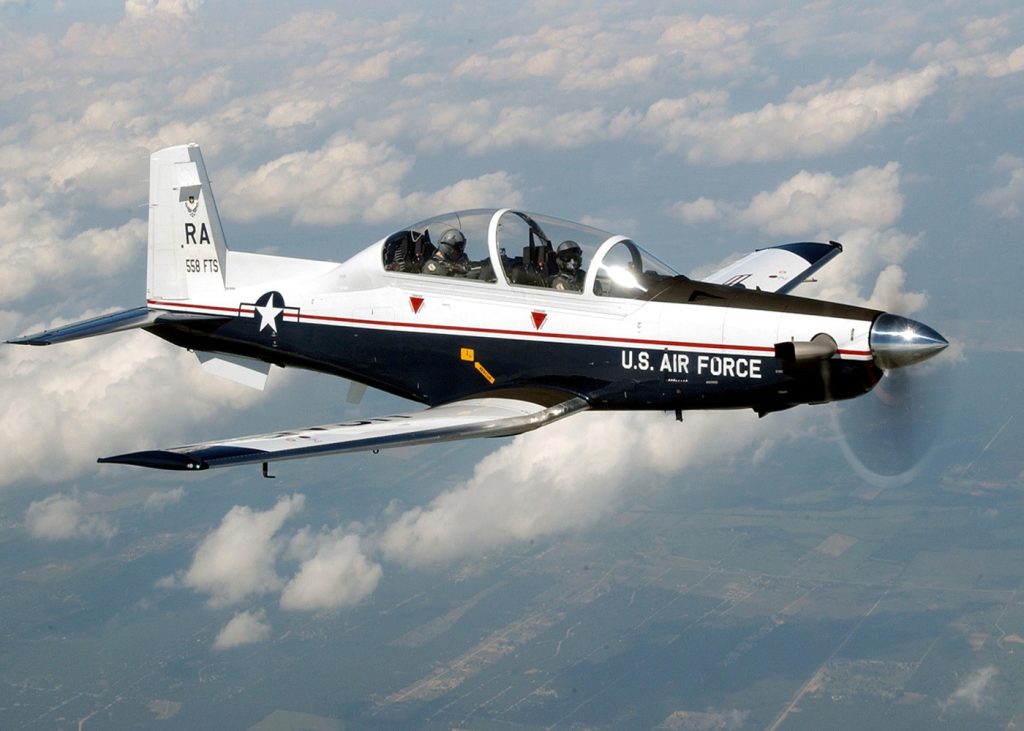
Beechcraft T-6
“Texan II”
The turboprop trainer that teaches almost every new American military pilot to fly — a pressurised, ejection-seat, 1,100-horsepower machine derived from the Pilatus PC-9, now the primary trainer for the U.S. Air Force, U.S. Navy and a dozen allied air forces.
The T-6 Texan II: a Swiss trainer, Americanised, that teaches a generation to fly
In the early 1990s the U.S. Air Force and U.S. Navy were flying two separate fleets of ageing primary trainers — the Cessna T-37 and the Beechcraft T-34C — and wanted a single, modern aircraft to replace both. The competition was the Joint Primary Aircraft Training System (JPATS), and in 1995 it was won not by a clean-sheet American design but by an Americanised version of a proven European one: the Pilatus PC-9 from Switzerland, offered by Raytheon (Beech) as the Beechcraft-built T-6.
The aircraft that emerged was far more than a re-badged PC-9. Raytheon and Pilatus reworked the airframe extensively for the demanding JPATS specification — a stronger structure, a pressurised cockpit, Martin-Baker ejection seats, an onboard oxygen system, a bird-strike-resistant canopy and a more powerful, flat-rated Pratt & Whitney Canada PT6A-68 turboprop of about 1,100 shaft horsepower. The production-configured T-6A first flew on 15 July 1998 and entered service in 2000, taking the historic name of the T-6 Texan, the tail-dragging radial trainer that had checked out a generation of Second World War pilots. It became, formally, the Texan II.
Since then the T-6 has become the aircraft nearly every new American military pilot meets first. USAF and Navy student aviators fly it in primary training before they ever touch a jet; the later glass-cockpit T-6B modernised the avionics, and the export T-6C added hardpoints and a wider fuel and mission fit. Overseas it flies as the CT-156 Harvard II in Canada and simply as the Texan II in Greece, Israel, Iraq, Morocco, Mexico, New Zealand, the United Kingdom and beyond. A light-attack armed derivative, the AT-6 Wolverine, took the trainer to war. More than a thousand have been built, and the worldwide fleet has flown over five million hours.
01The T-6 Texan II’s origin: how a Swiss PC-9 became America’s primary trainer
The T-6 exists because of JPATS — a mid-1990s programme to replace both the Air Force’s Cessna T-37 “Tweet” and the Navy’s Beechcraft T-34C Turbo Mentor with one common turboprop trainer. Rather than design a new aircraft, several bidders offered developed versions of existing proven trainers. Raytheon Aircraft (which owned Beech) partnered with Pilatus of Switzerland and offered a heavily modified PC-9, and that entry won the contract in 1995.
Calling the T-6 “just a PC-9” understates the change. To meet the U.S. specification the airframe was substantially redesigned — commonly cited as only a minority of parts remaining common with the PC-9 — gaining a pressurised cockpit, ejection seats, a stronger structure cleared for higher g and bird strike, a digital cockpit and the uprated PT6A-68 engine flat-rated to deliver full power across a wide altitude band. The result was a genuinely new aircraft with Swiss DNA: robust, docile enough for a first solo, yet powerful and modern enough to prepare a student for a front-line jet.
What makes the T-6 Texan II special
A trainer with a fighter’s safety kit
Unusually for a primary trainer, the T-6 gives students the survival equipment of a combat jet from day one: a pressurised cockpit, Martin-Baker Mk US16LA ejection seats in both tandem positions, an on-board oxygen-generating system and a canopy hardened against bird strike. Students learn ejection-seat and pressurised-flight discipline early, so nothing about a front-line jet’s cockpit is unfamiliar later.
1,100 flat-rated horsepower
Power comes from a single Pratt & Whitney Canada PT6A-68 turboprop delivering about 1,100 shaft horsepower, driving a four-blade constant-speed propeller. The engine is flat-rated — deliberately de-tuned so it delivers the same full power from sea level up to altitude — giving the student brisk, consistent performance and the kind of climb and energy that teaches real jet-style handling.
Glass cockpit and the T-6B leap
The original T-6A had conventional instruments; the T-6B and export T-6C introduced a modern glass cockpit with head-up display and multifunction displays, so students train from the start on the digital avionics and symbology they will use in an F-16, F/A-18 or F-35. The T-6C adds underwing hardpoints for weapons training and ferry tanks.
02The T-6 Texan II’s PT6 turboprop: why the engine is deliberately held back
The PT6A-68 fitted to the T-6 can produce well over 1,100 horsepower, but it is flat-rated to about 1,100 shp — the fuel scheduling limits it so that it delivers that same figure whether the aircraft is at sea level on a hot day or several thousand metres up. For a trainer this is exactly right: the student gets predictable, repeatable performance everywhere, strong enough to demonstrate real energy management, aerobatics and stall behaviour, without the engine’s output falling away with altitude the way an un-boosted piston’s would. A Hartzell four-blade constant-speed propeller and a power-management system smooth the torque so a low-hours student is not overwhelmed.
03The AT-6 Wolverine: how the T-6 trainer was turned into a light-attack aircraft
Beechcraft — and its successor Textron Aviation — developed an armed derivative of the Texan II, the AT-6 Wolverine, for the light-attack and armed-reconnaissance market. It keeps the T-6’s airframe and PT6 turboprop but adds a strengthened wing with multiple hardpoints, a sensor/targeting turret, a mission computer and a data-link, letting it carry guns, rockets, precision-guided bombs and missiles. Aimed at counter-insurgency and close air support — missions where a cheap, rugged, long-loiter turboprop can do work that an expensive fast jet does poorly — the AT-6 has been evaluated by the U.S. Air Force and ordered by export customers including Thailand and Tunisia. It is the modern echo of an old idea: a good trainer makes a natural light-attack aircraft.
Beechcraft T-6 Texan II: full specifications
Baseline note: the figures below describe the United States Air Force T-6A Texan II as delivered from 2000 — the 1,100 shp PT6A-68 aeroplane with no hardpoints at all — because that is what most of the fleet is. Deltas for the glass-cockpit T-6B, the six-station T-6C and the armed AT-6E Wolverine are given in grey. Four things commonly written about this aircraft need correcting before the tables start. First, the T-6 is routinely called a licence-built Pilatus PC-9, and that is misleading. Beechcraft and Pilatus teamed to offer a heavily reworked aeroplane, the Beech/Pilatus PC-9 Mk II, and the United States Air Force’s own systems engineering case study lists what changed: a new aft fuselage for handling qualities, a redesigned wing for durability and damage tolerance, a new canopy shape to take pressurisation, a new cowling, a different engine, and a cockpit sized to an American anthropometric standard the Swiss aeroplane was never built to. Pilatus takes a royalty; Beechcraft owns the drawings and builds it in Wichita. Second, the widely reproduced USAF fact sheet gives 6,500 lb as the "standard basic empty weight", which is simply wrong — 6,500 lb is the T-6A maximum take-off weight, and empty weight is about 4,707 lb. Third, there is no single maximum take-off weight: 6,500 lb for the T-6A, 8,300 lb for the store-carrying T-6C, 10,000 lb for the AT-6E. Fourth, production totals of "about 900" are stale — Textron handed the 1,000th T-6 to the Colombian Air Force in October 2022 and the line is still running.
Dimensions & weights
- Crew
- 2 — student forward, instructor aft on a raised seat. Both sit on Martin-Baker Mk US16LA zero-zero ejection seats and go out through a fracturing canopy, a capability the T-37 it replaced never had
- Length
- 10.16 m (33 ft 4 in)
- Wingspan
- 10.19 m (33 ft 5 in) — within a whisker of the length, the usual tandem turboprop-trainer proportion
- Height
- 3.25 m (10 ft 8 in)
- Wing area
- 16.49 m² (177.5 sq ft) for the T-6A; Textron publishes 16.28 m² (175.3 sq ft) for the T-6C, a small difference that reflects the hardpoint wing rather than a disagreement between sources
- Aspect ratio
- 6.29 — low. This is a wing built for roll rate, g tolerance and honest stall behaviour, not for loiter
- Propeller diameter
- 2.46 m (8 ft 1 in) — four-blade Hartzell HC-E4A-2, constant speed, feathering, and deliberately non-reversing
- Empty weight
- 2,135 kg (4,707 lb); the T-6C basic weight is 2,336 kg (5,150 lb), the extra 200 kg being pylons, wiring and local structure
- Max take-off weight, T-6A
- 2,948 kg (6,500 lb) — the trainer figure, and the one that applies to nearly every American and Canadian airframe
- Max take-off weight, T-6C
- 3,765 kg (8,300 lb) with stores; the AT-6E Wolverine is cleared to 4,536 kg (10,000 lb), more than half as much again as the trainer it grew from
- Wing loading
- 179 kg/m² (36.6 lb/sq ft) at T-6A weight; 231 kg/m² (47.4 lb/sq ft) at T-6C weight. A Pilatus PC-9 sits near 158 kg/m², which is one measure of how much heavier the American aeroplane became
- Power loading
- 2.68 kg/shp (5.9 lb/shp) at T-6A weight — roughly 50 per cent more power for weight than the T-37B, and the single number that sold the type to Air Education and Training Command
- Internal fuel
- 544 kg (1,200 lb), about 677 L (179 US gal, 149 Imp gal) in integral wing tanks with single-point pressure refuelling — a maintenance change from the PC-9, not a performance one
- External fuel
- ~932 kg (2,054 lb) total with two tanks on a T-6C, ~1,319 kg (2,908 lb) with four. On the armed variants every kilogramme of that competes directly with weapons
Performance
- Maximum cruise speed
- 515 km/h (278 kt, 320 mph) — the USAF fact-sheet figure, quoted as a maximum but flown as a fast cruise
- Never-exceed speed
- 586 km/h (316 kt indicated, 364 mph), or Mach 0.67 high up. Textron publishes the same limit for the T-6C with or without stores, which is unusual and speaks to how conservatively the pylons were cleared
- Rate of climb, sea level
- over 23 m/s (4,500 ft/min) — a student straight off a T-6 outclimbs one coming off almost any 1960s jet trainer
- Service ceiling
- 9,449 m (31,000 ft) — usable rather than notional, because the cockpit is pressurised. The PC-9’s higher published ceiling is flown on a mask
- Take-off ground roll
- 541 m (1,775 ft) at sea level, standard day
- Range, T-6A internal fuel
- 1,667 km (900 nmi, 1,036 mi)
- Ferry range, T-6C clean
- 1,637 km (884 nmi, 1,017 mi) — Textron’s own figure, and slightly below the T-6A number because the export aeroplane is heavier
- Ferry range, T-6C, two tanks
- 2,559 km (1,382 nmi, 1,590 mi) — enough to self-deploy across a continent, which is how New Zealand and Argentine aircraft were delivered
- Mission endurance, AT-6E
- ~4 h 30 min on a typical armed overwatch profile with external tanks. The trainer variants plan sorties of 60 to 90 minutes
- Load factor
- +7.0 / −3.5 g — a full aerobatic and spinning clearance, which is the whole point of a primary trainer and something the T-34C could not offer
- Fleet experience
- over 5,000,000 h flown by the global fleet by October 2022, on Textron’s count. Very few post-war training types have accumulated that much evidence about their own handling
Propulsion & systems
- Engine
- 1 × Pratt & Whitney Canada PT6A-68 free-turbine turboprop, flat-rated to 1,100 shp (820 kW). The core is capable of far more; flat-rating it low is what gives the T-6 its hot-and-high performance and its very long engine life. The PC-9 uses the smaller PT6A-62
- Engine, armed variants
- PT6A-68D, 1,600 shp (1,193 kW) on the AT-6B and AT-6E, with reinforced structure to match. Half the extra power is spent carrying the sensor and the stores rather than going faster
- Propeller
- Hartzell HC-E4A-2 hub with E9612 blades — four aluminium blades, constant speed, variable pitch, feathering, non-reversing
- Power management
- Single power lever with a power management unit that schedules propeller and engine together. It exists because the raw PC-9 throttle response was non-linear and could surge on a crosswind take-off — one of the concrete JPATS fixes
- Trim aid device
- Automatic rudder trim computed from torque, indicated airspeed, pitch rate and altitude. A turboprop of this power needs constant rudder retrimming; the computer does it so the student can think about something else
- Cockpit environment
- Pressurised, air-conditioned, with an anti-g system and an on-board oxygen generating system (OBOGS) — none of which the T-37B or T-34C had, and all of which the PC-9 lacked in this combination
- Escape system
- Martin-Baker Mk US16LA zero-zero seats canted aft, with a canopy-fracturing system. Recommended minimum ejection altitude in practice is about 610 m (2,000 ft) above ground
- Avionics, trainer variants
- T-6A: analogue instruments with electronic flight displays. T-6B, T-6C and the Canadian, British and Thai aircraft: a full glass cockpit with a head-up display, six multi-function displays and HOTAS controls, which is what makes the type a credible feed to fifth-generation fast jets
- Mission system, AT-6E
- Lockheed Martin A-10C mission computer and stores management with a SparrowHawk head-up display, Link 16 and the Situational Awareness Data Link, plus full-motion video downlink to ground parties. Sharing the A-10C’s software was the AT-6’s cleverest idea and its best sales argument
- Sensor, AT-6E
- L3Harris WESCAM MX-15Di electro-optical and infrared turret on the centreline, with laser designator and rangefinder. On an armed sortie this, not the weapons, is the aircraft’s reason for being airborne
- Hardpoints
- None on the T-6A or T-6B; six wing stations on the T-6C to NATO standard; six wing stations plus a centreline mount on the AT-6E, the centreline normally occupied by the sensor turret. Textron claims 85 per cent parts commonality between the T-6C and the AT-6E
04The T-6 Texan II’s operating costs: what it costs to fly a primary trainer
The T-6 was chosen partly because it is cheap to buy and run compared with a jet trainer — that affordability is the whole point of doing primary training in a turboprop. The U.S. Air Force fact sheet lists a unit cost of about $4.3 million, and Textron reported delivering the 1,000th aircraft in 2022 with the global fleet passing five million flight hours.
Cost-per-flight-hour figures for the T-6 are published but vary widely with what they include. A U.S. Department of Defense reimbursable rate reported in 2013 put the T-6A near $2,235 per flight hour, a figure that bundles in a great deal of overhead; leaner direct-operating estimates run lower, in the four-figure range. Any single number should be read as an order-of-magnitude guide, not a precise price — real cost swings with fuel, utilisation and how the accounting is done.
Armament & payload
Most Texan IIs carry nothing at all, and the armed ones have spent twenty years looking for someone to buy them
The two variants that account for the overwhelming majority of the fleet, the USAF T-6A and the US Navy T-6B, have no hardpoints. Not empty pylons — no provision. Everything on this page therefore belongs to a minority of the type: the twenty Greek T-6A NTAs, the export T-6C with its six NATO-standard wing stations, and the AT-6 Wolverine, which is a different aeroplane wearing the same skin. The Wolverine’s weapons list is genuinely good for its class, because Textron did the one thing nobody else in the light-attack market did: it bought the A-10C’s mission computer and stores management software wholesale, so the aircraft speaks the same language as the American close-air-support system it is meant to plug into. What it has never had is a customer of any size. It lost the Light Attack/Armed Reconnaissance contest to the A-29 Super Tucano in 2011, lost the re-run in 2013, flew in the 2017 Light Attack Experiment and the 2018 follow-on at Davis-Monthan, was one of five prototypes in US Special Operations Command’s Armed Overwatch demonstration in 2021, and lost that to the AT-802U Sky Warden in August 2022. The USAF bought exactly two, for $70.2 million, and had sent both back to the factory within sixteen months. Fits vary enormously by customer: a Greek NTA is a lightly armed trainer, a Thai AT-6TH is a genuine light-attack aeroplane in a fighter squadron at Chiang Mai, and no American T-6A or T-6B has ever carried anything heavier than a chart bag.
Gun
- No internal gun on any variant. Nothing in the airframe was ever laid out around a fixed weapon, and no customer has asked for one.
- FN Herstal HMP-400 podded 12.7 mm (.50 in) machine gun, 400 rounds per pod, carried in pairs on the inboard wing stations of the AT-6.
- Greek T-6A NTA aircraft are cleared for gun pods as part of their weapons-training fit.
- At 12.7 mm this strafes soft targets, light vehicles and dismounts. It is not an anti-armour gun, and the aircraft has neither the speed nor the protection to make repeated gun passes against anything that shoots back.
Air-to-air
- Nothing. No air-to-air weapon has been integrated on any T-6 or AT-6 variant, and none has been publicly demonstrated.
- There is no radar, no radar warning receiver in the published fit, and no beyond-visual-range capability of any kind.
- This is a real difference from rivals in the class: the Super Tucano carries short-range missiles in Brazilian and several export services, and the KAI KT-1 is at least marketed with them.
- The card is kept because the omission is the point. Textron sold the AT-6 as a close-air-support and armed-reconnaissance machine for permissive airspace, and never pretended otherwise.
Air-to-surface guided
- AGM-114 Hellfire laser-guided missile — the heaviest weapon cleared on the type, and the only one with a useful standoff against a moving vehicle.
- GBU-12 Paveway II (500 lb class) and GBU-58 Paveway II (250 lb class) laser-guided bombs.
- GBU-49 and GBU-59 Enhanced Paveway II — dual-mode GPS and laser guidance, which lets the aircraft attack through weather it could not designate through.
- APKWS II laser-guided 70 mm rockets, fired from standard LAU-131 launchers. For a light-attack aeroplane this is the sweet spot: seven precision shots on one pylon at a fraction of a Hellfire’s cost.
- All of this belongs to the AT-6 alone. No T-6C operator has fielded a guided weapon on the type.
Bombs
- Mk 81 (250 lb) and Mk 82 (500 lb) free-fall bombs on the AT-6, and bombs generically on the Greek T-6A NTA.
- BDU practice bomb carriers on the T-6C wing stations — in most export air forces the only ordnance the aeroplane ever actually carries, because the pylons exist so students learn weapons circuits cheaply.
- No JDAM-class weapon and no 1,000 lb class store has been integrated. Textron quotes more than 66 approved store configurations, but they are configurations of small things.
- With 4,110 lb of nominal external payload on the AT-6E, two 500 lb bombs, a sensor turret and enough fuel for a four-hour sortie consume the entire allowance.
Rockets
- LAU-131/A seven-tube 70 mm (2.75 in) launchers, the standard rocket fit on both the AT-6 and the Greek NTA.
- Hydra 70 family warheads: high explosive, flechette and white-phosphorus smoke for target marking.
- The same launchers take APKWS II guided rounds without modification, so a single pylon can be loaded for either area suppression or precision, decided on the ground that morning.
- Unguided 70 mm from a 300-knot turboprop is a 1960s weapon used in a 1960s way. Against an unprotected target in uncontested airspace it works; against anything else it is a way of losing aeroplanes.
Pods & other stores
- L3Harris WESCAM MX-15Di electro-optical and infrared turret on the AT-6 centreline, with laser designator and rangefinder — the most valuable item the aircraft carries.
- External fuel tanks: two give about 2,054 lb of total fuel on a T-6C, four give about 2,908 lb. Ferry tanks and weapons are largely mutually exclusive.
- Full-motion video and ROVER downlink pods for passing imagery straight to a ground party, plus Link 16 and SADL as fitted equipment rather than pods.
- Textron describes ballistic protection for the crew and critical systems on the Wolverine, but no operator has published a countermeasures or missile-warning fit, and it would be wrong to assume one.
Three typical loadouts
- Specialised undergraduate pilot training, T-6A, Columbus or Vance AFB
- Clean airframe with no external provision whatsoever, full internal fuel, +7.0 / −3.5 g and a full spinning clearance. A 60 to 90 minute sortie. This is what the great majority of the more than 1,000 airframes built have done every working day of their lives, and it is the mission the aeroplane was designed for.
- Armed training and border patrol, T-6A NTA, Hellenic Air Force, Kalamata
- Two LAU-131 seven-tube 70 mm rocket launchers on the inboard stations, two HMP-400 12.7 mm gun pods, practice bombs, and drop tanks for range. The Greek NTA was bought so that student pilots could complete weapons phases without moving to a jet, and it doubles as a cheap presence aircraft over the islands.
- Armed overwatch and close air support, AT-6E Wolverine
- MX-15Di turret on the centreline, two GBU-12 Paveway II laser-guided bombs, two LAU-131 launchers with APKWS II guided rockets, two external tanks; Link 16 and full-motion video downlink to the ground party; about four and a half hours on station. This is the configuration the USAF flew at Davis-Monthan and then declined to buy in quantity.
Sourcing caveat: weapons lists for the AT-6 come almost entirely from Textron marketing material and from USAF experimentation reporting, not from an operational manual, and "cleared" in that literature often means demonstrated on a test range rather than fielded. Greek T-6A NTA fits are described in general terms by the Hellenic Air Force and precise station-by-station loads are not published. Where a weapon is listed here it has at least been fired or carried by the type; nothing has been included on the strength of a brochure silhouette alone.
Variants
The Texan II family runs from an unarmed American trainer to a Thai attack aeroplane, and almost none of it is a Pilatus
The Joint Primary Aircraft Training System competition was a genuine contest. The request for proposals went out on 18 May 1994 and seven teams answered it: Beech with Pilatus, Northrop with Embraer’s Tucano H, Lockheed with the Aermacchi MB-339, Rockwell with Deutsche Aerospace’s Ranger 2000, Cessna with a CitationJet, Vought with the FMA Pampa 2000, and Grumman with the Agusta S.211. The Air Force wanted side-by-side seating and the Navy wanted tandem; tandem won. A large and often forgotten driver was anthropometric — JPATS had to accommodate crews from 84 to 102 cm (33 to 40 in) sitting height, opening military flying to a far larger share of the female population than the T-37 ever had. Beech and Raytheon were selected on 22 June 1995 for a programme then valued around $7 billion covering 711 aircraft, 372 for the Air Force and 339 for the Navy.
How much PC-9 survived is the question worth asking, and the honest answer is: the shape and the flying qualities, not the aeroplane. The USAF’s own systems engineering case study describes the T-6A as a significant modification of the PC-9 baseline with a new aft fuselage, a wing redesigned for durability and damage tolerance, a new canopy shape to take pressurisation, a new cowling, and a different and much more powerful engine. Add the American ejection seats, the anti-g system, the on-board oxygen generator, the single-point refuelling, the bird-strike windscreen, the automatic rudder trim and the power management unit, and what is left of Stans is the aerodynamic layout and the excellent spin behaviour Pilatus had already proved. Beechcraft owns the drawings and pays Pilatus a royalty; it does not build PC-9s under licence. That distinction matters commercially, because it is why Beechcraft has been free to sell the T-6C against the Pilatus PC-21 in export competitions ever since.
The type’s worst period was not structural but physiological. Five pilots at Vance Air Force Base reported hypoxia-like symptoms in November 2017 and the base grounded its aircraft for three weeks. Seventeen episodes were reported across the fleet in January 2018 alone, against an average of 1.4 a month over the preceding half-year; thirteen pilots at three bases were affected in the last week of that month, and on 1 February 2018 the commander of Nineteenth Air Force ordered a fleet-wide operational pause. It lasted until 27 February. In September 2018 Air Education and Training Command announced a cause: not too little oxygen but fluctuating concentration, an on-board oxygen generating system whose filters and drain valves were failing faster than predicted and admitting moisture, delivering wildly varying oxygen levels that stressed the body even when they exceeded what it needed. The fixes were a software change with Beechcraft to stabilise concentration, aggressive new inspection and moisture-purging schedules, a new emergency procedure to descend below 10,000 ft and go to ambient air, and a multi-year OBOGS redesign with moisture separators and an automatic backup supply. Individual squadrons paused again during 2018, including the 559th at Randolph in June. The USAF graduated about 10 per cent fewer pilots that year than planned. It is worth being precise about what this was and was not: no T-6 crash has been attributed to hypoxia, the events were symptoms rather than fatalities, and the same class of problem hit the F-22, F/A-18 and F-35 fleets in the same decade — but a primary trainer flown by students on their first solos is the worst possible place for an oxygen system nobody fully understands.
- Beech/Pilatus PC-9 Mk II (1992–95, 2 demonstrators)
- The JPATS entrant. Pressurised, PT6A-68, American seats, redesigned structure. Won on 22 June 1995 and was promptly renamed; the Mk II designation disappeared with the contract.
- T-6A Texan II (first production flight 15 July 1998; service entry 2001)
- The baseline. Analogue-plus-EFIS cockpit, no hardpoints. USAF undergraduate pilot training and combat systems officer training, US Navy naval flight officer training, and the standard delivered to Greece, Israel and Iraq.
- T-6A NTA (Greece, 20 aircraft)
- New Trainer Aircraft: a T-6A with wing stations for rocket pods, gun pods, bombs and external tanks, so that Hellenic Air Force students complete weapons training on the primary type. The first armed Texan II.
- CT-156 Harvard II (Canada, 25 delivered from 2000)
- T-6A standard leased to the Royal Canadian Air Force for NATO Flying Training in Canada at 15 Wing Moose Jaw, owned and maintained first by Bombardier and from 2015 by CAE. Two written off; 24 in service.
- T-6B Texan II (US Navy, from 2010)
- Full digital cockpit — head-up display, six multi-function displays, HOTAS. Primary naval aviator training for the Navy, Marine Corps and Coast Guard at Whiting Field and Corpus Christi, and the aircraft of the US Naval Test Pilot School.
- T-6C and T-6C+ (export, from 2008)
- The T-6B cockpit plus six NATO-standard wing hardpoints and a higher 8,300 lb maximum weight. This is the variant the export success is built on: Morocco, Mexico, New Zealand, Argentina, Colombia, Iraq, Tunisia and Vietnam.
- Texan T1 (United Kingdom, 10 contracted 2016, 14 on strength)
- T-6C for basic fast jet training under the UK Military Flying Training System. The airframes were procured and are owned by Affinity Flying Training Services, an Elbit Systems and KBR joint venture, and delivered into a training service run by Ascent Flight Training; the RAF flies them with No. 72 Squadron at RAF Valley, re-formed on 28 November 2019.
- T-6D Texan II (US Army, 4 delivered 2015)
- A T-6B/C hybrid bought in tiny numbers for operational support, flight test and chase work rather than training. The least-known member of the family.
- AT-6B and AT-6E Wolverine (2009–; 2 AT-6E to the USAF, 8 AT-6TH to Thailand)
- The armed derivative: PT6A-68D at 1,600 shp, reinforced structure, 10,000 lb maximum weight, MX-15Di turret, A-10C mission computer, Link 16. USAF type certification came in July 2022, a month after its two aircraft had already gone back to Wichita.
- T-6TH and T-6JP (Thailand 12 from 2020; Japan ordered December 2024)
- National export standards. The Royal Thai Air Force ordered 12 T-6TH trainers for $162 million and then 8 AT-6TH Wolverines for $143 million; Japan selected a bespoke T-6JP to replace the Fuji T-7, with entry to service before 2030 and quantity unannounced.
Closing caveat: production totals for this type are unusually slippery because Textron counts deliveries rather than build numbers and several fleets are leased rather than owned. The firm figure is the 1,000th aircraft, handed to the Colombian Air Force in October 2022; totals of "about 900" that still circulate date from 2015. The JPATS programme of record was 711 aircraft, and it triggered a Nunn-McCurdy breach in April 2007 for a 25 to 50 per cent unit-cost overrun — unusual for a programme already deep into full-rate production. Variant boundaries are also softer than the list suggests: T-6C+ is a marketing designation rather than an engineering one, and several operators have upgraded aircraft between standards in service.
Operators today
Fifteen air arms fly the Texan II, and the two American services still own more than three-quarters of them
This is one of the most widely used military aircraft in the world and almost nobody outside a training command ever sees one. The United States Air Force and Navy between them account for roughly 736 airframes; every other operator combined accounts for fewer than 300. The bars below count aircraft carried on charge rather than aircraft serviceable on a given morning, and for a training fleet that gap is usually small — these are simple aeroplanes with a long-life flat-rated engine and very high availability. Three caveats sit on the numbers. The United States Army holds four more T-6Ds for support and chase work, too few to draw. Canada’s Harvard IIs are leased from CAE rather than owned by the Royal Canadian Air Force, and their future beyond the Future Aircrew Training transition is a contractual rather than an aviation question. And Japan, which selected a bespoke T-6JP in December 2024 to replace the Fuji T-7, has not published a quantity and has no aircraft yet, so it has no row here.
These are estimates. Many airframes counted on paper are stored, in deep overhaul, or not operational. American figures come from the 2024 USAF almanac inventory and FlightGlobal World Air Forces; Greek, Israeli, Moroccan, Argentine, Iraqi, New Zealand, Tunisian and Mexican figures from FlightGlobal World Air Forces 2024–26, cross-checked against delivery reporting; the British figure is the UK Ministry of Defence 2025 aircraft statistics, which show 14 against an original contract for 10; the Mexican total combines about 56 Air Force T-6C+ from a 60-aircraft programme with about 13 held by the Mexican Navy; the Thai figure is 12 T-6TH plus 8 AT-6TH less one AT-6TH lost in January 2026; Tunisia received 8 T-6Cs by August 2023 against an original request for 12. Sources: IISS The Military Balance and FlightGlobal World Air Forces; entries that could not be corroborated are omitted, and no competitor dataset has been copied.
The T-6 Texan II: from JPATS contract to global trainer
The JPATS requirement
The USAF and USN launch the Joint Primary Aircraft Training System to replace the T-37 and T-34C with one common trainer.
The PC-9 entry wins
Raytheon (Beech) and Pilatus win JPATS with an Americanised, heavily modified Pilatus PC-9 — designated the T-6.
First flight
The production-configured T-6A Texan II first flies on 15 July 1998, with ejection seats and a pressurised cockpit.
Enters service
The T-6A enters USAF service at Randolph AFB from 2000 and begins replacing the T-37 and T-34C in primary training.
Goes global
Greece, Canada (as the CT-156 Harvard II), Morocco, Israel, Iraq and others adopt the Texan II for pilot training.
The glass-cockpit T-6B
The T-6B, with a modern digital glass cockpit and HUD, enters U.S. Navy and Air Force service; the export T-6C follows.
The AT-6 Wolverine
Beechcraft develops an armed light-attack derivative, the AT-6 Wolverine, later ordered by Thailand and Tunisia.
1,000th Texan II
Textron Aviation delivers the 1,000th T-6, with the worldwide fleet passing five million flight hours.
From the flight line: twelve T-6 Texan II stories
Replacing two fleets with one
JPATS set out to replace both the USAF T-37 and the Navy T-34C with a single common trainer.
Read the full story
From Pilatus PC-9 to Texan II
The T-6 is a deeply reworked Pilatus PC-9, not a clean-sheet American design.
Read the full story
Why “Texan II”
The aircraft revives the name of the WWII-era T-6 Texan that trained a generation of pilots.
Read the full story
The first aircraft every pilot flies
Nearly every new U.S. Air Force and Navy pilot begins in the T-6.
Read the full story
Ejection seats from day one
The T-6 puts student pilots on live ejection seats in a pressurised cockpit.
Read the full story
The engine that never fades
The PT6A-68 is flat-rated so its power stays constant with altitude.
Read the full story
The glass-cockpit T-6B
The T-6B swapped analogue dials for a digital cockpit matching the front-line fleet.
Read the full story
The T-6C goes worldwide
The export T-6C added hardpoints and range, and sold across the globe.
Read the full story
The Harvard II
Canada flies the Texan II as the CT-156 Harvard II, reviving another historic name.
Read the full story
The AT-6 Wolverine goes to war
Beechcraft armed the trainer into a light-attack aircraft with sensors and weapons.
Read the full story
A five-million-hour fleet
Over a thousand Texan IIs have flown more than five million hours worldwide.
Read the full story
The pilot maker of a new century
Like the Texan and Harvard before it, the T-6 defines a generation of aviators.
Read the full story
The T-6 Texan II in pictures
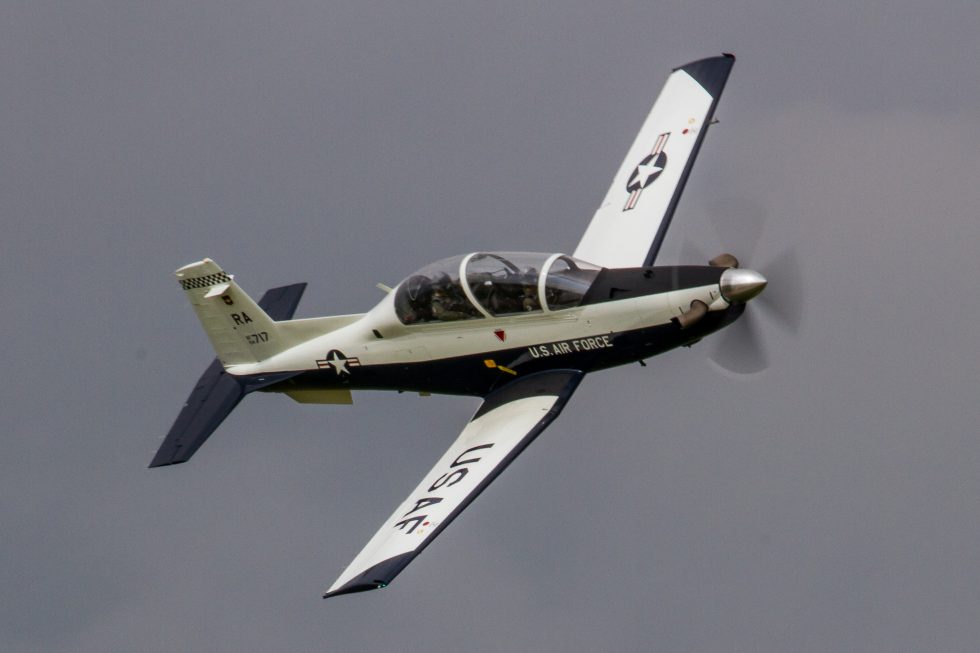
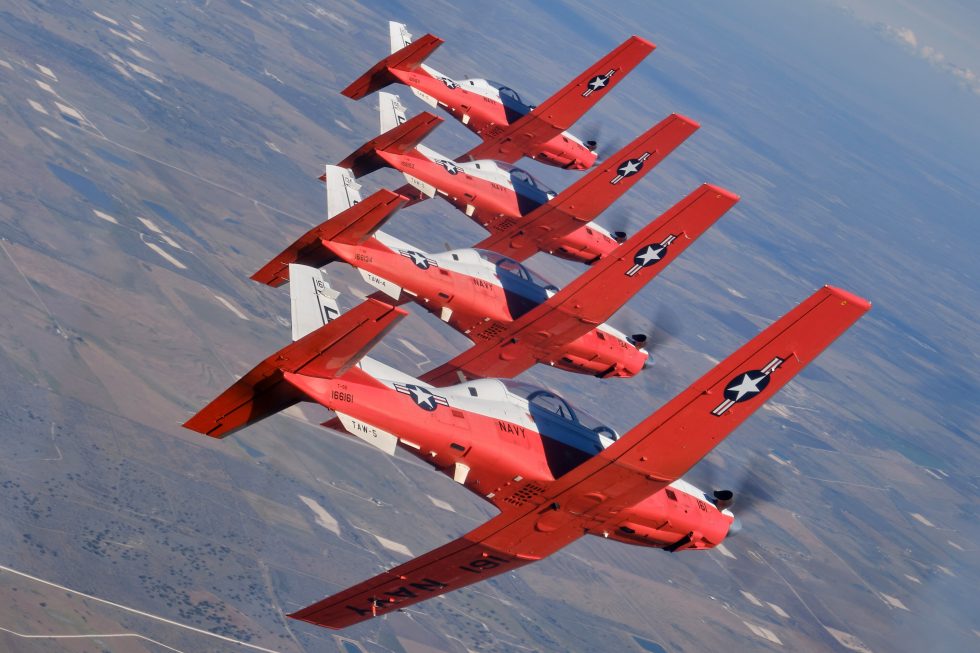
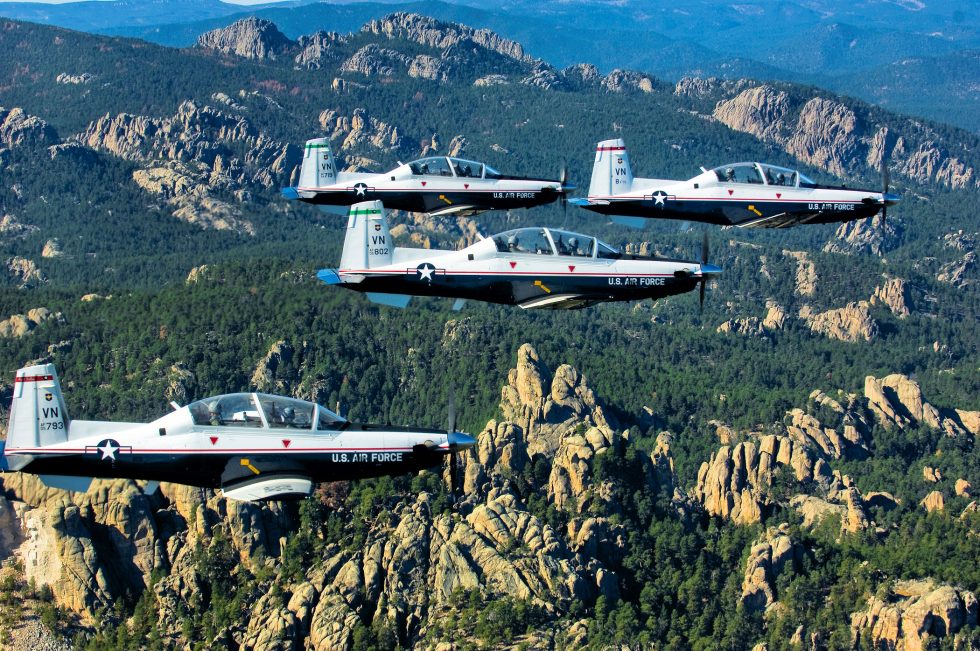
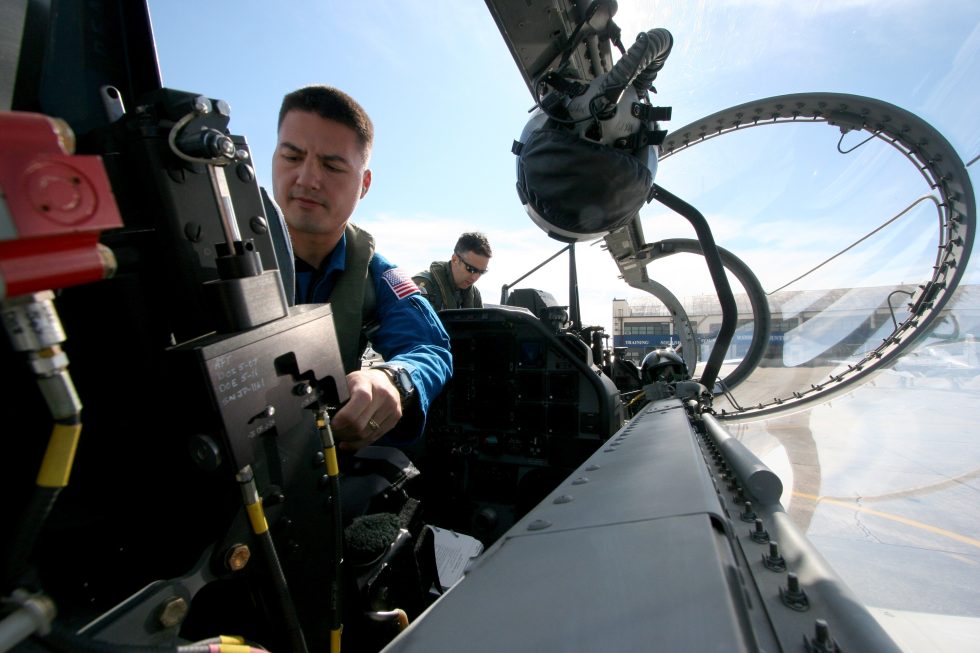
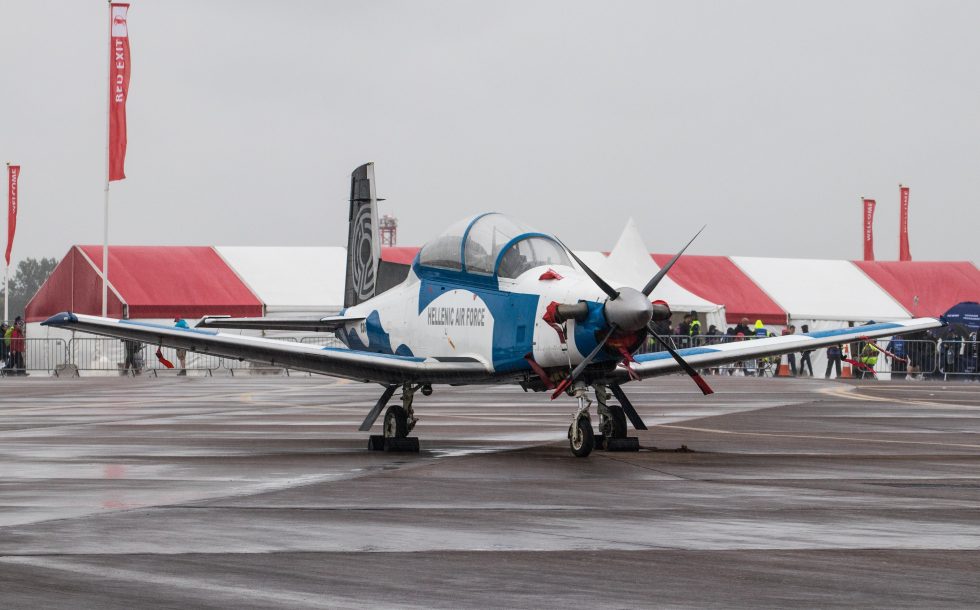
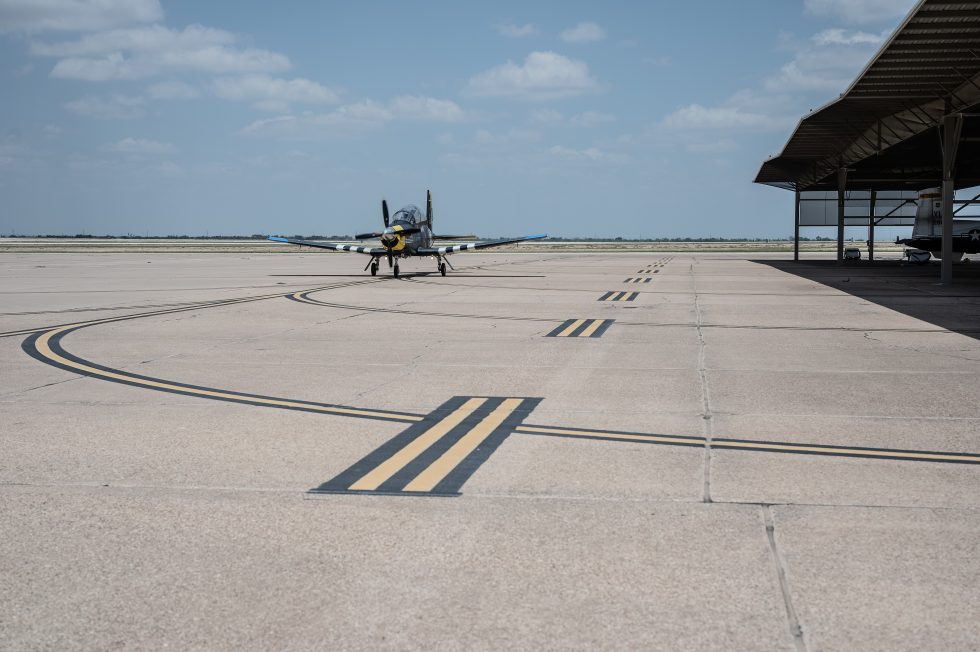
The T-6 Texan II in motion
A look at the T-6 Texan II — the turboprop primary trainer that starts almost every U.S. and allied military pilot on their way, with cockpit and flight-line footage. Verify current view count on YouTube.
Where the T-6 Texan II flies
The T-6 Texan II’s record: the pilot pipeline’s foundation
The Texan II is a trainer, not a fighter, so its record is measured in pilots made rather than aircraft shot down. It is the aircraft in which the United States and more than a dozen allied nations teach new aviators the fundamentals of military flying. Its armed derivative, the AT-6 Wolverine, has taken the airframe into the light-attack role, but the T-6’s own achievement is scale and reliability — the quiet foundation on which every front-line pilot is built.
Compare the combat record of every military aircraft. Figures as of 2026.
Everything people ask about the T-6 Texan II
Can I fly in a T-6 Texan II?
What is the T-6 Texan II used for?
Is the T-6 Texan II the same as the WWII T-6 Texan?
Is the T-6 Texan II a Pilatus PC-9?
What engine does the T-6 Texan II have?
What is the AT-6 Wolverine?
Which countries fly the T-6 Texan II?
You can’t fly the T-6 Texan II.
These, you can.
Some legends only live in museums — others are fuelled and waiting. MiGFlug has put civilians in real military jet cockpits since 2004.
 Fly the L-39 AlbatrosThe world’s most-flown jet trainer — aerobatics included
 Fly the F-104 Starfighter“The missile with a man in it”
 Fly the MiG-21The Cold War’s most-produced jet
 Fly the T-33 Shooting StarAmerica’s first jet trainer
 Fly the DH VampireA piece of early jet history
 Fly the S.211Agile Italian jet trainer
 Fly the MB-326The classic Aermacchi jet
 Fly the MiG-15The Soviet legend of the Korean War
Continue the tour
Every fact, checked
- U.S. Air Force — T-6A Texan II fact sheetOfficial specifications, engine, unit cost and service history.
- NAVAIR — T-6A Texan IIU.S. Navy programme page for the Texan II primary trainer.
- Airforce Technology — T-6A JPATSProgramme history, PC-9 lineage and the JPATS competition.
- Air & Space Forces Magazine — T-6Overview of the type, its variants and its role in pilot training.
- Pilatus PC-9 backgroundThe Swiss PC-9 lineage from which the T-6 was developed.
- Textron Aviation / BeechcraftManufacturer; 1,000th-aircraft delivery and five-million-hour fleet milestone (2022).
- Royal Canadian Air ForceThe CT-156 Harvard II and NATO Flying Training in Canada at Moose Jaw.
- TIME — Costly Flight HoursPublished U.S. DoD cost-per-flight-hour reimbursable rates, including the T-6A.