
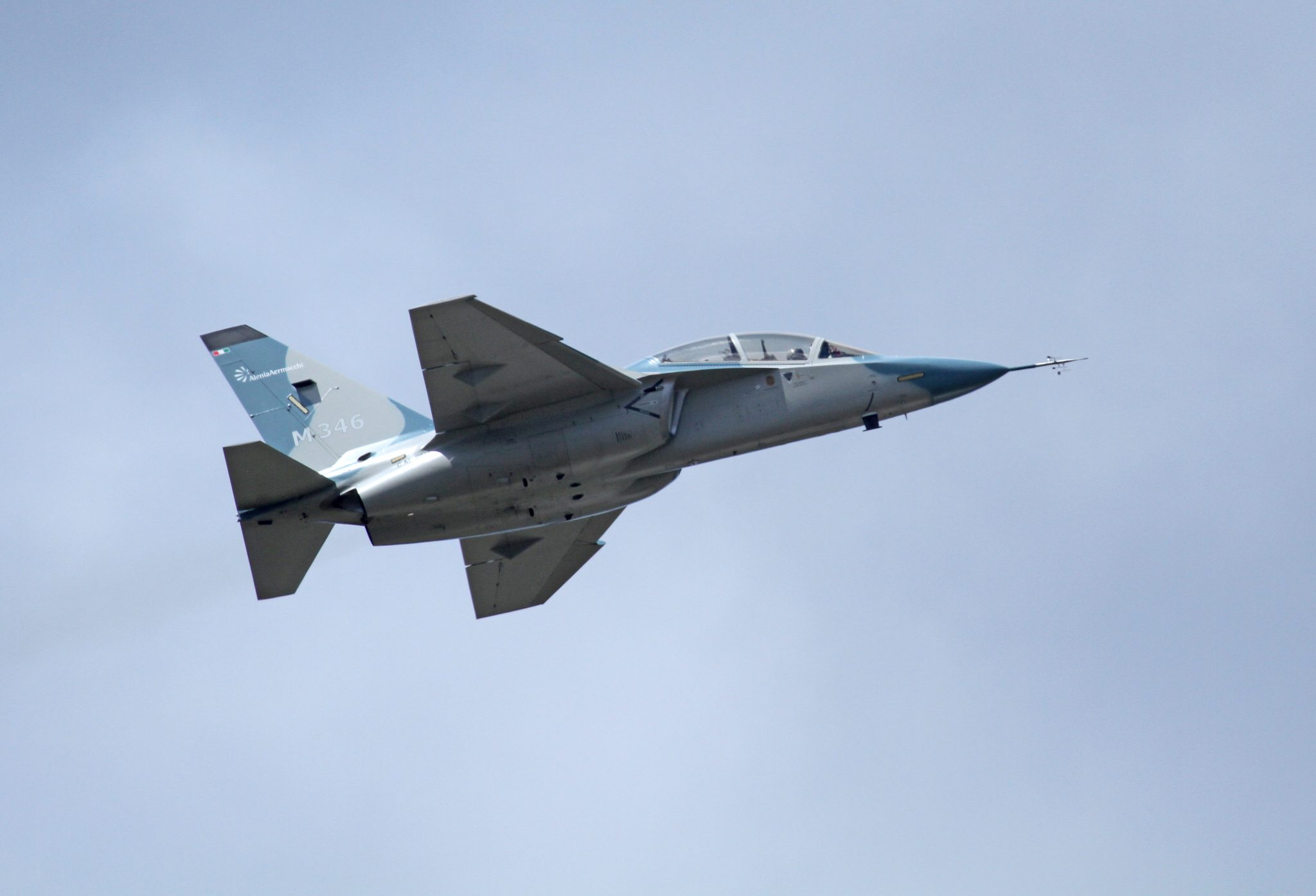
Aermacchi M-346
“Master”
Italy’s digital fly-by-wire advanced jet trainer — a twin-engine machine built to teach pilots to fly fourth- and fifth-generation fighters like the F-35, and now offered as the FA-346 light-attack aircraft.
The Aermacchi M-346 Master: the jet that teaches pilots to fly the F-35
The M-346 began not in Italy but as a Russian-Italian collaboration. In the early 1990s, with the Cold War over and defence budgets shrinking, the Russian design bureau Yakovlev and Italy’s Aermacchi joined forces to build a new advanced jet trainer, designated the Yak/AEM-130. The idea was to share the enormous cost of developing a modern trainer: Yakovlev brought the aerodynamic design and a flying demonstrator, Aermacchi brought Western avionics, systems and money. A joint aircraft flew in 1996.
The partnership did not last. By around 2000 the two companies split, dividing the intellectual property between them. Yakovlev went on to develop the aircraft for Russia and the export market as the Yak-130; Aermacchi took the rights to sell a Western-equipped version and redrew it around Honeywell engines, Western avionics and a digital fly-by-wire flight-control system. That aircraft became the M-346 Master. The two jets are visibly cousins — the same broad layout and shoulder-mounted wing — but under the skin they diverged into different machines for different customers.
Aermacchi’s M-346 prototype rolled out on 7 June 2003 and first flew on 15 July 2004. What set it apart was its purpose. Modern fighters — the Eurofighter Typhoon, the Rafale, the Gripen and above all the F-35 Lightning II — are so capable and so expensive to operate that flying training on the jets themselves is wasteful and, at the edges of their envelope, dangerous. The M-346 was designed to be a lead-in fighter trainer: a relatively cheap jet that behaves like a front-line fighter, so that a student arrives at an operational conversion unit already fluent in high angle-of-attack manoeuvring, sensor management and tactics.
Its defining trick is aerodynamic and digital. A vortex-lift wing and a full-authority quadruplex fly-by-wire system let the M-346 stay fully controllable at angles of attack beyond 35 degrees — deep into the region where older trainers depart into a spin. Because the flight-control laws are software, instructors can even make the trainer feel like a heavier, twitchier fighter. On top of that sits an embedded training system that generates simulated radar contacts, threats and weapons inside the real cockpit, letting a student fight an entire mock engagement against enemies that are not physically there.
Italy took the type into service as the T-346A, with first aircraft delivered from 2011, and built its training around it at the International Flight Training School (IFTS) — a joint Leonardo and Italian Air Force enterprise that now trains student fighter pilots from many nations at Decimomannu in Sardinia. Israel, Singapore, Poland, Greece, Qatar and others followed, each adapting the jet to its own pipeline: Israel flies it as the “Lavi,” Poland as the “Bielik.”
Leonardo has since pushed the design beyond training. The M-346FA (Fighter Attack) — sometimes styled the FA-346 — adds a multi-mode fire-control radar and a genuine combat fit across seven hardpoints, turning the trainer into a light-attack and air-policing aircraft that smaller air forces can afford. It is the same airframe that teaches pilots to fly fighters, now able to act as a modest one itself.
01The M-346 and the Yak-130: how one 1990s design became two rival jets
The M-346 and Russia’s Yak-130 share a common ancestor: the Yak/AEM-130 advanced trainer developed jointly by Yakovlev and Aermacchi from 1993. When the partnership dissolved around 2000, the two firms split the intellectual property and each finished its own aircraft. Yakovlev produced the Yak-130 with Russian engines and systems for Russia and export customers; Aermacchi produced the M-346 with Western engines, avionics and a digital fly-by-wire system.
They are best described as cousins, not the same aircraft. Both keep the shared aerodynamic layout — a shoulder-mounted wing with prominent leading-edge root extensions for vortex lift — but they differ in engines, flight-control philosophy, avionics and structure. The M-346 is aimed squarely at NATO and Western-aligned air forces training on aircraft like the F-35; the Yak-130 serves Russia and its export partners. It is one of the clearest modern cases of a single collaborative design splitting into two competing production aircraft.
What makes the M-346 special
Fly-by-wire that flies past 35 degrees
The M-346 uses a full-authority quadruplex digital fly-by-wire flight-control system with no mechanical backup — unusual in a trainer. Combined with a vortex-lift wing, it keeps the aircraft fully controllable at angles of attack beyond 35 degrees, deep into the regime where an older trainer would depart into a spin. The control laws can even be tuned to make the jet handle like a heavier front-line fighter.
An embedded ‘virtual’ battlefield
Its defining training feature is an embedded tactical training system that injects simulated radar contacts, threats, wingmen and weapons into the real cockpit displays. A student can fly a complete mock air-combat or strike mission — locking, launching and being shot at — against enemies that do not physically exist, an approach now extended into full Live-Virtual-Constructive networked training.
Two clean turbofans, no afterburner
Power comes from two Honeywell F124-GA-200 turbofans of about 28 kN (6,250 lbf) each — non-afterburning, chosen for low running cost and reliability. Twin engines give a genuine multi-engine fighter feel and safety margin, while a large internal fuel load and an air-to-air refuelling probe give the endurance to run long, layered training sorties.
02The M-346 as a lead-in trainer: bridging the gap to the F-35 and Eurofighter
Fifth-generation fighters such as the F-35, and advanced fourth-generation types like the Eurofighter Typhoon and Rafale, are extraordinarily expensive to fly and demanding to master. Air forces do not want students learning basic fighter skills on them. The M-346 fills the lead-in fighter training gap: a comparatively cheap jet whose handling, cockpit philosophy and embedded sensors deliberately mimic a front-line fighter, so a pilot arrives at the operational aircraft already competent in high-alpha manoeuvring, sensor and weapons management and tactical thinking.
This is why the aircraft sits at the heart of the International Flight Training School in Italy, where student fighter pilots from several nations — including those destined for the F-35 — complete their advanced phase before converting to type. The economic argument is blunt: every hour a student can spend on an M-346 instead of an F-35 saves a great deal of money and airframe fatigue.
03The M-346FA: turning the Master trainer into a light-attack fighter
The M-346FA (Fighter Attack), sometimes referred to as the FA-346, is the combat-capable development of the trainer. It keeps the M-346 airframe but adds a multi-mode fire-control radar (a Grifo-family or similar set), a defensive aids suite and a full weapons capability across seven hardpoints, carrying air-to-air missiles, precision-guided bombs and rockets up to roughly a three-tonne external load.
The pitch is affordability: for air forces that cannot justify a dedicated fleet of front-line fighters, a single M-346 fleet can provide advanced training and a credible light-attack, close-air-support and air-policing capability from the same aircraft and support chain. It will not out-fight a true multirole fighter, but it offers a large share of the utility at a fraction of the cost, which is exactly why it has drawn export interest.
Full Aermacchi M-346 Master specifications
Baseline note: the figures below describe the production M-346 Master advanced trainer as it left Venegono from 2011 — the aeroplane the Italian Air Force calls the T-346A, with two non-afterburning Honeywell/ITEC F124-GA-200 turbofans, no radar, no gun, seven stores stations and, in normal service, nothing hung on them. Deltas for the armed M-346FA with its Grifo-346 radar, and for the M-346FT that sits between trainer and fighter, are given in grey. Six disagreements between reputable sources are worth settling before the tables begin. First, empty weight: Leonardo’s brochure prints 4,610 kg, the encyclopaedic specification blocks print 4,900 kg, and both are probably right — the smaller figure is basic empty, the larger one an operating empty weight with crew, oil and unusable fuel. Second, maximum take-off weight: 9,500 kg is the trainer, 9,600 kg the armed aeroplane, and the two get shuffled between tables. Third, height: 4.76 m is Leonardo’s number and 4.98 m appears in the trade press, a difference of exactly the sort produced by measuring to the tip of the fin or to the top of an aerial. Fourth, speed: the M-346 is an unaugmented subsonic aeroplane whose operational limit is Mach 0.95, but on 18 December 2008 it reached Mach 1.15 in a shallow dive, and that number has been migrating into maximum-speed rows ever since. Fifth, angle of attack: 30°, 35° and 40° all appear in print, and the reason is that they measure different things — the syllabus limit at Decimomannu, the certified figure, and what the aeroplane has been demonstrated to. Sixth, hardpoints: seven is Leonardo’s count, nine appears in older trade coverage that counts the stations differently. Where the M-346FA differs materially the delta is stated in the row rather than buried in a footnote.
Dimensions & weights
- Crew
- 2 in tandem, the rear seat stepped up by some 38 cm so the instructor can see the runway over the student’s head rather than through a periscope. Both cockpits are identical and either can fly the aeroplane as the front seat; on the M-346FA the back seat becomes a weapons and sensor operator, and the type can be flown single-pilot from the front
- Length
- 11.49 m (37 ft 8 in), nose probe included
- Wingspan
- 9.72 m (31 ft 11 in) over the wingtip missile rails. The span is barely two-thirds of a Hawk T2’s length-to-span sense of proportion — this is a short, stubby, fighter-shaped wing rather than a trainer’s
- Height
- 4.76 m (15 ft 7 in). Several trade sources give 4.98 m (16 ft 4 in); the difference is a measuring convention, not two aeroplanes
- Wing area
- 23.52 m² (253.2 sq ft), including the leading-edge root extensions that do most of the work above 20° angle of attack
- Aspect ratio
- 4.0 — low, and chosen for roll rate, gust response and high-alpha vortex behaviour rather than for cruise efficiency. A Hawk is about 4.9, a BAE Systems-era jet trainer optimised for a different set of compromises. The M-346 was drawn to feel like a fighter, and this is where that decision was taken
- Empty weight
- 4,610 kg (10,163 lb) basic empty. Several widely reproduced specification tables give 4,900 kg (10,803 lb), which is an operating empty weight
- Basic gross weight
- 6,700 kg (14,771 lb) — the clean training weight at which Leonardo quotes wing loading and thrust-to-weight, and the weight the aeroplane actually spends its life at
- Maximum take-off weight
- 9,500 kg (20,944 lb) as a trainer; 9,600 kg (21,164 lb) is the figure usually attached to the armed M-346FA. Either way the aeroplane can lift more than twice its empty weight, which is unusual for a trainer and is the whole basis of the light-fighter pitch
- Maximum external stores
- ~3,000 kg (6,614 lb) on the M-346FA across seven stations. The number is real and misleading at once: the two wingtip rails take a Sidewinder-class missile and nothing else, and the three wet stations are where the fuel goes. A realistic strike load is well under half the advertised figure
- Internal fuel
- 2,000 kg (4,409 lb), roughly ~2,500 litres, in fuselage and wing tanks. Two tonnes of fuel in a 4.6-tonne airframe is a fighter’s fuel fraction, and it is why the aeroplane can fly a useful lead-in fighter sortie clean
- External tanks
- 3 × 630 litres on the centreline and the two inboard wing pylons, which are the only plumbed stations. Every tank is a pylon not carrying a weapon; on the FA that trade is the central design tension
- Wing loading
- 285 kg/m² (58 lb/sq ft) at the 6,700 kg basic gross weight, rising to 404 kg/m² (83 lb/sq ft) at maximum take-off weight. The published figure is the clean one, and the difference between the two is the difference between a training aeroplane and a loaded attack aeroplane
- Thrust-to-weight
- 0.84 at 6,700 kg on military power — genuinely fighter-like, and achieved without an afterburner. At maximum take-off weight it falls to about 0.60, which is where the honest limits of the light-fighter claim begin
- Load factors
- +8 / −3 g clean. The Decimomannu syllabus flies much of its work at +6 g because a centreline tank is fitted, and the flight control system simply reprogrammes the limit rather than relying on the student to respect it
- Stores stations
- 7 — one under the fuselage, four under the wings, two at the wingtips. Older trade coverage says nine. Three of the seven are plumbed for fuel
Performance
- Maximum level speed
- 1,090 km/h (590 kt, 678 mph) at altitude, about Mach 0.95. There is no afterburner and there was never meant to be one: dry thrust is what keeps the fuel bill and the engine overhaul interval where a training air force can live with them
- Never-exceed speed
- 1,470 km/h (794 kt) or Mach 1.2 as a dive limit. The structure is not designed for sustained supersonic flight and the aeroplane has no business there
- Supersonic dive
- Mach 1.15 on 18 December 2008 — a deliberate demonstration, and the first time an aeroplane built entirely in Italy had gone through the sound barrier in fifty years. It is a record, not a capability, and it has been quietly promoted into maximum-speed tables ever since
- Stall speed
- 176 km/h (95 kt, 109 mph) clean. The useful number is not the stall but what happens past it: the aeroplane remains controllable well beyond the speed at which the wing has stopped flying conventionally
- Rate of climb
- 112 m/s (22,000 ft/min) initial, at sea level and light. That is F-16 territory from a 6,700 kg aeroplane with two 28 kN engines, and it is the single figure that sells the type to air forces buying a lead-in fighter trainer
- Service ceiling
- 13,716 m (45,000 ft)
- Maximum angle of attack
- in excess of 30° as certified, with full roll and pitch control retained; 40° has been demonstrated in flight test and Italian sources quote it. The IFTS syllabus works to 30° with a centreline tank fitted. All three numbers are correct and describe different things
- Sustained turn
- 8 g at low level, falling to 5–6 g at medium altitude on the figures its own test pilots quote. For comparison, sustaining 5 g at medium altitude is roughly what a clean early-block F-16 manages, and the M-346 does it on a third of the fuel flow
- Take-off run
- 320 m (1,050 ft) at training weight
- Landing run
- 470 m (1,542 ft). There is no arrester hook for shore-based use on the standard aeroplane; the proposed M-346N for the US Navy adds carrier-landing practice but not a catapult or a hook
- Range
- 1,925 km (1,196 miles, 1,039 nm) on internal fuel
- Ferry range
- 2,550 km (1,584 miles, 1,377 nm) with three 630 litre tanks. Italian sources give 2,220 km for the M-346FA, which carries the same fuel behind more drag and more weight. Leonardo does not publish a combat radius for the armed aeroplane, and any figure quoted for one should be treated as an estimate
- Endurance
- 2 h 45 min on internal fuel, about 4 hours with external tanks. A training sortie is typically an hour and a quarter, and the surplus is what allows the Decimomannu syllabus to run air-to-air refuelling and long transits to the ranges without cutting the useful part of the lesson
Propulsion & systems
- Engines
- 2 × Honeywell/ITEC F124-GA-200 low-bypass turbofans, unaugmented, mounted side by side in the rear fuselage and fed by fixed lateral intakes. ITEC is the International Turbine Engine Company, Honeywell’s joint venture with Taiwan’s AIDC; Italian production content came through Avio. The original Yak/AEM-130 was to have had the Ukrainian Lotarev DV-2S, and the switch to an American engine in July 2000 is inseparable from the break-up of the partnership
- Thrust
- 27.8 kN (6,250 lbf) each at sea level, static. Leonardo quotes 2,850 kgf (6,280 lbf), and the GA-200 is a slightly de-rated F124-GA-100 with a new accessory gearbox. Total installed thrust is 55.6 kN (12,500 lbf) with no afterburner anywhere in the aeroplane
- Engine architecture
- bypass ratio 0.49:1 , overall pressure ratio 19.4:1, dry weight about 522 kg each. The core is descended from the civil Honeywell TFE731 business-jet engine, and the F125 is the same engine with an afterburner. That civil ancestry is the reason the M-346 is cheap per hour and the reason it will never be supersonic in level flight
- Engine control
- dual-channel FADEC on each engine, with no mechanical throttle linkage to argue with. The student cannot mishandle the engine; on the L-39 and the MB-339 this aeroplane replaced, the student very much could
- Flight control system
- quadruplex digital fly-by-wire , full authority, built around four flight control computers of BAE Systems origin. Redundancy rather than cable is the back-up, which is a fighter architecture appearing on a trainer a decade before most of its competitors
- Control laws
- selectable limits — and this is the detail most often got wrong. The M-346 is not an aeroplane without an angle-of-attack limiter. Its flight control system explicitly provides angle-of-attack limiting, g limiting and stall and spin prevention. What is unusual is that the limits are software values rather than aerodynamic ones: the airframe itself stays controllable past 30° and has been flown to 40°, so the limiter is not protecting the aeroplane from departure, it is shaping the lesson. Set it one way and the machine handles like an F-16; set it another and it handles like a Typhoon; relax it and the student discovers what carefree handling is actually hiding
- Recovery system
- PARS — a Pilot Activated Recovery System on a large red button. Press it, let go, and the aeroplane returns itself to wings-level unaccelerated flight. It exists because a disorientated student at night under a helmet-mounted display is a well-understood way to lose an aeroplane, and because an instructor in the back needs a single action that always works
- Avionics
- dual-redundant MIL-STD-1553B with a modular open architecture explicitly modelled on the Gripen, Typhoon and F-22 generation rather than on trainer practice. The point of the aeroplane is that the cockpit a student learns is structurally the cockpit he graduates into
- Cockpit
- three colour multi-function displays per cockpit, HOTAS controls, a head-up display in front and a HUD repeater or second HUD in the rear, and an optional helmet-mounted display. The Block 20 standard now in development replaces the three screens with large-area displays, which is the same generational change the F-35 forced on everyone else
- Embedded Tactical Training System
- ETTS — the reason the aeroplane exists. Onboard computing synthesises a radar picture, a radar warning receiver, targeting-pod imagery, electronic warfare effects and the weapons themselves, so a clean airframe carrying nothing can fly an intercept against threats that are not there. It runs standalone with a scenario loaded before start, or networked over a datalink with live inputs from the ground, and it generates computer-generated forces both friendly and hostile. Live, virtual and constructive training in one aeroplane, and the store that never has to be bought, loaded, or written off on a range
- Radar
- none as standard — the trainer has an empty nose and a simulated radar picture, which is the entire economic argument. The M-346FA fits the Leonardo Grifo-346, a multi-mode fire-control set credited with detection out to some 92 km. The FT sits between the two: the tactical datalink and the combat software, without the hardware changes
- Self-protection
- DASS on the armed variants — radar warning receiver, missile approach warning, chaff and flare dispensers, with Link 16 for NATO customers. Leonardo also offers a low-observability kit which it says takes radar cross section from about 20 m² to about 1 m². That is a manufacturer’s claim about a manufacturer’s measurement and no independent figure exists
- Hydraulics & electrics
- two independent systems at 20.7 MPa (3,000 psi), with 28 V direct-current and alternating-current electrical systems and an on-board oxygen generating system in place of bottled gas — one less thing for a training base to service between four sorties a day
- Escape system
- Martin-Baker Mk16 zero-zero ejection seats in both cockpits, in the variant Martin-Baker builds specifically for the M-346, with command ejection so the instructor can get both crew out
- Refuelling
- probe-equipped — an air-to-air refuelling probe on the forward fuselage, and air-to-air refuelling is part of the Phase IV syllabus at Decimomannu rather than an export option nobody uses
04The M-346’s operating costs: cheap by fighter standards
The M-346’s entire commercial argument is cost. Precise figures are rarely published and vary by contract and configuration, but a flyaway unit cost commonly cited in the US$30–40 million range is a reasonable order of magnitude, and the cost per flight hour is a small fraction of a front-line fighter’s — the whole point of using it as a lead-in trainer. Independent, audited cost-per-hour numbers are not consistently public, so any exact dollar figure should be read as an estimate. What is not in doubt is the direction: an M-346 hour is dramatically cheaper than an F-35 or Eurofighter hour, which is why air forces buy it to offload as much training as possible from their expensive front-line jets.
Armament & payload
The M-346 was designed to carry nothing at all, and the most interesting weapon it has is the one that does not exist
The standard M-346 has no gun, no radar and, on a normal training day, nothing on any of its seven pylons. Its magazine is software: the Embedded Tactical Training System generates a radar picture, a threat warning, a targeting pod image and the missiles themselves, so a student can fly a beyond-visual-range intercept against an enemy that was never built, fire a weapon that was never bought and be scored on it after landing. That is the aeroplane Leonardo sold to Italy, Israel, Singapore, Poland, Greece and Qatar. From 2016 the company began selling a different one, first the M-346FT with a tactical datalink and combat software but no new hardware, then the M-346FA with a Grifo-346 radar in the nose, a defensive aids suite and three tonnes of advertised external load, and that aeroplane has so far found two customers. The honest way to read the weapons list below is that most of it has been cleared and very little of it has been dropped in anger. Fits vary enormously by operator and by variant. Israeli, Singaporean and Greek aircraft are trainers and fly unarmed; Italian and Polish machines carry practice stores and occasional live ordnance; only Turkmenistan and Nigeria have bought the fully armed M-346FA, and much of what appears on Leonardo’s cleared-store lists is an offer rather than a weapon any squadron has loaded.
Gun
- There is no internal gun in any version of the M-346, and never has been. That is a deliberate choice rather than an omission: a cannon bay costs weight, structure and gas ingestion at the intakes, and on an aeroplane whose synthetic magazine is infinite it buys nothing a student needs
- The podded options are the Nexter (formerly GIAT) NC621 20 mm cannon pod and the FN Herstal HMP-series 12.7 mm machine gun pod with 400 rounds, carried on the centreline or an inboard wing station. Each costs a pylon, and on a seven-station aeroplane with three plumbed stations that matters
- Italian sources list a 30 mm cannon for the M-346FA. No 30 mm installation has ever been shown on the aeroplane and the credible fits are 12.7 mm and 20 mm; treat the 30 mm as a transcription error that has propagated
- Aiming is by computing head-up display with continuously computed impact point, fed by the mission computer. On the FA the same display is fed by the Grifo radar and, if fitted, a targeting pod
- What the gun cannot do is defend the aeroplane. A subsonic unaugmented trainer that has been seen and engaged is in trouble whatever is bolted under it, and no serious M-346 operator plans around a strafing pass in contested airspace
Air-to-air
- Two wingtip rails, cleared for the AIM-9L and AIM-9M Sidewinder and for the German IRIS-T. On the training aeroplane those rails normally carry an acquisition round or an air combat manoeuvring instrumentation pod rather than a live missile
- There is no beyond-visual-range weapon. The Grifo-346 in the M-346FA has the mechanical capability to support one and no integration has been announced, let alone fielded. Anyone describing the FA as a beyond-visual-range fighter is describing a brochure
- The role the rails genuinely exist for is quick reaction alert against slow movers — light aircraft, helicopters and, increasingly, drones — for air forces whose alternative is nothing. Turkmenistan and Nigeria bought the FA on exactly that reasoning
- The second role is aggressor and companion training. An M-346 flying dissimilar air combat against Typhoons or F-35s costs a fraction of a second front-line jet per hour, and its selectable control laws let it be made to behave like whatever the exercise needs it to be
- Against a real fighter it loses, and everybody serious concedes it. Subsonic, unaugmented, no radar in the trainer and a small one in the FA: this is an aeroplane for airspace somebody else has already made safe
Air-to-surface guided
- Paveway II laser-guided bombs are the staple of the cleared list: the 500 lb GBU-12, the 1,000 lb GBU-16, and the dual-mode GPS and laser GBU-49 Enhanced Paveway II
- GBU-38 JDAM appears on the integration lists, with the GBU-39 small diameter bomb discussed as growth. Elbit’s Lizard 2 laser kit and Lizard 4 with GPS aiding are the Israeli-sourced alternative and appear on Italian-language clearance lists
- AGM-65 Maverick is cleared, which is a heavier and older weapon than the aeroplane really wants; two Mavericks and a tank is most of a useful load gone
- Brimstone was offered for the Polish light combat aircraft competition, and the Marte anti-ship missile in its MK-2A and ER forms is the maritime-strike pitch. Neither has an M-346 operator behind it, and both should be read as capability offers
- Every one of these weapons needs somebody’s laser. The M-346FA can carry a Rafael Litening targeting pod and self-designate, but on a seven-station aeroplane the pod, the tank and the bombs are competing for the same small number of pylons
Bombs
- Mk 82 500 lb and Mk 83 1,000 lb low-drag general-purpose bombs, in slick and retarded forms, are the unguided iron the aeroplane is cleared for
- The training stores matter more in practice: BDU-33 practice bombs on multiple carriers, which is how weapons delivery is actually taught and how the great majority of M-346 bomb releases have been made
- Cluster munitions do not appear, and will not. Italy ratified the Convention on Cluster Munitions in 2011 and neither Leonardo nor its principal customers can integrate them
- The payload arithmetic is worth doing honestly. Three tonnes across seven stations sounds like an attack aeroplane, but the two wingtip stations take a light missile only, one or more of the three wet stations usually carries fuel, and the airframe is stressed to +8 g clean rather than loaded. A realistic close-air-support load is four 500 lb-class weapons and a tank
- What the M-346 cannot do is carry a heavy weapon a long way. It was never asked to: the competition it was drawn against was the Hawk and the L-39, not the A-10
Rockets
- Unguided 70 mm (2.75 in) rocket pods of the LAU-68 and LAU-131 class are the standard fit, and Italian sources list 70 mm containers among the FA’s cleared stores
- Rockets are the cheapest live weapon a training air force can put on a range, which is why a trainer that will never drop a Paveway in anger still gets cleared for them
- For the FA’s real customers — air forces flying counter-insurgency over their own territory — 70 mm is arguably the right weapon rather than the cheap one: small warhead, small danger-close radius, a lot of shots per sortie
- Laser-guided 70 mm of the APKWS type is the obvious growth path and the natural pairing with a Litening pod. It is discussed rather than confirmed on the M-346, and should not be listed as a fielded capability
- The pods are carried on the four wing stations. Rockets and drop tanks compete for the inboard pylons in exactly the way bombs do
Pods & other stores
- Three 630 litre drop tanks on the centreline and the two inboard wing pylons, which are the only plumbed stations. With three fitted the aeroplane ferries 2,550 km; with one fitted the g limit comes down to +6
- Rafael Litening targeting pods and Reccelite reconnaissance pods are the sensor fit on armed variants, and the reconnaissance role is what the Turkmen M-346DR designation refers to
- Air combat manoeuvring instrumentation pods on the wingtip rails are the store the aeroplane carries most often in service, because they are what turns a training sortie into a debriefable one
- The defensive aids suite — radar warning receiver, missile approach warning, chaff and flares — is a store in its own right on the FA, along with Link 16 for NATO operators
- And then the ETTS, which is the only thing in this section unique to the type. Simulated radar, simulated threats, simulated weapons and simulated wingmen, generated onboard, networked to the ground if required, and weighing nothing. Leonardo’s optional low-observability kit, which it says reduces radar cross section from about 20 m² to about 1 m², sits at the other end of the credibility scale and has no independent corroboration
Three typical loadouts
- Phase IV advanced training, Decimomannu
- Clean airframe or one 630 litre centreline tank, wingtip instrumentation pods, no live store of any kind. The flight control system is set to 30° angle of attack and +6 g with the tank fitted; the ETTS runs the radar picture, the threats and the weapons. Roughly 150 live and simulator events make up the syllabus, and the aeroplane fires nothing across any of them.
- Lead-in fighter training, dissimilar air combat
- Two 630 litre underwing tanks, two captive-carry AIM-9 acquisition rounds on the wingtip rails, ACMI pods, helmet-mounted display. Control laws set to emulate the type the student is going on to. Against Typhoons or F-35s the M-346 is the aggressor, and the point of the sortie is that it costs a fifth of what a second front-line jet would.
- M-346FA close air support
- Grifo-346 radar, a Litening pod, two GBU-12 Paveway II, two 70 mm rocket pods, two AIM-9L on the tips and one 630 litre centreline tank — about two hours on station over a permissive area. This is the load Turkmenistan and Nigeria bought the aeroplane for, and the one Leonardo photographs. It is also close to the practical limit of what seven stations and 9,600 kg will actually allow.
Sourcing caveat: cleared-store lists for the M-346FA come overwhelmingly from Leonardo marketing material and from national-language encyclopaedic compilations of it, not from operational records. Integration status, clearance status and customer status are three different things and are routinely conflated. Where a weapon appears here without an operator named against it, assume it has been offered rather than fielded.
Variants
The M-346 and the Yakovlev Yak-130 are the same aeroplane drawn twice, and the divorce that produced them was settled in Soviet debt
This is the fact that matters about the M-346, and it is routinely mangled. In 1991 the Yakovlev design bureau began work on a jet trainer, the Yak-UTS, to replace the Aero L-39 Albatros in Soviet service. The Soviet Union then ceased to exist, and Yakovlev had a design and no money. In 1992 it opened talks with Aermacchi of Varese, and in 1993 the two signed: the Italians would put in finance and Western technical support, the Russians the aerodynamics and the airframe. The result was the Yak/AEM-130, a full-size demonstrator built by Sokol at Nizhny Novgorod, shown publicly in June 1995 and flown for the first time from Zhukovsky on 25 April 1996. It was brought to Italy the following year. In February 1996 Russia said it would buy up to 200.
Russia did not pay. By October 1998 the venture had become an Italian-led effort for want of Russian funding, and by July 2000 the shareholding was Aermacchi 50 per cent, Yakovlev 25 and Sokol 25. The engine was the breaking point as much as the money: Aermacchi wanted a Western turbofan and, as one account of the split puts it flatly, the Russians would not accept an American engine on a Russian military aeroplane. In mid-2000 the partnership was dissolved on terms that tell you a great deal about the era. Yakovlev received US$77 million, paid not in cash but as a partial write-off of Soviet and Russian debt to Italy, together with the legal right to the technical documents. The world was then divided: Yakovlev could sell to the Commonwealth of Independent States, India, Slovakia and Algeria; Aermacchi took NATO and the West. Both sides walked away with the same aeroplane and built it separately.
What followed is the reason the two types look like twins and are not interchangeable. Yakovlev fitted Ukrainian Ivchenko-Progress AI-222-25 engines, kept the Russian air force’s demand for rough-strip operation, and won the Russian competition against the MiG-AT in 2002. Aermacchi selected the Honeywell F124 in July 2000, rebuilt the aeroplane around Western systems, thinned and refined the structure, and rolled out its first prototype on 7 June 2003; it flew on 15 July 2004 and received military type certification on 20 June 2011 after 180 test flights and more than 3,300 test points. The planforms are near-identical because the aerodynamics were designed jointly. Everything inboard of the skin is different. The M-346 is not a licensed Yak-130 and the Yak-130 is not a copy of the M-346; they are two production aeroplanes descended from one drawing, now competing for the same export customers with sanctions rather than merit doing much of the deciding.
- Yak/AEM-130D (1993–2000, one demonstrator)
- The joint aeroplane. Built by Sokol at Nizhny Novgorod, registered RA-43130, unveiled June 1995, first flight 25 April 1996. Larger than either production descendant and fitted with Ukrainian engines; the ancestor of both types and the property, ultimately, of neither.
- Yakovlev Yak-130 (from 2002, several hundred built)
- The Russian half of the divorce. Ivchenko-Progress AI-222-25 engines, intake protection for unpaved strips, Russian avionics, and a NATO reporting name of Mitten. Exported to Algeria, Belarus, Bangladesh, Myanmar, Laos, Iran and Vietnam — the market Aermacchi signed away in 2000.
- M-346 Master (first flight 15 July 2004; certified 20 June 2011)
- The Italian half. Honeywell/ITEC F124-GA-200 engines, quadruplex digital fly-by-wire, Western avionics and the Embedded Tactical Training System. Unarmed advanced trainer as built, seven stations as provisioned.
- T-346A and T-346B (Italy 18 from 2011; Qatar 6, 2021–2022)
- National trainer designations. The Italian T-346A serves with the 61st Wing and with the International Flight Training School; the six Qatari aircraft are pooled into the same school on Italian registrations, which is why Qatar appears as an operator without a Qatari base.
- M-346 Lavi (Israel, 30, 2014–2016)
- The M-346i, named Lavi — young lion — after the indigenous fighter Israel cancelled in 1987, which is either a fine piece of naming or a slightly painful one. Bought in a barter that saw Italy acquire Gulfstream G550 airborne early warning aircraft and an Israeli reconnaissance satellite. Flown unarmed by 102 Squadron at Hatzerim, replacing the A-4N Skyhawk.
- M-346 Bielik (Poland, 16 delivered 2016–2024, 15 remaining)
- Named for the white-tailed eagle. Ordered in three tranches and based at Dęblin. One was lost near Gdynia on 12 July 2024, killing its pilot — the type’s only fatal accident in service.
- T-100 (2015–2017, none built)
- The American T-X submission, offered with Raytheon and later with Leonardo DRS after Raytheon withdrew. Abandoned in 2017; Boeing’s clean-sheet T-7A won. The loss mattered — the T-X order was several hundred aeroplanes, roughly three times the M-346’s entire order book to date.
- M-346FT (announced 2016)
- Fighter Trainer. A tactical datalink and combat software on an otherwise unchanged airframe, so an air force can fly the same aircraft as a trainer on Monday and as an armed light-attack machine on Tuesday. No hardware changes and, deliberately, no radar.
- M-346FA and M-346FGA (announced 2017; Turkmenistan 4, Nigeria 24 ordered)
- Fighter Attack: Grifo-346 multi-mode radar in a redesigned nose, defensive aids suite, seven stations and an advertised three-tonne external load. The Nigerian aircraft carry the FGA designation. This is the variant that turned a trainer into a product line, and the one whose combat record is still empty.
- M-346N (proposed from 2024)
- The offer for the US Navy’s Undergraduate Jet Training System, aimed at field carrier landing practice rather than at deck operations — no hook, no catapult gear. A Block 20 cockpit with large-area displays comes with it. Undecided at the time of writing.
Closing caveat: variant boundaries on this type are commercial rather than engineering ones. FT and FA differ from the baseline trainer largely in software, wiring and one radar, and Leonardo moves capability between the labels as campaigns require; national names such as Lavi, Bielik and Master describe the same aeroplane in different paint. Production and order figures move constantly — roughly 165 ordered and around 110 delivered is the best current reading, and any precise total will be out of date within a quarter.
Operators today
Israel, not Italy, flies the largest M-346 fleet, and the type’s most important customer is a school rather than an air force
Seven air forces fly the M-346 today and the production line is still running. The bars below count aircraft delivered and taken on national charge rather than aircraft serviceable on a given morning, and for this type that distinction is unusually slippery for a specific reason: a large part of the fleet is pooled. The International Flight Training School at Decimomannu in Sardinia — a joint venture between the Italian Air Force and Leonardo, moved there from Lecce-Galatina in 2023 — flies a shared fleet of Italian Air Force T-346As, Leonardo-owned aircraft and Qatar’s six machines on Italian registrations. Nine nations have sent students, among them Canada, the United Kingdom, Germany, Austria, Saudi Arabia, Japan and Singapore, and in September 2025 ten United States Air Force students began a course there, the first time American pilots have been trained through a foreign NATO school. Several of those countries appear nowhere in the table below because they buy the training rather than the aeroplane, which is the business Leonardo actually built.
Three fleets are absent by design. Austria signed in December 2024 for twelve M-346FA in a package reported at around €1.5 billion, with deliveries to Linz-Hörsching from 2028, and does not yet have an aeroplane. Nigeria ordered twenty-four in 2023 and completed factory acceptance on the first three at Venegono in 2026, after the original 2025 delivery date slipped; the first Nigerian aircraft flew in its national markings in April 2026 but a delivered fleet cannot yet be counted. Azerbaijan’s president announced a purchase in February 2020 of somewhere between ten and twenty-five aircraft, and in more than six years no contract, no delivery and no airframe has been corroborated — it is listed here as a reminder that an announcement is not a fleet. The armed M-346FA, for all the attention it gets, is at present flown in numbers by exactly one air force.
These are estimates. Many airframes counted on paper are stored, in deep overhaul, or not operational. Sources: IISS The Military Balance and FlightGlobal World Air Forces; entries that could not be corroborated are omitted. Israel 30 M-346i Lavi delivered 2014–2016 with 102 Squadron at Hatzerim, acquired in a barter under which Italy took G550 airborne early warning aircraft and an Israeli reconnaissance satellite; Italy 22, being 18 Air Force T-346A delivered from 2011 plus four Leonardo-owned aircraft in the IFTS pool, with further aircraft ordered in 2024 and a longer-term plan to re-equip the Frecce Tricolori; Poland 16 Bielik delivered 2016–2024 in three tranches, one lost near Gdynia on 12 July 2024, so 15 remain; Singapore 12 delivered from September 2014 and based not in Singapore but at Cazaux in France, where the Republic of Singapore Air Force runs its advanced jet training; Greece 10 delivered 2023–2025 to the Hellenic Air Force at Kalamata; Qatar 6 delivered 2021–2022 and flown on Italian registrations within the IFTS rather than from Doha; Turkmenistan 6, comprising four armed M-346FA and two M-346FT or reconnaissance-configured aircraft delivered around 2021, the only fleet of armed aircraft in service. Austria (12 ordered, from 2028), Nigeria (24 ordered, first three accepted 2026) and Canada’s civil test-pilot school (6 ordered) are excluded as undelivered; Azerbaijan is excluded as uncorroborated.
From a Russian-Italian trainer to a global fighter school
Yak/AEM-130 partnership
Yakovlev and Aermacchi join forces to develop a new advanced trainer, sharing the cost of a modern design.
The partnership splits
The two firms divide the intellectual property. Yakovlev pursues the Yak-130; Aermacchi keeps the rights to a Western-equipped derivative.
M-346 flies
The Aermacchi M-346 prototype rolls out on 7 June 2003 and makes its first flight on 15 July 2004, now with Honeywell engines and digital fly-by-wire.
Italy takes delivery
The Italian Air Force begins receiving the type as the T-346A, building its advanced fighter training around it.
First export wins
Singapore and Israel select the M-346; Israel names its aircraft the “Lavi” and begins replacing its ageing trainer fleet.
Poland, Qatar and more
Poland (the “Bielik”), Qatar and others order the type, and the International Flight Training School expands into a multinational fighter school.
The M-346FA appears
Leonardo unveils the M-346FA light-attack variant with a fire-control radar and full weapons fit, broadening the aircraft from trainer to light fighter.
A widening fleet
Greece, Azerbaijan, Turkmenistan and further customers join Italy, Israel, Singapore, Poland and Qatar, and the IFTS relocates its live-flying to Decimomannu in Sardinia.
Twelve M-346 Master stories
A Russian-Italian jet
The M-346 was born from a 1990s partnership between Yakovlev and Aermacchi.
Read the full story
One design, two aircraft
When the partnership broke up around 2000, the shared design became two rival jets.
Read the full story
Built to be flown, cheaply
The whole point of the M-346 is to be a fighter you can afford to train on.
Read the full story
Controllable past the stall
A quadruplex digital flight-control system lets the M-346 fly where older trainers spin.
Read the full story
Fighting invisible enemies
The M-346 can conjure radar contacts, missiles and threats that are not really there.
Read the full story
The T-346A and the IFTS
Italy flies the Master as the T-346A and built an international fighter school around it.
Read the full story
The Lavi
Israel replaced its ageing Skyhawk trainers with the M-346, naming it the Lavi.
Read the full story
Trainer far from home
Singapore, short of airspace at home, flies its M-346s from bases abroad.
Read the full story
The Bielik
Poland flies the Master as the Bielik, the white-tailed eagle of its national emblem.
Read the full story
Growing teeth
The M-346FA turns the trainer into an affordable light-attack fighter.
Read the full story
A quiet best-seller
The M-346 has become one of the West’s most successful modern trainers.
Read the full story
The school jet of the F-35 age
The M-346 has become the aircraft that quietly stands behind a generation of fighter pilots.
Read the full story
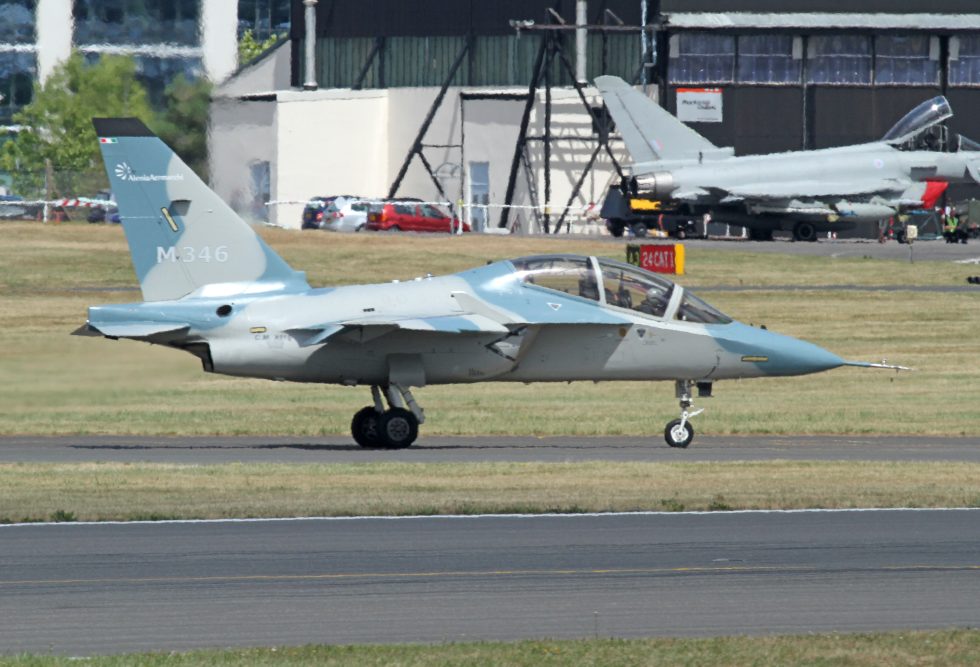
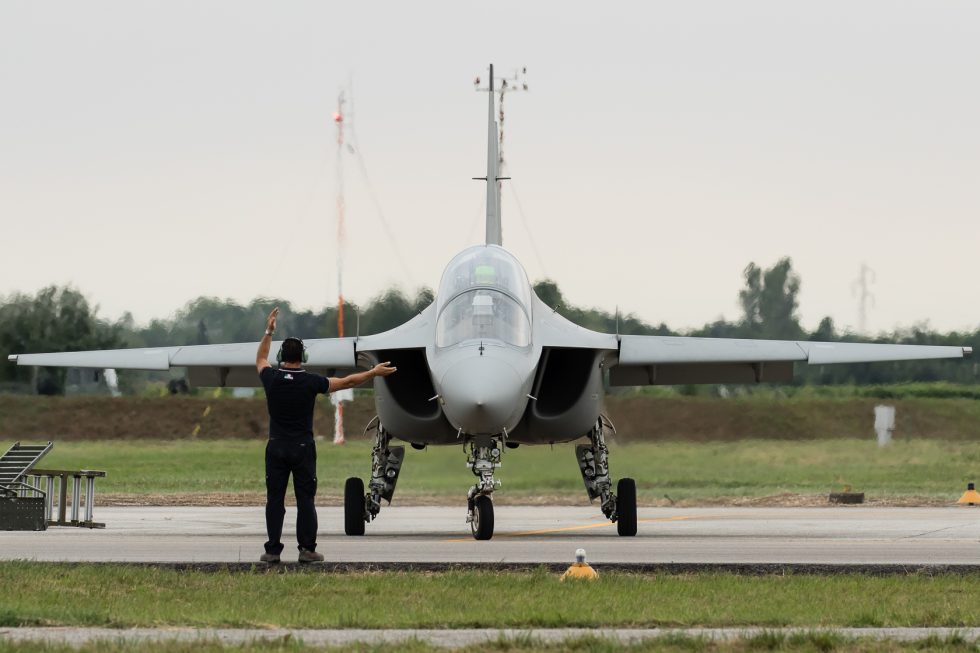
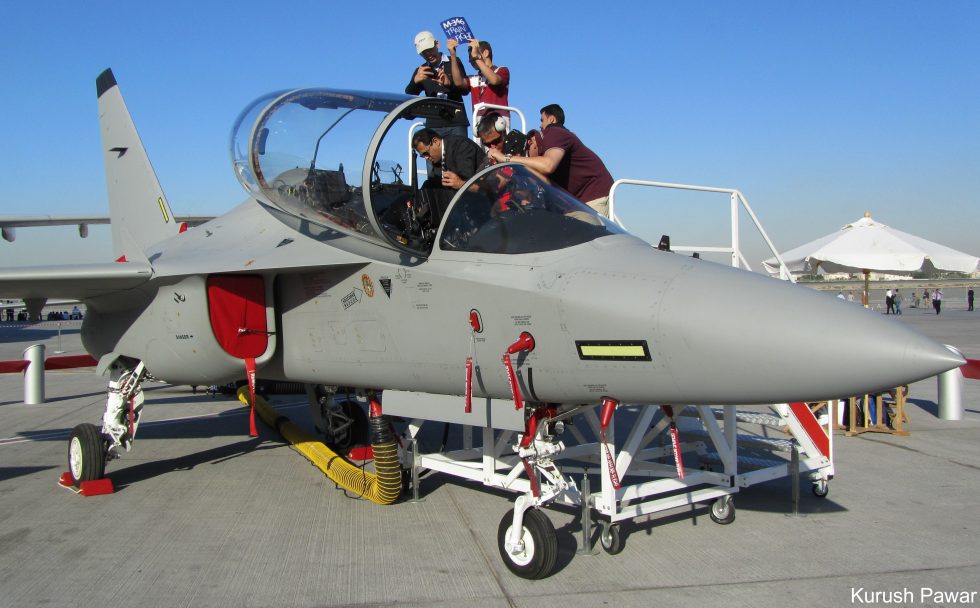
The M-346 Master in pictures


Where the M-346 Master flies
A trainer measured in pilots, not kills
The M-346 has no air-to-air record — that is not its purpose. Its success is measured in the number of air forces that have chosen it and the pilots it puts through advanced training every year. From Italy’s T-346A fleet and the multinational International Flight Training School to operators in Israel, Singapore, Poland, Greece, Qatar and beyond, the Master has become one of the West’s standard lead-in fighter trainers. The armed M-346FA now extends that into a genuine light-attack and air-policing capability.
See the wider combat record of every military aircraft. The M-346 is a training and light-attack aircraft, not a front-line fighter.
Everything people ask about the M-346 Master
Can I fly in an M-346?
What is the Aermacchi M-346 Master?
Is the M-346 related to the Russian Yak-130?
Does the M-346 train F-35 pilots?
Which countries fly the M-346?
Can the M-346 carry weapons?
You can’t fly the M-346.
These, you can.
Some legends only live in museums — others are fuelled and waiting. MiGFlug has put civilians in real military jet cockpits since 2004.
 Fly the L-39 AlbatrosThe world’s most-flown jet trainer — aerobatics included
 Fly the F-104 Starfighter“The missile with a man in it”
 Fly the MiG-21The Cold War’s most-produced jet
 Fly the T-33 Shooting StarAmerica’s first jet trainer
 Fly the DH VampireA piece of early jet history
 Fly the S.211Agile Italian jet trainer
 Fly the MB-326The classic Aermacchi jet
 Fly the MiG-15The Soviet legend of the Korean War
Continue the tour
Every fact, checked
- Leonardo — M-346 product pageManufacturer data on the trainer, fly-by-wire, embedded training and the M-346FA.
- GlobalSecurity.org — M-346 MasterFly-by-wire, high angle-of-attack performance, embedded training and the lead-in fighter role.
- MilitaryFactory — Leonardo M-346 MasterDimensions, weights, engines, performance, hardpoints and the Yak-130 shared origin.
- Global Military — M-346 MasterOperator list and quantities, development history and the International Flight Training School.
- The War Zone — Flying the M-346First-hand account of handling, high-alpha behaviour and the embedded training system.
- Defense.info — M-346 and LVC trainingLive-Virtual-Constructive training architecture and the F-35-era training role.
- European Airshows — M-346 first flightReference for the 7 June 2003 rollout and 15 July 2004 first flight.
- AeroCorner — Alenia Aermacchi M-346Consolidated specifications and variant overview.