
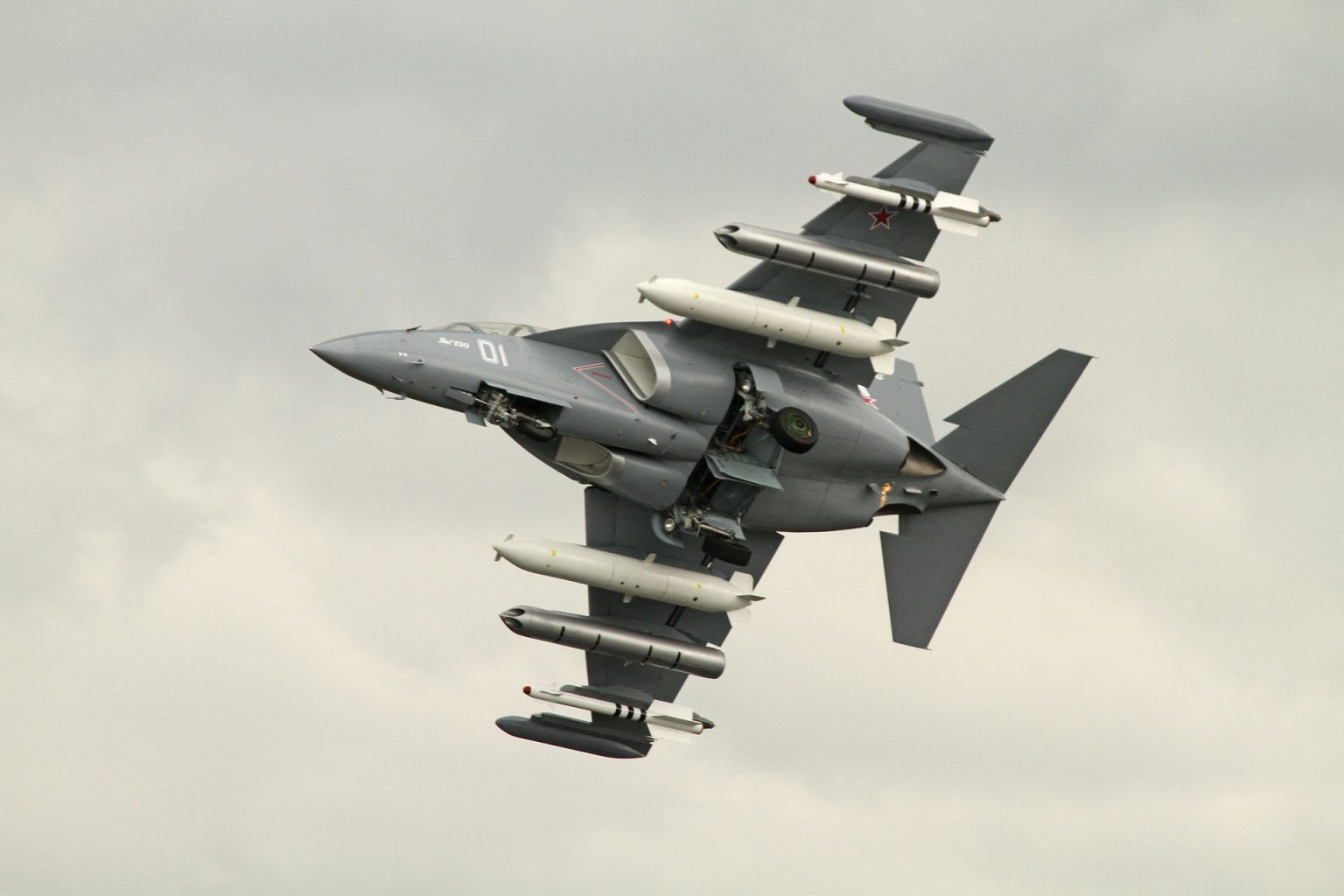
Yakovlev Yak-130
“Mitten”
A modern Russian advanced jet trainer and light-attack aircraft — digital fly-by-wire, designed to mimic the handling of fourth- and fifth-generation fighters, and now exported across three continents.
A modern trainer built to teach the fighters of today
By the early 1990s the Soviet, and then Russian, air force faced a training problem. Its cadets learned on the Czechoslovak L-29 and L-39 Albatros, subsonic jets designed decades earlier, while the fighters they would go on to fly — the MiG-29, Su-27 and their descendants — were digitally controlled, relaxed-stability machines that flew nothing like the old trainers. The Yakovlev design bureau set out to build a replacement: an advanced jet trainer whose flight controls could be tuned to imitate the behaviour of modern combat aircraft, so that much of a pilot’s conversion could happen in a cheaper, safer jet.
The programme began in 1993 as a partnership with Italy’s Aermacchi. Together they built the Yak/AEM-130 demonstrator, which first flew in 1996. The collaboration did not last: around the turn of the century the two companies parted ways and split the design, each taking the shared aerodynamic layout in its own direction. Aermacchi (later Leonardo) developed the closely related M-346 Master with Western engines and avionics, while Yakovlev produced the Russian Yak-130. The redesigned production aircraft flew in the mid-2000s and entered Russian service in 2010.
What emerged is a two-seat jet with a genuinely digital, quadruplex fly-by-wire control system — unusual for a trainer — that can be reprogrammed to mimic the handling of different fighter types. It is also a capable light-attack platform: with up to nine hardpoints it can carry guided and unguided weapons, and several export operators have used it in that armed role. It has become one of Russia’s more successful recent aircraft exports, sold to operators across the former Soviet space, the Middle East, Africa and South-East Asia.
01The Yakovlev Yak-130’s origins: the shared programme that also produced the M-346
The Yak-130 and the Italian M-346 share a common ancestor. From 1993 Yakovlev and Aermacchi jointly developed the Yak/AEM-130 demonstrator, which first flew in 1996. When the partnership ended around 1999–2000, the two firms divided the intellectual property and pursued separate aircraft from the same basic aerodynamic design.
Aermacchi went on to build the M-346 Master, fitted with Western (Honeywell/ITEC F124) engines and NATO-standard avionics, which serves as a trainer with Italy, Israel, Poland, Singapore and others. Yakovlev developed the Yak-130 around Russian systems and Ukrainian-designed AI-222 engines. The two aircraft look similar and share a lineage, but they are distinct programmes built for different markets — a point often blurred in casual descriptions.
What makes it special
Reprogrammable digital fly-by-wire
The Yak-130’s defining feature is its digital fly-by-wire control system, which can be tuned to change how the aircraft responds. By adjusting the control laws, instructors can make it behave like different combat types — giving it the heavier, relaxed-stability feel of a modern fighter, or a docile response for early students. The idea is to let cadets rehearse the handling of aircraft such as the MiG-29 or Su-30 in a cheaper, more forgiving jet.
High angle-of-attack, departure-resistant flying
Wide leading-edge root extensions and the fly-by-wire system let the Yak-130 fly controllably at very high angles of attack — commonly cited up to around 40 degrees — without departing into a spin. That envelope is useful both for teaching students where the edges are safely and for the aerobatic and combat manoeuvres its graduates will need, making it one of the more agile aircraft in its class.
Trainer by day, light attacker by need
Beyond training, the Yak-130 is a genuine light-attack aircraft. With up to nine hardpoints and a reported external load of about 3,000 kg, it can carry guided bombs, rockets, air-to-air missiles and a gun pod. Several export customers bought it partly for that secondary strike role, and it has been used operationally as a light striker — a flexibility that helps explain its export success.
02The Yak-130’s cockpit and avionics: the first all-digital Russian production trainer
The Yak-130 was described by its makers as the first Russian series-production aircraft built around an all-digital avionics suite, with multi-function glass displays in both cockpits rather than analogue dials. Embedded simulation lets the aircraft generate synthetic radar contacts, targets and weapon effects in the cockpit, so students can practise sensor and weapons work without any of it being real. Combined with the reprogrammable flight controls, this is what lets one airframe stand in for several more expensive fighters during training.
03The Yak-130’s engines: the AI-222-25 and its Russian-Ukrainian roots
Production Yak-130s are powered by two Ivchenko-Progress AI-222-25 non-afterburning turbofans, each in the region of 2,500 kgf (about 24.5 kN) of thrust. The engine was designed by the Ukrainian Ivchenko-Progress bureau and built with Russian partners (Salut/Motor Sich), a cross-border arrangement that later became complicated by the deterioration of Russian-Ukrainian relations. Russia has since worked to produce the engine domestically. The twin-engine layout gives redundancy and the roughly 1,060 km/h top speed, though the Yak-130 remains subsonic.
Full specifications
Figures are for the production Yak-130 and are drawn from manufacturer and reference sources. Values vary slightly between sources and configurations, so treat them as representative rather than exact.
Baseline note: the figures below describe the production Yak-130 as built at the Irkutsk Aviation Plant and flown by the Russian Aerospace Forces since February 2010 — two Ivchenko-Progress AI-222-25 turbofans, a four-channel digital fly-by-wire system, no radar, no internal gun, nine stores stations and, on a normal training day, nothing hung on any of them. Deltas for the Yak-130M, shown as a concept at Army 2024 and first flown on 25 June 2026, and for the abandoned Yak-131 attack proposal are given in grey. Six disagreements between reputable sources are worth settling before the tables begin. First, the dimensions, and this is the awkward one: two sets circulate, 11.245 m long by 9.72 m span in the trade data derived from Irkut, and 11.49 m by 9.84 m in the encyclopaedic specification blocks. The Yak-130 and the M-346 were drawn to a common planform by a joint team, so their published dimensions have been contaminating each other for a quarter of a century; the reading taken here is that the Yak is 11.245 m long and spans 9.84 m, while 11.49 m and 9.72 m are the Italian aeroplane’s length over its nose probe and span over its wingtip rails. Second, maximum take-off weight: 9,000 kg belongs to the demonstrator and the early pre-production aircraft, 10,290 kg to the production machine loaded to its limit, and the two are printed interchangeably. Third, internal fuel: 1,700 kg and 1,750 kg are the same tanks measured as usable and as total. Fourth, hardpoints: nine is the manufacturer’s count and appears in the body of every serious account, while specification tables routinely print eight by discarding the centreline station or by ruling the wingtips out as countermeasure-only. Fifth, angle of attack: 35° is the service limit, 40° the certified figure and 42° what the aeroplane has been demonstrated to, and all three appear without qualification. Sixth, maximum speed: 1,050 km/h and 1,060 km/h both appear, a rounding difference rather than two aeroplanes. Where the Yak-130M differs materially the delta is given in the row itself.
Dimensions & weights
- Crew
- 2 in tandem, the rear seat raised 100 mm with a periscope-free view over the student’s canopy. Both cockpits are fully equipped and either can fly the aeroplane; on a combat sortie the back seat becomes a weapons operator, and the type can be flown solo from the front. This is the Soviet training tradition of an instructor who can see what is about to happen, rather than one who is told about it afterwards
- Length
- 11.245 m (36 ft 11 in), fuselage. The widely reprinted 11.49 m (37 ft 8 in) is the M-346’s length over its nose probe and has migrated into Yak-130 tables through the shared drawing
- Wingspan
- 9.84 m (32 ft 3 in) over the wingtip stations. Some sources give 9.72 m (31 ft 11 in), which is the Italian aeroplane’s span across its missile rails
- Height
- 4.76 m (15 ft 7 in) to the top of the fin. This is one of the very few dimensions on which every source agrees, which tells you something about the rest
- Wing area
- 23.52 m² (253.2 sq ft), including the large leading-edge root extensions that generate the vortex flow the whole high-alpha design depends on
- Aspect ratio
- 4.1 — low for a trainer and chosen deliberately. An L-39 Albatros is about 4.4 and a Hawk about 4.9; the Yak-130 was drawn to roll, buffet and depart like a fighter rather than to cruise economically, and the price is paid in fuel burn every hour of every sortie
- Empty weight
- 4,600 kg (10,141 lb). The airframe is roughly 26 per cent composite by area in fairings, doors and control surfaces, with a conventional metal primary structure — conservative by Western standards of the late 1990s and one reason the aeroplane is cheap to repair on an export base with no autoclave
- Normal take-off weight
- 6,350 kg (14,000 lb) in the clean training configuration the aeroplane actually spends its life at. A gross weight of 7,250 kg (15,984 lb) is quoted for the armed training case with practice stores aboard
- Maximum take-off weight
- 10,290 kg (22,686 lb). Older tables give 9,000 kg (19,842 lb), which is the demonstrator and the first pre-production aircraft rather than the machine Irkutsk builds. At the higher figure the aeroplane is lifting more than twice its empty weight, which is the entire basis of the light-attack pitch and also the point at which it stops behaving like a trainer
- Maximum external stores
- ~3,000 kg (6,614 lb) across nine stations. Real and misleading at once: the two wingtip stations are countermeasure or acquisition-round positions in Russian service, the centreline is usually a tank, and a credible strike load is a little over half the advertised number. The Yak-130M is quoted at ~2,500 kg (5,512 lb), the difference being the radar, the defensive suite and the fuel they displace
- Internal fuel
- ~1,700 kg (3,748 lb), about 2,100 litres in wing and fuselage tanks; 1,750 kg appears where total rather than usable capacity is being quoted. With external tanks the total reaches ~2,600 kg (5,732 lb)
- External tanks
- 2 × 450 litres on the inboard wing pylons, with a centreline tank offered. Every tank fitted is a pylon not carrying a weapon, and on an aeroplane with no air-to-air refuelling probe that trade is not optional on any sortie longer than an hour
- Wing loading
- 270 kg/m² (55 lb/sq ft) at normal take-off weight, rising to 437 kg/m² (90 lb/sq ft) at maximum. The published figure is always the clean one, and the gap between the two numbers is the gap between the aeroplane in the brochure and the aeroplane over a target
- Thrust-to-weight
- 0.79 at 6,350 kg on full military power, falling to about 0.49 at maximum take-off weight. There is no afterburner anywhere in the design, so what you read is what you get; the higher figure is genuinely fighter-like for a subsonic trainer, the lower one is why a fully loaded Yak-130 climbs like a loaded transport
- Load factors
- +8 / −3 g clean, with a sustained 4.8 g available at Mach 0.8 at medium altitude. The flight control system reduces the limit automatically as stores and fuel are added rather than trusting a student to remember the placard
Performance
- Maximum speed
- 1,060 km/h (572 kt, 659 mph) at altitude, Mach 0.93. Some sources round to 1,050 km/h. The aeroplane is unaugmented and subsonic by design; unlike the M-346 it has never been dived through Mach 1, and no supersonic claim should be entertained
- Cruise speed
- 887 km/h (479 kt, 551 mph), which is a high-subsonic cruise on a training profile and closer to fighter practice than to the 700 km/h an L-39 would be doing on the same leg
- Take-off and landing speed
- 210 / 190 km/h (113 / 103 kt). The low approach speed is the payoff from the leading-edge root extensions and the slatted wing, and it is what lets the type operate from the short unpaved strips the Russian requirement insisted on
- Rate of climb
- 65 m/s (12,800 ft/min) at sea level, clean. That is a genuinely brisk figure for 5,000 kgf of unaugmented thrust and reflects how light the aeroplane is when it is not carrying anything
- Service ceiling
- 12,500 m (41,000 ft). Unpressurised-cabin arguments do not arise — the cockpit is pressurised and the crew are on an onboard oxygen system rather than bottles
- Range
- 2,000 km (1,080 nmi) on internal fuel; 2,100 km appears in several tables and is the same sortie flown at a more favourable altitude. There is no refuelling probe, which is the single largest practical limitation on the type as a combat aeroplane
- Ferry range
- ~2,600 km (1,400 nmi) with two 450-litre tanks. Deliveries to Algeria, Myanmar and Laos were nonetheless made by An-124 rather than by air, which is the honest measure of what that number is worth
- Combat radius
- ~500 km (270 nmi) on a low-level attack profile with a useful load, and closer to 300 km with a heavy one. Every published radius figure for this type is a manufacturer’s profile; none has ever been independently flown and reported
- Endurance
- ~2 h 30 min on internal fuel at training power settings. A typical syllabus sortie is an hour, and the surplus is what allows a student to be taken to a range and brought back without cutting the lesson short
- Take-off run
- 380 m (1,247 ft) at normal weight from a paved runway, and the type is cleared for unpaved strips — a Russian requirement the Italians never had to meet, and the reason for the intake protection and the tall, soft-field undercarriage
- Landing run
- 670 m (2,198 ft), without a brake parachute. The aeroplane has carbon brakes and an anti-skid system rather than the drag chute a MiG-29 would need for the same job
- Angle of attack
- 35° as the service limit, 40° certified and 42° demonstrated. The airframe is controllable well past the limiter and the point of the limiter is pedagogical rather than structural: the instructor can move it, and moving it is how a student is shown what carefree handling has been hiding from him
- Spin behaviour
- recoverable and deliberately taught — the Yak-130 is cleared for spinning, which most Western advanced trainers of its generation are not. Spin entry and recovery are part of the Russian syllabus and the aeroplane was designed around that requirement rather than being certified for it afterwards
Propulsion & systems
- Engines
- 2 × Ivchenko-Progress AI-222-25 two-shaft turbofans, unaugmented, mounted side by side in the rear fuselage. Designed at Ivchenko-Progress in Zaporizhzhia and originally built jointly with Motor Sich in Ukraine and NPTs Salyut in Moscow, with roughly half the components Russian and half Ukrainian. That arrangement died in 2014 and was buried in 2022; Salyut now builds the whole engine, and the localisation programme is a large part of why Russian deliveries slowed in the middle of the last decade
- Thrust
- 24.52 kN (2,500 kgf, 5,510 lbf) each at sea level, static, giving 49.0 kN (11,020 lbf) installed. There is no afterburner in any production version. An afterburning AI-222-25F of 4,200 kgf was flown for the abandoned Yak-131 and for Chinese interest in the L-15, and never entered Yak-130 service
- Engine growth
- SM-100 on the Yak-130M — a Salyut development claimed to give 20 per cent more thrust in the same envelope and weight with double the service life. As with every Russian engine announcement of the period, the claim is the manufacturer’s and no independent bench figure exists. The 2026 first flight of the Yak-130M was made on standard AI-222-25s
- Intakes
- lateral, with protection doors — the intakes can be closed off on the ground and take-off run, air being drawn through louvres on the upper fuselage instead. This is the single most visible piece of Russian design philosophy on the aeroplane and the clearest divergence from the M-346, which has no such system because Italian air forces do not operate from gravel
- Flight control system
- KSU-130 , a four-channel digital fly-by-wire system with full authority and no mechanical reversion. On a trainer in the 1990s that was a bold decision, and it cost the programme an aircraft: the first pre-production machine was lost on 26 July 2006 to a control-system failure, both crew ejecting
- Reprogrammable handling
- selectable control laws — the reason the aeroplane exists. The instructor can change the aircraft’s apparent stability, stick forces, damping and limits in flight, so the same airframe can be made to fly like a Su-30, a MiG-29 or a Su-57. Yakovlev and Rosoboronexport also claim emulation of the F-15, F-16, F/A-18, Mirage 2000, Rafale, Typhoon and F-35. Treat the Western half of that list as marketing: emulating an aeroplane’s handling means matching a stability derivative set somebody has to possess in the first place, and no Russian bureau has flight-test data on an F-35
- Training coverage
- up to 80 per cent of a fighter pilot’s syllabus, on the developer’s estimate. No independent audit of that claim exists, and it is the number every advanced-trainer manufacturer on earth quotes about its own product
- Avionics
- MIL-STD-1553 open architecture with three colour liquid-crystal multifunction displays of roughly 150 × 200 mm in each cockpit, HOTAS controls, a head-up display in front and a repeater behind. The point is structural rather than cosmetic: the cockpit a Russian student learns on is laid out like the Su-30SM and Su-35S cockpit he graduates into, which was not true of the L-39 he used to learn on
- Navigation
- laser-gyro inertial platform with a dual GLONASS and GPS receiver, and a helmet-mounted sighting system for the front cockpit. Late-production Russian aircraft add SVP-24-class targeting computation for unguided bombing, which is how a Russian aeroplane without a targeting pod is made to hit anything
- Radar
- none as standard — an empty nose and a simulated picture. Osa and Kopyo-type sets have been offered for export for two decades without a taker. The Yak-130M carries the BRLS-130R active electronically scanned array with the SOLT-130K electro-optical and laser targeting station, which is the change that turns the type from an armed trainer into a light combat aircraft
- Self-protection
- chaff and flare dispensers at the wingtips on the baseline aeroplane, and nothing else. The Yak-130M adds the President-S130 suite with missile approach warning and the KSS-130 communications and datalink set. A baseline Yak-130 flown into defended airspace has no radar warning receiver worth the name, and every operator that has used the type in anger has used it where nothing was shooting back
- Escape system
- NPP Zvezda K-36LT3.5Y zero-zero ejection seats in both cockpits, with command ejection. The K-36 family is the best-regarded ejection seat in the world and its record on this type bears that out: the great majority of Yak-130 losses across seven air forces have been survived
- Airframe life
- 10,000 flying hours , 30 calendar years and 20,000 landings, extendable on inspection to 15,000 hours. For a training aeroplane flying four sorties a day that is the specification that decides the cost per hour, and it is far more relevant to a customer than any performance figure in the tables above
04The Yak-130’s cost: why a trainer is a bargain next to a fighter
Part of the Yak-130’s appeal is economic. Published export prices have generally fallen in the region of US$15–25 million per aircraft depending on package and customer, a fraction of the cost of a front-line fighter, and its running costs per hour are far lower than those of the jets it trains pilots for. Exact figures are commercially sensitive and vary by contract, so any single number should be read as an estimate.
No reliable, independently verified cost-per-flight-hour figure exists in open sources for the Yak-130. The economic case made for the type — that hours flown on it are much cheaper than hours on a fighter — is widely repeated but rarely accompanied by audited numbers.
Armament & payload
The Yak-130 carries nine hardpoints, three tonnes and almost nothing that can find its own target
The Yak-130 has no internal gun, no radar and, in Russian service, spends almost all of its life with empty pylons. What it has instead is nine hardpoints and a manufacturer’s claim of three tonnes, and those two numbers have sold the aeroplane to seven air forces that wanted a trainer they could also use to bomb something. The weapons themselves are the standard Russian tactical inventory scaled down: unguided rockets, iron bombs, a podded 23 mm cannon and the R-73 for self-defence. Guided weapons appear on every export brochure and almost nowhere else, because the baseline aeroplane has no targeting pod, no laser designator and no radar with which to use them — the Kh-25ML needs somebody else’s laser and the KAB-500Kr needs a television seeker the pilot must find the target with himself, in daylight, unopposed. The Yak-130M finally fixes this with an AESA radar and the SOLT-130K sighting station, which is an admission of what the baseline could not do. Fits vary enormously by operator. Russian aircraft fly clean or with practice stores; Algerian, Belarusian, Bangladeshi and Vietnamese machines are trainers with a weapons syllabus; Myanmar’s are used as attack aeroplanes; Iran has fitted the R-73E and flies air-defence patrols. Much of what appears on Rosoboronexport’s cleared-store list is an integration offer rather than a weapon any squadron has loaded.
Gun
- There is no internal cannon in any production Yak-130, and the omission is deliberate: a gun bay costs weight and volume in an aeroplane whose primary customer wanted cheap flying hours, and gas ingestion into two closely spaced intakes is a real problem on a design this small
- The standard fit is a podded gun on the centreline or an inboard wing station: the UPK-23-250 carrying a twin-barrel GSh-23L of 23 mm with 250 rounds, or the SNPU-130 pod built for this type. Each one costs a pylon and roughly 220 kg
- The abandoned Yak-131 would have carried a fixed GSh-30-1 of 30 mm — the Su-27 and MiG-29 gun — along with cockpit and engine armour. That aeroplane died in late 2011 when it failed the Russian Air Force’s pilot-survivability requirements, which is a polite way of saying that a trainer airframe cannot be armoured into a Su-25
- Aiming is by head-up display with a continuously computed impact point, fed by the mission computer and, in the front cockpit, by a helmet-mounted sight. On the Yak-130M the same display is fed by the SOLT-130K electro-optical station
- What the gun cannot do is make the aeroplane survivable. A subsonic unaugmented trainer that has been acquired by anything with a radar is in trouble regardless of what is bolted underneath it
Air-to-air
- R-73 (AA-11 Archer) infrared short-range missile, in the R-73E export form, on the underwing pylons. This is the only air-to-air weapon actually carried in service, and Iran’s decision to fit it in 2024 turned a trainer delivery into an air-defence asset for a country that had no other new fighters
- R-77 (AA-12 Adder) appears on Russian-language capability lists and cannot be used: the baseline aeroplane has no radar to guide it. It belongs to the Yak-130M with the BRLS-130R, and even there no integration has been announced
- The wingtip stations are countermeasure dispensers in Russian service rather than missile rails, which is why specification tables that count them as weapons stations get to nine and tables that do not get to eight. Both are describing the same aeroplane
- The role the missile genuinely serves is quick-reaction alert against slow movers — light aircraft, helicopters and, increasingly, drones. The Yak-130M is being sold to Russia on precisely that basis, as a cheap interceptor of Ukrainian long-range one-way attack drones that a Su-35 is absurdly expensive to chase
- Against a real fighter it loses. On 20 June 2026 an Israeli F-35I Adir shot down an Iranian Yak-130 over Tehran, the first manned aircraft ever destroyed in air combat by an F-35. That engagement is the clearest possible statement of what this aeroplane is and is not
Air-to-surface guided
- Kh-25ML (AS-10 Karen) semi-active laser-guided missile is the weapon most often listed, and it needs a laser designator the baseline aeroplane does not carry. In practice it requires a ground party or a second aircraft to mark the target
- KAB-500Kr television-guided bomb of 500 kg is the other standard entry. The seeker is locked on before release by the pilot, in daylight, in clear weather, which is a demanding task in a single-seat sense even with a second crew member to help
- Kh-29 and the 9K121 Vikhr laser-beam-riding missile appear on some export lists. Neither has been shown on a Yak-130 and neither should be counted as fielded capability
- The Yak-130M is the variant where this card stops being aspirational. The SOLT-130K station gives the aeroplane its own laser designator and thermal imager, and the BRLS-130R gives it a radar picture, which between them make the guided weapons listed above usable for the first time in the type’s history
- No Yak-130 operator has been confirmed employing a guided air-to-surface weapon in combat. Myanmar’s strikes have used rockets and unguided bombs, which is what the aeroplane can actually do
Bombs
- FAB-100, FAB-250 and FAB-500M-62 general-purpose bombs are the standard iron, carried on multiple ejector racks on the four inboard wing stations and the centreline. Two FAB-500s and a tank is most of a useful load gone
- OFAB-250-270 fragmentation bombs and RBK-500 cluster dispensers are cleared. ZB-500 incendiary tanks appear on the older lists and are the sort of store nobody advertises any more
- Practice stores matter more than any of the above in day-to-day use: P-50T and similar 50 kg practice bombs on multiple carriers are how weapons delivery is taught, and they account for the overwhelming majority of Yak-130 releases ever made
- Aiming is by the mission computer with a continuously computed release point. Late Russian aircraft carry SVP-24-class computation, which improves unguided accuracy substantially by solving the ballistics precisely rather than relying on the pilot to fly a textbook profile
- This is the card that describes the aeroplane’s actual combat record. Myanmar’s Yak-130s have dropped unguided bombs and fired unguided rockets at ground targets since 2020, including in attacks documented by human rights investigators as having struck civilians and civilian buildings
Rockets
- B-8M1 pods, each carrying twenty S-8 rockets of 80 mm, are the signature Yak-130 store and the one seen most often on operational aircraft. Four pods is eighty rockets and a little over 1,000 kg
- B-13L pods with five S-13 rockets of 122 mm give a heavier warhead for bunkers and hardened targets, at the cost of a much smaller salvo
- S-24B rockets of 240 mm on single rails are listed, and are an old and violent weapon whose launch transients a light airframe does not enjoy. They are rare in practice
- Rockets are the reason the Yak-130 has any counter-insurgency value at all: they need no designator, no datalink and no radar, they are cheap, and against an opponent with no air defence they are effective. They are also indiscriminate, which is the other half of the Myanmar story
- The Yak-130M retains the same rocket fit. Nothing about the upgrade changes the aeroplane’s unguided ordnance; what changes is the ability to find the target at night and in weather
Pods & other stores
- 450-litre drop tanks on the inboard wing pylons, with a centreline tank offered. Since the aeroplane has no air-to-air refuelling probe — a significant divergence from the M-346, which does — the tanks are not optional on any sortie worth the name, and they take the pylons the weapons want
- Reconnaissance pods have been offered since the joint-venture days, when the Italian ELT-55 electronic-warfare and Vicon-601 camera pods were part of the Yak/AEM-130 sales pitch. Nothing equivalent is known to be in Russian service
- The Platan infrared and laser targeting pod was developed for Russian tactical aircraft and has been proposed for the Yak-130 without being fielded on it. The SOLT-130K on the Yak-130M is an internally mounted station rather than a pod, which is the better answer on an aeroplane this short of stations
- Chaff and flare dispensers occupy the wingtip stations. On the Yak-130M these are supplemented by the President-S130 suite with missile approach warning, which is the first genuine self-protection the type has had
- What is absent is as telling as what is present: no targeting pod in service, no datalink on the baseline aeroplane, no refuelling probe and no radar warning receiver of consequence. Every one of those gaps is filled by the M, and every one of them was a gap for sixteen years of production
Three typical loadouts
- Advanced training sortie, Russian syllabus
- Clean. No stores on any of the nine stations, internal fuel only, about an hour airborne. The instructor reprogrammes the control laws in flight so the student flies the first half of the sortie in a stable trainer mode and the second half with the stability relaxed to something approximating a Su-30SM. This is what the overwhelming majority of Yak-130 flights look like, and it is the configuration the type was designed for.
- Counter-insurgency strike, Myanmar pattern
- Two B-8M1 rocket pods with forty S-8 rockets on the outboard wing stations, two FAB-250 general-purpose bombs inboard, a 450-litre tank on the centreline, chaff and flares at the wingtips. Around 1,400 kg of ordnance, no guided weapons, no targeting pod, visual delivery in daylight. Effective against an enemy with nothing to shoot back with, and the configuration in which this aeroplane has done its documented killing.
- Air policing and drone interception, Iranian pattern
- Two R-73E infrared missiles on the inboard wing pylons, a UPK-23-250 gun pod on the centreline, wingtip countermeasures, internal fuel. Roughly an hour on station within a short radius of base, under ground-controlled interception because the aeroplane has no radar of its own. Adequate against a slow drone; catastrophically inadequate against anything that can see it first, as June 2026 demonstrated.
Sourcing caveat: Russian weapons integration lists are sales documents, not clearance records, and Rosoboronexport routinely advertises stores that have been carried on a pylon for a photograph and never released. Where a weapon is described above as cleared it means it appears on the manufacturer’s list; where it is described as carried it means photographic or operational evidence exists. Payload figures are quoted at maximum take-off weight with no fuel margin for a realistic profile, and the loadouts above are reconstructions from photographic evidence rather than published mission cards.
Variants
One aeroplane, two nationalities and a divorce settlement that created the M-346
In 1990 the Soviet Air Force asked its industry for an aeroplane to replace the L-39 Albatros, and received five answers: the Sukhoi S-54, the Myasishchev M-200, the Mikoyan MiG-AT, an Ilyushin proposal and the Yakovlev Yak-UTS. By 1991 only the MiG and the Yak were left, and by the end of that year there was no Soviet Union to buy either. Yakovlev had a design, no customer and no money. In 1992 it approached Aermacchi of Varese, and in 1993 the two signed: Italian finance and Western systems expertise, Russian aerodynamics and airframe. The result was the Yak/AEM-130D, built by Sokol at Nizhny Novgorod, unveiled in June 1995 and flown from Zhukovsky on 25 April 1996 by Andrey Sinitsyn. It was a genuinely joint aeroplane and it is the common ancestor of two production types still competing against each other today.
The partnership broke in 2000, and the reasons were money and an engine. Russia never funded its share; by 1998 the venture was Italian-led for want of Russian cash, and Aermacchi wanted a Western turbofan on an aeroplane Yakovlev intended to sell to the Russian air force. The settlement was characteristic of the period: Yakovlev received US$77 million, paid as a partial write-off of Soviet-era debt to Italy rather than in cash, plus the right to the joint technical documentation. The world was carved up by sales territory — Yakovlev took the Commonwealth of Independent States, India, Slovakia and Algeria, Aermacchi took NATO and the West. Both walked away with the same drawing. Aermacchi built it around the Honeywell F124 and called it the M-346 Master; Yakovlev built it around the Ukrainian Ivchenko-Progress AI-222-25, added intake protection for gravel strips, and beat the MiG-AT in the Russian competition in April 2002.
What followed diverged further than the shared planform suggests. The M-346 became a Western trainer with an embedded synthetic training system and, latterly, a radar-equipped light fighter; the Yak-130 became an armed trainer for air forces that buy Russian, sold on nine hardpoints and a price. The first pre-production Yak-130 flew from Nizhny Novgorod on 30 April 2004, the type was accepted for Russian service in December 2009 and the first serial aircraft reached the training centre at Lipetsk in February 2010. Sokol built the first twelve; everything since has come from the Irkutsk Aviation Plant. Neither aeroplane is a copy of the other, and anyone who calls one a clone of its twin is describing a divorce settlement rather than an aircraft.
- Yak-UTS (1990–1993, project only)
- The original Yakovlev answer to the Soviet requirement to replace the L-39, and the design that survived the 1991 cull alongside the MiG-AT. Detail design was completed in September 1993, by which time the customer had ceased to exist and the bureau was looking for a foreign partner.
- Yak/AEM-130D (1993–2000, one demonstrator)
- The joint Russian-Italian aeroplane, built by Sokol at Nizhny Novgorod and powered by two Slovak-built Povazske Strojarne DV-2S turbofans of 2,200 kgf. Unveiled June 1995, first flight 25 April 1996, later flown in Italy. Larger and heavier than either production descendant, and the common ancestor of both.
- Yak-130 (first flight 30 April 2004; in Russian service from February 2010)
- The Russian production aeroplane, NATO reporting name Mitten. AI-222-25 engines, KSU-130 four-channel fly-by-wire, intake protection doors for unpaved operation, three colour displays per cockpit and nine stores stations. Twelve built by Sokol, all subsequent aircraft at Irkutsk.
- Yak-130 export standard (from 2011; Algeria, Belarus, Bangladesh, Myanmar, Laos, Vietnam, Iran, Ethiopia)
- Not a distinct mark so much as a shifting set of downgrades and options: export avionics, export weapons clearances and no single agreed configuration. Individual customers have specified different display suites and different self-protection, which is why photographs of two national fleets rarely show identical cockpits.
- Yak-131 (proposed to 2011, none built)
- The attack variant, intended as a cheap partial replacement for the Su-25 Frogfoot: cockpit and engine armour, a fixed GSh-30-1 cannon of 30 mm, and reportedly the afterburning AI-222-25F. Work stopped in late 2011 when the Russian Air Force judged that the aircraft could not meet its pilot survivability requirements. A trainer fuselage will not become an armoured attack aeroplane, and this is the programme that proved it.
- Yak-133 family (proposed from the late 1990s, none built)
- A paper family of single-seat derivatives — the Yak-133IB fighter-bomber, the Yak-133R reconnaissance aircraft, the Yak-133PP electronic warfare version and an unmanned strike proposal. None progressed beyond study, and their persistence in reference works is a good illustration of how a Russian brochure variant acquires the appearance of hardware.
- Yak-135 (proposed, none built)
- A four-seat business and liaison derivative using the Yak-130 wing and powerplant with a widened fuselage. It never left the drawing board and is included here only because it appears in almost every variant list as though it had.
- Yak-130M (concept August 2024; first flight 25 June 2026)
- The upgrade that finally addresses what the baseline could not do: the BRLS-130R active electronically scanned array radar, the SOLT-130K electro-optical and laser targeting station, the President-S130 self-protection suite and the KSS-130 communications set, with more than half the onboard equipment renewed and the supply chain reindigenised after 2022. Nine stations, ~2,500 kg of stores. A second prototype rolled out in October 2025 and the first flight was made at Irkutsk on 25 June 2026, a 50-minute sortie to 2,000 m and 600 km/h. Marketed for counter-drone work, close air support and air policing.
- SM-100 engine programme (announced with the Yak-130M, 2024)
- A Salyut development of the AI-222-25 claimed to offer 20 per cent more thrust in the same envelope with double the service life. It has not flown in the Yak-130M and is the single largest unresolved question about whether the M is a genuine light combat aircraft or a better-equipped trainer.
- Aermacchi M-346 Master (Italian branch; first flight 15 July 2004)
- The other half of the 2000 settlement, and a separate aeroplane in this encyclopedia. Honeywell/ITEC F124-GA-200 engines, quadruplex fly-by-wire, Western avionics, an embedded synthetic training system in place of the Yak’s hardpoints, an air-to-air refuelling probe the Yak lacks and no unpaved-strip capability the Yak has. Same planform, entirely different aeroplane inboard of the skin.
Closing caveat: production totals for this type are unusually hard to pin down because Irkutsk builds Yak-130s alongside Su-30SM airframes and does not publish a separate line rate. Adding delivered fleets, known losses and prototypes gives roughly 230 airframes completed by the middle of 2026, of which about 130 have gone to Russia; Russian sources have quoted totals from 200 to 250 in the same year. Export unit cost is usually given as ~US$15 million flyaway, against ~US$25–30 million commonly quoted for an M-346 and around US$45 million for a T-7A, which is the whole of the Yak-130’s commercial argument. Variant designations beyond the Yak-130 and the Yak-130M should be treated with suspicion: the Yak-131, Yak-133 and Yak-135 are proposals that never became metal, and they appear in tables as though they had flown.
Operators today
Russia flies five Yak-130s for every one abroad, and only Myanmar has used the type in a war
Nine air forces fly the Yak-130 today and the Irkutsk line is still running, which makes this one of the few Russian combat aircraft programmes to have survived 2022 with its export business intact. The shape of the fleet is unusual: one enormous operator and eight small ones. Russia holds roughly five-sixths of all the aeroplanes built, and no export customer has more than eighteen. That is what an advanced trainer looks like when its home air force needs to replace an entire generation of L-39s and its foreign customers need a dozen jets to keep a training pipeline alive. The bars below count airframes on national charge rather than aircraft serviceable on a given morning, and on this type that distinction bites unusually hard: Bangladesh’s fleet has been grounded since the fatal accident at Chattogram in May 2024, and several smaller operators have lost a meaningful fraction of what they bought.
Two absences are worth stating plainly. Syria is the one everybody expects to see: Russia announced a thirty-six-aircraft contract, with nine to be handed over by the end of 2014, twelve in 2015 and fifteen in 2016. Not one was ever delivered, the deal was suspended over the civil war and the payments, and the fall of the Assad government in December 2024 ended the question for good. Syria has never operated a Yak-130 and is omitted here. Libya ordered six in 2010 and the contract was cancelled in September 2011 for the same sort of reason. Kazakhstan, Bolivia, Malaysia, Mongolia and Uruguay all appear in negotiation reports and none has a fleet. An announcement is not an aeroplane.
These are estimates. Many airframes counted on paper are stored, in deep overhaul, or not operational. Sources: IISS The Military Balance and FlightGlobal World Air Forces; entries that could not be corroborated are omitted. Russia ~120 is a midpoint: World Air Forces 2026 gives 123 in service with 14 on order, the World Directory of Modern Military Aircraft gives 109, and about five have been lost in training accidents since 2010 — the fleet is split between the training centres at Borisoglebsk, Armavir and Lipetsk, and Borisoglebsk was struck by Ukrainian long-range drones on 5 July 2025. Myanmar 18, delivered in two batches of six from 2015 and expanded since, the only fleet with a documented combat record. Algeria 16 delivered 2011–2012 as the launch export customer, though World Air Forces prints 18. Bangladesh 12 remaining of 16 delivered from September 2015, with four lost and the survivors grounded after the fatal Chattogram crash of 9 May 2024. Belarus 11 of 12 delivered in three batches of four from 2015, one lost at Baranavichy in May 2021, flown by the 206th training centre at Lida. Vietnam 10 of 12 delivered from 2021 with the 940th training regiment, two lost. Iran ~6 delivered from September 2023 in what is widely read as part-payment for drone supply to Russia, fitted with R-73E missiles and used for air-defence patrols; one was shot down by an Israeli F-35I over Tehran in June 2026. Ethiopia ~6 with four more on order, deliveries reported only in January 2026 and the least corroborated entry here. Laos 3 of a ten-aircraft order, deliveries from 2018 and incomplete, one lost on 3 October 2024. Syria (36 contracted, none delivered) and Libya (6 cancelled 2011) are excluded because no airframe was ever handed over.
From joint prototype to global export
Programme begins
Yakovlev partners with Italy’s Aermacchi to develop a new advanced jet trainer for a post-Cold-War market.
First flight
The joint Yak/AEM-130 demonstrator makes its maiden flight, proving the shared aerodynamic design.
The partners split
Yakovlev and Aermacchi part ways and divide the design; it becomes the Russian Yak-130 and the Italian M-346 Master.
Redesigned prototype flies
The definitive production-standard Yak-130, built around Russian systems, begins its own flight-test programme.
Enters Russian service
The Yak-130 formally enters service with the Russian Air Force as its standard advanced trainer, replacing older types.
First export
Algeria becomes the first export customer, beginning the type’s spread beyond Russia.
Widening export
Belarus, Bangladesh, Myanmar, Laos and others take delivery; several operators use the jet in a light-attack role.
Upgrades and combat use
An upgraded Yak-130M is developed for export, while operators such as Myanmar reportedly employ the type in combat.
Twelve Yak-130 stories
A Cold War training gap
Russia needed a jet that flew like its new fighters, not like the ageing L-39.
Read the full story
An Italian collaboration
The Yak-130 began as a joint project with Aermacchi, and shares its shape with the M-346.
Read the full story
1996
The joint demonstrator first flew in 1996, proving the aerodynamic concept.
Read the full story
A trainer that pretends
The Yak-130’s digital controls can be reprogrammed to mimic other aircraft.
Read the full story
On the edge, on purpose
Big root extensions let the Yak-130 fly controllably at very high angles of attack.
Read the full story
Glass and simulation
Digital displays and embedded simulation let one jet stand in for several.
Read the full story
A cross-border powerplant
Its AI-222-25 engines were designed in Ukraine and built with Russian partners.
Read the full story
More than a trainer
With up to nine hardpoints, the Yak-130 doubles as a light striker.
Read the full story
Algeria goes first
Algeria became the first foreign buyer, opening the export account in 2011.
Read the full story
A wide customer list
Belarus, Bangladesh, Myanmar, Vietnam, Laos and Iran have all bought the jet.
Read the full story
Used in anger
Some operators have flown the Yak-130 as a light attacker, Myanmar most visibly.
Read the full story
The Yak-130M
An upgraded export variant aims to keep the design competitive.
Read the full story
The Yak-130 in pictures
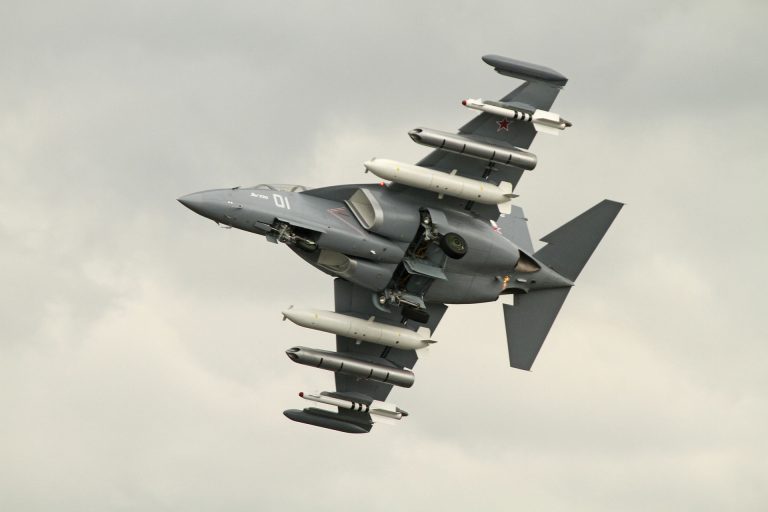
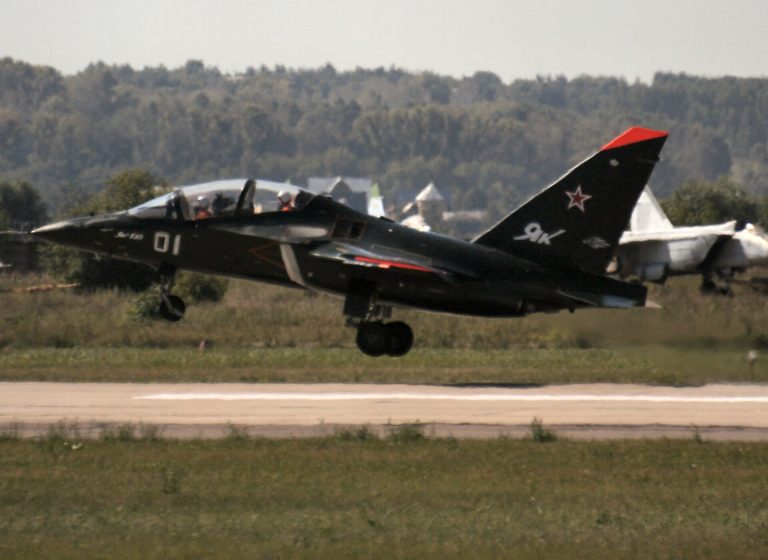
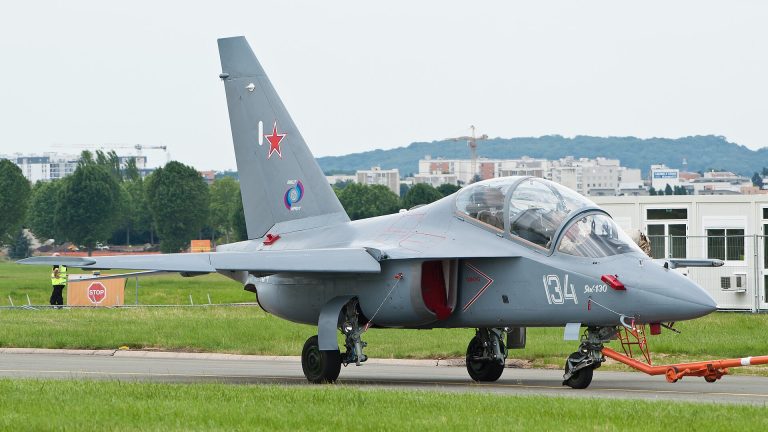
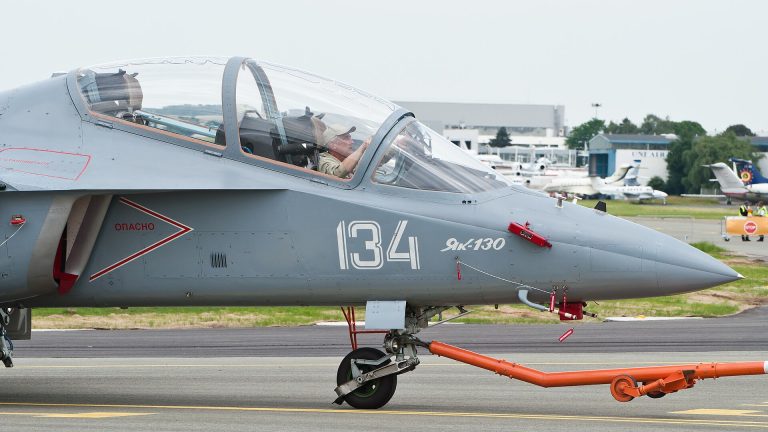
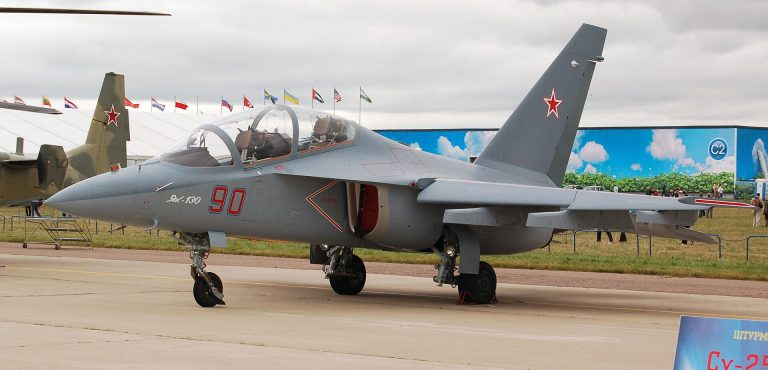
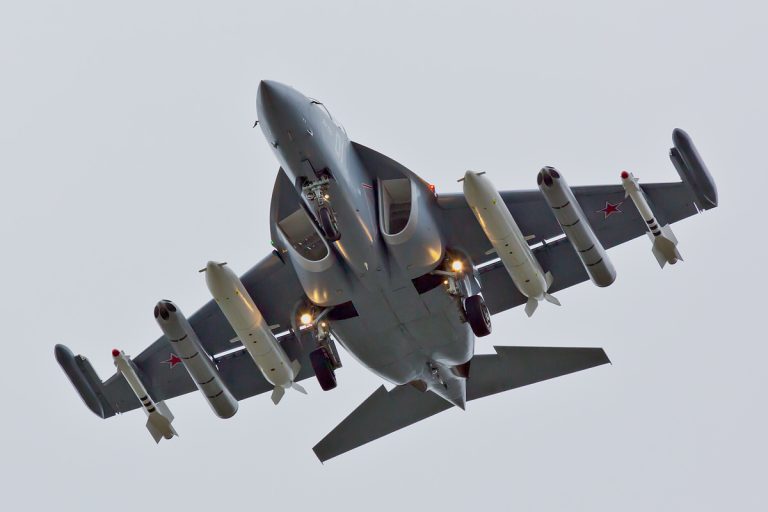
The Yak-130 in motion
A curated video feature for the Yakovlev Yak-130 is coming soon. In the meantime, explore the photo gallery above and the operator map below.
Where the Yak-130 operates
Where the record stands
The Yak-130 is first and foremost a trainer, so its story is written mostly in flying hours and pilots produced rather than air-to-air kills. It has, however, been used in anger: several operators employ it as a light attacker, and Myanmar’s air force has — according to open-source investigations and news reporting — used the type in air strikes during that country’s internal conflict. Those accounts are contested and hard to verify independently, and are presented here with caution.
Compare the combat record of every military aircraft. Figures as of July 2026.
Everything people ask about the Yak-130
Can I fly in a Yak-130?
What is the Yak-130 used for?
How is the Yak-130 related to the M-346?
Is the Yak-130 supersonic?
Which countries operate the Yak-130?
Has the Yak-130 been used in combat?
Who makes the Yak-130?
You can’t fly the Yak-130.
These, you can.
Some legends only live in museums — others are fuelled and waiting. MiGFlug has put civilians in real military jet cockpits since 2004.
 Fly the L-39 AlbatrosThe world’s most-flown jet trainer — aerobatics included
 Fly the F-104 Starfighter“The missile with a man in it”
 Fly the MiG-21The Cold War’s most-produced jet
 Fly the T-33 Shooting StarAmerica’s first jet trainer
 Fly the DH VampireA piece of early jet history
 Fly the S.211Agile Italian jet trainer
 Fly the MB-326The classic Aermacchi jet
 Fly the MiG-15The Soviet legend of the Korean War
Continue the tour
Every fact, checked
- Airforce Technology — Yak-130 project profileDevelopment history, the Aermacchi split, dimensions, engines and avionics baseline.
- Military Factory — Yakovlev Yak-130 (Mitten)Weights, performance, hardpoints, operator list and production figures.
- Centre for Information Resilience — Myanmar Witness Yak-130 investigationOpen-source investigation into Myanmar’s Yak-130s and their reported use in air strikes.
- Al Jazeera — Myanmar used Russian-made aircraft in attacksReporting on the Yak-130 in Myanmar’s internal conflict; treated here as contested.
- Army Recognition — Yak-130M enters trialsThe upgraded export variant and its expanded light-attack ambitions.
- Flugzeuginfo.net — Yak-130 technical dataIndependent specification sheet used to cross-check dimensions and performance.
- AeroCorner — Yakovlev Yak-130General reference on the type’s role, engines and operators.
- The National Interest — the Yak-130’s light-attack potentialAnalysis of the trainer’s secondary combat role and export appeal.