
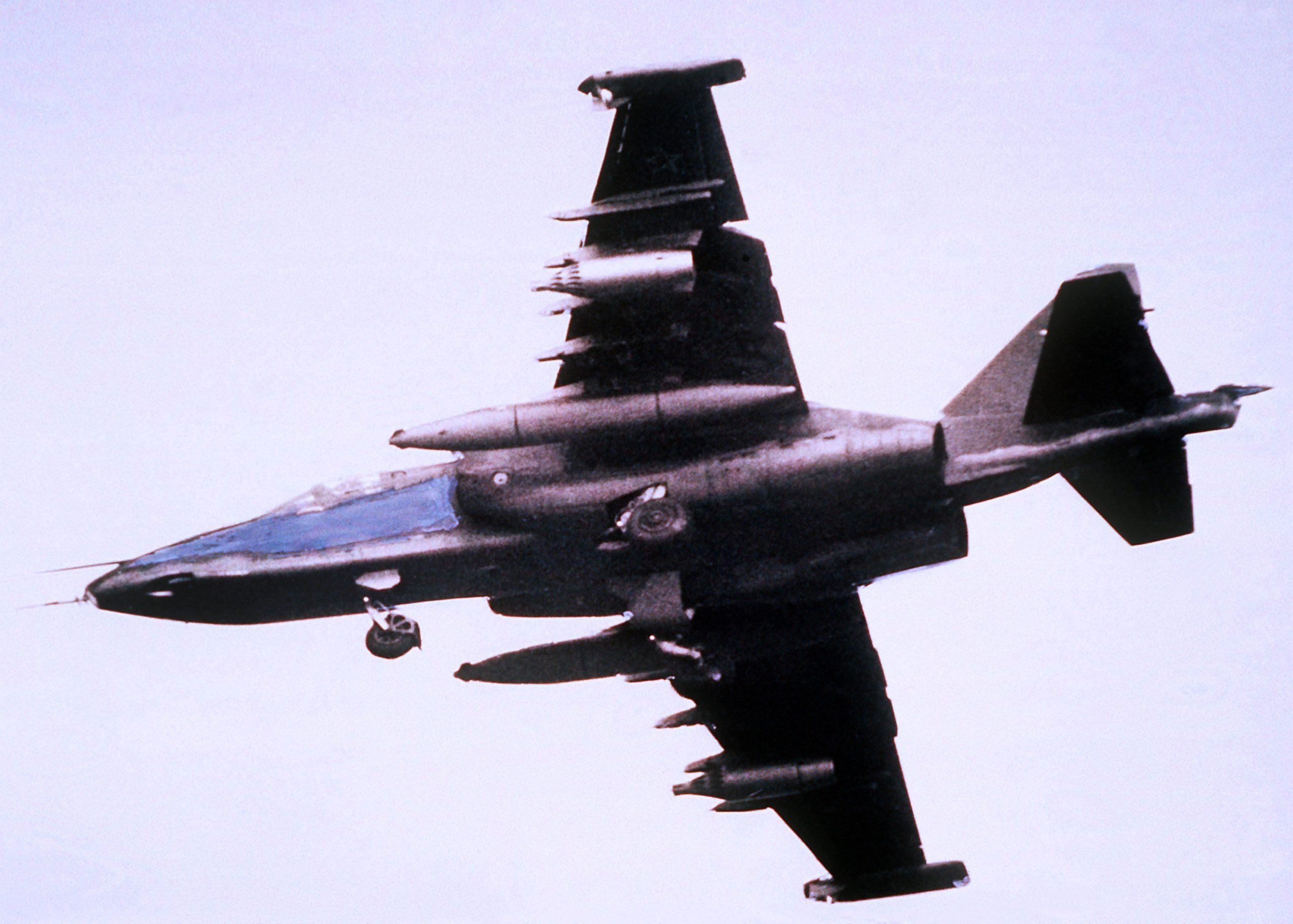
Sukhoi Su-25
“Frogfoot”
The Soviet Union’s answer to the A-10 — a heavily armoured, subsonic attack jet built to fly low, absorb ground fire and put cannon, rockets and bombs onto the battlefield the moment troops call for help. Four decades on, it is still flown at low level by both sides in the war in Ukraine.
The flying tank
By the late 1960s the Soviet Air Force had no purpose-built aircraft for the job the wartime Il-2 Shturmovik had once done so brutally well: flying low and slow over the battlefield, taking hits, and hammering enemy troops and armour in direct support of the ground forces. Fast jets were too fragile and flew too quickly to do it. In 1968 the Sukhoi bureau began work on a dedicated close-support machine — the T-8 — and the aircraft that emerged was unlike the sleek fighters around it.
The Su-25, which first flew in 1975 and entered service in 1981, was built around survival. Its pilot sits inside a welded titanium ‘bathtub’; its fuel tanks are self-sealing; its two rugged, non-afterburning turbojets sit far apart behind an armoured firewall so that losing one need not mean losing the jet. It is subsonic, unglamorous and deliberately simple — a machine meant to work from rough strips near the front and keep flying after damage that would down a lighter aircraft.
NATO called it “Frogfoot”; its crews called it the Grach (rook). The West already had its own answer to the same problem in the A-10 Thunderbolt II, and the two aircraft are often compared as the era’s definitive armoured attack jets. The Su-25 went to war first, over Afghanistan in the 1980s, and it has been in combat almost continuously since — today on both sides of the fighting in Ukraine, where its low-level attacks are effective and costly in equal measure.
01Why the Soviet Union built a slow, armoured jet in the age of Mach 2
When the Su-25 was designed, Soviet fighter development was obsessed with speed and altitude — the MiG-25 could touch Mach 2.8. Close air support was an afterthought handed to fast jets and helicopters that were ill-suited to it. Lessons from the 1967 and 1973 Arab-Israeli wars, and a hard look back at the Il-2’s wartime record, convinced Soviet planners they needed a slow, heavily protected aircraft that could see the battlefield, take hits and stay overhead. The result deliberately traded speed for armour, endurance and a punishing weapons load — the same bargain the Americans struck with the A-10. Both aircraft proved that, for supporting troops in contact, survivability matters more than raw performance.
What makes it special
The titanium bathtub
The pilot sits inside a welded titanium armour tub, with plating commonly cited between about 10 and 24 mm thick and roughly 1,050 kg of armour in all. Fuel tanks are self-sealing and foam-filled, control runs are duplicated and shielded, and the two engines sit either side of an armoured firewall. Frogfoots have flown home from Afghanistan and Ukraine with shredded wings, holed tails and one engine dead.
Cannon and a heavy load
Built into the nose is a twin-barrel 30 mm GSh-30-2 cannon with 250 rounds, firing armour-piercing and high-explosive shells at a high rate. Eleven underwing hardpoints carry up to about 4,400 kg of bombs, unguided rockets, cluster munitions and guided weapons such as the Kh-25 and Kh-29 — the full toolkit of a dedicated ground-attack aircraft.
Rough-field ruggedness
The Su-25 was made to fight from damaged and unpaved strips close to the front. Low-pressure tyres, a built-in boarding ladder and auxiliary power unit, simple robust systems and two widely spaced non-afterburning turbojets let it operate where sophisticated jets cannot — and its twin-engine layout gives it a real chance of surviving a hit that would down a single-engine aircraft.
02The Su-25 and the A-10: two answers to the same question
The Su-25 and the American A-10 Thunderbolt II were designed at the same time, on opposite sides of the Iron Curtain, to solve the same problem: how to keep a slow, heavily armoured aircraft alive over a battlefield thick with anti-aircraft fire. They ended up different in emphasis. The A-10 is larger, longer-ranged and built around its huge 30 mm GAU-8 tank-killing cannon. The Su-25 is smaller, faster and lighter, closer to a fast jet in feel, with its firepower spread across cannon and a heavy load of rockets and bombs. Both wrap the pilot in a titanium bath, both can absorb astonishing damage, and both have outlived every prediction of their retirement. They are the two definitive close-support jets of the age.
03Afghanistan and the Stinger: the war that shaped the Frogfoot
The Su-25 came of age over Afghanistan, where nearly 50 aircraft flew tens of thousands of sorties as the Soviet army’s primary close-support jet. It was effective — and increasingly vulnerable once the mujahideen received US-supplied FIM-92 Stinger shoulder-fired missiles from 1986. Around two dozen were lost in combat over the war. The heat-seeking threat drove a series of changes: more flare dispensers, extra shielding and fireproofing between and around the engines, and steel plates to protect fuel and control lines. Those hard lessons in surviving man-portable missiles were built into later Su-25s and shape how the aircraft is still flown today, hugging the ground to stay below the missile threat.
Full specifications
Dimensions & weights
- Crew
- 1 (Su-25UB trainer: 2)
- Length
- 15.53 m (50 ft 11 in)
- Wingspan
- 14.36 m (47 ft 1 in)
- Height
- 4.80 m (15 ft 9 in)
- Wing area
- 30.1 m² (324 sq ft)
- Empty weight
- 9,500 kg (20,950 lb)
- Normal takeoff weight
- 14,600 kg (32,190 lb)
- Max takeoff weight
- 17,600 kg (38,800 lb)
- Max weight, later marks
- 19,300 kg (42,550 lb)
- Internal fuel
- ~3,000 kg (~6,610 lb)
Performance
- Max speed
- 975 km/h (606 mph) at sea level
- Cruise speed
- 750 km/h (466 mph)
- Rate of climb
- 58 m/s (11,400 ft/min)
- Service ceiling
- 7,000 m (22,970 ft)
- Combat radius
- ~375 km (~233 mi) low-level, with load
- Ferry range
- 1,850 km (1,150 mi) with external tanks
- Takeoff run
- 550 m (1,800 ft) unpaved strip
- Landing run
- 600 m (1,970 ft) with brake chute
- Load factor
- +6.5 g
Propulsion & systems
- Engines
- 2 × Soyuz/Tumansky R-95Sh turbojets (R-195 in Su-25T/SM)
- Thrust (each)
- 44.1 kN (9,910 lbf / 4,500 kgf), non-afterburning
- Cannon
- 1 × 30 mm GSh-30-2 250 rounds
- Hardpoints
- 11 up to ~4,400 kg (~9,700 lb) of ordnance
- Armour
- ~1,050 kg (~2,315 lb) welded titanium bath, 10–24 mm
- Ejection seat
- Zvezda K-36L (K-36 family in later upgrades), zero-zero capable
- First flight
- 22 February 1975
- Service entry
- 1981
- Built
- ~1,000+ (from 1978, Tbilisi)
- Unit cost
- ~US$11 million (1990s export estimate)
- Cost per flight hour
- Not publicly disclosed; Western close-support analogues are commonly quoted around US$15,000–20,000
04The Su-25’s cost: why no reliable price exists
The Su-25 was a Soviet state product, built in Tbilisi and issued to air forces rather than sold on an open dollar market, so a firm flyaway price simply does not exist in the public record. Export and second-hand deals over the decades have ranged from a few million dollars for used airframes upward, but these reflect condition, upgrades and politics as much as any list price. No credible cost-per-flight-hour figure exists in open sources either. Any precise dollar number attached to a Su-25 should be read as an estimate, not a sourced fact.
What the Su-25 Frogfoot carries
Eleven hardpoints, roughly four tonnes of stores, and a gun built to kill armour. The Frogfoot's load is deliberately unglamorous: most of it is iron, and most of it is aimed from low level.
Gun
- 1 × 30 mm GSh-30-2 twin-barrel cannon, 250 rounds, lower port nose
- ~3,000 rounds/min; armour-piercing and HE-incendiary belts
Air-to-air (self-defence)
- R-60 / R-60M (AA-8 Aphid) short-range IR
- R-73 (AA-11 Archer) on upgraded marks
Air-to-surface, guided
- Kh-25ML (AS-10 Karen) laser-guided
- Kh-29L / Kh-29T (AS-14 Kedge) heavy laser / TV
- Kh-58 (AS-11 Kilter) anti-radiation, Su-25T
- S-25L laser-guided heavy rocket
Bombs
- Low-drag FAB-100 / FAB-250 / FAB-500
- Cluster RBK-250 / RBK-500
- Guided KAB-500Kr
- Incendiary ZAB series
- KMGU-2 submunition dispensers
Rockets
- S-5 57 mm in UB-32 pods
- S-8 80 mm in B-8M1 pods
- S-13 122 mm
- S-24 / S-25 heavy single rockets
Pods & other stores
- SPPU-22 gun pods (23 mm GSh-23, depressible)
- SPS-141 ECM / jamming pods
- PTB-800 external fuel tanks
Three typical Su-25 loadouts
- Close air support
- 4 × FAB-500 · 2 × B-8M1 rocket pods · 2 × R-60M
- Anti-armour sweep
- 4 × KMGU-2 dispensers · 2 × S-8 pods · 2 × R-60M
- Precision strike
- 2 × Kh-25ML · 2 × FAB-500 · 2 × R-60M
Fits are variant-dependent: the guided-weapon options above belong mainly to the Su-25T/TM and Su-25SM marks. Baseline Frogfoot-A squadrons flew overwhelmingly with iron bombs, rockets and the gun.
The Su-25 Frogfoot family, mark by mark
- Su-25 (Frogfoot-A)
- Initial single-seat production attack aircraft, R-95Sh engines. The bulk of the fleet.
- Su-25UB (Frogfoot-B)
- Two-seat conversion trainer with a raised rear cockpit; fully combat-capable.
- Su-25UTG
- Carrier deck-training variant with arrestor hook, used for Soviet/Russian naval pilot training. Built in small numbers.
- Su-25BM
- Target-towing version for gunnery and missile training.
- Su-25K / Su-25UBK
- Export single-seat and two-seat variants, supplied widely to Warsaw Pact and client states.
- Su-25T / Su-25TM (Su-39)
- Dedicated anti-armour development with the Shkval targeting system and Kh-29/Kh-58 capability. Only small numbers completed.
- Su-25SM / SM3
- Russian digital upgrade: new avionics, SVP-24 bombing computer, improved navigation and self-protection. The mainstay of current Russian service.
- Su-25KM "Scorpion"
- Georgian airframes upgraded with Israeli (Elbit) avionics, glass cockpit and precision-weapon capability. A handful converted.
Four decades of low-level war
Programme begins
The Sukhoi bureau starts work on the T-8, a dedicated armoured close-support jet to fill the gap left by the wartime Il-2.
First flight
The first T-8 prototype flies on 22 February, beginning years of testing before service.
Enters service
The Su-25 is cleared for Soviet service and is quickly sent to combat over Afghanistan.
Afghanistan
The Frogfoot becomes the Soviet army’s primary close-support jet, flying tens of thousands of sorties; Stinger missiles drive major survivability upgrades.
Iran–Iraq War
Iraqi Su-25s enter the fight late in the war, flying high-tempo ground-attack sorties.
Russia–Georgia War
Both sides fly the Su-25 — built in Georgia — against each other; Russia loses three or four aircraft to air defences.
Donbas
Ukraine flies Su-25s over eastern Ukraine and loses several to missiles as the conflict escalates.
Full-scale war
Russia and Ukraine both fly Su-25s at very low level over the front, taking heavy losses; Ukraine adapts survivors to carry Western guided bombs.
Twelve stories of the Frogfoot
A jet born from the Shturmovik
The Su-25 revived a wartime idea: a slow, armoured aircraft built purely to support troops.
Read the full story
The Grach over the Hindu Kush
Soviet crews nicknamed the Su-25 the ‘Grach’ (rook) as it became their workhorse over Afghanistan.
Read the full story
The Stinger reckoning
US-supplied Stinger missiles from 1986 forced a wave of survivability changes onto the Frogfoot.
Read the full story
East meets West
The Su-25 and the A-10 were built at the same time to solve the same problem — from opposite sides.
Read the full story
Iraq’s late-war attacker
Iraqi Su-25s flew intense ground-attack sorties in the closing phase of the Iran-Iraq War.
Read the full story
Home on one engine
The Frogfoot built a reputation for bringing its pilot back after damage that should have been fatal.
Read the full story
Frogfoot versus Frogfoot
In the 2008 war, Russia and Georgia both flew the Su-25 — a jet built in Tbilisi.
Read the full story
The Su-25T and Su-25SM
Upgraded variants added precision weapons and new avionics to the basic airframe.
Read the full story
War returns to the Donbas
Ukraine flew Su-25s over the Donbas in 2014 and lost several to missiles.
Read the full story
Both sides, low and dangerous
Since 2022 Russia and Ukraine have both flown Su-25s at treetop height, with heavy losses on each side.
Read the full story
A jet for many wars
Beyond the former USSR, the Su-25 has flown for air forces across Africa and the Middle East.
Read the full story
The jet that will not retire
Designed in the 1970s, the Frogfoot is still fighting on front lines nearly half a century later.
Read the full story
The Frogfoot in pictures
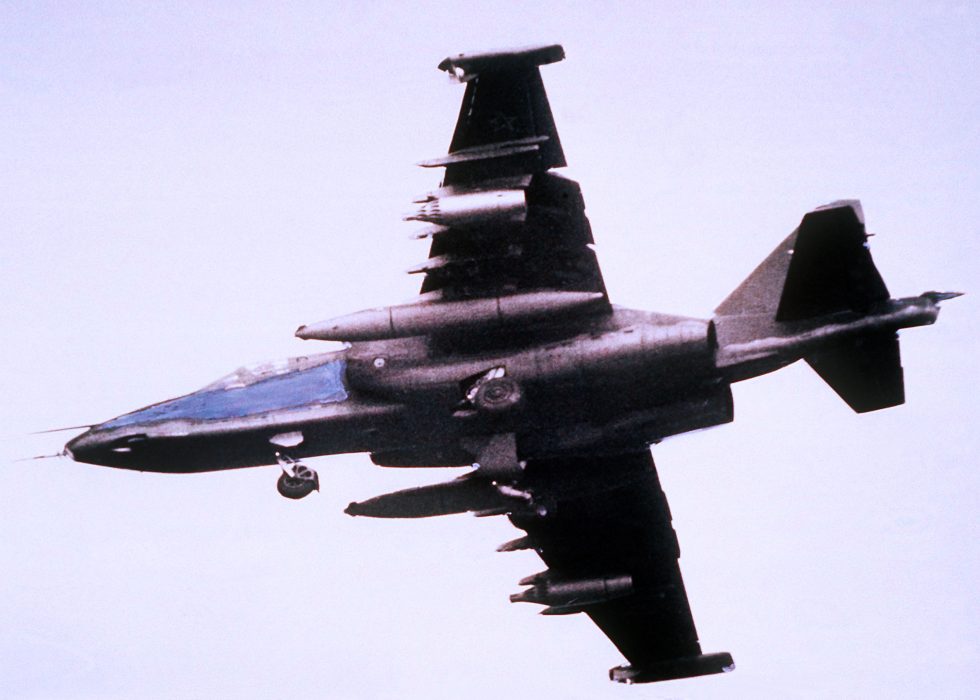
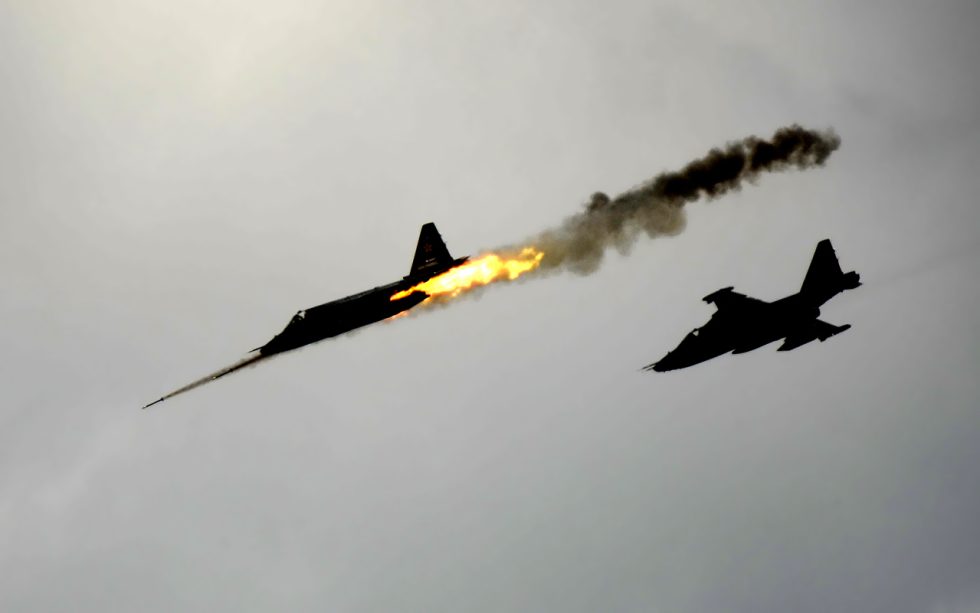
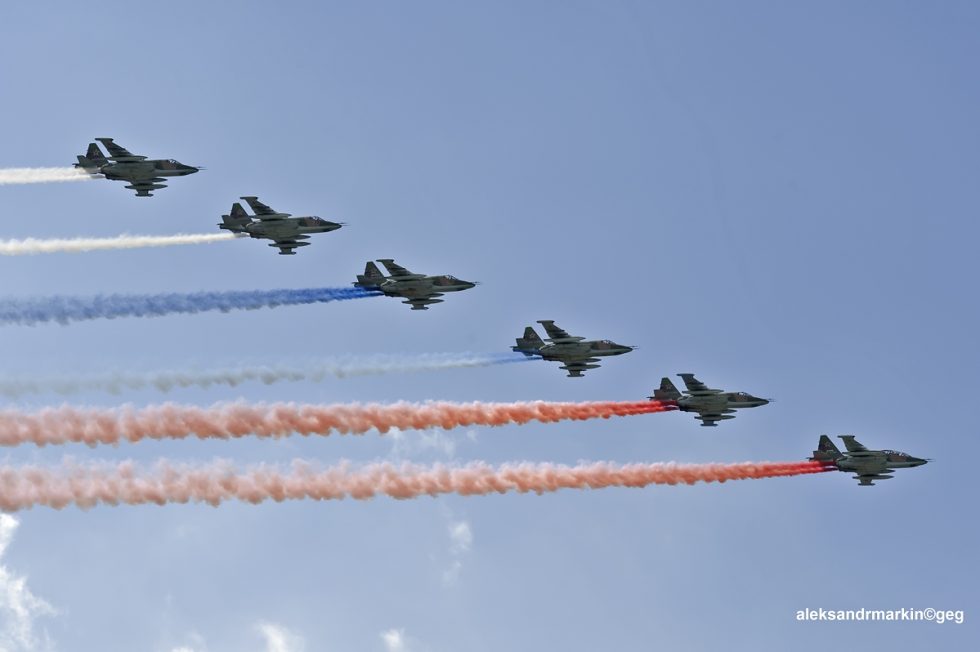
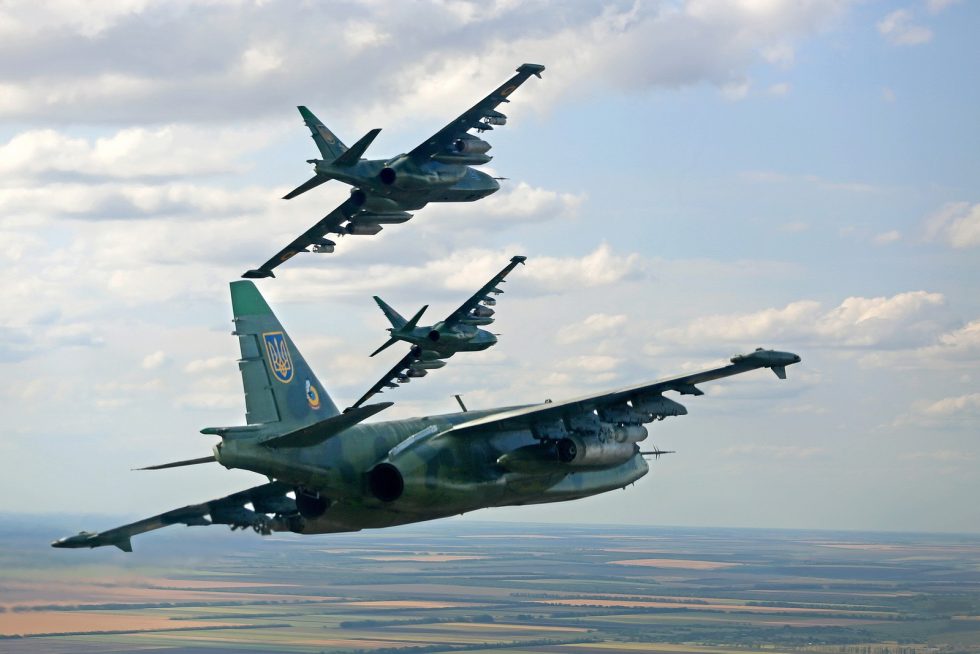
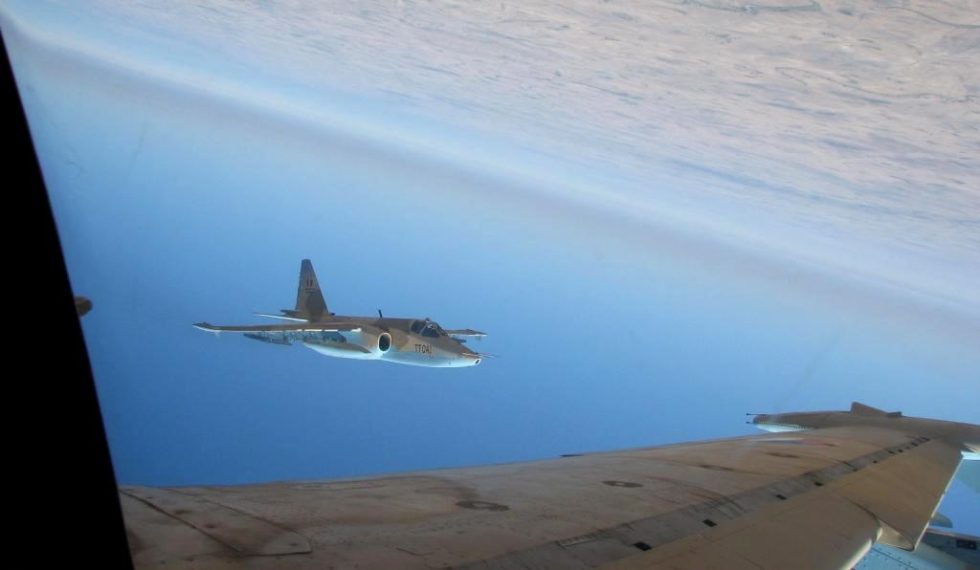
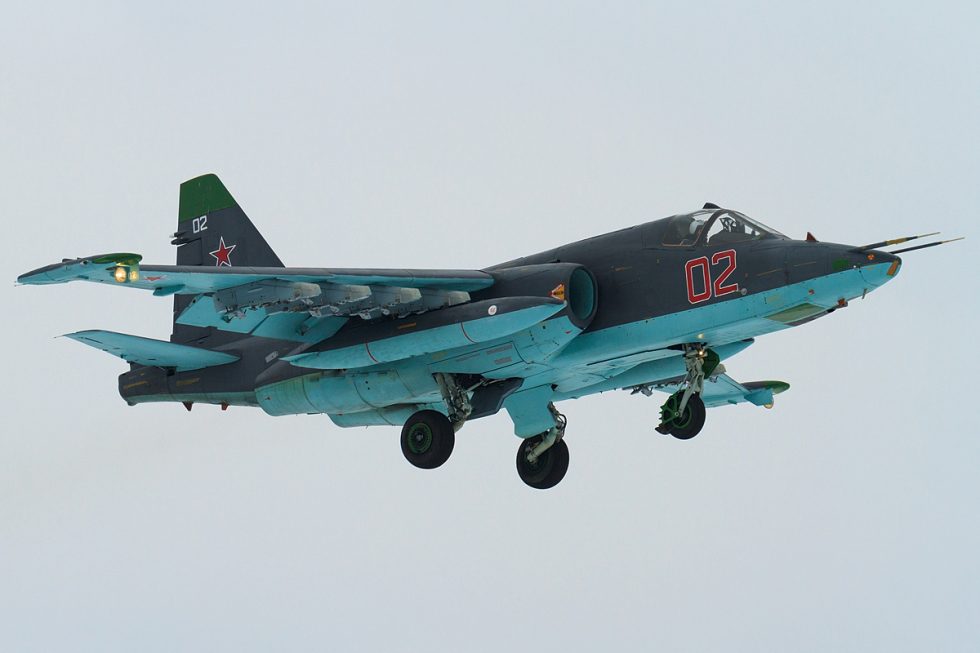
The Frogfoot in motion
A hand-picked Su-25 video is coming soon to this exhibit. In the meantime, explore the gallery above and the operations map below to see where the Frogfoot has flown.
Where the Frogfoot flies
Who flies the Su-25 Frogfoot, and how many
The map above shows where the Frogfoot serves. This shows the scale of each fleet — a reminder that one operator dwarfs all the others combined.
Approximate active inventories, rounded. Published fleet figures for this type differ substantially between sources, and a large share of airframes on paper are in storage, awaiting overhaul or non-operational — read these as orders of magnitude, not exact counts. † Poorly documented; estimates vary widely. ‡ Ukraine’s fleet has changed continuously through the war, with both combat losses and transfers from other operators; no current figure is reliable. § Bulgaria has been in the process of withdrawing the type. Figures are compiled from open-source reporting rather than a single proprietary database.
A career written at low level
The Su-25 has been in combat almost continuously since 1981 — in Afghanistan, the Iran-Iraq War, the Caucasus, and today on both sides in Ukraine. Its record is not one of dogfights but of close support: cannon runs, rocket salvoes and bomb passes flown low over the battlefield, often at high cost. Figures below are best-available estimates and, for the current war, are contested and still changing.
Compare the combat record of every military aircraft. Figures as of July 2026 and, where contested, hedged.
Everything people ask about the Su-25
Can I fly in a Su-25?
What is the Su-25, and what is it for?
Is the Su-25 like the A-10 Warthog?
How well protected is the Su-25?
Who flies the Su-25 today?
What are the Su-25T and Su-25SM?
Is the Su-25 still in service?
You can’t fly the Su-25.
These, you can.
Some legends only live in museums — others are fuelled and waiting. MiGFlug has put civilians in real military jet cockpits since 2004.
 Fly the L-39 AlbatrosThe world’s most-flown jet trainer — aerobatics included
 Fly the F-104 Starfighter“The missile with a man in it”
 Fly the MiG-21The Cold War’s most-produced jet
 Fly the T-33 Shooting StarAmerica’s first jet trainer
 Fly the DH VampireA piece of early jet history
 Fly the S.211Agile Italian jet trainer
 Fly the MB-326The classic Aermacchi jet
 Fly the MiG-15The Soviet legend of the Korean War
Continue the tour
Every fact, checked
- 19FortyFive — Su-25 Frogfoot: the ‘Flying Tank’ guideOverview of the design, armour and combat history.
- The AviationistReporting on Su-25 losses and low-level tactics in the war in Ukraine.
- The Aviation Geek ClubSu-25 development, Afghanistan service and survivability features.
- Forbes — David AxeAnalysis of Ukrainian and Russian Su-25 attrition and confirmed losses.
- Key.Aero — Su-25 operatorsSurvey of current and former Su-25 operators worldwide.
- Military FactoryReference specifications, dimensions and armament.
- Global MilitarySpecifications and operator summary for the type.
- The National InterestBackground on the Su-25, the A-10 comparison and Afghan-war service.