
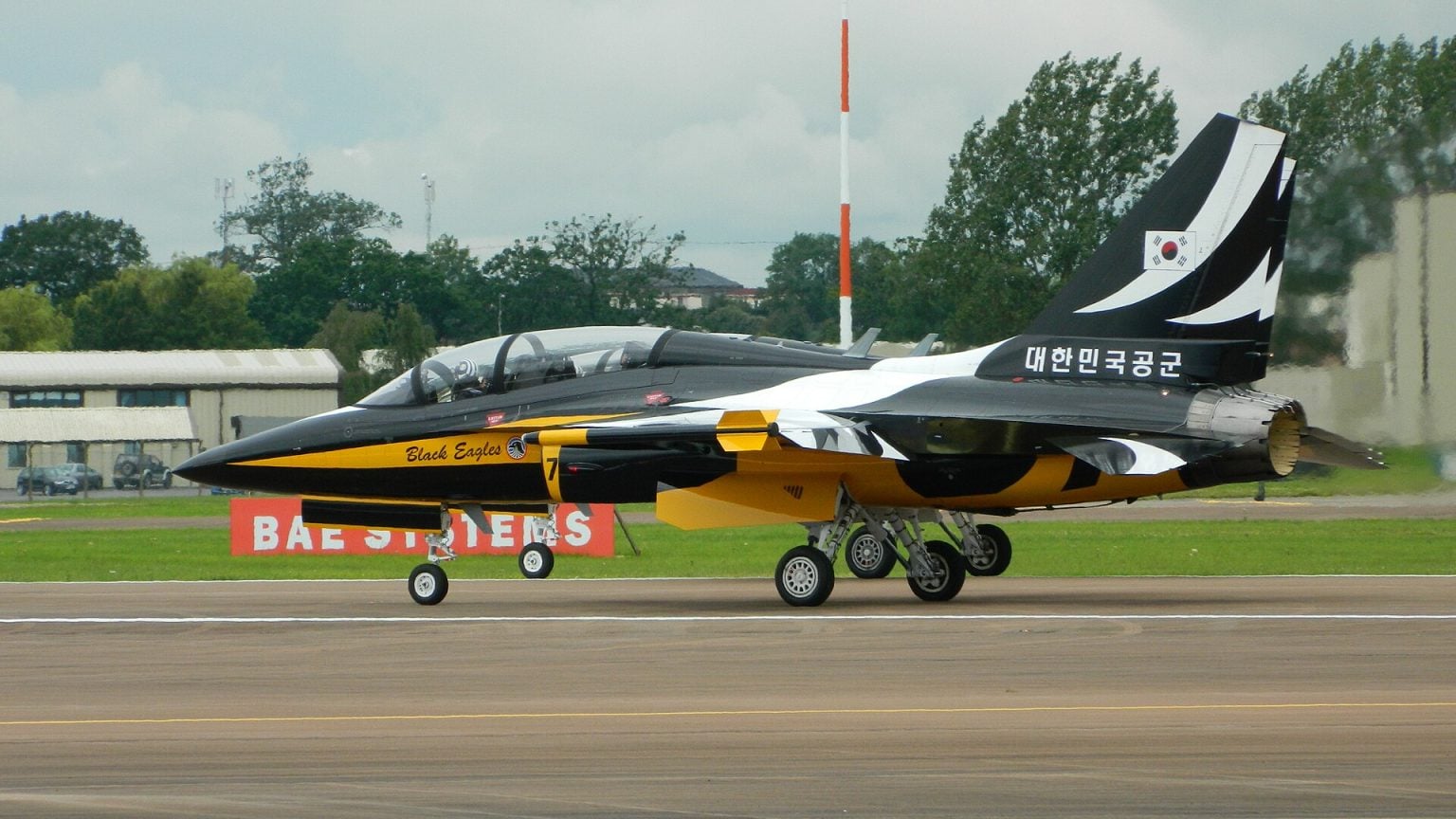
KAI T-50 Golden Eagle
& the FA-50 Fighting Eagle
South Korea’s first home-built supersonic jet — a Lockheed-Martin-assisted advanced trainer that grew into the FA-50 light fighter now flying with air forces from Manila to Warsaw.
From lead-in trainer to light fighter
In the 1990s South Korea set out to build something it had never built before: a modern jet fast enough to prepare pilots for supersonic front-line fighters like the F-16 and F-15K. The programme, known as KTX-2, was led by Korea Aerospace Industries (KAI) with substantial design help from Lockheed Martin, whose engineers brought across the aerodynamic and systems know-how of the F-16. The result, the T-50 Golden Eagle, looks and flies like a scaled two-seat Fighting Falcon.
The T-50 first flew on 20 August 2002 and entered Republic of Korea Air Force service in 2005. From that single airframe KAI grew a whole family: the T-50 advanced trainer; the T-50B flown by the ROKAF Black Eagles display team; the TA-50 light-attack version; and the FA-50, a genuine light combat aircraft with radar, a cannon and combat-capable hardpoints. A single-seat variant and the T-50A — Lockheed Martin and KAI’s bid for the US Air Force’s T-X trainer contest — extended the line further, though the T-X was lost to the Boeing–Saab T-7A.
What began as a domestic training jet has become one of the most successful defence-export stories in Asia. FA-50s and T-50s now serve or are on order with the Philippines, Indonesia, Iraq, Thailand, Malaysia and — in the programme’s biggest single deal — Poland, a NATO member that ordered 48 aircraft in 2022 to replace its Soviet-era MiG-29s and Su-22s. The latest FA-50 Block 20 adds an AESA radar, an air-to-air refuelling probe and extended range, pushing the design further toward a true light fighter.
01The KAI T-50 Golden Eagle’s origins: how Korea built a supersonic jet with Lockheed’s help
The KTX-2 study dates back to the early-to-mid 1990s; it was suspended for budget reasons in 1995 and relaunched later in the decade, with full-scale development commonly dated to around 1997. South Korea funded the bulk of the programme, with KAI and Lockheed Martin taking minority shares. Lockheed Martin’s role was decisive: it transferred F-16-derived aerodynamics, flight-control and systems experience, which is why the T-50 is often described as a two-seat, smaller cousin of the Fighting Falcon.
The pay-off was that South Korea gained a sovereign supersonic jet and a manufacturing base it could build on — first the trainer, then the FA-50 light fighter, and later the far more ambitious KF-21 Boramae fighter programme. The T-50 was the stepping stone that proved Korea could design and export fast jets.
What makes it special
F-16 aerodynamics on a single engine
Thanks to Lockheed Martin’s input, the T-50 carries F-16-derived aerodynamics — blended wing-body, leading-edge root extensions and a fly-by-wire flight-control system — but on a smaller, cheaper airframe powered by a single General Electric F404-GE-102 afterburning turbofan of about 17,700 lbf (78.7 kN). That makes it a genuinely supersonic trainer, able to reach roughly Mach 1.5.
One airframe, four jobs
Few designs stretch as far. The same basic aircraft serves as the T-50 advanced trainer, the aerobatic T-50B of the Black Eagles, the TA-50 light-attack jet and the FA-50 light fighter. This trainer-to-light-fighter scalability lets one production line and one pilot-training pipeline cover a whole spectrum of missions.
The FA-50 Block 20 grows teeth
The latest FA-50 Block 20 adds a modern AESA radar (options include Israel’s IAI Elta EL/M-2032 on earlier jets and Raytheon’s new air-cooled PhantomStrike), an air-to-air refuelling probe, more hardpoints and extended range — turning what started as a trainer into a credible light fighter with beyond-visual-range potential.
02The FA-50’s engine and airframe: one GE F404 and F-16 aerodynamics
The FA-50 is built around a single General Electric F404-GE-102 — the same engine family that powers the F/A-18 Hornet and the Indian Tejas — rated at roughly 17,700 lbf (about 78.7 kN) in full afterburner and managed by a digital FADEC. A single modern engine keeps the aircraft light and cheap to run while still giving supersonic performance (about Mach 1.5). The airframe itself is closely related to the F-16 in planform and flight-control philosophy, which is why FA-50 pilots transition so smoothly onto the KF-16.
03The FA-50 Block 20: the AESA radar and refuelling probe that turn a trainer into a fighter
Early FA-50s flew with a mechanically-scanned radar and short legs. The Block 20 standard — central to the Polish FA-50PL and later Philippine and Malaysian jets — introduces an AESA radar for longer detection range and better resistance to jamming, an air-to-air refuelling probe to extend endurance, and integration of newer weapons such as the AIM-9X and beyond-visual-range missiles. Raytheon delivered the first of its GaN-based PhantomStrike AESA sets for the FA-50 in 2025. The upgrade is what lets buyers market the FA-50 as a low-cost light fighter rather than merely an armed trainer.
Full specifications
Figures below are for the FA-50 light-combat variant; the T-50 trainer is very similar but unarmed. Contested values are hedged.
Baseline note: the figures below describe the FA-50 Fighting Eagle light combat aircraft as delivered to the Republic of Korea Air Force from 2013 and to the Philippine Air Force from 2015 — one afterburning General Electric F404-GE-102 in the tail, an Israeli Elta EL/M-2032 pulse-Doppler radar in a lengthened radome, an internal 20 mm rotary cannon, seven stores stations and a tactical datalink. Deltas for the T-50 basic trainer, the T-50B flown by the Black Eagles, the TA-50 lead-in fighter trainer and the Block 20 standard that becomes the FA-50PL, the FA-50M and the second Philippine batch are given in grey. Six disagreements between reputable sources are worth settling before the tables begin. First, empty weight: 6,470 kg is the T-50 trainer and 6,454 kg the FA-50, and the imperial conversion reprinted everywhere for the first of those, 14,285 lb, is simply arithmetic that went wrong — 6,470 kg is 14,265 lb. Second, maximum take-off weight: 10,722 kg is the T-50, 12,215 kg the FA-50 and 12,223 kg the TA-50, and the trainer’s number has migrated into a great many FA-50 specification blocks, where it understates the aeroplane by a tonne and a half. Third, service ceiling: KAI quotes 14,630 m (48,000 ft) and the airframe is cleared to it, while an FA-50 Block 10 table in wide circulation prints 16,764 m (55,000 ft); a single F404 at Mach 1.5 will touch the second figure in a zoom and hold the first. Fourth, height: 4.82 m converts to 15 ft 10 in, not the 15 ft 8 in that most tables carry. Fifth, payload: the advertised 5,440 kg (12,000 lb) across seven stations cannot be flown with full internal fuel, because an empty weight of 6,454 kg plus roughly 2.5 tonnes of fuel leaves barely 3.2 tonnes inside a 12,215 kg maximum. Sixth, combat radius: the published clean figure is 444 km (240 nmi), and KAI’s own F-50 material quotes 239 nmi; those are the same number rounded twice, not two aeroplanes. Figures current to 3 September 2026.
Dimensions & weights
- Crew
- 2 in tandem under a single side-hinged canopy, the rear seat stepped up so the instructor can see the runway over the student’s head. Both cockpits can fly the aeroplane. In Philippine and Korean service the FA-50 flies operational sorties single-pilot from the front with the back seat empty or occupied by a weapons officer, and KAI’s F-50 project deletes the rear cockpit altogether to put a 300 US gal fuel cell in the space
- Length
- 13.14 m (43 ft 1 in) including the nose probe. That is about 80 per cent of an F-16C, and the family resemblance is not a coincidence: Lockheed Martin came into the KTX-2 programme in 1997 as design partner and brought F-16 forebody shaping, wing practice and flight-control experience with it, on top of the 140 KF-16s Samsung Aerospace had already licence-built
- Wingspan
- 9.45 m (31 ft 0 in) measured over the wingtip launch rails, which are structural and always present
- Height
- 4.82 m (15 ft 10 in) to the tip of the fin. The 15 ft 8 in printed in most reference tables is a conversion error, not a different aeroplane
- Wing area
- 23.69 m² (255.0 sq ft), a cropped-delta planform with substantial leading-edge root extensions that do the high-alpha work, exactly as they do on the F-16 and for the same reason
- Aspect ratio
- 3.77 — low, and chosen for roll rate and gust response rather than cruise efficiency. This is a fighter’s wing on a trainer’s airframe, and it is why the T-50 can be flown like a KF-16 rather than merely talked about as though it could
- Empty weight
- 6,454 kg (14,229 lb) for the FA-50, whose radar, gun, ammunition, datalink and extra fuel are offset by structure the trainer does not need. The T-50 is 6,470 kg (14,265 lb)
- Maximum take-off weight
- 12,215 kg (26,929 lb), which is KAI’s own published figure for the FA-50. T-50 10,722 kg (23,638 lb); TA-50 12,223 kg (26,947 lb). The aeroplane can therefore lift about ninety per cent of its own empty weight, which is respectable for a trainer airframe and modest for a fighter
- Internal fuel
- ~2,655 litres (701 US gal) on the T-50. The FA-50 carries roughly 2,500 kg, near 3,100 litres, in fuselage and wing tanks; the extra internal capacity is one of the three things that distinguish the fighter from the trainer, the others being the longer radome and the datalink
- External fuel
- 3 × 570 litres (150 US gal) on the centreline and the two inboard wing stations, 1,710 litres (452 US gal) in all. Every tank is a pylon not carrying a weapon, and on a seven-station aeroplane that trade is severe. Block 20 adds 300 US gal (1,136 litre) conformal tanks on the fuselage shoulders, which is the first time in the type’s life that it gains fuel without giving up a hardpoint
- Maximum external stores
- ~5,440 kg (12,000 lb) is the advertised figure across seven stations, and it is a weights-and-balance ceiling rather than a mission load. Subtract 6,454 kg empty and 2.5 tonnes of internal fuel from a 12,215 kg maximum and about 3.2 tonnes remain. A realistic Philippine strike load is closer to 1.5 tonnes with a targeting pod and a drop tank aboard
- Hardpoints
- 7 — four underwing, two wingtip rails and one under the fuselage. The wingtip rails take a Sidewinder-class missile and nothing else; the centreline and inboard wing stations are the plumbed ones. Only three of the seven are genuinely useful for heavy ordnance
- Airframe life
- 8,000 flight hours as designed, with a fatigue programme run against it. For an aeroplane bought to fly four sorties a day at a training base, that number matters more than any performance figure in the next column
Performance
- Maximum speed
- Mach 1.5 (1,837 km/h; 1,141 mph; 992 kt) at 9,150 m (30,000 ft). When it entered service in 2005 the T-50 was the only supersonic trainer in production anywhere, and it remains the only supersonic aeroplane in this class beside the Yak-130’s abandoned ambitions and the T-7A’s subsonic acceptance
- Minimum flying speed
- 195 km/h (105 kt) — the approach and threshold end of the envelope, which for a trainer is quoted as often as the top end and used a great deal more
- Rate of climb
- 198 m/s (39,000 ft/min) at sea level, clean, on afterburner. Roughly two-thirds of an early F-16A and about twice anything the T-38 or A-37 it replaced could manage
- Service ceiling
- 14,630 m (48,000 ft), KAI’s figure and the one the airframe is cleared to. The 16,764 m (55,000 ft) that appears in an FA-50 Block 10 table is a zoom number and should not be read as a sustained altitude
- Combat radius
- ~444 km (~240 nmi) clean. This is the aeroplane’s central weakness and the reason Block 20 exists: a light fighter with a radius smaller than the width of Luzon has to be based close to the fight, and Poland bought it to sit over its own territory rather than to reach anybody else’s
- Range
- 1,851 km (1,150 miles; 1,000 nmi) on internal fuel
- Ferry range
- 2,592 km (1,611 miles; 1,400 nmi) with three drop tanks. Deliveries to Iraq, the Philippines and Poland have all been flown by staged self-ferry with tanker support or, for Indonesia’s second batch in February 2026, in the belly of a cargo aircraft
- Load factors
- +8 / −3 g on the T-50; the FA-50 is quoted at +8.3 / −3 g. Both are fighter limits rather than trainer limits, and the difference between this and the +6 g a syllabus normally flies is the whole point of a lead-in fighter trainer
- Thrust-to-weight
- 0.96 at the T-50’s 10,722 kg with the afterburner lit — near unity, which is what makes the aeroplane feel like a fighter in the vertical. At the FA-50’s 12,215 kg maximum it falls to about 0.66, and with a war load and tanks aboard the light-fighter claim gets noticeably quieter
- Wing loading
- 378 kg/m² (77 lb/sq ft) clean at about 8,950 kg with full internal fuel, rising to 516 kg/m² (106 lb/sq ft) at maximum take-off weight. The clean figure is a trainer’s; the loaded one is an attack aeroplane’s, and the aircraft turns accordingly
- Fuel fraction
- ~0.28 internal — two and a half tonnes of fuel in a six-and-a-half-tonne airframe. That is a good fraction for a trainer and a poor one for a fighter, and it is precisely the gap that the Block 20 conformal tanks and the Cobham refuelling probe are meant to close
Propulsion & systems
- Engine
- 1 × General Electric F404-GE-102 afterburning low-bypass turbofan, assembled under licence in South Korea by Samsung Techwin, now Hanwha Aerospace, from kits supplied directly by GE. Three-stage fan, seven-stage axial compressor. It is the same engine family that powers the F/A-18 Hornet and the Gripen A to C, which is why the aeroplane has a fighter’s acceleration and a fighter’s fuel appetite
- Thrust
- 78.7 kN (17,700 lbf) with afterburner, 53.07 kN (11,930 lbf) dry. KAI has offered the Eurojet EJ200 and the General Electric F414 at 89–98 kN (20,000–22,000 lbf) to prospective customers, twelve to twenty-five per cent more thrust, and no customer has ever taken one
- Engine control
- FADEC — full authority digital engine control, developed jointly by General Electric and KAI, with no mechanical throttle linkage for a student to mishandle. On the T-38 and A-37 this aeroplane replaced, a student very much could
- Flight control system
- triple-redundant digital fly-by-wire with a side-stick controller on the right console and HOTAS throttle, deliberately identical in feel to the KF-16 the graduate will fly. There is no mechanical reversion. This was, in 2002, an unusually ambitious system for a first indigenous jet and it worked
- Avionics operating system
- NEOS — a real-time operating system developed in Korea, certified to DO-178B and IEEE POSIX, and at the time the only such system built by an Asian company. It is the least glamorous and most consequential piece of the programme, because it is what let Korean firms write the mission software rather than buy it
- Radar
- Elta EL/M-2032 pulse-Doppler fire-control radar, X-band, with Korean-specific modifications by LIG Nex1. It was chosen over Lockheed Martin’s preferred AN/APG-67(v)4 and the SELEX Vixen 500E, and the FA-50 set has roughly two-thirds greater range than the TA-50’s. The T-50 trainer flies with the APG-67(v)4 or with no fire-control radar at all
- AESA upgrade
- Raytheon PhantomStrike selected on 15 May 2023 over the Northrop Grumman AN/APG-83 for the Block 20, and delivered to KAI during 2025. It weighs 68 kg, less than the mechanically scanned set it replaces, is air-cooled rather than liquid-cooled, and does digital beam forming with interleaved air and ground modes. LIG Nex1’s domestic ESR-500A is the Korean alternative, and the Philippine Block 20 radar choice was still unannounced as of mid-2026
- Cockpit
- HUD and three colour multi-function displays per cockpit with HOTAS, a digital moving map and a data transfer cartridge. Block 20 adds a helmet-mounted display, which is what makes an AIM-9X worth carrying
- Navigation
- Honeywell H-764G embedded GPS/inertial unit, ring-laser gyro, with a radar altimeter and TACAN
- Datalink
- Link 16 on Block 50 aircraft and later, alongside the Korean tactical datalink. The FA-50’s ability to take a picture from an E-737 rather than build one with its own small radar is worth more than any incremental radar upgrade
- Self-protection
- RWR and countermeasures dispensers as standard on Block 50, with the LIG Nex1 ALQ-200K jamming pod carried externally when the threat warrants. There is no internal jammer and no missile approach warning system in the baseline aeroplane
- Air-to-air refuelling
- Cobham telescopic probe — Cobham Mission Systems was named prime contractor on 2 December 2020 to design, develop and qualify a retractable probe for hose-and-drogue tankers, and it is standard on Block 20. The abandoned T-50A for the American T-X competition had a boom receptacle in a dorsal hump instead, which is the other half of the same problem
- Escape system
- zero-zero ejection seats in both cockpits, of the Martin-Baker Mk16 family, with command ejection so that either crew member can get both out
- Production and price
- ~200 built by the mid-2020s across all marks, with 292 ordered in total and about 70 still to be manufactured. Unit prices vary enormously with the package: the Philippines paid US$421 million for 12 in 2014, roughly US$35 million each; Poland US$700 million for 12 FA-50GF and US$2.3 billion for 36 FA-50PL; Malaysia US$920 million for 18; the Philippines US$700 million for 12 Block 20 in June 2025. The Block 20 aeroplane costs roughly twice what the first export FA-50 did
04The FA-50’s operating costs: why it sells as a budget fighter
The FA-50’s whole commercial pitch is affordability. A flyaway price commonly quoted in the US$30-million range undercuts a full multirole fighter several times over, and a single modern engine keeps fuel and maintenance bills far below a twin-engine jet. Buyers such as the Philippines and Poland chose it precisely because it delivers a supersonic, radar-and-missile-equipped platform for the cost of a heavy trainer.
Precise operating costs are not officially published. A cost-per-flight-hour in the low five figures of US dollars is frequently cited in trade press — well under a comparable F-16 hour — but treat any exact number as an estimate rather than an audited figure.
Armament & payload
The FA-50 carries a fighter’s gun and seven stations, and until Block 20 it could not shoot at anything it had not been vectored onto
The FA-50 is a trainer that was given a radar, a gun and a datalink, and the armament reflects that order of events. Everything it carries is hung externally on seven stations, of which the two wingtip rails take a Sidewinder and nothing else and the three plumbed stations are where the fuel goes; a strike fit with a targeting pod and a tank leaves two useful pylons. The weapons themselves are the American tactical inventory in its cheaper forms — Mk 82s, GBU-12s, JDAM, the AGM-65 Maverick — plus the Korean KGGB glide kit, which is the store best matched to an aeroplane that often flies without a pod. What was missing for twenty years was a medium-range air-to-air missile, and that absence is the whole argument for Block 20: an AESA radar, a helmet-mounted display and the AMRAAM turn a light attack aeroplane into a thin but genuine air-defence fighter. Whether that promise is kept is a political question rather than an engineering one. Fits vary enormously by operator and by block. Korean and Philippine aircraft are Block 50 with Sniper pods and laser-guided bombs; Indonesian and Thai aircraft are armed trainers; Iraq’s twenty-four sat unflown from 2018 to 2022; Poland’s twelve fly with infrared missiles only. Much of the cleared-store list is an integration offer no squadron has ever loaded.
Gun
- 1 × General Dynamics M197 20 mm three-barrel rotary cannon with 205 rounds, mounted internally behind the cockpit and firing linkless ammunition. The M197 is a lightened three-barrel derivative of the M61 Vulcan, the same weapon the AH-1 Cobra carries in a turret, and at roughly 750 rounds a minute in its aircraft installation the magazine is gone in about sixteen seconds
- The gun is fitted to the TA-50, the FA-50 and every export fighter variant. It is not fitted to the T-50 basic trainer or to the T-50B of the Black Eagles, whose forward fuselage carries the smoke system instead
- Aiming is by head-up display with a continuously computed impact line fed by the mission computer and the EL/M-2032. Block 20 adds a helmet-mounted display, which matters more for missile cueing than for the gun
- Twenty millimetres and 205 rounds is a light fit by fighter standards — an F-16 carries 511 rounds of the same calibre — and in Philippine service the gun has been used for strafing insurgent positions rather than for air combat
Air-to-air
- AIM-9L and AIM-9M Sidewinder (the standard fit) on the two wingtip rails. This is the only air-to-air weapon carried in service by every operator, and until Block 20 it was the only air-to-air weapon at all
- AIM-9X Sidewinder on Block 20 aircraft with a helmet-mounted display. Poland signed the agreement enabling American support for AIM-9X integration on the FA-50PL on 13 January 2026, having flown its interim FA-50GFs on leased AIM-9P4s and then on 24 refurbished AIM-9L/I-1 rounds
- AIM-120 AMRAAM (beyond visual range) is the headline Block 20 capability and the one that turns a light attack aeroplane into a thin air-defence fighter. It is also the least settled: Poland’s 2022 contract covered most integration work but explicitly not the AMRAAM, which needs a separate agreement that had still not been concluded by early 2026, and Warsaw has openly discussed a European missile as a fallback
- Rafael Python 5 and Derby appear as provisions rather than integrations. MBDA has offered Meteor and ASRAAM for the FA-50 and the KF-21; neither has been fired from this aeroplane
- The honest summary is that after twenty years in service the FA-50 in the field still fights with a short-range infrared missile off a wingtip rail, exactly as an F-5E did
Air-to-surface guided
- AGM-65G and AGM-65G2 Maverick, the heavyweight infrared-imaging versions. This is the FA-50’s proven precision weapon: the ROKAF fired one at a decommissioned ship on 9 October 2014, the Philippine Air Force fired one against a floating target off Palawan on 25 June 2020, and another sank the ex-BRP Pangasinan during Balikatan on 26 April 2023
- GBU-12 Paveway II laser-guided bombs, cleared on Block 50 aircraft in company with the Sniper targeting pod. Without the pod there is no self-designation, which is why the Philippine fleet had to wait for Block 50 before it could laser-guide anything of its own
- GBU-38 JDAM and JDAM-ER satellite-guided bombs. A Philippine FA-50 dropped a GPS-guided weapon among six bombs on a New People’s Army camp in Sultan Kudarat on 25 December 2020
- KGGB, the Korean GPS Guided Bomb — a LIG Nex1 wing-and-guidance kit on a Mk 82 that gives a stand-off glide of tens of kilometres from a launch aircraft with no targeting pod at all. It is the cheapest useful precision weapon in the Korean inventory and the one best matched to this aeroplane
- A shortened Taurus KEPD 350 for stand-off strike out to about 400 km has been studied for the FA-50 and remains a study. It would be a transformative weapon on an aeroplane with a 240-nautical-mile radius, which is exactly why it keeps being proposed
Bombs
- Mk 82 general-purpose 500 lb bombs, slick or retarded, and the ordnance that did the actual work over Marawi in 2017 and over Butig in January 2017 before it
- CBU-58 cluster bombs, an inheritance from the Korean stockpile rather than a weapon anyone intends to use
- CBU-97 and CBU-105 Sensor Fuzed Weapon with the Wind Corrected Munitions Dispenser tail kit — an anti-armour weapon aimed squarely at massed North Korean vehicles, and one of the few stores on the list that reflects the FA-50’s actual wartime task
- SUU-20 practice dispenser for bomb and rocket training, and the BDU-33 practice bomb. On a fleet that spends most of its life training, these are the stores most often loaded
- The FA-50 has no internal bay and no low-observable pretension. Everything it carries hangs in the airflow, and a strike fit of two bombs, a pod and a tank leaves the aeroplane with three usable stations and not much fuel
Rockets
- 70 mm (2.75 in) unguided rockets in LAU-series pods on the underwing stations, the standard light-attack fit and the one the Korean and Indonesian fleets train with
- The LOGIR laser-guided 70 mm rocket, a Korean-American development, has been proposed for the type as a cheap precision weapon against small targets. It is not a fielded FA-50 store
- Rockets are the weapon the aeroplane is least often photographed carrying and most often cleared for. Where the FA-50 has actually gone to war — Marawi, the New People’s Army camps, Banan District in Cambodia — it has carried bombs and Mavericks rather than rocket pods
- The distinction matters because a rocket pass demands a shallow dive inside small-arms range, and a light fighter with no armour and one engine is a poor aeroplane in which to fly one twice
Pods & other stores
- Lockheed Martin AN/AAQ-33 Sniper advanced targeting pod, the defining addition of the Block 10 software upgrade and the thing that converted the FA-50 from an aeroplane that dropped bombs where it was told into one that could find its own target. Rafael LITENING is the alternative fit
- LIG Nex1 ALQ-200K electronic countermeasures pod, the Korean self-protection jammer, carried on the centreline at the cost of the biggest drop tank
- Elbit Condor 2 long-range oblique reconnaissance pod, the basis of the proposed but unbuilt RA-50 reconnaissance variant
- Sky Shield stand-off jamming pod and, on Block 20 aircraft, the conformal fuel tanks and the retractable Cobham refuelling probe, which are stores in everything but name because they change what the pylons can be used for
- Three 150 US gal (570 litre) drop tanks. On a seven-station aeroplane with a 240-nautical-mile radius, fuel and a targeting pod between them routinely consume four of the seven stations before a single weapon is loaded, and that arithmetic is the FA-50 in one sentence
Three typical loadouts
- Close air support over Marawi, Philippine Air Force, 2017
- Two Mk 82 general-purpose bombs on the inboard wing stations, a 150 US gal tank on the centreline, two AIM-9L on the wingtip rails carried as ballast rather than in expectation, 205 rounds in the gun. No targeting pod, because the FA-50PH did not yet have one: weapons were delivered visually or from coordinates passed by a joint terminal attack controller on the ground. On 12 July 2017 a bomb landed about 250 m off target and killed two Philippine soldiers and wounded eleven; the crew and the aeroplane were cleared, which is another way of saying the fault lay in the method rather than the machine.
- Maritime strike demonstration, Balikatan 2023
- One AGM-65G2 Maverick on an inboard pylon, a Sniper pod on the fuselage station, one drop tank, two AIM-9 on the tips. This is the configuration that put a missile into the ex-BRP Pangasinan on 26 April 2023 and the one the Philippine Air Force cites when it argues the FA-50 is a maritime asset. It is also four of seven stations spent to deliver a single 300 kg missile at a radius of a couple of hundred miles.
- Air policing, Polish Air Force FA-50GF, 2026
- Two AIM-9L/I-1 on the wingtip rails, no air-to-ground stores, two or three drop tanks, full gun. The 23rd Tactical Air Base at Mińsk Mazowiecki flies the twelve gap-filler aircraft in the quick-reaction role the MiG-29 is vacating, under ground-controlled interception, within a short radius of home. Without AMRAAM the aeroplane cannot engage anything it has not first been vectored to within a few miles of, which is what the FA-50PL and its PhantomStrike radar are meant to fix from 2027.
Sourcing caveat: KAI’s and Elta’s cleared-store lists are marketing documents rather than clearance records, and a weapon that appears on a brochure has often been carried on a pylon for a photograph and never released. Where a store is described above as carried, photographic or operational evidence exists; where it is described as cleared or provisioned, only a manufacturer’s list does. Payload figures are quoted at maximum take-off weight with no allowance for a realistic fuel state. The three loadouts are reconstructions from published operational accounts and photography, not from mission cards. Block 20 weapon fits in particular remain partly aspirational: the AIM-120 integration that defines the standard was still unresolved for its largest customer in early 2026.
Variants
One Korean trainer became four aeroplanes, and the fourth turned South Korea into a fighter exporter
The KTX-2 programme began in the early 1990s with a modest aim: give the Republic of Korea Air Force a supersonic trainer for its new KF-16s and F-15Ks, and give Korean industry something to build after licence-assembling somebody else’s fighters. The Ministry of Finance suspended it in 1995 on cost. It restarted, Lockheed Martin came in as design partner in 1997 with a 13 per cent stake, the basic design was frozen in 1999, and the first aeroplane was assembled between January and September 2001. What emerged looked like a four-fifths-scale F-16 because in most of the ways that matter it was one.
The interesting part is what happened next. A trainer acquired a radar and became the TA-50; the TA-50 acquired fuel, a longer radome and a datalink and became the FA-50; and the FA-50 was sold to the Philippines, Iraq, Thailand, Poland and Malaysia. That is the whole point of this aeroplane in the history of the industry. Before the FA-50, South Korea sold ships and armoured vehicles. After it, South Korea sells combat aircraft, and the KF-21 Boramae now in flight test is only possible because a generation of Korean engineers first built this.
The block designations are a genuine mess and should be treated with suspicion. Block 10, 20, 40, 50, 60 and 70 all appear in KAI material and in customer announcements, they do not map cleanly onto one another, and the same aeroplane is described as Block 20 by one source and Block 70 by another. Where a block number is used below, it is the one the customer used.
- T-50 Golden Eagle (2001–, about 50 for the ROKAF plus exports)
- The advanced trainer the whole programme was built around, first flown on 20 August 2002 and in service from 22 February 2005. No gun, no combat systems; Lockheed Martin’s AN/APG-67(v)4 was the design radar and many ROKAF trainers fly without a fire-control set at all. Development was funded 70 per cent by the South Korean government, 17 per cent by KAI and 13 per cent by Lockheed Martin, at a programme cost of roughly two billion dollars.
- T-50B (2010–2013, 10 built)
- The display version for the 53rd Air Demonstration Group, the Black Eagles, at Wonju: smoke generators in place of the gun bay, a display-specific control law and a distinctive black and yellow scheme. On their first appearance at the Royal International Air Tattoo, on 8 July 2012, the team took both the King Hussein Memorial Sword for best overall flying demonstration and the As The Crow Flies trophy. A T-50B was lost on 15 November 2012 near Hoengsong, killing its pilot.
- TA-50 (2011–, 22 for the ROKAF, 20 TA-50 Block 2 ordered 2020)
- The lead-in fighter trainer: the Elta EL/M-2032 radar, the internal M197 gun, weapons pylons and a full stores management system, but the trainer’s shorter radome and smaller fuel load. This is where the family stopped being a training aeroplane and started being a weapons system, and it is the direct ancestor of every export fighter variant.
- FA-50 Fighting Eagle, Block 10 / 40 / 50 (2011 prototype, 60 for the ROKAF 2013–2016)
- Originally the A-50. More internal fuel, a longer radome with the higher-performance EL/M-2032 fit, a tactical datalink and the combat avionics. Block 40 is the delivered baseline; Block 50 adds Link 16, a radar warning receiver, a countermeasures dispenser and the Sniper pod with laser-guided bombs and JDAM; Block 10 is the software step that made the Sniper pod possible from 2019. The Korean and Philippine fleets have been progressively brought to Block 50.
- FA-50 Block 20 (from 2023, in development; the standard for Poland, Malaysia and the Philippines’ second batch)
- An AESA radar — the Raytheon PhantomStrike, chosen on 15 May 2023 and delivered to KAI in 2025 — a retractable Cobham refuelling probe, 300 US gal conformal fuel tanks, a helmet-mounted display and beyond-visual-range missiles. KAI’s marketing has also used Block 60 for the fuel-and-refuelling package and Block 70 for the full air-to-air standard, and the numbers are used inconsistently even by KAI. The substance is the same: range and a radar that can support a missile the aeroplane never had.
- T-50i, T-50IQ and T-50TH (Indonesia 16 from 2013 plus 6 from 2026; Iraq 24 from 2017; Thailand 14 from 2018)
- The export trainers, each armed to a different degree. Indonesia’s carry pylons and a gun module; Iraq’s T-50IQ is an FA-50 Block 50 in all but name, ordered in December 2013 for about US$1.1 billion and then left unflown from the second delivery in May 2018 until June 2022 because no support contract had been agreed; Thailand’s T-50TH progressed from trainer to FA-50 Block 50 standard, and on 24 December 2025 flew the type’s second combat debut, a deep strike into Banan District, Battambang, during the Cambodia–Thailand fighting.
- FA-50PH (Philippines, 12 delivered 2015–2017, 12 Block 20 ordered June 2025)
- The variant that made the type’s reputation. Contracted on 28 March 2014 for 18.9 billion pesos, about US$421 million, delivered from November 2015 and complete by 31 May 2017. It gave the Philippine Air Force its first jet combat capability since the F-5A was retired in 2005, flew the country’s first jet combat sorties in January 2017 and was used heavily over Marawi. One was lost on Mount Kalatungan on 4 March 2025 with both pilots; a US$700 million contract for twelve Block 20 aircraft followed on 4 June 2025, for delivery by 2030.
- FA-50GF and FA-50PL (Poland, 12 delivered 2023 and 36 ordered, first due mid-2027)
- The largest export order the type has taken and the one that changed South Korea’s standing as an arms supplier. A framework agreement in late July 2022 was followed by execution contracts on 16 September 2022 worth about US$3 billion: US$700 million for twelve FA-50GF Block 10 gap-filler aircraft, all delivered within fifteen months and now at Mińsk Mazowiecki, and US$2.3 billion for 36 FA-50PL Block 20. Speed of delivery, not capability, was the stated deciding factor. The FA-50PL has slipped from a 2025–2028 schedule to a first delivery in mid-2027 and completion in early 2029, and the prototype had not flown as of January 2026.
- FA-50M (Malaysia, 18 ordered 2023, first deliveries from October 2026)
- Signed on 23 May 2023 for US$920 million after a competition against the HAL Tejas, the M-346, the Hürjet, the L-15, the MiG-35 and the JF-17, to replace the MB-339 and the Hawk 108/208. Six are now promised by the end of 2026 and the remaining twelve from 2027. Kuala Lumpur has spoken of a further eighteen. No aircraft had been handed over as of September 2026.
- T-50A, TF-50A, TF-50N and F-50 (2015–, none sold)
- The American proposals and the single-seater. The T-50A was the Lockheed Martin and KAI entry for the USAF’s T-X competition, with a dorsal spine for extra fuel, a boom refuelling receptacle, large-area displays and an embedded training suite, and a production line promised for Greenville, South Carolina. On 27 September 2018 the Air Force chose the Boeing and Saab clean-sheet design instead, later named the T-7A Red Hawk, on a bid far below the service’s own cost estimate for an initial 351 aircraft. TF-50A and TF-50N have since been offered for the USAF Advanced Tactical Trainer and US Navy programmes without success. The F-50 deletes the rear cockpit for fuel and payload, was revived with Korean government funding in 2024, and is intended to fly as a prototype in 2026 and to be complete by 2028.
Closing caveat: production totals for this family are unusually slippery because trainers have been converted to fighters, fighters upgraded between blocks, and orders announced, revised and re-announced. About 200 airframes had been built by the mid-2020s against 292 ordered, with roughly 70 still to come. Seven have been written off: one Korean T-50B in 2012, three Indonesian T-50is in 2015, 2020 and 2022, and one Philippine FA-50PH in 2025, with the remainder unattributed in published tallies. Where a variant designation is used here it is the operator’s own; KAI’s marketing names for the same standards differ, sometimes within a single press release.
Operators today
South Korea flies two-thirds of every Golden Eagle ever delivered, and only two foreign air forces have taken one to war
Six air forces have delivered T-50 or FA-50 aircraft on charge in September 2026 and the Sacheon line is still running, which makes this the most commercially successful combat aircraft ever designed outside the traditional exporting powers. The shape of the fleet is the familiar one for a trainer that grew into a fighter: one very large home operator and five small foreign ones, none of which flies more than two dozen. What is unusual is the direction of travel. Every foreign fleet on this chart is due to grow — Poland by 36, the Philippines by 12, Malaysia by 18, Indonesia by four more — and none is due to shrink.
Three absences need stating plainly, because all three appear in press coverage as though they were operators. Malaysia signed for 18 FA-50M Block 20 in May 2023 for US$920 million and has taken delivery of none; the first six are promised by the end of 2026. Egypt has been in negotiation since 2025 over a package reported at up to 100 aircraft with local manufacture, and no contract has been announced, let alone an aeroplane handed over. Uzbekistan negotiated for twelve T-50s in 2015 and the sale was blocked by the United States over the American content in the airframe; nothing has been delivered since. An announcement is not an aeroplane, and a memorandum of understanding is not an air force.
These are estimates, and they count only aircraft actually delivered and on national charge — orders, options and aircraft still in build are excluded throughout. Many airframes counted on paper are stored, in deep overhaul, or not operational. Sources: IISS The Military Balance and FlightGlobal World Air Forces, cross-checked against operator statements; entries that could not be corroborated are omitted. South Korea ~140 is a midpoint and the least precise figure here: the ROKAF took 50 T-50, 10 T-50B, 22 TA-50 and 60 FA-50, which is 142 delivered, against which one T-50B was lost in 2012 and published tallies subtract three losses in all; FlightGlobal’s World Air Forces has printed a T-50 line as high as 72, which would push the total nearer 165, and the discrepancy has never been reconciled in open sources. Iraq 24 T-50IQ, all delivered by November 2019 but grounded from 2018 until June 2022 for want of a support contract, and availability since has never been independently verified — this is the least reliable number on the chart. Indonesia ~15: 16 T-50i delivered 2013–2014 less three lost in 2015, 2020 and 2022, plus the first two of a six-aircraft second batch flown in by cargo aircraft in February 2026. Thailand 14 T-50TH delivered from January 2018 in four batches, two of them since upgraded to FA-50 Block 50 standard, with two more approved. Poland 12 FA-50GF, all delivered inside fifteen months of contract signature and complete by the end of 2023, at the 23rd Tactical Air Base; the 36 FA-50PL are excluded because the first is not now expected before mid-2027. Philippines 11 of 12 FA-50PH, one lost on Mount Kalatungan on 4 March 2025. Malaysia (18 ordered, none delivered), Egypt (in negotiation) and Uzbekistan (blocked in 2015) are excluded because no airframe has been handed over.
From KTX-2 to global export
KTX-2 development launches
KAI and Lockheed Martin begin full-scale development of an F-16-derived supersonic trainer for South Korea.
First flight
The T-50 Golden Eagle makes its maiden flight on 20 August 2002.
Enters ROKAF service
The T-50 joins the Republic of Korea Air Force as its advanced jet trainer.
First export — Indonesia
Indonesia orders 16 T-50i trainers, the type’s first foreign sale.
Iraq and the Philippines
Iraq orders 24 T-50IQ; the Philippines contracts for 12 FA-50PH light fighters.
Combat debut over Marawi
Philippine FA-50PHs fly close-air-support strikes against ISIS-aligned militants in the Marawi siege.
Loses the US T-X
The Lockheed Martin/KAI T-50A is beaten by the Boeing–Saab T-7A Red Hawk for the US Air Force trainer.
Poland’s landmark order
Poland signs for 48 FA-50s (12 FA-50GF + 36 FA-50PL) worth about US$3 billion — the biggest export deal.
Malaysia and Block 20
Malaysia orders 18 FA-50M; the Philippines adds 12 Block 20 jets and the first PhantomStrike AESA is delivered.
Twelve Golden Eagle stories
Lockheed’s Korean F-16 cousin
The T-50 was co-designed with Lockheed Martin and flies like a shrunk two-seat F-16.
Read the full story
Frozen, then revived
The trainer programme was suspended in 1995 for lack of money before being relaunched.
Read the full story
Korea’s first supersonic jet
The T-50 was the first supersonic aircraft designed and built in South Korea.
Read the full story
The Black Eagles
The ROKAF’s Black Eagles aerobatic team flies the T-50B in a striking black-and-gold livery.
Read the full story
One airframe, four jobs
Trainer, aerobatic jet, light-attack aircraft and light fighter all share the same design.
Read the full story
Baptism at Marawi
The FA-50’s first shots in anger came over a Philippine city besieged by ISIS-aligned fighters.
Read the full story
Poland’s post-Soviet pivot
A NATO member bought 48 Korean jets to finally retire its MiG-29s and Su-22s.
Read the full story
The ‘Gap Filler’
Poland took 12 near-stock FA-50GF jets fast, just over a year after signing, to plug a capability gap.
Read the full story
Beaten by the Red Hawk
The T-50A lost the US Air Force’s huge T-X trainer contest to the Boeing–Saab T-7A.
Read the full story
An American radar for a Korean jet
Raytheon’s air-cooled GaN PhantomStrike AESA is being fitted to give the FA-50 fighter-class eyes.
Read the full story
Not a Vulcan
Despite the Gatling label, the FA-50 carries a three-barrel 20 mm cannon, not the six-barrel M61.
Read the full story
The trainer that fights
Operators increasingly send their “trainer” Golden Eagles into real combat.
Read the full story
The Golden Eagle in pictures
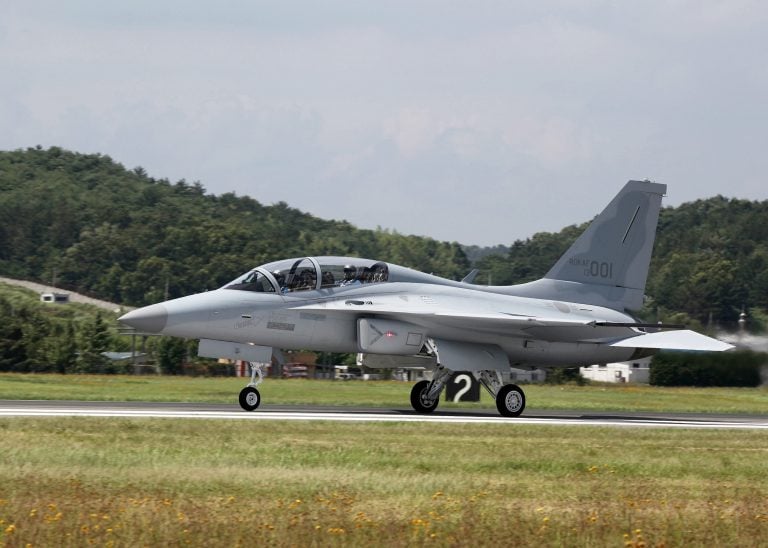
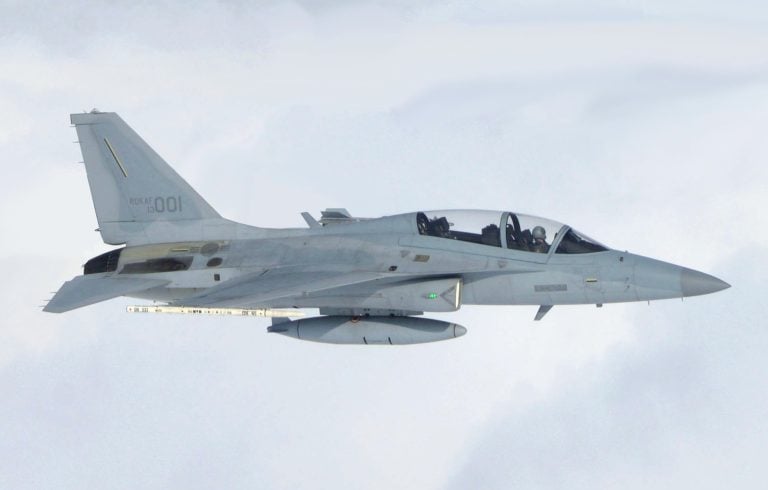
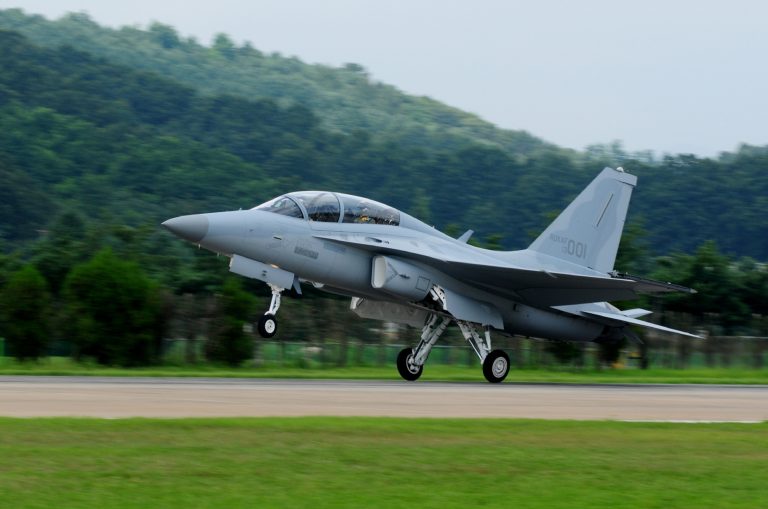
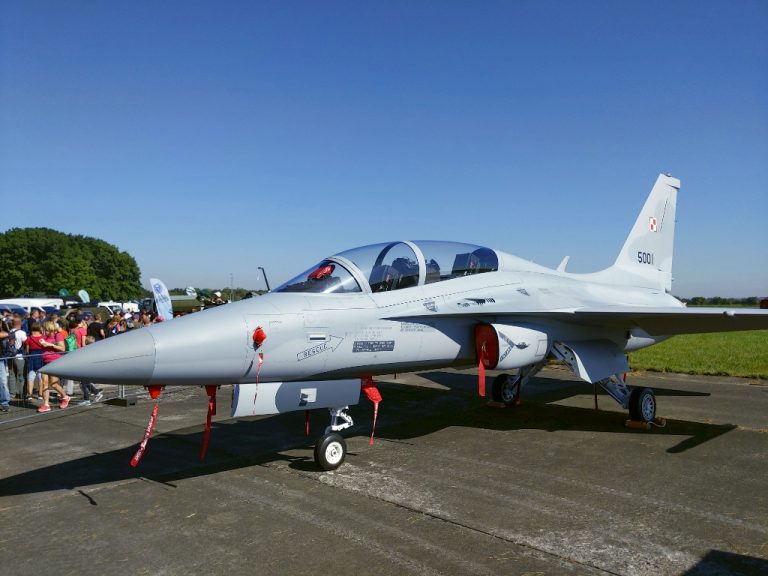
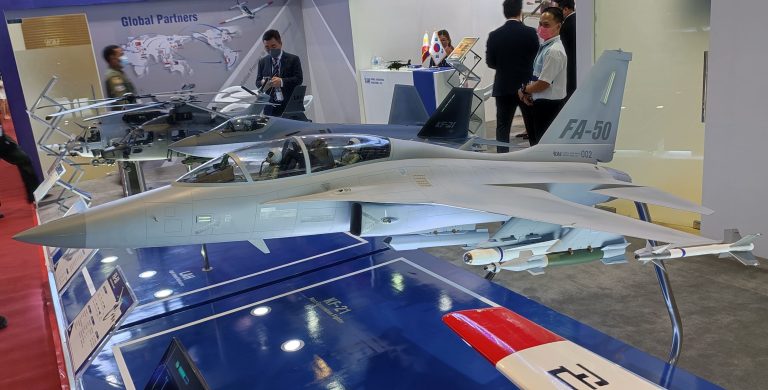
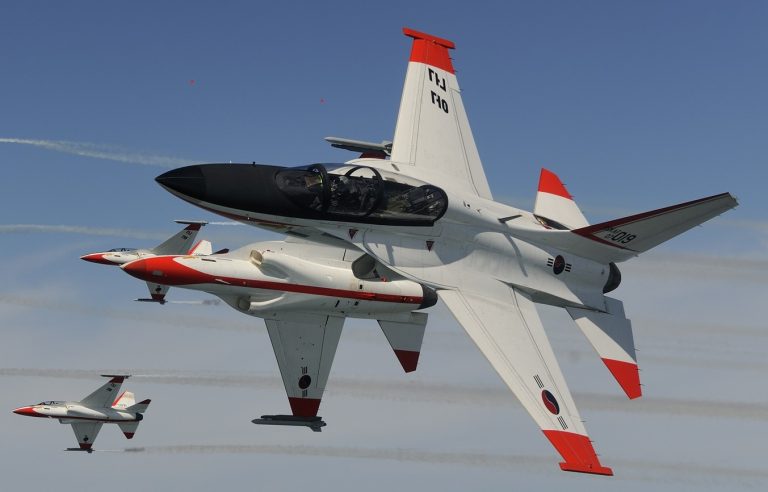
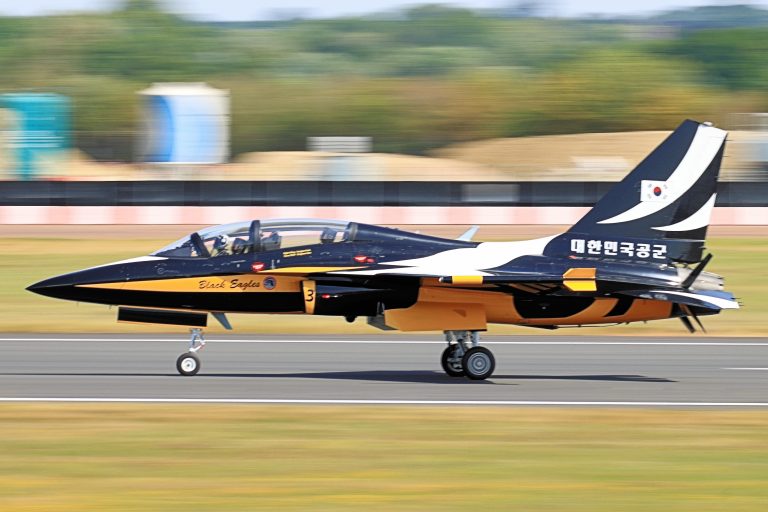
The Golden Eagle in motion
A curated video feature for the T-50 / FA-50 is coming soon. In the meantime, explore the photo gallery above and the operator map below.
Where the Golden Eagle flies
The record that defines it
The Golden Eagle was born as a trainer, but its FA-50 light-fighter form has seen real combat. Its defining moment came in 2017, when Philippine Air Force FA-50PHs flew close-air-support strikes during the five-month Battle of Marawi against Maute and ISIS-aligned militants — the type’s combat debut. Iraq acquired its T-50IQ jets partly for the fight against ISIS, and Thailand reportedly committed its T-50THs during 2025 border clashes. In March 2025 the Philippines lost one FA-50PH in a night mission crash, its first operational loss.
Compare the combat record of every military aircraft. Figures as of July 2026.
Everything people ask about the T-50 & FA-50
Can I fly in a T-50?
What is the difference between the T-50 and the FA-50?
Who makes the T-50 Golden Eagle?
Has the FA-50 seen combat?
How fast is the T-50 / FA-50?
Why did Poland buy the FA-50?
Does the FA-50 have an AESA radar?
Is the T-50 still in production?
You can’t fly the T-50.
These, you can.
Some legends only live in museums — others are fuelled and waiting. MiGFlug has put civilians in real military jet cockpits since 2004.
 Fly the L-39 AlbatrosThe world’s most-flown jet trainer — aerobatics included
 Fly the F-104 Starfighter“The missile with a man in it”
 Fly the MiG-21The Cold War’s most-produced jet
 Fly the T-33 Shooting StarAmerica’s first jet trainer
 Fly the DH VampireA piece of early jet history
 Fly the S.211Agile Italian jet trainer
 Fly the MB-326The classic Aermacchi jet
 Fly the MiG-15The Soviet legend of the Korean War
Continue the tour
Every fact, checked
- Air Force Technology — FA-50 project profileDevelopment history, variants and specification baseline.
- Defense News — Poland’s FA-50 dealThe 48-aircraft, ~US$3 billion Polish order and its FA-50GF/FA-50PL split.
- Breaking Defense — Poland beyond post-Soviet airframesContext on Poland replacing its MiG-29 and Su-22 fleets.
- Philippine News Agency — FA-50 in the Marawi campaignPhilippine Air Force use of the FA-50PH during the 2017 siege.
- RTX / Raytheon — first PhantomStrike AESA for KAIDelivery of the air-cooled GaN radar for the FA-50 Block 20.
- FlightGlobal — FA-50 wins Malaysia’s LCA contestMalaysia’s 18-aircraft FA-50M order.
- Janes — T-50TH for ThailandThai orders and delivery milestones.
- Forbes — Iraq’s T-50 jets against ISISBackground on the Iraqi T-50IQ acquisition and use.