
Beechcraft T-34
“Mentor”
The Bonanza-derived tandem trainer that taught generations of American and allied pilots — a piston lightplane turned turboprop workhorse that stayed in the training role for more than sixty years.
How the Beechcraft T-34 Mentor became the West’s primary trainer
In the years after the Second World War, Walter Beech gambled that the military would need a modern replacement for its war-surplus trainers. Rather than design from scratch, Beechcraft took the wing, tail surfaces and powerplant thinking of its sleek civilian Model 35 Bonanza and wrapped them around a new, narrow fuselage with two seats in tandem — student in front, instructor behind. The company-funded prototype, the Beechcraft Model 45, first flew on 2 December 1948.
The armed forces took their time, but the aircraft they eventually bought was almost unchanged. The US Air Force adopted it as the T-34A in 1953 and the US Navy followed with the T-34B in 1954, both powered by a Continental piston engine of around 225 horsepower. Docile, aerobatic and cheap to run, the Mentor taught tens of thousands of ab-initio pilots the fundamentals before they moved on to jets. Beechcraft, Canadian Car & Foundry in Canada and Fuji in Japan all built the type under licence.
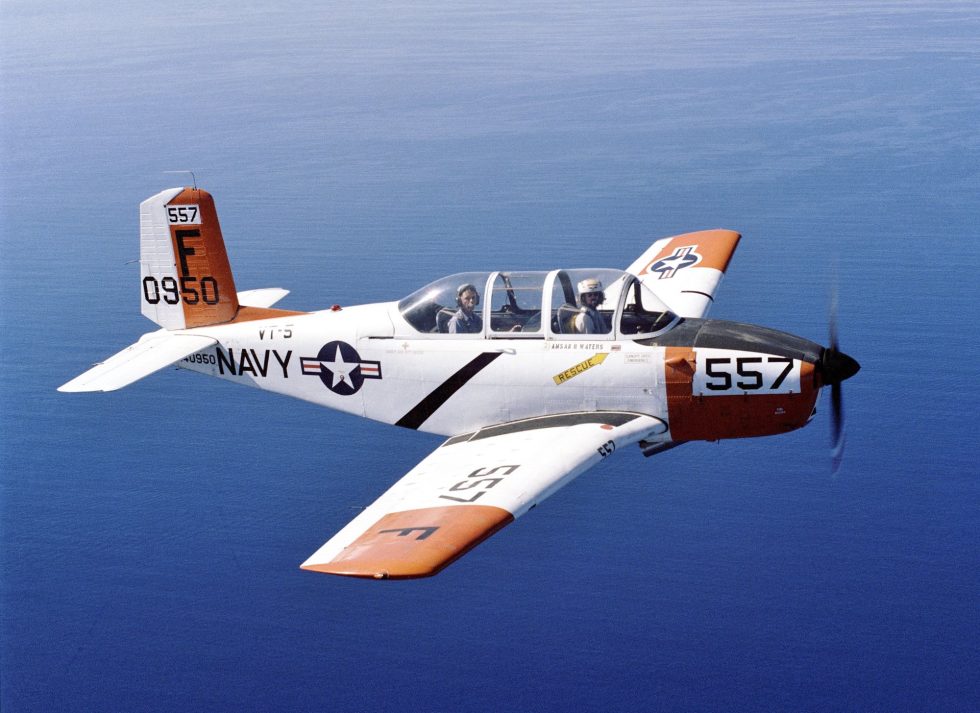
By the late 1960s the piston Mentor was ageing, and Beechcraft answered with the aircraft that would define the type’s second life: the T-34C Turbo Mentor. First flown on 21 September 1973, it swapped the piston engine for a Pratt & Whitney Canada PT6A-25 turboprop, deliberately derated to about 400 shaft horsepower to prolong its life and keep training costs down. The US Navy made it the backbone of its primary flight training for decades, and the last examples soldiered on until roughly 2015–2016 before the Beechcraft T-6 Texan II finally took over.
Beyond US service the Mentor spread across dozens of air forces from Argentina to Taiwan, some flying armed T-34C-1 light-attack versions. And when military examples were retired, a huge civilian following adopted them: today the T-34 is one of the most popular ex-military warbirds in the United States, flown in formation teams and aerobatics — a role that, in the 1990s and 2000s, would expose a hard lesson about the fatigue life of a 1950s wing.
01The Beechcraft T-34 Mentor’s Bonanza roots: a civilian design drafted into uniform
The Mentor was not a clean-sheet military aeroplane. Beechcraft built it around proven Bonanza structure — famously sharing wing and tail design philosophy with the civilian Model 35 — but replaced the Bonanza’s cabin with a slim tandem cockpit and its distinctive V-tail with a conventional tail. That heritage made the Model 45 cheap to develop and easy to certify, and gave it the light, responsive handling that made it such an effective first aircraft for a student pilot. The commonality also made the type inexpensive to maintain, a major reason it stayed in service, in one form or another, for well over sixty years.
What makes the T-34 Mentor special
A Bonanza in uniform
The Mentor borrowed the Beechcraft Model 35 Bonanza’s wing and tail engineering and mated it to a new tandem fuselage. The result was light, aerobatic and forgiving — exactly what an ab-initio trainer needs — while sharing enough with a mass-produced civilian aircraft to stay cheap to build and maintain.
From piston to PT6A turboprop
The original T-34A/B used a Continental O-470 piston of roughly 225 hp. In 1973 Beechcraft re-engined the airframe with a Pratt & Whitney Canada PT6A-25 turboprop for the T-34C, giving students turbine experience while derating the engine to about 400 shp for economy and long life.
Built to be forgiving
As a primary trainer the Mentor was designed to be honest and predictable — stable, benign at the stall and fully aerobatic within limits (+6/−3 g). That docility is why so many air forces chose it, and why it later became a favourite of the civilian warbird and formation-flying community.
02The Beechcraft T-34C Turbo Mentor’s engine: why the Navy derated a turboprop
The PT6A-25 fitted to the T-34C is capable of far more than the aircraft uses. Its thermodynamic core can produce well over 700 shaft horsepower, but in the Turbo Mentor it is deliberately flat-rated to around 400 shp. Derating a turboprop like this trades raw performance for reliability, predictable handling and dramatically longer time between overhauls — all priorities for an aircraft whose job is to fly thousands of training hours safely and cheaply. It also gave student pilots their first taste of turbine engine management without overwhelming performance.
03The Beechcraft T-34 Mentor’s wing-spar Airworthiness Directives: the 1999–2004 fatigue crisis
The Mentor was designed in the early 1950s, before modern fatigue-life requirements, for a gentle training career. When civilian owners began flying surplus T-34s hard in aerobatics and simulated air-combat rides, cumulative high-g loading found the limits of the original wing. A right wing separated in flight over Rydal, Georgia in April 1999, and further fatal break-ups followed, culminating in a Houston accident in December 2004. The FAA responded with a series of Airworthiness Directives — g-load and airspeed limits, then repetitive wing-spar inspections, and finally an emergency AD in December 2004 that effectively grounded the fleet pending inspection. Approved spar-reinforcement kits later returned many aircraft to flight. Figures and attributions here follow the FAA and AOPA accounts.
Beechcraft T-34 Mentor full specifications
Baseline: the T-34A, the 450-aircraft USAF production run of the Beech Model A45 delivered from October 1953, with the 225 hp Continental O-470-13 and a two-blade constant-speed propeller. Deltas for the US Navy T-34B (Model D45), for the licence-built B45s from Canada, Japan and Argentina, and for the turboprop T-34C Turbo Mentor with the Pratt & Whitney Canada PT6A-25 are in grey. Two traps in the literature are worth flagging before any number below is quoted. First, the specification table in the English-language Wikipedia entry is drawn from Jane's 1988–89 and describes the T-34C alone; it is routinely reprinted as though it were the piston aeroplane, which is how a 4,300 lb maximum weight and a 280 kn never-exceed speed end up attached to a 225 hp trainer. Second, the 185 hp Continental E-185 belongs to the 1948 Model 45 prototype and the first two A45T development machines, not to any production T-34A or T-34B; every service Mentor with a piston engine has an O-470 of 225 hp.
Dimensions & weights
- Crew
- 2, in tandem under a long sliding bubble canopy, with full dual controls; the instructor sat behind and the canopy was the point of the aeroplane, because the T-6 Texan it replaced gave the man in the back almost nothing to see
- Length
- 7.87 m (25 ft 10 in) T-34C: 8.75 m (28 ft 8.5 in), almost the whole 0.88 m being the longer nose needed to hang a PT6A ahead of the firewall and keep the centre of gravity honest
- Wingspan
- 10.01 m (32 ft 10 in) T-34C: 10.16 m (33 ft 3.875 in) — the turboprop took its wing from the Beech Baron and its main undercarriage from the Beech Duke rather than reusing the 1948 structure
- Height
- 2.92 m (9 ft 7 in) a number of warbird tables print 10 ft 0 in; the discrepancy is almost certainly tail-fin tip against rudder-top measurement rather than a real difference
- Wing area
- 16.50 m² (177.6 sq ft) T-34C: 16.69 m² (179.6 sq ft)
- Aspect ratio
- 6.07:1 6.18:1 on the T-34C — modest, which is why the Mentor rolls quickly for a trainer and why it bleeds energy honestly in a turn
- Empty weight
- 932 kg (2,055 lb) T-34C: 1,343 kg (2,960 lb) — the turboprop is 44 per cent heavier empty than the piston aeroplane it superficially resembles
- Maximum take-off weight
- 1,338 kg (2,950 lb) T-34B is usually quoted at 1,315 kg (2,900 lb); T-34C: 1,950 kg (4,300 lb), and the armed T-34C-1 weapons trainer 2,494 kg (5,500 lb)
- Internal fuel
- ~189 L (~50 US gal) in two wing tanks T-34C: 492 L (130 US gal). The piston figure is the standard fit and is quoted less consistently than it should be, because many surviving civil aircraft carry tip tanks or auxiliary cells that no service Mentor had.
- Wing loading
- 81.1 kg/m² (16.6 lb/sq ft) at maximum weight T-34C: 116.8 kg/m² (23.9 lb/sq ft), a step change that a student feels in the flare
- Power loading
- 5.95 kg/hp (13.1 lb/hp) T-34C: 3.55 kg/shp (7.8 lb/shp) — the single number that explains why the Navy went turboprop rather than buying more pistons
- Structure
- all-metal stressed-skin cantilever low wing and semi-monocoque fuselage, taken from the Model 35 Bonanza but with the fuselage narrowed to two tandem seats and the V-tail replaced by a conventional fin and tailplane, because service pilots in 1948 did not want to explain a butterfly tail to a first-solo student
- Undercarriage
- electrically retractable tricycle with a steerable nosewheel on the T-34A; the T-34B deleted nosewheel steering in favour of differential braking, added wing dihedral and gained adjustable rudder pedals, all of it aimed at a Navy student who would shortly meet a carrier deck
- Design load factors
- +10 g and −4.5 g as designed — far beyond the Bonanza it came from, and the figure most often cited in the Mentor's defence. It is also the figure that misled people. A wing designed to a high ultimate load is not a wing certified for unlimited fatigue cycles, and the difference between those two statements is the whole of the spar story below.
Performance
- Maximum speed
- 304 km/h (189 mph, 164 kn) at sea level, T-34A
- Maximum cruise
- 278 km/h (173 mph, 150 kn) T-34C: 396 km/h (246 mph, 214 kn) at 5,200 m (17,000 ft), which is the Jane's maximum-cruise figure and the highest speed properly attributable to the type in level flight
- Never-exceed speed
- T-34C: 520 km/h (320 mph, 280 kn). The National Naval Aviation Museum plaque prints 322 mph as the aircraft's "maximum speed"; that is the never-exceed figure, not a speed the aeroplane will reach in level flight.
- Placarded limits, US civil piston fleet
- 282 km/h (175 mph, 152 kn) never-exceed, with acceleration limits of −0 to +2.5 g, aerobatics prohibited and flight into known or forecast moderate or severe turbulence prohibited — the interim restriction imposed by FAA emergency AD 2004-25-51 on airframes not yet through an approved inspection or modification programme
- Stalling speed
- 98 km/h (61 mph, 53 kn) flaps down, power off, T-34C the piston aircraft stall a little lower at their much lighter weights, but no single authoritative T-34A figure is consistently published
- Rate of climb
- 6.2 m/s (1,230 ft/min) at sea level T-34C: 7.5 m/s (1,480 ft/min) — a smaller gain than the doubling of power suggests, because the turboprop also gained 612 kg of maximum weight
- Service ceiling
- 6,100 m (20,000 ft) T-34C: 9,100 m (30,000 ft), high enough that the Navy fitted oxygen and taught its use in primary
- Range
- 1,240 km (770 miles, 669 nmi) T-34C: 1,311 km (815 miles, 708 nmi) cruising at 333 km/h (180 kn) at 6,100 m (20,000 ft)
- Endurance
- roughly 3 hours on internal fuel at training power settings for either generation, which is well beyond what a primary sortie needs; the constraint on a school detail was always the student's concentration rather than the tanks
- Manoeuvre limits in service
- +6 g and −3 g on the T-34C, cleared for the full aerobatic syllabus including deliberate spinning and spin recovery — the reason both US services chose it, and the reason its later civilian owners flew it the way they did
- Typical training use
- about 70 flight hours per student in the US Navy primary syllabus, including first solo; from 1977 to 2012 essentially every American naval aviator, Marine and Coast Guard pilot began in a T-34C
- Spin behaviour
- conventional and recoverable, with the aeroplane deliberately given enough adverse yaw and stall warning to teach rather than to flatter — the Mentor was designed to be honest rather than docile, which is a distinction most 1950s primary trainers did not draw
Propulsion & systems
- Engine, T-34A
- one Continental O-470-13 air-cooled horizontally opposed six-cylinder of 225 hp (168 kW), driving a two-blade Beech constant-speed propeller
- Engine, T-34B
- one Continental O-470-13A of the same rating; the Navy variant differed in accessories and in the airframe around it rather than in output
- Engine, prototypes
- the 1948 Model 45 and the first two A45T development aircraft flew on the 185 hp Continental E-185; the third A45T had the E-225. Neither engine reached a production T-34 and their appearance in secondary tables for the T-34A is a straightforward transcription error
- Engine, T-34C
- one Pratt & Whitney Canada PT6A-25 free-turbine turboprop rated at 550 shp (410 kW) as installed, driving a three-blade Hartzell constant-speed propeller. The PT6A-25 is thermodynamically capable of more; the T-34C torque-limits it well below its potential so that the reduction gearbox and the airframe survive a school's duty cycle, which is why the aeroplane feels less rapid than 550 shp in a 4,300 lb airframe implies.
- Turboprop conversion origins
- two T-34Bs were converted by the US Navy as YT-34C prototypes and the first turbine flight was made on 21 September 1973, fifteen years after Beech had shut the Mentor line; series production restarted in 1975
- Fuel and oil
- wing tanks with gravity-fed crossfeed on the piston aircraft; the T-34C carries 130 US gal and adds the fuel control, ignition and starter-generator systems that go with a free-turbine engine, plus an inertial particle separator on the intake for operations from unimproved fields
- Electrics and actuation
- 28 V DC system; undercarriage and flaps electrically actuated on the piston Mentors, with no hydraulic system to maintain — a deliberate simplification for a school aeroplane, and one reason the type was cheap to keep flying for decades
- Cockpit
- identical full instrument panels front and rear, with a blind-flying hood for the student and a standard military communications and navigation fit; the T-34C added a turbine instrument set and oxygen for its 30,000 ft ceiling
- Hardpoints
- none on the T-34A, T-34B or the standard T-34C. The armed T-34C-1 introduced from 1977 has four underwing stations rated at 600 lb (272 kg) inboard and 300 lb (136 kg) outboard, 1,200 lb (544 kg) total
- Licence-built powerplants
- the Canadian, Argentine and Japanese Mentors kept the Continental O-470. Fuji's own descendants moved to Lycoming: the KM-2 trainer of 1962 and the tandem-seat KM-2B that became the JASDF Fuji T-3 used a Lycoming flat-six of 340 hp
- Civil re-engining
- surviving civil Mentors have been fitted with larger Continental IO-520 and IO-550 piston engines and, in a small number of cases, with Allison Model 250 turboprops as the Allison Turbine Mentor. More power on a 1950s wing is exactly the direction of travel that the structural history below argues against, and re-engined aircraft are not exempt from the wing-spar airworthiness directives.
- What it does not have
- no pressurisation, no de-icing on the service aircraft, no ejection seats and no armour. The Mentor is a light aeroplane with military paint, and its safety case has always rested on structural margin and honest handling rather than on escape systems
04The Beechcraft T-34 Mentor’s operating costs: why no reliable figure exists
Because the T-34 was a government-procured trainer bought over many decades and, later, a privately owned warbird, there is no single credible flyaway price or cost-per-flight-hour figure in the public record. The 1950s piston Mentors were low-cost aircraft — on the order of tens of thousands of dollars each in period terms — and the turboprop T-34C was valued chiefly for keeping training costs low. Any precise operating-cost number quoted for the type today should be treated as an estimate rather than an official figure.
Armament & payload
The Mentor spent almost its entire career carrying nothing at all, and the one time an armed version met an enemy aeroplane it was chased off by Sea Harriers
The T-34A, the T-34B and the standard T-34C have no hardpoints, no gun and no provision for either. For roughly the first thirty years of the type's life its payload was a student, an instructor and a set of dual controls, and that is not an evasion of the question: it is the answer. The armed aeroplane is the T-34C-1, introduced for export in 1977, which added four underwing stations rated at 600 lb inboard and 300 lb outboard for 1,200 lb total, and raised maximum take-off weight from 4,300 lb to 5,500 lb to carry them. Beech sold it as a weapons trainer and light counter-insurgency aircraft, and the ordnance list in the sales literature runs to flares, incendiary and practice bombs, rocket pods, gun pods and anti-tank missiles.
What the type actually did with that capability is a much shorter story. Argentine Naval Aviation deployed four T-34C-1s to Port Stanley on 25 April 1982 and flew them on visual reconnaissance. On 1 May three of them went after a Royal Navy Sea King over Berkeley Sound and were intercepted by Sea Harriers of 801 Naval Air Squadron from HMS Invincible; one Mentor was damaged by cannon fire and the attack came to nothing. All four were destroyed on the ground at Pebble Island by the SAS raid of 15 May 1982. That is the whole combat record of the Beechcraft Mentor, and it reads as a fair verdict on sending a 550 shp trainer to look for warships. Fits vary enormously by operator and almost none of them are documented in primary sources; the pylon ratings below come from Jane's and the manufacturer, the specific store types largely from secondary compilations that do not cite unit records.
Gun
- No Mentor of any mark has ever carried a built-in gun. There is no wing bay, no fuselage trough and no synchronisation problem to solve — the question simply never arose
- The T-34C-1 could carry gun pods on its underwing stations, which is the only gun armament the type has ever had
- Rifle-calibre and 12.7 mm pods are the fits generally quoted; the tandem cockpit has no gunsight as standard, so aiming was by whatever sight the operator chose to install
- The inboard stations at 600 lb each are the only ones with useful capacity for a podded gun and its ammunition
- No published source names a specific gun pod carried operationally on a T-34C-1 by a specific unit. Designations quoted in secondary compilations should be read as plausible rather than recorded.
Air-to-air
- None, on any variant. No air-to-air missile has ever been cleared on a Mentor and no gun installation was intended for air combat
- The type nonetheless has an air-to-air history, on the receiving end: on 1 May 1982 two Sea Harrier FRS.1s of 801 NAS engaged three Argentine Navy T-34C-1s over Berkeley Sound and damaged one with cannon fire
- The Mentors had been attempting to attack a Sea King; the encounter ended with the Argentine aircraft withdrawing into cloud and the helicopter unharmed
- The lesson drawn at the time was the obvious one, and the four Falklands aircraft were pulled back to Pebble Island rather than risked again
- Accounts of this engagement come from British squadron histories and secondary Falklands literature; the Argentine side of it is less fully published, and claims about how close the interception came to a kill vary between authors.
Air-to-surface guided
- Beech listed anti-tank missiles among the T-34C-1's options, which in the late 1970s means a wire-guided weapon of the AS.11 or TOW class
- The 600 lb inboard rating is sufficient for a two-round installation on paper
- There is no documented operational carriage of a guided weapon by any T-34C-1 in any air arm
- A trainer with no stabilised sight, no dedicated gunner and a 214 kn cruise is a poor guided-weapon platform, and export customers appear to have understood that
- This card exists because the manufacturer's brochure said so. Treat "anti-tank missiles" as a marketing capability rather than a fielded one unless a specific unit and a specific missile can be named, and no source consulted here does that.
Bombs
- Light bombs to the station limits: 600 lb on each inboard pylon, 300 lb on each outboard, 1,200 lb in total across all four
- Practice bombs and smoke or marking stores are the realistic and most commonly quoted fit, because the T-34C-1's primary market was weapons training rather than weapons delivery
- Incendiary bombs appear in the manufacturer's option list, which places the aircraft squarely in the light counter-insurgency market of the late 1970s
- Carrying anything at all costs the aeroplane climb and endurance it can ill afford, and the 5,500 lb armed weight is 28 per cent above the clean T-34C's maximum
- Specific bomb types cleared on the T-34C-1 are not published in any accessible primary source; the capacities are firm, the inventory is not.
Rockets
- Rocket pods on all four stations are the T-34C-1 fit most often described, and the most militarily sensible one for the aircraft's weight class
- 70 mm (2.75 in) folding-fin aircraft rockets in seven-tube pods are the standard Western store of the period and the fit generally attributed to export Turbo Mentors
- Rockets suit the aeroplane because they need no sophisticated sight, no data link and no significant single-store weight — a dive, a sight picture and a release
- This is also the store most likely to have been carried by the Argentine Navy aircraft in the Falklands, whose role there was nonetheless reconnaissance rather than attack
- Nineteen-tube pods are sometimes listed; at 300 lb outboard they would not fit the outer stations, so any such claim can only apply inboard and should be treated cautiously.
Pods & other stores
- No radar, no sensor turret, no reconnaissance camera fit is documented as standard on any Mentor. The Falklands reconnaissance sorties were flown with the crew's eyes
- Six Turbine Mentor 34C aircraft, the civil-standard governmental variant, went to an Algerian pilot training school in 1979 — the type sold as often for schooling as for shooting
- Surviving civil aircraft commonly carry smoke systems for display flying, which is the only "store" most Mentors will ever see
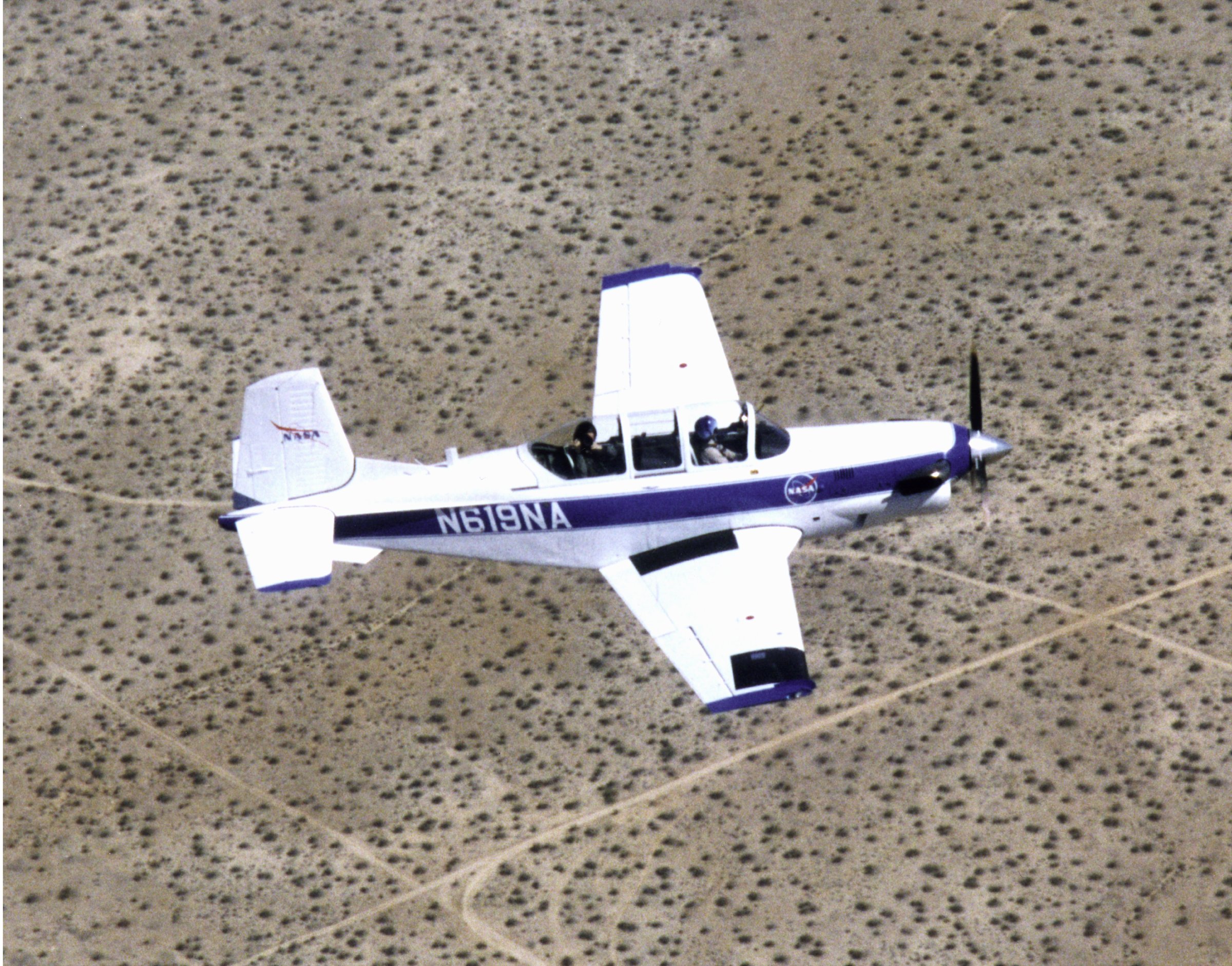
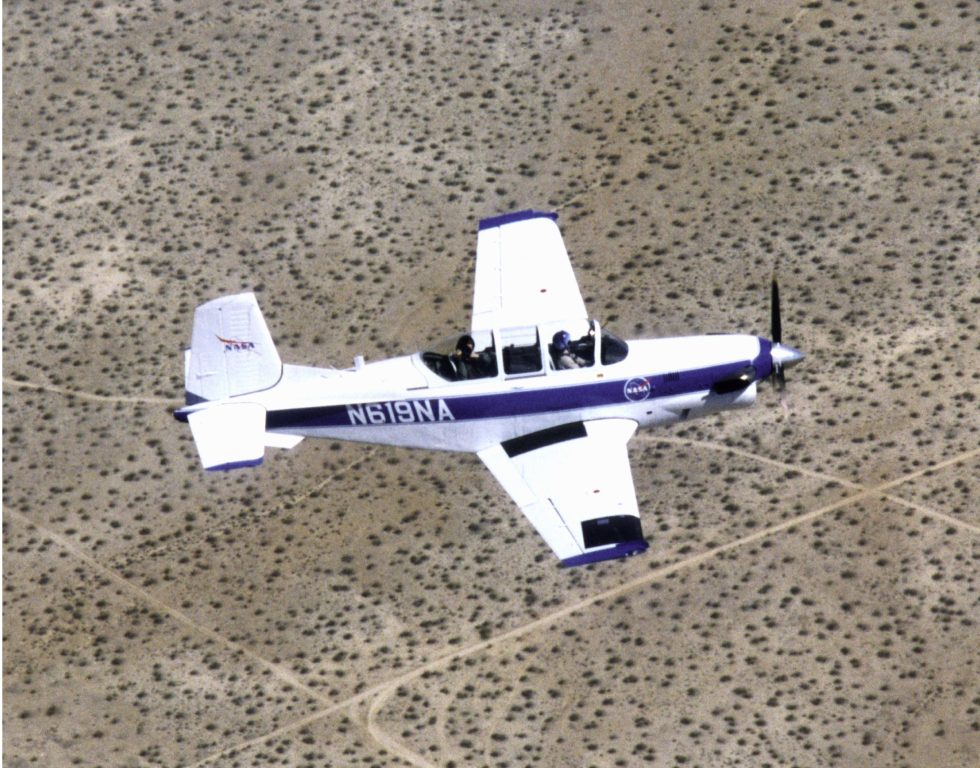
- Six ex-Navy T-34Cs served the US Army as test and chase platforms, and NASA has operated the type at Armstrong Flight Research Center as a chase and unmanned-vehicle support aircraft — useful work for an aircraft whose real payload is a pair of trained eyes
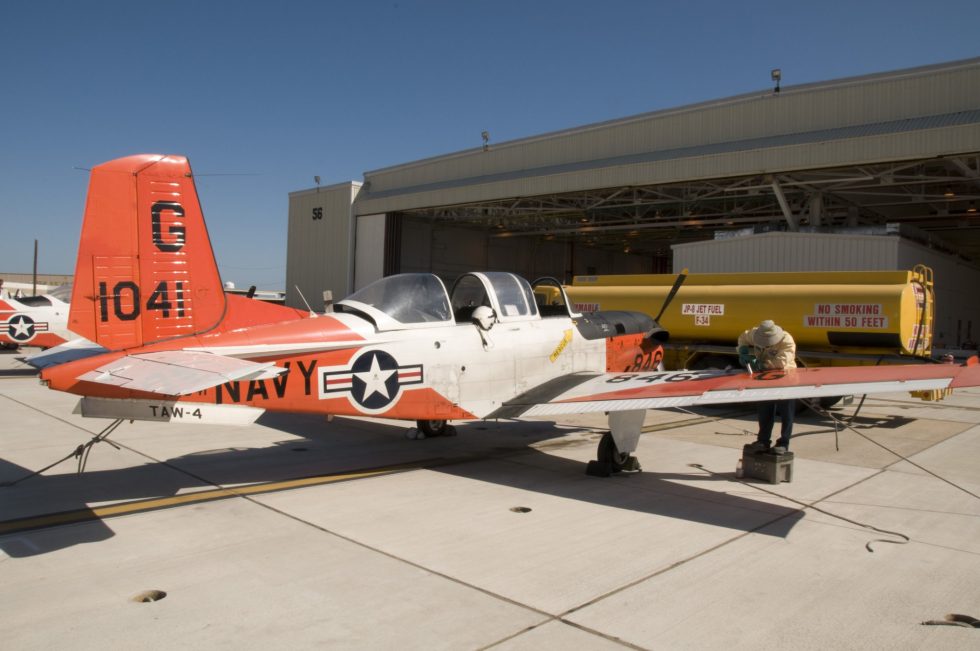
- The T-34C's longest-lived US Navy role after primary training ended was as an airborne spotter for strike-fighter weapons schools at Oceana, Lemoore, Miramar and Fallon, which required no stores at all.
Three typical loadouts
- US Navy primary training sortie, T-34C
- Clean airframe, no pylons fitted. Two crew, 130 US gal of fuel, oxygen, a blind-flying hood in the front cockpit. Roughly 70 hours of this per student between 1977 and 2012, first solo included.
- Armed reconnaissance, Argentine Naval Aviation T-34C-1, Falkland Islands, 1982
- Inboard stations loaded with rocket or gun pods, outboard stations typically empty, two crew, operating from the Port Stanley strip and later Pebble Island. Flown as a visual reconnaissance aircraft; one offensive sortie was attempted and was intercepted.
- Light attack and weapons training, export T-34C-1
- All four stations occupied within the 1,200 lb total — typically rocket pods inboard and light or practice bombs outboard — at the 5,500 lb armed maximum take-off weight. A configuration bought by several air arms and, on the available evidence, very seldom flown in anger.
Sourcing: station ratings and the 5,500 lb armed weight come from Jane's All the World's Aircraft 1988–89 via the standard reference literature and are firm. The list of store types is the manufacturer's option list, which is a sales document, not a clearance record. Where a specific weapon is named above without a unit attached, that is because no accessible source attaches one.
Variants
Beechcraft built the Mentor on three continents, killed the line in 1959, and then reopened it fifteen years later with a turbine on the front
The Mentor is two aeroplanes wearing one name. The first is a 225 hp piston trainer built in enormous numbers between 1953 and 1959 by Beech, by Canadian Car and Foundry, by Fuji in Japan and by FMA in Argentina, sold or given to a long list of air arms under mutual-assistance programmes, and then almost entirely forgotten by its original customers within a decade. The second is the T-34C Turbo Mentor, a 1970s aircraft that reuses the general shape and very little else: a longer fuselage, a Baron wing, Duke undercarriage, a PT6A-25 and a 44 per cent higher empty weight. Beech went back to a fifteen-year-old design because the Navy wanted a cheap turboprop primary trainer and the Mentor's handling qualities were already proven; it worked, and the T-34C outlasted the piston aircraft in service by nearly forty years.
Add the licence lines and the descendants and the family becomes genuinely large. Wikipedia's figure of 1,904 Continental-engined Mentors, plus a turboprop run of roughly 350 between 1975 and 1990, gives the commonly quoted grand total of about 2,300 airframes. Japan then took the design somewhere else entirely, stretching it into the four-seat LM-1 Nikko and re-engining it as the KM-2 and the tandem-seat T-3, so that a Beechcraft of 1948 was still coming off a Japanese production line in 1992. Production breakdowns disagree at the margins — Fuji's Mentor total is given as 173 in one Wikipedia article and 176 in another, and the T-34C figure is not firmly corroborated in any source consulted here — so the 2,300 total should be read as an order of magnitude rather than a census.
- Model 45, A45T and YT-34 (1948–1951 / 1 prototype plus 3 A45T and 3 YT-34)
- Walter Beech's private venture, flown by Vern Carstens on 2 December 1948 as a cheap replacement for the T-6 Texan. Bonanza wing and undercarriage, narrowed tandem fuselage, conventional tail instead of the V-tail one of the three design studies proposed. First two A45T on the 185 hp Continental E-185, the third on the E-225; three YT-34 ordered for USAF service test in 1950.
- T-34A, Beech Model A45 (1953–1956 / 450 built)
- The USAF production aircraft, first delivered to Edwards AFB in October 1953 with the 225 hp Continental O-470-13, nosewheel steering and a two-blade propeller. It replaced the T-6 in primary training and was itself displaced by the Cessna T-37 jet within about five years, an unusually short front-line life for an aircraft that would go on flying for seventy.
- T-34B, Beech Model D45 (1955–1957 / 423 built)
- The US Navy version, built from May 1955 to October 1957. Differential braking replaces nosewheel steering, wing dihedral is increased and the rudder pedals are made adjustable. Served as the Navy's primary trainer at Saufley Field into the mid-1970s and lingered with Navy Recruiting Command until the early 1990s.
- Model B45 (Beech-built export, to 1959)
- The export designation, delivered to a long list of customers under military assistance arrangements. The last Beech-built B45s left Wichita in 1959, after which the piston line closed for good.
- B45 built by Canadian Car and Foundry (1950s / 125 built)
- Canadian licence production, largely for supply to third countries under mutual-aid programmes rather than for Canadian use. The RCAF itself evaluated 25 T-34As at Penhold, Alberta between 1954 and 1956 and did not adopt the type; Turkey later flew ex-Canadian aircraft.
- B45 built by FMA (to 1958 / 75 built)
- Argentine licence production at Fabrica Militar de Aviones in Cordoba, supplementing 15 Beech-built T-34Bs. Argentina thus operated Mentors of two generations and two nationalities, and was the only country to take the type into a shooting war.
- Fuji-built Mentors and their Japanese descendants (1950s–1992 / 173 to 176 Mentors, plus 27 LM-1, 62 KM-2 and 50 T-3)
- Fuji Heavy Industries, Nakajima's successor, built the largest licence batch and then kept going. The LM-1 Nikko of the mid-1950s put a lengthened four-seat centre fuselage on the Mentor wing, tail and undercarriage for JASDF communications work; the KM-2 of January 1962 gave the JMSDF a 340 hp Lycoming-engined trainer; the KM-2B of 1978 restored the tandem cockpit and entered JASDF service as the Fuji T-3, built until 1992. The Philippines flew 36 Fuji-built T-34As.
- Model 73 Jet Mentor (1955 / 1 built)
- A private-venture jet conversion with a 920 lbf Continental J69 buried in the rear fuselage and intakes at the wing roots, flown on 18 December 1955 as N134B. The USAF chose the Cessna T-37 and the Navy the Temco TT Pinto; the Jet Mentor never entered production and survives at the Kansas Aviation Museum. The Navy abandoned the Pinto by December 1960 and went back to the T-34B and T-28, so the Jet Mentor lost to an aircraft that was itself a failure.
- YT-34C and T-34C Turbo Mentor (first turbine flight 21 September 1973; production 1975–1990)
- Two T-34Bs converted by the Navy as turboprop testbeds, then a substantially new aeroplane: PT6A-25 of 550 shp, Baron-derived wing, Duke undercarriage, longer fuselage, 4,300 lb maximum weight. Entered US Navy service in 1977 and trained every American naval aviator, Marine and Coast Guard pilot in primary until the T-6 Texan II replaced it.
- T-34C-1 and Turbine Mentor 34C (from 1977–1979)
- The armed export version with four underwing stations, 1,200 lb of stores and a 5,500 lb maximum weight, bought by Argentine Naval Aviation among others; and the civil-standard Turbine Mentor 34C for governmental sales, six of which went to an Algerian flying school in 1979. Taiwan took 49 T-34Cs from 1985 and still lists the type among its trainers.
Survivors and current status. Every flying Mentor is an original airframe — Beech, Canadian Car and Foundry, Fuji or FMA — and there are no reproductions or new-build replicas of the type, which matters because the structural history below applies to every single one of them. Secondary sources have put the airworthy population at around 400 aircraft with well over a hundred in private hands, but that figure predates the 2004 grounding and no reliable post-restriction census has been published; the honest statement is that several hundred T-34s remain on civil registers and an unknown fraction of them are compliant and flying. Military use has shrunk to a handful of air arms: Argentine Naval Aviation still trains on the T-34C-1 and the Republic of China Air Force still lists the T-34C among its trainers, with small numbers surviving elsewhere in Latin America and North Africa. Colombia retired its last Mentors in December 2013; Spain, Turkey, the Philippines and the US services are long out. No fleet chart is offered on this page because no per-country figure could be corroborated against two independent sources, and a chart of guesses would be worse than none.
The structural record, stated plainly. Between 1999 and 2004 three US-registered piston Mentors lost a wing in flight, all of them operated for paying passengers on simulated air-combat rides. The FAA's own documents record them: a Model A45 flown by Sky Warriors near Rydal, Georgia, whose right wing separated and whose fracture surfaces showed structural fatigue cracks at several locations, prompting priority letter AD 99-12-02 of 28 May 1999; a Texas Air Aces Model A45 near Conroe, Texas in November 2003, whose right wing failed at Wing Station 34 on the forward spar and WS 66.00 on the rear spar; and a Texas Air Aces Model A45 near Montgomery, Texas on 7 December 2004, whose left wing centre section failed four inches inboard of the forward wing attach fitting. AD 2001-13-18 of 16 August 2001 had already imposed repetitive 80-hour inspections of the wing spar assemblies to Raytheon Mandatory Service Bulletin SB 57-3329, at an estimated $14,460 for the initial inspection; AD 2001-13-18 R1 of March 2004 invalidated every alternative method of compliance then approved, on the finding that they "do not address all critical areas in the wing spar assemblies". Emergency AD 2004-25-51, effective 21 December 2004, grounded the entire US civil fleet pending an inspection or modification programme approved specifically for that AD by the FAA Wichita Aircraft Certification Office, allowing only ten flight hours in thirty days for repositioning under a 175 mph placard, −0 to +2.5 g and a prohibition on aerobatics. The fleet was restored to full flight status by 2011 through approved wing-spar structural modifications and negotiated alternative methods of compliance. A separate line of directives addresses the horizontal stabiliser: AD 62-24-01 required 500-hour dye-penetrant inspections of the stabiliser spars, and after a wing-separation investigation found stabiliser-spar root cracks on an aircraft inspected only 281 hours earlier, AD 2007-06-01 R1 of 16 April 2007 replaced dye penetrant with surface eddy current to a T-34 Spar Corporation procedure, with replacement required on any crack and no terminating action. Two things should be said about all this without exaggeration. First, the failures are fatigue failures, not overload failures: the Mentor was designed to +10 g and −4.5 g, and the aeroplanes that broke were being flown through repeated high-g cycles in a role — paid mock dogfighting — for which no 1950s primary trainer was ever fatigue-substantiated. Second, the type was not condemned. It was inspected, modified and returned to flight, and it continues to fly under a regime of directives that a normally used warbird can meet. Bill Anders, the Apollo 8 lunar module pilot, was killed on 7 June 2024 when his own T-34 crashed into Puget Sound between Jones and Orcas Islands; no finding connecting that accident to the spar history has been published.
The T-34 Mentor from prototype to warbird
First flight
The company-funded Beechcraft Model 45 prototype, derived from the Bonanza, first flies on 2 December.
USAF adopts the T-34A
The US Air Force orders the piston Mentor as its primary trainer; first deliveries follow that autumn.
US Navy T-34B
The Navy adopts its own variant with differential braking and revised controls for carrier-pilot training.
Turbo Mentor first flight
The T-34C flies with a Pratt & Whitney Canada PT6A-25 turboprop, derated to about 400 shp.
T-34C enters Navy service
The Turbo Mentor becomes the US Navy’s standard primary trainer, a role it holds for decades.
First wing-spar break-up
A civilian T-34 loses a wing during mock air combat over Georgia; the FAA issues its first restrictive AD.
Emergency grounding
After further fatal break-ups, an emergency Airworthiness Directive effectively grounds the civilian fleet pending spar inspection.
Retirement from US service
The last US Navy T-34Cs are withdrawn as the Beechcraft T-6 Texan II completes the takeover of primary training.
From the flight line: twelve T-34 Mentor stories
From Bonanza to battlefield
Beechcraft turned its civilian Model 35 Bonanza into the military Model 45 trainer on its own money.
Read the full story
Front to back
The tandem layout put the student in front and the instructor behind, the classic primary-trainer arrangement.
Read the full story
The turboprop leap
In 1973 Beechcraft swapped the Mentor’s piston engine for a PT6A turboprop to create the T-34C.
Read the full story
Built under licence
Mentors rolled off production lines in Canada and Japan as well as the United States.
Read the full story
Mentors of many flags
From Argentina to Taiwan, dozens of air forces adopted the T-34 as a trainer.
Read the full story
Taiwan’s enduring fleet
The Republic of China Air Force remains one of the type’s major current operators.
Read the full story
Argentina’s armed Mentor
The T-34C-1 added hardpoints, turning the trainer into a light-attack aircraft.
Read the full story
The warbird boom
Surplus Mentors became one of America’s most popular ex-military aircraft.
Read the full story
Air combat for civilians
Some operators used T-34s to sell adversary-style dogfight and upset-training rides.
Read the full story
When the wings came off
A run of in-flight wing separations from 1999 revealed a fatigue problem in the original spar.
Read the full story
Save the Mentor
FAA groundings and new spar kits kept the fleet flying rather than ending it.
Read the full story
Why “Mentor”?
The name captured the aircraft’s single purpose: to guide new aviators into the air.
Read the full story
The T-34 Mentor in pictures
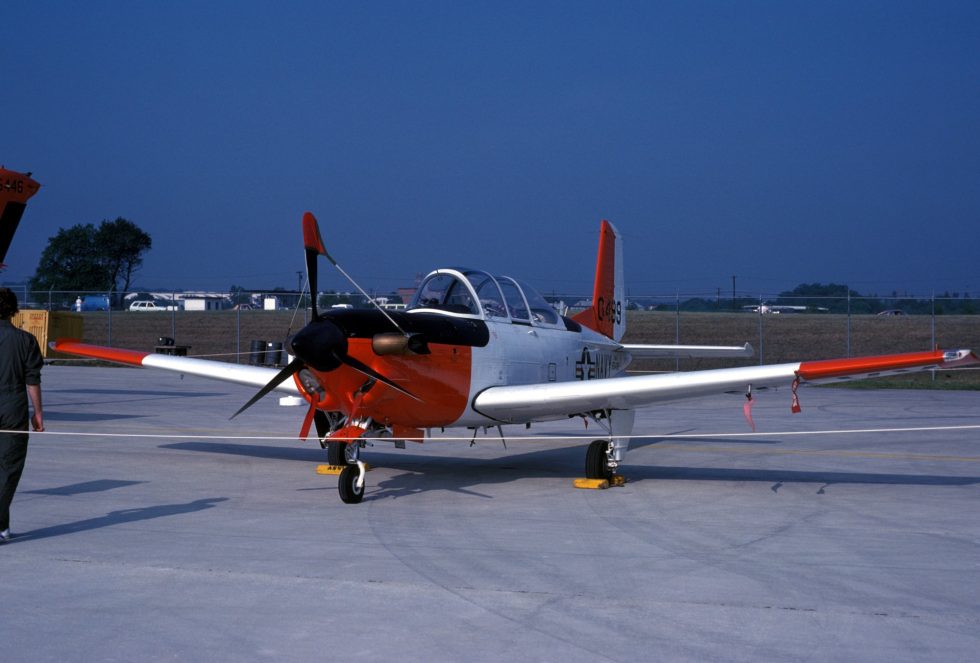
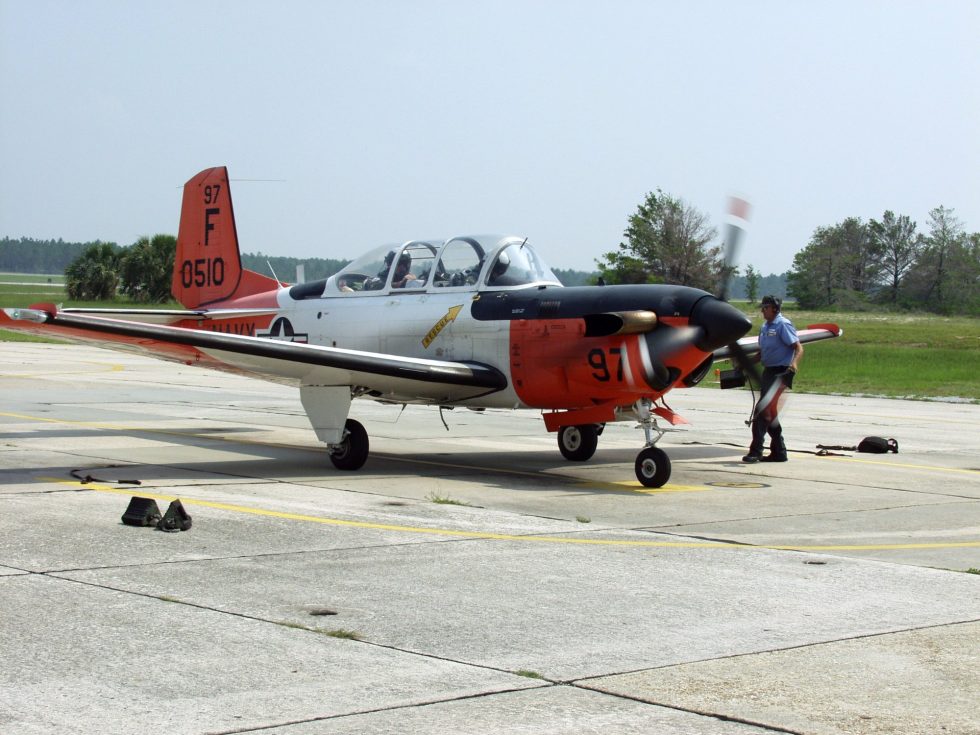

The T-34 Mentor in motion
Commemorative Air Force: What do you know about the T-34 Mentor? A short warbird-org profile of the type, its history and how it flies, from one of the largest flying-warbird operators.
Where the T-34 Mentor flew
The Beechcraft T-34 Mentor by the numbers
The Mentor never made its name in combat — it made it in the training command. Its record is one of longevity and reach: a single, forgiving design that outlasted the jets it fed pilots to, spread across dozens of air forces, and found a whole second life in civilian hands.
The T-34C was eventually replaced in US service by the Beechcraft T-6 Texan II, its direct turboprop successor.
Everything people ask about the T-34 Mentor
Can I fly in a Beechcraft T-34 Mentor?
What is the Beechcraft T-34 Mentor?
What is the difference between the T-34B and the T-34C Turbo Mentor?
Is the T-34 Mentor related to the Beechcraft Bonanza?
Why were T-34 Mentors grounded in 2004?
Who still flies the T-34 Mentor?
How fast is the T-34 Mentor?
What replaced the T-34 in US service?
You can’t fly the Beechcraft T-34 Mentor.
These, you can.
Some legends only live in museums — others are fuelled and waiting. MiGFlug has put civilians in real military jet cockpits since 2004.
 Fly the L-39 AlbatrosThe world’s most-flown jet trainer — aerobatics included
 Fly the F-104 Starfighter“The missile with a man in it”
 Fly the MiG-21The Cold War’s most-produced jet
 Fly the T-33 Shooting StarAmerica’s first jet trainer
 Fly the DH VampireA piece of early jet history
 Fly the S.211Agile Italian jet trainer
 Fly the MB-326The classic Aermacchi jet
 Fly the MiG-15The Soviet legend of the Korean War
Continue the tour
Every fact, checked
- National Museum of the US Air Force — Beech T-34A MentorUSAF fact sheet: first flight, engine and production of the piston Mentor.
- NAVAIR — T-34 TurbomentorOfficial US Navy specifications and role for the T-34C.
- Naval History & Heritage Command / NNAMNavy service history and replacement by the T-6 Texan II.
- FAA — Lessons Learned: Beechcraft T-34The 1999–2004 wing-spar accidents and the resulting Airworthiness Directives.
- AOPA — T-34 Wing Spar Regulatory BriefAD numbers and the inspection and modification requirements.
- Smithsonian Air & Space — “Save the Mentor”The grounding and the effort to keep the warbird fleet flying.
- GlobalSecurity — T-34 MentorProduction numbers, variants and operator overview.
- Vintage Aviation News — Boneyard Files: T-34 MentorProduction, operators and the type’s retirement and warbird career.