
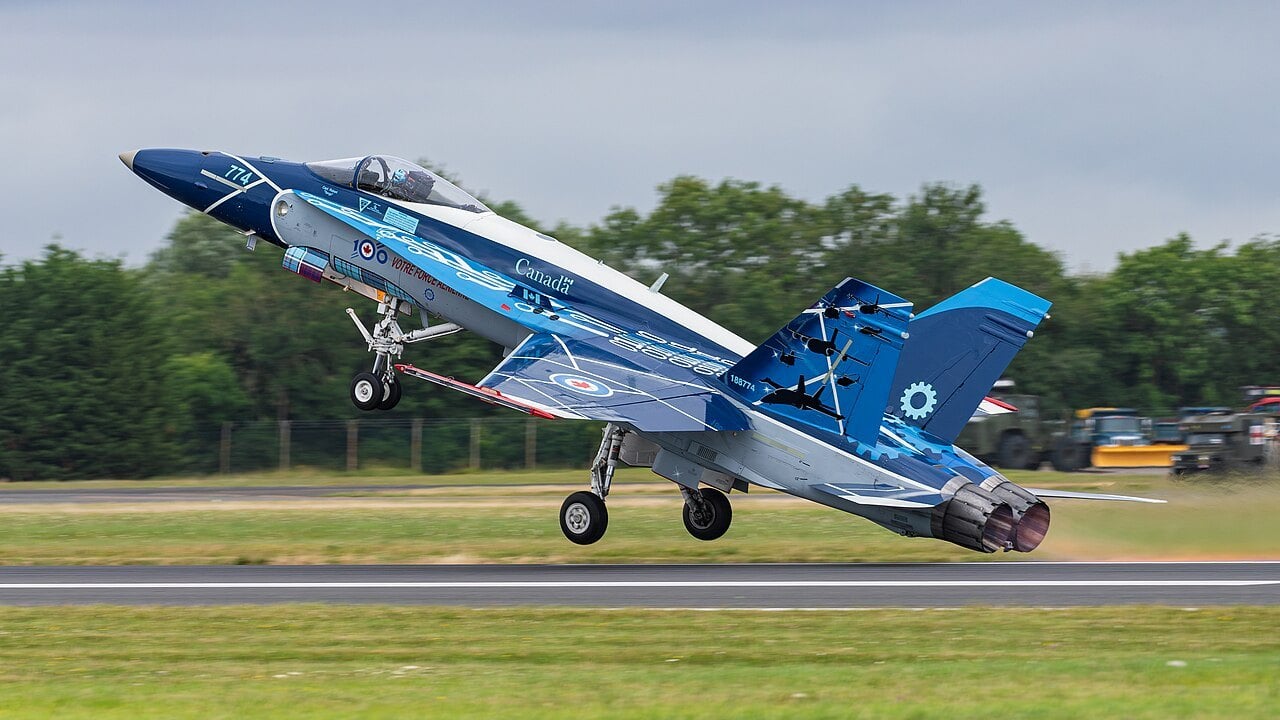
Ottawa still has not decided whether it will buy all 88 of its F-35s. But it keeps paying to make sure it can. On Thursday 26 November 2026, The Globe and Mail and CBC News reported that the Canadian government has made a further round of “long-lead” payments for parts that will go into future F-35 fighters.
With the latest instalment, Canada has now bought or partially paid for components for up to 48 jets. That is three times the 16 aircraft the government is actually committed to buy, and it comes 20 months into a review of the F-35 purchase that still has no end date.
Quick Facts
- News: New long-lead payments for Canadian F-35 parts
- Reported: Thursday 26 November 2026 (Globe and Mail, CBC News)
- Covers: Parts for another 18 jets, per government officials
- Total paid for: Up to 48 jets bought or partially paid for
- Firm commitment: 16 F-35s (funded in the 2024 budget)
- Original plan: 88 F-35As, signed in 2023
- Amount: Not disclosed
- Status: Review of the full order ongoing; no decision on more aircraft
What the money pays for
Long-lead items are the parts that Lockheed Martin and its suppliers must order well before a fighter goes down the assembly line. Customers pay for them early to keep their slot in the production schedule run by the Pentagon’s F-35 Joint Program Office.
According to the Globe, two government officials said this latest payment covers another 18 jets, on top of 16 aircraft already funded and 14 more for which long-lead money was set aside in 2025, as CBC reported earlier this year. Neither outlet published a dollar figure, and the officials declined to say exactly when the money was paid.
The defence minister’s office was careful about what the payment does not mean. Simon Lafortune, director of communications for Defence Minister David McGuinty, told both outlets that no decision on more aircraft has been made.
The officials also told the Globe that long-lead payments are not irreversible: the parts can be sold on to other F-35 customers and the money recouped. They denied any link to trade talks with Washington, saying the payments follow a schedule and Canada pays when the program office sends notification.
A review that keeps running
Canada signed up for 88 F-35As in 2023 to replace its ageing CF-18 Hornets, a purchase CBC puts at $27.9 billion. In March 2025, as the trade war with the United States escalated, Prime Minister Mark Carney ordered the deal re-examined. Saab has since pitched the Gripen E, including a Canadian assembly line, to fill out the rest of the fleet.
Two defence sources told CBC that the air force finished its part of the review within weeks of being asked. It has been with cabinet ever since. In the meantime, the first two Canadian F-35As have been handed over at Luke Air Force Base in Arizona, where Royal Canadian Air Force pilots and maintainers are training on them.
CBC News: The National explains the differences between the F-35 and the Gripen, the two fighters at the centre of Canada’s review.
The payments land in a busy week for the file. On 24 November, Afterburner reported on the Pentagon rebuking Canada over defence spending and the F-35 review. A day later we covered Project Arrow, an RCAF planning paper that builds its future air combat force around the F-35. The long-lead payment is a separate, concrete step: real money committed while the politics stay open.
Every day without a decision
Philippe Lagassé, a defence procurement expert at Carleton University, told the Globe that the Carney government tends to move fast when it considers something urgent, and that it has taken no steps toward actually buying the Gripen. In his view, that makes the Swedish option look like a bargaining chip in trade talks with the Trump administration.
Lagassé added that the window to replace most of the F-35s with Gripens has effectively closed, though Canada could still supplement an F-35 fleet with them. With the CF-18s at the end of their lives, the only plan actually funded is the F-35. Ottawa keeps saying it has not chosen. Its chequebook keeps saying something else.
Sources: The Globe and Mail, CBC News, U.S. Department of Defense


0 Comments