
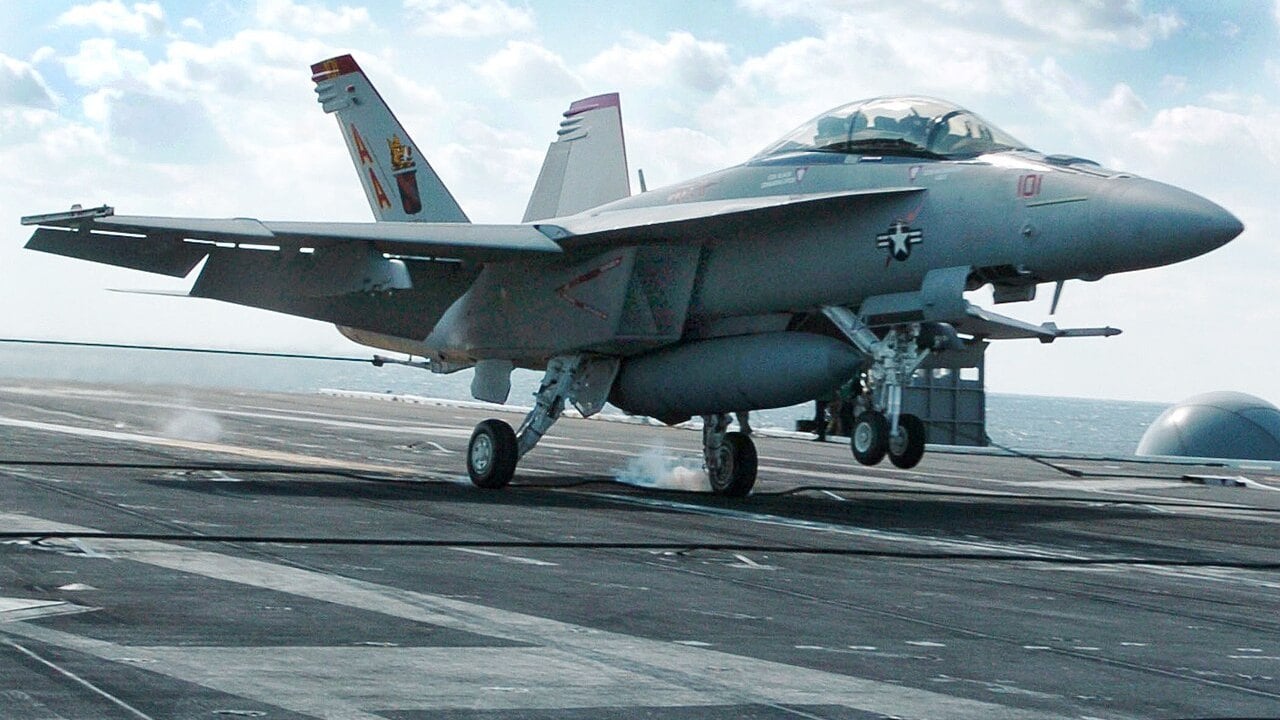
Ashore, a fighter needs a runway of a mile or more to land. On the deck of a US Navy supercarrier, the same jet comes to a dead stop in a little over 100 metres, from approach speed to zero, with the engines still roaring at full power. The thing that makes that possible is a steel cable about 35 millimetres thick, and a 43-ton machine hidden below the flight deck.
Every carrier landing ends in what naval aviators call a trap. The pilot sees the wire for a fraction of a second, if at all. What happens next is carrier arresting gear at work: a piece of hydraulic engineering that has caught Navy jets for decades, and is now being replaced by something run on water turbines and software.
Quick Facts
- What it is: Shipboard system that stops a landing aircraft by its tailhook
- Wires: Four cross-deck pendants on Nimitz-class carriers, three on the Ford class
- Legacy engine: Mk 7 Mod 3: hydraulic, 50 ft long, 43 tons, ethylene glycol fluid
- Reeving ratio: 18:1, every foot of ram travel pays out 18 ft of cable
- Stopping distance: Within about 350 ft; 344 ft maximum pendant run-out
- Energy rating: 47.5 million ft-lb maximum (Mk 7 Mod 3)
- New system: Advanced Arresting Gear (General Atomics): water turbines plus induction motor
- First AAG trap at sea: 28 July 2017, F/A-18F on USS Gerald R. Ford
The wire on deck
The visible part is the cross-deck pendant: a flexible steel wire rope stretched across the landing area. A Nimitz-class carrier has four of them, numbered from the stern forward, while the newest Ford-class ships carry three. The pendants sit a few inches above the deck on curved steel leaf springs, high enough for a tailhook to snag but low enough for a jet to taxi over afterwards.
Pilots do not aim for the first wire. On a four-wire ship the target is the 3-wire, because aiming for the first would put the jet uncomfortably close to the round-down, the stern edge of the deck. The Landing Signal Officer on the platform beside the deck grades every one of those passes.
A 1944 US Navy training film on arresting gear for flight deck crews: the principle of hook, wire and engine has not changed since.
The idea is as old as naval aviation itself. When Eugene Ely landed on the armoured cruiser USS Pennsylvania on 18 January 1911, his hooks caught ropes stretched across a wooden platform, each weighted at the ends with sandbags. Drag the bags, slow the plane. Modern arresting gear works on the same principle; it just swaps the sandbags for a machine that can be tuned for every landing.
Below deck: the Mk 7 engine
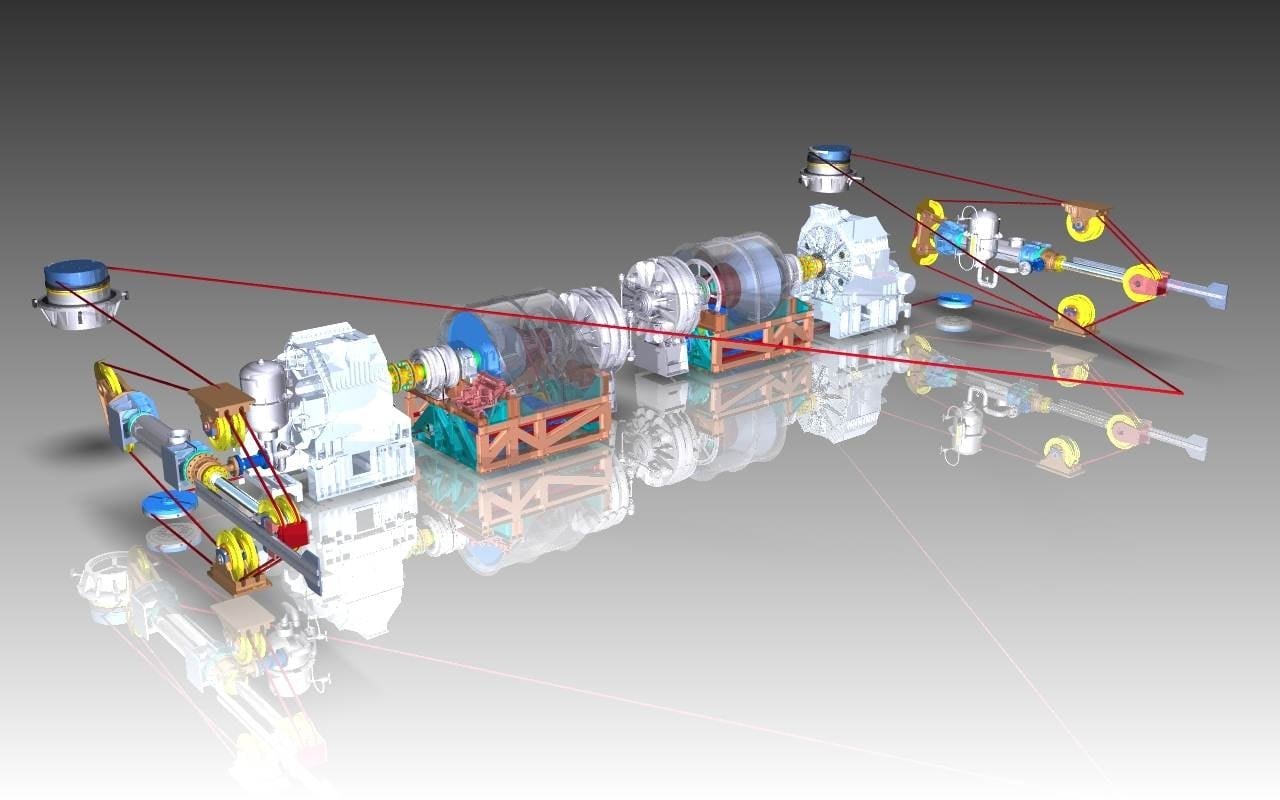
The pendant is only the handle. Each end is coupled to a purchase cable that runs over sheaves, through the deck and into an arresting engine room below. On today’s Nimitz-class carriers that engine is the Mk 7, and according to the US Navy’s own training manual for the sailors who run it, a Mk 7 Mod 3 engine is 50 feet long and weighs 43 tons.
The principle is a giant hydraulic syringe. The purchase cable is wound back and forth between a fixed set of sheaves and a moving crosshead, like the block and tackle on a sailing ship. When the hook pulls the cable out, the crosshead is dragged towards the fixed sheaves and drives a 20-inch ram into a cylinder full of ethylene glycol. The fluid has to escape through a control valve into an accumulator, and that metered escape is what soaks up the aircraft’s energy.
The pulley arrangement is the clever part. The Mk 7 has an 18:1 reeving ratio, so every foot the ram moves lets 18 feet of cable pay out on deck. A short, immensely forceful stroke below decks becomes a long, progressive pull on the aircraft. The gear is rated to absorb a maximum of 47.5 million foot-pounds of energy, with a deck pendant run-out of 344 feet to the tailhook.
Why the weight dial matters
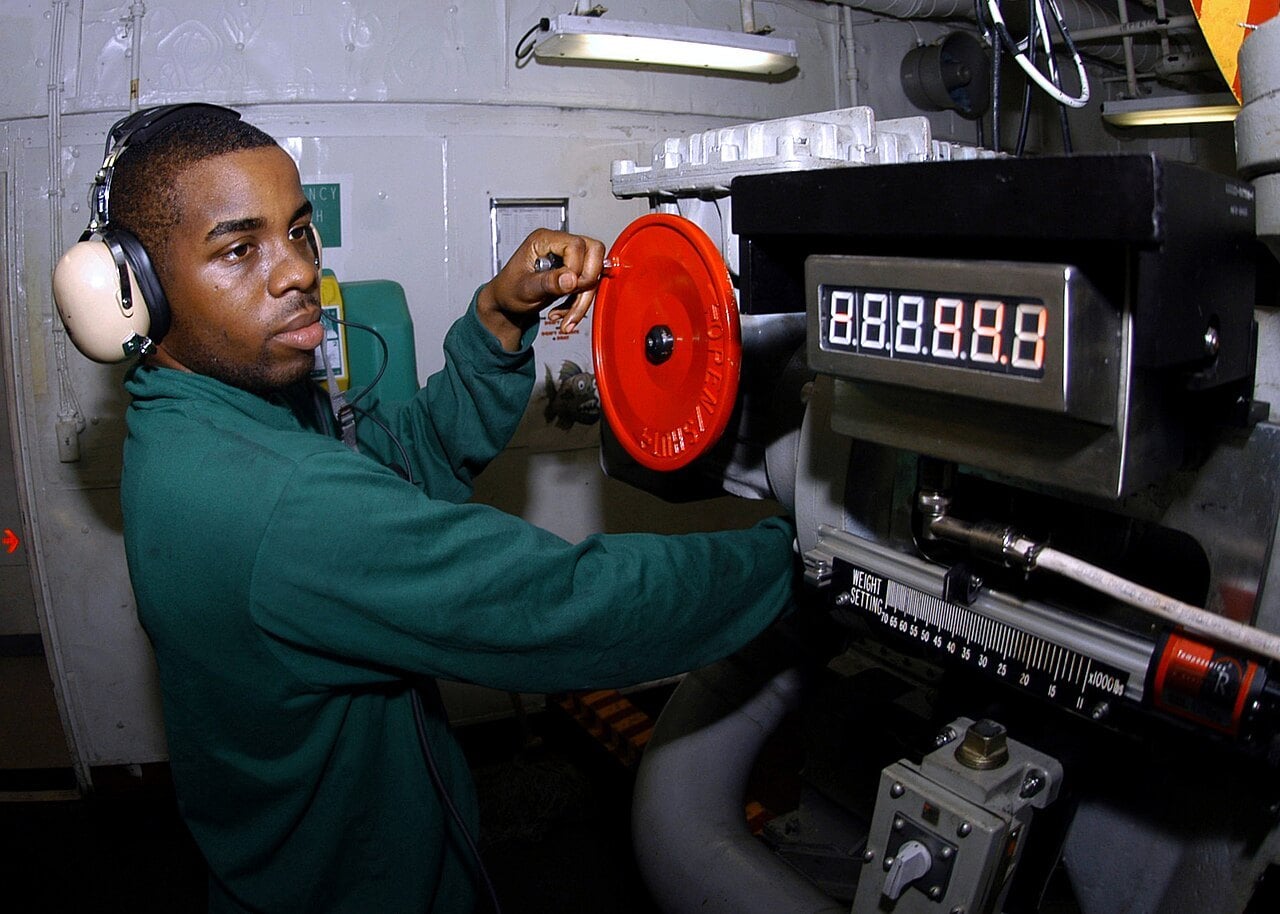
A 50,000-pound jet and a much lighter one arrive with very different amounts of energy, yet both have to stop inside the same few hundred feet of deck. The answer is the constant runout valve, or CROV. Before each landing, the arresting gear officer is told the type and weight of the incoming aircraft, and sailors in each engine room set that weight on a dial.
A heavy aircraft gets a smaller, more restrictive valve opening, so the fluid escapes more slowly and the ram pushes back harder. A light aircraft gets a larger opening and a gentler pull. As the crosshead moves, a cam progressively closes the valve until the flow stops and the aircraft is at rest. Set the dial too low and a heavy jet can run out of cable; set it too high and the arrestment is needlessly violent on the airframe.
After the jet stops, the pilot raises the hook, the wire drops free and a retract valve lets pressurised fluid from the accumulator push the ram back out. That hauls the purchase cable back into the engine and pulls the pendant back across the deck, ready for the next aircraft in the landing pattern.
NAVAIR footage of the first fly-in arrestment on the Advanced Arresting Gear at Lakehurst, New Jersey.
Built to wear out
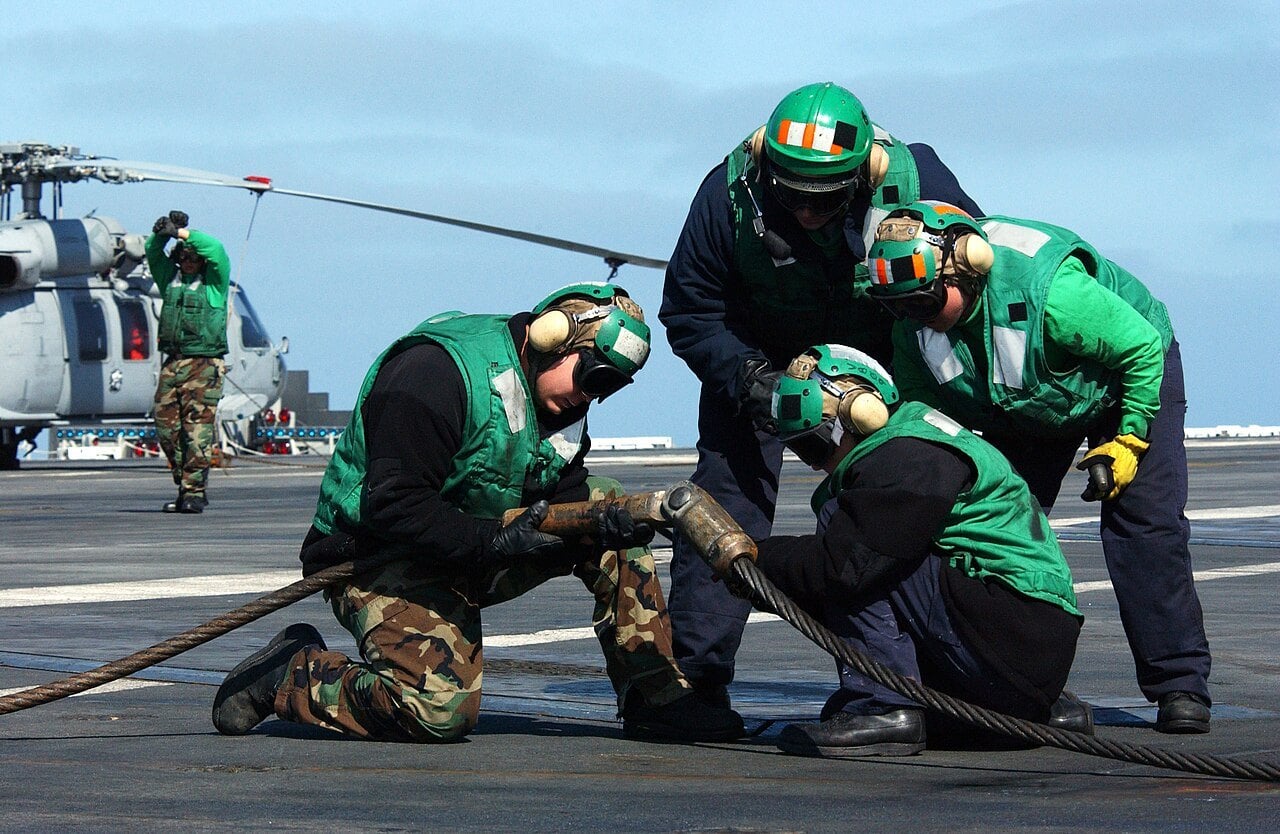
The cables take a brutal beating. Every trap stretches the pendant over the hook at full load, so the wire ropes are inspected constantly and replaced after a set number of arrestments, using quick-release couplings at each end so a crew can swap one between landings. The pendants on the Mk 7 are rated in the Navy manual at a breaking strength of 188,000 to 205,000 pounds, depending on construction.
If a jet cannot use the wires at all, because its hook is damaged or will not come down, the carrier rigs a nylon barricade across the deck instead, driven by its own arresting engine. And if the hook simply misses, the full power applied at touchdown carries the aircraft off the angled deck and back into the air for another try.
The Ford-class rethink: water and electricity
The Mk 7 works, but it is a mechanical system with little room for fine control and a lot of maintenance. For the Ford-class carriers the Navy commissioned the Advanced Arresting Gear from General Atomics. NAVAIR describes AAG as a modular system of energy absorbers, power conditioning equipment and digital controls, with built-in test and diagnostics.
Instead of a ram pushing fluid through a valve, the purchase cable turns a drum. QinetiQ, a partner on the programme, says the design uses energy-absorbing water turbines coupled to a large induction motor for fine control of the arresting forces. The water turbines do the heavy braking; the motor trims the force in real time, so the same gear can stop anything from a light drone to a heavy fighter.
Getting there was not easy. Testing at Joint Base McGuire-Dix-Lakehurst in New Jersey slipped by years, and the first fly-in arrestment of an F/A-18E Super Hornet did not happen until 13 October 2016. On 28 July 2017, Lt. Cmdr. Jamie Struck of test squadron VX-23 made the first arrested landing aboard USS Gerald R. Ford in an F/A-18F.
The first arrested landing aboard USS Gerald R. Ford on 28 July 2017, flown by Lt. Cmdr. Jamie Struck of VX-23.
In August 2019 the Navy cleared AAG for the C-2A Greyhound, the E-2C and E-2D Hawkeye, the Super Hornet and the EA-18G Growler, after more than 2,500 dead-load and 1,420 manned arrestments ashore. The gear is also fitted to USS John F. Kennedy, where the F-35C has since completed its Ford-class carrier trials, and is planned for the future USS Enterprise.
From sandbags in 1911 to software-trimmed water turbines today, the job has never changed: take the energy of a fast, heavy aircraft and turn it into heat in about 100 metres of deck. The pilot only feels the violent tug forward into the straps. Below deck, the sailors on the engine are already resetting for the next one.
Sources: US Navy (NAVEDTRA 14310 Aviation Boatswain’s Mate E training manual), Naval Air Systems Command (NAVAIR), US Navy press releases (July 2017, August 2019), General Atomics Electromagnetic Systems, QinetiQ, USNI News

0 Comments