
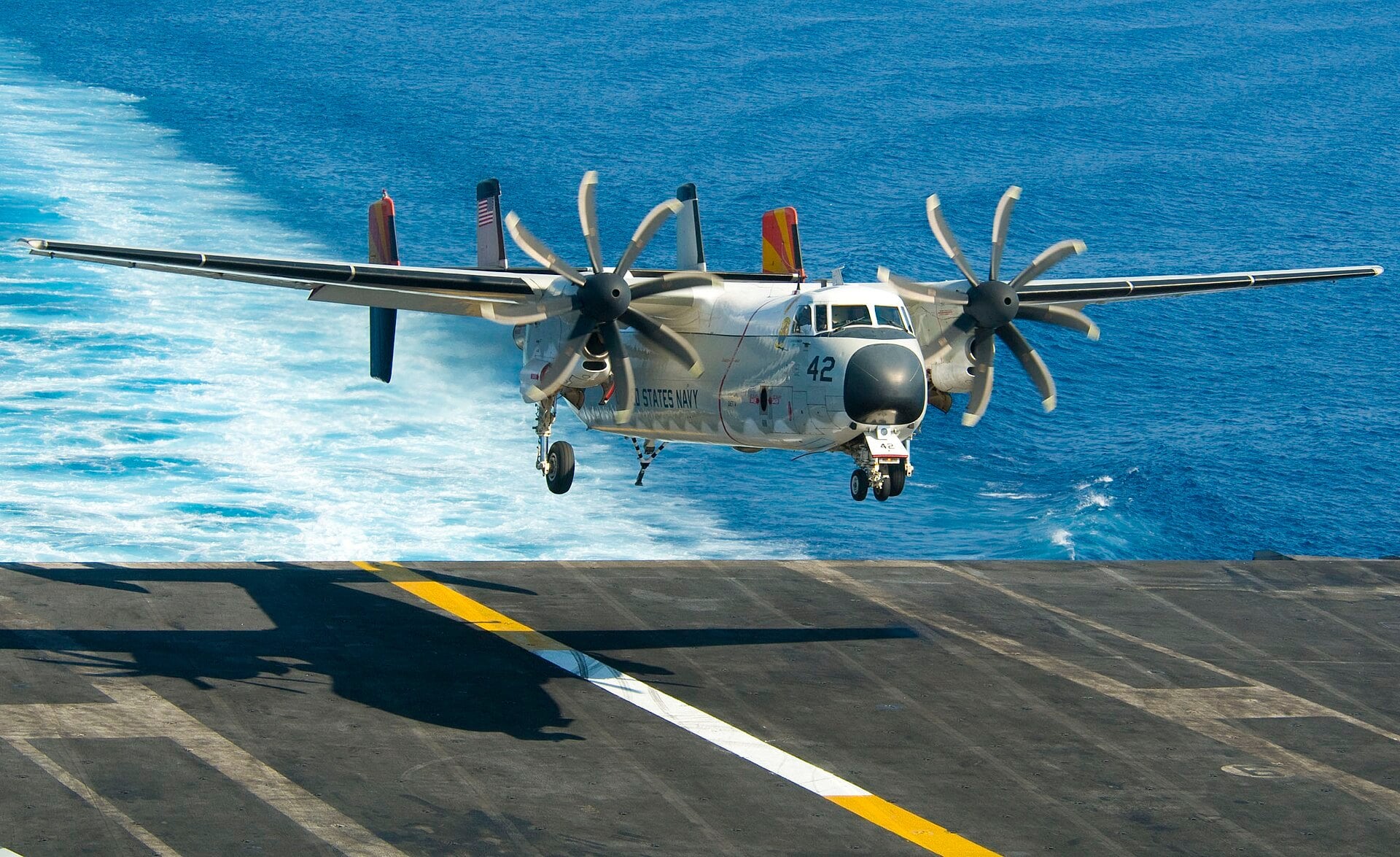
Grumman C-2 Greyhound
Carrier Onboard Delivery
For sixty years the US Navy’s lifeline to its aircraft carriers: a Hawkeye-derived twin turboprop that was catapulted off and trapped aboard carriers with mail, spare engines and passengers, until the Osprey replaced it in 2026.
The C-2 Greyhound: how a Hawkeye became the carrier fleet’s delivery van
An aircraft carrier at sea is a city of five thousand people that never stops consuming. It needs mail, medicine, spare parts, jet engines and people, and it needs them while sailing hundreds of miles from land. For most of the jet age the US Navy’s answer was carrier onboard delivery, or COD: a small fleet of transport aircraft that could be catapulted from and land aboard a carrier like any fighter. In the early 1960s that job was done by the piston-engined C-1 Trader, a derivative of the S-2 Tracker. Grumman’s replacement used the wings, engines and tail of its new E-2 Hawkeye radar aircraft, joined to a wide new fuselage with a rear loading ramp. The C-2 Greyhound flew on 18 November 1964.
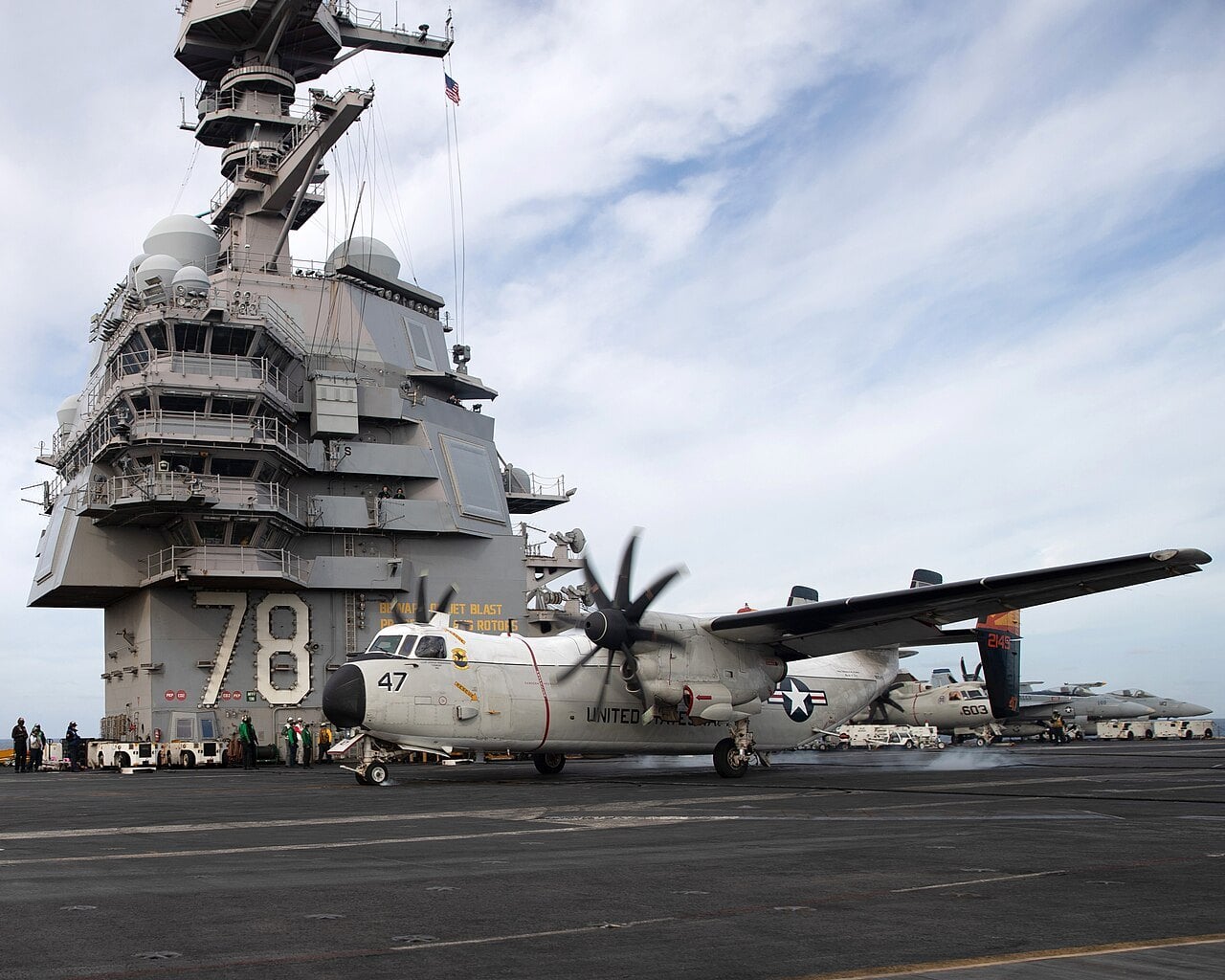
The Greyhound entered service in 1966 and quickly proved its worth. It could carry about 10,000 lb of cargo, or up to 26 passengers, or stretchers for medical evacuation, and its rear ramp could swallow a complete jet engine. A cargo restraint system held loads in place through the brutal deceleration of an arrested landing. The first production run was small, about 17 to 19 aircraft, and in 1973 they went through a service life extension. By the 1980s the fleet was worn out, and the Navy took the unusual step of reopening production: 39 improved C-2A(R) “reprocured” aircraft were built between 1985 and 1989. It also gave the carrier an aircraft that could land beside a hospital ashore and bring injured sailors home, a role that mattered as much as its cargo work.
For the next four decades the Greyhounds of VRC-30 in California, VRC-40 in Virginia and, until the 1990s, VRC-50 in the western Pacific shuttled between shore and carrier in every crisis and war, from Vietnam to the Gulf and Afghanistan. Generations of sailors, reporters and visiting dignitaries had their first carrier landing strapped into a rear-facing seat in a Greyhound’s windowless cabin. From 2020 the Navy began to replace them with the CMV-22B Osprey tiltrotor, and the last Greyhound flight was reported in July 2026, ending sixty years of service. The Greyhound was never glamorous, but carrier aviation as the world knows it would not have worked without it.
01The C-2’s reprocurement: reopening a closed production line
Military aircraft production lines rarely reopen once closed. The C-2 was an exception. By the early 1980s the original C-2As were tired after years of catapult launches and arrested landings, and the Navy needed a replacement. Rather than design a new aircraft, it ordered more Greyhounds. Because the E-2 Hawkeye was still in production, Grumman could build new C-2s using the same wings, engines and many systems.
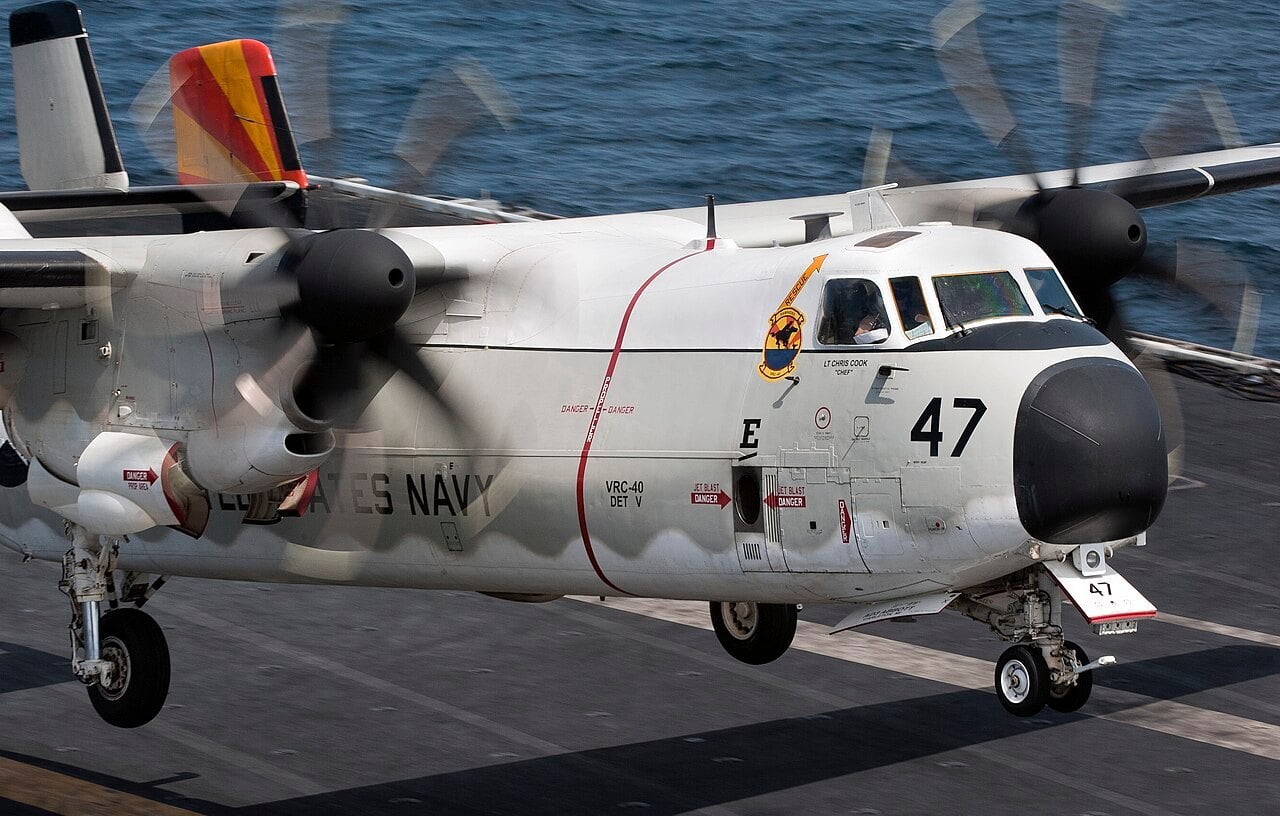
The result was the C-2A(R), with improved avionics, a stronger airframe and better corrosion protection. NAVAIR’s standard aircraft characteristics for the reprocured aircraft date from 1984, and 39 were delivered between 1985 and 1989. They were later fitted with new eight-blade propellers, glass-cockpit and navigation upgrades and further life extensions, which allowed them to fly far longer than originally planned.
That longevity was both a triumph and a problem. By the 2010s the C-2A(R)s were themselves more than thirty years old, and the Navy had to choose between another life extension, a new version of the Greyhound based on the E-2D, or a different aircraft altogether. It chose the tiltrotor.
02The C-2’s last years: making way for the Osprey
In 2015 the Navy announced that a variant of the Bell Boeing V-22 Osprey would replace the Greyhound. The CMV-22B has a larger fuel capacity than the Marine Corps MV-22 and, unlike the C-2, can land on ships other than carriers. The first was delivered in June 2020 and the type achieved initial operating capability in December 2021, according to Bell.
The transition was gradual. The Greyhound’s great advantage was its cabin, which could carry cargo the Osprey cannot, and its ability to fly higher and faster on long transits. The CMV-22B’s advantage was flexibility. As more Ospreys arrived, the C-2 squadrons stood down detachments one by one. VRC-40 at Norfolk, the last Greyhound squadron, flew the final operational carrier landings in mid-2026, aboard USS Nimitz, and the last flight, from Norfolk to Pensacola, was reported on 28 July 2026. The aircraft, BuNo 162159, was handed to the National Naval Aviation Museum.
What makes the C-2 Greyhound special
Hawkeye underneath
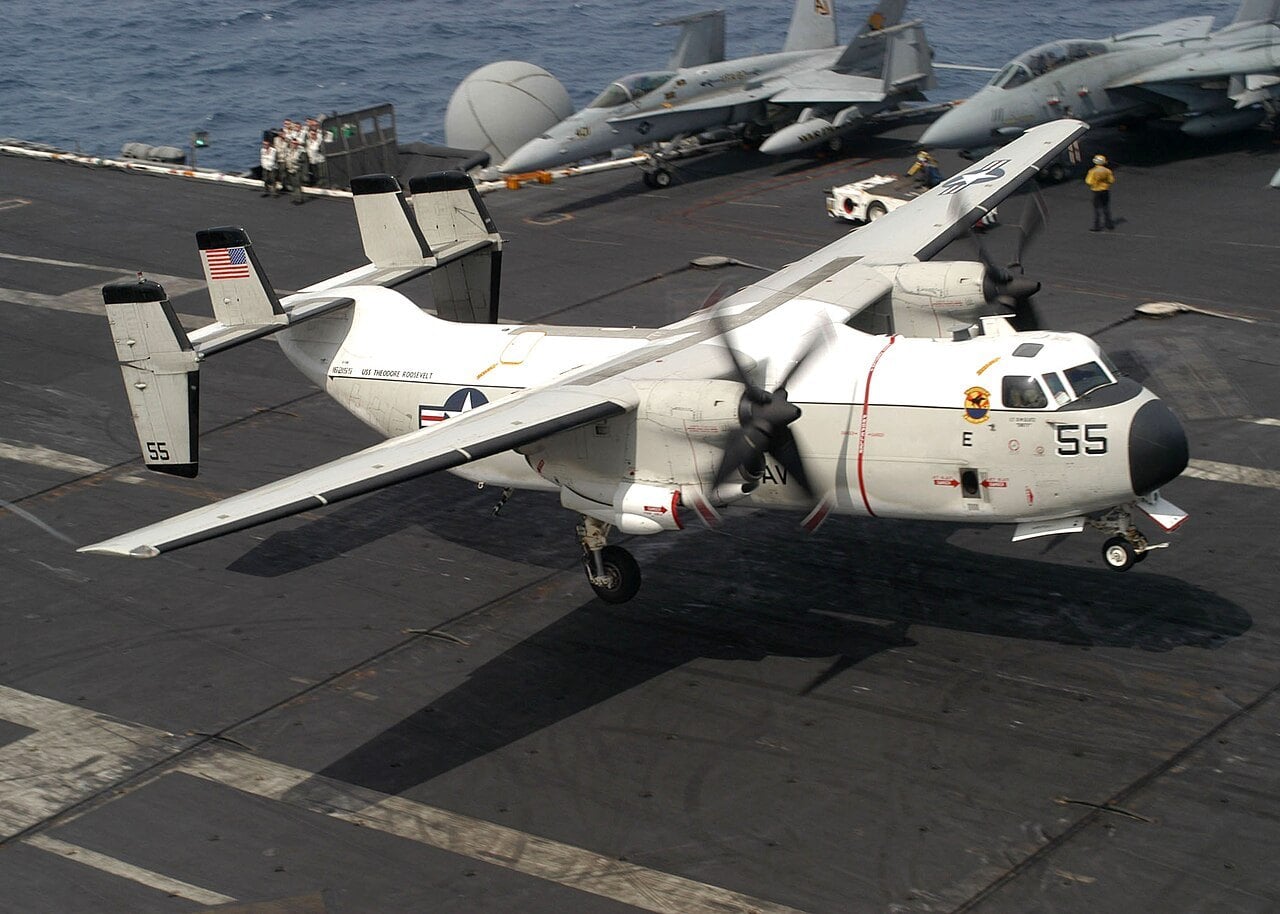
The C-2 shares its wing, engines and much of its tail with the E-2 Hawkeye airborne early warning aircraft, which made it cheap to develop and simple to support on a carrier already operating Hawkeyes. The four-fin tail is a carrier compromise, allowing a large total fin area within the limits of hangar deck height. The wings fold back along the fuselage for stowage. The fuselage is new: wider, deeper and without the Hawkeye’s rotating radar dome, with a large rear ramp.
Built for the trap
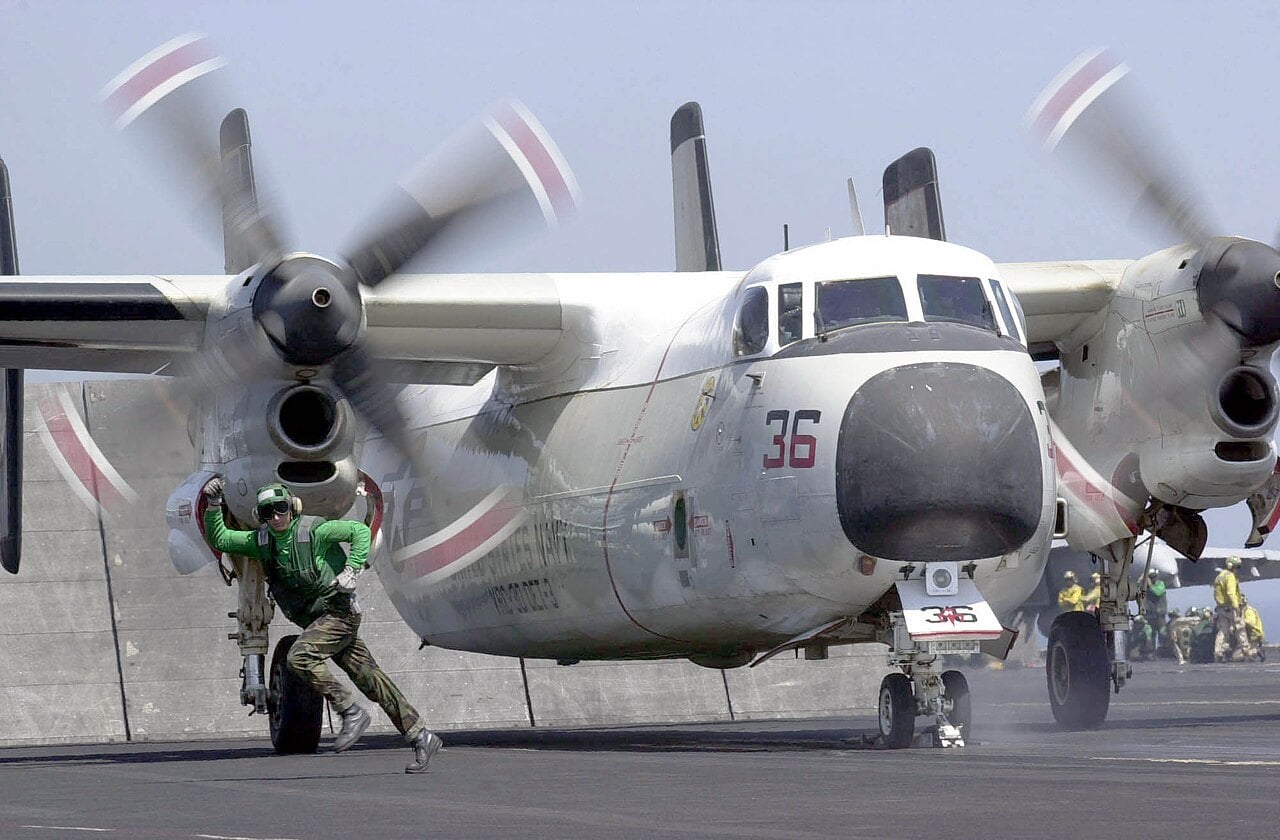
Every Greyhound flight to a carrier ended in an arrested landing, and every departure began with a catapult launch. Its cabin was designed around that reality. Cargo was locked in a restraint system able to hold loads against the extreme decelerations involved, and passengers sat in rear-facing seats with helmets and life vests. The open-ramp flight capability meant cargo and even special forces could be air-dropped, and an onboard auxiliary power unit let the aircraft start its engines without ground equipment at remote airfields.
Two T56 turboprops
Two Allison T56-A-425 turboprops of about 4,600 shp each, the same engine family as the C-130 Hercules and P-3 Orion, gave the Greyhound a maximum speed of about 343 knots and a range of about 1,300 nautical miles with a full cargo load. Later in life the aircraft were fitted with eight-blade propellers similar to those on the E-2. The engines were reliable and widely supported, one reason the Greyhound could keep flying into the 2020s. Their simplicity also suited carrier life, where maintainers worked in cramped hangar bays far from depot support.
03The C-2’s cabin: what it was like to fly COD
For passengers, a COD flight was memorable. The cabin was noisy, with few windows. Passengers wore a cranial helmet, ear protection and a flotation vest, and sat facing the tail so that the deceleration of the arrested landing would press them back into the seat rather than throw them forward. The crew chief would signal the landing, and in a couple of seconds the aircraft went from about 100 knots to a standstill. The catapult launch on departure was the reverse: a violent push from behind followed by sudden calm.
For the crew of two pilots and two loadmasters, the C-2 was a demanding aircraft. It was large for a carrier aircraft, with a wide wingspan and limited clearance on deck, and it often flew long overwater legs at night or in poor weather. Its pilots qualified for carrier landings like fighter pilots, and many went on to fly airliners or other transports after their naval careers.
Grumman C-2A(R) Greyhound specifications
Specifications
- Crew
- 4 (2 pilots, 2 loadmasters)
- Capacity
- Up to about 10,000 lb (4,500 kg) of cargo, or 26 passengers, or stretcher patients
- Length
- 17.32 m (56 ft 10 in)
- Wingspan
- 24.56 m (80 ft 7 in)
- Height
- 4.85 m (15 ft 11 in)
- Empty weight
- 15,310 kg (33,746 lb)
- Max take-off weight
- 27,216 kg (60,000 lb)
- Powerplant
- 2 × Allison T56-A-425 turboprops, 4,600 shp (3,400 kW) each
- Maximum speed
- 635 km/h (343 kn)
- Cruise speed
- 465 km/h (251 kn)
- Range
- About 2,400 km (1,300 nmi) with full cargo
Costs & production
- Cost per flight hour
- No single published figure; an estimate in the order of US$10,000 to 20,000 per hour is plausible, based on the costs of comparable twin-T56 carrier aircraft such as the E-2 Hawkeye
- Production
- About 17 to 19 original C-2As (1965 to 1968) and 39 C-2A(R)s (1985 to 1989)
- Programme
- Service life extensions, eight-blade propellers and avionics upgrades; replaced by 44 CMV-22B Ospreys from 2020
04The C-2’s variants: Greyhound and reprocured Greyhound
- YC-2A: prototypes converted from E-2 airframes, first flown in 1964.
- C-2A: original production version, about 17 to 19 built, extended under a 1973 service life extension programme.
- C-2A(R): reprocured version with improved systems and airframe, 39 built from 1985, later fitted with eight-blade propellers and upgraded avionics.
05The C-2’s operating costs: an expensive necessity
The Navy does not publish a simple cost per flight hour for the Greyhound, and figures depend heavily on what is counted. Its two T56 turboprops are economical by military standards, but carrier operations are hard on airframes, and an ageing fleet with a small number of aircraft required intensive maintenance. Cost was one of the reasons the Navy chose a common V-22 variant over a new Greyhound: sharing logistics with the Marine Corps and Air Force Ospreys promised savings over decades. An hourly figure in the region of US$10,000 to 20,000 is a fair estimate rather than an official number.
The C-2 Greyhound from Hawkeye offspring to museum piece
First flight
The prototype C-2 flies on 18 November 1964.
Into service
The Greyhound enters fleet service, replacing the piston-engined C-1 Trader.
Life extension
The original C-2As undergo a service life extension programme.
Reprocured
Deliveries of 39 new C-2A(R)s begin, an unusual reopening of production.
Desert Storm
Greyhounds support carriers in the Gulf War, and later in Afghanistan.
Helping the French
Two C-2s are loaned to the French Navy for 16 days during operations off Libya.
Philippine Sea crash
On 22 November a C-2 bound for USS Ronald Reagan ditches; eight are rescued and three are lost.
The Osprey arrives
The first CMV-22B is delivered to the Navy in June 2020.
Last trap and last flight
VRC-40 makes the final carrier landings in June; the last flight, to Pensacola, is reported on 28 July 2026.
Stories & eyewitnesses: the C-2 Greyhound between shore and carrier
Backwards into the wire
For thousands of passengers, the C-2 was their first carrier landing.
Read the full story
VRC-50: delivering to Yankee Station
The Foo Dogs kept the Vietnam carrier fleet supplied.
Read the full story
1985: the line reopens
The Navy bought the same aircraft twice.
Read the full story
Libya, 2011: Greyhounds for the Charles de Gaulle
The US Navy lent its delivery vans to France.
Read the full story
Philippine Sea, 22 November 2017: three lost
A Greyhound bound for USS Ronald Reagan ditched at sea.
Read the full story
VRC-30 in Japan: always forward
A detachment of Greyhounds lived with the forward-deployed carrier.
Read the full story
The Rawhides of Norfolk
VRC-40 became the last Greyhound squadron.
Read the full story
Pensacola: the last Greyhound comes home
The final flight ended at the Navy’s museum.
Read the full story
The C-2 in pictures
Where the C-2 flies and flew
The C-2 Greyhound’s record
The C-2 was never a combat aircraft, but it supported every major US carrier operation from Vietnam to Afghanistan, flying mail, parts and people to ships at sea. Its service record is measured in decades and deliveries; its losses, including the 2017 Philippine Sea ditching, were the price of routine carrier flying.
See how training and combat types compare in the military aircraft statistics database. Figures are approximate.
Everything people ask about the C-2
Can I fly in a Grumman C-2 Greyhound?
What does COD mean?
Is the C-2 related to the E-2 Hawkeye?
How much could a C-2 carry?
Why did passengers sit backwards?
What replaced the C-2?
Is the C-2 still flying?
You can’t fly the C-2.
These, you can.
Most of this museum you can only look at. These genuine military jets you can fly yourself with MiGFlug — with aerobatics and time on the controls.
 Fly the L-39 AlbatrosThe world’s most-flown jet trainer — aerobatics included
 Fly the F-104 Starfighter“The missile with a man in it”
 Fly the MiG-21The Cold War’s most-produced jet
 Fly the T-33 Shooting StarAmerica’s first jet trainer
 Fly the DH VampireA piece of early jet history
 Fly the S.211Agile Italian jet trainer
 Fly the MB-326The classic Aermacchi jet
 Fly the MiG-15The Soviet legend of the Korean War
Continue the tour
Every fact, checked
- C-2A GreyhoundGlobalSecurity: payload, SLEP, squadrons and capabilities
- Fleet Logistics Support Squadron 30 (VRC-30)US Navy Naval Air Force Pacific: VRC-30 mission and forward detachment
- Fleet Logistics Support Squadron 40 (VRC-40)US Navy Naval Air Force Atlantic: VRC-40 mission and strength
- Bell Boeing V-22Bell: CMV-22B delivery (June 2020) and IOC (December 2021)
- V-22 OspreyBoeing: CMV-22B carrier onboard delivery role
- National Naval Aviation MuseumPensacola museum, destination of the last Greyhound