
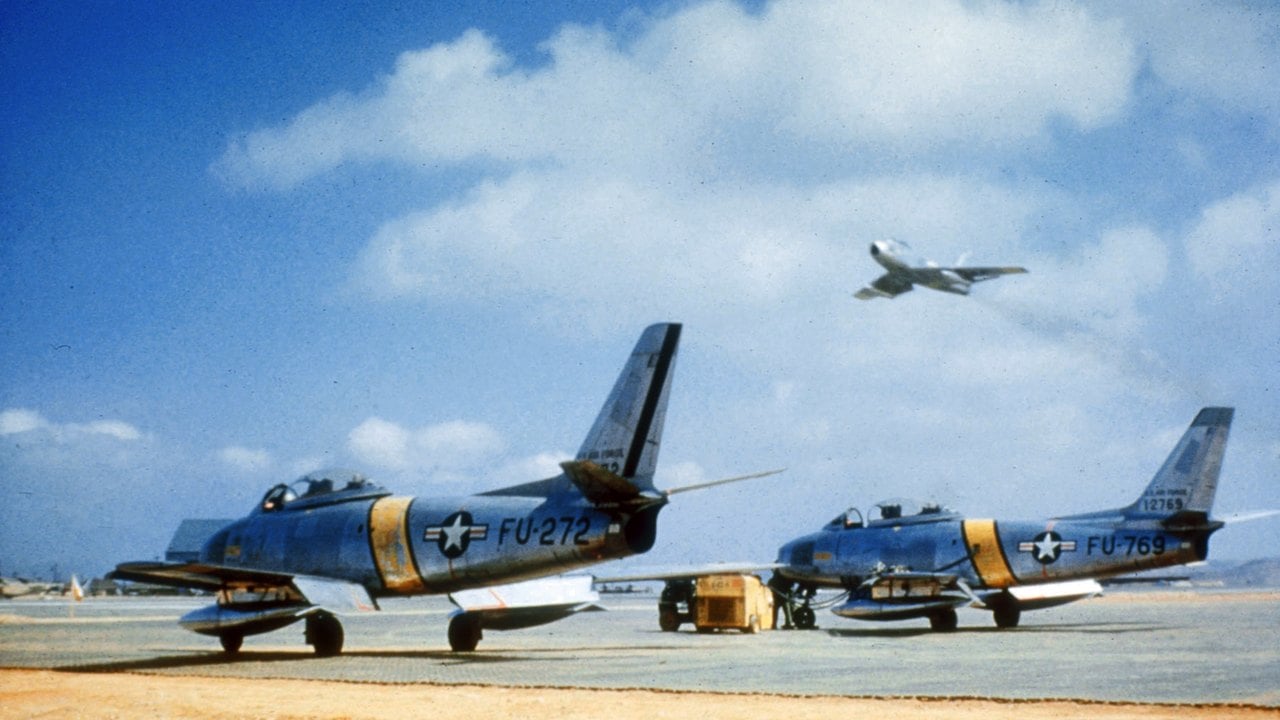
At Nellis Air Force Base in the 1950s, a young instructor at the Fighter Weapons School had a standing offer for anyone who thought they could fly. Start with him sitting in front of you, on your “six,” in perfect firing position. Within 40 seconds he would reverse the situation and have you in his gunsight, or he would pay you 40 dollars. According to the Air University Press, he never lost the bet.
The instructor was John Boyd, and the habit of mind behind that trick became the most quoted idea in modern military thinking: the OODA loop. Observe, orient, decide, act. It sounds like something you could print on a coffee mug, and it often is. But the version Boyd actually drew is stranger, richer and far more useful than the slogan.
Quick Facts
- What it is: A model of decision-making in conflict: observe, orient, decide, act
- Creator: Col. John R. Boyd, US Air Force fighter pilot and theorist (retired 1975)
- Also called: The Boyd cycle, or the decision cycle
- Origin: Air-to-air combat and Boyd’s idea of “fast transients”
- Key briefing: “Patterns of Conflict,” part of “A Discourse on Winning and Losing”
- Famous diagram: “The Essence of Winning and Losing,” 28 June 1995
- Most important step: Orientation, which Boyd called the Schwerpunkt (focal point)
- In doctrine: US Marine Corps Warfighting (MCDP 1)
From fighter tactics to a theory of conflict
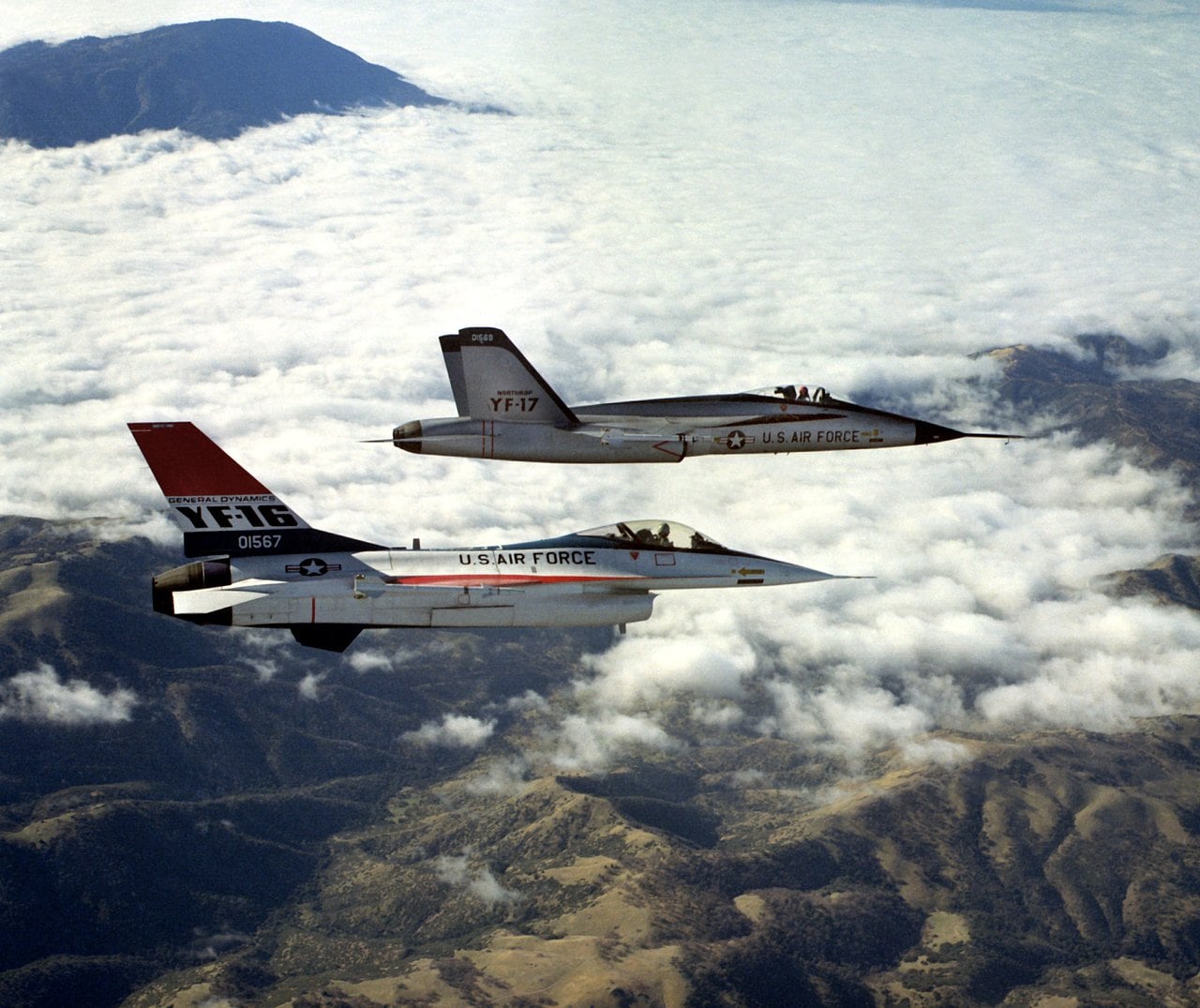
Boyd joined the Air Force in 1951, flew briefly in Korea at the very end of the war and retired as a colonel in 1975. In between he wrote the “Aerial Attack Study,” described by Air University as the first manual on air-to-air jet combat, and developed Energy-Maneuverability theory with mathematician Tom Christie. That work fed directly into the F-15 Eagle and the lightweight fighter that became the F-16.
In retirement he turned from aircraft to conflict itself. His briefing “Patterns of Conflict” started as a 90-minute talk and grew, by Air University’s count, to 327 view graphs. Together with four other parts it became “A Discourse on Winning and Losing,” a presentation that could run for 15 hours and was passed from officer to officer for years before it was ever printed.
The Legends of Airpower episode on John Boyd, from fighter tactics instructor to the designer of a theory of conflict.
The starting point was air-to-air combat. Boyd looked at what let one fighter beat another and concluded that raw performance numbers were not the whole story. What mattered was how quickly a pilot and his aircraft could change from one manoeuvre to another, what he called “fast transients.”
The four steps, and why the second one matters most
The simple version goes like this. You observe what is happening. You orient, making sense of it. You decide what to do. You act. Your action changes the situation, so you observe again, and the loop restarts. The US Marine Corps doctrine manual Warfighting sums it up in exactly those terms, and adds the punchline that made the concept famous.
That is where most explanations stop, and where Boyd’s own diagram gets interesting. He drew it in “The Essence of Winning and Losing,” a four-slide brief dated 28 June 1995 that he called “the big squeeze,” the final compression of everything he had learned. It is not a neat circle at all.
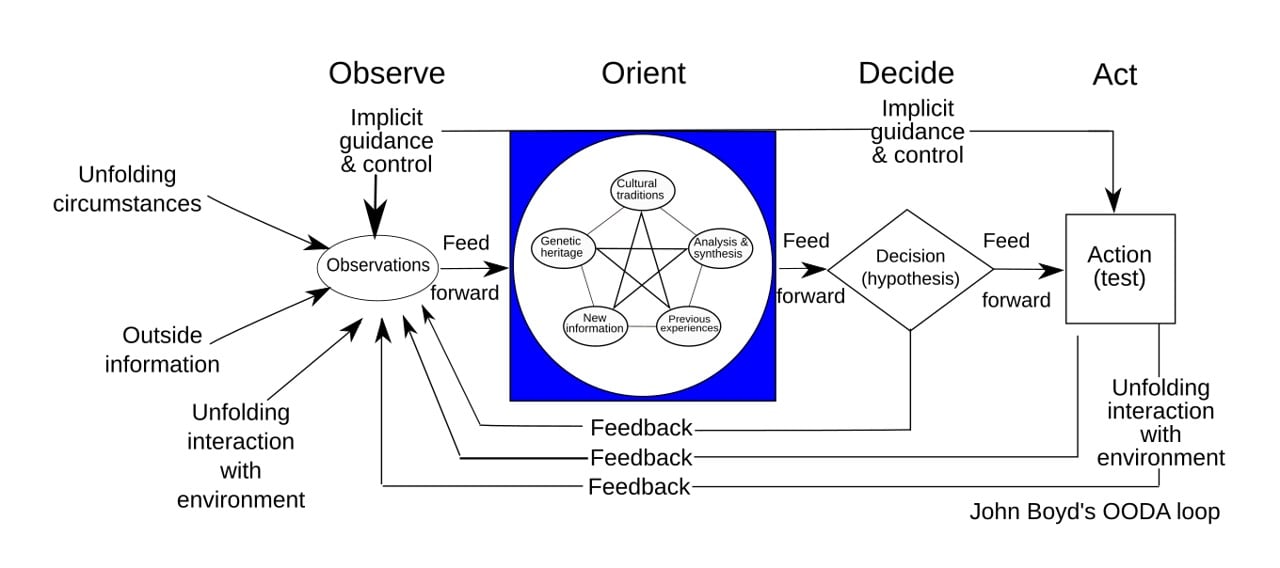
The orient box sits at the centre, and it is crowded. Inside it Boyd placed genetic heritage, cultural traditions, previous experiences, new information, and analysis and synthesis, all interacting. Feedback lines run back to observation from decision and action. And a line labelled “implicit guidance and control” runs straight from orientation to action, skipping the decision step entirely.
That shortcut is the real aha. A well-trained fighter pilot does not consciously decide to roll into a defensive break when he sees a missile launch; his orientation, built from years of training, sends him straight to the action. The fastest loop is not the one where every step is rushed. It is the one where good orientation lets you skip steps altogether.
Getting inside the other side’s loop
In “Patterns of Conflict,” Boyd listed three examples of the idea at work: Blitzkrieg against the Maginot Line mentality in 1940, the Israeli raid of 1976 and, from his own world, the F-86 against the MiG-15 over Korea from 1951 to 1953.
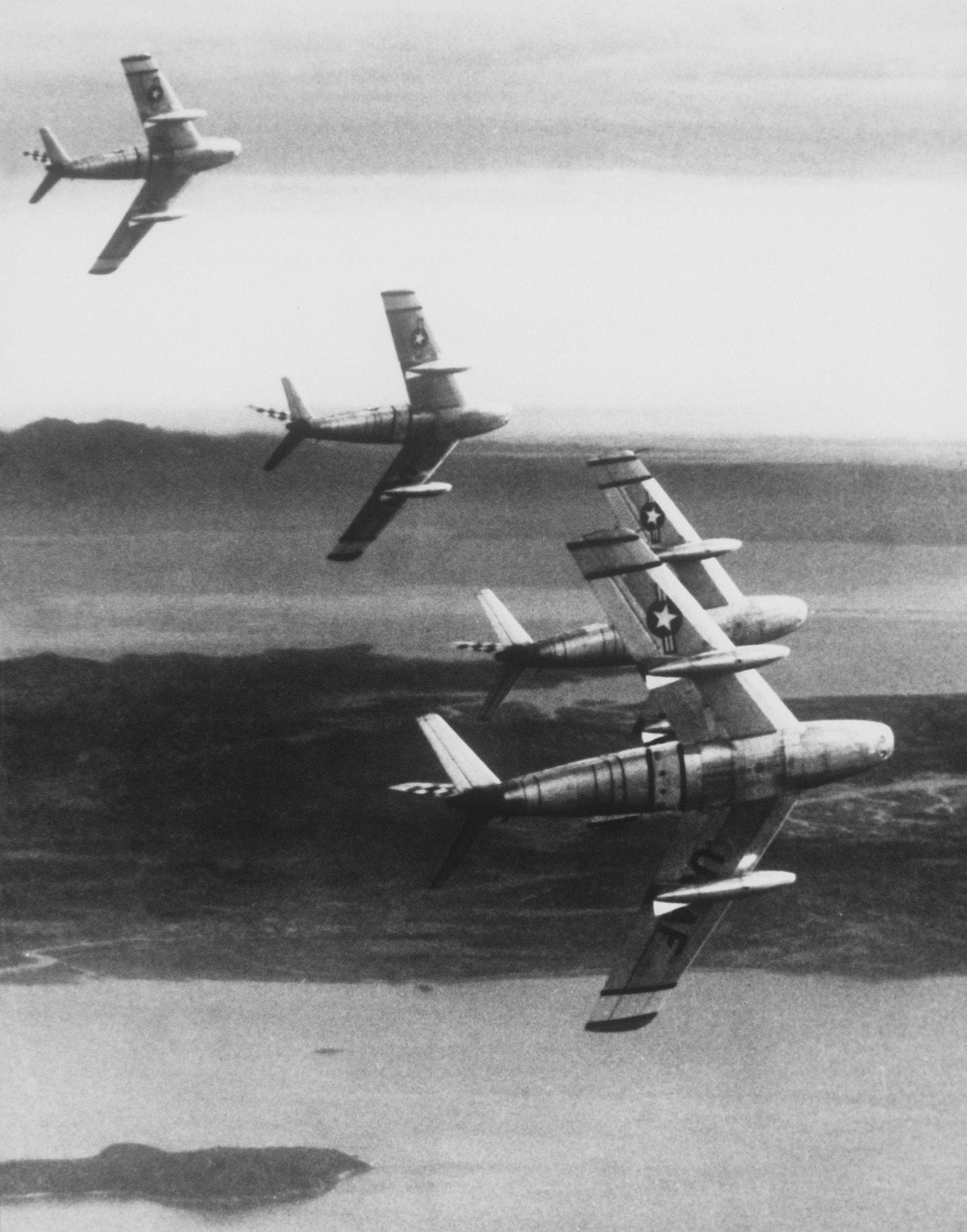
The goal, in Boyd’s own words on the slide that follows, was to “collapse adversary’s system into confusion and disorder.” Speed alone does not do that. What does is changing the situation faster than the opponent can build an accurate picture of it, so that every decision he makes is already out of date when he acts on it.
Boyd’s recipe for air-to-air and air-to-ground combat reads almost like a specification for a modern fighter: quick, clear scanning sensors; suppressed or distorted signatures; quick-shoot fire control and high-speed weapons; supercruise; rapid energy gain and loss; and high pitch, roll and yaw rates combined with ease of control. In other words, see first, be hard to see, and make the other pilot’s picture of the fight wrong.
Boyd himself delivering his “Patterns of Conflict” lecture to congressional staffers, copied from a tape in the Boyd Collection at the US Marine Corps Archives.
Orientation as the centre of gravity
Boyd borrowed a German term to say how much weight he put on that second O. Orientation, he wrote, is the Schwerpunkt, the focal point of the whole process.
This is why the OODA loop is about more than reaction time. Two pilots with identical reflexes can run very different loops if one has a better picture of the fight. It also explains why Boyd cared so much about deception and ambiguity: if you can corrupt the other side’s orientation, everything downstream of it, his decisions and his actions, goes wrong with it.
Boyd took the idea well beyond the cockpit. He argued that the observation, orientation, decision, action process is what happens in command and control, so the OODA loop can be thought of as the command-and-control loop. Getting inside an enemy’s loop at the level of an army or a whole government follows the same logic as it does in a turning fight.
Why it still matters
Boyd died in 1997. His ideas outlived the opposition they met inside the Air Force. His views on manoeuvre warfare helped change the US Marine Corps, whose doctrine manual credits him by name, a building at Nellis was named after him, and Air University Press finally published the full “Discourse” in March 2018. Strategist Colin Gray, quoted in that edition, paid the loop a rare compliment.
The most common mistake is to treat the OODA loop as a race to the bottom of a checklist. Boyd’s own drawing argues the opposite. The winner is the side that sees clearly, understands what it sees, and acts while the opponent is still trying to work out what just happened.
Major Ian T. Brown explains John Boyd and the OODA loop in a talk recorded in 2020.
That is what Boyd was doing at Nellis with 40 dollars on the line. He was not just faster on the stick. He was already flying the next manoeuvre while his opponent was still making sense of the last one.
Sources: John R. Boyd, A Discourse on Winning and Losing, ed. Grant T. Hammond (Air University Press, 2018), US Marine Corps MCDP 1 Warfighting, Grant T. Hammond, The Mind of War: John Boyd and American Security


0 Comments