
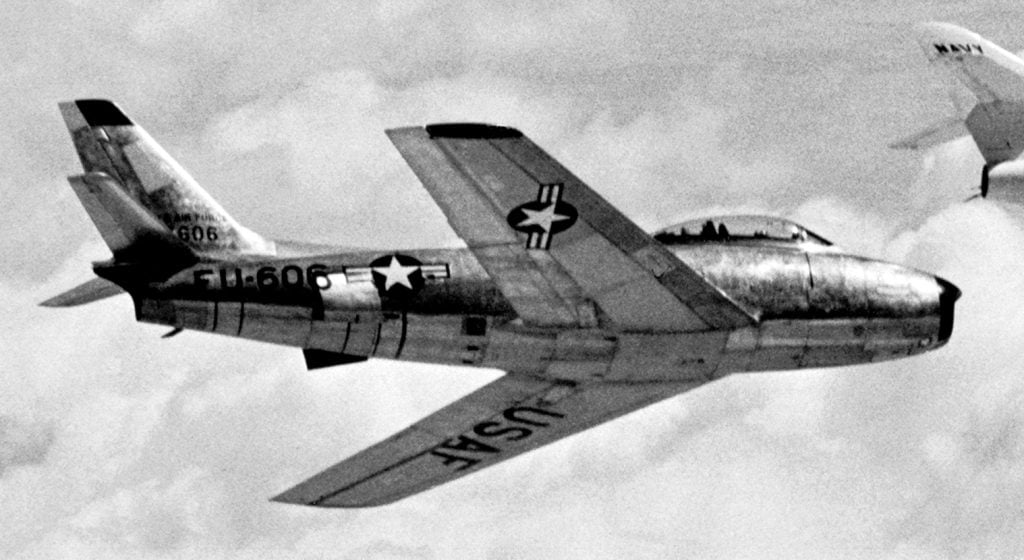
North American F-86
“Sabre”
America’s first swept-wing jet fighter and the star of “MiG Alley” — where, from December 1950, it fought the Soviet MiG-15 in history’s first sustained jet-versus-jet air war and set the template for every dogfight since.
The jet that won MiG Alley
The F-86 Sabre was the first American swept-wing jet fighter. North American Aviation began it as a straight-wing naval fighter in the FJ-1 Fury lineage, but in 1945 its engineers redesigned the wing after studying captured German wartime swept-wing research, adopting a 35-degree sweep to delay compressibility at high speed. The prototype XP-86 first flew on 1 October 1947, and the F-86A entered USAF service in 1949 — the first swept-wing fighter America put on the line.
Its legend was forged in “MiG Alley,” the corridor of far-northwest Korea where, from December 1950, Sabres met the Soviet-built MiG-15 in history’s first sustained jet-versus-jet combat. Both were swept-wing, transonic and closely matched: the MiG climbed higher and hit harder with cannon; the Sabre dived faster, turned better low down, and gave its pilot a far better view and a radar-ranging gunsight. The USAF long publicised a lopsided 10:1 kill ratio — a figure now heavily disputed (see the combat record below), though the Sabre’s hold on UN air superiority is not.
Roughly 9,860 Sabres were built across North American, Canada’s Canadair and Australia’s Commonwealth Aircraft Corporation, plus licence assembly in Italy and Japan. Some 30 air forces flew the type over four decades — and it kept making history, from the world’s first air-to-air missile kills over the Taiwan Strait in 1958 to frontline service in the 1965 Indo-Pakistani War, with the last examples retiring abroad in the 1990s.
01The F-86 Sabre’s numbers: how ~9,860 swept-wing fighters armed the free world
Production of the F-86 Sabre ran from 1949 to 1956 and totalled roughly 9,860 airframes. North American Aviation built about 6,300; Canadair in Canada built around 1,815 under licence (several marks, up to the Rolls-Royce Avon-powered Sabre Mk 6); and Australia’s Commonwealth Aircraft Corporation built 112 cannon-armed CAC Avon Sabres. Further licence assembly took place in Italy and Japan.
The families split two ways. The gun-armed F-86A/E/F were the definitive day-fighter dogfighters of Korea; the radar-nosed F-86D/K/L “Sabre Dog” traded guns for rockets to become an all-weather interceptor; and the fighter-bomber F-86H closed the line. That spread is why the Sabre ended up in some 30 air forces on every inhabited continent — the Western answer to the MiG-15 it fought over Korea.
What makes the F-86 special
The 35-degree swept wing
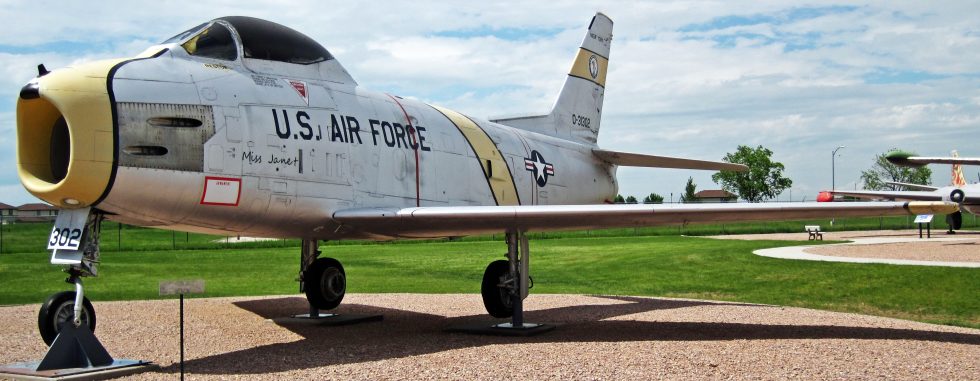
The Sabre’s defining feature is its 35-degree swept wing with automatic leading-edge slats. The German-inspired sweep pushed the F-86’s usable speed toward Mach 0.9, while the slats preserved low-speed handling and turn performance — a decisive edge in a tight dogfight where rivals stiffened up near the sound barrier.
The radar-ranging gunsight
Coupled to an AN/APG-30 ranging radar, the Sabre’s A-1CM / A-4 gunsight computed the firing solution automatically — a genuine combat advantage over the MiG-15’s simpler optical sight. It let a good pilot open fire with the odds already stacked in his favour. (Sub-model designations vary by production block.)
The “all-flying” tail
From the F-86E onward, an all-moving horizontal stabiliser replaced the conventional fixed-stabiliser-plus-elevator arrangement. It restored the pitch control that ordinary tails lost near the speed of sound — a key transonic breakthrough that gave Sabre pilots authority their MiG opponents lacked.
02The F-86 Sabre’s wing: German research, American fighter
North American’s Sabre was born straight-winged, then reborn with a 35-degree sweep after engineers studied captured German aerodynamic data at the end of World War II. The gamble worked: the Sabre flirted with Mach 0.9 while contemporaries stalled at the sound barrier, and automatic leading-edge slats kept it docile enough for a conscript-trained air force to land safely. It is the single design choice that made the F-86 both fast and flyable — and the shape every later jet fighter inherited.
03The F-86 Sabre vs the MiG-15: a fight decided by the pilot
Over MiG Alley the two jets were uncannily close. The MiG-15 climbed higher, accelerated well at altitude, and carried heavier cannon; the Sabre dived faster, turned better at low level, and offered a bubble canopy, a G-suit and the radar-ranging gunsight. Neither machine dominated on paper. That is why the human factor mattered so much: American training, combat experience and crew equipment repeatedly tipped fights the Sabre’s way — and why the true Korean kill ratio remains so fiercely argued.
Full specifications
All figures below are for the F-86F — the definitive day-fighter Sabre, the most numerous mark and the aircraft most people mean when they say "Sabre". Earlier F-86A and F-86E airframes, the radar-nosed F-86D interceptor, the heavier F-86H fighter-bomber and the licence-built Canadair and CAC Sabres differ, sometimes sharply; those deltas are given in grey.
Dimensions & weights
- Crew
- 1 pilot
- Length
- 11.30 m 37 ft 1 in
- Wingspan
- 11.30 m 37 ft 1 in, 35-degree sweep
- Height
- 4.29 m 14 ft 1 in
- Wing area
- 29.11 m² 313.4 sq ft
- Empty weight
- 5,046 kg 11,125 lb
- Loaded weight
- 6,894 kg 15,198 lb, clean
- Max takeoff weight
- 8,234 kg 18,152 lb, with tanks and stores
- Internal fuel
- ~1,650 L ~437 US gal; two 200 US gal drop tanks typical
Performance
- Max speed (altitude)
- 964 km/h 599 mph at 35,000 ft (10,700 m); about Mach 0.90
- Max speed (sea level)
- 1,106 km/h 687 mph at sea level
- Cruise speed
- 782 km/h 486 mph
- Rate of climb
- 45.7 m/s 9,000 ft/min initial, clean; the MiG-15bis bettered this
- Service ceiling
- 15,100 m 49,600 ft
- Combat radius
- ~670 km ~415 miles on internal fuel plus two drop tanks
- Ferry range
- ~2,450 km ~1,525 miles with two 200 US gal tanks
- Takeoff run
- 790 m 2,600 ft at gross weight, sea level, dry runway
- Landing run
- 730 m 2,400 ft on brakes alone; no drag chute fitted
Propulsion & systems
- Engine
- General Electric J47-GE-27 one single-shaft axial-flow turbojet, no afterburner
- Thrust
- 26.3 kN 5,910 lbf dry; the F-86D's afterburning J47-GE-17 gave 33.4 kN / 7,500 lbf
- Cannon / guns
- 6 × .50 in M3 Browning 267 rounds per gun, 1,602 total; about 1,200 rounds per minute each
- Hardpoints
- 2 underwing pylons F-86F-40 and F-86H added outboard stations; drop tanks normally occupy the inboard pair
- Max ordnance
- ~910 kg ~2,000 lb typical, two 1,000 lb bombs or napalm and rockets; the F-86H was cleared for more, including a single tactical nuclear store
- Swept wing
- 35 degrees at quarter-chord the decisive design choice, taken after captured German swept-wing research reached North American in 1945 and the straight-wing XP-86 was redrawn; the hard extended "6-3" leading edge on later F models raised the critical Mach number and sharpened transonic handling at the price of a higher stall speed and a nastier low-speed departure
- Radar gunsight
- A-1CM with AN/APG-30 radar-ranging computing sight; it fed true target range to the sight instead of leaving the pilot to estimate it, and was a genuine edge over the MiG-15's simple gyro sight
- Ejection seat
- North American ballistic seat cartridge-fired, not zero-zero; safe escape needed altitude and speed
- First flight
- 1 October 1947 XP-86 prototype, Muroc Dry Lake, California
- Service entry
- 1949 F-86A with the 1st Fighter Group from February 1949
- Built
- ~9,860 all variants including Canadair, CAC and Mitsubishi licence production
- Unit cost
- ~US$219,000 F-86F flyaway, early 1950s; very roughly US$2.5m in today's money, and quoted figures vary with how spares and engines were counted
- Cost per flight hour
- ~US$6,000–10,000 modern civilian warbird estimate, fuel, insurance and reserves included; no authoritative published figure exists and real costs swing widely with engine condition and utilisation
04The F-86 Sabre’s specs and cost: read the fine print
Figures for the F-86 vary by source and sub-block, so treat single numbers with care. Top speed is usually quoted around 685–690 mph at sea level (Mach ~0.9) and lower at altitude; the Sabre could only exceed Mach 1 in a dive. The day fighters used the M3 .50 cal machine gun (some references wrongly say M2); a handful of blocks and the Australian CAC Sabre carried 20–30 mm cannon instead. Period unit-cost estimates for the F-86F sit around US$178,000–219,000; a widely-circulated $1.2 million figure appears to conflate the Avon Sabre and inflation and should not be applied to the F-86F. No credible cost-per-flight-hour figure exists in open sources.
Armament & payload
The Sabre fought with six rifle-calibre-plus machine guns and a radar gunsight — and its rivals hit harder
The F-86 entered the jet age with an armament fit inherited more or less intact from the P-51: six .50 calibre Brownings in the nose, chosen for volume of fire and ease of aiming rather than for destructive power. That decision defined how Sabre pilots fought, and it is the single most argued point in the aircraft's combat record. What the Sabre added was not a bigger gun but a better way of pointing the one it had.
Guns
Six .50 in M3 Browning machine guns, three per side in the nose, 267 rounds each and roughly 1,200 rounds per minute per gun — a dense, flat-shooting stream that was easy to aim and forgiving of small tracking errors. The honest qualification is that .50 calibre was marginal against the MiG-15. The Soviet fighter was structurally robust, and Sabre pilots repeatedly reported MiGs absorbing long bursts and flying home. The MiG's answer — one 37 mm N-37 and two 23 mm NR-23 cannon — was devastating when it connected, a single 37 mm hit often being enough, but the guns fired slowly, the two calibres had different trajectories, and hitting a hard-manoeuvring Sabre with them was genuinely difficult. Two opposite compromises, each with a real cost.
Air-to-air missiles
Late-mark Sabres and, most significantly, Republic of China Air Force F-86Fs were wired for the first-generation AIM-9B Sidewinder, an uncooled rear-aspect seeker that needed a clean tail-on shot against a hot exhaust and clear sky. On 24 September 1958, over the Taiwan Strait, Nationalist Chinese Sabres fired Sidewinders at PLAAF MiG-17s in what is generally recorded as the first combat use of an air-to-air guided missile and the first missile air-to-air kills. Claim totals for that engagement are disputed, and at least one unexploded Sidewinder is widely reported to have been recovered and reverse-engineered by the Soviets into the K-13 / AA-2 Atoll.
Bombs
In the fighter-bomber role the Sabre carried up to about 910 kg (~2,000 lb) on two underwing pylons — typically two 1,000 lb general purpose bombs, or napalm tanks, with the inboard stations otherwise taken by drop tanks. Range and payload always traded against each other. The F-86H, built as a dedicated fighter-bomber with a deeper fuselage and more thrust, carried a heavier and more varied load and was cleared for a single tactical nuclear store using the low-altitude bombing system.
Rockets
Ground-attack Sabres carried 5 in HVAR rockets on underwing stubs, the standard American air-to-ground rocket of the period, used against vehicles, bunkers and rolling stock in Korea. Air-to-air rocketry was a different matter entirely and belonged to the F-86D: a retractable ventral tray of twenty-four 2.75 in Mighty Mouse folding-fin aerial rockets, salvoed by the fire-control system into the predicted path of a bomber.
Gunsight & fire control
The A-1CM computing sight coupled to the AN/APG-30 ranging radar was one of the Sabre's quiet advantages. The radar measured range to the target and fed it into the sight, which then computed the correct lead; the pilot tracked, and the pipper told him the truth about deflection instead of asking him to guess. Against a MiG-15 flown on a plain gyro sight this mattered, and it mattered most at the long, high-deflection shots that were common in the sort of high-speed diving fights the Sabre preferred. Early sets were unreliable and many pilots used them in a fixed mode when the radar misbehaved.
Interceptor & special fits
The F-86D "Sabre Dog" was a different aeroplane behind the same wing: a single-seat all-weather interceptor with an AN/APG-36 search radar in a nose radome above a chin intake, an afterburning J47, an E-4 fire-control system and no guns at all — its entire armament was the Mighty Mouse rocket tray. The NATO F-86K reversed that decision, replacing the rocket tray and its complex fire control with four 20 mm cannon for European air forces. The F-86H and the Italian-assembled Ks brought cannon to the family, and the Australian CAC Sabre went further with two 30 mm ADEN.
Three typical Sabre fits
- MiG alley combat air patrol
- Six .50 in M3 Brownings with a full 1,602 rounds, two 120 US gal drop tanks on the inboard pylons, no other stores. the standard F-86E/F fit over north-west Korea; the tanks were jettisoned on contact and endurance in the patrol area was often only a few minutes
- Fighter-bomber, close support
- Two 1,000 lb bombs or two napalm tanks on the underwing pylons, guns loaded, no drop tanks. F-86F work over the front line; short radius, and the Sabre was vulnerable while heavy and low
- All-weather interception, F-86D
- Twenty-four 2.75 in Mighty Mouse FFAR in the retractable ventral tray, E-4 fire control, afterburning J47, no guns. a single salvo pass against a bomber formation, flown largely on the radar and the autopilot-coupled attack steering
Armament on the Sabre is strongly mark-dependent, and general statements about "the Sabre's guns" are usually wrong for some large part of the fleet. The day fighters kept six .50 in machine guns; the F-86H and the NATO F-86K carried four 20 mm cannon; the Australian CAC Sabre carried two 30 mm ADEN; the Canadair Mk 5 and Mk 6 kept the six .50s while gaining far more thrust; and the F-86D carried no guns whatever. Round counts, pylon fits and missile wiring also varied between production blocks and between air forces, so block-level sources are worth checking before quoting any single loadout.
Variants
From a straight-winged prototype to Orenda and Avon Sabres — and a kill ratio still being argued over
No part of the Sabre's record is more quoted or less settled than its exchange rate with the MiG-15 over Korea. The wartime USAF figure — roughly 792 MiGs destroyed for 78 Sabres lost in air combat, or about 10:1 — was compiled under wartime conditions from pilot claims and gun-camera film, with no access to enemy loss records. Later analysis has revised it substantially downward. Post-Soviet archival work showed that a large share of the MiGs were flown by Soviet air force pilots, whose own loss returns do not come close to matching American claims, while Soviet claims against Sabres are in turn far higher than USAF loss records admit. Modern estimates vary widely with the method and the sources trusted, and figures ranging from low single-digit ratios up to considerably higher have been argued in print. The honest position is that the true ratio is contested and probably unrecoverable to any precision, that both sides overclaimed in the way air forces always do, and that the Sabre nonetheless clearly finished the war on the better side of the ledger.
The technical comparison is easier to state fairly. The MiG-15bis out-climbed the Sabre, held a higher ceiling and could often sit above a Sabre formation choosing whether to engage, and its 37 mm and 23 mm cannon hit far harder than six .50s. The Sabre was better at high speed and in the dive, with hydraulically boosted controls and, from the E model, an all-flying tail that stayed effective where the MiG grew unpleasant; it had better cockpit visibility, a radar-ranging gunsight, and G-suits. The factor most historians weight heaviest is not technical at all: on average, USAF Sabre units were manned by far better trained and more experienced pilots, many of them Second World War veterans, and they faced opponents whose quality ranged from elite Soviet regiments to barely worked-up Chinese and North Korean units.
- F-86A
- First production day fighter, 554 built, in service from 1949 with a 5,200 lbf J47 and a conventional tailplane. It met the MiG-15 first and was the least well matched of the Sabres that did. 554 built
- F-86E
- Introduced the all-flying tail and fully hydraulic irreversible controls, which transformed handling at high indicated airspeed and near the Mach limit where the A model's elevator went heavy and vague. ~456 built, from 1951
- F-86F
- The definitive day fighter and the baseline for this page: J47-GE-27, and from the F-25 block the extended hard "6-3" leading edge that improved transonic manoeuvre at the cost of low-speed docility. The F-86F-40 restored a slatted, longer-span wing for the export and Japanese aircraft. ~2,540 built, much the largest single variant
- F-86D
- All-weather interceptor, so extensively changed it is close to a separate aircraft: nose radar over a chin intake, afterburning J47, E-4 fire control, no guns, twenty-four Mighty Mouse rockets in a ventral tray. ~2,504 built, the second most numerous mark
- F-86H
- Dedicated fighter-bomber with a deeper fuselage, a General Electric J73, greatly increased internal fuel and, on later production, four 20 mm M39 cannon in place of the machine guns; nuclear-capable via LABS. ~473 built
- F-86K
- NATO interceptor derived from the D for European air forces, with the rocket tray and its complex fire control replaced by four 20 mm cannon and a simplified MG-4 system. Many were assembled by Fiat in Italy. ~341 built plus Fiat assembly; flown by Italy, France, the Netherlands, Norway, West Germany and others
- FJ Fury
- The naval sibling, not a Sabre sub-variant: the straight-wing FJ-1 actually preceded the F-86, and the later swept FJ-2, FJ-3 and FJ-4 were navalised developments with cannon, folding wings, arrestor gear and their own structural lineage. ~1,100 of all Fury marks; covered on a separate page
- Canadair Sabre Mk 5 / Mk 6
- Canadian licence production with the Avro Canada Orenda engine — Orenda 10 in the Mk 5, Orenda 14 in the Mk 6 — giving substantially more thrust than the J47. The Mk 6 is widely regarded as the best-performing Sabre ever built, and many later served with the Luftwaffe and South Africa. ~1,815 Canadair Sabres of all marks, ~655 of them Mk 6
- CAC Sabre (CA-27)
- Australian licence build, and the most heavily reworked: a Rolls-Royce Avon in a widened fuselage with about 50 per cent more thrust than the J47, and two 30 mm ADEN cannon replacing the six machine guns. Served with the RAAF into the 1970s and later with Malaysia and Indonesia. 112 built
- Japanese licence build
- Mitsubishi assembled F-86F-40s for the JASDF from 1956, the first postwar Japanese combat aircraft production and the foundation of the modern Japanese aerospace industry; further F-86Ds were supplied directly. The Blue Impulse display team flew the type. 300 F-86F-40 built by Mitsubishi
The Sabre is effectively gone from military service — Bolivia was among the last operators, retiring its Canadair Sabres in the mid-1990s — but it is far from gone. A healthy number of airframes survive, and several dozen are airworthy in civilian hands, which makes the Sabre one of the more commonly flown early jets on the warbird circuit alongside the T-33 and the Hunter; Canadair Mk 5 and Mk 6 airframes are especially well represented because of their thrust and their availability as surplus. Many more sit as static exhibits in museums, on gate guard plinths and in collections worldwide, in North America, Europe, Japan, Australia, Latin America and beyond.
From German data to MiG Alley and beyond
The swept-wing idea
Captured German swept-wing research prompts North American to redesign the Sabre’s straight wing for a 35-degree sweep.
First flight
The XP-86 prototype flies for the first time, test pilot George Welch at the controls.
World speed record
An early F-86A sets a world air-speed record of roughly 671 mph.
Enters service
The F-86A joins the USAF — America’s first swept-wing fighter operational.
First MiG duel
Sabres and MiG-15s clash over MiG Alley in the first jet-versus-jet combat of the Korean War.
The definitive Sabres
The F-86E introduces the all-flying tail; the F-86F becomes the definitive Korean-War day fighter.
Korean armistice
The war ends with the Sabre credited with holding UN air superiority over the battlefield.
First missile kills
ROCAF (Taiwan) F-86Fs score history’s first air-to-air guided-missile victories with AIM-9 Sidewinders.
Long twilight
PAF Sabres fight in the 1965 Indo-Pakistani War; the type soldiers on abroad, with Bolivia among the last to retire it in 1994.
From the flight line: twelve Sabre stories
MiG Alley — where the jet dogfight was born
Over the Yalu from December 1950, Sabres and MiG-15s clashed at near-sonic speed.
Read the full story
The first missile kills
Taiwan Strait, 24 September 1958 — the day the heat-seeker changed air war.
Read the full story
The Canadair Sabre
A Canadian-built Sabre for NATO and the Commonwealth.
Read the full story
The Sabre aces
Thirty-nine names written across the Korean sky.
Read the full story
The swept-wing leap
German data, American fighter — the shape every jet inherited.
Read the full story
Warbird Sabres
Silver ghosts still flying — but not for hire.
Read the full story
Sabre vs Sabre-Slayer
1965 over the subcontinent, the Sabre met a tiny nemesis.
Read the full story
The 10:1 myth?
When Soviet archives opened, the famous kill ratio came under fire.
Read the full story
Record breaker
Barely a year after first flight, the Sabre was the fastest thing in the sky.
Read the full story
The Sabre Dog
A radar nose and a belly of rockets — a very different animal.
Read the full story
The Avon Sabre
Australia rebuilt the Sabre into the most powerful gun version of all.
Read the full story
The all-flying tail
An unglamorous fix that quietly won fights.
Read the full story
The Sabre in pictures
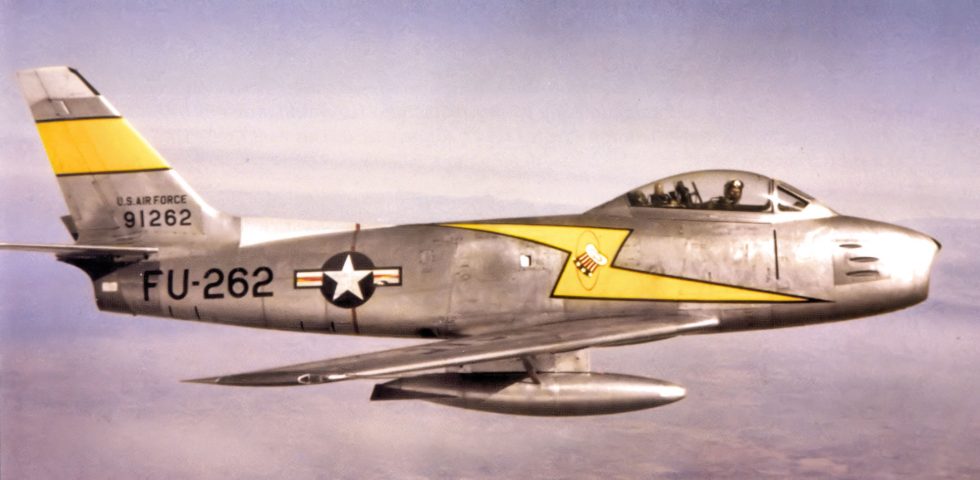
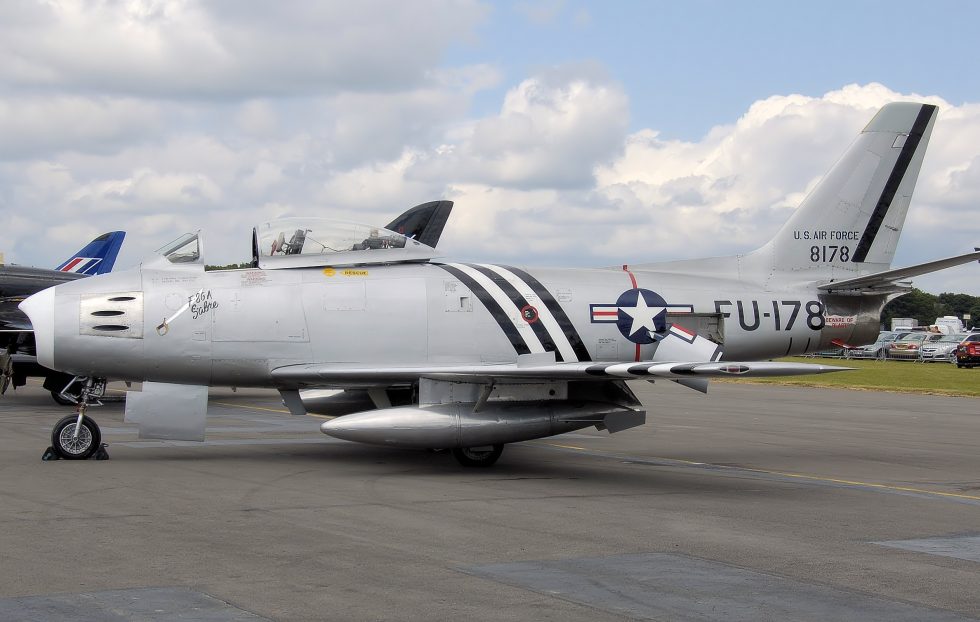
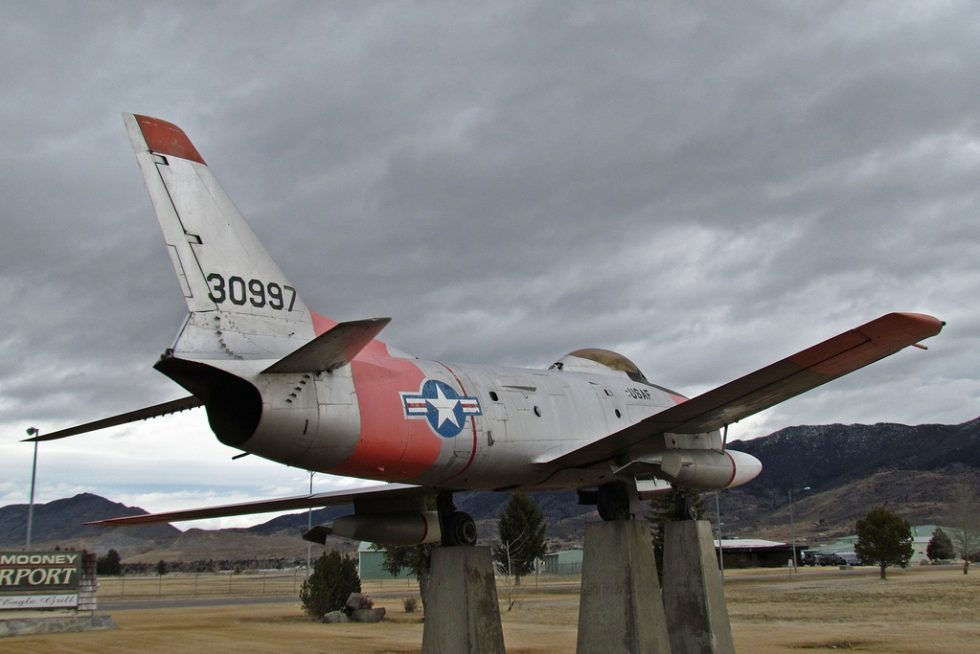
The F-86 Sabre in motion
A documentary on the Sabre and its MiG Alley duels is coming soon.
The F-86 Sabre in motion
Paper Skies — one of the most-watched F-86 Sabre films on YouTube.
Where the Sabre flew
MiG Alley, missiles and the 10:1 debate
The Sabre’s Korean kill ratio is the single most contested statistic on the aircraft, so treat every figure as a claim, not a settled score. The classic USAF claim was about 792 MiG-15s downed for 78 Sabres lost — a ratio near 10:1 (some period accounts cited up to 14:1). Since the Cold War, historians using Soviet-bloc records have argued the true figure was far lower: modern estimates range from around 7:1 down toward roughly 2:1, and some analysts contend engagements against experienced Soviet-flown MiG units were near even (about 1:1) in places. What is not in dispute is that the Sabre held UN air superiority over the battlefield for the whole war.
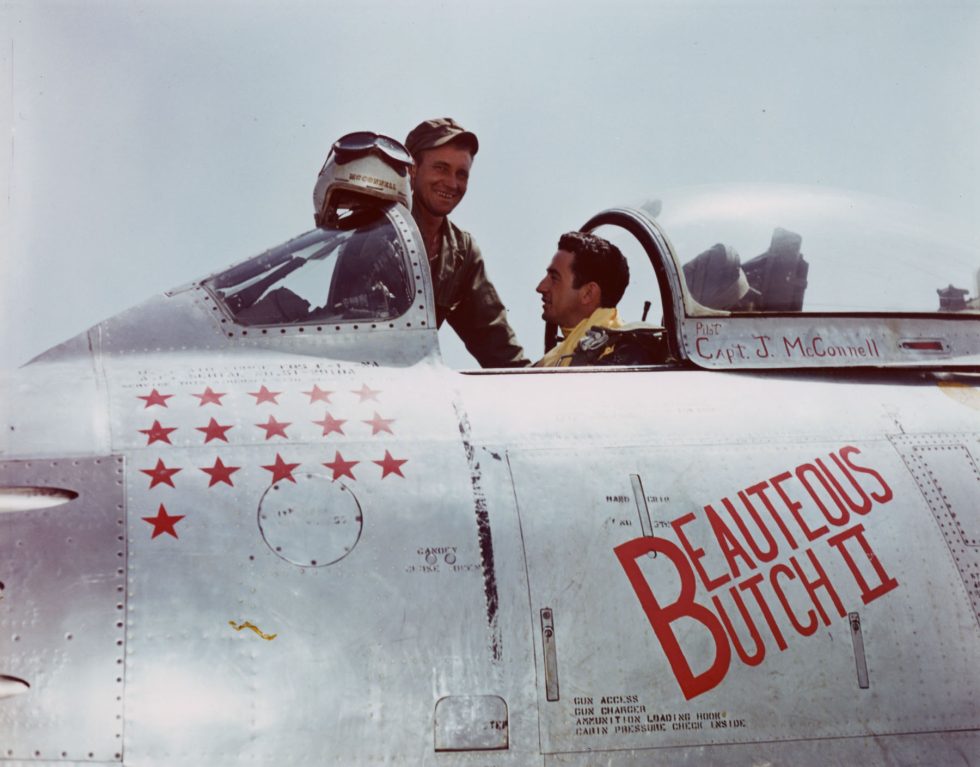
Korea produced some 39 US Sabre aces, including top scorer Joseph McConnell (16 kills) and first-ever jet ace James Jabara. Compare the combat record of every military aircraft. Figures as of July 2026.
Everything people ask about the F-86 Sabre
Can I fly in an F-86 Sabre?
Was the F-86 fast?
Could the F-86 reach Mach 1?
Was the 10:1 Korean kill ratio real?
How did the F-86 compare to the MiG-15?
How many F-86 Sabres were built?
Were there other versions?
What did the F-86 fight in?
You can’t fly the F-86.
These, you can.
Some legends only live in museums — others are fuelled and waiting. MiGFlug has put civilians in real military jet cockpits since 2004.
 Fly the L-39 AlbatrosThe world’s most-flown jet trainer — aerobatics included
 Fly the F-104 Starfighter“The missile with a man in it”
 Fly the MiG-21The Cold War’s most-produced jet
 Fly the T-33 Shooting StarAmerica’s first jet trainer
 Fly the DH VampireA piece of early jet history
 Fly the S.211Agile Italian jet trainer
 Fly the MB-326The classic Aermacchi jet
 Fly the MiG-15The Soviet legend of the Korean War
Continue the tour
Every fact, checked
- MilitaryFactory — North American F-86 SabreProduction, variants and specification overview.
- Airplanes-Online — F-86 SabreHistory and specifications of the day-fighter Sabres.
- The Aviation Geek Club — Walter J. Boyne on the 10:1 ratioThe case that the famous Korean kill ratio was overstated.
- The War Zone — first Sidewinder kill, 1958The Taiwan Strait engagement and history’s first missile kills.
- ThePrint — PAF Sabres in the 1965 warThe Sabre’s frontline role and its contested 1965 tallies.
- PlaneHistoria — “30 different air forces”The Sabre’s worldwide operator spread.
- Planes of Fame Air Museum — F-86FAirframe history and preserved-Sabre context.
- GlobalMilitary — F-86 SabreSpecifications and operators (note: some figures describe the Avon Sabre, not the F-86F).