
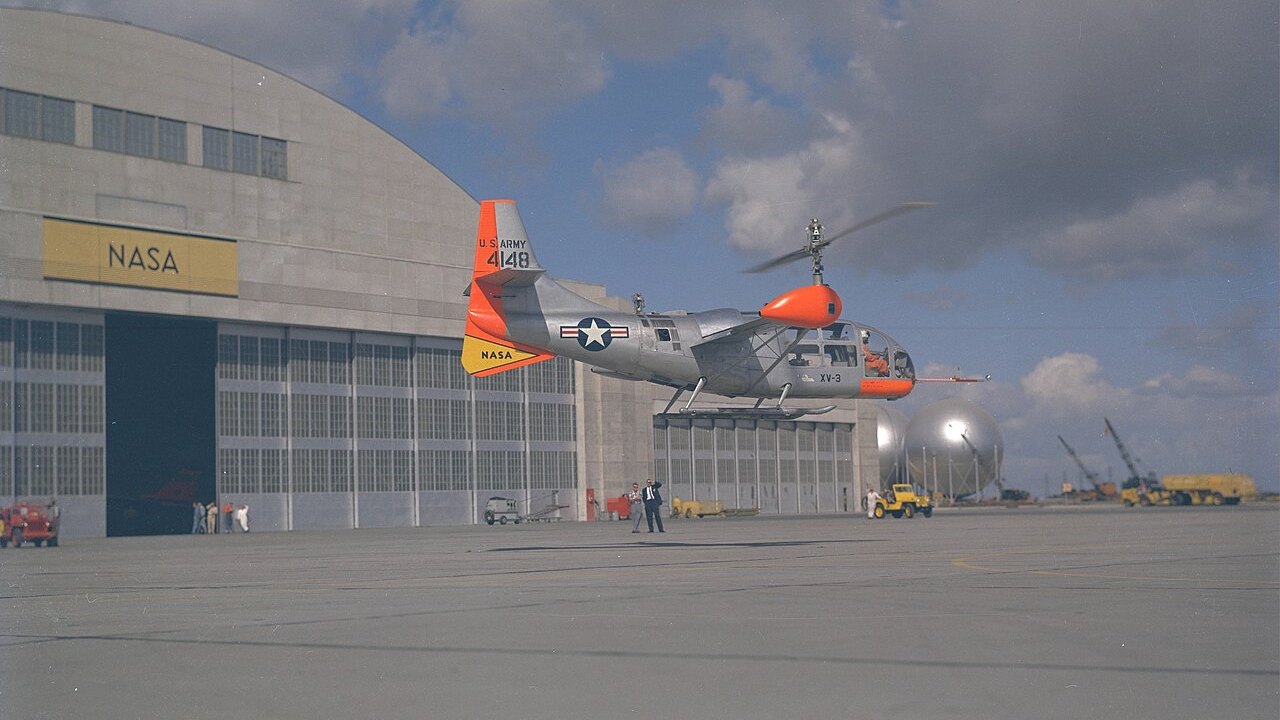
On 18 December 1958, at Bell, test pilot Bill Quinlan did something no one had managed in three years of trying. He lifted a small, silver, helicopter-like machine off the ground, then slowly tilted its two wingtip rotors forward until they were spinning like propellers, and flew on as an aeroplane. Nothing shook itself apart.
The machine was the Bell XV-3, and that flight was the first dynamically stable full conversion of a tiltrotor from helicopter mode to airplane mode. Every V-22 Osprey flying today traces its family tree straight back to that afternoon.
Getting there had cost one airframe, one seriously injured test pilot and a near-collapse of faith in the whole idea. The XV-3 was slow, underpowered and difficult to fly. It also proved the one thing that mattered.
Quick Facts
- Aircraft: Bell XV-3 (Bell Model 200) tiltrotor research aircraft
- Programme: US Army and Air Force Convertible Aircraft Program, launched 1951; contract for two aircraft October 1953
- First hover: 11 August 1955, pilot Floyd Carlson
- First stable full conversion: 18 December 1958, pilot Bill Quinlan
- Engine: One 450 hp Pratt & Whitney R-985 radial in the fuselage driving two wingtip rotors
- Speed: 115 knots in level flight, 155 knots in a dive
- Record: 110 full conversions in 125 flight hours by ten test pilots
- Survivor: Tail number 4148, National Museum of the US Air Force, Dayton, Ohio
A convertiplane for the Army and Air Force
In 1951 the US Army and Air Force launched the Convertible Aircraft Program and asked industry for a “convertiplane”: an aircraft that could take off and land like a helicopter but cruise faster and farther like a fixed-wing aeroplane. Bell answered with the Model 200, a tiltrotor championed by engineer Bob Lichten, the principal advocate of the concept.
In October 1953 the services awarded Bell a contract for two full-scale aircraft. The layout was simple on paper. A 450 hp Pratt & Whitney R-985 radial engine sat in the fuselage behind the wing. Shafts carried its power out to gearboxes at each wingtip, and electric actuators pivoted those gearboxes, and the rotors on top of them, through 90 degrees from vertical to horizontal.
The pilot flew it with helicopter controls: cyclic stick, collective with a twist-grip throttle, and rudder pedals. There was no stability augmentation of any kind. As the rotors tilted forward, the system automatically blended out the helicopter-style controls so the aircraft could be flown like an aeroplane.
Shaken to pieces
The first XV-3 made its initial hover flight on 11 August 1955 with Bell test pilot Floyd Carlson at the controls. Within the same flight he felt a heavy vibration. A week later, on 18 August, the rotor dynamic instability came back and caused a hard landing with minor airframe damage.
Bell grounded the aircraft, investigated, and flew again on 29 March 1956. On 25 July the instability returned. Engineers of the 1950s had no computer model of how a rotor, a pylon and a flexible wing would interact, so every fix had to be found by combining primitive analysis with tied-down ground runs.
Archive footage of Bell XV-3 flight tests from the 1950s, showing the tiltrotor hovering and flying with its rotors tilted.
On 25 October 1956, Bell test pilot Dick Stansbury tilted the rotor shafts 17 degrees forward from vertical. A violent rotor instability set in, the cockpit vibrations became so extreme that he blacked out, and the first XV-3 crashed. Stansbury was seriously injured and the aircraft never flew again.
According to NASA’s official history of the tiltrotor, the crash pushed the programme into crisis and made even some of the concept’s keenest supporters question whether the technology was ready. The supporters held on.
Two blades and a wind tunnel
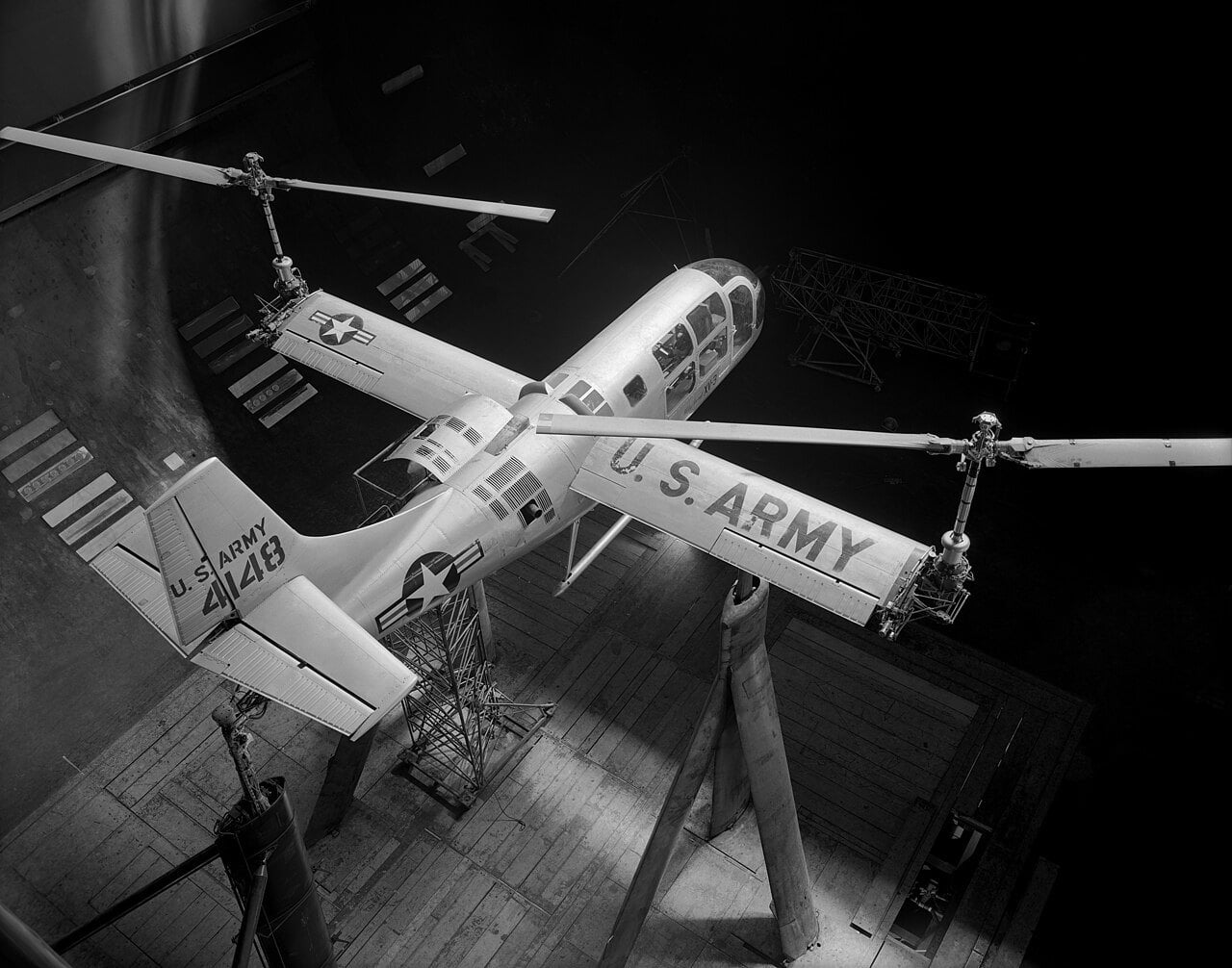
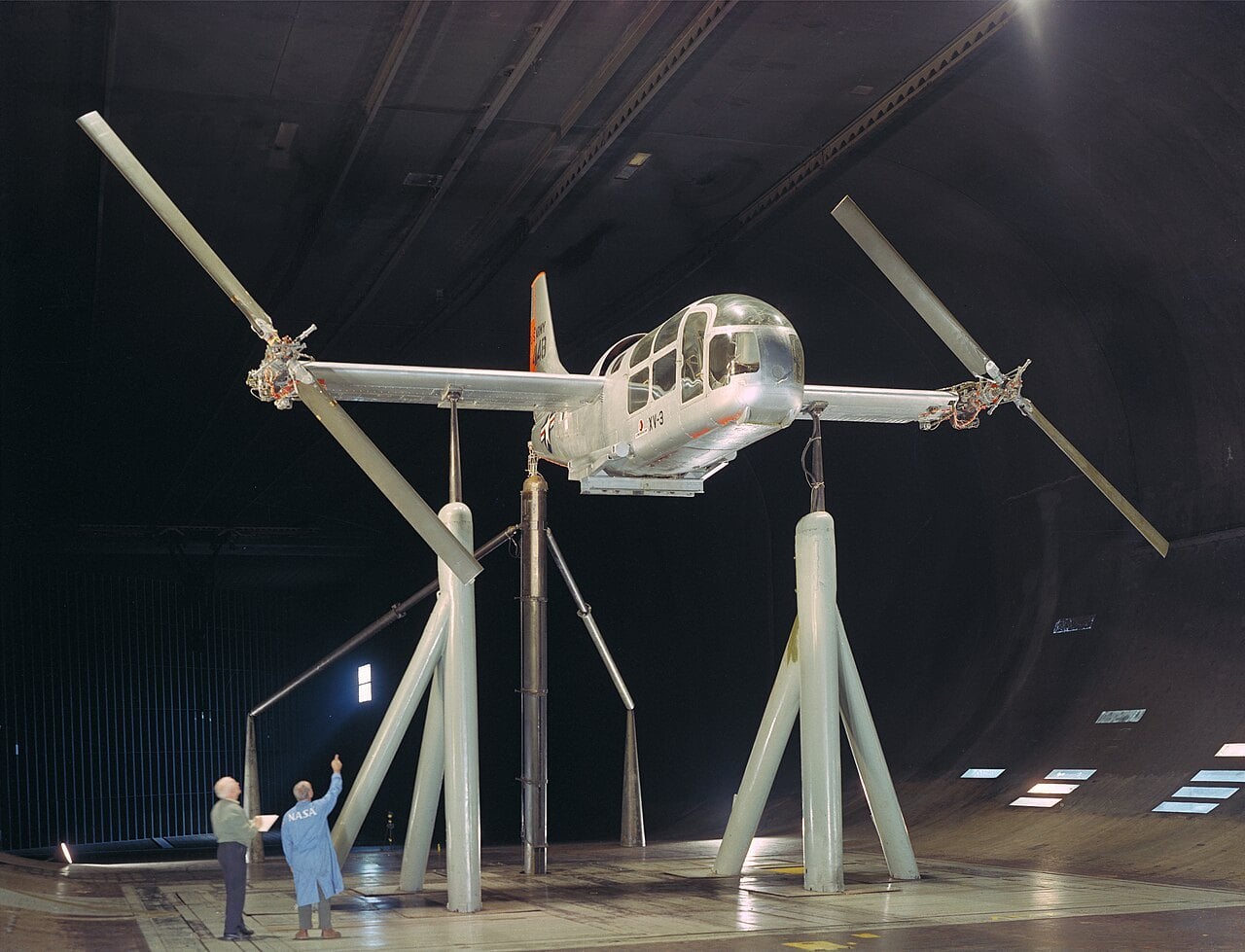
The second XV-3 was rebuilt with a completely different rotor. The original three-bladed, 25-foot articulated rotors gave way to two-bladed stiff-inplane rotors, and the aircraft went into the 40- by 80-foot wind tunnel at the NACA Ames Aeronautical Laboratory in California.
Over the next 18 months it made two tunnel entries, in September–October 1957 and October 1958, interleaved with tied-down ground runs and flight tests. Each round brought changes: the rotor diameter shrank to 23 feet, external struts were added to stiffen the wing, and the rotor controls were made much stiffer.
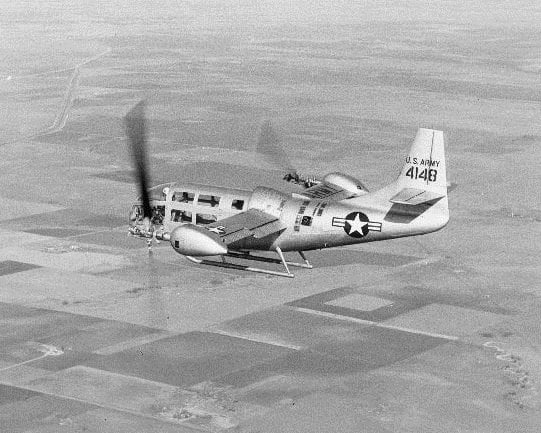
The configuration that emerged finally did what the programme had promised. On 18 December 1958, with Quinlan at the controls, the XV-3 converted fully to airplane mode and back without the rotors trying to tear the wings off.
Edwards, Ames and 110 conversions
In 1959 the XV-3 went to Edwards Air Force Base, where Major Robert Ferry flew it for the first time on an Air Force flight on 21 May. From May to July he and project engineer Lieutenant Wallace Deckert put it through handling-quality tests, short take-offs and landings and autorotation demonstrations.
Their report listed many deficiencies in performance and flying qualities. It still concluded that the tiltrotor principle was sound and deserved serious consideration in future vertical and short take-off designs.
A Bell promotional film from around 1960 showing the XV-3 convertiplane converting between helicopter and airplane flight.
An Air Force C-130 then carried the XV-3 to NASA Ames, where research flying continued until July 1962. On 12 August 1959, NASA test pilot Fred Drinkwater flew the first full tiltrotor conversion at Ames. By the end, ten test pilots from Bell, the Army, the Air Force and NASA had logged 125 flight hours and 110 full conversions.
The limits were real. The XV-3 topped out at 115 knots in level flight and 155 knots in a dive, far too slow to prove the speed advantage that justified a tiltrotor. It was unstable in some low-speed regimes, and shifting its two-speed gearbox after each conversion to slow the rotors gave the pilot an unacceptably high workload.
The wind tunnel test that ended it
The XV-3’s last job was a full-scale test of a new theory. After years of model tests and analysis, Bell believed it could finally predict the rotor, pylon and wing instability that had haunted the programme from the start, and it won NASA’s support to check those predictions in the Ames 40- by 80-foot tunnel.
The predictions held up. Configurations calculated to be stable were stable. Then, at the end of the test in May 1966, both pylons broke away from the wing and were blown down the tunnel. Months of analysis traced the failure not to the theory but to a fatigue crack and loose rivets in the left wingtip spar.
That mattered. Bell now had a way to predict whether a tiltrotor would shake itself apart, and in 1966 the company paid inventor Haviland Platt for the rights to his tiltrotor patent so it could legally keep going. The road led to the Bell XV-15, and from there to the Osprey.
More historical footage of the Bell XV-3 tiltrotor in flight.
Found behind a museum
The surviving XV-3, tail number 4148, spent years in storage. In 1984 the XV-15 flight test team, on a demonstration tour, spotted it parked outside at the Army aviation museum at Fort Rucker, Alabama. Retired XV-3 engineer Claude Leibensberger led an Army-supported repair that was finished by December 1986.
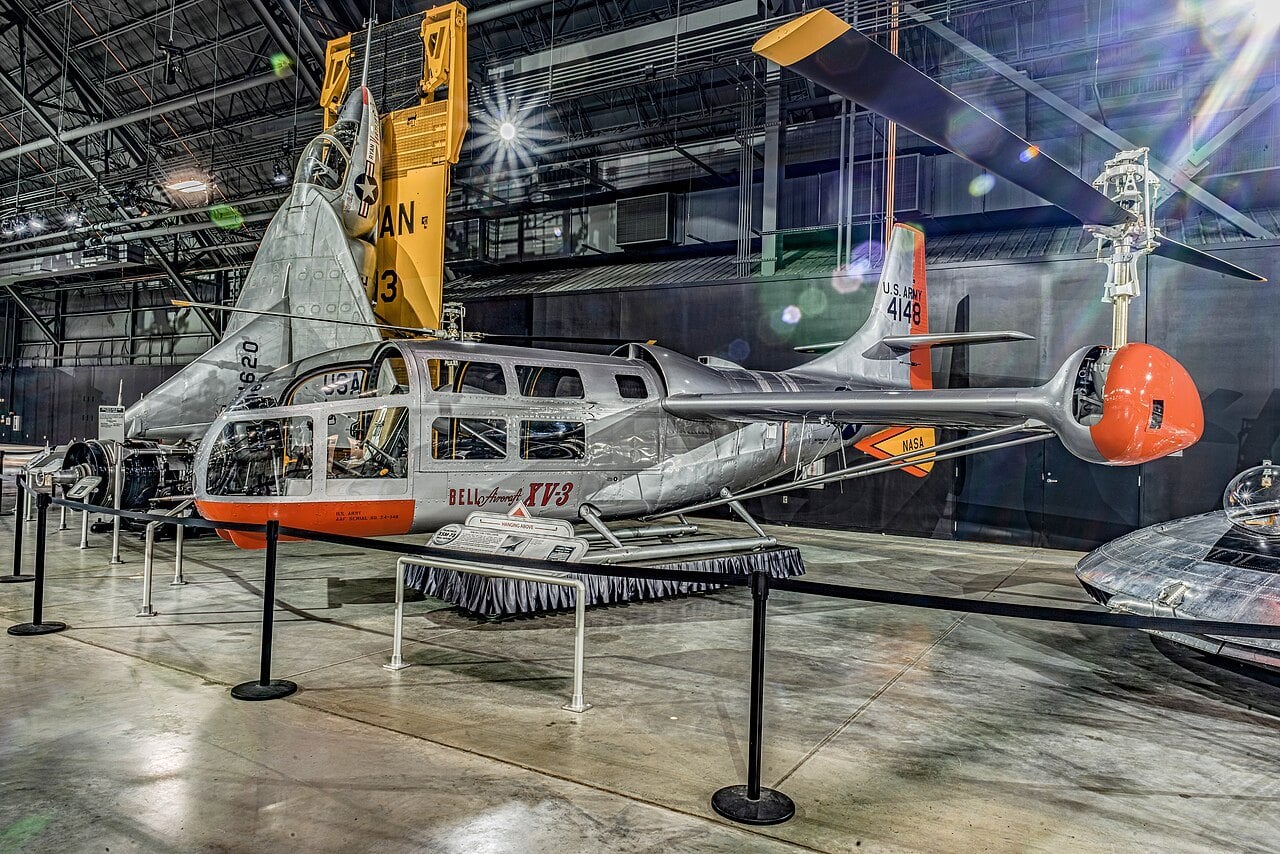
In 2004 the aircraft returned to Bell in Arlington, Texas, where retired and current engineers restored it to display condition. It went on show at the National Museum of the United States Air Force in Dayton, Ohio, in 2007.
It looks almost comically small next to the machines it inspired. But every tiltrotor that has flown since owes something to a 450 hp radial engine, two wobbling rotors and a test team that refused to give up after the first one crashed.
Sources: Martin D. Maisel, Demo J. Giulianetti and Daniel C. Dugan (The History of the XV-15 Tilt Rotor Research Aircraft: From Concept to Flight, NASA SP-2000-4517, 2000), National Museum of the United States Air Force, Air Force Test Center History Office, NASA Ames Research Center
0 Comments