
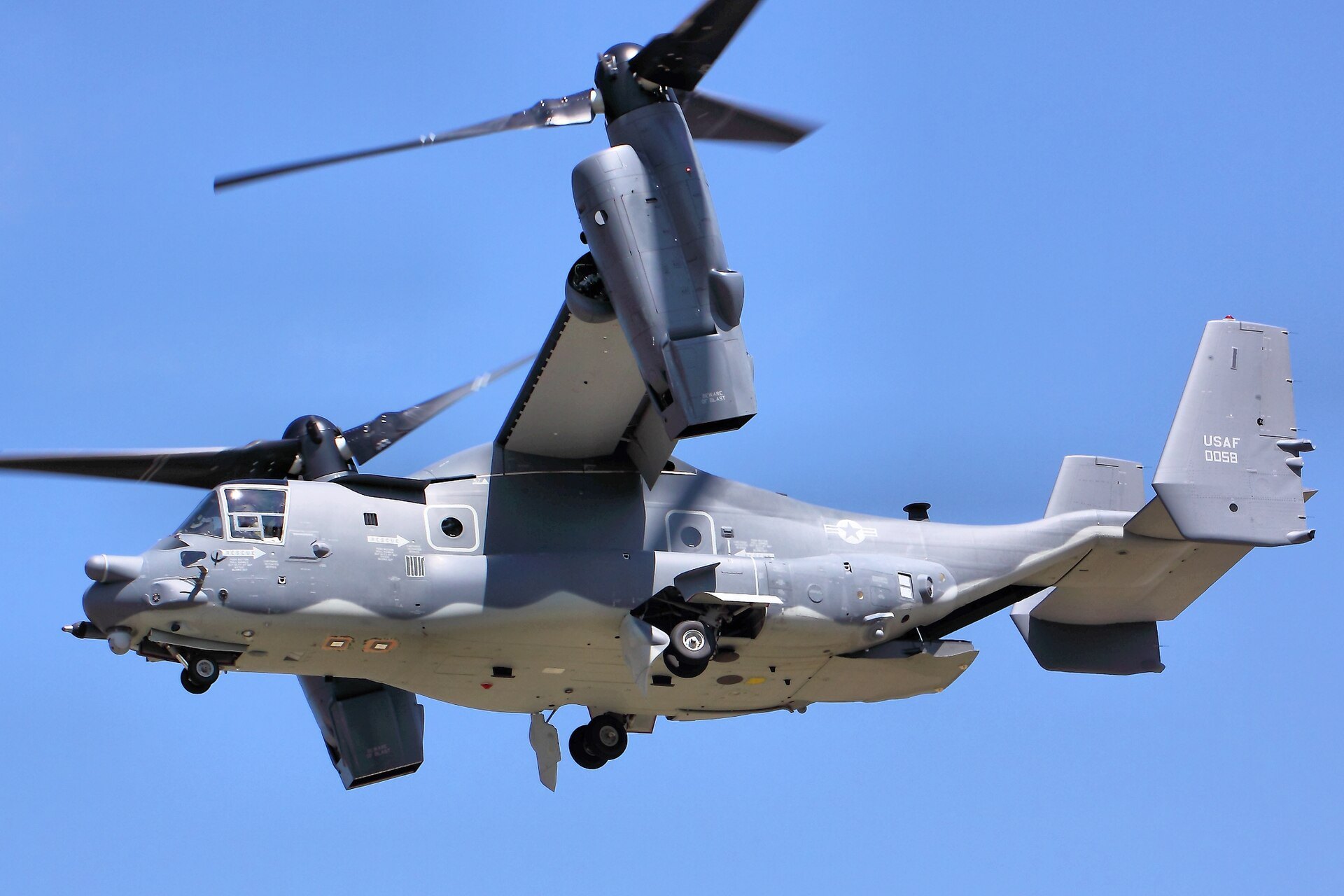
Bell Boeing V-22 Osprey
The Tiltrotor
The world’s first production tiltrotor: born from the Desert One disaster, nearly cancelled more than once, and now the aircraft that carries US Marines, air commandos and carrier cargo at twice helicopter speed.
The V-22: how a hostage-rescue disaster produced the first tiltrotor in service
On 24 April 1980 the American attempt to rescue the hostages held in Tehran ended at a desert refuelling site in Iran known as Desert One. The plan had been made complex and fragile by the short legs of the helicopters it depended on, and during the refuelling an RH-53 struck a USAF C-130; the fire killed eight servicemen. Out of that night grew a requirement for an aircraft that could take off and land like a helicopter but cruise like a transport aeroplane. The Pentagon launched a multiservice programme in 1982 with the Marine Corps in the lead, and in 1983 a team of Bell and Boeing won the contract with an enlarged version of the experimental XV-15 tiltrotor that Bell had built for NASA. On 15 January 1985 the design was named the V-22 Osprey.
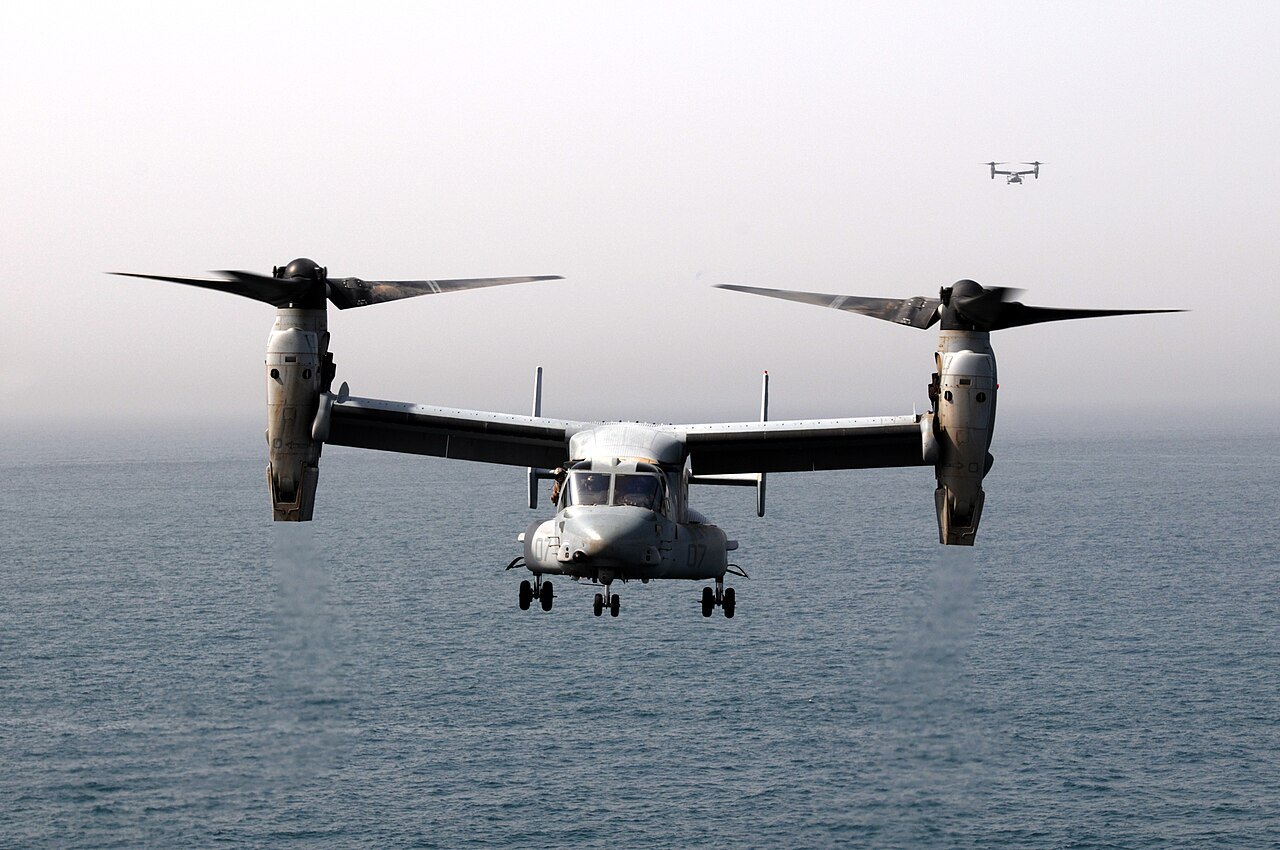
The idea is simple to describe and fiendishly hard to build. A three-blade proprotor, engine and gearbox sit in a nacelle at each wingtip. For take-off and landing the nacelles point upwards and the aircraft flies as a helicopter; once airborne they rotate forward and the V-22 cruises as a turboprop, at roughly twice the speed of a conventional helicopter. A cross-wing driveshaft lets either engine turn both rotors, and the whole aircraft folds its rotors and swivels its wing to fit aboard ships. The first prototype flew on 19 March 1989. What followed was one of the most fraught development programmes in American military aviation: Defence Secretary Dick Cheney tried to cancel it from 1989, Congress kept funding it, and four crashes during development killed 30 Marines and Boeing personnel.
The Osprey survived, was redesigned after two fatal accidents in 2000, and entered Marine Corps service in 2007, replacing the Vietnam-era CH-46 Sea Knight and CH-53D. The Air Force fielded the CV-22B for special operations from 2006 and declared it operational in 2009; the Navy’s CMV-22B took over carrier onboard delivery from the C-2 Greyhound in 2021, and Japan became the first export customer. The type has flown troops and casualties in Iraq and Afghanistan, rescued and evacuated in Libya, South Sudan and the Bahamas, and carried presidents’ staff and senior officers. Bell now counts a fleet of about 450 aircraft and more than 750,000 flight hours. Its safety record remains contested and every accident draws close scrutiny, especially in Japan, but no other aircraft yet in service can do quite what it does.
01The V-22’s near-death: cancellation attempts, Marana and the 2000 grounding
Few aircraft have come closer to cancellation and still entered service. Delays and design changes drove the expected cost of a Marine MV-22 from about US$24 million per aircraft in 1986 to an estimated US$84 million by 2009, according to Air & Space Forces Magazine, and Defence Secretary Dick Cheney tried to kill the programme in 1989. Congress kept it alive. In 1989 the Pentagon was still planning for 663 aircraft; by 1997 the number had settled at 458, a figure the Congressional Research Service tracked through the following decade.
The worst blow came in 2000. In April a V-22 descended too quickly with too little forward speed, entered vortex ring state and crashed at Marana, Arizona, killing 19 Marines. After another fatal crash in December the fleet was grounded and the programme looked finished. On the advice of a blue-ribbon panel the Pentagon gave it one more chance. Bell and Boeing reworked the flight-control software and hydraulics, and 18 months of increasingly demanding test flying showed that the tiltrotor was in fact less susceptible to vortex ring state than conventional helicopters and, because its nacelles can tilt forward, recovered faster. Aircraft now carry visual and aural warnings of the condition, and pilots are trained to recognise it. Full-rate production was approved on 28 September 2005, and the Marines deployed the type to Iraq two years later.
02The V-22 in combat: Iraq, Afghanistan and the Bor evacuation
The first operational MV-22s went to Al Asad in Iraq’s Anbar province in 2007. They flew troops, cargo and casualties between forward bases, and senior commanders quickly realised that speed and altitude kept them above much of the small-arms fire that threatened helicopters. One aircraft carried Senator Barack Obama during his visit to Iraq in 2008. The deployment was not smooth: the Congressional Research Service recorded mission-capable rates of about 68, 57 and 61 percent for the three squadrons, short of the 82 percent requirement, and squadrons cannibalised parts because components wore out far faster than predicted. In Afghanistan from late 2009 the Osprey flew assault, resupply and casualty evacuation, its speed getting more wounded to surgery inside the “golden hour”.
The most dramatic Air Force mission came on 21 December 2013. Three CV-22s were sent to Bor in South Sudan to evacuate US citizens from a civil war, their crews told to expect a permissive landing zone. As they approached they were hit 119 times by AK-47 and .50-calibre fire; four Navy SEALs in the lead aircraft were wounded. All three Ospreys, leaking fuel and hydraulic fluid, diverted to Entebbe in Uganda. The incident led Air Force Special Operations Command to request removable armour: NAVAIR fielded a kit of 66 plates, adding about 800 lb, within 179 days.
What makes the V-22 special
Helicopter at both ends, aeroplane in between
The V-22’s nacelles rotate through about 90 degrees. Nose-up, the aircraft hovers on its two 38-foot proprotors; tilted forward, it cruises like a turboprop at around 277 mph, the figure the USAF and its museum quote for the CV-22. Pilots can also use intermediate angles for rolling take-offs. The result, Boeing says, is nearly twice the speed of typical helicopters and far greater range, which is why special forces planners speak of reaching an objective and returning within a single night. Its quietness in aeroplane mode was also prized for covert work.
Built to live on ships
The Osprey was designed from the start for the Navy and Marine Corps, so its rotors fold and its whole wing swivels fore and aft for stowage on amphibious ships and carriers. That requirement drove up cost and complexity and limited rotor diameter, which gives the V-22 a high disc loading and powerful downwash. The payoff is an aircraft that can self-deploy across oceans with air-to-air refuelling, as four CV-22s showed in 2008 when they flew more than 5,000 miles from Florida to Mali, and then operate from a ship’s deck on arrival.
Fly-by-wire and a glass cockpit
The V-22 was among the first rotorcraft to rely on triple-redundant digital fly-by-wire controls. The computers blend helicopter-style rotor control with aeroplane control surfaces as the nacelles move, so pilots fly one consistent aircraft through the conversion. Bell says the coupled modes and glass displays reduce workload when landing in brownout or flying long legs in cloud. The cockpit uses night-vision-compatible multifunction displays, and the CV-22 adds terrain-following radar, forward-looking infrared and missile countermeasures for low-level penetration of defended airspace.
03The V-22’s drivetrain and engines: one shaft across the wing
Each nacelle carries a Rolls-Royce AE 1107C turboshaft, designated T406 in US service and marketed as the Liberty, rated at 6,150 shp. The two engines are linked by a driveshaft running through the wing, so if one fails the other can turn both proprotors. That protects against asymmetric thrust, but the V-22 is generally not able to hover on one engine, and its light, stiff rotors have poor autorotation characteristics; in a total power loss crews are trained to convert to aeroplane mode and glide. The wing itself is short and thick to carry the nacelle loads, and the airframe makes heavy use of composites.
The arrangement has been refined continually. Rolls-Royce added a new turbine and software to raise power in hot and high conditions, and Bell’s recent Nacelle Improvement programme reworked wiring and structure inside the nacelles to cut maintenance hours, a long-standing weak point. Bell says the work brought a dramatic reduction in maintenance hours, and both companies now gather data from every aircraft to spot failing parts before they ground it.
Bell Boeing V-22 Osprey specifications
Specifications
- Crew
- 3–4 (2 pilots plus 1–2 crew chiefs or flight engineers)
- Capacity
- 24 seated troops or 32 floor-loaded; USAF quotes 10,000 lb (4,536 kg) cargo for the CV-22
- Length
- 17.48 m (57 ft 4 in) fuselage
- Width
- 25.8 m (84 ft 7 in) rotors turning; 5.6 m (18 ft 5 in) stowed
- Height
- 6.73 m (22 ft 1 in), nacelles vertical
- Rotor diameter
- 2 × 11.6 m (38 ft 1 in)
- Empty weight
- 14,432 kg (31,818 lb)
- Max take-off weight
- 23,859 kg (52,600 lb) vertical; 27,442 kg (60,500 lb) rolling take-off, ferry
- Powerplant
- 2 × Rolls-Royce AE 1107C (T406) turboshafts, 6,150 shp (4,586 kW) each
- Maximum speed
- 509 km/h (275 kn) at sea level
- Cruise speed
- 446 km/h (277 mph)
- Range
- 1,628 km (879 nmi); ferry 4,130 km (2,230 nmi)
- Combat radius
- about 926 km (500 nmi) for the CV-22, per USAF
- Service ceiling
- 7,620 m (25,000 ft)
- g limits
- +4 / −1
- Armament
- One removable ramp-mounted M240 7.62 mm or M2 .50-calibre machine gun; optional belly-mounted remotely operated gun turret
Costs & production
- Unit cost
- About US$90 million for a CV-22 (USAF fact sheet); DoD’s December 2011 estimate put the average procurement unit cost at about US$83.0 million in base-year 2005 dollars (via CRS)
- Cost per flight hour
- Marine Corps officials said in 2011–12 that they had cut the MV-22’s cost from about US$12,000 to US$9,000 per flight hour, and lower in some cases (as reported by CRS); an earlier GAO assessment put it at over US$11,000. Later figures depend heavily on what is counted
- Production
- Fleet of about 450 aircraft across the USMC, USAF, USN and Japan (Bell)
- Programme
- DoD estimated total acquisition at about US$50.0 billion (base-year 2005) for 459 aircraft in 2011, including about US$11.9 billion of development (CRS)
04The V-22’s variants: Marine, Air Force, Navy and the ones never built
- V-22 (FSD and EMD): six full-scale development prototypes from 1989, followed by redesigned engineering and manufacturing development aircraft from 1997.
- MV-22B: Marine Corps assault transport for troops, equipment and supplies, operating from amphibious ships or austere bases; replaced the CH-46E and CH-53D. Also used for VIP support by HMX-1. Japan’s Ground Self-Defense Force operates the same Block C standard.
- CV-22B: Air Force Special Operations Command variant with terrain-following radar, extra wing fuel tanks, forward-looking infrared and infrared countermeasures, for long-range infiltration, exfiltration and resupply. Replaced the MH-53 Pave Low.
- CMV-22B: Navy carrier onboard delivery version with enlarged sponson tanks, high-frequency radio and a public-address system; NAVAIR quotes 6,000 lb carried 1,150 nmi.
- HV-22, SV-22, EV-22: proposed Navy rescue, anti-submarine and airborne early warning versions that were studied but not built.
05The V-22’s operating costs: expensive to buy, dearer to keep ready
The Osprey’s price has always been part of its story. The Government Accountability Office noted that 1986 plans for nearly 1,000 aircraft at US$37.7 million each, in fiscal 2009 dollars, had become fewer than 500 aircraft at US$93.4 million each, a 148 percent increase in procurement unit cost. Operating cost drew similar scrutiny. Marine aviation leaders said in 2011 that changes in flying procedures had cut about US$3,000 from each flight hour, bringing the figure from roughly US$12,000 to around US$9,000, but earlier GAO work had found it to be more than double the original target.
Readiness is the other half of the equation. In Iraq the three deployed squadrons averaged mission-capable rates of 57 to 68 percent against an 82 percent requirement, and some components lasted less than a tenth of their predicted life. Bell and Boeing have since set up fleet data analysis and nacelle improvement programmes aimed specifically at maintenance hours. Any figure for cost per hour should be read as an estimate that varies with variant, year and accounting method.
The V-22 from Desert One to the carrier deck
Desert One
The failed Iran hostage rescue exposes the limits of helicopters for long-range missions.
Bell and Boeing chosen
The Marine Corps awards the Bell Boeing team the contract to develop a tiltrotor for the joint JVX programme.
First flight
The first prototype flies in helicopter mode on 19 March; Defence Secretary Cheney tries to cancel the programme.
Two fatal crashes
Accidents in April and December kill 23 Marines and ground the fleet; the programme is restructured.
Full-rate production
The Pentagon approves full-rate production on 28 September after operational evaluation.
Air commandos receive the CV-22
The first CV-22 arrives at Kirtland AFB, New Mexico, on 20 March for special operations training.
Into service and into Iraq
The MV-22 reaches initial operational capability and deploys to Al Asad, Iraq.
Nonstop to Africa
Four CV-22s fly more than 5,000 miles from Florida to Mali with air refuelling for Exercise Flintlock.
Fired on at Bor
Three CV-22s are hit 119 times during an evacuation attempt in South Sudan on 21 December.
Half a million hours
The fleet passes 500,000 flight hours; Ospreys fly relief missions in the Bahamas after Hurricane Dorian.
Navy service
The CMV-22B deploys aboard USS Carl Vinson and is declared operational on 14 December.
Yakushima crash
A CV-22B crashes off Japan on 29 November, killing eight; US and Japanese fleets are grounded into 2024.
Stories & eyewitnesses: the V-22 in war, rescue and controversy
The fire at Desert One
A failed rescue in 1980 created the requirement that became the Osprey.
Read the full story
Marana, April 2000
The crash that nearly ended the programme.
Read the full story
Florida to Mali without stopping
Four CV-22s proved they could cross an ocean on their own.
Read the full story
First deployment: Al Asad, 2007
Iraq tested the Osprey’s speed and its supply chain.
Read the full story
119 hits over Bor
An evacuation flight into South Sudan met heavy ground fire.
Read the full story
Caught in a leader’s wake
A 2012 crash at Eglin revealed how little was known about tiltrotor wake turbulence.
Read the full story
Half a million hours and a hurricane
In 2019 the fleet passed a milestone while flying relief in the Bahamas.
Read the full story
Japan’s first Osprey
The first V-22 for a military outside the United States flew in Texas in 2017.
Read the full story
Off Yakushima, November 2023
The loss of eight airmen grounded Ospreys on both sides of the Pacific.
Read the full story
A test aircraft in Dayton
The Air Force museum’s CV-22B flew more than 600 test missions before retiring.
Read the full story
The V-22 in pictures
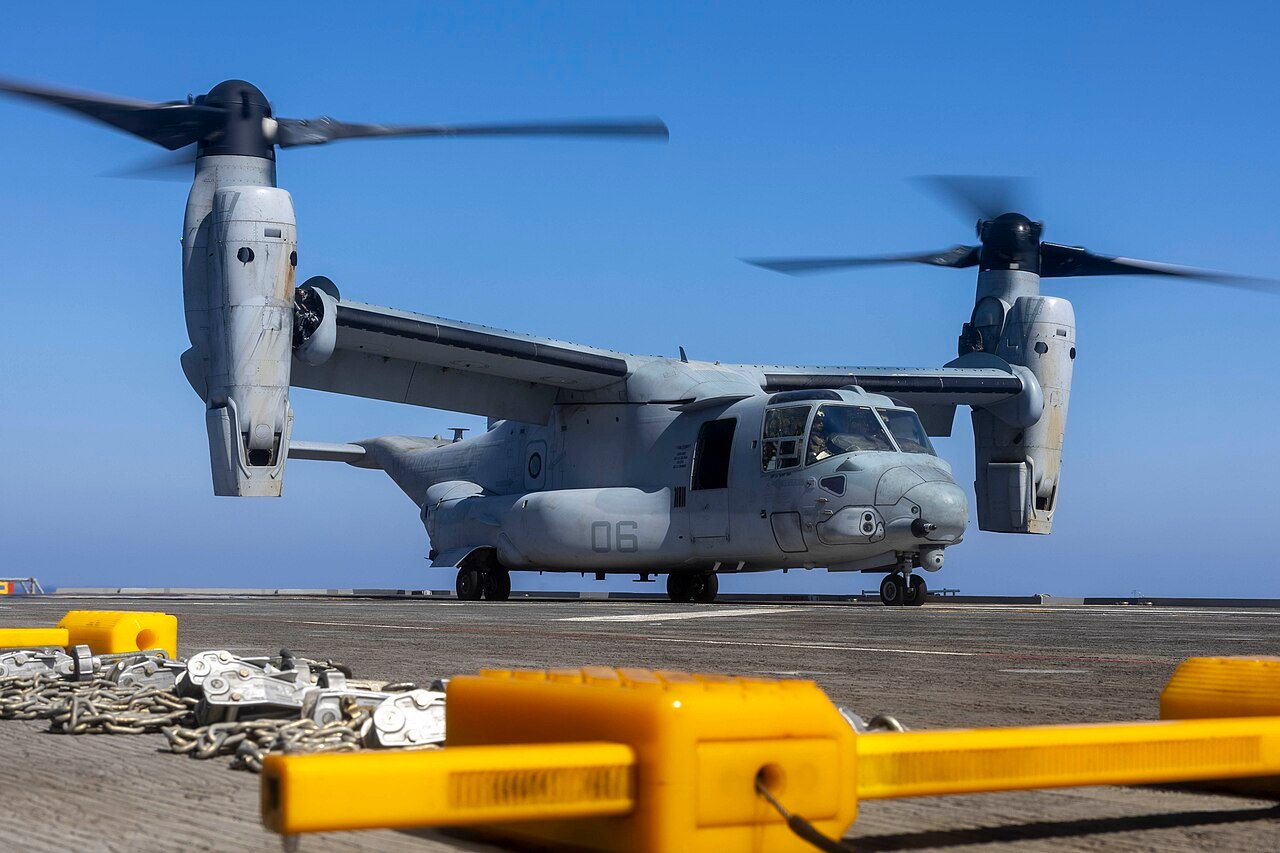
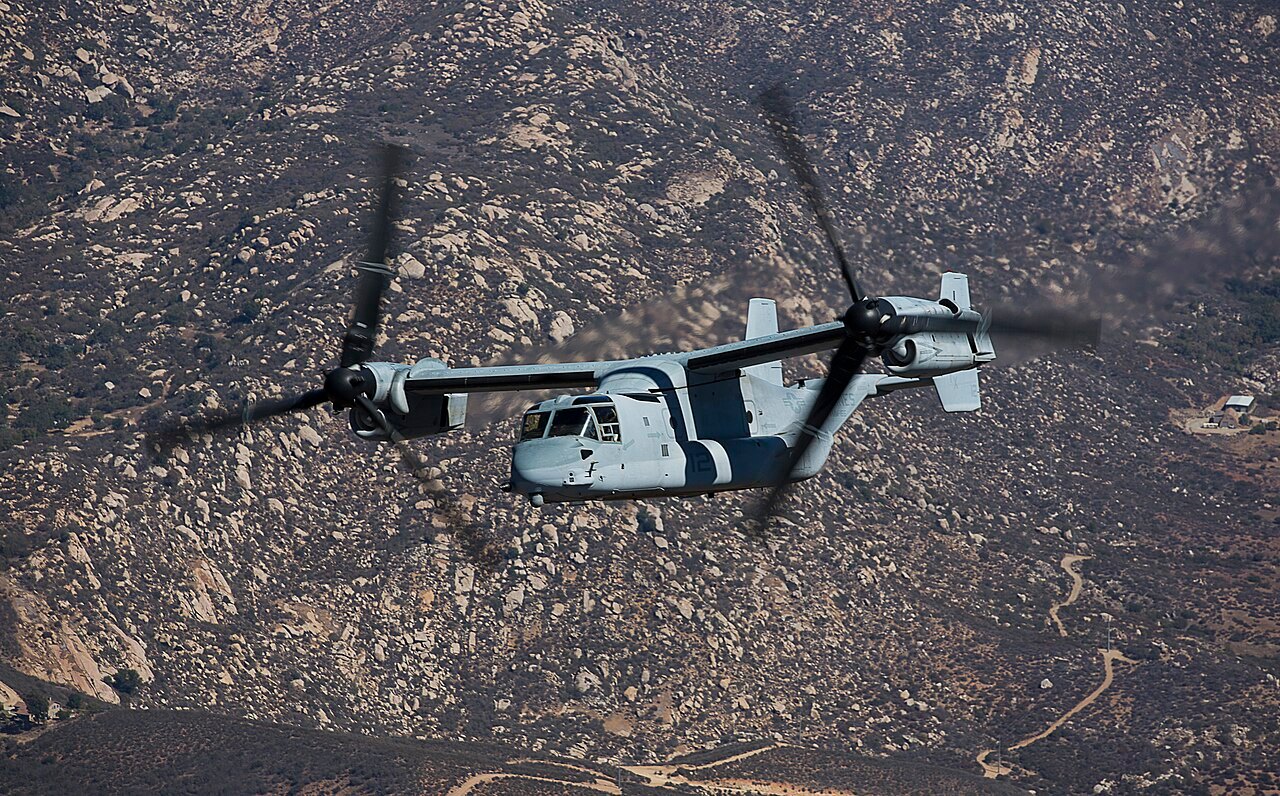
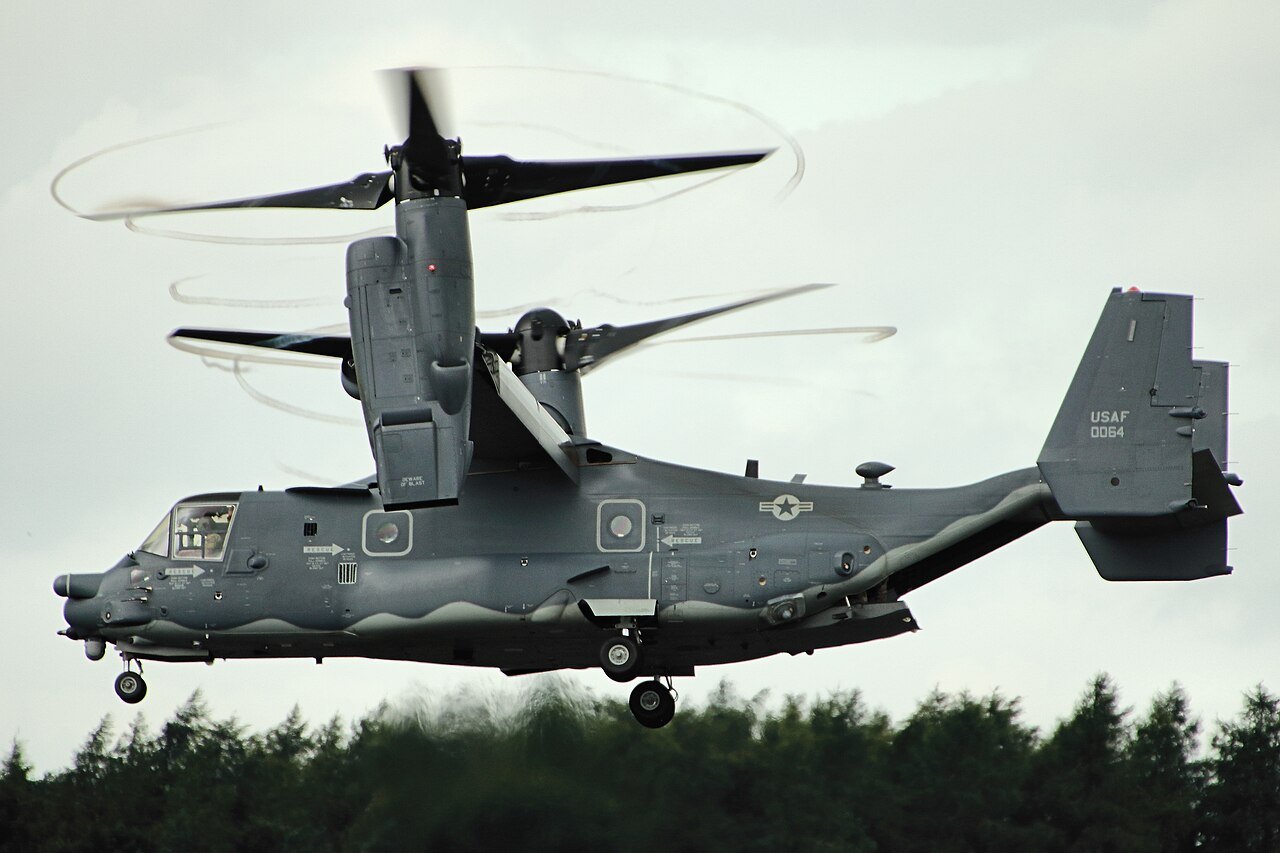
Where the V-22 flies and flew
The V-22’s record
The Osprey has flown combat and contingency operations in Iraq, Afghanistan, Libya, South Sudan and beyond, mostly as a fast troop, cargo and casualty transport rather than a shooter. Its record also includes a long and contested accident history that has repeatedly grounded the fleet.
See how training and combat types compare in the military aircraft statistics database. Figures are approximate.
Everything people ask about the V-22
Can I fly in a Bell Boeing V-22 Osprey?
When did the V-22 Osprey first fly?
How fast is the V-22 Osprey?
Who flies the V-22?
How many troops can a V-22 carry?
Is the V-22 Osprey safe?
What replaced the CH-46 in the Marine Corps?
You can’t fly the V-22.
These, you can.
Most of this museum you can only look at. These genuine military jets you can fly yourself with MiGFlug — with aerobatics and time on the controls.
 Fly the L-39 AlbatrosThe world’s most-flown jet trainer — aerobatics included
 Fly the F-104 Starfighter“The missile with a man in it”
 Fly the MiG-21The Cold War’s most-produced jet
 Fly the T-33 Shooting StarAmerica’s first jet trainer
 Fly the DH VampireA piece of early jet history
 Fly the S.211Agile Italian jet trainer
 Fly the MB-326The classic Aermacchi jet
 Fly the MiG-15The Soviet legend of the Korean War
Continue the tour
Every fact, checked
- Finally, the OspreyAir & Space Forces Magazine (2009): Desert One, development, Marana, Mali self-deployment, CV-22 introduction, costs
- CV-22 Osprey fact sheetUS Air Force: CV-22 mission, units, specifications, unit cost
- Bell-Boeing CV-22B OspreyNational Museum of the USAF: history of displayed airframe 99-0021
- CMV-22B OspreyNAVAIR: Navy variant, IOC date, range and payload
- V-22 OspreyBoeing: roles, dimensions, engines
- Bell Boeing V-22Bell: fleet size, flight hours, variants
- V-22 Osprey Tilt-Rotor Aircraft Program (RL31384)Congressional Research Service: procurement numbers, costs, cost per flight hour, Iraq readiness
- AFSOC Ospreys Armor Up After Painful Lessons Learned In South SudanBreaking Defense: Bor incident, armour kit, 2012 Eglin wake crash
- Bell Boeing V-22 Osprey Fleet Surpasses 500,000 Flight HoursBoeing press release, October 2019, Hurricane Dorian relief
- Here Is Japan’s First V-22The Aviationist: first export Osprey, Japanese order
- Remains of Osprey crash in Japan found, U.S. Air Force saysNPR/AP on the November 2023 Yakushima crash