
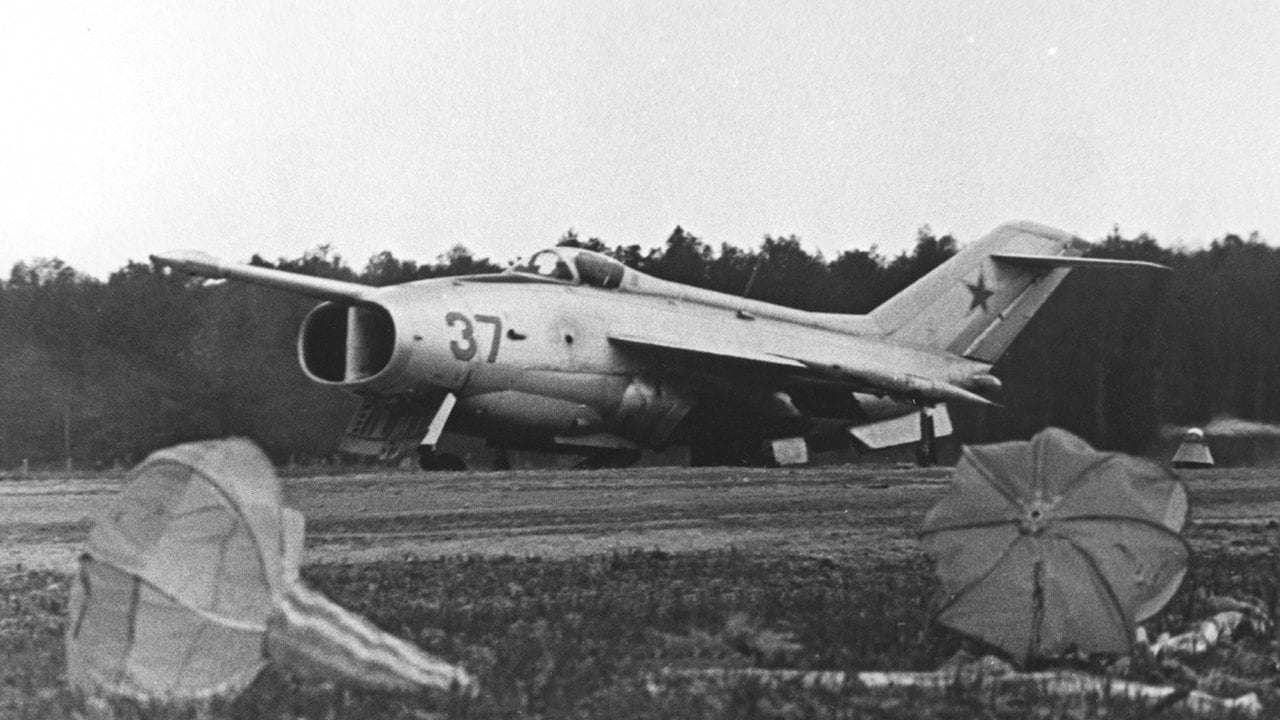
In July 1967, at the Domodedovo air display outside Moscow, Western observers saw something they had not expected from the Soviet Union: a stubby, twin-engined jet that rose straight off the ground, hung in the air on two columns of exhaust, and then flew away like an ordinary fighter.
NATO named it “Freehand”. Inside the Yakovlev design bureau it was the Yak-36, or Izdeliye V. It never carried a weapon in anger and never went into production. But every Soviet jump jet that followed, from the Yak-38 to the supersonic Yak-141, traces its family tree back to it.
Quick Facts
- Aircraft: Yakovlev Yak-36 (Izdeliye V), NATO name “Freehand”
- Role: Soviet jet VTOL technology demonstrator
- Engines: 2 Tumansky R-27V-300 turbojets, about 52 kN (5,300 kgf) each, one swivelling nozzle per engine
- Built: 4 airframes, 1 for static tests
- First tethered hover: 9 January 1963
- First full VTOL cycle: 24 March 1966, Valentin Mukhin
- Public debut: Domodedovo, July 1967
- Successor: Yak-36M, which became the Yak-38 Forger
- Survivor: Central Air Force Museum, Monino
Two engines, one idea
In 1961 the Yakovlev bureau was tasked with building a jet VTOL demonstrator. In Britain, Hawker was flying the P.1127, ancestor of the Harrier, with one big engine and four swivelling nozzles. Yakovlev went a different way.
The Yak-36 had two Tumansky R-27V-300 turbojets mounted side by side in the forward fuselage, each giving about 52 kN (5,300 kgf) without afterburner. They were derived from the R-27-300 then being developed for the MiG-23. Each engine exhausted through one swivelling nozzle on either side of the lower fuselage, close to the centre of gravity.
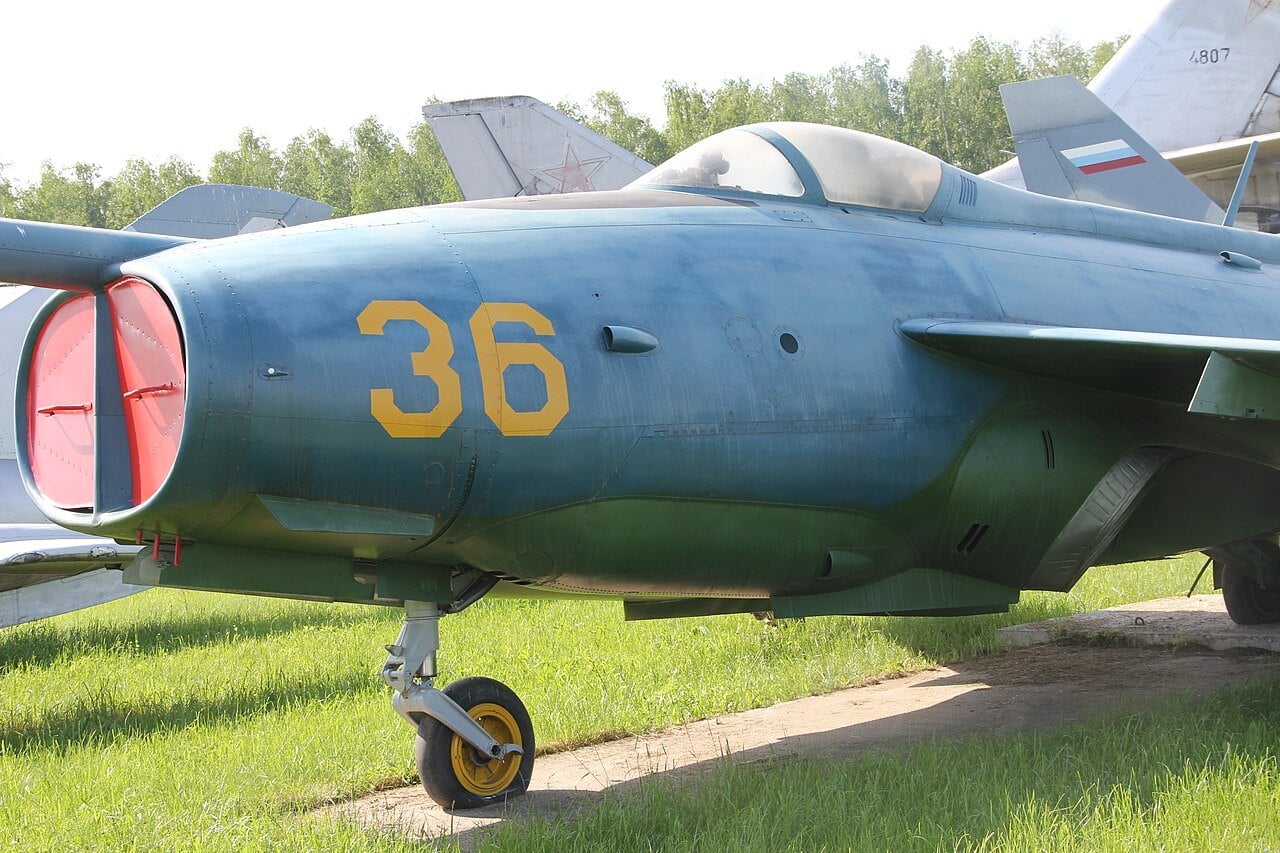
Four airframes were built. One was used for structural testing and the others in the flight programme. With both engines, the fuel and the cockpit packed close to the centre of gravity, the Yak-36 looked short, deep-bellied and nose-heavy, more like a flying engine bay than a fighter.
The nose boom that puzzled the West
Hovering jets have no airflow over their control surfaces, so they steer with puffs of compressed air. The Yak-36 bled air from its engines to small reaction nozzles at the wingtips and the tail, and to one at the end of a long boom sticking out of the top of the nose intake. The boom gave the forward puffer more leverage in pitch.
Western analysts studying the 1967 photos were baffled by it, and some guessed it might be for ramming, according to the Air Vectors history of Soviet VTOL aircraft. The real reason was simple physics. The same trick of moving a control jet as far from the centre of gravity as possible shows up on most jump jets.
Archive film of the Yakovlev Yak-36 VTOL prototype.
Five years from tether to triumph
The test programme was slow and frequently frightening. Tethered hover trials began on 9 January 1963, with the aircraft held to the ground by cables. Like every early jump jet, it ran into hot gas re-ingestion, when the jet’s own exhaust is sucked back into the intakes and robs the engines of thrust.
The early hovers were flown by test pilot Yuri Garnayev, according to Air Vectors; Valentin Mukhin later took over the programme. The Yak-36 made its first conventional take-off and landing on 27 July 1964. On 24 March 1966, Mukhin flew the first complete cycle: vertical take-off, transition to wingborne flight, transition back and vertical landing. It was the first time a Soviet jet had done it.
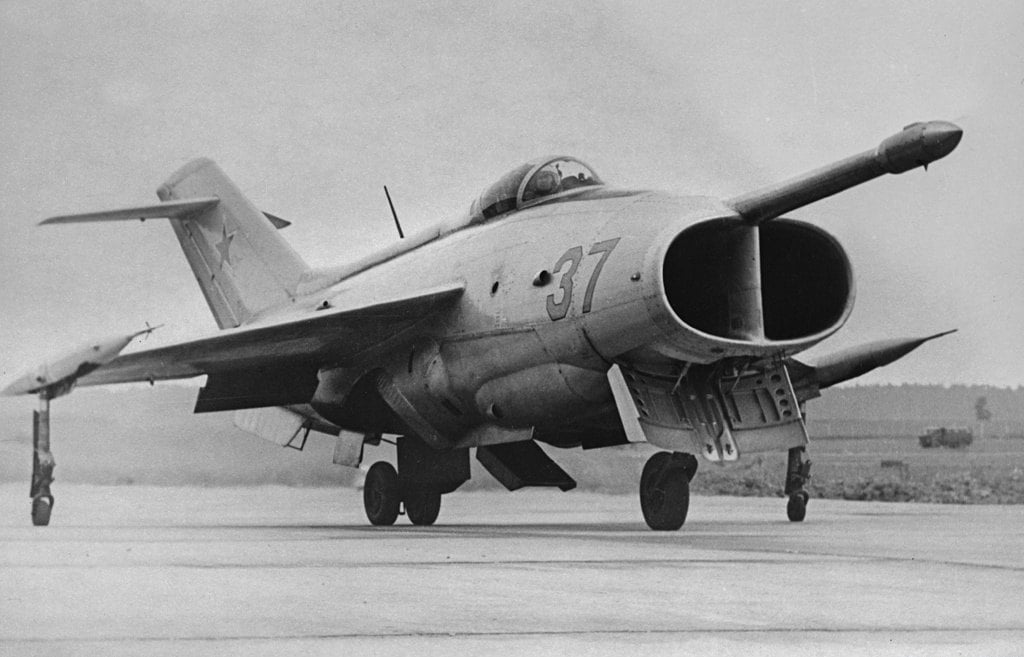
Then came the public debut. In July 1967 the Yak-36 flew at Domodedovo, with an unguided rocket pod under each wing to make it look like a combat aircraft. It was a show. With little spare thrust and a short range, the Yak-36 was never going to be a practical combat aircraft.
From Freehand to Forger
The Yak-36 had done its job. It proved that the bureau could make a jet take off and land vertically, and showed the next step had to be different. The follow-on Yak-36M, which became the Yak-38 “Forger”, used one lift/cruise engine in the rear fuselage and two separate lift engines behind the cockpit, and went to sea on the Soviet Navy’s Kiev-class carriers.
A short look at the Yakovlev Yak-36 demonstrator.
That story is told in our Yak-38 feature. The supersonic Yak-141 “Freestyle” came after that.
A surviving Yak-36 is on display at the Central Air Force Museum at Monino, outside Moscow. Next to the Forgers and Freestyles that followed, it looks almost toy-like. But it was the first Soviet jet to hover, and the one that got the whole line off the ground.
Sources: Air Vectors (Greg Goebel), Vertical Flight Society V/STOL Wheel, Kapil Kajal (Vintage Aviation News, 2026), www1.ru (2025)
0 Comments