
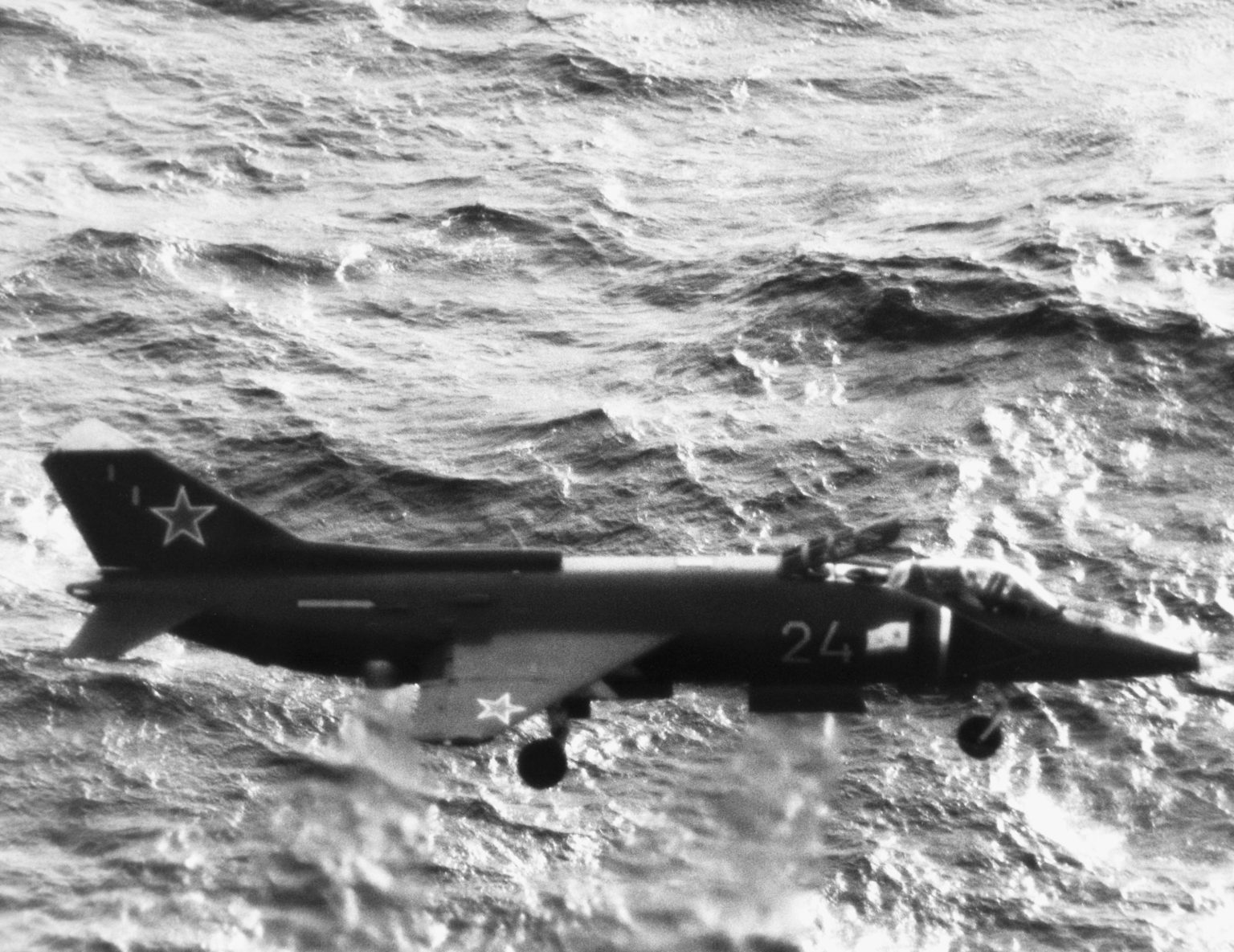
Yakovlev Yak-38
“Forger”
The Soviet Navy’s only operational vertical-takeoff fighter — a three-engine carrier jet that could rise straight off a deck, but struggled to carry much once it did.
The Yak-38 Forger: the Soviet Navy’s vertical-takeoff gamble
The Yak-38 was the Soviet Union’s first — and only — operational vertical- and short-takeoff-and-landing (VTOL/STOVL) combat jet. When the Soviet Navy laid down its Kiev-class ships in the late 1960s, it needed a fixed-wing aircraft that could fly from their short decks without steam catapults. Yakovlev, which had spent most of a decade experimenting with jet lift on the ungainly Yak-36 “Freehand” testbed, answered with the Yak-36M — redesignated Yak-38 in service. It first flew on 15 January 1971 and joined the fleet aboard the carrier Kiev in 1976.
Its defining feature was a three-engine layout. Where Britain’s Harrier used a single engine with four swivelling nozzles, the Yak-38 used three: one vectored-thrust cruise engine in the tail, plus two dedicated lift jets standing almost vertically behind the cockpit. The lift jets fired only for takeoff, hover and landing; in level flight they were simply dead weight and drag. To manage the split-second dangers of the hover, the jet carried a world-first automatic ejection system wired to fire the pilot the instant the aircraft departed control on takeoff or landing.
The result was an aircraft that could do the trick but struggled to do the job. Range and payload were poor, and in hot or high-altitude conditions the lift engines lost so much thrust that the Forger could barely lift a useful weapon load — a limitation brutally exposed during a 1980 test deployment to Afghanistan, where the jets could reportedly carry only a token pair of small bombs and flew mostly in the cool of early morning. A high accident rate — commonly cited as around a third of the fleet lost — underlined how unforgiving the VTOL regime was. The Yak-38 is widely remembered less as a successful warplane than as a technology stepping-stone.
That stepping-stone pointed somewhere. Yakovlev’s intended successor, the supersonic Yak-141, flew but was cancelled as the Soviet Union collapsed. In the mid-1990s Lockheed Martin briefly cooperated with Yakovlev and reportedly obtained Yak-141 documentation — fuelling an enduring, and genuinely contested, claim that Soviet VTOL work helped inform the STOVL F-35B. The Yak-38 itself was withdrawn in the early 1990s, having proved that Soviet naval VTOL was possible — even if it was never quite practical.
01The Yakovlev Yak-38 Forger’s origins: from the Yak-36 “Freehand” to a carrier fighter
Yakovlev began serious jet-VTOL research around 1960. Its testbed, the Yak-36 “Freehand”, used twin vectored turbojets and in 1966 became one of the first jets to take off vertically, hover, transition to wing-borne flight and land vertically. But it lacked the thrust and range to be a weapon — it was a flying laboratory, not a fighter.
The lessons produced the combat-oriented Yak-36M: a slimmer airframe with a completely different propulsion philosophy of one cruise engine plus two lift jets, folding wings for hangar stowage, and naval systems for the Kiev-class ships. Redesignated Yak-38, it entered Soviet Naval Aviation service on 11 August 1976. A two-seat trainer, the Yak-38U “Forger-B”, followed to teach the demanding transition between vertical and forward flight.
What makes the Yak-38 Forger special
A three-engine VTOL arrangement
The Forger’s signature is its combined propulsion: one rear vectored-thrust cruise engine (Tumansky/Soyuz R-27V-300) with two rotating nozzles, plus two dedicated lift jets (Rybinsk RD-36-35VFR) mounted vertically behind the cockpit. The lift jets provided vertical thrust for takeoff, hover and landing, then shut down — leaving them as pure dead weight and internal volume in cruise, one root cause of the type’s short range.
The automatic ejection seat
A lift-engine failure or excessive bank in the hover was effectively unrecoverable, and gave a pilot no time to react. So the Yak-38’s seat was wired to fire automatically — without any pilot command — if the jet departed controlled flight during takeoff or landing (commonly cited as past roughly 60° of bank). It is widely regarded as the first automatic ejection system on a fixed-wing fighter, and is credited with saving several pilots.
Naval STOVL from Kiev-class ships
The Yak-38 was the Soviet Navy’s first operational fixed-wing carrier aircraft, flying from the Project 1143 Kiev-class ships — officially rated as “heavy aviation cruisers” bristling with anti-ship missiles. It used vertical and, later, short-takeoff techniques, folded its wings for hangar stowage, and in 1983 even flew from a civilian roll-on/roll-off ship to prove dispersed basing.
02The Yak-38 Forger’s three engines versus the Harrier’s one: two answers to the same problem
Both the Yak-38 and the Harrier had to solve the same puzzle — how to make a jet hover — and chose opposite paths. The Harrier used a single Pegasus engine whose four vectoring nozzles swivelled together, so all of its thrust was available in both hover and cruise. The Yak-38 split the task: a rear cruise engine for forward flight and two separate lift jets for the vertical phases. The Soviet scheme used simpler nozzles on the main engine, but the two lift jets added weight, drag and failure modes, took up fuel volume, and reportedly needed overhaul after very few running hours. Western assessments generally rated the Forger behind the Sea Harrier in sensors, weapons, range and payload; its clearest advantages were the automatic ejection seat and, later, automated engine-transition control.
03The Yak-38 Forger and the F-35B: what the Yak-141 successor did and did not pass on
The Yak-38 was always seen as an interim step toward a supersonic VTOL fighter. That successor, the Yak-141 (Yak-41) “Freestyle”, flew in the late 1980s but never entered production — undone by accidents, the Soviet collapse and lost funding. In the mid-1990s Lockheed Martin and Yakovlev entered a brief cooperation, and Lockheed reportedly received Yak-141 technical documentation. This underpins the widely repeated claim that Soviet VTOL work informed the F-35B. It should be treated with care: the two designs share a broadly similar STOVL layout (lift device forward, vectoring nozzle aft) and a documented brief corporate cooperation occurred, but a direct causal design lineage is contested and not firmly established — several analysts argue the resemblance is largely convergent engineering rather than a copied blueprint.
Yak-38 Forger full specifications
Figures are broadly for the improved Yak-38M; sources vary, and contested values (especially range and combat radius) are hedged. Performance fell sharply in hot or high-altitude conditions.
Baseline note: the figures below describe the Yak-38M (izdeliye 82, factory code VMM) as it stood in Soviet Naval Aviation service in the second half of the 1980s — the last and best of the three production marks, with the uprated Tumansky R-28V-300 lift/cruise engine, two Rybinsk RD-38 lift jets, a steerable nosewheel and, for the first time, underwing drop tanks. Deltas for the original Yak-38, for the two-seat Yak-38U trainer and for the experimental Yak-36 that preceded them all are in grey. Three warnings before any number is read. First, this aircraft has two of almost every weight and payload figure, one for a vertical take-off and one for a rolling take-off along the deck, and reference tables routinely quote the better of the pair without saying which — a habit that flatters the Forger by a full tonne in the mode that defined it. Second, Russian and Western authorities disagree on length, span, empty weight and rated thrust by margins too wide to reconcile quietly; the Soviet Navy’s own 1983 training manual is preferred here where it covers the point, with the Western figure given alongside. Third, every performance number below is a temperate-latitude figure taken at sea level in cool air. In the tropics and over Afghan plateau the powerplant lost as much as 1,500 kgf (3,307 lbf) of thrust, and the aircraft simply could not lift its own permitted weight vertically.
Dimensions & weights
- Crew
- 1 — one pilot on a Zvezda K-36VM seat, the naval jet-lift version of the K-36 family. The first four prototypes and the first ten production aircraft used the older Yakovlev KYa-1M; the K-36VM came in from airframe serial 2709. The Yak-38U trainer seated two in tandem
- Length
- 16.37 m (53 ft 8 in). The 1983 Soviet manual gives 15.98 m (52 ft 5 in) for the Yak-38, probably excluding the pitot boom. The Yak-38U was stretched at both ends to 17.76 m (58 ft 3 in), which left it disproportionately long for its span and earned it the nickname "the banana"
- Wingspan, spread
- 7.022 m (23 ft 0 in), swept 45° on the leading edge with 10° of anhedral and zero incidence. Western tables almost universally print 7.32 m (24 ft 0 in); Russian primary sources do not
- Wingspan, folded
- 4.45 m (14 ft 7 in) — the outer panels fold upwards through 102°, each hinged on two lugs and locked in flight by two pins. On a ship with hangar lifts sized around the Ka-25 this mattered more than almost any other dimension
- Height
- 4.25 m (13 ft 11 in). The training manual gives 4.40 m (14 ft 5 in) at rest, the difference presumably being oleo compression state
- Wing area
- 18.41 m² (198 sq ft), or 18.69 m² (201 sq ft) counting the under-fuselage centre section. Aspect ratio 2.58 — a stubby, high-loaded wing that exists mostly to keep the aeroplane flying between vertical take-off and vertical landing
- Undercarriage
- Retractable tricycle — semi-levered KN-7 nosewheel on a 600 × 155 mm tyre retracting aft, levered-suspension KT-61/3 mainwheels on 660 × 200 mm tyres retracting forward with the wheel rotating 90°. Track 2.75 m (9 ft 0 in), wheelbase 6.24 m (20 ft 6 in). The Yak-38M added nosewheel steering, which is why deck handling and rolling take-offs got easier
- Empty weight
- 7,500 kg (16,535 lb). Stewart Wilson gives 7,385 kg (16,281 lb) for the same mark. The 1983 manual quotes 6,515 kg (14,363 lb) for the plain Yak-38, and the Yak-36M pre-production machines are cited at 6,650 kg (14,660 lb). The Yak-38U, with a second cockpit and a stretched fuselage, weighed 8,390 kg (18,497 lb) empty
- Max take-off, vertical
- 10,800 kg (23,810 lb). The Yak-38 was limited to 10,300 kg (22,707 lb) and the Yak-38U to 10,000 kg (22,046 lb). This is the number that governs what the aircraft can actually do from a deck in still air
- Max take-off, rolling
- 11,800 kg (26,014 lb) after a run along the angled deck; 11,300 kg (24,912 lb) on the Yak-38. English-language tables often print 12,000 kg (26,455 lb) for the M. The 1,000 kg (2,205 lb) gap between the rolling and vertical figures is the whole argument about jet-lift aircraft, expressed as a mass
- Internal fuel
- 2,750 kg (6,063 lb), roughly 3,440 litres (909 US gal) in two fuselage tanks, No. 1 forward being the collector; 2,900 kg (6,393 lb) could be squeezed in as an overload. Unusable residue 22 litres. A carbon-dioxide inerting bottle protected the tanks for 55 minutes of flight
- External fuel
- 800 kg (1,764 lb) in two underwing tanks — introduced with the Yak-38M and the single most useful thing the modernisation delivered. Neither the Yak-38 nor the Yak-38U could carry drop tanks at all
- Max landing weight
- 10,000 kg (22,046 lb) vertically, but only 8,150 kg (17,967 lb) landing conventionally — the reverse of the usual naval arrangement, and a reminder that this airframe was stressed for jet-borne recovery first and a runway second
- Wing loading
- 587 kg/m² (120 lb/sq ft) at the vertical take-off weight, 641 kg/m² (131 lb/sq ft) at the rolling take-off weight — fighter-class loading on an aeroplane with a strike aircraft’s speed and no manoeuvring flap of consequence
Performance
- Max speed, sea level
- 1,210 km/h (752 mph, 653 kn), about Mach 0.99 — genuinely fast on the deck, and the one number where the Forger beat a Sea Harrier outright
- Max speed, altitude
- 1,050 km/h (652 mph, 567 kn). The airframe was deliberately held to Mach 0.95; the original 1967 sketch was for a supersonic aeroplane and was abandoned as too hard. Clean, the manual permits 1,150 km/h (715 mph, 621 kn) indicated-limited; the Yak-38U was restricted to 850 km/h (528 mph, 459 kn)
- Rate of climb
- 100 m/s (19,685 ft/min) at sea level in the Soviet manual. Western tables print 75 m/s (14,764 ft/min). Either way it climbed hard and briefly, because it had very little fuel to climb with
- Service ceiling
- 12,000 m (39,370 ft) for the Yak-38M; 11,300 m (37,073 ft) for the Yak-38, with an operational limit of 10,000 m (32,808 ft) in the manual. The Yak-38U was cleared only to 5,000 m (16,404 ft)
- Combat radius
- ~195 km (105 nmi, 121 mi) at low level after a vertical take-off. Some Western assessments put the useful figure nearer 100 km (54 nmi). Either way this is a radius measured in minutes, and it is the single fact that decides what the Yak-38 was worth as a weapon
- Range
- 860 km (534 mi, 464 nmi) flying at 10,000 m with a full 2.7 tonnes of fuel, a vertical take-off and a vertical landing. The commonly quoted 1,300 km (808 mi, 702 nmi) is a ferry figure and should never be read as a mission radius
- Transition speed
- 450 km/h (280 mph, 243 kn) indicated clean, 500 km/h (311 mph, 270 kn) with stores — the speed above which the wing carries the aeroplane and the lift jets may be shut down. Below it the pilot is flying on three throttles and four puffer nozzles
- Take-off run, conventional
- 1,050 m (3,445 ft), unstick at 335 km/h (208 mph, 181 kn) — a long roll for a light aeroplane, because the lift jets contribute nothing once the nozzles are aft and the wing is small
- Landing run
- 1,530 m (5,020 ft), touchdown at 330 km/h (205 mph, 178 kn), with a 13 m² (140 sq ft) PTK-36 brake chute cleared between 320 and 70 km/h. Deck rolling landings needed a barrier net rigged
- Rolling take-off
- Developed 1979–1982 as the answer to hot-weather thrust loss, first flown from the deck of Minsk by Oleg Kononenko and Mikhail Deksbakh on 22–27 December 1979 — twenty sorties, 3 h 20 min in total. The metal strip built for the Afghan detachment was 150 m (492 ft) long and broke up after five rolling take-offs and one vertical
- Ski-jump
- None — a persistent error worth killing. The Kiev class carried a flat angled deck along the port side and never received a ramp; sources that credit these ships with a 192 m ski-jump have confused the ramp with the length of the deck. The T-1 ramp at the NITKA shore complex at Saky went up in the summer of 1982 and the first launches from it, on 21 and 28 August 1982, were by a MiG-29 and a Su-27, aircraft built for the conventional carrier that became Kuznetsov. The Yak-38’s own short take-off was a flat rolling run, and the ski-jump belongs to the generation that replaced it
- g limit
- 6 g maximum operational, with no more than 15 seconds of negative or zero g permitted before the fuel system unports. The Yak-38U was never cleared to a published figure
- Vertical take-off timing
- 12 seconds from nozzle rotation to unstick. If the aircraft had not left the ground within twelve seconds the take-off was to be abandoned and the engine shut down immediately — a hard limit written into the manual because the lift jets were cooking themselves
Propulsion & systems
- Lift/cruise engine
- 1 × Tumansky R-28V-300 (izdeliye 59), a two-shaft turbojet with an eleven-stage compressor of pressure ratio 11, an annular combustor with eighteen burners and a two-stage cooled turbine, exhausting through a bifurcated tailpipe with two rotating nozzles. The Yak-38 and Yak-38U used the earlier R-27V-300; the parent R-27V-300 was 3,706 mm long, 1,012 mm across and weighed 1,350 kg dry
- Lift/cruise thrust
- 66.7 kN (6,800 kgf, 14,995 lbf). Russian sources split between 6,700 kgf (65.7 kN) and 7,100 kgf (69.6 kN) for the same engine; the R-27V-300 of the Yak-38 gave 6,100 kgf (59.8 kN) and the Yak-36M pre-production standard 5,900 kgf (57.9 kN)
- Lift engines
- 2 × Rybinsk RD-38 — single-shaft turbojets with a six-stage compressor, straight-through combustor and a single turbine stage, mounted in tandem in a bay immediately behind the cockpit and inclined 10° forward of vertical. Their predecessor, the RD-36-35FV, weighed just 199.5 kg and had a compressor pressure ratio of 5.1. On the Yak-38M the rear unit’s nozzle could be swivelled from 5° forward to 30° aft to help the rolling take-off
- Lift thrust
- 31.9 kN (3,250 kgf, 7,165 lbf) each. The Yak-38 had RD-36-35FVR lift jets of 3,050 kgf (29.9 kN) and the earliest machines RD-36-35FV of 2,900 kgf (28.4 kN). Started by bleed air tapped from the lift/cruise engine’s compressor
- Installed thrust and lift margin
- 130.4 kN (13,300 kgf, 29,325 lbf) with all three running, against a vertical take-off weight of 10,800 kg — a thrust-to-weight of about 1.23. Recirculation and hot-gas ingestion below two metres ate up to 800 kgf of that margin until gas-deflecting strakes and a 15° rearward cant on the forward lift nozzle were fitted
- Lift engine life
- 37 hours 30 minutes assigned life and 1,030 cycles for the RD-36-35FV, with no more than 30 seconds of continuous running at maximum and 2 min 6 s in total. Western accounts put the practical figure nearer 22 hours. Engines were swapped between airframes more than fifty times on one Minsk transit alone, simply to get three units that would run together
- Reaction control
- Four jet nozzles — nose, tail and one at each wingtip — fed with compressor bleed at up to 16 kg/cm² and 10 kg/s. Nose and tail nozzles swivel 45° either way for yaw; the wingtip nozzles open upper or lower ports for roll; pitch on the hover comes from differential thrust between the lift jets and the main engine. Engine control for all three units was purely mechanical, a linkage from one throttle lever, which Western engineers had assumed impossible without a digital computer
- Flight control system
- SAU-36 two-channel duplex autopilot in pitch and roll, with a mandatory VVP hover mode that held the aircraft wings-level at 3° nose-up until the pilot intervened. Vertical take-offs and landings without VVP engaged were forbidden. Damper, attitude-hold and override modes covered wingborne flight. Nine electronic boxes, four rate gyros, two accelerometer packs
- Escape system
- SK-EM automatic ejection — the component of this aeroplane that worked. Watching bank and pitch angle and their rates, the box fired the seat without pilot input on 20° of bank at 36°/s, 10° nose-down at 24°/s or 25° nose-up at 28°/s. It had to be switched off below 4–5 m and disengaged itself in transition to wingborne flight. Zero-zero capability up to 950 km/h, and through the canopy glazing below 500 km/h. The Yak-38U fired both seats together with a 0.6 s stagger and divergent trajectories
- Sighting and avionics
- ASP-PFM-7 or ASP-PFD-21 gunsight — and no radar of any kind, in any mark, ever. The PNK-36 nav-attack set was developed on a Yak-28U hack in 1972–1973. RSBN-4 Kvadrat short-range navigation working to shipboard beacons, RV-5 radio altimeter to 750 m, ARK-15 radio compass, MRP-56P marker receiver, Kremniy-2M IFF with self-destruct charges wired to the ejection seat
- Self-protection and recording
- SPO-2 Sirena-3M radar warning receiver and a Gvozdika jammer (SPS-132 or SPS-133). Early aircraft carried a Tester-UZL flight recorder inside the fuselage; later machines had the Opushka-VM in a buoyant, self-locating capsule with its own beacon — a sensible fit for an aeroplane that spent its career over water
04The Yak-38 Forger’s operating costs: why the real burden was measured in lost airframes
Soviet military procurement and operating costs were never publicly disclosed, so any dollar figure for the Yak-38 would be pure speculation — and this page does not invent one. What is documented is the aircraft’s real-world operational burden. The two lift jets reportedly needed overhaul after only a couple of dozen running hours, keeping availability low and maintenance crews busy. And the accident record was severe: sources commonly cite that roughly a third of the fleet was lost to accidents over the type’s life. In practical terms, the Forger was expensive not in rubles that anyone published, but in airframes and in the constant care its unforgiving VTOL system demanded.
Armament & payload
The Yak-38 carried its entire war on four pylons, and taking off vertically halved what it could lift
Everything the Forger fired or dropped hung outside. There was no internal gun, no internal bay, no radar to cue anything, and four BD3-60-23F1 pylons under a wing of eighteen square metres. The Yak-38M could take 2,000 kg (4,409 lb) after a rolling take-off along the deck and 1,000 kg (2,205 lb) if it went straight up; the Yak-38 managed 1,500 kg and 1,000 kg respectively. Since a vertical launch was the entire justification for the aircraft’s existence, the honest number is the smaller one: a tonne of stores, out to roughly 195 km, in visual conditions, by day.
What that tonne could consist of was also narrower than the catalogue suggests. Soviet aviation in the mid-1970s had no compact long-range anti-ship missile of the Exocet or Sea Eagle class, so the Forger’s only guided weapons were the radio-command Kh-23M and later the Kh-25MR — short-legged rounds that required the pilot to fly towards the target while thumbing a joystick and watching a flare in the tail of his own missile. Against a warship with modern point defence that is an approach to within a few kilometres of something designed to kill aircraft at twenty. The air-to-air fit was two R-60 heat-seekers, adequate for shooting down a maritime patrol aircraft or a helicopter and nothing else.
The comparison that matters is the Sea Harrier, and the Yak-38 loses it on every axis except sea-level dash speed. Where the British aircraft had Blue Fox radar, Sidewinder and eventually Sea Eagle, the Soviet one had an optical gunsight and a pair of gun pods. Russian assessments are unusually blunt about this: one widely repeated verdict is that as a shipboard strike aircraft the Yak-38 was inferior not only to the Harrier but to the Ka-29 assault helicopter, which carried more, went further and broke down less. Weapon fits varied a great deal by mark, by year and by ship. The VSPU-36 ventral gun pack was designed specifically for this aircraft and its testing dragged on until 1988, by which time production was ending; there is no reliable evidence that squadrons ever used it. Nuclear provision existed on paper for the RN-28, RN-40 and RN-41, but there is no public record of a Yak-38 ever carrying one to sea.
Gun
- No internal cannon in any mark. This is the aircraft’s defining armament fact and it is not a rounding error — a strike aircraft with no gun of its own.
- UPK-23-250 pods, one 23 mm Gryazev-Shipunov GSh-23L twin-barrel cannon with 250 rounds each, hung on the outer BD3-60-23F1 pylons. Two were the normal fit; a rounds-remaining counter was wired only to the left pod.
- VSPU-36 ventral gun pack, a semi-conformal GSh-23L installation with 160 rounds mounted under the fuselage between the mainwheel legs, designed for the Forger alone. Development ran to 1988; squadron use is unattested.
- Carrying gun pods consumed two of four pylons and a third of the vertical take-off payload, which is why an armed Yak-38 was very often an aeroplane carrying only guns.
Air-to-air
- R-60 and R-60M (AA-8 Aphid) infrared dogfight missiles, two rounds on APU-60-1 rails under the outer pylons — the standard and in practice the only air-to-air weapon.
- R-3S (AA-2 Atoll) appears in some early Soviet loading tables as an alternative pair; it was heavier, less agile and rapidly superseded.
- With no radar, engagement was strictly visual and strictly within a few kilometres. The written requirement was frank about the intended targets: transports, helicopters, airborne early warning aircraft and maritime patrol aircraft — not fighters.
- On 16 December 1982 a pair of armed Yak-38s from Minsk intercepted aircraft from USS Enterprise over the Arabian Sea, the first time Soviet V/STOL aircraft did so carrying missiles. It was a political event rather than a tactical one.
Air-to-surface guided
- Kh-23M (AS-7 Kerry) radio-command missile, two rounds on APU-68U launchers, guided by the Delta-NG or Delta-NG2 datalink pod carried on the left inner pylon. Command range 3–10 km, release height 50–5,000 m.
- Kh-25MR appears on later loading lists as the Kh-23M’s replacement in the same manual-command role, with the same fundamental limitation.
- Manual command to line of sight means the pilot flies a steady course towards a defended target while steering the missile by eye. Against a modern escort this is close to a suicide profile.
- No anti-ship missile of any useful range was ever integrated. The Yak-39 project of 1979–1985 was meant to fix exactly this, with a multi-mode radar and radar-homing anti-ship rounds; it was cancelled in favour of the Yak-141.
Bombs
- General-purpose and fragmentation weapons up to 500 kg: FAB-100-M54 and FAB-250-230; OFAB-100-120, OFAB-100NV, OFAB-250-270 and OFAB-250-M54. Small bombs were tripled up on MBD2-67U multiple ejector racks, three FAB-100 per outer pylon.
- Cluster weapons: RBK-250 with GPAB-2.5M submunitions, RBK-500 with ZAB-2.5SM incendiaries and RBK-500 with ShOAB-0.5M ball-fragmentation bomblets.
- ZB-360 and ZB-500 incendiary tanks; P-50Sh, P50-75D and P50-75N practice bombs for the endless training sorties that made up most of the fleet’s flying hours.
- Tactical nuclear stores RN-28, RN-40 and RN-41 on a single BD3-UMK rack replacing the left outer pylon, with a FAB-250 hung on the right outer as a counterweight.
- Release logic allowed sticks of four at 150 ms spacing, salvoes of two from the inner racks, and salvo series from the multiple racks. Emergency jettison from the MBD2-67U threw the racks off with the bombs.
Rockets
- UB-16-57UMP-73 pods, sixteen 57 mm S-5 rockets each, two or four carried — the standard light attack fit and the one most often seen on deck photographs.
- UB-32A-73 pods, thirty-two S-5 rockets each, two carried, for a heavier saturation pass.
- B-8M1 pods, twenty 80 mm S-8 rockets each, two carried — the later and far more effective weapon, in high-explosive, shaped-charge and other forms.
- Two 240 mm S-24B or S-24BNK heavy rockets on APU-68U launchers, for hardened point targets.
- Firing intervals were 50 ms for the S-5, 75 ms for the S-8 and 150 ms for the S-24, with single, four-round and ripple options and emergency jettison of the pods themselves.
Pods & other stores
- Delta-NG2 command-guidance pod on the left inner pylon, mandatory whenever a Kh-23M was carried and therefore a permanent tax on an already tiny payload.
- PTB underwing drop tanks totalling 800 kg (1,764 lb) of fuel — Yak-38M only, and the modernisation’s most valuable addition by a distance.
- K-513D radiological, chemical and biological sampling pod. It existed; squadron units never received one.
- Not carried, and conspicuous by its absence: any targeting or designator pod, any reconnaissance camera fit of consequence, any buddy refuelling store, any external jammer. Electronic protection was the internal Gvozdika set and the Sirena-3M warning receiver, and that was all.
Three typical loadouts
- Deck alert, air defence
- Two R-60M on the outer pylons and two UPK-23-250 gun pods, vertical take-off, full internal fuel. About 700 kg of stores against a 1,000 kg vertical allowance, giving a visual-range interception out to something over 100 km and a very short time on station. This is what the pair from Minsk was carrying over the Arabian Sea in December 1982.
- Anti-shipping strike, rolling take-off
- Four FAB-250-230, or two UB-32A-73 rocket pods and two UPK-23-250 gun pods, launched with a run along the angled deck at up to 11,800 kg. Roughly 2,000 kg of ordnance on the Yak-38M, aimed by an optical sight in daylight, against surface targets the pilot must first see. The Kh-23M option substitutes two missiles and a Delta pod for half the load.
- Afghanistan, April and May 1980
- Rocket pods or a pair of 250 kg bombs, less than full fuel, and a rolling take-off from a 3,000 m concrete runway at 1,140 m (3,740 ft) elevation with air temperatures reaching 35 °C. The powerplant lost up to 1,500 kgf of thrust in those conditions. The four aircraft of the Romb detachment flew 107 sorties, escorted by Su-17s, and the operational conclusion was that the aircraft needed more thrust before it could be useful at all.
Sourcing caveat: the weapon list above comes from the Soviet Navy’s 1983 Yak-38 training manual and from Yefim Gordon’s and Piotr Butowski’s monographs, and it describes what the aircraft was cleared to carry rather than what a given squadron actually loaded. Photographs of Yak-38s at sea show a strikingly narrow real-world repertoire: gun pods, UB-16 rocket pods, practice bombs and, most often, nothing at all. Payload figures differ between Russian and Western tables by up to 500 kg; the split vertical and rolling figures given here follow the Russian training tables, which state both.
Variants
The Yak-38 was the middle member of a family of three Yakovlev jump jets, and the only one to reach a squadron
The line runs from the Yak-36 of 1964, an experimental machine that could barely lift dummy rocket pods, through the Yak-36M of 1970 that became the production Yak-38, to the supersonic Yak-141 that was flying and then was not. It is worth being precise about the middle of that sequence, because the designations overlap confusingly: the aircraft was designed, built, tested, shipped and flown operationally as the Yak-36M, and only became the Yak-38 when it was formally accepted into service by decree No. 644-210, dated 11 August 1977. Almost every photograph captioned "early Yak-38" is a Yak-36M.
Three marks entered production at Saratov, and none of them was what the Navy had wanted. The programme decree of 27 December 1967 had promised a light attack aircraft, a trainer and, in due course, a fighter. The attack aircraft and the trainer were delivered; the fighter never was. The Yak-36P with a radar, the Yak-38I and Yak-38MP multi-role fighters, the Yak-38MTs with Kh-31 and R-77, and the fully worked-out Yak-39 of 1979–1985 all died on the drawing board, and with each cancellation the fleet was left with an aeroplane that could not see beyond its own windscreen.
The type served aboard all four Kiev-class aviation cruisers, whose nominal air group was twelve Yak-38 and sixteen Ka-25 or Ka-27 helicopters, though five to ten aircraft was the usual embarked strength. Kiev sailed for the Northern Fleet on 16 July 1976 with five Yak-38s and one Yak-38U aboard and flew the type off Crete that month, the first appearance of Soviet V/STOL aircraft outside home waters; seven flying periods and 45 hours were logged on that passage. Minsk transferred to the Pacific in 1978–1979, meeting Kiev off Libya on 28 February 1979 for a joint five-aircraft demonstration in front of the US Sixth Fleet, and on the 131-day passage flew 230 sorties in 20 flying periods for 50 hours while engines were swapped between airframes more than fifty times. Novorossiysk ran from the Kola Inlet to Vladivostok between 17 October 1983 and 27 February 1984, flying roughly 600 sorties and proving the rolling take-off in service; the regimental commander, Lieutenant Colonel Yuri Churilov, was made Hero of the Soviet Union for it. Baku, commissioned in December 1987 and renamed Admiral Gorshkov in 1990, operated the type for barely three years before the grounding. Ashore, Yak-38s also landed on the roll-on roll-off ships Agostinho Neto on 14 August 1983 and Nikolai Cherkasov, using heat-resistant AK-9F panels, in trials of dispersed basing modelled on RAF Harrier practice in Germany.
Total output was 231 airframes of all marks between 1974 and 1988, all from the Saratov Aviation Plant, none exported. Forty-eight were lost in accidents and crashes — almost exactly one airframe in five. Eleven of those were fatal, two with test pilots and nine with squadron crews, killing thirteen men.
- Yak-36 (izdeliye V; 1962–1967, 4 built)
- The experimental predecessor and a different aeroplane in every respect: two R-27-300 turbojets side by side in the nose with rotating nozzles at the centre of gravity, bicycle undercarriage, and a reaction-control nozzle on a long boom out in front. Tethered hovering from 9 January 1963, first conventional flight 27 July 1964, first full vertical circuit 24 March 1966, public debut at Domodedovo in July 1967 with dummy UB-16 pods under the wings. Two of the four flew. NATO called it Freehand; it lifted nothing useful and was never intended to.
- Yak-36M (izdeliye VM; 1970–1976, 4 prototypes plus early production)
- The real aircraft, conceived by a group under deputy chief designer Stanislav Mordovin working against Alexander Yakovlev’s explicit instruction to leave combined powerplants alone. First free hover 22 September 1970 by Valentin Mukhin, first conventional flight 2 December 1970, first full vertical-to-vertical profile by Mikhail Deksbakh on 25 February 1972, first deck landing aboard the cruiser Moskva on 18 November 1972. Not one prototype was lost in flight test, against three of six Harriers written off in the British programme.
- Yak-38 "Forger-A" (izdeliye 86; 1974–1983, roughly 145 including Yak-36M-standard machines)
- The production single-seater: R-27V-300 lift/cruise engine of 6,100 kgf, RD-36-35FV and later FVR lift jets, 10,300 kg vertical and 11,300 kg rolling take-off weights, 1,000 kg of stores from a vertical launch. No radar, no internal gun, no drop tanks. Accepted 11 August 1977; the first deployment, aboard Kiev from 16 July 1976, carried five Yak-38s and one Yak-38U.
- Yak-38U "Forger-B" (izdeliye 76; 1973–1985, 34 built including one prototype)
- The two-seat trainer, and a necessity rather than a luxury: the transition to jet-lift flying defeated a substantial fraction of the pilots sent to it. Both fuselage ends were stretched to fit a second cockpit and hold the centre of gravity, producing an aircraft notoriously banana-shaped in profile. First flight 17 August 1973, in service 15 November 1978. Unarmed, no pylons, ceiling 5,000 m. Its escape system was a world first: forced synchronised ejection of both crew in jet-borne flight, staggered by 0.6 seconds with divergent trajectories. Eight were lost.
- Yak-38M "Forger-A" (izdeliye VMM, izdeliye 82; 1983–1988, 2 prototypes and 50 production)
- The modernisation this page is baselined on, and the mark that made the aeroplane merely inadequate rather than useless. R-28V-300 and RD-38 engines with roughly a tenth more thrust, widened intakes, a steerable nosewheel, a swivelling rear lift nozzle for rolling take-offs, strengthened underwing pylons and, at last, drop tanks. First flight 18 January 1983, shipboard trials aboard Minsk in spring 1984, in service from June 1985. Soviet assessments credited it with a 15–20 per cent gain in effectiveness over the Yak-38, which tells you how little was on the table.
- Yak-36P, Yak-38I, Yak-38MP, Yak-38MTs (1970s–1984, projects only)
- Successive attempts to give the airframe a radar and turn it into a fighter. The Yak-36P was a radar-equipped Yak-36M; the Yak-38MP would have used the S-41 fire-control system and a leading-edge root extension in the manner of the AV-8B; the Yak-38MTs of 1983–1984 proposed Kh-31, R-27 and R-77 missiles. None was built, and the planned Yak-38P interceptor was never created — which is why the Soviet Navy’s only fixed-wing shipboard aircraft went through its entire career blind.
- Yak-39 (1979–1985, project only)
- The serious redesign: a multi-mode radar in an enlarged nose, greater wing area, more internal fuel, a built-in 30 mm cannon, the PRNK-39 nav-attack suite and RD-41 lift engines of 4,100 kgf with vectoring nozzles. Fighter, attack and trainer versions were studied from 1981; prototypes were scheduled for 1984–1986. Quoted radius was 450 km after a 200 m run with a tonne of stores, and 200 km from a vertical take-off. Cancelled in 1985 when the bureau’s effort went to the Yak-141.
- Yak-141 (izdeliye 48; 1987–1991, 4 airframes, 2 of them flying)
- Not a Yak-38 variant and should never be described as one. A separate supersonic design with a three-bearing swivel nozzle, a radar, 4,400 kg of internal fuel and a 1,800 km/h top speed, intended to replace the Forger aboard Admiral Gorshkov. It flew from that ship in September and October 1991, lost an airframe in a heavy landing on 5 October 1991, never completed state acceptance trials and was abandoned as the Soviet Union dissolved. The Yak-38 was retired with no successor.
- Retirement (1989–2004)
- Production ended in 1988 and deliveries stopped by the end of 1989. On 25 June 1991 a Yak-38M taking off conventionally at Saky-4 at night lost its canopy, which was ingested and set the engine alight; the pilot could not eject with the canopy locked open, and the seat fired only as the burning aircraft hit the ground. That crash was the formal pretext for an order from the Commander-in-Chief of the Soviet Navy in July 1991 suspending Yak-38 operations, and the fleet never flew again. The regiments had already begun re-equipping with Su-25s in the late 1980s. Scrapping ran through the 1990s, and the type was only formally struck off Navy charge in 2004, by which time almost nothing was left to strike.
- Operators (1976–1991 Soviet Union; 1992–1990s Ukraine)
- Two front-line regiments only — the 279th OKShAP of the Northern Fleet at Severomorsk-3 and the 311th OKShAP of the Pacific Fleet at Pristan — plus the 299th instructor and research regiment at Saky in the Crimea, where both front-line units were formed. Never exported. On the breakup of the Union most airframes stayed with Russia and a handful of training-centre aircraft passed to Ukraine, which flew a few from land bases before withdrawing them.
Closing note on survivors: no Yak-38 of any mark is airworthy anywhere, and none ever will be — nothing survives that could be restored to a flying condition, and no reproduction has ever been built, so every airframe listed below is an original. Roughly thirty are known to exist, all in the former Soviet Union. In Russia: two Yak-38s at the Central Air Force Museum at Monino, one at the Vadim Zadorozhny Museum of Technology at Arkhangelskoye, a Yak-38M at the Northern Fleet aviation museum at Safonovo, examples at the AvtoVAZ technical museum in Tolyatti, the Taganrog aviation museum, Khodynka Field in Moscow, Victory Park in Saratov, Kubinka, Murmansk, Syzran and the former base at Severomorsk-3, plus a Yak-38U preserved at Zhukovsky and instructional airframes at MAI and KhAI. In Ukraine and Crimea: two Yak-38s at the State Aviation Museum in Kyiv, a Yak-38 and a Yak-38U at the naval museum in the Mikhailovskaya Battery in Sevastopol, a Yak-38M at the Ukrainian Air Force museum, a Yak-38U as a monument at Saky, and several airframes at the Yevpatoria repair works. Counts on that last group are unreliable and some listed aircraft have moved or been scrapped since the surveys were made. The three older ships went too: Kiev, Minsk and Novorossiysk were struck in the early 1990s and sold abroad, two ending as Chinese museum attractions and one for scrap in South Korea, while Baku, renamed Admiral Gorshkov, was sold to India in 2004 and rebuilt as Vikramaditya — the only Kiev-class hull still afloat as a warship, and the only one that never operated a Yak-38 for long.
From the Freehand testbed to fleet retirement
Yakovlev begins jet-VTOL research
The Yakovlev OKB starts exploring vertical-lift jet flight, the work that will lead to the Yak-36 and eventually the Yak-38.
Yak-36 “Freehand” proves the concept
The experimental Yak-36 completes a full vertical-takeoff, hover, transition and vertical-landing cycle — but lacks the range and payload to fight.
Yak-36M first flight
The combat-oriented Yak-36M — later the Yak-38 — makes its maiden flight on 15 January 1971 with its new three-engine layout.
Enters service aboard Kiev
The Yak-38 joins Soviet Naval Aviation on 11 August 1976, flying from the lead Kiev-class carrier as the fleet’s first fixed-wing type.
Yak-38U trainer enters service
The two-seat Yak-38U “Forger-B” arrives to teach the demanding VTOL transition; it carries a stepped second cockpit and no weapons.
Afghanistan trial exposes the limits
Operation Romb sends four Yak-38s to Shindand; hot-and-high air guts lift-engine thrust, and the jets can carry only token loads.
Armed intercept over the Arabian Sea
Two armed Yak-38s from the carrier Minsk intercept aircraft from USS Enterprise — a rare moment of the Forger looking the part.
Improved Yak-38M in service
The Yak-38M brings uprated engines and detail improvements, but the type’s core range and payload limits remain.
Retired with the Soviet collapse
The Yak-38 is withdrawn as the USSR dissolves; its supersonic successor, the Yak-141, is cancelled before entering production.
Twelve Yak-38 Forger stories
From Freehand to Forger
The whole programme traces to the ungainly Yak-36 “Freehand” testbed.
Read the full story
Three engines, one hover
Unlike the single-engine Harrier, the Forger used a cruise engine plus two lift jets.
Read the full story
The seat that fired itself
The Yak-38’s ejection seat could punch the pilot out automatically.
Read the full story
Humbled at Shindand
In 1980 the desert heat robbed the Forger of nearly all its lift.
Read the full story
One in three lost
Sources commonly cite that about a third of the fleet was destroyed in accidents.
Read the full story
The twenty-two-hour lift jets
The two lift jets reportedly needed overhaul after only a couple of dozen hours.
Read the full story
Confronting the Enterprise
In 1982 armed Yak-38s intercepted aircraft from a US carrier.
Read the full story
Not a carrier, on paper
The ships that carried it were officially “heavy aviation cruisers.”
Read the full story
Fighter from a cargo ship
In 1983 the Soviets flew Yak-38s from a civilian merchant vessel.
Read the full story
The two-seater with a hump
The Yak-38U stretched the fuselage and stacked a second cockpit.
Read the full story
Behind the Sea Harrier
Western assessments generally rated the Forger below the Sea Harrier.
Read the full story
The stepping-stone to the F-35B?
The Forger’s cancelled successor sits at the heart of a contested claim.
Read the full story
The Yak-38 Forger in pictures
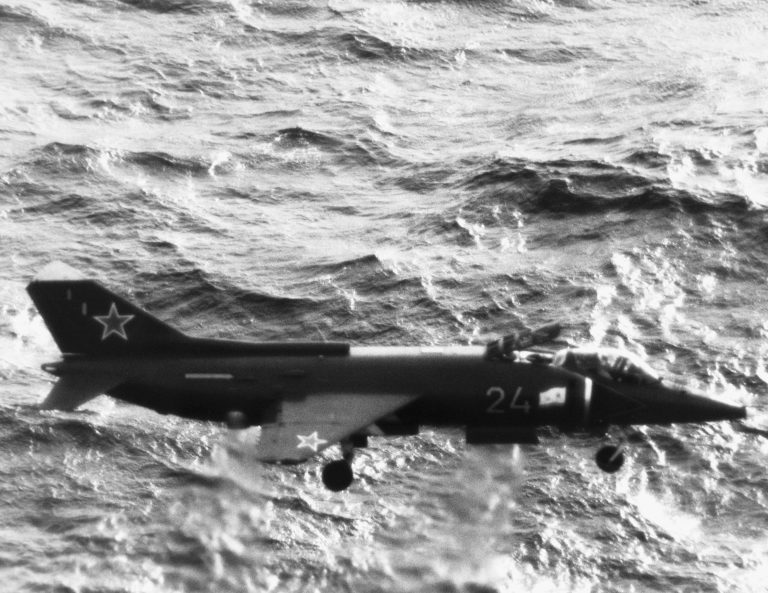
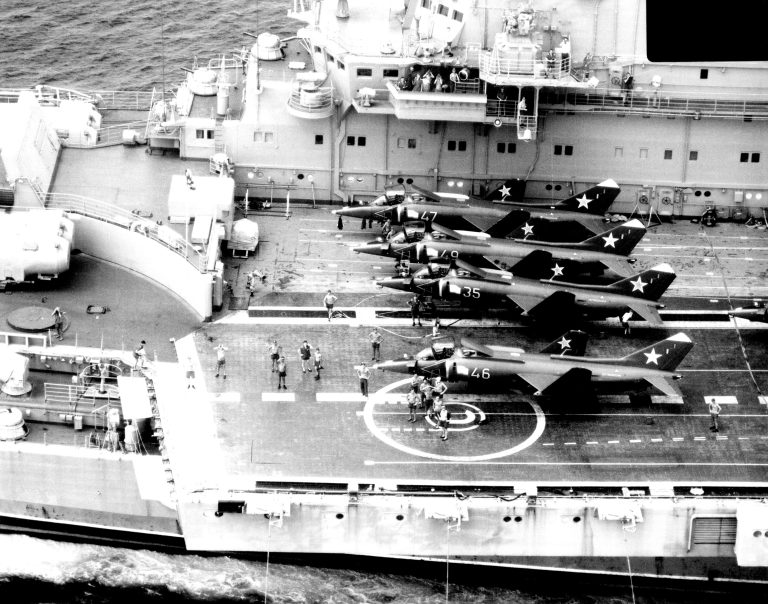
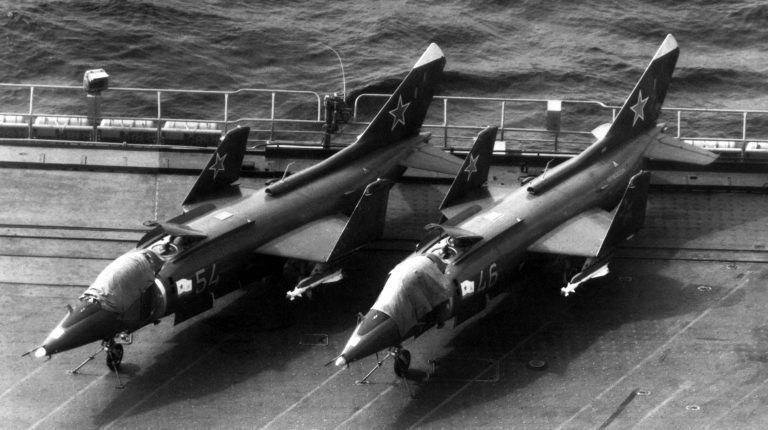
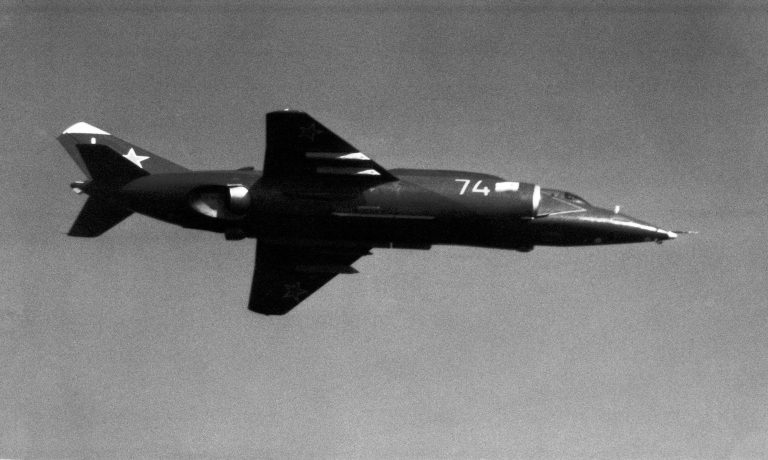
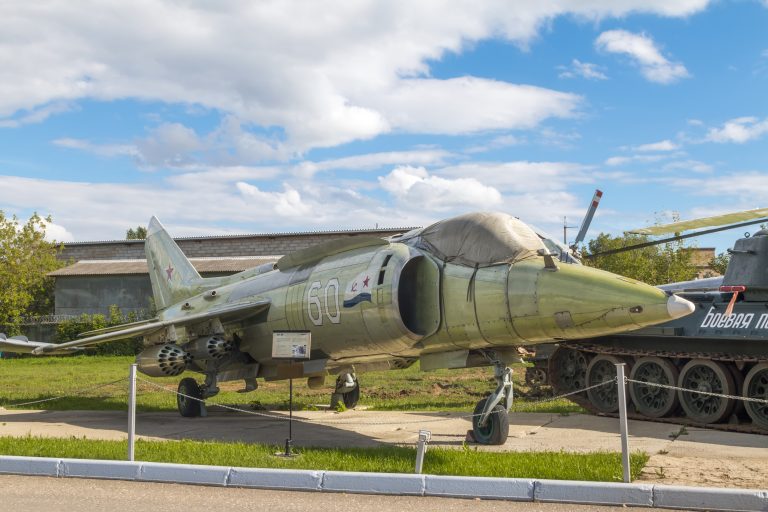
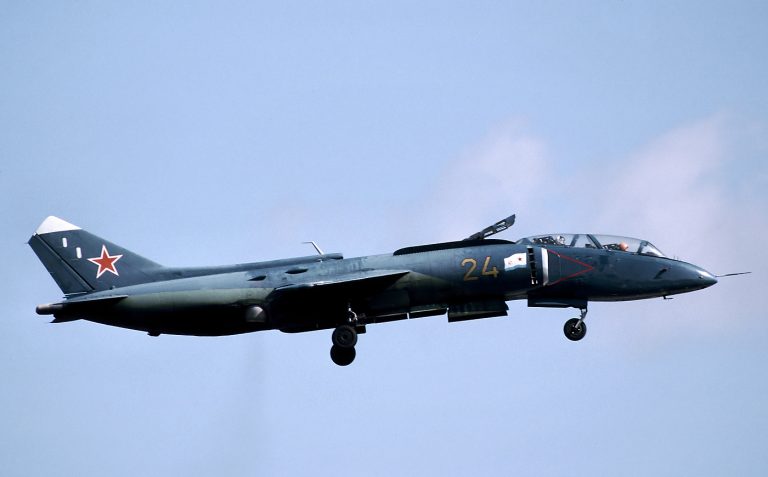
The Yak-38 Forger in motion
A curated video feature for the Yak-38 Forger is coming soon. In the meantime, explore the photo gallery above and the operations map below.
Where the Yak-38 Forger operated
The record that defines the Yak-38
The Yak-38 scored no aerial victories and fought no war; its record is one of hard-won experience rather than combat success. Its single operational test under fire — the 1980 Operation Romb deployment to Afghanistan — exposed how badly its VTOL performance collapsed in heat and altitude, and it flew only about a dozen largely inconclusive sorties. At sea it served aboard the four Kiev-class ships until the early 1990s, and in 1982 armed Forgers from Minsk intercepted US carrier aircraft over the Arabian Sea. Set against those thin operational credits is a severe safety record: sources commonly cite that roughly a third of the fleet was lost to accidents.
Compare the combat record of every military aircraft. Figures as of July 2026; contested values are hedged.
Everything people ask about the Yak-38 Forger
Can I fly in a Yak-38?
Why did the Yak-38 have three engines when the Harrier had one?
What was special about its ejection seat?
What happened when the Yak-38 was sent to Afghanistan?
Was the Yak-38 supersonic?
Did the Yak-38 really inspire the F-35B?
Who operated the Yak-38, and is it still in service?
You can’t fly the Yak-38.
These, you can.
Some legends only live in museums — others are fuelled and waiting. MiGFlug has put civilians in real military jet cockpits since 2004.
 Fly the L-39 AlbatrosThe world’s most-flown jet trainer — aerobatics included
 Fly the F-104 Starfighter“The missile with a man in it”
 Fly the MiG-21The Cold War’s most-produced jet
 Fly the T-33 Shooting StarAmerica’s first jet trainer
 Fly the DH VampireA piece of early jet history
 Fly the S.211Agile Italian jet trainer
 Fly the MB-326The classic Aermacchi jet
 Fly the MiG-15The Soviet legend of the Korean War
Continue the tour
Every fact, checked
- Military Factory — Yakovlev Yak-38 (Forger)Specifications, variant build numbers, armament and the Yak-36 development lineage.
- Naval-Aviation.com — Yakovlev Yak-38 “Forger”The three-engine layout, service dates, Kiev-class deployment and Harrier comparison.
- Military Aviation Videos — The forgotten Soviet VTOL jetsOperation Romb in Afghanistan, the accident rate and lift-engine service life.
- Vintage Aviation News — First untethered flight of the Yak-36Dated milestones for the Yak-36 “Freehand” VTOL precursor.
- UAS Vision — Yakovlev Yak-38Prototype dates, the 1982 Minsk/Enterprise intercept and the automatic ejection system.
- Russia Beyond — Is the Yak-141 the “father” of the F-35B?The Lockheed–Yakovlev cooperation and a hedged view of the F-35B lineage claim.
- The National Interest — The Yak-41 and the F-35BA skeptical counterpoint on how much the Yak-141 really influenced the F-35B.
- RuAviation — Yak-38M carrier-based strike fighterYak-38M engine upgrades and the automatic-ejection trigger logic.