
Every delta-winged aircraft America built in the 1950s and 1960s owes something to one prototype that only one pilot ever had a good word for, and he did not really.
The Convair XF-92A flew 118 times over five years, was rebuilt around three different engines, was hated by everybody who flew it, ended its career with its nose gear folding up as it taxied off a dry lake bed, and taught the United States something about wings that nobody had gone looking for.
Kurzinfo
Gebaut: One aircraft, serial 46-682
Erster Flug: 18 September 1948, at Muroc Dry Lake, with Convair test pilot Ellis D. “Sam” Shannon
Motor: Started with a 4,250 lbf Allison J33-A-21; re-engined in 1951 with an afterburning J33-A-29 at 7,500 lbf; finally a 5,400 lbf J33-A-16
Am schnellsten: Mach 1.05, briefly, in a 4g split-S dive — never supersonic in level flight
Convair testing: 47 flights, 20 hours 33 minutes, before handover to the Air Force on 26 August 1949
NACA testing: 25 flights by Scott Crossfield, ending 14 October 1953
Descendants: F-102 Delta Dagger, F-106 Delta Dart, B-58 Hustler, F2Y Sea Dart, XFY Pogo
Wo es sich jetzt befindet: Research & Development Gallery, National Museum of the United States Air Force, Dayton, Ohio
It was supposed to be something far stranger
The XF-92 began as the XP-92, an answer to a 1945 Army Air Forces requirement for an interceptor that could do 700 mph and reach 50,000 feet in four minutes. Convair’s proposal was not a conventional jet. It was a mixed-propulsion machine: a small Westinghouse turbojet assisted by a battery of six 2,000 lbf liquid-fuelled rockets, with a duct so large that it fed the jet and passed air around the rocket exhaust for thrust augmentation.
The duct was so big there was nowhere to put a cockpit. So, like the French Leduc 0.10 and Britain’s Miles M.52, Convair put the pilot in a cylindrical body sitting in the middle of the intake.
That aircraft was never built. But to get real flight experience with the wing before committing, Convair proposed a smaller, simpler test aircraft — the Model 7002 — and the Air Force agreed in November 1946. That is what became the XF-92A.
It was assembled from other people’s aeroplanes
To save time and money, the XF-92A was built largely out of parts already lying around. The main landing gear came from a North American FJ-1 Fury. The nosewheel came from a Bell P-63 Kingcobra. The engine and hydraulics came from a Lockheed P-80 Shooting Star. The ejection seat and cockpit canopy came from the cancelled Convair XP-81. Even the rudder pedals were lifted from a BT-13 trainer.
Convair found the delta on its own
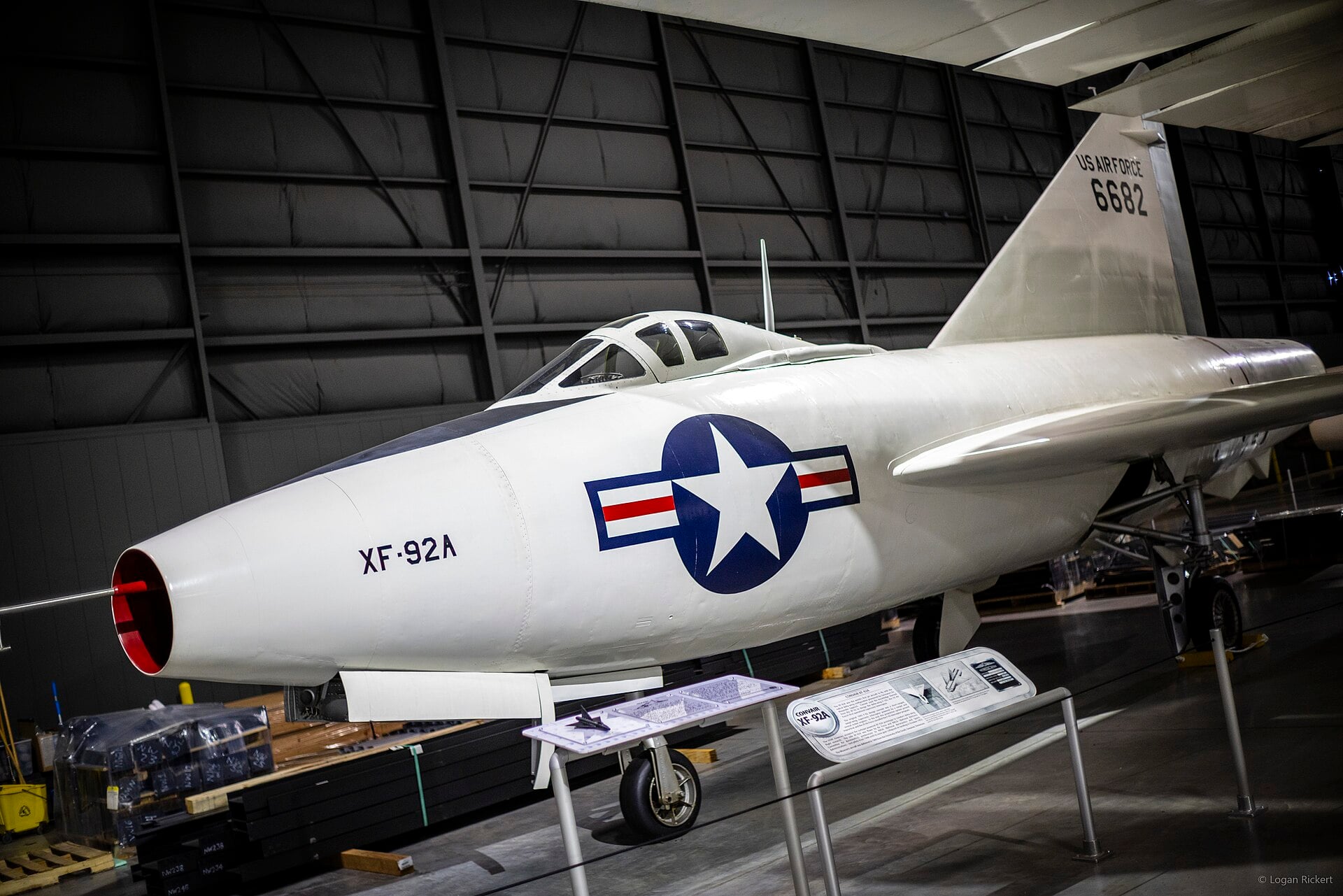
There is a persistent story that Convair simply copied Alexander Lippisch. It is not what happened. Convair’s original submission had 45-degree swept wings; wind tunnel testing found problems with it; and by straightening the trailing edge and increasing the leading-edge sweep the company arrived at the thin delta on its own.
Ralph Shick, Convair’s chief of aerodynamic research, did later meet Lippisch at Wright-Patterson, and the meeting helped convince him the thin delta was the right road. But the influence amounted to what one history calls moral support. Convair rejected most of what Lippisch actually proposed, including the thick wing of his P.13a and the DM-1 test glider the Americans had brought home and tested.
The XF-92A at Muroc — period footage of the Model 7002 flying.
Nobody wanted to fly it
The complaints were fair. The J33 was never enough engine for the airframe. The 1951 re-engining with an afterburning J33-A-29 promised 7,500 lbf and delivered very little improvement, along with maintenance problems so persistent that the aircraft managed only 21 flights in the following nineteen months.
Under NACA, Crossfield’s testing from April 1953 turned up something worse: a violent pitch-up in high-speed turns, frequently pulling 6g and on one occasion 8g. Wing fences helped, partially. On 14 October 1953, after his twenty-fifth flight, the nose gear collapsed as he taxied off the lake bed, and that was the end of the programme.
Chuck Yeager, who became the first Air Force pilot to fly it on 13 October 1949, was more diplomatic. Barely.
That Mach 1.05 came on his second flight, in a 4g split-S dive. The XF-92A was never supersonic in level flight, and was never going to be.
The accident that mattered
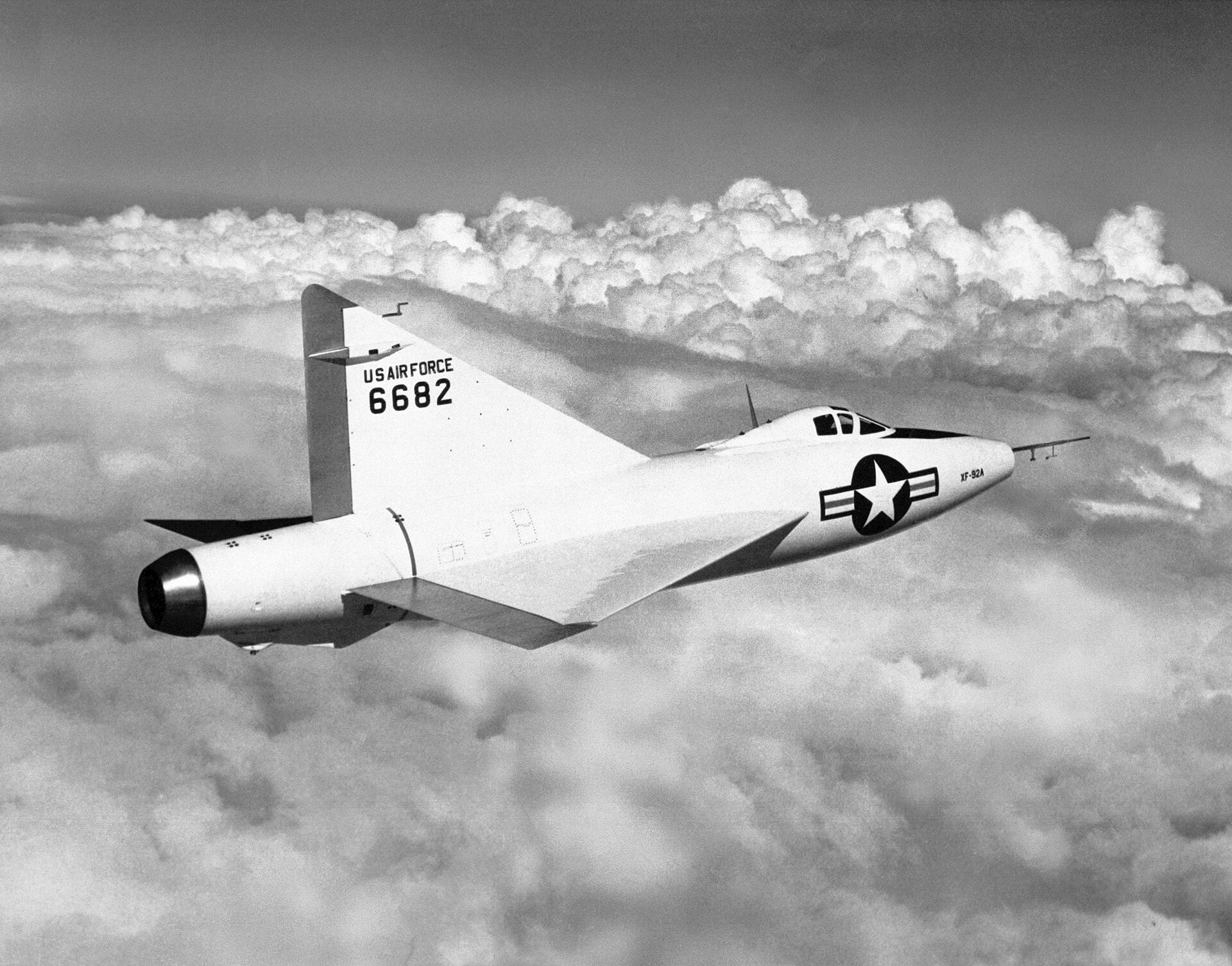
On that same second flight, Yeager came back to land and, wanting to avoid the trouble he had had on his first approach, kept raising the nose to bleed off speed. The aircraft did not stall. He kept pulling. It still did not stall. He flew it under control at 45 degrees nose-up and touched down at 67 mph — a hundred miles an hour slower than Convair had ever managed.
Nobody had designed that in. What was happening was that at high angles of attack, the airflow between the fuselage and the wing leading edge was rolling up into a large vortex which then attached itself to the upper surface of the wing, feeding it air moving far faster than the aircraft itself. The wing was being kept alive by its own turbulence.
That is vortex lift, and understanding it is why delta-winged aircraft of the 1960s and 1970s sprouted canards, and why almost every modern fighter has a leading edge extension at the wing root. The XF-92A did not invent the delta wing. It accidentally demonstrated the thing that would make the delta wing usable.
The XF-92A’s story and its place in the American delta lineage.
The original 1948 USAF film of the Model 7002 research tests.
A second career in the movies
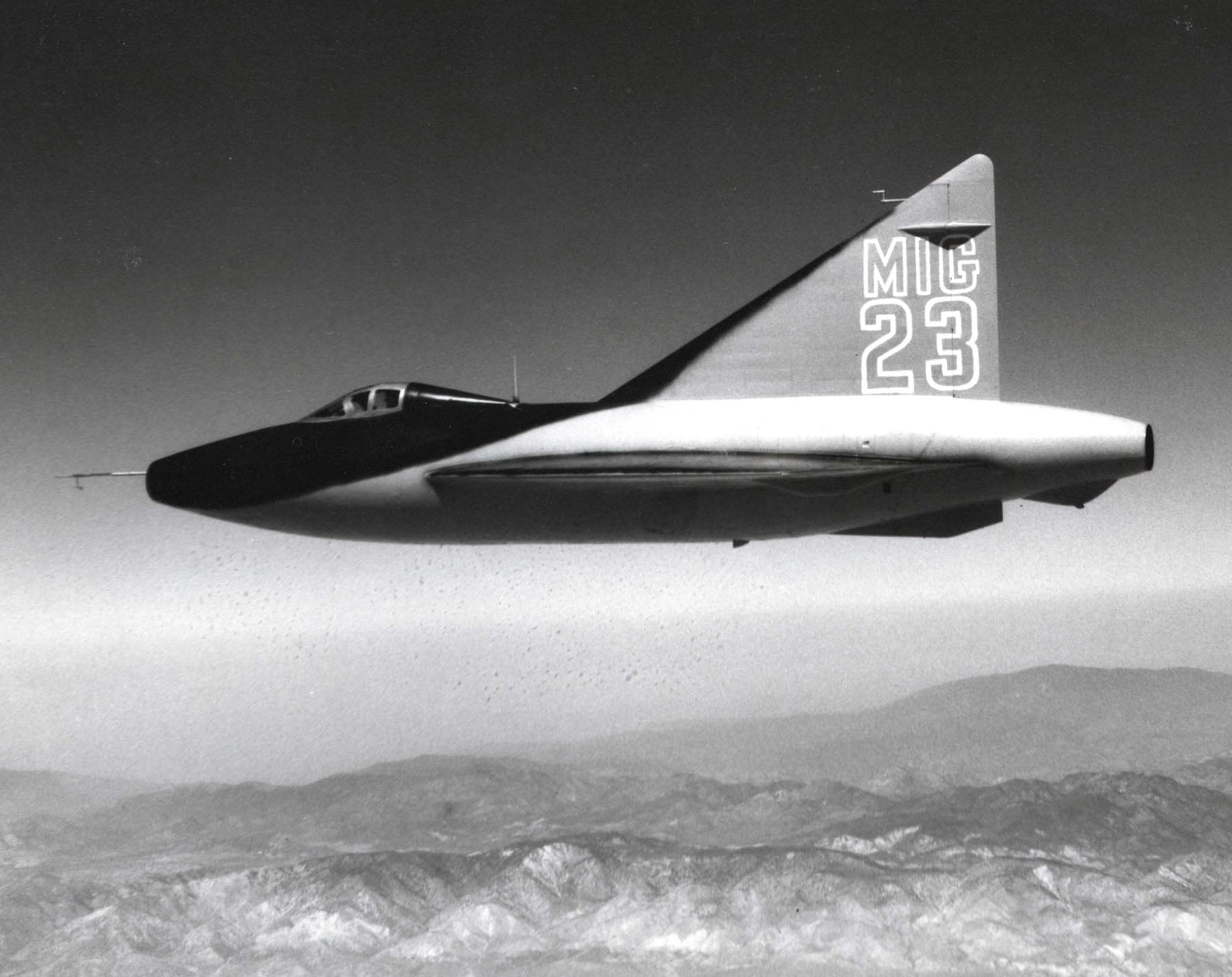
Between test programmes the aircraft was painted in Soviet markings to play a “MiG-23” in Howard Hughes’s Jet Pilot, starring John Wayne and Janet Leigh. Hughes sat on the film so long that by its 1957 release the XF-92A’s footage had been cut. It did make it onto screens in Toward the Unknown in 1956 — again pretending to be another aircraft, this time its own descendant, the F-102.
There is something fitting in that. The XF-92A spent its whole life standing in for aeroplanes that were better than it: first as a stand-in for the interceptor Convair never built, then for a fighter that did not exist, then for the one it made possible. It is in a museum in Dayton now, in the Research and Development gallery, which is exactly the right room for it.
Häufig gestellte Fragen
What was the Convair XF-92A?
A single-seat American delta-wing research aircraft, and the first delta-winged jet to fly in the United States. Only one was built, serial 46-682. Originally designated XP-92 and conceived as a point-defence interceptor, the fighter project was cancelled and the aircraft was completed purely as an experimental machine, first flying on 18 September 1948.
How fast was the XF-92A?
It briefly reached Mach 1.05 with Chuck Yeager at the controls, in a 4g split-S dive on his second flight. It was never supersonic in level flight. Published figures give a maximum speed of 718 mph (1,156 km/h) and a service ceiling of 50,750 ft.
Did Convair copy Alexander Lippisch’s delta wing?
No. Convair’s original design used 45-degree swept wings, and the company arrived at the thin delta independently after wind tunnel testing, by straightening the trailing edge and increasing leading-edge sweep. Convair’s chief of aerodynamic research, Ralph Shick, later met Lippisch at Wright-Patterson, which helped convince him the thin delta was correct, but that influence has been described as no more than moral support. Convair rejected Lippisch’s thick-wing ideas, including the P.13a and the DM-1 glider.
Why did pilots dislike the XF-92A?
It was underpowered throughout its life, even after being re-engined in 1951 with an afterburning Allison J33-A-29, and it developed a violent pitch-up during high-speed turns — frequently 6g and on one occasion 8g — which wing fences only partially cured. NACA pilot Scott Crossfield called it a miserable flying beast and said there was no queue of pilots wanting to fly it.
What was the XF-92A built from?
Largely from other aircraft, to save time and money. The main gear came from a North American FJ-1 Fury, the nosewheel from a Bell P-63 Kingcobra, the engine and hydraulics from a Lockheed P-80 Shooting Star, the ejection seat and canopy from the cancelled Convair XP-81, and the rudder pedals from a BT-13 trainer.
What did the XF-92A actually contribute?
Its most important discovery was accidental. Landing on his second flight, Yeager found the aircraft simply would not stall, and flew it under control at 45 degrees nose-up to a touchdown at 67 mph. The cause was a large vortex forming between the fuselage and wing leading edge at high angle of attack and attaching to the upper surface of the wing. Understanding that vortex lift led directly to canards on later delta designs and to the leading edge extensions found on most modern fighters.
Which aircraft came out of the XF-92A programme?
The delta wing it proved went on to the Convair F-102 Delta Dagger, F-106 Delta Dart and B-58 Hustler, the US Navy’s F2Y Sea Dart, and the VTOL XFY Pogo.
Where is the XF-92A now?
On display in the Research & Development Gallery at the National Museum of the United States Air Force, Wright-Patterson Air Force Base near Dayton, Ohio.
Sources: Wikipedia and the works it cites, including Yenne, Convair Deltas from SeaDart to Hustler (2009); Jenkins and Landis, Experimental & Prototype U.S. Air Force Jet Fighters (2008); Hallion (1979); Joe Baugher’s USAF Fighters; NASA Dryden fact sheets; National Museum of the United States Air Force.
0 Comments