
In 1949, English Electric wanted to build a supersonic fighter with sixty degrees of wing sweep. Nobody in the world had flown a wing swept that far. The Royal Aircraft Establishment thought it would be uncontrollable at low speed, and said so.
There was no computational fluid dynamics to settle it, no wind tunnel that could reproduce a full-scale approach and landing, and a great deal of money and national prestige riding on the answer. So Britain did the only thing available: it built an aeroplane specifically to find out who was right.
The Short SB.5 had a wing you could unbolt and reset to a different sweep angle, and a rear fuselage you could swap for a different one with the tailplane somewhere else. One was built. It settled the argument, and the aircraft it de-risked became the Englische elektrische Beleuchtung.
Kurzinfo
| Flugzeug | Short SB.5, serial WG768 |
| Gebaut | One, by Short Brothers and Harland, Belfast |
| Vertrag | 2 August 1950, to Air Ministry requirement ER.100 |
| Erster Flug | 2 December 1952 at Boscombe Down, flown by Tom Brooke-Smith |
| Wing sweep settings | 50, 60 and 69 degrees, adjusted on the ground |
| Tail configurations | Two interchangeable rear fuselages, one with a T-tail, one with a low tailplane |
| Wing construction | Plywood with light alloy at the leading and trailing edges |
| Undercarriage | Fixed, because the aircraft only ever needed to fly slowly |
| Original engine | Rolls-Royce Derwent Mk 8, 3,500 lbf, later replaced by a Bristol Orpheus |
| 69-degree first flight | 18 October 1960, flown by Denis Tayler at RAE Bedford; the greatest wing sweep flown anywhere at the time |
| Schicksal | Passed to the Empire Test Pilots’ School in 1967 and preserved at the RAF Museum |
An aeroplane built to settle an argument
The P.1, which became the Lightning, was an extraordinarily bold design: two engines stacked vertically one above the other to cut frontal area, a simple pitot intake with the shock cone in the middle, and a wing swept far beyond anything then flying.
Sweep buys you supersonic performance and takes away low-speed behaviour. A heavily swept wing sheds lift outboard first, which pitches the nose up just when the pilot least wants it, and the RAE's concern was that a 60-degree wing with a low-set tailplane would put that tailplane into the wing's wake at high angles of attack, with the aircraft locked into a stall it could not recover from. English Electric disagreed.
The most modular aeroplane in Britain
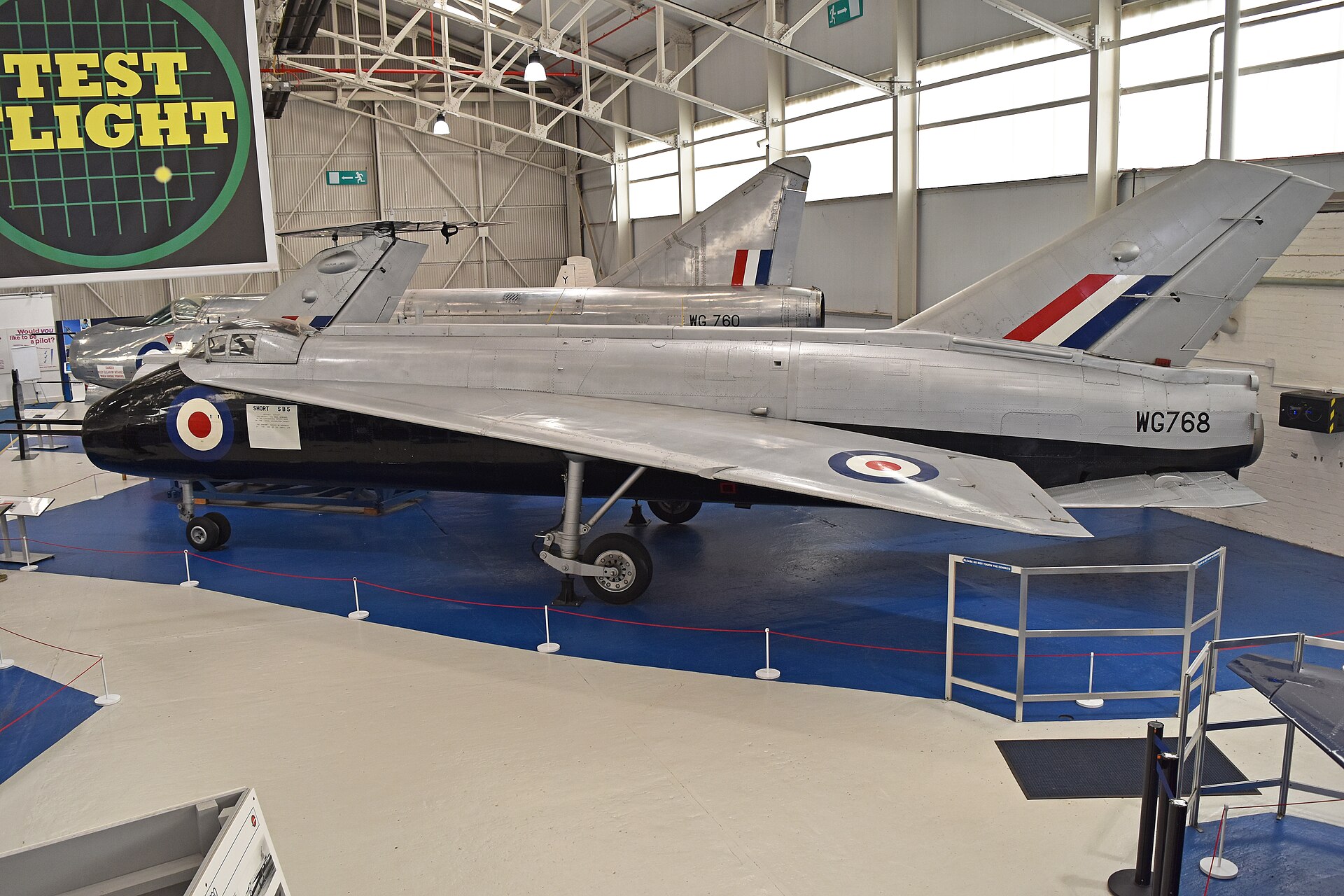
The contract went to Short Brothers and Harland in Belfast on 2 August 1950. What they produced was less an aircraft than a test rig that happened to fly.
The wings could be reset on the ground to 50, 60 or 69 degrees of sweep. The entire rear fuselage aft of the engine detached, and two were built: one carrying the tailplane on top of the fin, the other carrying it low on the fuselage. The tailplane's incidence was electrically adjustable in flight. In the 60-degree setting, the aircraft was aerodynamically close to a seven-eighths scale Lightning.
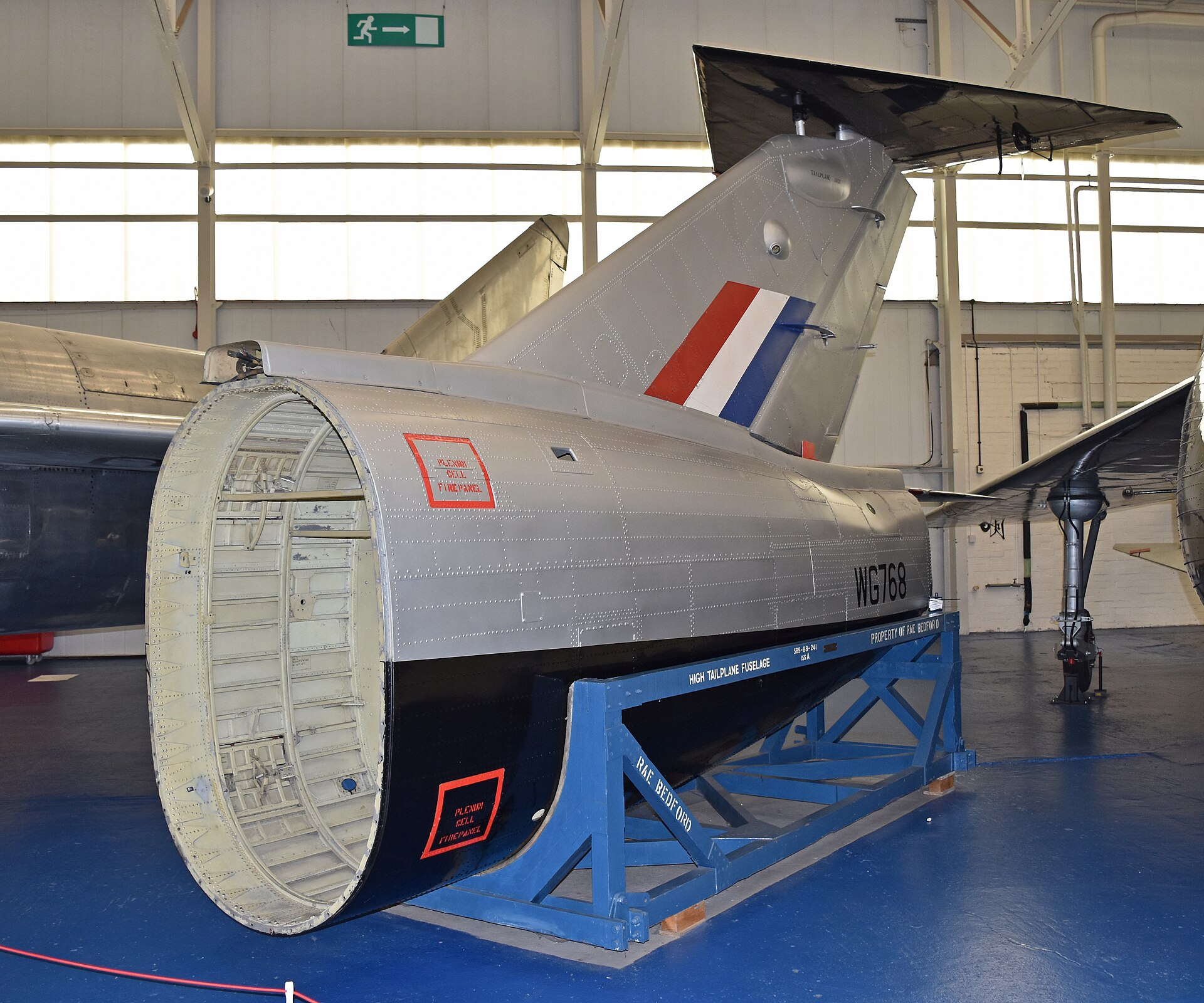
Because it never needed to go fast, the SB.5 was built cheaply and sensibly. The undercarriage was fixed. The wings were plywood with light alloy sheeting at the leading and trailing edges, which capped the aircraft at around 350 knots and did not matter in the slightest, since the entire point was the bottom of the speed range. There were two twenty-foot brake parachutes and a twenty-foot anti-spin parachute stowed above the jet pipe, which tells you what the test programme expected to encounter.
Eight years of unbolting things
Tom Brooke-Smith, Shorts' chief test pilot, made the first flight from Boscombe Down on 2 December 1952 with the wing at 50 degrees. He flew a display at the Farnborough show the following year. Roland Beamont, running English Electric's P.1 programme, flew it in August 1953.
In July 1953 the wing went to 60 degrees, still with the T-tail. In January 1954 the low-tailplane rear fuselage was fitted, deliberately timed so that the results would reach English Electric before the P.1 flew.
The result was the opposite of what the RAE had feared. The T-tail turned out to be the unsatisfactory configuration. The low tailplane, the one English Electric had wanted all along, worked. Testing at 60 degrees continued until April 1958, and comprehensively confirmed that the manufacturer had been right.
Sixty-nine degrees
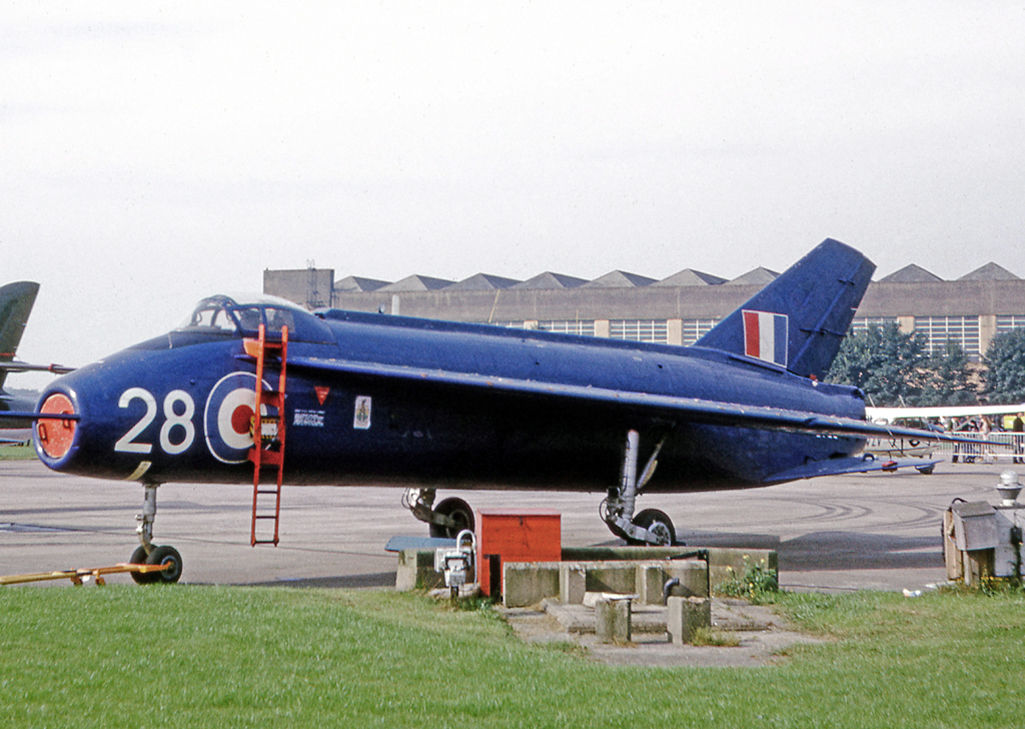
The Lightning question had been answered by 1958, but the airframe still had one setting nobody had used. Before attempting it, the SB.5 was given two significant upgrades: a Martin-Baker ejection seat, fitted for the first time in the aircraft's life, and a Bristol Orpheus in place of the Derwent.
The fact that the first eight years of flying were done without an ejection seat, in a plywood-winged aircraft deliberately exploring the edge of the low-speed envelope with an anti-spin parachute in the tail, is worth sitting with for a moment.
Denis Tayler flew it at 69 degrees on 18 October 1960 from RAE Bedford. It was, at the time, the greatest wing sweep flown by any aircraft in the world.
What it bought
The Lightning went on to become the only Mach 2 fighter Britain designed and built entirely on its own, an aircraft with a rate of climb that still startles people and a service career stretching into the 1980s. None of that would have been impossible without the SB.5, but the programme would have carried a large, expensive, unquantified risk right through to the P.1's first flight.
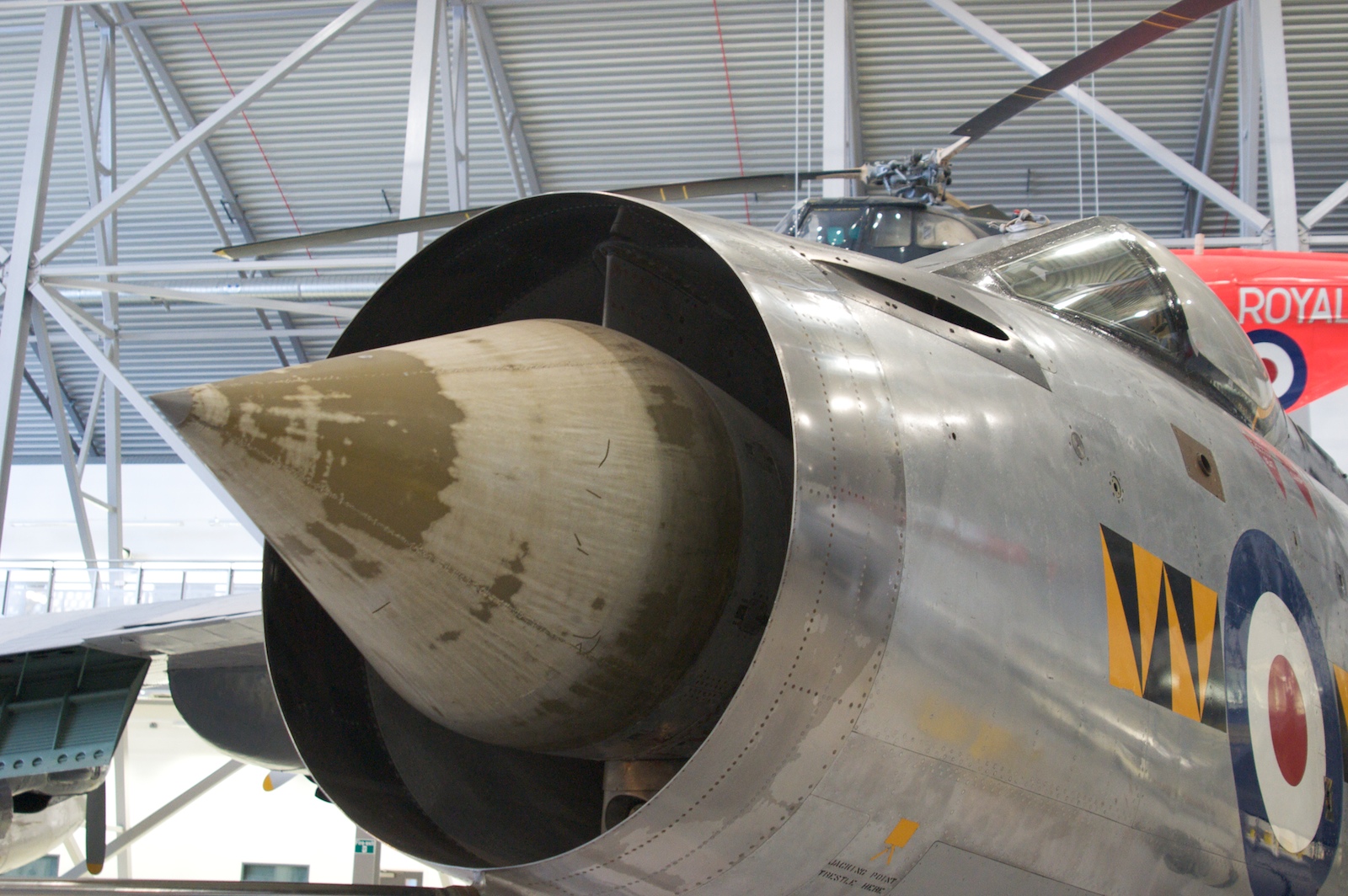
Instead, one cheap aeroplane with bolt-on wings and a detachable back end answered the question for a few hundred thousand pounds. It then spent its retirement teaching test pilots at the Empire Test Pilots' School, and is preserved today at the RAF Museum, complete with its spare tail.
Modern aerospace settles arguments like this in software. It is worth remembering that within living memory, the way to find out whether a wing would work was to build the wing, bolt it on, and send somebody up in it without an ejection seat.
Häufig gestellte Fragen
What was the Short SB.5?
Why was the Short SB.5 built?
Who was right, the RAE or English Electric?
How did the SB.5 change its wing sweep?
How fast could the Short SB.5 fly?
What happened to the Short SB.5?
Did the SB.5 have an ejection seat?
Sources: RAF Museum aircraft history file for WG768; K. J. Staples, Flight Tests on the Short SB5; Jane’s All the World’s Aircraft; The Lightning Association.
0 Comments