
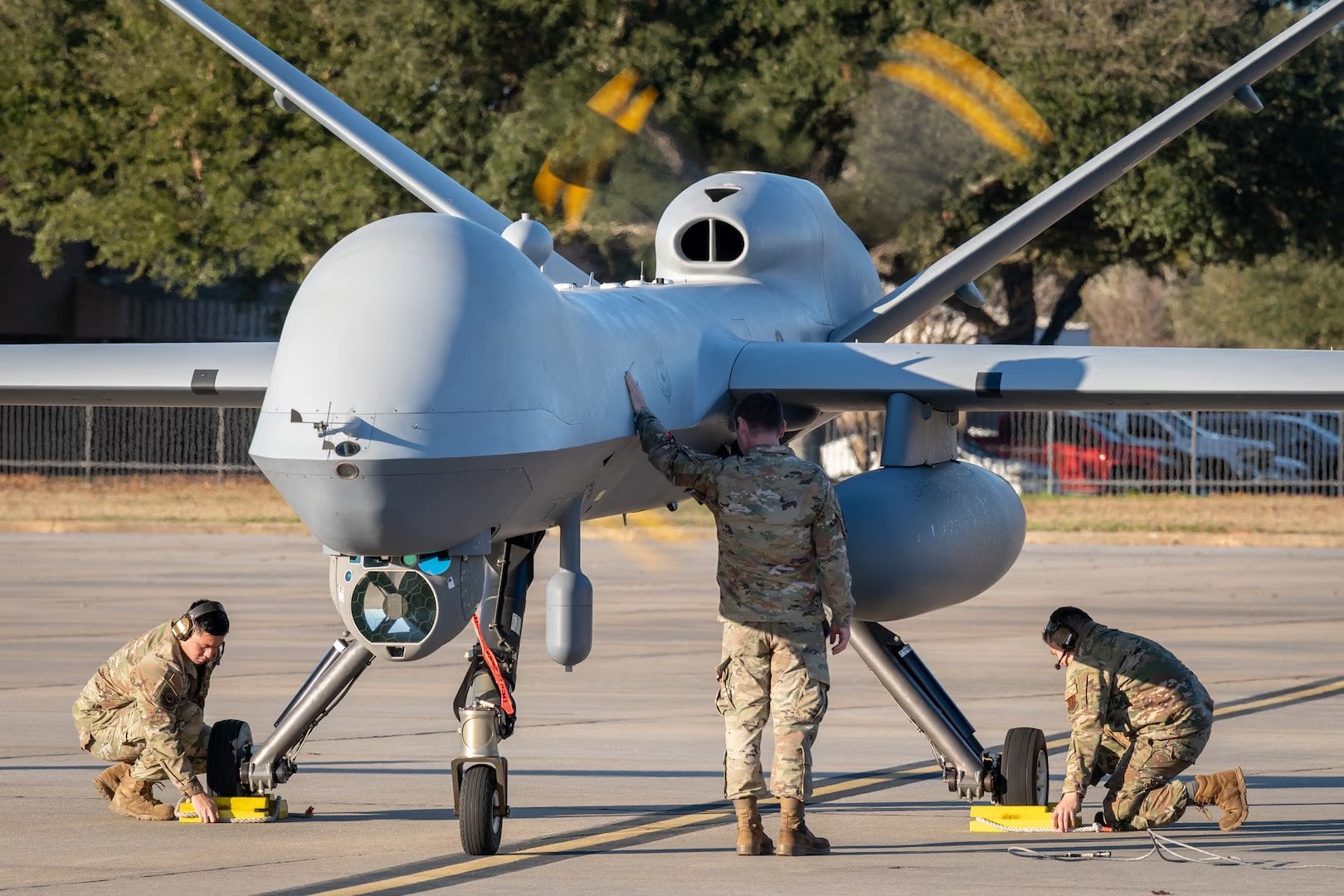
The United States bought 337 MQ-9 Reapers over the nineteen-year life of the programme. After the fighting with Iran, the Air Force has roughly 135 left, against a floor it says should be 189. That is the arithmetic behind everything that happened on the show floor at National Harbor on Monday.
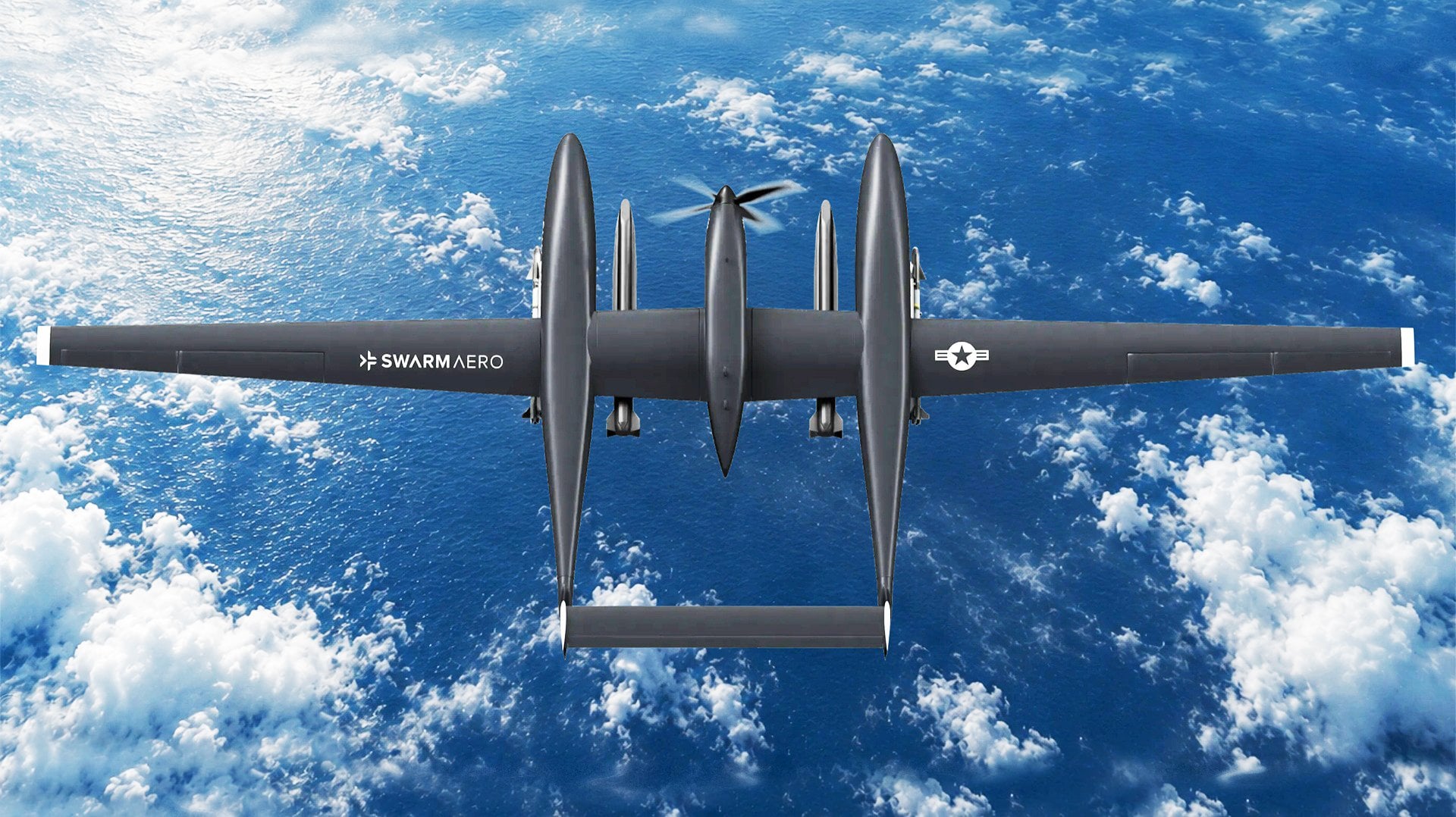
A company almost nobody outside the drone business had heard of wheeled in a full-size mockup with a 72-foot wingspan, a cruise missile hanging off its belly, and a price tag attached. The company is Swarm Aero, founded in 2022, based in northwest Arkansas. The aircraft is called Gamera. The number is under $10 million.
If that number holds, it is somewhere between a fifth and a third of what a kitted-out Reaper reportedly costs today.
Kurzinfo
| Flugzeug | Swarm Aero Gamera, Group 5 strike and sensing UAS |
| Enthüllt | 14 September 2026, AFA Air, Space & Cyber Conference, National Harbor, Maryland |
| Spannweite | About 72 ft (22 m) |
| Nutzlast | 2,800 lb (1,270 kg) across seven stores stations |
| Reichweite | About 9,000 miles unrefuelled; combat radius about 2,300 miles (company figures) |
| Native weapon | AGM-158B JASSM-ER cruise missile on the centreline |
| Antrieb | Single propeller, twin-boom T-tail, sponson fuel cells |
| Target unit cost | Under $10 million, the USAF Massed Modular Aircraft ceiling |
| Hersteller | Swarm Aero, founded 2022, northwest Arkansas |
A clean sheet built around a price tag
Most cheap-drone pitches are expensive drones with the expensive parts removed. Swarm Aero says Gamera is the other thing: an aircraft designed from a blank page with cost as the first constraint rather than the last one.
The design reads that way. A single propeller, like the Reaper. A central fuselage carrying the main hardpoint. Fuel in sponsons on either side rather than in the wings, which lets the wings come off and be built separately. And a twin-boom T-tail lifted straight from the OV-10 Bronco playbook, which keeps the area behind the fuselage clear for whatever the aircraft is carrying.
Kalogiannis told TWZ the Bronco tail exists for flexibility as much as for cost: it lets the aircraft carry released payloads, rocket-powered ones, or sensors, without redesigning the back end each time. It is also, in his words, straightforward to manufacture.
That claim is not free-floating. Swarm Aero is executing more than $10 million in Air Force Research Laboratory contracts to develop metal composites, and the company says its very first engineering hire was a materials and process engineer. Hiring the manufacturing problem before the aerodynamics problem tells you what the company thinks it is actually solving.
Seven hardpoints and a bomber’s missile
The headline claim is the weapon. Gamera’s native payload is the AGM-158B JASSM-ER, a stealthy air-launched cruise missile with a reach of roughly 600 miles that until now has been the business of B-1s, B-2s, B-52s and fighters. Swarm Aero says it is the first uncrewed aircraft designed from the outset to employ bomber-class strike munitions.
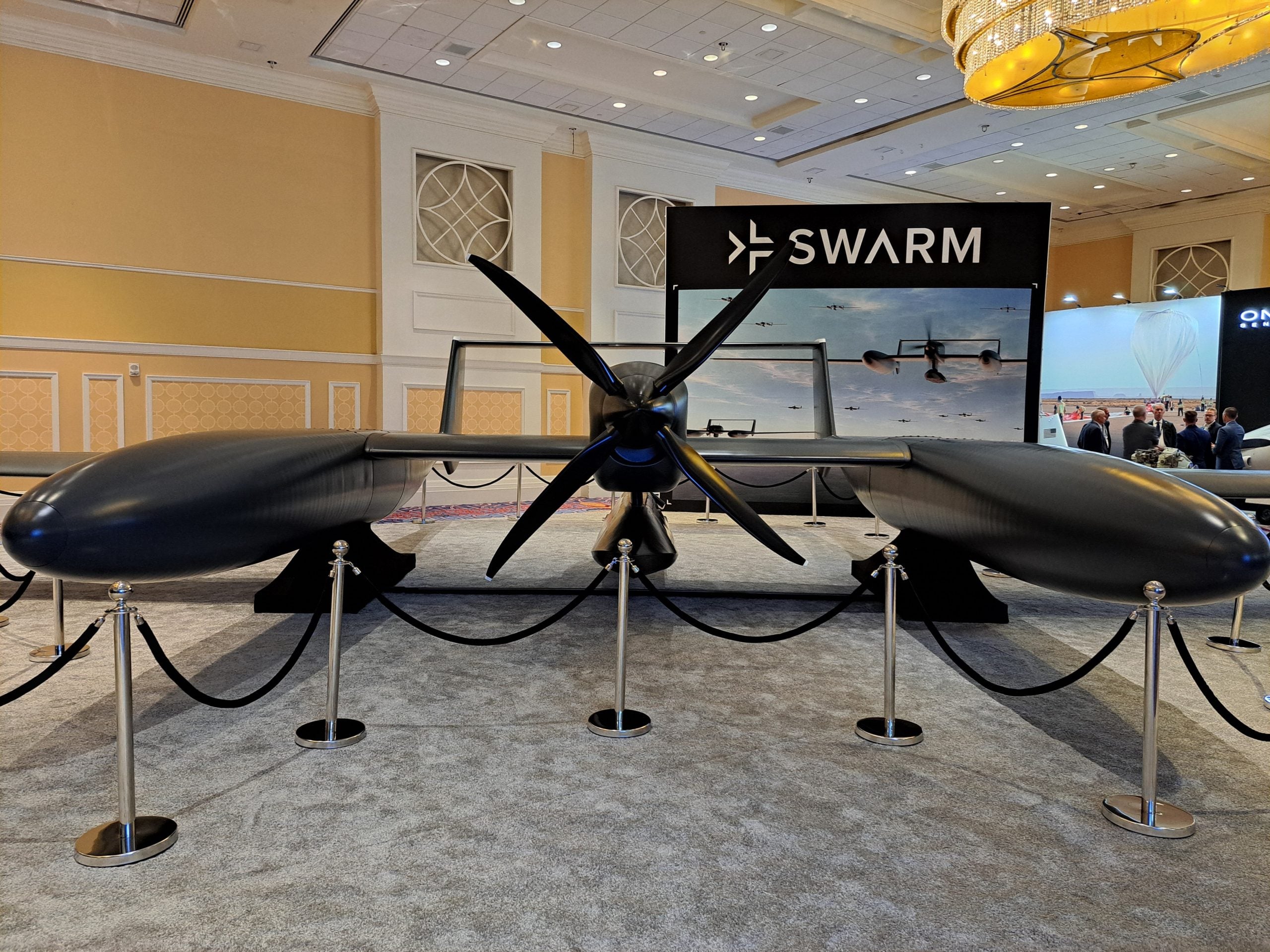
Six more hardpoints sit outboard of the centreline. Company renderings show configurations for direct attack with Hellfire and JAGM missiles, for ISR with podded sensors, and, more surprisingly, for air-to-air missiles. The company’s framing is that it delivers comparable strike effects to far more exotic platforms for roughly a tenth of the cost per effect.
Those are vendor numbers, and they should be read as vendor numbers. What is not a vendor number is the requirement they line up against. The Air Force’s Massed Modular Aircraft wish list asks for a 2,800-pound payload and a 2,300-mile unrefuelled combat radius. Gamera claims a 2,800-pound payload and a 2,300-mile combat radius. Nobody at Swarm Aero is pretending that is a coincidence.
Eighty at a time
The name is not decoration. Swarm Aero’s actual product before Gamera was software: a command-and-control and autonomy system called Legion, which is meant to let a single operator or small team run dozens of uncrewed vehicles across different domains at once. The company says Gamera is most effective in groups of up to 80.
Legion is further along than the airframe. The Navy has already evaluated it for directing air and sea drones together, and the Defense Innovation Unit has picked it as a command-and-control source for its Autonomous Collaborative Teaming programme. The aeroplane, for now, is a mockup.
The race the Air Force just made worth winning
Swarm Aero did not pick Monday at random. Hours after the mockup went up, the Air Force confirmed at the same conference that it intends to field at least 500 Massed Modular Aircraft by 2032, alongside 500 Collaborative Combat Aircraft. A programme that had been talked about in the low hundreds is suddenly a five-hundred-airframe programme.
It is also suddenly a contested one. Earlier this month General Atomics, which builds the Reaper, unveiled Wildfire, a MALE drone derived from the MQ-9 that promises broadly similar performance with some deliberate tradeoffs. General Atomics has been notably blunt that matching Reaper capability at a fraction of Reaper cost is harder than it sounds, and has not yet said whether Wildfire lands under the $10 million line.
Palmer declined to say how far under $10 million Gamera comes in, only that the bid would be competitive. He also suggested the price might push the Air Force past its stated floor of 180 aircraft, which is the kind of thing a challenger says and an incumbent hates to hear.
The honest summary: one company has a flying track record and no cheap aeroplane yet, and the other has a cheap aeroplane and no flying track record yet. The Air Force needs somebody to be right, because it is burning Reapers faster than it can buy them.
Häufig gestellte Fragen
What is the Swarm Aero Gamera?
How much does the Gamera cost compared with an MQ-9 Reaper?
What weapons can the Swarm Aero Gamera carry?
Why does the US Air Force need a cheaper Reaper?
Who else is competing to replace the MQ-9 Reaper?
Has the Gamera actually flown?
Sources: TWZ, Defense News, aeroTELEGRAPH, Air Force Times, Swarm Aero.
0 Comments