
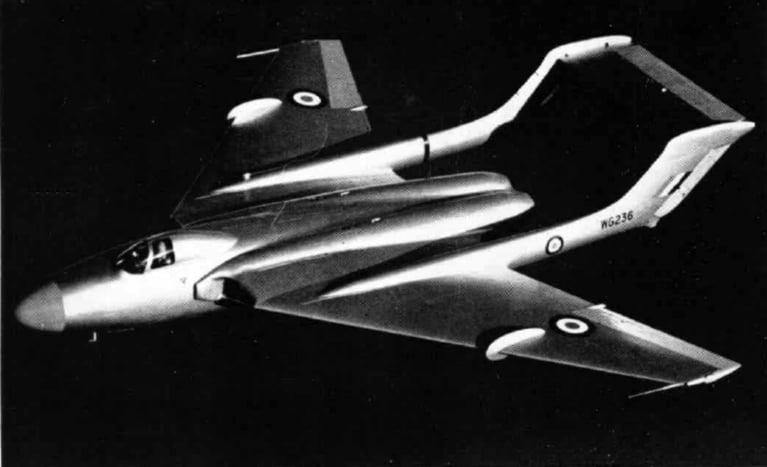
On 6 September 1948, John Derry became the first Briton to fly faster than sound, in a de Havilland DH.108. Four years later to the day, on 6 September 1952, he was killed at Farnborough in front of a crowd of a hundred thousand people, along with his flight test observer and twenty-nine spectators.
He was thirty years old. And he was not even supposed to be flying that aeroplane.
Kurzinfo
Datum: Saturday 6 September 1952, the last public day of the SBAC display at Farnborough
Flugzeug: de Havilland DH.110, serial WG236, the first prototype
Crew: John Derry, de Havilland test pilot, and Anthony Richards, flight test observer
Ursache: Structural failure of the outer wings in torsion during a high-speed pull-up and turn
Dead: 29 spectators plus both crew. Contemporary reports said 28 spectators; one more died of injuries
Injured: Around 60 to 63
Consequence: UK display rules imposing minimum crowd distances and altitudes, and displays flown parallel to the crowd
Legacy of the type: Redesigned and flying again by June 1953. It became the de Havilland Sea Vixen
The wrong aeroplane
The DH.110 scheduled to display was the second prototype, WG240, painted all black as a night fighter. It went unserviceable. So Derry and Richards drove to Hatfield, collected the first prototype WG236, and flew it down to Farnborough that day.
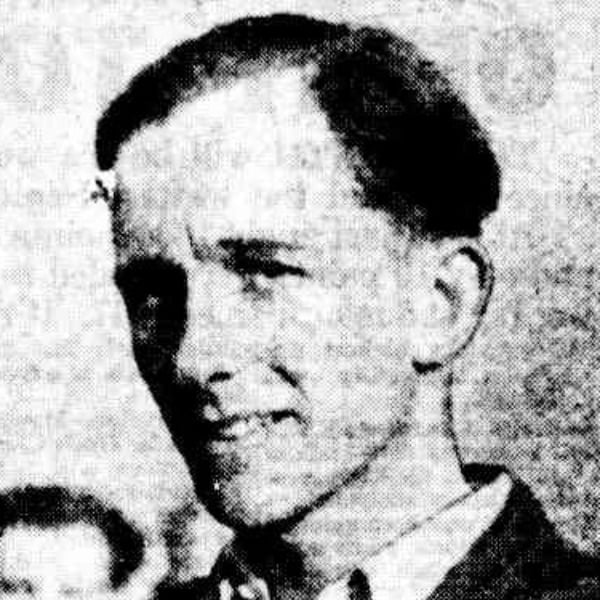
The display was a dive from 40,000 feet through the sound barrier, a pull-out, and a fast run along the main runway. Observers put the speed somewhere between 450 and 650 miles an hour depending on which account you read. Two small white puffs appeared in the sky north of the airfield as he went supersonic in the dive — a detail recorded by a Flug staff writer who was standing there.
Then he turned left into the circuit, came back over the northern boundary at around 400 feet, and pulled up into a turn towards the enclosures.
Under one second
The DH.110’s swept wing put its ailerons a long way aft of the centre of gravity. The pull-up and roll twisted the outer wing panels past what they could take. The starboard outer wing failed first, then the port.
With the wings gone the centre of pressure moved violently and the aircraft pitched up at more than twelve g. The cockpit was torn off. Both engines separated. So did the tail. The whole break-up took less than a second.
The cockpit fell in front of the enclosure beside the runway. One engine landed harmlessly. The other struck Observation Hill, where most of the spectators who died were standing. The remainder of the airframe came down in the north-west corner of the airfield. A five-year-old boy in the crowd, Richard Gardner, remembered it later on television: it looked like silver confetti, he said, and the airframe came down like a leaf.
The only words anyone has been able to document from the public address system that afternoon were shouted as it happened. Zeit magazine, reporting nine days later, recorded the announcer yelling: look out.
A modern documentary account of the accident and the investigation that followed.
The inquest
Group Captain Sidney Hughes, who commanded the experimental flying department at the Royal Aircraft Establishment, gave evidence that mattered to Derry’s widow and to every test pilot in Britain.
The jury found that Derry and Richards had died accidentally in the normal course of their duty, that the spectators’ deaths were accidental, and that no blame attached to Derry. Both men were posthumously awarded the Queen’s Commendation for Valuable Service in the Air.
The display went on
This is the part of the story that people remember, and it is worth telling accurately rather than dramatically.
Once the debris had been cleared from the runway, the display continued. Neville Duke, Hawker’s chief test pilot and a personal friend of Derry’s, took the prototype Hawker Hunter up that same afternoon and flew his display, going supersonic over the show. Accounts that say he was airborne “minutes later” trace back to a paraphrase of his own memoir rather than to any documented interval, so the honest version is simply that he flew that afternoon.
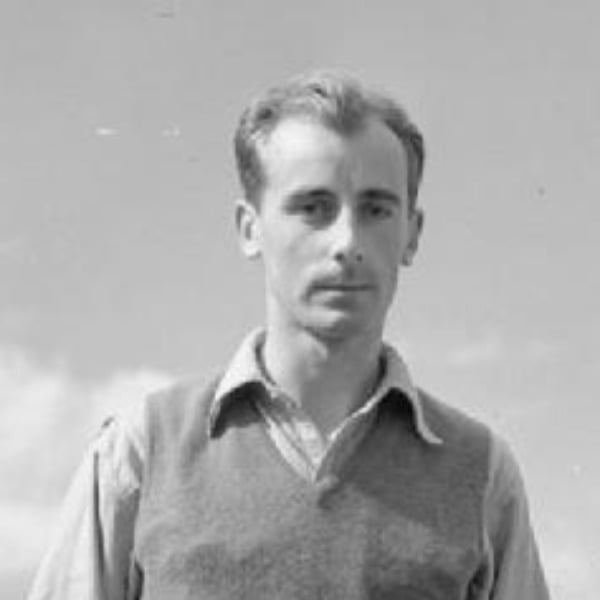
The next day Winston Churchill wrote to him by hand from Downing Street. Churchill was honorary Air Commodore of No. 615 Squadron, which Duke had commanded two years earlier.
The letter was sold at auction in 2020. Note that the version quoted here is taken from the physical document; a shorter rendering circulates that omits the reference to 615 Squadron.
What changed
Britain tightened its display rules after 1952 along lines that will look familiar to anyone who has read about Ramstein thirty-six years later. Jets had to remain at least 230 metres from the crowd when flying straight and 450 metres when manoeuvring, with a minimum altitude of 150 metres. Aircraft were to fly parallel to the crowd line rather than towards it.
Those rules held for a very long time. No spectator was killed at a British airshow again until Shoreham in August 2015.
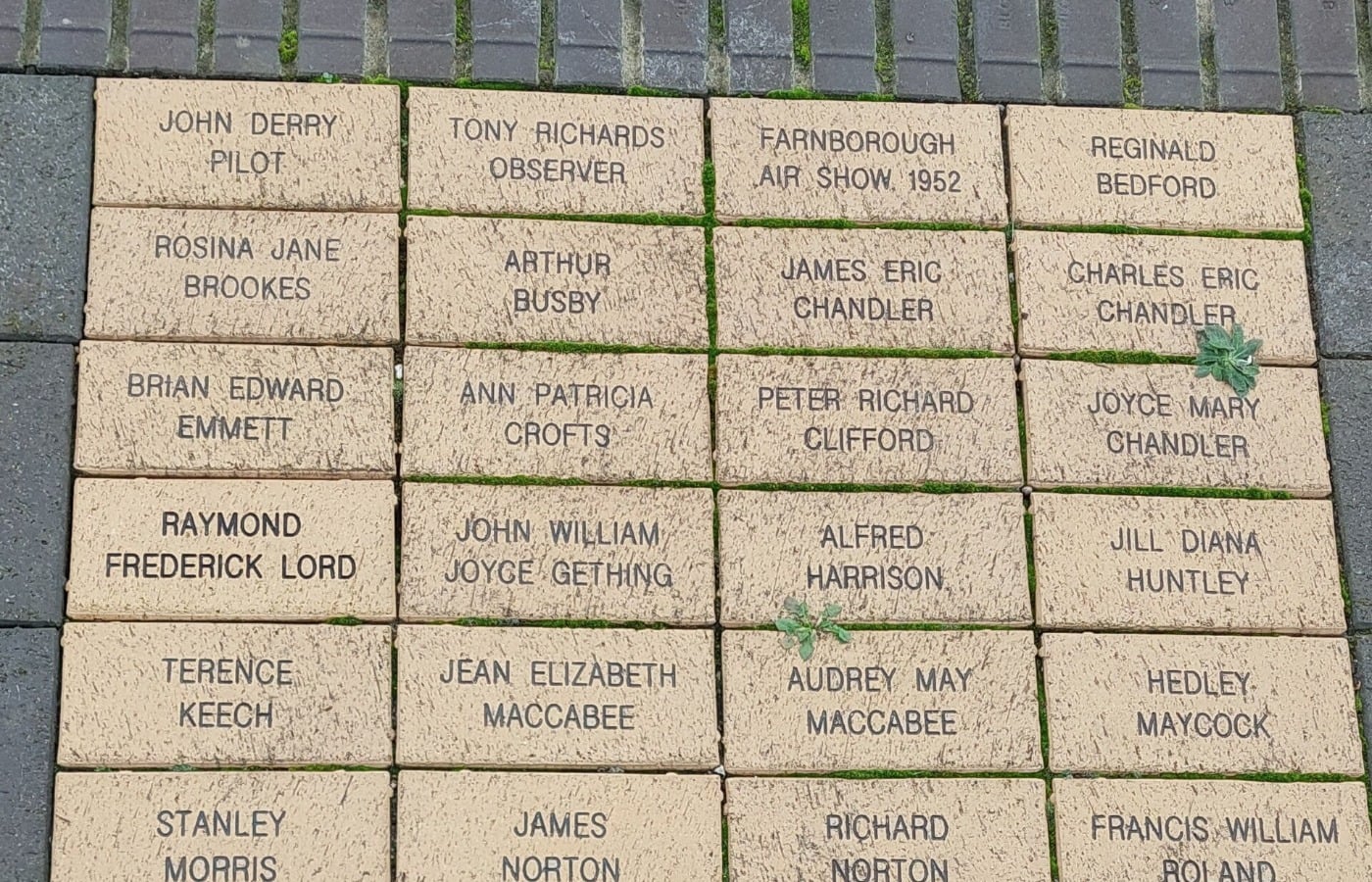
The DH.110 itself was not abandoned. The wings were redesigned, the type flew again in June 1953, and it entered Royal Navy service as the Sea Vixen. In 2021 a memorial was finally unveiled at the Farnborough Air Sciences Museum: thirty-two bricks, one for the show and thirty-one for the people who did not come home from it.
British Pathé newsreel material from 1952, including footage of Derry. Contains contemporary coverage of the accident.
Häufig gestellte Fragen
What happened at Farnborough in 1952?
What caused the DH.110 to break up?
Who was John Derry?
Did the Farnborough display really continue after the crash?
How many people died at Farnborough in 1952?
What airshow rules came out of the 1952 crash?
What happened to the DH.110 design?
Sources: Flight and Aircraft Engineer, 12 September 1952; Time, 15 September 1952; The Guardian, 9 September 1952; Sotheby’s sale catalogue, May 2020; BBC On This Day; Farnborough Air Sciences Museum.
0 Comments